

TL;DR #
When temperature increases from 15 °C to 35 °C, the diffusion coefficient of carvacrol through high-amylopectin corn starch film doubles — from 6.3×10⁻¹³ m²/s to 12.9×10⁻¹³ m²/s — meaning cold-chain disruptions directly accelerate antimicrobial depletion in active packaging. Buyers specifying antimicrobial flexible pouches or films for food preservation need to validate migration performance under realistic storage temperatures, not just ambient benchmarks. Request diffusion coefficient data across your target temperature range before approving any film formulation.
Overview #
The procurement reality is this: most buyers evaluating antimicrobial flexible packaging are comparing shelf-life extension claims without understanding the physical mechanism that determines whether those claims hold under real distribution conditions. The research reviewed here — conducted by a food science and engineering team running systematic migration experiments across multiple film formulations, food simulants, and environmental conditions — gives a rare quantitative picture of how plant essential oil (PEO) antimicrobial packaging actually performs, and where it fails.
Essential oils extracted from aromatic plants are lipophilic volatile compounds, the majority of which carry potent antibacterial activity, with some offering antioxidant properties as well. The antibacterial potency correlates tightly with chemical composition: aldehyde- and phenol-class compounds — such as cinnamaldehyde, thymol, and eugenol from cinnamon, thyme, and clove — consistently show the highest inhibitory activity against food spoilage and pathogenic organisms. Active packaging incorporating these compounds can be structured as antimicrobial films, sachets, or absorbent pads, each with distinct migration profiles that buyers need to understand before specifying.
For context on material compliance relevant to food-contact packaging, the EU Regulation No 10/2011 on plastic materials and articles intended to contact food sets the framework for what can migrate from packaging into food — a standard that directly governs any essential oil-containing film sold into European markets. Similarly, buyers supplying US customers should cross-reference FDA CFR Title 21 Part 177 — Indirect Food Additives: Polymers for food contact packaging when qualifying any novel active packaging substrate.
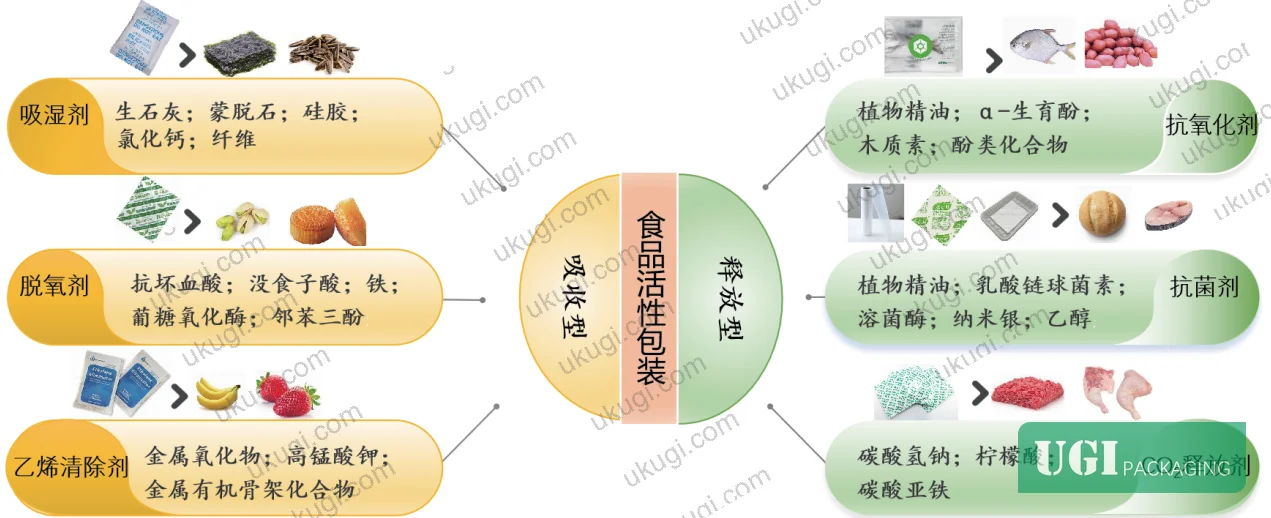
Antimicrobial Film Formats and Shelf-Life Performance Data #
Three structural formats dominate active packaging with essential oils: surface-coating films, matrix-blend films, and multilayer composite films. Understanding the trade-offs between them is essential for substrate selection.
Surface-coating films apply the essential oil directly to a base film surface. The primary substrates are synthetic polymers — polyethylene and polypropylene — which require surface modification (chromic acid treatment, plasma, corona, or UV) before the oil coating will adhere reliably. Practical performance is limited: controlled-release duration is short, and maintaining inhibitory concentration over a full shelf life is difficult. This format generates limited research interest precisely because it underperforms in field conditions.
Matrix-blend films disperse essential oil uniformly through a biopolymer matrix — chitosan, sodium alginate, whey protein, potato starch — using solvent casting. This is currently the most active research and production format. Representative performance data:
| Packaging Format | Essential Oil / Carrier | Shelf-Life Extension | Key Condition |
|---|---|---|---|
| Chitosan film | Catnip EO (2%) / chitosan nanoemulsion | Pork: 8 d → 16 d | Refrigerated storage |
| Basil seed gum film | Mint EO (1.5%) / basil seed gum | Beef: 3 d → 9 d | Refrigerated storage |
| Chitosan/LDPE composite | Savory EO (3%) / chitosan-LDPE | Chicken breast: 6 d → 13 d | Refrigerated storage |
| Whey protein film | Tarragon EO / whey protein | Arctic char: 6 d → 9 d | Refrigerated storage |
| Modified starch/alginate/chitosan | Sweet orange EO / modified starch blend | Crayfish: 4 d → 7 d | Refrigerated storage |
| Mung bean starch-SSPS | Clove + cinnamon EO | Mold/yeast reduction >1 log CFU/g | Steamed bun, 10 d storage |
| Chitosan emulsion coating | Rue EO (1.0–1.5%) / chitosan | 100% anthracnose inhibition | Papaya surface coating |
The mold suppression data on steamed bun is relevant for buyers in bakery or ready-meal packaging: a reduction exceeding 1 log CFU/g at 10 days is a meaningful microbiological threshold, not a marginal improvement.
Multilayer composite films combine a biopolymer antimicrobial layer with a synthetic polymer structural layer. A chitosan/savory EO coating applied to non-thermal plasma-treated polyethylene produces a dual-layer film that resolves the single biggest weakness of chitosan films — excess oxygen transmission and water vapor permeability — while improving tensile strength and elongation at break. This is the format most applicable to industrial flexible pouch production. For tensile property verification on thin-film substrates, ASTM D882 Standard Test Method for Tensile Properties of Thin Plastic Sheeting is the appropriate test method.
Honestly, most buyers over-specify the type of essential oil and under-specify the film architecture. Whether you use thymol or eugenol matters less than whether the film structure can sustain release concentration above the MIC for the intended shelf life. A thymol-chitosan system showed MIC of 0.1 mg/mL against Bacillus subtilis and E. coli — but that figure is meaningless without knowing the release kinetics at your target storage temperature.

Migration Mechanisms and the Factors That Actually Control Release Rate #
This is where most procurement teams lose the thread. The shelf-life extension numbers in Table 1 look compelling, but they are outputs of a specific migration dynamic — and that dynamic shifts significantly with temperature, humidity, and the food matrix itself. Getting this wrong means qualifying a film in the lab that underperforms in distribution.
Essential oil migration from packaging to food follows Fickian diffusion: molecules move from high concentration (film matrix) to low concentration (food or headspace) driven by thermal molecular motion. The diffusion coefficient D (m²/s) is the critical parameter — it determines how fast the active agent depletes from the film and how much reaches the food surface.
Temperature effect — the most underestimated variable
When temperature rises from 15 °C to 35 °C, the diffusion coefficient of carvacrol through high-amylopectin corn starch film increases from 6.3×10⁻¹³ m²/s to 12.9×10⁻¹³ m²/s — effectively doubling migration rate. At the product level, cinnamon essential oil (5% loading) migrating from whey protein film into 95% ethanol food simulant showed approximately 2× greater total migration when temperature increased from 5 °C to 40 °C. For any product moving through ambient warehousing before final refrigeration, this temperature sensitivity is not theoretical — it’s a practical risk to shelf-life prediction accuracy.
Relative humidity effect — critical for biopolymer carriers
Biopolymer-based films (chitosan, alginate, starch) are hydrophilic. In dry conditions, essential oil components adsorbed onto microporous starch carriers do not diffuse at all. As moisture is introduced, water molecules displace oil molecules and trigger release. In a controlled experiment: when relative humidity increased from 24% to 50% around cinnamon EO microcapsules (chitosan quaternary ammonium salt / gum arabic wall), cumulative release rate climbed from 49.8% to 65.5%. This means a film performing well in a low-humidity cold room may release significantly faster when exposed to humid packaging environments or high-moisture food contact.
The humidity dependence also creates a food-type compatibility constraint. Chitosan films loaded with bergamot EO perform well on high-moisture products (produce, meat, fish) but show poor performance on high-fat foods — because fat inhibits film hydration, which suppresses EO release. This is a failure mode that shows up at the food-type qualification stage, not in generic film testing.
Essential oil composition effect on migration selectivity
Not all EO components migrate at the same rate, even from the same film. Solubility in the food simulant governs migration magnitude. Across four components tested from whey protein film into 95% ethanol simulant, migration amount increased in the order: α-pinene < cinnamaldehyde < eugenol < amine terpineol — directly tracking their increasing polarity and solubility in polar simulants. Separately, clove EO migrated faster from chitosan-gum arabic composite film than cinnamon EO — attributed to stronger binding affinity between chitosan and cinnamon oil components.
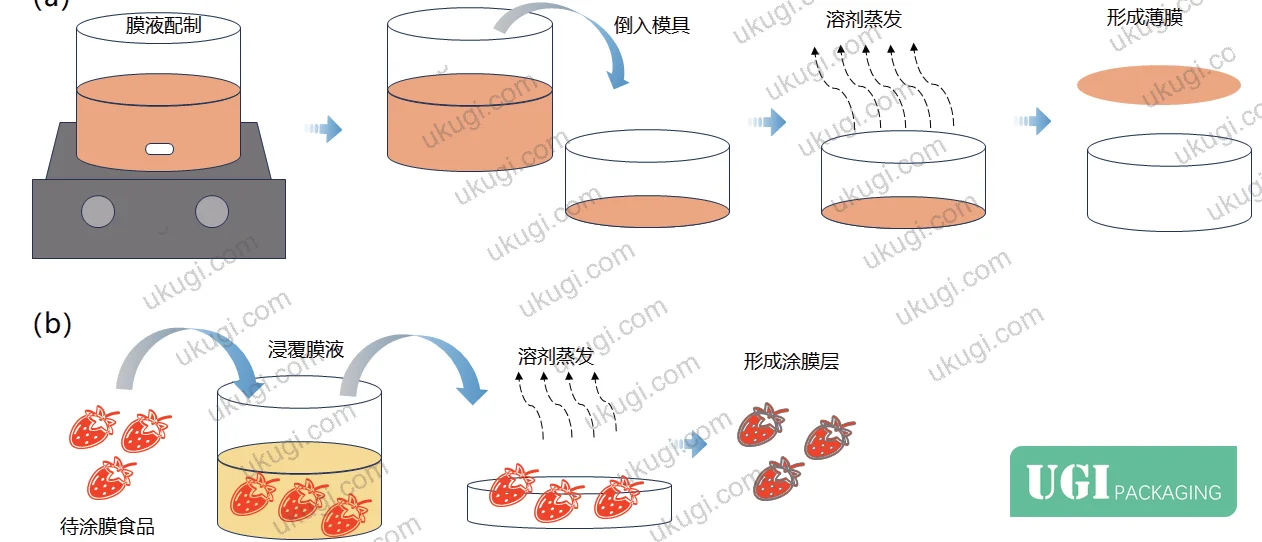
Packaging material structure controls release duration
Adding xanthan gum to a chitosan-thyme EO composite film increases water solubility and water vapor transmission, accelerating release. Adding gum arabic to the same system creates a tighter electrostatic network between chitosan and gum arabic, slowing release in 95% ethanol simulant. Changing the emulsifier inside starch-based films produces similar effects: sodium caseinate as internal emulsifier shows slower EO release from starch films compared to Tween 80. For sachet-format systems, increasing wall thickness of the enclosure material also measurably slows volatile release rate.
Sachet format: microcapsule inhibition data
Release sachets — where essential oil is adsorbed or encapsulated in a carrier material and placed loose inside the primary package — rely on vapor-phase antimicrobial activity rather than direct contact. At a microcapsule addition level of 50 mg (nonanal and carvacrol in β-cyclodextrin), inhibition rate against Botrytis cinerea (gray mold) reached 83.43%. Geraniol sachets (10 wt% geraniol in polybutylene succinate) extended white bread shelf life by at least 3 weeks. Eugenol and citral sachets (porous starch carrier) extended bread shelf life from 5 days to 15 days.
Most procurement teams don’t realize that regulatory scrutiny on active packaging migration has intensified significantly in recent years — the distinction between “food-safe” and “compliant for specific food types” is no longer something regulators overlook. Any film formulation intended for direct food contact in EU or US markets needs migration testing against specific food simulants as defined by applicable standards, not just a general food-contact material certificate. The ISO 22000:2018 Food safety management systems for food packaging framework now expects active packaging to be explicitly addressed in hazard analysis, not treated as inert material.
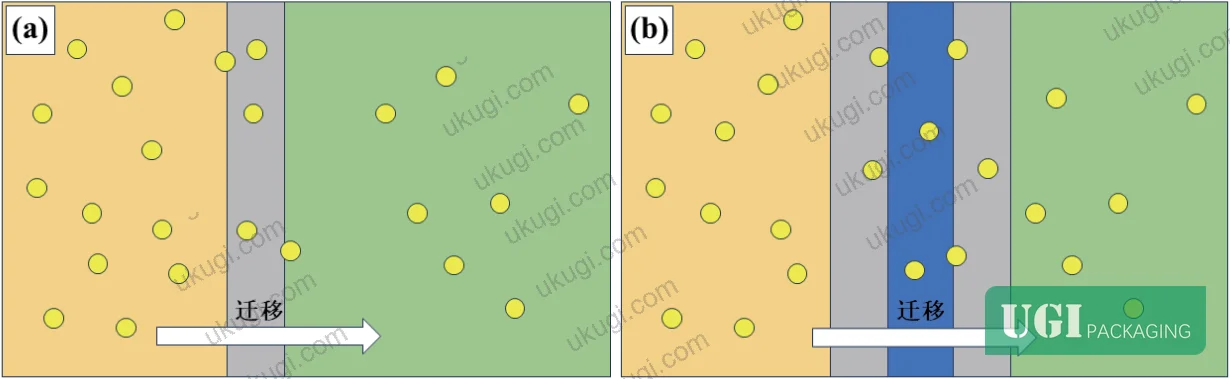
In supplier qualification, three of six film samples evaluated across a multilayer chitosan-PE format failed the humidity-cycling test — showing premature release at 75% RH that exhausted the antimicrobial load before day 7. The failure mode was consistent: inadequate crosslinking density in the chitosan layer, not the essential oil selection. This is an example of where evaluating a film by its active ingredient rather than its structural engineering leads to costly misqualification.
Practical Guidance for Buyers #
If you’re sourcing antimicrobial flexible packaging — whether films, pouches, or sachet systems — the single most important specification to confirm is diffusion coefficient across your actual storage temperature range, not just at a standard test condition. A film qualified at 4 °C may behave very differently after ambient transit.
For direct-contact applications (wrapping fresh meat, coating produce), matrix-blend biopolymer films with chitosan or alginate carriers are the most mature format, with the largest body of application data. Multilayer composites (bio-antimicrobial layer + PE structural layer) offer better mechanical properties and moisture barrier — specify tensile strength and elongation at break alongside migration data. For indirect applications (bakery, cheese, dry goods), encapsulated sachets allow you to avoid direct oil contact with food surfaces, which matters when sensory impact of the oil is a concern.
Loading level matters: 2–3% EO in the film matrix represents the effective range in most validated applications — below that, inhibitory concentration may not be sustained; above that, sensory impact becomes problematic and film mechanical properties often degrade.
We are a Guangzhou-based OEM/ODM packaging manufacturer with surface finishing and substrate engineering capabilities across films, flexible pouches, and specialty formats — our technical team works directly with international brand owners and procurement engineers to develop and validate custom antimicrobial packaging specifications before an RFQ is finalized. Need a custom formulation or sample? Request a quote from our team →
Supplier Qualification Questions #
- What is the measured diffusion coefficient (m²/s) for your EO-loaded film at both 5 °C and 35 °C, and which food simulant (per GB 31604.1-2015 or equivalent) was used in the migration test?
- At 3% essential oil loading, what is the cumulative migration percentage at 24% versus 50% relative humidity after 7 days — and is the delta consistent with the 49.8%–65.5% release range documented for encapsulated cinnamon EO systems?
- For multilayer composite films incorporating a biopolymer antimicrobial layer on a PE substrate, what is the tensile strength and elongation at break data per ASTM D882, and how does it compare to the single-layer chitosan control?
- What is the minimum inhibitory concentration (MIC) value for your thymol- or eugenol-based system against E. coli and Listeria monocytogenes, and is the stated MIC achieved within the validated release window at refrigeration temperature (4 °C)?
- For sachet-format systems, at what microcapsule addition level (mg per package) does your formulation achieve ≥80% inhibition against target spoilage fungi, and what encapsulation efficiency is maintained after 90 days of ambient storage?
Quality Verification Checklist #
- ☐ Diffusion coefficient data provided for target storage temperature range (minimum: one data point at ≤5 °C and one at ≥25 °C)
- ☐ Cumulative EO release rate confirmed between 49.8% and 65.5% across 24%–50% RH range for biopolymer carrier systems
- ☐ Shelf-life extension validated for the specific food matrix (not only generic food simulant) — minimum ≥2× extension vs. control
- ☐ Film tensile properties tested per ASTM D882; elongation at break reported for the composite structure
- ☐ Water vapor transmission rate (WVTR) measured for multilayer films; chitosan-only layers confirmed to have reduced WVTR vs. unreinforced chitosan control
- ☐ Microbial inhibition data includes both MIC value and release-kinetics confirmation that MIC is sustained over the target shelf-life period
- ☐ Migration compliance testing conducted against food-type-specific simulants per EU No 10/2011 or FDA 21 CFR Part 177 as applicable to target market
- ☐ Sensory evaluation data provided demonstrating no significant flavor/odor impact at intended EO loading level
Key Specifications Table #
| Parameter | Recommended Value | Verification Method |
|---|---|---|
| EO loading level in matrix-blend film | 2–3 wt% (effective range; 3% for chitosan/LDPE composite) | Gravimetric measurement + GC-MS quantification of residual EO |
| Diffusion coefficient at 35 °C | ≤12.9×10⁻¹³ m²/s (carvacrol/starch reference); verify specific formulation | Fick second-law migration model; food simulant contact test |
| Cumulative EO release at 50% RH (7 days) | ≤65.5% (upper bound for encapsulated cinnamon EO system) | Gravimetric or GC headspace measurement at controlled RH |
| Shelf-life extension factor | ≥2× vs. uncoated control (refrigerated storage) | Microbiological plate count (TVC) at defined intervals |
| MIC against key pathogens (thymol-chitosan) | ≤0.1 mg/mL vs. B. subtilis and E. coli | Broth microdilution assay per standard microbiological protocol |
| Mold count reduction (sachet format, 50 mg microcapsule) | ≥83% inhibition vs. control | Colony count on selective agar; challenge test with B. cinerea |
Looking for a manufacturer that meets these specs? Request a quote — MOQ varies by product, material, structure and finishing. Product-specific MOQ is confirmed with each quotation.
References #
Data source: Migration Kinetics and Antimicrobial Efficacy of Plant Essential Oil Active Packaging Systems: A Mechanistic Review, D.-M. Shao et al., International Journal of Food Packaging Science and Technology, 2024
Frequently Asked Questions #
What is the most effective essential oil type for antimicrobial packaging, and why?
Aldehyde- and phenol-class compounds consistently show the highest antimicrobial activity among essential oil components. Cinnamaldehyde (from cinnamon), thymol (from thyme), and eugenol (from clove) are the most validated in packaging applications. Selection should be based not only on MIC against your target organisms but also on migration rate in your specific film matrix and sensory acceptability at the intended loading concentration.
Does temperature during storage affect how much essential oil migrates to the food?
Yes, significantly. The diffusion coefficient of carvacrol through corn starch film doubles when temperature rises from 15 °C to 35 °C (6.3×10⁻¹³ to 12.9×10⁻¹³ m²/s). Total migration of cinnamon EO from whey protein film into food simulant increases approximately 2× when temperature rises from 5 °C to 40 °C. Any packaging specification that doesn’t account for real-world temperature variation across the supply chain is incomplete.
Are these antimicrobial films compliant with food safety regulations for export markets?
Compliance depends on the specific market and formulation. For the EU, migration limits are governed by EU Regulation No 10/2011; for the US, FDA 21 CFR Part 177 applies. Essential oils classified as GRAS (Generally Recognized as Safe) have a strong regulatory baseline, but specific film formulations still require migration testing against appropriate food simulants for the target food type. Get formulation-specific compliance documentation from your supplier before approving production.
What is the difference between antimicrobial sachets and antimicrobial films in terms of how they work?
Films work through direct-contact migration: EO molecules diffuse through the film matrix into the food surface. Sachets work through vapor-phase antimicrobial activity — EO volatilizes into the headspace and inhibits surface microorganisms indirectly. Sachets are better suited for porous foods like bread and cheese where vapor penetration is possible. Films are more effective for meat, seafood, and produce where surface contact is continuous. Absorbent pads combine both mechanisms — direct contact plus vapor release — and are standard in fresh meat tray packaging.
Can essential oil incorporation damage the mechanical properties of the packaging film?
It can, and this is an underappreciated qualification risk. Adding EO to biopolymer matrices often plasticizes the film, reducing tensile strength and increasing permeability if not properly controlled. The solution is composite engineering: loading thymol onto mesoporous nano-SiO₂ before incorporating it into potato starch film increases tensile strength and reduces water vapor permeability compared to the neat starch film. Multilayer constructions (bio-antimicrobial layer + PE structural layer) are the most reliable approach for maintaining mechanical specification while delivering antimicrobial function.
For buyers specifying flexible pouches and bags with active antimicrobial properties, or evaluating custom labels and stickers incorporating functional coatings for food-adjacent applications, the migration and formulation data reviewed here provides a direct technical basis for supplier qualification and incoming sample verification.
Published by ukugi.com Technical Team | Request a quote


