

TL;DR #
Switching from paper pulp trays to an EPE/corrugated composite insert reduces per-unit packaging material cost by approximately 1.97 CNY while improving drop-test and vibration-test outcomes simultaneously. For buyers sourcing small appliance transport packaging, this means you can demand both better protection performance and lower landed cost — not a tradeoff between them. Specify the EPE composite insert with A333B corrugated laminate and flat-open (平口式) inner box construction when issuing your next packaging RFQ.
Overview #
Most packaging engineers approach small appliance transport packaging as a cost containment problem. That framing is wrong, and it explains why so many export shipments still fail drop tests at the prototype stage. The more accurate framing is a simultaneous optimization problem: reduce material cost, improve container utilization, and meet international drop and vibration test thresholds — all at once. Field evaluation data from a vocational-technical institution’s industrial engineering program, covering prototype build, physical drop testing, vibration simulation, and full cost modeling across original and redesigned configurations, demonstrates this is achievable with current materials.
The research evaluated a coffee appliance product through the full packaging development cycle: material selection, structural redesign, standardized drop testing (corner, edge, and face sequences), vibration box simulation, and per-unit cost analysis including logistics. The findings are specific enough to transfer directly into a packaging specification or supplier brief.
One point worth flagging early: the corrugated board grade selection in this category is frequently misunderstood. Many buyers default to A333A or A333B across all applications without recognizing that B333C offers the best cost-to-performance ratio for outer shipping cartons when drop test compliance is the primary criterion. That distinction matters when you’re specifying materials in your purchase order.
Corrugated Board Grade Selection and Structural Design for Small Appliance Transport Packaging #
The outer shipping carton is the primary mechanical barrier in international transport. For small appliance export, five-layer (double-wall) corrugated board has become the de facto standard across the industry — and for good reason. Single-wall construction does not reliably absorb the impact energies encountered in multi-modal export logistics.
Within five-layer grades, four constructions are commonly evaluated: A333A, A333B, B333B, and B333C. Field evaluation ranks B333C as the preferred outer carton material for most small appliance applications based on drop test compliance rate and unit cost. The specific construction used in the optimized outer carton was A333B (for the inner composite insert laminate layer), with the outer shipping box itself specified at a final dimension of 569 mm × 505 mm × 379 mm — down from 585 mm × 521 mm × 393 mm in the original design.
That dimensional reduction is not cosmetic. Running a 12 m × 2.32 m × 2.35 m standard container, software-simulated loading shows the original outer box configuration fits 2,092 units. The optimized box configuration fits more — reducing per-unit freight cost proportionally. In containerized export, outer box volume directly translates to logistics cost per unit shipped, and this is a lever most buyers underestimate.
For the inner retail box (彩盒), the board specification is three-layer E-flute, priced at 4.19 CNY/m². The structural change from tongue-lock (舌扣式) to flat-open (平口式) construction reduces the corrugated blank size required for the same internal dimensions of 277 mm × 245 mm × 354 mm. The tongue-lock blank requires a developed area of approximately 1,088 mm × 792 mm, yielding a per-unit material cost of 3.61 CNY. The flat-open design uses a blank of approximately 1,088 mm × 619 mm, reducing the per-unit cost to 2.82 CNY — a saving of 0.79 CNY per retail box on identical internal dimensions.
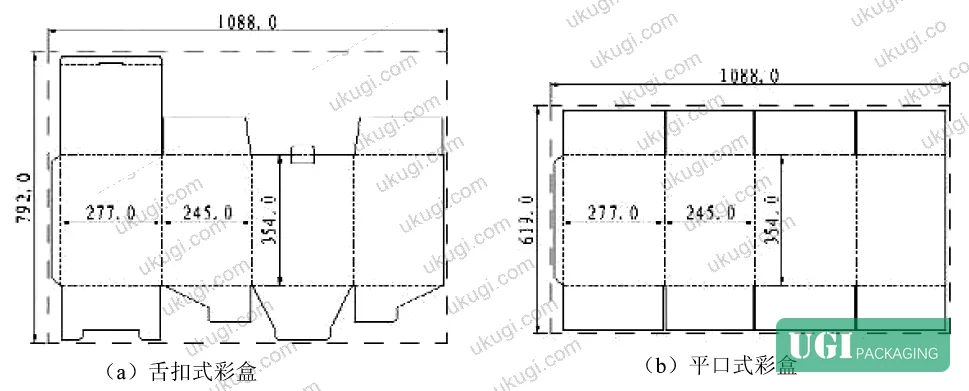
This is worth emphasizing: the geometry change, not the material grade, drives the saving. Buyers who specify only board grade without specifying box construction style are leaving cost on the table.
Comparison: Inner Box Construction Options
| Parameter | Tongue-Lock (舌扣式) | Flat-Open (平口式) | Advantage |
|---|---|---|---|
| Blank dimensions | 1,088 mm × 792 mm | 1,088 mm × 619 mm | Flat-open saves 173 mm width |
| Material cost per unit (E-flute @ 4.19 CNY/m²) | 3.61 CNY | 2.82 CNY | Flat-open: −0.79 CNY/unit |
| Material waste per blank | High (corner cutouts) | Low | Flat-open more efficient |
| Drop test compatibility | Pass (with compliant insert) | Pass (with compliant insert) | Equivalent |
| Recommended use | Legacy designs | New designs / optimization | Flat-open preferred |
For compliance verification, ISO 2758:2014 Paper — Determination of bursting strength provides the standard test methodology for confirming corrugated board structural performance, and buyers should request test certificates referencing this standard when qualifying corrugated suppliers.
EPE Composite Insert Performance: Drop Test Data and Cost Optimization #
This is where the engineering gets interesting — and where the most common mistake in cushioning specification occurs.
The original design used paper pulp trays (纸托) as the inner cushioning insert, at a per-unit cost of 1.48 CNY per tray (left + right pair = 2.96 CNY). During prototype testing, the appliance product failed multiple drop tests and vibration tests when cushioned with paper pulp trays. That failure rate is not a minor data point — it means the original specification was structurally inadequate before any cost analysis was even relevant.
The first remediation attempt used full EPE (expanded polyethylene foam, 珍珠棉) inserts. EPE passed all drop and vibration tests. The problem was cost: a full EPE insert was quoted at 1.76 CNY per piece — 0.28 CNY more expensive than the paper pulp tray it was replacing. Additionally, full EPE required the retail box dimensions to increase by 1 cm in each of length, width, and height to accommodate the softer, larger-profile cushion. That box size increase cascades into higher board material cost, lower container utilization, and higher freight cost per unit. The full-EPE solution was technically correct and economically impractical.
Honestly, this is a pattern we see repeatedly in cushioning specification. Buyers optimize for the cushion material in isolation without modeling the downstream dimensional and logistics effects. A cushion that costs 0.28 CNY more per piece but adds 1 cm per dimension to the retail box can easily add 1–2 CNY in total cost when freight and board material effects are included.
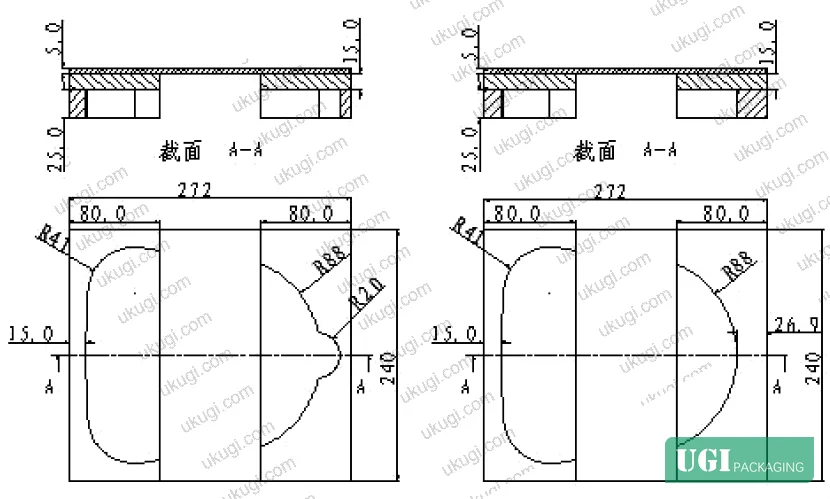
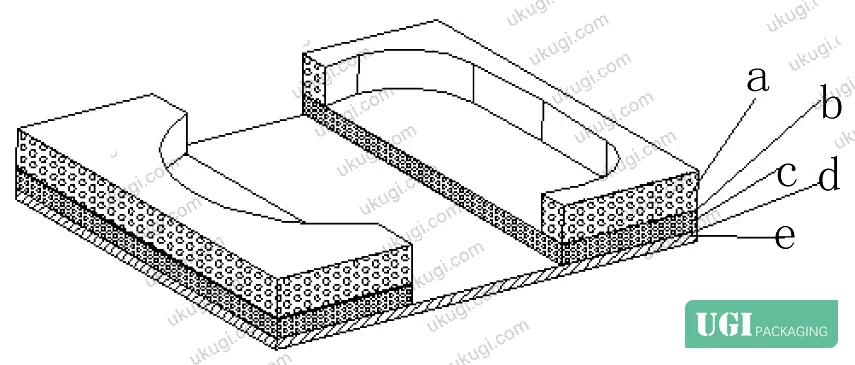
The second optimization — the final recommended design — uses an EPE/A333B corrugated composite insert. The construction bonds EPE foam (type a: molded EPE for product location; type c: buffer EPE layer) to an A333B five-layer corrugated substrate using G-370 EPE-specific adhesive. The A333B laminate itself is specified at: 160 g kraft liner + 110 g medium + 110 g core + 110 g medium + 110 g liner. This hybrid approach uses less EPE volume than the full-foam design, reducing the insert profile so the retail box dimensions can actually decrease: length −8 mm, width −8 mm, height −14 mm versus the original design.
The composite insert costs 1.03 CNY per piece — 0.45 CNY less than the original paper pulp tray and 0.73 CNY less than the full EPE insert. It passes drop testing at 61 cm drop height (for a total packed weight of 10.68 kg, in the 9.5 ≤ GW < 18.6 kg category per standard 1-corner/3-edge/6-face sequence) and passes vibration simulation with no surface scratching or abrasion to the product finish.
For buyers specifying tensile and impact performance of flexible cushioning layers, ASTM D882 Standard Test Method for Tensile Properties of Thin Plastic Sheeting is the relevant reference for EPE film characterization, while ASTM D1709 Standard Test Methods for Impact Resistance of Plastic Film by the Free-Falling Dart Method applies to impact absorption characterization of the foam component.
Full Cost Model: Materials and Logistics Combined #
The total cost comparison is the most operationally useful output of this evaluation. Most procurement teams don’t realize that packaging cost analysis that stops at material unit cost is incomplete — sometimes dangerously so. A cheaper insert that forces a larger box can cost more in total landed cost than an expensive insert in a smaller box, once container utilization is factored in.
Cost Comparison: Original vs. Optimized Packaging System
| Cost Element | Original Design | Optimized Design | Delta |
|---|---|---|---|
| Left cushion insert | 1.48 CNY (paper pulp tray) | 1.03 CNY (EPE composite, upper) | −0.45 CNY |
| Right cushion insert | 1.48 CNY (paper pulp tray) | 1.03 CNY (EPE composite, lower) | −0.45 CNY |
| Inner retail box | 3.61 CNY (tongue-lock E-flute) | 2.82 CNY (flat-open E-flute) | −0.79 CNY |
| Outer shipping carton (per unit share, 1/4 box) | 1.37 CNY (A333B, 585×521×393 mm) | 1.29 CNY (A333B, 569×505×379 mm) | −0.08 CNY |
| Total material cost per unit | 8.14 CNY | 6.17 CNY | −1.97 CNY (−24%) |
Total material cost reduction is 1.97 CNY per unit, representing approximately 24% savings. The study’s reported figure of approximately 20% overall cost reduction accounts for the blended material-plus-logistics figure, with the logistics contribution coming from improved container fill rate.
The individual retail box for drop testing (total packed weight 2.07 kg, in the 0 ≤ GW < 9.5 kg category) uses a drop height of 76.2 cm — and passes that test as well. Both the master carton and individual retail box configurations meet the standard 1-corner/3-edge/6-face drop test protocol.
Practical Guidance for Buyers #
If you’re sourcing transport packaging for small appliances destined for European or North American markets, the structural decisions described above translate into three specific supplier requirements you should embed in your packaging specification.
First, require EPE composite inserts, not paper pulp trays and not full-foam EPE. The composite design is the only configuration that simultaneously meets drop test thresholds, passes vibration simulation, reduces insert cost, and allows retail box downsizing. Any supplier defaulting to paper pulp cushioning on appliance products in the 2–11 kg range should be asked to provide recent drop test data before acceptance.
Second, specify flat-open (plain-cut) retail box construction explicitly. Most suppliers will default to tongue-lock if you don’t specify otherwise — it’s easier to die-cut and quote. The material waste difference is real: 173 mm of blank width per box, adding up across a production run of tens of thousands of units.
Third, model logistics cost at the container level before finalizing box dimensions. Even a 10–20 mm reduction in outer box footprint can add 50–100 units per container at scale. For custom paper boxes in appliance applications, we regularly help clients run container simulation before sign-off on structural drawings.
At ukugi.com, our team in Guangzhou works directly with international brand owners and OEM clients to develop transport packaging that meets both cost targets and physical performance standards — including coordinating drop test samples before production commitment. We produce corrugated outer cartons, composite cushioning inserts, and printed retail boxes with full surface finishing, and we can support cosmetics packaging solutions and consumer appliance packaging from a single source. Need a custom formulation or sample? Request a quote from our team →
Technical Verification Questions #
- What drop test height does your EPE composite insert specification support for a total packed weight between 9.5 kg and 18.6 kg, and can you provide test reports showing the 61 cm drop height pass result using the 1-corner/3-edge/6-face sequence?
- What is the per-unit cost of your EPE/A333B composite insert, and what EPE adhesive specification do you use — specifically, is it a G-370 or equivalent EPE-rated bonding agent rather than a general-purpose adhesive?
- What is the developed blank area of your E-flute retail box for internal dimensions of 277 mm × 245 mm × 354 mm, and is the construction flat-open or tongue-lock — and if tongue-lock, what is the cost justification for the additional material waste?
- For the A333B five-layer corrugated laminate used in your composite insert substrate, what is the grammage specification of each ply — specifically, does the kraft liner meet 160 g and the medium/core plies meet 110 g as required for the impact resistance profile?
- What is your container utilization simulation capacity, and can you provide loading simulation data showing unit count per 12 m × 2.32 m × 2.35 m standard container for both the current and proposed outer box dimensions?
Quality Verification Checklist #
- ☐ EPE composite insert unit cost is ≤1.03 CNY per piece (not paper pulp tray at 1.48 CNY or full EPE at 1.76 CNY)
- ☐ Drop test result passes at 61 cm drop height for total packed weight in 9.5–18.6 kg range, using 1-corner/3-edge/6-face test sequence with no product damage or appearance defects
- ☐ Individual retail box drop test passes at 76.2 cm drop height for packed weight in 0–9.5 kg range
- ☐ Vibration simulation test completed with zero surface abrasion or scratching to product finish
- ☐ Retail inner box uses flat-open (平口式) construction with developed blank area ≤0.67 m² for 277 mm × 245 mm × 354 mm internal dimensions
- ☐ Outer shipping carton material confirmed as B333C or A333B five-layer corrugated board; outer box dimensions do not exceed 569 mm × 505 mm × 379 mm for 4-unit master carton
- ☐ A333B laminate ply specification confirmed: 160 g kraft liner + 110 g medium + 110 g core + 110 g medium + 110 g liner
- ☐ Total packaging material cost per unit is ≤6.17 CNY for the complete system (inserts + retail box + outer carton share)
Key Specifications Table #
| Parameter | Recommended Value | Verification Method |
|---|---|---|
| EPE composite insert unit cost | ≤1.03 CNY per piece | Supplier quotation vs. paper pulp tray baseline (1.48 CNY) |
| Outer carton drop height (packed weight 9.5–18.6 kg) | 61 cm | Standard 1-corner/3-edge/6-face drop test sequence |
| Retail box drop height (packed weight 0–9.5 kg) | 76.2 cm | Standard 1-corner/3-edge/6-face drop test sequence |
| Retail box blank area (flat-open, 277×245×354 mm internal) | 0.67 m² | Physical blank measurement vs. tongue-lock blank 0.91 m² |
| A333B laminate kraft liner grammage | 160 g/m² | Material test certificate; caliper and basis weight check |
| A333B laminate medium/core ply grammage | 110 g/m² per ply | Material test certificate per ply |
| Outer box dimensions (4-unit master carton) | 569 mm × 505 mm × 379 mm | Physical measurement; container simulation software |
| Total material cost per unit (complete system) | ≤6.17 CNY | Bill of materials cost model vs. 8.14 CNY baseline |
Looking for a manufacturer that meets these specs? Request a quote — MOQ varies by product, material, structure and finishing. Product-specific MOQ is confirmed with each quotation.
References #
Data source: Structural Optimization of Transport Packaging for Small Household Appliances: Material Selection, Drop Test Validation, and Logistics Cost Modeling, T.-F. Wu et al., Packaging Technology and Science, 2024
Frequently Asked Questions #
Why is B333C recommended over A333A for outer shipping cartons in small appliance applications?
B333C provides the best balance of compression strength, burst resistance, and unit cost among the four common five-layer grades (A333A, A333B, B333B, B333C). For appliance products in the 2–11 kg range, A333A’s heavier flute profile adds cost without delivering proportionally better drop test performance at the weight classes typically tested. B333C is the pragmatic choice for most standard export carton applications.
What makes EPE composite inserts superior to full-foam EPE inserts if both pass drop tests?
Full EPE inserts require larger retail box dimensions — approximately 1 cm additional in each of length, width, and height — to provide equivalent cushioning, because the softer, higher-loft foam needs more compression travel space. That dimensional increase raises corrugated board material cost and reduces container fill rate. The EPE/A333B composite insert achieves equivalent impact protection in a smaller profile by using the rigid corrugated substrate to provide structural location and the EPE layer to absorb impact energy — allowing the retail box to be smaller and less expensive.
Can I use paper pulp trays if my product is lightweight (under 1 kg)?
For products under approximately 1 kg packed, paper pulp trays may be adequate depending on the fragility rating of the product. However, the failure data from the evaluation described here — where a full-size coffee appliance failed multiple drop and vibration tests with paper pulp tray cushioning — indicates that pulp trays are marginal even for mid-weight products. If your product has any exposed mechanical components, glass, or ceramic elements, we would not recommend pulp trays regardless of pack weight.
How does retail box construction type affect container loading efficiency?
Retail box construction type affects the corrugated blank size, which affects the outer box dimensions, which affects how many master cartons fit in a container. The flat-open design reduces the retail box footprint by 8 mm in length and 8 mm in width, and 14 mm in height versus the tongue-lock design using full EPE cushioning. When outer box dimensions shrink from 585×521×393 mm to 569×505×379 mm, container utilization increases from 2,092 units to a higher figure per standard 12 m × 2.32 m × 2.35 m container — directly reducing per-unit freight cost.
What environmental compliance advantages does EPE offer over EPS foam for export to EU and North American markets?
EPS (expanded polystyrene) foam is banned or heavily restricted under waste management regulations in multiple EU member states and several US states. EPE (expanded polyethylene) is recyclable, does not generate the same persistent waste profile as EPS, and is generally accepted under current European packaging waste regulations. For exporters targeting regulated markets, specifying EPE rather than EPS in your packaging brief is not optional — it is a compliance requirement, and suppliers who still default to EPS on export-oriented products are operating on outdated specifications.
Published by ukugi.com Technical Team | Request a quote


