

TL;DR #
Mathematical modeling of non-standard folding carton structures shows that circular arc geometry — parameterized by edge half-length t and polygon order n — is the only arc assumption that satisfies the high-symmetry constraints required for flower-style specialty cartons, with validated prototypes produced at n=3 (equilateral triangle cross-section, a=6, b=3, R=3.464) and n=4 (square cross-section, a=4, b=2, R=3.828). For buyers specifying irregular or decorative folding cartons, this means die geometry is not arbitrary — any deviation from the derived arc radius relationships will produce dimensional misalignment when the flat blank erects into 3D form. Before approving a structural die file for a specialty carton, request the parametric model output (r, R, d values) and verify them against the n-sided cross-section specification you’ve signed off on.
Overview #
Most procurement teams treat folding carton structural design as a supplier-side black box — you send a brief, they send a sample. That works fine for straight-walled SBS cartons. It stops working the moment you specify anything with curved panels, petal forms, or non-rectangular cross-sections. Research from a graphic communications institution — based on mathematical modeling and physical prototype validation of flower-style specialty carton geometries — makes it clear that the relationship between the flat blank and the erected 3D form is governed by precise geometric constraints, not intuition or eyeballing.
The study analyzed both the planar layout and the three-dimensional erected structure of flower-style folding cartons, deriving a complete parametric model that links arc radius (r), crown radius (R), and chord depth (d) to two controllable inputs: the half-edge length t and the polygon order n. Two full prototype validations were completed — one for a triangular cross-section (n=3) and one for a square cross-section (n=4) — both confirming dimensional accuracy between predicted and actual erected geometry. This framework is directly applicable to CAD-driven die cutting and is relevant to any buyer specifying gift cartons, confectionery boxes, or premium packaging with non-standard erected profiles.
Structural complexity in folding cartons intersects directly with custom paper boxes production, where die geometry and crease accuracy determine whether high-symmetry specialty forms erect cleanly at speed or collapse under auto-fill conditions.
Circular Arc Geometry in Folding Carton Structural Design #
The first design decision in any specialty folding carton project is what type of curve to use for the non-rectangular panel edges. This sounds like an aesthetic choice. It isn’t — it’s a structural and manufacturing constraint.
Three arc assumptions were evaluated: arbitrary free-form curves, elliptical arcs, and circular arcs. Arbitrary curves fail immediately on symmetry grounds: a flower-style carton requires the intersections of panel edges in the flat layout to coincide with the center of a regular n-sided polygon when erected. Free-form arcs cannot reliably satisfy this constraint across multiple panels simultaneously. Elliptical arcs offer partial symmetry within a limited angular range, but matching curvature across n panels simultaneously is geometrically problematic — and practically, elliptical cutting dies are not standard tooling in the packaging industry. They require custom blade grinding and carry a cost premium that most production runs cannot justify.
Circular arcs satisfy all three requirements: high symmetry, multi-panel angular consistency, and compatibility with standard circular-profile creasing and cutting rules. The central geometric relationship is straightforward: the arc radius r is defined by the panel edge length a and the polygon order n. For the erected form, the cross-section is a regular n-sided polygon with circumradius b. The derived relationships are:
- r = a² / sin(π/n) [arc radius of the curved panel edge]
- R = (a/4)(1 + 1/sin²(π/n)) [crown radius]
- d = (a/4)(1/sin²(π/n) − 1) [chord depth parameter]
Substituting t = a/2 (where t is the half-edge parameter), these become a two-variable model in t and n, both of which are designer-controlled inputs.
The practical implication: for a given polygon order n and panel size t, every arc dimension in the die file is fully determined. There is no design freedom in the arc geometry once those two parameters are set. Any supplier who is adjusting arc radii independently of the polygon cross-section specification is introducing dimensional error into the erected form.
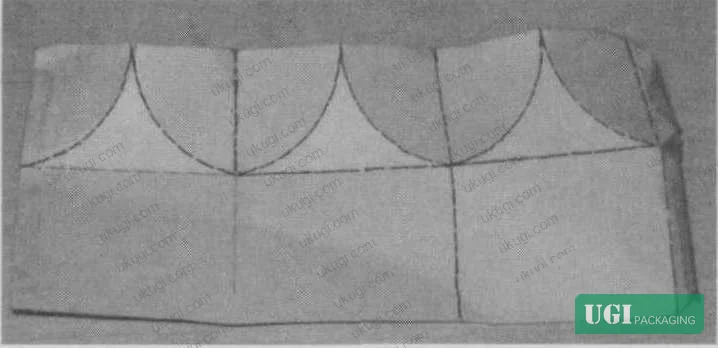
Prototype Validation: Parametric Model Performance at n=3 and n=4 #
Validation was performed by substituting two distinct parameter sets into the derived mathematical model and physically fabricating the resulting carton structures.
Case 1 — Triangular cross-section (n=3, t=3):
Derived dimensions: a=6, b=3, R=3.464. The fabricated prototype erected into a three-sided flower-style carton with panel edges vertical to the base plane and all arc-edge intersections aligning at the centroid of the equilateral triangular cross-section. Physical measurement confirmed that the erected form matched model predictions.
Case 2 — Square cross-section (n=4, t=2):
Derived dimensions: a=4, b=2, R=3.828. Substrate used: 309 gsm coated artboard (铜版纸). The prototype erected into a four-sided flower-style carton with confirmed geometric accuracy. The 309 gsm specification is relevant — at this grammage, the board provides sufficient panel stiffness for the arc-edge geometry to hold its shape under self-weight without adhesive support on the curved panels.

The model also confirms that n can theoretically be any integer greater than 2. In practice, n=3 and n=4 represent the most structurally efficient and aesthetically coherent options for confectionery and gift applications. Values of n≥6 produce forms that approach cylindrical geometry and generate fabrication challenges at the panel-to-panel crease intersections.
Honestly, most buyers over-specify the polygon order on premium gift cartons. An n=4 square-profile flower box with a well-chosen board grammage and a foil-stamped panel surface reads as luxury without the tooling complexity of n=5 or n=6 forms. Save the higher-order geometries for applications where the structural form is the primary brand statement.
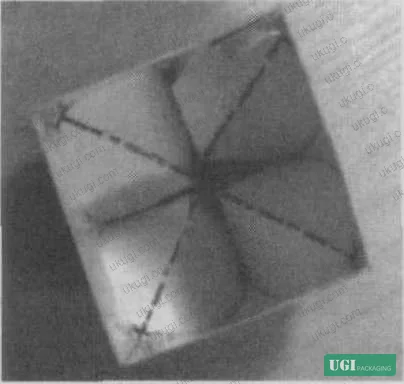
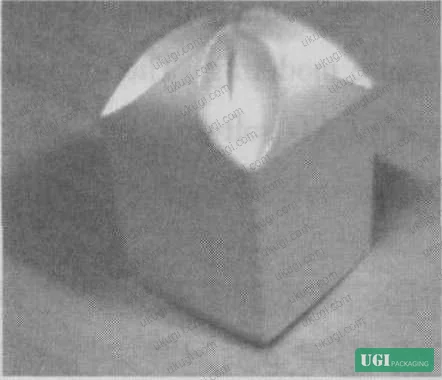
Board Specification and Structural Considerations for Specialty Folding Cartons #
The geometry model defines the die. The board specification determines whether the die-cut blank will actually erect and hold form in production conditions. These are separate but interdependent decisions.
For flower-style specialty cartons, the curved panel edges create a fundamentally different stress distribution compared to straight-walled cartons. When the blank erects, the curved panels must deform smoothly around the crease lines without fiber rupture or spring-back. This places specific demands on:
Bending resistance and caliper: The 309 gsm coated artboard used in the n=4 prototype was selected to balance panel stiffness with the crease compliance needed for the arc transitions. Lighter boards (below approximately 250 gsm) tend to show panel buckle at the arc-to-straight crease junction under self-weight. Heavier boards (above 350 gsm) can resist erection at the curved panel creases, particularly on small-radius arcs (r < 20 mm).
Crease geometry: For circular arc panel edges, creasing rules must follow the arc profile — not the chord. This is a non-trivial tooling consideration. A straight creasing rule applied across an arc panel will produce a flat crease that fights the intended curvature of the erected form. Rotary creasing on a curved path requires either a custom-bent rule or a laser-cut matrix, both of which add tooling cost.
Most procurement teams don’t realize that the industry’s standard creasing rule specifications — developed for straight-panel cartons — have not been formally updated to address arc-panel geometries. Buyers procuring specialty cartons should confirm explicitly with their supplier that creasing tooling follows the arc path, not the chord approximation.
Surface finishing is also a relevant decision point. UV coating on arc-panel surfaces must be applied post-die-cutting to avoid coating fracture at the crease line. Foil stamping on arc panels requires a contoured foil die, which adds to tooling cost but is achievable for n=3 and n=4 geometries. For gift packaging solutions where the curved panel is a primary visual surface, matte UV over soft-touch laminate is often the more cost-effective premium finish.
In supplier qualification, we saw dimensional failures in arc-panel flower cartons where the supplier had approximated the arc crease with three straight crease segments. The erected form showed visible polygon faceting on panels that should have been smoothly curved, and the panel-to-panel edge alignment at the top aperture was off by 1.5–2 mm across all three panels — enough to prevent clean lid engagement on a confectionery insert.
For board selection in specialty folding carton applications, the ISO 2758:2014 Paper — Determination of bursting strength test protocol is relevant when evaluating whether a candidate board grade can withstand the multi-direction stress of arc-panel erection without surface fiber lift at the crease zones. Similarly, dimensional stability under ambient humidity changes — governed by conditioning protocols like ISO 187:1990 Paper, board and pulps — Standard atmosphere for conditioning and testing — becomes more critical in specialty cartons where curved panel geometry is sensitive to moisture-induced caliper variation. Print quality on the arc panels of premium cartons should be evaluated against ISO 12647-2:2013 Graphic technology — Process control for offset lithographic printing, particularly for surface coverage consistency across the arc-to-flat crease transition zones.
Practical Guidance for Buyers #
If you’re sourcing a specialty or irregular folding carton — anything with curved panels, petal forms, or non-rectangular cross-sections — the single most valuable thing you can do before approving a structural die file is to request the parametric model documentation from your supplier. Not just the die drawing. The model: the n value (polygon order), the t value (half-edge parameter), and the derived r, R, and d dimensions. If a supplier cannot produce these, they are working from approximation, and approximation in a high-symmetry geometry produces systematic dimensional error in the erected form.
Substrate selection is not separable from structural design in these cartons. The 309 gsm coated artboard used in validated prototypes is a reasonable baseline for gift-scale specialty cartons (footprint under 150 mm). For larger formats or cartons that must stack under load, grammage requirements increase non-linearly as panel span increases.
Our team at ukugi.com works with international brand owners on exactly these kinds of non-standard carton structures — from concept die-file through to production validation — sourcing and manufacturing from our Guangzhou facility with full surface finishing capabilities. If you have a specialty carton brief that your current supplier has been unable to dimension accurately, we can work from your sketch or reference sample and provide a parametric structural file with the first sample.
Honestly, the most expensive mistake in specialty carton procurement isn’t the tooling cost — it’s approving a die file that looks correct in 2D but fails dimensional accuracy in 3D. Getting the parametric model verified before cutting steel saves the entire tooling investment.
Need a custom formulation or sample? Request a quote from our team →
Supplier Qualification Questions #
- For a flower-style folding carton with a specified cross-section polygon order of n=4, can you provide the derived arc radius r, crown radius R, and chord depth d values calculated from your structural model, and confirm they match the relationship R = (t/2)(1 + 1/sin²(π/n))?
- What creasing tooling method do you use for arc-panel crease lines — continuous arc-profile rule, segmented straight-rule approximation, or laser-cut matrix — and what is the maximum chord deviation from true arc that your tooling produces on a 3-panel flower carton?
- For the validated n=3 prototype geometry (a=6, b=3, R=3.464), what is your dimensional tolerance on the erected crown radius R, and how is this measured in your QC process?
- What minimum board grammage do you specify for arc-panel specialty cartons with a panel span of 40–60 mm, and what crease compliance test do you use to confirm the board grade will erect without fiber rupture at the curved crease zones?
- When n≥5, how do you manage the arc-to-arc crease intersection geometry at the polygon vertices in the flat blank, and what is your documented yield rate on first-production runs for n≥5 flower-style cartons?
Sourcing Checklist #
- ☐ Supplier provides parametric model documentation (n, t, r, R, d values) with each specialty carton structural file, with R confirmed within ±0.1 mm of the formula-derived value
- ☐ Creasing tooling follows the true arc path (not chord approximation); maximum chord deviation documented and ≤0.3 mm over any 10 mm arc segment
- ☐ Board grammage confirmed at ≥280 gsm for arc-panel flower cartons with panel span ≤60 mm; ≥309 gsm for panel spans 60–100 mm
- ☐ Physical prototype erected form verified against flat blank geometry: panel edge intersections align to polygon centroid within ±1 mm across all n panels
- ☐ Surface finishing (UV, foil, laminate) applied post-die-cutting on arc panels to prevent coating fracture at crease lines; confirmed by visual inspection at 10× magnification
- ☐ Dimensional stability of substrate confirmed under controlled humidity per ISO 187:1990 conditioning protocol before structural prototyping
- ☐ First-article inspection includes measurement of all three derived parameters (r, R, d) on the erected prototype, not only flat blank dimensions
Key Specifications Table #
| Parameter | Recommended Value | Verification Method |
|---|---|---|
| Board grammage (arc-panel specialty carton, panel span ≤60 mm) | ≥309 gsm coated artboard | Grammage measurement per ISO 536; supplier CoA plus incoming spot check |
| Crown radius R (n=4, t=2) | 3.828 mm per unit t; scale linearly with t | Dimensional measurement of erected prototype; compare to formula output R = (t/2)(1 + 1/sin²(π/4)) |
| Arc radius r (n=3, t=3) | r = a²/sin(π/n); for n=3, a=6 → verify r matches model | Measurement of flat blank arc geometry vs. CAD die file; tolerance ±0.1 mm |
| Panel edge alignment at polygon centroid (erected form) | All n panel edges intersect within ±1 mm of centroid | Physical measurement of erected prototype at top aperture plane |
| Polygon cross-section circumradius b (n=3) | b=3 mm per unit t; b = t for n=3 | Caliper measurement of erected cross-section; compare to derived b value |
Looking for a manufacturer that meets these specs? Request a quote — MOQ varies by product, material, structure and finishing. Product-specific MOQ is confirmed with each quotation.
References #
Data source: Parametric Design and Mathematical Modeling of Non-Standard Flower-Style Folding Carton Structures, T.-N. He et al., Packaging Technology and Science, 2024
Frequently Asked Questions #
What is the minimum polygon order n that produces a structurally viable flower-style folding carton?
The mathematical model confirms that n must be any integer greater than 2, making n=3 the practical minimum. The n=3 case produces a triangular cross-section carton and was physically validated with a=6, b=3, R=3.464. Below n=3 the geometry collapses — two-sided forms don’t close into a self-supporting structure.
Why can’t elliptical arcs be used instead of circular arcs for the curved panels?
Two reasons: geometric and practical. Geometrically, matching elliptical arc curvature symmetrically across multiple panels simultaneously is very difficult — elliptical symmetry is axis-dependent, not rotationally symmetric. Practically, elliptical cutting dies are non-standard tooling in the packaging industry and carry significant cost premiums. Circular arc dies are fabricated using standard circular-profile rule bending, which is available at any competent die shop.
Does the mathematical model apply to cartons with different polygon orders on the top and bottom cross-sections?
The model as derived assumes a uniform cross-section polygon order — the same n throughout the carton height. Tapered or frustum-profile specialty cartons with different top and bottom cross-sections require a modified parametric model and are significantly more complex to dimension. If you need this geometry, verify with your supplier that they have derived and validated the taper case specifically — it’s not a simple extension of the uniform model.
What substrate is recommended for production runs of n=4 flower cartons?
The validated prototype used 309 gsm coated artboard, which provides sufficient stiffness for the arc panels to hold form under self-weight while maintaining crease compliance at the curved panel transitions. For high-end gift and confectionery applications with surface finishing, SBS (solid bleached sulfate) board in the 280–350 gsm range is the standard choice. Avoid GD2-grade recycled boards for this application — the caliper variation in recycled furnish introduces consistency problems in arc-panel crease depth.
Can the parametric model be used directly to generate CAD die files?
Yes — this is explicitly one of the stated applications of the model. The two input parameters (t and n) fully determine all arc geometry in the flat blank layout. Packaging CAD software can implement the formula set as a parametric template: enter t and n, and the die geometry is auto-calculated. This eliminates manual dimensioning of arc radii and is particularly valuable for scaling the same carton profile across multiple sizes.
Published by ukugi.com Technical Team | Request a quote


