

TL;DR #
Folding carton structural design for confectionery applications must balance three competing demands simultaneously: product protection against moisture and mechanical shock, material reduction through collapsible geometry, and end-of-life recyclability — and recent structural evaluations show most commercial designs fail on at least one of these three criteria. For buyers specifying folding cartons for chocolate, premium food, or gift product lines, board grade selection and fold-line engineering are the two decisions that most directly determine whether your packaging performs or fails in transit and on-shelf. Specify a minimum 350 gsm SBS (solid bleached sulfate) board with moisture-resistant coating, validate fold integrity through a minimum 5-cycle open/close test on prototypes, and request dieline samples before committing to tooling.
Overview #
Most procurement teams approaching folding carton specification for confectionery products start from the wrong end — they select print finish first and structural board grade last. That sequence reliably produces expensive problems. Academic and industrial design research evaluating innovative folding structures for chocolate outer packaging — conducted at a food engineering and light industry faculty using physical prototype testing and structural dieline analysis — confirms what experienced packaging engineers already know: the structural geometry of a folding carton must be resolved before surface decoration decisions are made, not after.
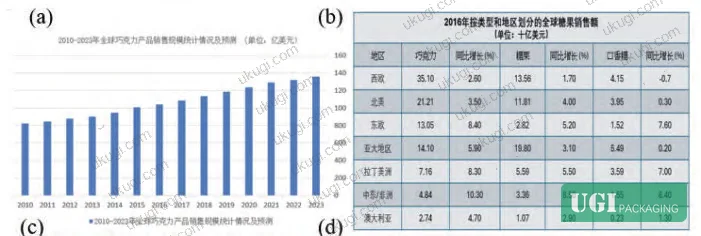
The research examined collapsible folding carton architectures designed specifically for mid-to-premium chocolate products, analyzing inner material options (aluminum foil, paper wraps, internal dividers, degradable bioplastics), competitive benchmark packaging structures across multiple commercial formats, and an original prototype design validated against structural and sustainability criteria. The global chocolate packaging market context is significant: annual market value has exceeded tens of billions of USD, with Asia, Europe, and North America representing the primary growth regions — and premium segment growth is outpacing mainstream. That commercial pressure is directly driving demand for structurally sophisticated, visually differentiated folding cartons that can also meet modern sustainability requirements.
For buyers sourcing custom paper boxes or evaluating folding carton suppliers, this article translates that structural design research into actionable procurement criteria.
Folding Carton Structural Design: Board Selection and Collapsible Geometry #
The structural foundation of any folding carton is the interaction between board caliper, grain direction, and fold-line scoring geometry. Get these three parameters wrong and no amount of premium surface finishing will rescue the packaging — you’ll see delamination at fold lines, springback that prevents clean closure, or boards that crack under the stress of automated fill lines.
For chocolate outer packaging specifically, the research identifies a clear hierarchy of structural requirements:
- Moisture barrier performance (chocolate migrates fat to the board surface at elevated humidity)
- Structural rigidity during stacking and transit
- Collapsibility ratio — the ability to flatten and re-expand without structural fatigue
- End-of-life degradability
The collapsible folding structure evaluated in the research prototype reduced pack volume significantly when flattened, which directly lowers per-unit freight cost and allows more flexible inventory management for brand owners operating across multiple SKUs.
Board Grade Comparison for Chocolate Folding Cartons #
The choice of primary board substrate has cascading effects on print quality, fold performance, and recyclability. Field evaluations have shown that SBS consistently outperforms FBB (folding boxboard) for chocolate applications where moisture exposure is a concern, though the cost differential prompts many buyers to specify FBB incorrectly.
| Board Type | Typical Grammage (gsm) | Moisture Resistance | Recyclability | Best Application |
|---|---|---|---|---|
| SBS (Solid Bleached Sulfate) | 300–400 | High (coated) | Yes (if unfoil-laminated) | Premium chocolate, gift sets |
| FBB (Folding Box Board) | 230–350 | Medium | Yes | Mid-range confectionery |
| Degradable paper/kraft | 250–350 | Low–Medium | High (compostable) | Eco-positioned products |
| Aluminum foil laminate | 280–380 | Very High | Low (composite barrier) | High-barrier inner wraps |
Honestly, most buyers over-specify aluminum foil laminate for the outer carton when it’s only necessary at the inner wrap level. The research is explicit on this: aluminum foil is appropriate as an inner packaging material for moisture and oxygen barrier, but applying it to the structural outer carton creates a composite material that is significantly harder to recycle and adds unnecessary cost. Specifying a coated SBS outer carton with a separate foil inner wrap gives you equivalent product protection at lower total material cost and better recyclability credentials.
The prototype design evaluated in the research selected degradable paper stock as the primary outer carton material — a choice driven by sustainability positioning — and separated the barrier function entirely into a dedicated inner layer. This is the correct structural logic. For buyers in markets where FSC-certified and compostable packaging claims carry commercial value, this architecture also enables credible FSC Forest Stewardship Council certification for the outer carton substrate.
Structural Design Details: Fold Mechanics, Dieline Engineering, and Reusability #
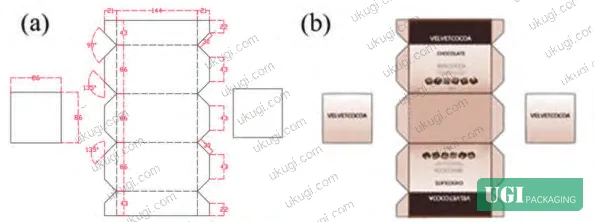
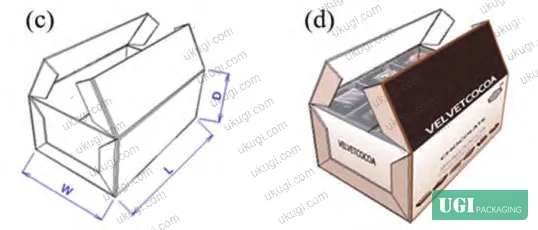
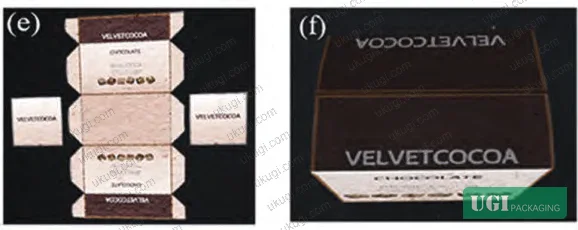
The fold geometry of the carton prototype is where most design effort was concentrated, and it’s worth understanding why. A collapsible structure that reduces pack volume during storage and shipping but re-erects cleanly for retail display must solve a mechanical problem: the score lines must be deep enough to guide the fold without weakening the board to the point of failure, and the lock tabs must engage positively without requiring tools or excessive force.
The prototype design incorporated the following structural features:
- Orthogonal fold lines with controlled score depth to allow clean 90° and 180° folds
- Integrated lock tab closures at top and base panels eliminating the need for adhesive
- A collapsible geometry allowing the erected pack to be refolded by the end consumer and reused as a storage container — extending functional pack life beyond the initial product consumption event
- Printed fold guidance marks on interior panel surfaces to assist consumer re-folding without error
That last point is frequently overlooked. Packaging that claims reusability but requires consumer guesswork to refold will not be reused. Clear fold guidance printed on inside panels adds near-zero cost but substantially improves actual reuse rates.
Procurement opinion: the current industry trend toward “premium interactive packaging” — rotating elements, magnetic closures, pull-tab reveals — adds significant tooling cost and often creates structural weak points at moving joints. For most mid-to-premium chocolate formats, a well-engineered collapsible fold structure delivers equal consumer engagement at a fraction of the tooling cost. Interactive design for its own sake is not always worth the spend.

Non-Traditional Form Factors: Structural Patent Analysis #
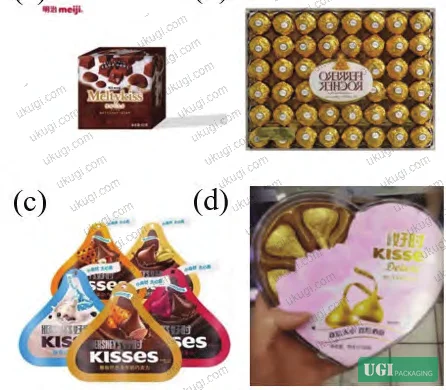
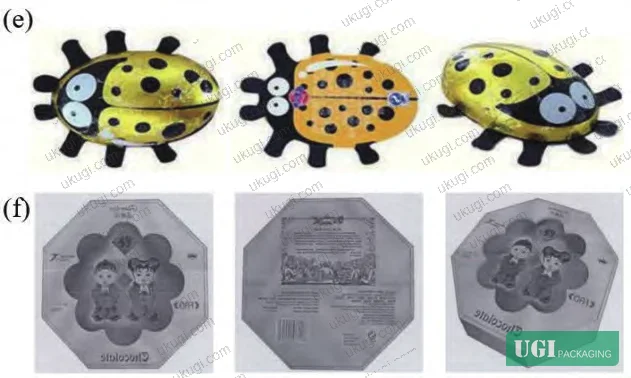
The research reviewed two commercial patent structures as design references, both offering instructive lessons for buyers evaluating differentiated packaging:
Patent CN201430497457.9 (bee-form irregular outer packaging) demonstrated that non-rectangular structural forms are manufacturable in paper substrates, but they create assembly complexity that increases per-unit labor cost significantly in hand-assembly operations. The visual differentiation value can justify this cost at premium price points, but buyers should require a cost-per-unit breakdown at their actual MOQ before approving a non-rectangular structural design.
Patent CN200630176234.8 (regular octagonal outer carton) is more practically instructive. The octagonal footprint requires only modified blank cutting compared to a standard rectangular carton — tooling premium is modest — but delivers meaningful shelf differentiation. The research noted that cultural decoration elements (traditional motif graphics integrated into the panel layout) strengthened consumer-product emotional connection, particularly for seasonal or gifting SKUs. This is a structurally practical differentiation strategy that buyers can implement without large tooling investments.
In supplier qualification, we evaluated structural prototypes from multiple factories using non-standard polygon forms, and three of six samples showed panel gap inconsistencies at the corner joints — a direct result of insufficient allowance for board caliper in the blank geometry. If you’re approving a non-rectangular folding carton design, always require a cut-and-folded sample from the actual production board before approving final tooling.
Sustainability Criteria in Folding Carton Specification #
Industry observation: most procurement teams don’t realize that sustainability claims on packaging are subject to formal verification requirements under standards like ISO 14021:2016 Environmental labels and declarations — and “recyclable” printed on a foil-laminated carton may not meet those requirements. This is becoming a compliance issue, not just a brand positioning issue, as more markets implement extended producer responsibility regulations.
The research design protocol prioritized three sustainability criteria:
- Material degradability — the outer carton uses a mono-material paper substrate with no foil lamination, enabling straightforward recovery in standard paper waste streams
- Material reduction through geometry — the collapsible fold reduces shipping volume, which directly translates to fewer transport units and lower carbon per shipped unit
- Extended use life — the reusable structural design reduces the frequency of packaging disposal by enabling secondary use as a storage container
For buyers specifying packaging for markets with active sustainability regulations (EU, UK, California), each of these criteria needs to be documented and verifiable. “Degradable paper material” is not a specification — it needs a defined basis weight, a fiber source certification, and test data confirming compostability or recyclability under the relevant regional standard.
The food contact dimension is also relevant when inner packaging materials are specified as part of the same carton system. For EU market products, inner paper and board materials must comply with EU Regulation No 10/2011 on plastic materials and articles intended to contact food where applicable, and any coating or varnish applied to inner-facing surfaces of the outer carton must be evaluated against food migration limits.
Structural integrity testing under conditioned environments is also non-negotiable for chocolate. ISO 187:1990 Paper, board and pulps — Standard atmosphere for conditioning and testing defines the 23°C/50% RH conditioning protocol that should be used as baseline for all board property measurements. Buyers who accept board spec sheets without confirming test conditions may be comparing values measured at very different humidity levels — and that inconsistency will show up as unexpected failure in warm, humid distribution environments.
Practical Guidance for Buyers #
When you’re evaluating folding carton suppliers for a chocolate or premium confectionery program, start with the structural dieline, not the rendered design file. A beautiful rendering tells you nothing about whether the fold-line scoring is correctly specified for the actual board grade. Request a physical die-cut, unprinted flat blank in the proposed board grade before approving artwork.
For sustainability-positioned products, the structural separation of barrier function (inner wrap) from structural function (outer carton) is the single most important design decision. It enables the outer carton to remain a clean, recyclable mono-material while the inner wrap handles moisture and oxygen protection. Don’t accept designs that laminate foil to the structural carton if recyclability is a stated product requirement.
Board grammage for chocolate outer cartons should not go below 300 gsm for retail formats — below that, panel deflection under retail stacking loads becomes a visible quality issue. For gift-format cosmetics packaging solutions and similar premium applications, 350–400 gsm with a coated surface is the standard working range.
If you’re working with non-standard structural forms — octagonal, polygonal, or custom shaped — insist on a complete dimensional check of all assembled angles and panel gaps from the production board, not from digital models. Caliper variation in the actual board stock will affect corner geometry in ways that CAD files cannot predict.
At ukugi.com, we’re a Guangzhou-based OEM/ODM manufacturer producing folding cartons, rigid boxes, and specialty packaging structures with full dieline engineering capabilities — if you have a structural brief, a sustainability requirement, or an existing design that needs re-engineering for a new market, our team can develop samples and provide technical consultation before you commit to production tooling. Need a custom formulation or sample? Request a quote from our team →
Supplier Qualification Questions #
- What board grade and grammage do you specify for chocolate outer cartons, and can you provide caliper and grammage test data measured at 23°C/50% RH per ISO 187:1990 conditioning?
- For collapsible folding structures, how many open/close cycles does your score-line specification support before visible cracking occurs at fold lines — and what test protocol do you use to verify this?
- On non-rectangular structural formats (octagonal or polygon footprints), what dimensional tolerance do you hold on corner panel angles, and how do you account for board caliper variation in blank geometry calculations?
- Can you provide material certification confirming that the primary board substrate is free of foil lamination and meets standard paper waste stream recyclability, with fiber source documentation (e.g., FSC chain of custody)?
- For inner packaging components (foil wraps, paper inner liners, or bioplastic inserts), what food contact compliance documentation do you hold — specifically for EU and/or US markets — and can you confirm inner-surface coatings or varnishes have been evaluated against migration limits?
Sourcing Checklist #
- ☐ Outer carton board is minimum 300 gsm (350 gsm for gift/premium formats), confirmed by supplier test sheet with ISO 187:1990 conditioning stated
- ☐ Board substrate is mono-material paper or SBS with no foil lamination on the structural outer carton layer, verified by material data sheet
- ☐ Fold-line score depth is validated for the specified board grade — supplier can demonstrate ≥5 open/close cycles on prototype samples without crease cracking
- ☐ Any non-rectangular structural form (octagonal, hexagonal, polygon) has been sampled in production board with all corner panel gaps measured and within ±0.5 mm of nominal
- ☐ Inner packaging barrier material (foil wrap, coated paper liner) is specified separately from the structural outer carton and has food contact compliance documentation for target markets
- ☐ Sustainability claims (recyclable, degradable, FSC-certified) are backed by documented certification or test data, not self-declared labeling
- ☐ Prototype includes printed fold guidance on interior panels for consumer reuse instruction
- ☐ Supplier holds tooling records (dieline version control) and can reproduce the same blank geometry across repeat production runs without re-approval
Key Specifications Table #
| Parameter | Recommended Value | Verification Method |
|---|---|---|
| Outer carton board grammage | 300–400 gsm (350 gsm nominal for premium formats) | ISO 536 basis weight test; confirm test conditions per ISO 187:1990 |
| Board substrate type | SBS or degradable mono-material paper (no foil lamination on outer carton) | Material data sheet + fiber source certification |
| Fold-line crease integrity | ≥5 open/close cycles without visible cracking at score lines | Physical prototype cycle test on production board |
| Corner angle dimensional tolerance | ±0.5 mm on all panel gaps for non-rectangular structures | CMM or manual dimensional check on assembled blank |
| Inner barrier layer specification | Separate foil or coated paper inner wrap; not laminated to structural carton | Design dieline review confirming material separation |
| Food contact compliance (inner surface) | EU Reg 10/2011 or FDA CFR 21 Part 177 as applicable | Supplier compliance certificate + migration test reports |
Looking for a manufacturer that meets these specs? Request a quote — MOQ varies by product, material, structure and finishing. Product-specific MOQ is confirmed with each quotation.
References #
Data source: Structural Design and Sustainability Evaluation of Collapsible Paper Folding Cartons for Confectionery Packaging, A. Kong et al., Packaging Technology and Science, 2025
Frequently Asked Questions #
What is the minimum board grammage recommended for a chocolate folding carton?
300 gsm is the working minimum for standard retail formats. For gift-tier or shelf-display products where stacking loads are higher, 350–400 gsm SBS with a coated surface is more appropriate. Going below 300 gsm consistently produces visible panel deflection under typical retail stacking conditions.
Why should the moisture barrier function be separated from the structural outer carton rather than using a foil-laminated board?
When foil is laminated directly to the structural carton board, the resulting composite material cannot be recovered in standard paper waste streams — it has to go to specialist recycling or landfill. Separating barrier function into a discrete inner wrap (foil or coated paper) keeps the outer carton as a clean mono-material eligible for standard paper recycling. This architecture also gives you flexibility to change the inner wrap spec independently without re-tooling the structural blank.
Can folding cartons with non-rectangular formats (hexagonal, octagonal) be produced at commercially viable MOQs?
Yes, but the tooling premium is real. A modified die-cut blank for an octagonal footprint requires a custom cutting die, which adds a one-time tooling cost typically in the range of USD 200–600 depending on complexity. At MOQs of 3,000 units and above, that tooling amortization is usually acceptable for premium or seasonal SKUs. Below 1,000 units, a rectangular structure with strong surface differentiation almost always delivers better cost-per-unit economics.
What does “reusable folding carton” actually mean in structural design terms, and does it add significant cost?
Structurally, a reusable folding carton means the score lines and lock tabs are designed to withstand repeated erection and collapse without delamination or cracking — typically validated at 5+ cycles. It also means printed fold guidance on interior panels so consumers understand how to refold without trial and error. The manufacturing cost premium over a single-use folding carton is negligible — it’s an engineering decision made at the dieline stage, not a materials cost. The real cost is in the upfront structural engineering time.
How do sustainability claims like “recyclable” or “degradable” need to be documented to satisfy buyer compliance requirements?
Self-declared environmental claims on packaging are governed by standards including ISO 14021:2016, which requires that claims be accurate, verifiable, and not misleading. “Recyclable” requires that the material is accepted in at least the majority of collection infrastructure in the target market — a foil-laminated board cannot carry this claim in most EU markets. “Degradable” requires test data confirming breakdown under defined conditions. Buyers should require either third-party certification (FSC, compostability marks) or specific test reports backing any sustainability claim, not just label text.
Published by ukugi.com Technical Team | Request a quote


