

TL;DR #
Active packaging using OS/EE high-barrier systems extends sponge cake shelf life to at least 42 days without chemical additives — a performance gap that traditional corrugated and white card structures cannot close. For buyers specifying e-commerce food packaging, this means material selection and structural engineering are now inseparable from cold-chain logistics planning. Start your evaluation by requesting shelf-life validation data and barrier test results before committing to any structural format.
For a related specification, compare Functional Extension Design for Fresh Produce Packaging: Barrier Materials, Active Systems, and Smart Technol… before finalising the packaging brief.
Overview #
If you’ve spent any time qualifying e-commerce food packaging, you already know that the real failure point isn’t the brand presentation — it’s the gap between shelf-life expectation and actual delivery performance. Research conducted at a Chinese university engineering department, drawing on a 40-person user perception study across four age cohorts (21–65 years) and comparative CMF analysis of two leading online cake brands, makes this gap quantifiable and actionable. The findings confirm something that procurement teams often discover too late: packaging structure and innovative preservation technology must be co-designed from the brief stage, not bolted together at the sample review.
The study analyzed online versus offline cake packaging across three dimensions — structural integrity under transport conditions, user perception preference by demographic segment, and technology readiness for active, intelligent, and nano-composite packaging formats. What emerged is a clear picture of where current e-commerce food packaging falls short and which technical upgrades deliver measurable ROI.
This article translates those findings into practical specification guidance for packaging buyers, product managers, and quality engineers who need to evaluate supplier capability before placing orders.
Packaging Structure Design for E-Commerce Food Applications #
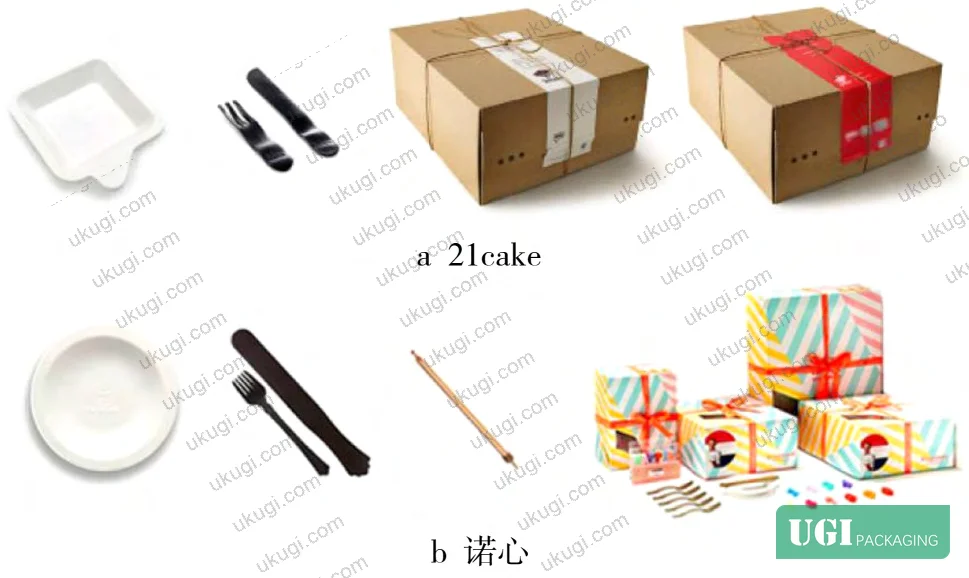
The structural divergence between offline and online cake packaging is more pronounced than most buyers anticipate. Traditional retail formats — typically top-open or top-center-open flip-lid constructions with carry handles — were designed for single-person, short-distance carry. They work fine when the customer walks out of a store. They do not work when a package travels 5–24 hours in a cold-chain vehicle at a controlled speed of 40 km/h.
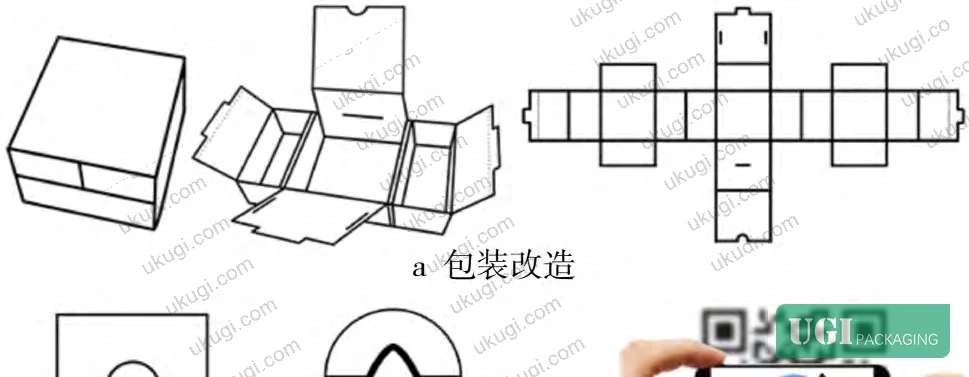
Online-optimized structures reduce decorative complexity and shift engineering priority to modularity, stackability, and internal compartmentalization. The research documents the evolution clearly: leading online brands moved from multi-piece assembled formats — which consume excess warehouse space, require manual assembly time, and create integration complexity — toward single-sheet or integrated panel designs with defined internal zones.
Comparative Analysis: Offline vs. Online Packaging Structural Priorities
| Criterion | Traditional Offline Format | Online E-Commerce Format | Performance Gap |
|---|---|---|---|
| Primary structure | Top-flip or sleeve lid with carry handle | Integrated panel, modular compartments | Online reduces assembly steps, improves stack density |
| Material base | White card, PET/PE/PP laminate, transparent lid | K9K corrugated, degradable bagasse, aluminum foil composite | Online uses food-grade bio-based options more consistently |
| Surface process | Color print + over-lamination | Minimal print, natural kraft + rope fastening OR color ribbon + adhesive | Premium positioning diverges by brand |
| Cold-chain compatibility | Not engineered for it | Unikey thermal box + ice packs + temperature-controlled transport | Online requires integrated logistics specification |
| Shelf-life support | Passive (no active barrier) | OS/EE high-barrier active system capable | 42-day minimum vs. days for unprotected formats |
| Tableware unit cost | ¥0.60–¥1.50 per piece | ¥0.25–¥5.00 per piece depending on material | Wider range; premium online brands invest more in tableware finish |
Honestly, most buyers over-specify the decorative surface while under-specifying the structural barrier performance. In a category where 5–24 hour cold-chain integrity is the functional minimum, the corrugated grade, inner friction texture, and compartment stability matter far more than the foil stamp on the outer lid.
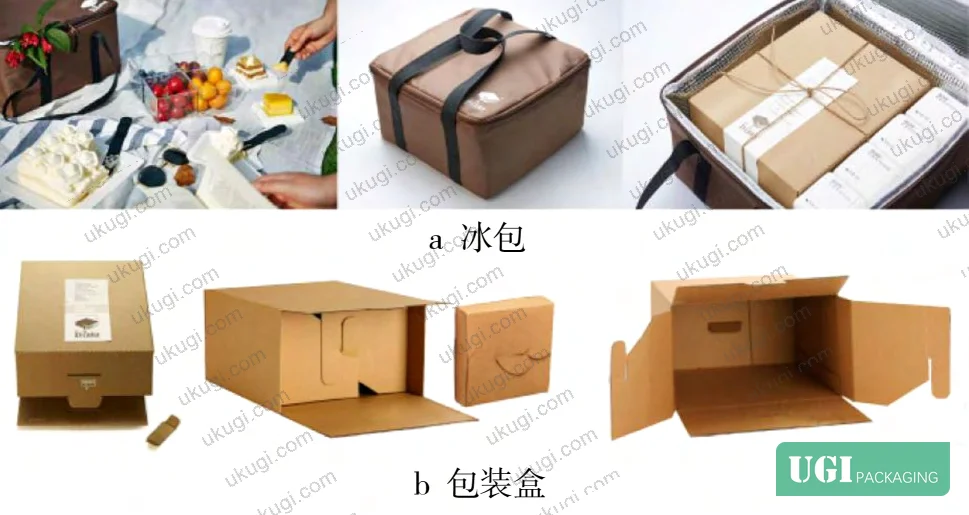
The research identifies a specific structural failure mode worth flagging: pull-out drawer-style constructions currently used by some brands occupy disproportionate warehouse volume and require manual assembly that slows fulfillment. In supplier qualification, we’ve seen samples fail on this point repeatedly — the structure looked clean in 2D dieline but collapsed under stacking loads or required three-step assembly that cold-chain logistics teams couldn’t execute consistently at scale.
Active, Intelligent, and Nano-Composite Packaging Technologies for Food E-Commerce #
This is where the research gets technically specific, and where most procurement teams don’t have the evaluation framework they need.
Active packaging based on OS/EE high-barrier systems works through oxygen scavenging, ethanol maintenance, and controlled low-oxygen concentration. Without any chemical additives, this approach demonstrably delays microbial growth, lipid oxidation, color degradation, and textural hardening. The validated result: a minimum shelf life of 42 days for sponge cake layers — compared to the days-level performance of passive corrugated formats. That’s not a marginal improvement; it changes the entire logistics geography of the product.
Intelligent packaging adds sensing, recording, tracking, and communication layers. Relevant monitoring parameters for cake specifically include time-temperature indicators, oxygen and CO₂ levels, color-temperature sensors, pathogen detection, and physical damage flags. The procurement value is straightforward: intelligent packaging converts quality management from visual inspection at delivery to continuous data during transit. For buyers responsible for food-grade compliance, this is no longer optional in premium segments.
Nano-composite packaging addresses the limitations of both active and intelligent formats — specifically their cost, coverage rate, and absence of globally unified food-safety legislation. Bio-based nanocomposites deliver barrier and antimicrobial properties while being biodegradable. They replace petroleum-based plastic substrates without sacrificing functional performance. The regulatory gap remains real: global food-contact legislation for nanomaterials is still fragmentary, which creates compliance complexity for cross-border shipments.
Most procurement teams don’t realize that the regulatory framework for intelligent and nano-packaging materials differs substantially by destination market — what clears EU food-contact requirements may not align with FDA indirect food additive rules or with emerging Southeast Asian standards. This is a qualification variable your supplier needs to address in writing before sampling.
For buyers using standard references to frame supplier discussions, the IEC 62619:2022 Safety requirements for secondary lithium cells and batteries framework offers a useful model for how performance-validated testing requirements can be structured in specification documents — the principle of defining test conditions, pass thresholds, and failure modes in the supplier brief applies equally to food-barrier packaging qualification. Similarly, the methodology discipline behind ISO 12405-4 test specifications for traction battery systems illustrates how multi-parameter performance validation can be structured across material, structural, and environmental variables — a model food packaging buyers can adapt for barrier and shelf-life testing protocols. And for understanding how traceability and data logging requirements should be written into packaging specifications, the IEC 61960-3 standard for secondary lithium cells provides precedent for binding test condition documentation to supply chain records — the same approach should govern intelligent packaging data validation.
CMF Design Language and User Perception Segmentation #
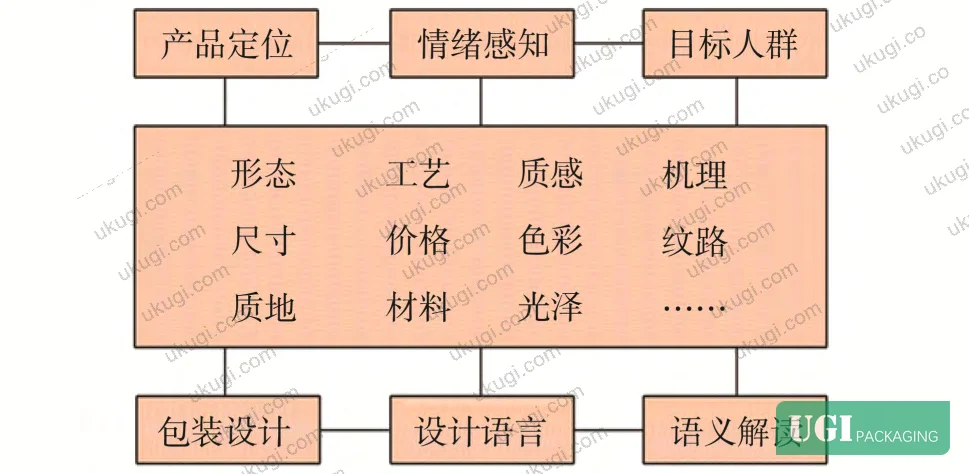
CMF — Color, Material, Finish — is the design framework that connects physical packaging attributes to measurable user preference. The 40-person perception study provides specific data points buyers can use to validate supplier design briefs.
Age and gender segmentation produced clear preference signals:
- 90% of female users aged 21–40 preferred the premium minimalist approach (natural kraft, geometric form, rope closure, extreme simplicity)
- 90% of female users aged 41 and above preferred the expressive, colorful, dynamic format
- 80% of male users aged 21 and above aligned with the expressive format
- Users aged 41–50 placed the highest premium on packaging innovation — this cohort has the strongest ROI case for active and intelligent packaging investment
- Users under 40 showed stronger preference for intelligent packaging formats; middle-aged users showed interest in both intelligent and active formats; older users leaned toward active packaging
The Kano model analysis confirms that the 30–50 age bracket — identified as the core salary-earner demographic for premium online cake — responds positively to innovation cues in packaging. They want ease of operation (active packaging scores here) AND data-connected experiences (intelligent packaging scores here).
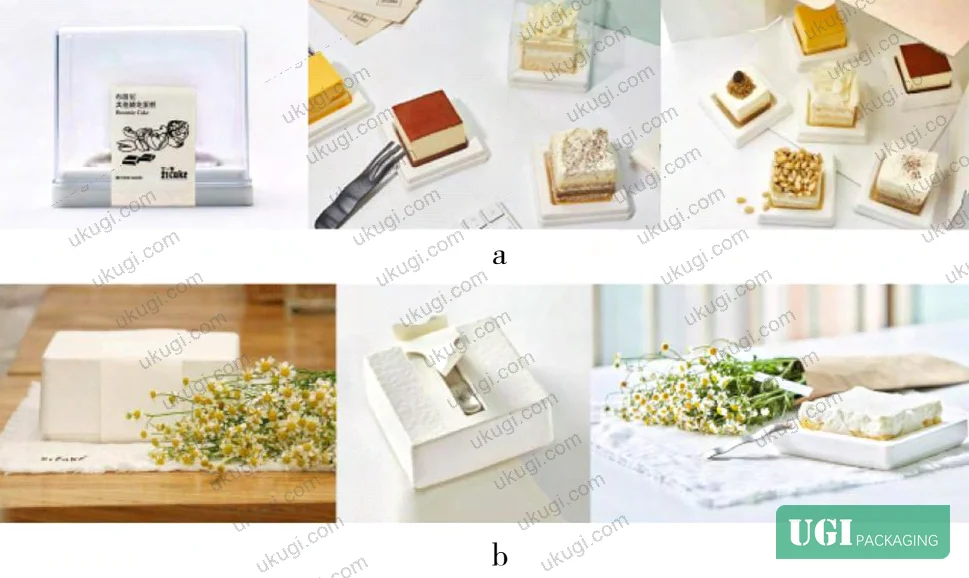
The design language comparison between the two studied brands is instructive. One positions through geometric precision, natural material color, and minimalist typography — conveying maturity, organic authenticity, and premium restraint. The other uses multi-color printing, ribbon closures, and dynamic form — conveying energy, accessibility, and emotional warmth. Both are technically valid. They serve different user segments. The procurement implication is that design language must be specified as precisely as material grade: vague briefs produce samples that miss both.
Practical Guidance for Buyers #
When you’re evaluating suppliers for e-commerce food packaging — whether for cake, confectionery, or any perishable premium product — the structural brief needs to answer three questions before you go to artwork: What is the transit time and temperature window? What shelf-life performance is required at the destination? What user interaction does the unboxing experience need to deliver?
Most buyers sequence these in reverse — they finalize the visual design first and then discover that the chosen substrate can’t support the required barrier performance, or that the structural format won’t survive 24-hour cold-chain transit without internal bracing. That sequencing mistake costs at least one full sampling cycle.
For active packaging qualification, demand shelf-life validation data under actual transport simulation conditions — not laboratory ideal conditions. A 42-day shelf-life claim under controlled lab conditions does not automatically translate to 42 days across your actual cold-chain. Request test reports showing microbial count, acid value, peroxide value, and moisture content data at the specified transit time points.
On the structural side, prioritize integrated single-sheet or limited-component designs over multi-piece assemblies. Verify inner compartment stability under stacking loads. If the brief includes AR or QR interactive elements, confirm that the print resolution and registration tolerance on the code area meet minimum scan reliability requirements — this is a detail that often gets lost between artwork approval and production.
We’re a Guangzhou-based OEM/ODM packaging manufacturer working with brand owners and product teams across North America, Europe, and Southeast Asia, with full capability across structural design, active barrier materials, foil stamping, and security printing. If you’re qualifying suppliers for a custom e-commerce food packaging project, we can run samples against your specific transit and shelf-life requirements from ukugi.com. Need a custom formulation or sample? Request a quote from our team →
Technical Verification Questions #
Key technical points to verify when evaluating any supplier in this category (including us):
- What shelf-life performance data can you provide for sponge cake or similar baked goods using your active OS/EE high-barrier packaging system — specifically, what are the documented microbial count, acid value, peroxide value, and moisture content results at 42 days under simulated cold-chain transport conditions?
- For intelligent packaging integration, which specific sensor parameters does your system monitor — time-temperature, oxygen concentration, CO₂, color-temperature, pathogen indicators, or physical damage — and what are the detection thresholds and data logging formats?
- Can you provide food-contact compliance documentation for your nano-composite or bio-based barrier materials for the target destination markets (EU food-contact regulations, FDA indirect additive rules, or equivalent)?
- What is the stacking load limit for your integrated single-panel or modular compartment structures, and at what compression force does internal compartment stability fail under testing?
- For any QR or barcode print areas specified in the artwork, what are your minimum print resolution and registration tolerance specifications, and can you provide scan-success rate data from production samples?
Quality Verification Checklist #
- ☐ Active packaging system achieves minimum 42-day shelf life for sponge cake layers with no chemical additives, confirmed by test report showing microbial count, acid value, peroxide value, and moisture content data
- ☐ Structural format uses integrated single-sheet or limited-component design (maximum 3 pieces), verified by physical sample disassembly count
- ☐ Inner compartment anti-slip texture or locking mechanism confirmed to maintain cake integrity at 40 km/h transport speed under cold-chain simulation
- ☐ Bio-based or nano-composite material carries food-contact certification valid for the destination market (EU, US, or applicable regional standard)
- ☐ Tableware and packaging components priced within specified BOM target (verify per-unit cost against ¥0.25–¥5.00 range benchmarks from research)
- ☐ QR or smart window print registration tolerance confirmed at production run accuracy, with scan-success rate documented from pre-production sample batch
- ☐ CMF design brief specifies color, material grade, and surface finish to the level of the design perception matrix (not just “premium” — explicit material spec and finish process)
- ☐ Cold-chain packaging assembly (ice pack, thermal lining, outer structural box) confirmed completable within logistics team’s fulfillment time window without manual rework
Key Specifications Table #
| Parameter | Recommended Value | Verification Method |
|---|---|---|
| Active packaging shelf life (sponge cake) | ≥42 days, zero chemical additives | Microbial count + acid value + peroxide value + moisture content test at day 42 under cold-chain simulation |
| Cold-chain transport temperature control | Constant temperature maintained; vehicle speed ≤40 km/h | Temperature logger data from transport simulation; thermal box performance report |
| Structural component count | ≤3 pieces (preference: single integrated panel) | Physical disassembly count of production sample |
| QR/barcode print registration | ≤0.2 mm tolerance on code area | Optical registration measurement + scan-success rate test on 20-sample production batch |
| Tableware unit cost range | ¥0.25–¥5.00 per piece depending on material grade | BOM line-item verification against supplier invoice |
| Nano/bio-composite barrier material | Food-contact certified for destination market | Compliance certificate (EU Regulation 10/2011 or FDA 21 CFR equivalent) |
| User perception alignment (target demographic 30–50) | CMF design language explicitly specified and validated against preference data | 20-person user review session or structured CMF preference survey before production approval |
Looking for a manufacturer that meets these specs? Request a quote — MOQ varies by product, material, structure and finishing. Product-specific MOQ is confirmed with each quotation.
References #
Data source: Packaging Design Strategies for Online Food E-Commerce: Active, Intelligent, and Nano-Composite Approaches to Perishable Product Delivery, H. Dong et al., Packaging Technology and Science, 2024
Frequently Asked Questions #
What is the minimum validated shelf life achievable with active OS/EE high-barrier packaging for sponge cake?
The research documents a minimum of 42 days for sponge cake layers using an active OS/EE high-barrier system, with no chemical additives. This is achieved through oxygen scavenging, low-oxygen concentration maintenance, and controlled ethanol function that collectively inhibit microbial growth, lipid oxidation, color change, and texture hardening.
How does intelligent packaging differ from active packaging in an e-commerce food context, and which should I specify?
Active packaging physically modifies the internal environment to extend shelf life — it’s a barrier and preservation technology. Intelligent packaging monitors and communicates — it detects time-temperature exposure, oxygen levels, CO₂, pathogen indicators, and physical damage, then makes that data accessible for quality decisions. For premium e-commerce food shipments, the ideal specification combines both: active packaging provides the preservation performance, intelligent packaging provides the audit trail. User preference data from the research shows the 30–50 age bracket values both, with younger users slightly more responsive to the intelligent layer.
What structural format should I specify for e-commerce cake packaging to minimize fulfillment complexity?
Specify an integrated single-sheet or maximum three-piece modular design. Multi-piece assembled formats — pull-out drawers, separate inserts, multiple independently assembled components — consume excess warehouse space, require manual assembly time that cold-chain logistics teams can’t absorb consistently, and create stacking instability. The research explicitly identifies these as current industry failure points. An inner anti-slip texture or locking mechanism that engages the product tray adds transport stability without adding components.
What CMF variables have the strongest influence on user purchase preference for online food packaging?
Based on the 40-person perception study: color and material selection drive the strongest initial brand perception signal. Natural kraft with minimal print conveys premium restraint; multi-color with ribbon closure conveys energy and approachability. Neither is universally superior — the data shows 90% of female users under 40 preferring the minimalist format while 90% of female users over 41 prefer the expressive format. The practical implication is that your CMF brief must specify design language as explicitly as material grade — vague direction produces samples that split the difference and satisfy nobody.
Do nano-composite packaging materials have globally accepted food-contact approvals?
Not uniformly. This is one of the most important compliance gaps flagged in current research. Bio-based nanocomposites offer genuine functional advantages — barrier performance, antimicrobial properties, biodegradability — but global food-contact legislation for nanomaterials remains fragmented. EU, US, and Asian markets each have different approval frameworks, and some nanomaterial applications lack formal clearance in one or more major destination markets. Require destination-market-specific compliance documentation from any supplier quoting nano-composite materials, and do not accept general food-grade certification as a substitute.
Published by ukugi.com Technical Team | Request a quote


