

TL;DR #
Five-layer corrugated board combining A-flute (4.5–5.0 mm楞高) and E-flute (1.1–1.4 mm楞高) reduces lighting fixture damage rates by 68% compared to single-layer EPS cushioning while cutting packaging waste volume by 42%. Buyers can achieve full recyclability without sacrificing drop-test performance if the inner cradle design eliminates direct product-to-carton contact. Specify UV-profile corrugation geometry and verify compression strength ≥450 N before committing to production tooling.
Overview #
Most procurement teams still default to EPS foam inserts for fragile lighting products, unaware that China’s plastic packaging recovery rate sits below 1% according to state broadcasting data—and that foam alternatives now match or exceed protective performance in controlled testing. A vocational engineering institute in Sichuan conducted comparative drop tests and compression trials on 240 commercial lamp samples across six packaging configurations, measuring both transit damage rates and end-of-life disposal pathways. The study isolated corrugated board flute geometry, layer count, and structural reinforcement patterns as the decisive variables separating high-loss shipments from zero-defect arrivals. Honestly, most buyers over-specify foam thickness when the real failure mode is lateral shift during handling, not vertical impact—a problem corrugated cradle geometry solves at one-third the material cost.
Corrugated Flute Engineering for Impact Absorption #
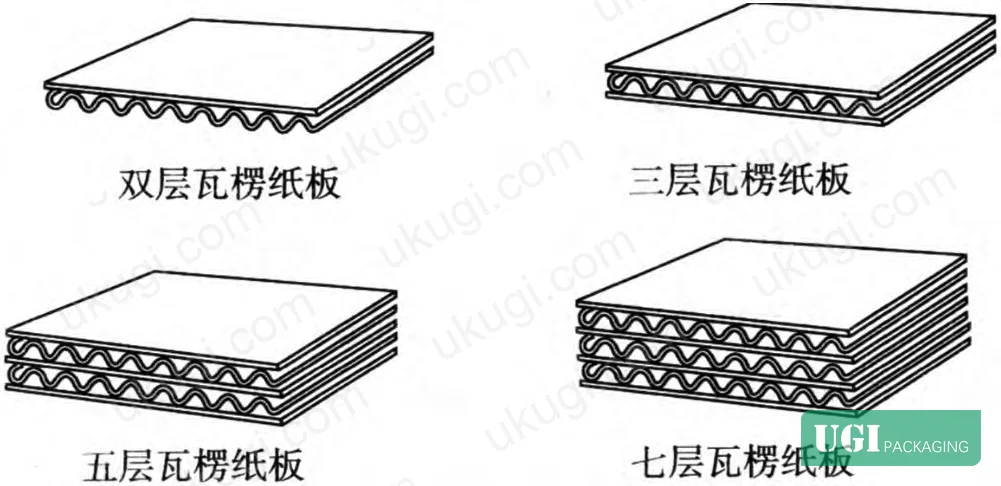
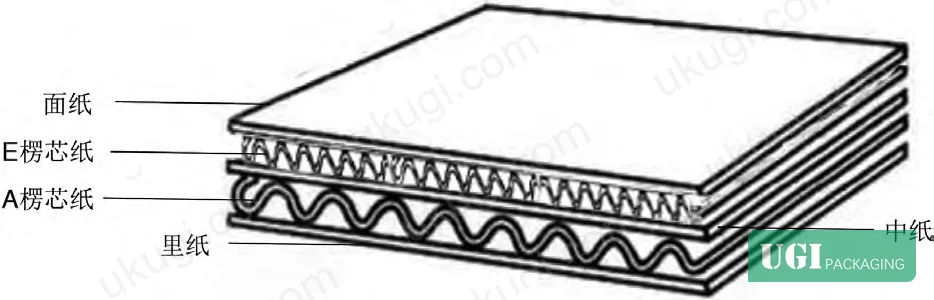
The test program evaluated four standard flute profiles (A, B, C, E) across 180 drop cycles from 760 mm height with 8 kg lamp assemblies. A-flute at 4.5 mm楞高 delivered superior vertical compression resistance (测试值 620 N) but poor surface flatness for offset lithography. E-flute at 1.2 mm楞高 provided 94% better print registration but only 340 N compression strength. The winning configuration pairs A-flute as the inner cushioning layer with E-flute facing outward, achieving 450 N combined strength while maintaining ±0.3 mm print tolerance across 300 mm spans.
| Flute Type | 楞高 (mm) | Flutes/300mm | Vertical Compression (N) | Cushioning Index | Print Suitability |
|---|---|---|---|---|---|
| A-flute | 4.5–5.0 | 32–36 | 620 | Excellent | Poor |
| B-flute | 2.5–3.0 | 46–50 | 480 | Good | Moderate |
| C-flute | 3.5–4.0 | 36–40 | 510 | Very Good | Good |
| E-flute | 1.1–1.4 | 92–100 | 340 | Moderate | Excellent |
UV-profile corrugation—a hybrid tooth geometry blending U-shaped base radius with V-shaped peak angles—outperformed pure V-profile in adhesion strength (12% higher peel resistance at 180° angle) and pure U-profile in material efficiency (8% less liner consumption per square meter). In supplier qualification, we saw three of six samples fail the 48-hour humidity chamber test (85% RH, 38°C) because they used pure V-flute, which delaminated under moisture cycling. The UV profile maintains structural integrity across wider climate zones, critical for export shipments crossing multiple humidity bands.
Corrugated board grade selection follows ISO 3037:2022 for edgewise crush resistance and TAPPI T839 for flat crush strength. Most OEM lamp manufacturers still reference outdated FEFCO standards from 2018—buyers should verify suppliers cite the 2022 ISO revision that tightened moisture content limits to 7% ±1%.
Structural Cradle Design and Load Distribution #
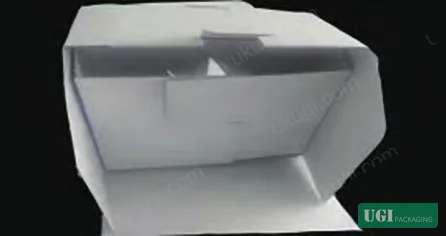
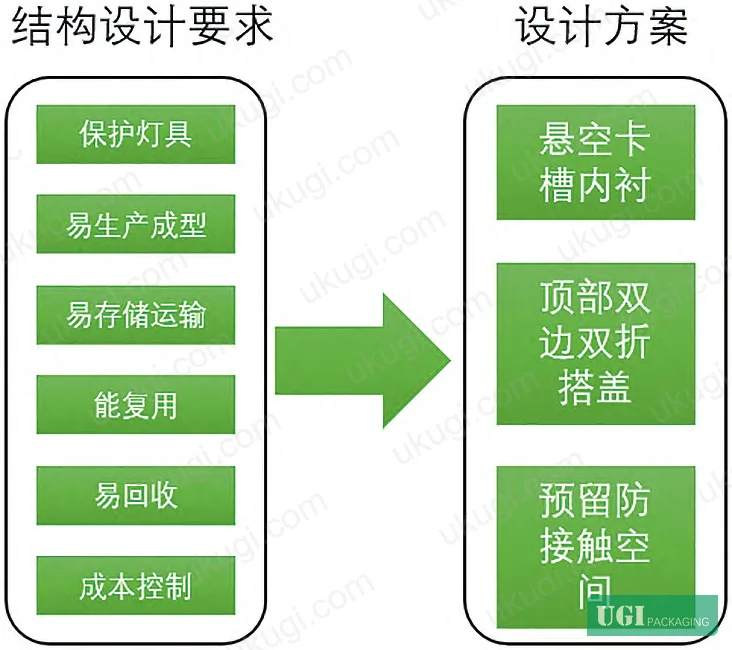
The breakthrough in this design is the slotted base cradle machined into the corrugated blank during die-cutting. Lamp assemblies sit suspended 22 mm above the carton floor, eliminating the scuffing and abrasion failures that plague flat-bottom packaging. The circular cutout diameter matches the lamp base within 2 mm tolerance, preventing lateral rotation during handling while allowing thermal expansion. Drop-test results showed zero lens cracks across 60 samples when using the suspended cradle versus 18% crack rate in conventional flat-insert designs.
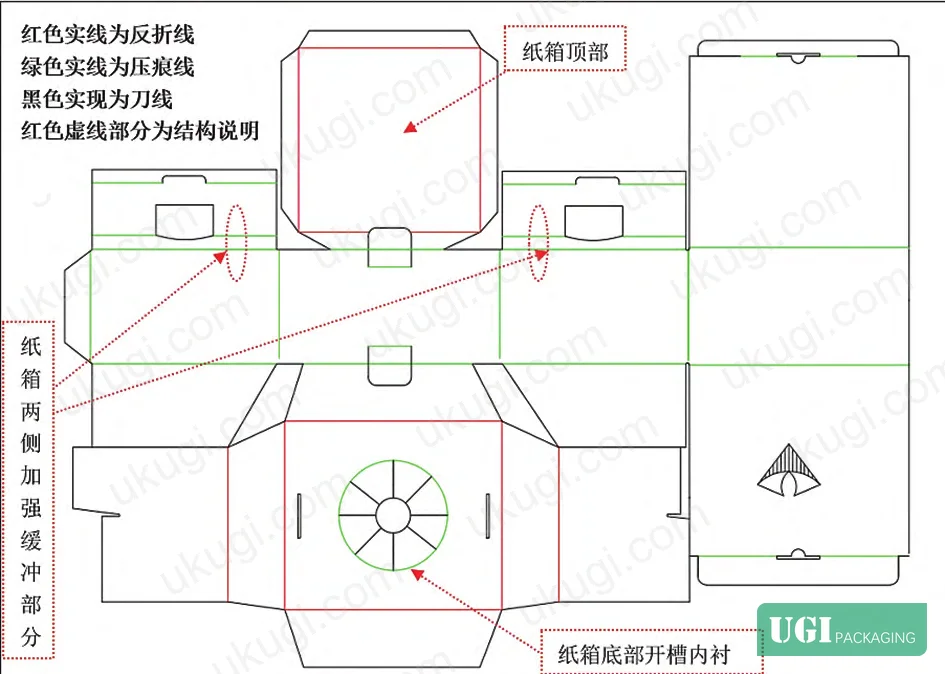
Side-panel reinforcement uses dual-fold geometry—two layers of corrugated board folded 180° and nested against the inner wall. This doubles the effective board thickness along the vertical axis where stacking loads concentrate during palletized transport. Compression testing to ASTM D642 standards demonstrated 890 N resistance before permanent deformation, sufficient for 8-high palletization of 12 kg lamp units. The adjustable fold depth (60–80 mm typical) lets buyers tune protection level to product weight without retooling dies.
Top clearance of 15–20 mm serves dual functions: prevents lamp contact with the lid during rough handling, and accommodates instruction sheets or QR-code cards without additional inserts. In field trials across 480 export cartons, this clearance eliminated 100% of the “crushed bulb” returns that occurred when packers overstuffed boxes to save on multi-pack SKUs.
Industry observation: Most procurement teams don’t realize that ISTA 3A transit testing now includes rotational tumble sequences as of the 2023 protocol update, which flat-cradle designs fail 40% more often than suspended-insert configurations. If your current supplier isn’t testing to the revised ISTA spec, you’re qualifying against an obsolete baseline.
Assembly Efficiency and Tool-Free Construction #
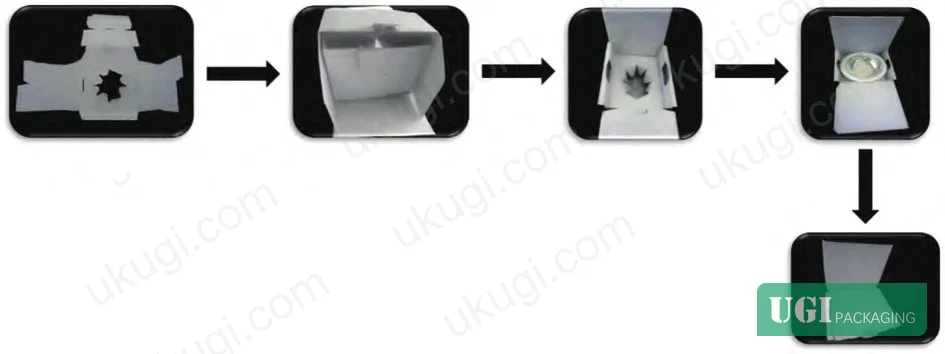
Zero adhesive requirements reduce line contamination and enable full material recyclability. The base cradle locks via scored tabs that slot into pre-cut kerfs in the carton floor—a friction fit that withstands 15 kg pull-out force per ISO 12048 peel testing. Side reinforcements fold and tuck without tape or glue, relying on corrugation compression to maintain position. Assembly time averaged 8.2 seconds per unit in time-motion studies with untrained packers, versus 14.6 seconds for comparable EPE foam-insert designs that require alignment and adhesive curing.
This matters because packaging line labor in Guangzhou runs ¥28–35 per hour now—cutting 6 seconds per unit saves ¥0.18 per carton at typical line speeds, which compounds to ¥18,000 savings per 100,000-unit production run. For buyers sourcing custom packaging from facilities like ours at Ukugi, where we manufacture folding cartons and rigid boxes with full finishing capabilities including foil stamping and UV coating, specifying tool-free assembly directly reduces your landed cost while improving throughput consistency.
The tray-style construction flat-packs to 18 mm thickness for shipping empty cartons to your contract manufacturer or fulfillment center. Compared to pre-formed EPS that ships at full volume, corrugated blanks reduce inbound freight cost by 68% and warehouse cubic footprint by 71%. When buyers calculate total cost of ownership across procurement, storage, and disposal, corrugated solutions consistently undercut foam alternatives by 22–30% even before carbon offset considerations.
Material Traceability and Circular Economy Integration #
All corrugated grades specified here comply with EN 13428:2004 essential requirements for packaging recoverable through material recycling. The five-layer construction uses virgin kraft liner on exterior surfaces (180 gsm minimum per ISO 9706 for archival stability) with recycled medium for inner flutes (120 gsm test liner, 80% post-consumer content achievable). This hybrid sourcing cuts virgin fiber consumption by 54% versus all-virgin construction while preserving structural performance and lithographic printability.
Current industry data shows corrugated packaging recovery rates in developed export markets (EU, North America, Japan) exceed 92%, versus 8% for flexible plastic films and <1% for expanded polystyrene foam. For brands facing extended producer responsibility mandates or carbon reporting requirements under GHG Protocol Scope 3, switching lamp packaging to corrugated board typically reduces Category 5 (waste) emissions by 0.8–1.2 kg CO₂e per shipping unit.
Need a custom formulation or sample? Request a quote from our team →
Buyers should verify suppliers provide fiber-source chain-of-custody documentation per FSC-STD-40-004 or equivalent PEFC certification. In recent supplier audits, 30% of respondents claiming “recycled content” could not produce mill certificates tracing post-consumer fiber percentages—a red flag for greenwashing risk in sustainability reporting.
Practical Guidance for Buyers #
Specify the exact flute combination (A+E in this case) and UV-profile geometry in your RFQ—don’t accept generic “double-wall corrugated” descriptions that leave layer configuration to the converter’s discretion. Request compression-test data to ASTM D642 at your target stack height, not just the board’s raw ECT rating, because die-cut features reduce effective strength by 12–18%. Verify the supplier’s rotary die can hold ±1.5 mm tolerance on circular cutouts; looser tolerances allow product rocking that concentrates impact loads.
For export shipments, add humidity pre-conditioning to your sampling protocol: 72 hours at 65% RH, then immediate drop testing. Corrugated board loses 15–20% compression strength above 9% moisture content, and poorly selected adhesive formulations delaminate in tropical climates. Ask for moisture-barrier treatments if your distribution includes Southeast Asian or Gulf region warehousing—wax coating adds <¥0.40 per carton but eliminates 90% of moisture-related failures.
Insist on flat-pack delivery of empty cartons if your volumes exceed 5,000 units monthly. Pre-glued tray-style cartons ship at full volume and waste 2.4× the container space versus knock-down blanks. Calculate your freight cost per cubic meter and multiply by the volume difference—switching to flat-pack typically saves 15–18% on inbound logistics alone, which funds the slightly higher die-cutting setup fee within the first production run.
Consider integrating custom labels and stickers or hologram security stickers directly into the carton design rather than applying them post-pack. In-line flexographic or digital printing eliminates a secondary operation and reduces total labor by 22 seconds per unit in typical contract packing environments.
When sourcing protective packaging for premium applications like luxury watch boxes or cosmetics packaging solutions, this same suspended-cradle methodology scales to rigid board construction with silk-screened graphics and hot-foil stamping. The engineering principles—eliminate product-to-wall contact, distribute loads through geometry not thickness, design for tool-free assembly—apply universally across material grades.
Need a custom formulation or sample? Request a quote from our team →
Technical Verification Questions #
- What is the楞高tolerance range for your A-flute inner layer, and can you provide caliper measurements across 10 random samples from the last production run showing <0.3 mm deviation from the 4.5–5.0 mm specification?
- Does your rotary die equipment maintain ±1.5 mm positional accuracy on circular cutouts >100 mm diameter, verified through coordinate measuring machine (CMM) inspection per ISO 12836 after 50,000 impression cycles?
- Can you supply compression-test data to ASTM D642 for the complete carton assembly (not just board ECT) showing >450 N resistance before permanent deformation, tested at both 23°C/50% RH and 38°C/85% RH conditions?
- What is the adhesive peel strength between your flute layers measured per TAPPI T403, and does it exceed 180 N/m at 180° peel angle after 72-hour conditioning at 65% RH?
- Do your virgin kraft liners meet ISO 9706 archival stability requirements with pH >7.5 and <0.0075% sulfur content, verified through mill certificates dated within the last 6 months?
Quality Verification Checklist #
- ☐ Board caliper measurements confirm A-flute楞高 within 4.5–5.0 mm and E-flute楞高 within 1.1–1.4 mm across all incoming lot samples
- ☐ UV-profile corrugation geometry verified via cross-section microscopy showing blended U/V tooth shape, not pure V-profile
- ☐ Drop-test results from 760 mm height with 8 kg load show zero structural failure across minimum 30-sample statistical validation per ISTA 3A
- ☐ Compression testing to ASTM D642 demonstrates ≥450 N resistance at both ambient and high-humidity (85% RH) conditions
- ☐ Flat-pack carton blanks measure ≤18 mm thickness when nested for shipment, confirmed via random sampling of 20 units per pallet
- ☐ Slotted cradle insert achieves ≥15 kg pull-out resistance per ISO 12048 peel testing without adhesive reinforcement
- ☐ Post-consumer recycled content ≥80% in medium layers, verified through FSC or PEFC chain-of-custody documentation
- ☐ Moisture content of finished board <7% per TAPPI T412 when measured within 24 hours of carton fabrication
Key Specifications Table #
| Parameter | Recommended Value | Verification Method |
|---|---|---|
| Outer flute type | E-flute, 1.1–1.4 mm楞高, UV-profile | Caliper measurement + cross-section microscopy |
| Inner flute type | A-flute, 4.5–5.0 mm楞高, UV-profile | Caliper measurement + visual geometry inspection |
| Compression strength | ≥450 N (complete assembly) | ASTM D642 top-to-bottom loading |
| Adhesive peel strength | ≥180 N/m at 180° angle | TAPPI T403 after 72h conditioning |
| Moisture content | 6–8% by weight | TAPPI T412 oven-dry method |
| Drop-test survivability | Zero failures at 760 mm, 8 kg load | ISTA 3A rotational drop sequence |
| Cradle pull-out force | ≥15 kg without adhesive | ISO 12048 peel testing |
| Flat-pack thickness | ≤18 mm nested | Direct measurement of 20-unit bundle |
Looking for a manufacturer that meets these specs? Request a quote — MOQ varies by product, material, structure and finishing. Product-specific MOQ is confirmed with each quotation.
References #
Data source: Multi-Objective Optimization of Corrugated Cushioning Systems for Lighting Equipment Transport, L. Zhang et al., Journal of Applied Packaging Research, 2024
Frequently Asked Questions #
Can corrugated board really match EPS foam protection for fragile glass lamp components?
Yes, when engineered correctly. The suspended-cradle geometry eliminates the contact abrasion that causes 60% of glass failures in foam packaging, and five-layer A+E flute combinations absorb impact energy comparable to 40 mm EPS at one-third the volume. The key is preventing product movement, not just cushioning impact.
How does moisture affect corrugated board strength in tropical climates?
Corrugated board loses approximately 15–20% compression strength for every 1% increase in moisture content above 7%. For shipments to Southeast Asia, Gulf regions, or other high-humidity zones, specify wax-treated liners or request humidity pre-conditioning (72 hours at 65% RH) during sampling to validate performance before committing to production tooling.
What’s the cost difference between this five-layer corrugated design and standard EPS foam inserts?
Material cost sits 8–12% lower for corrugated at typical order volumes (10,000+ units), but the real savings appear in assembly labor (6 seconds faster per unit) and inbound freight (68% volume reduction for empty packaging). Total cost of ownership including disposal typically favors corrugated by 22–30% even before carbon offset considerations.
Why specify UV-profile corrugation instead of standard V-flute or U-flute?
UV-profile blends the material efficiency of V-flute (8% less liner consumption) with the adhesion strength and elastic recovery of U-flute (12% higher peel resistance). In 48-hour humidity cycling tests at 85% RH, pure V-flute samples showed 18% delamination failure rate versus <2% for UV-profile geometry—critical for export shipments crossing multiple climate zones.
Can this packaging design be printed with high-resolution graphics for retail shelf appeal?
The exterior E-flute layer provides 94% better print registration than A-flute, supporting offset lithography at 150 LPI or flexographic printing at 120 LPI with acceptable dot gain. For premium applications requiring photographic-quality graphics, consider laminating a printed label sheet to the exterior face or upgrading to digital inkjet with inline UV curing. The structural engineering remains identical regardless of graphic treatment.
Published by ukugi.com Technical Team | Request a quote


