

TL;DR #
The integrated roll-to-sheet feed mechanism tested in production trials raised square-bottom paper bag output from 60 bags/min to 100 bags/min while eliminating mechanical surface impressions — a quality defect that accounts for a significant share of cosmetic rejects in premium retail bag orders. For buyers sourcing flat-bottom carrier bags at volume, the production platform your supplier runs directly determines both surface finish quality and the flexibility to switch bag specifications without multi-hour downtime. Before finalizing any supplier, ask specifically whether their equipment uses servo-controlled handle cutting and continuous bottom-card placement — these two mechanisms separate modern flexible production lines from legacy equipment.
Overview #
Most procurement teams evaluating paper shopping bag suppliers focus almost entirely on paper weight and print finish. That’s a reasonable starting point, but it misses the manufacturing variable that most directly drives cosmetic defect rates and delivery reliability: the bag-forming machine architecture itself. Engineering evaluations conducted at an industrial research institution — running controlled production trials across multiple bag specifications with instrumented comparison of output rates, surface quality, and changeover time — confirm that equipment generation has a measurable, quantified impact on every one of these outcomes.
The square-bottom flat-base carrier bag (方底手提纸袋) is the dominant structural format for retail packaging across apparel, food, gift, pharmaceutical, and footwear categories. It’s a deceptively complex structure: the forming sequence requires ten discrete mechanical operations, from roll slitting and sheet interleaving through accordion-fold creasing, side gluing, tube forming, bottom card insertion, and bottom sealing. Each transition point is a potential source of surface damage, dimensional error, or throughput loss. Understanding which of those operations your supplier has automated — and how — is the difference between qualifying a capable source and inheriting a quality problem.
For buyers sourcing paper bags and carrier bags for retail or gift applications, this article breaks down exactly what to look for, what questions separate technically competent suppliers from those who cannot answer, and which specifications matter most.
Square-Bottom Paper Bag Production Speed: Why 100 bags/min Changes the Calculation #
The production speed benchmark is where equipment generations diverge most sharply. Legacy single-sheet (单张式) machines operate at a maximum of 60 bags/min using intermittent bottom-card feed and mechanically linked handle delivery. The integrated roll-to-sheet (卷单一体) platform tested in recent engineering trials achieved a verified maximum of 100 bags/min — a 67% throughput improvement on the same bag specification.
To put that in procurement terms: at a 10-hour production shift, the difference between 60 bags/min and 100 bags/min is 24,000 units per shift per machine. For buyers running seasonal peaks or tight delivery windows, that gap directly affects whether your order ships on time.
The comparison becomes sharper when international equipment is included. The Japanese “bag king” (袋王) fully automatic multi-format machines — which currently represent the recognized global benchmark for this category — max out at 70 bags/min, and they share the same core limitation as domestic single-sheet machines: no flexible one-key changeover, and no integrated roll-sheet feed. The machines also don’t publish paper weight parameters, which is itself a disclosure red flag worth noting.
Production Speed and Paper Weight Compatibility Comparison #
| Parameter | Legacy Single-Sheet (单张式) | Integrated Roll-Sheet (卷单一体) | Japanese “Bag King” |
|---|---|---|---|
| Maximum production speed | 60 bags/min | 100 bags/min | 70 bags/min |
| Paper weight range | 120–350 g/m² | 190–350 g/m² | Not disclosed |
| Bottom card feed method | Intermittent | High-speed continuous | Intermittent |
| Surface defect profile | Creases, bonding gap errors | No mechanical impressions | Mechanical impressions, scratches |
| Bottom seam method | Scissor-clamp (leaves clamp marks, edge burst) | Flap-actuated fold (no clamp marks, no edge burst) | Scissor-clamp (clamp marks, edge burst) |
| Changeover time | 6–8 hours | Under 1 hour | 6–8 hours |
| Control system | PLC | Dual-layer PLC + servo motion controller | PLC |
The bottom seam comparison deserves special attention. Both legacy domestic machines and the Japanese benchmark use a scissor-clamp bottom mechanism that leaves visible clamp marks on the base and — critically — produces edge burst failures. The tested platform uses a flap-actuated fold forming process that eliminates both defect types. For premium retail applications where the bag bottom is visible during display or gifting, this is not a cosmetic detail — it’s a reject criterion.
Servo Handle Cutting and Changeover Time: The Hidden Cost in Paper Bag Procurement #
Honestly, most buyers don’t think about changeover time when they’re qualifying a paper bag supplier. They should. A machine that takes 6–8 hours to retool for a different bag specification is not a flexible production asset — it’s a scheduling liability that gets passed directly to the buyer as extended lead times and minimum order quantity inflation.
The conventional approach to changeover on single-sheet machines relies on mechanical linkages and manual limit adjustments across multiple stations. Switching bag dimensions requires physical repositioning of guides, rollers, and forming elements at each of nine production stations. Six to eight hours is not an outlier — it’s the industry standard for this equipment type, domestically and internationally.
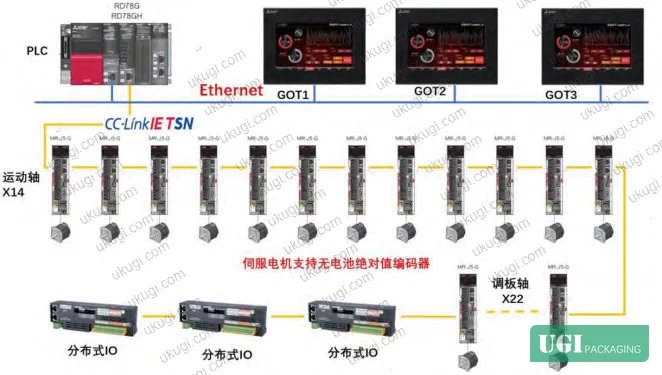
The servo-controlled architecture in the evaluated platform replaces those manual adjustments with 22 servo-motorized adjustment axes, all driven by independent motion controllers under a unified one-key adjustment routine. Changeover time drops to under 1 hour. The 14 primary power drive shafts are each independently servo-controlled, synchronized via PID motion controllers linked through an OPC UA protocol stack connecting supervisory HMI to field-level PLC.
This matters for buyers sourcing across multiple SKUs. If your bag program includes three or four size variants — say, a small gift bag, a medium boutique bag, and a large carry bag — and your supplier needs 6–8 hours per changeover, your effective capacity utilization is dramatically lower than the peak bag/min rate suggests.
The handle cutting mechanism specifically benefits from servo control. The conventional approach uses mechanically linked cutting synchronized to the main drive shaft, which wastes handle material at every start-stop cycle and at changeover. The servo cutter runs an independent position-controlled cut cycle, eliminating material waste at transitions and allowing handle pitch to be adjusted electronically rather than through physical tooling changes.
For buyers sourcing gift packaging solutions that require multiple bag formats in a single production run, the changeover specification is worth calling out explicitly in your RFQ.
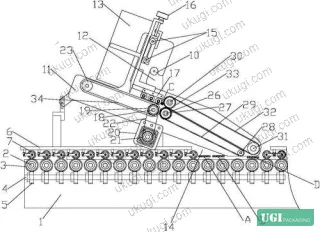
Roll-to-Sheet Integration: Why Paper Weight Range Defines Bag Structural Performance #
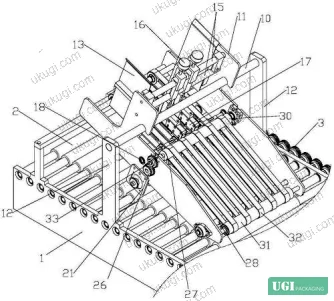
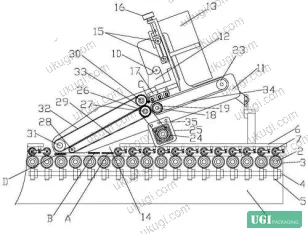
The integrated roll-to-sheet feed mechanism is the engineering core of the platform and directly determines which paper substrates can be processed. The mechanism handles roll stock from 190 g/m² to 350 g/m² — the upper end of the practical range for retail carrier bags. For context, legacy roll-fed machines handle 120–350 g/m², but they produce surface impressions and cannot form a folded upper closure. Single-sheet machines handle the same weight range but cap at 60 bags/min.
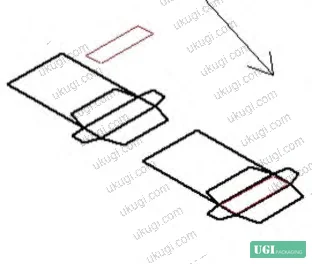
The sheet interleaving mechanism is the technically interesting part. After slitting from roll, individual sheets are fed onto a dual-speed conveyor: the rear belt section runs faster than the front section, causing each successive sheet to overtake and slide underneath the preceding sheet. The result is a continuous overlapping shingled stream that feeds the bag-forming stations at full production speed without the intermittent stops that limit single-sheet throughput. Vacuum suction fixtures hold the leading edge of each sheet in register during the overlap transition. The suction field geometry was optimized through fluid simulation and coupled rigid-flexible body analysis of the paper during interleave.
Most procurement teams don’t realize that the paper weight floor of 190 g/m² on the roll-to-sheet variant — versus 120 g/m² on pure roll machines — reflects a structural constraint in the sheet interleaving mechanism, not an arbitrary specification. Lighter stock below 190 g/m² does not have sufficient bending stiffness to maintain register during the rear-to-front shingling sequence. If your bag specification calls for a lighter-weight stock, confirm which feed mode the supplier’s machine will actually use.
For structural performance verification of the paper substrate itself, buyers should reference ISO 2758:2014 Paper — Determination of bursting strength when evaluating base stock suitability for heavy-load carrier applications.
Surface finish quality is where the roll-to-sheet platform shows its most visible advantage. The production trials confirmed zero mechanical impressions on bag surfaces — a direct result of the non-contact vacuum sheet handling and the flap-actuated bottom forming. This compares to documented crease marks, bonding gap errors, mechanical impressions, and scratches on both conventional domestic and international competing equipment.
Practical Guidance for Buyers #
When you’re comparing suppliers for square-bottom retail carrier bags, don’t rely on the surface spec sheet. Ask what generation of equipment they run, and specifically how they handle bottom card insertion and handle cutting. These two operations — not paper weight, not print resolution — are where the quality differences actually show up in production.
The 6–8 hour changeover standard still dominates the industry. If a supplier quotes you a short lead time across multiple bag sizes but runs legacy equipment, the math doesn’t work. Either they’re holding excess inventory, or your non-standard sizes are getting deprioritized.
In supplier qualification, we evaluated production data from multiple machine types and found that surface defect rates (impressions, clamp marks, edge burst at the bottom seam) were consistently present on scissor-clamp bottom machines regardless of paper grade. Switching to a higher paper weight doesn’t fix a process-induced defect.
For buyers evaluating print quality alongside structural performance, ISO 12647-2:2013 Graphic technology — Process control for offset lithographic printing provides the reference framework for verifying color consistency on the printed outer surface of carrier bags.
At ukugi.com, our production team in Guangzhou works with international brand buyers to specify square-bottom paper bags with the surface finish and dimensional consistency that premium retail demands — if you’re evaluating sources for your next program, we can supply samples against your spec. Need a custom formulation or sample? Request a quote from our team →
Technical Verification Questions #
- What is the maximum verified production speed of your bag-forming machine in bags/min, and was that figure measured on square-bottom bags with bottom card insertion active — not on simpler tubular or no-bottom formats?
- What is the paper weight range your feed system supports, and specifically does your roll-to-sheet interleaving mechanism maintain sheet register at the minimum specified weight (confirm the floor value in g/m²)?
- How is your bottom seam formed — scissor-clamp mechanism or flap-actuated fold — and can you provide production samples showing the base interior so we can inspect for clamp marks and edge burst?
- How many servo-controlled adjustment axes does your changeover system have, and what is the documented changeover time in minutes when switching between two different bag width specifications?
- What control architecture connects your supervisory system to field-level servo controllers — and can one-key format adjustment be performed from the HMI without manual mechanical intervention at any of the nine production stations?
Quality Verification Checklist #
- ☐ Production speed on square-bottom bags with bottom card confirmed at ≥100 bags/min under standard operating conditions
- ☐ Paper weight range declared and covers 190–350 g/m² minimum for roll-to-sheet feed mode
- ☐ Incoming sample bags show zero mechanical impressions, clamp marks, or edge burst at the bottom seam — inspect base interior
- ☐ Changeover time between bag specifications documented at under 1 hour via servo one-key adjustment
- ☐ Bottom card placement uses high-speed continuous feed (photoelectric-triggered) rather than intermittent feed — confirm by requesting a machine specification sheet or video
- ☐ Surface finish inspection per ISO 15397:2014 Printing inks — Determination of resistance to rubbing applied to printed outer surface of bag samples
- ☐ Control system includes dual-layer architecture (supervisory HMI + field PLC) with OPC UA data protocol, not single-layer PLC only
- ☐ Handle material cut quality verified on samples — no torn edges, consistent cut position, no handle material waste at cut points
Key Specifications Table #
| Parameter | Recommended Value | Verification Method |
|---|---|---|
| Maximum production speed | ≥100 bags/min (square-bottom with bottom card) | Production trial observation or supplier-documented test data |
| Paper weight compatibility (roll-to-sheet mode) | 190–350 g/m² | Supplier machine specification sheet; verify against ISO 187:1990 atmosphere conditioning for test paper samples |
| Changeover time between bag formats | Under 60 minutes | Time-documented changeover trial or supplier video evidence |
| Bottom seam defect criteria | Zero clamp marks, zero edge burst | Visual inspection of bag base interior; destructive sample cross-section |
| Surface impression defect rate | Zero mechanical impressions on bag outer surface | 100% visual inspection per production batch sample |
| Number of servo adjustment axes (changeover) | 22 axes minimum | Request machine engineering specification or servo controller count |
| Drive shafts under independent servo control | 14 primary power axes minimum | Machine electrical schematic review |
Looking for a manufacturer that meets these specs? Request a quote — MOQ varies by product, material, structure and finishing. Product-specific MOQ is confirmed with each quotation.
References #
Data source: Design and Performance Analysis of a Square-Bottom Eco-Friendly Carrier Bag Machine with Integrated Roll-to-Sheet Feed System, G.-A. Pan et al., Packaging Technology and Science, 2025
Frequently Asked Questions #
What is the practical difference between roll-fed and sheet-fed bag machines for a buyer?
Roll-fed machines run faster but historically produced surface impressions from the tension and roller contact on the paper web, and couldn’t form a folded upper closure or insert a bottom board. Sheet-fed machines avoided those surface defects but were limited to 60 bags/min. The integrated roll-to-sheet platform resolves the speed limitation of sheet-fed machines while retaining surface quality — getting to 100 bags/min without mechanical impressions.
Why does bottom card insertion method affect bag quality?
Intermittent bottom card feed creates timing windows where the card and bag are not synchronized, leading to misregistration, bottom panel gaps, and potential burst failures at the base seam. Continuous photoelectric-triggered card feed keeps the card-to-bag registration tight at full production speed. The downstream result is a cleaner base fold, no edge burst, and more consistent bottom panel adhesion.
What paper weight should I specify for a premium retail carrier bag?
For a structurally sound square-bottom bag capable of carrying typical retail loads, 190–350 g/m² is the practical range for roll-to-sheet production. Lighter stocks below 190 g/m² are possible on intermittent sheet-fed machines but compromise the interleaving register and can produce feed errors. For heavy-load applications — wine bottles, footwear, multi-item gift sets — 250 g/m² and above is the working standard. See also the guidance for custom paper boxes if your structural requirement exceeds what a bag can carry.
Does changeover time really matter if I’m placing large single-SKU orders?
For single-SKU, high-volume orders, changeover time is less critical. But most brand packaging programs involve at least two or three size variants, and changeover costs show up as either higher per-unit pricing (to absorb downtime) or longer total lead times. If your supplier quotes 6–8 hours per changeover and you have three sizes, that’s up to 24 hours of non-productive machine time in your order cycle — before the first bag of your smallest size is produced.
How do I verify surface finish quality before approving a production run?
Request pre-production samples and inspect the outer surface under raking light — mechanical impressions from roller contact are most visible at a low angle. Check the bag base interior for clamp marks from the bottom forming mechanism. Run a rub resistance test on the printed surface if ink adhesion is a concern. For printed bags, ISO 15397:2014 is the reference method for ink rub resistance quantification.
Published by ukugi.com Technical Team | Request a quote


