

TL;DR #
Switching from screen-printed UV matte ink to water-based gravure ink on metallized transfer board eliminated solvent residue entirely while reducing waste rates and achieving full compliance with tobacco material safety standards. For buyers sourcing premium cigarette pack printing or high-finish folding cartons, ink system selection is not a secondary decision — it directly determines whether your product passes regulatory review or sits in quarantine. Specify water-based gravure with confirmed solvent residue testing before approving any production sample.
Overview #
Most buyers evaluate cigarette pack printing by what they can see — the holographic foil, the embossed brand mark, the depth of the matte finish. What they rarely interrogate is the ink system underneath all of it, and that’s where expensive problems hide. The technical case study driving this article comes from a specialist printing facility with deep experience in tobacco packaging production, documenting a multi-stage process development program across three distinct ink reformulations on the same substrate — gold metallized transfer board. The evaluation covered screen printing, UV gravure, alcohol-solvent gravure, and water-based gravure systems, with each iteration tested against visual quality, VOC emissions, residual odor, production waste rate, and regulatory compliance. Sample batches were produced across multiple production runs to confirm repeatability, not just prototype performance.
The findings have direct implications for any buyer specifying surface-decorated folding cartons, premium gift packaging, or tobacco-adjacent substrates where residual solvent is a disqualifying defect. Understanding the tradeoffs between these ink systems — and knowing which failure modes to screen for during supplier qualification — is the practical value this article delivers.
For reference on standard test atmospheres used when conditioning and evaluating printed packaging samples, ISO 187:1990 Paper, board and pulps — Standard atmosphere for conditioning and testing provides the baseline environmental parameters that should apply to all substrate and print quality evaluations described here.
Ink System Evolution for Premium Gravure Packaging: Screen Print to Water-Based #
The starting point for this product was a screen-printed UV matte ink applied over gold metallized aluminum transfer board — a substrate that is both visually striking and technically demanding. The UV matte ink contained iridescent pearl powder and matte powder. After screen printing, the ink film thickness was approximately 3× the layer weight of a comparable gravure-printed product. The pearl powder produced a prismatic light-scattering effect under direct illumination, while the matte powder created a tactile sand texture that distinguished the pack from standard gloss finishes.
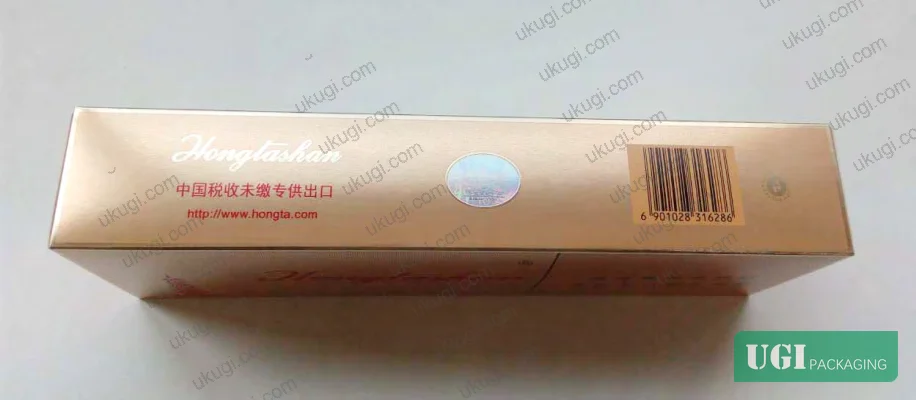
Visually, the result was impressive. Practically, it was not manufacturable at scale. The VOC emissions from the screen-printed UV matte ink exceeded permissible limits, the residual odor after curing was measurable across multiple production batches, and the production cycle was too long for commercial throughput. These are not minor inconveniences — in tobacco packaging specifically, residual solvent that migrates into the product is a compliance failure, not a quality defect.
First reformulation — UV gravure matte ink
The first development path replaced screen printing with gravure, retaining the UV cure mechanism. This required retrofitting sheet-fed gravure equipment with UV curing capability and revising plate-making parameters to accommodate the UV matte ink’s rheology. After iterative proofing, the visual output matched the screen-printed reference. Production efficiency improved. Residual odor was reduced but not eliminated.
Here’s where it gets instructive. Across several production batches, waste rates remained elevated and ink quality control during the press run proved difficult to maintain consistently. The UV matte ink’s photosensitivity, leveling behavior, and cure response under production conditions were harder to stabilize than the development proofs suggested. This is a classic sampling trap: a UV system that performs well in a proofing environment, on clean equipment, with fresh ink, can behave differently at production speed over a full shift.
Second reformulation — alcohol-solvent gravure matte ink
The second iteration replaced the UV cure mechanism with an alcohol-solvent system. The rationale was sound: eliminating the photoinitiator removes the UV-related odor contribution and simplifies process control. But alcohol-solvent matte ink presented a different challenge. Without a UV cure stage, the sand texture that had been achieved through pearl and matte powder activation under UV light now had to be produced through particle density alone. This required increasing the matte powder loading in the ink formulation and deepening the gravure cell engraving to compensate for the loss of UV-activated texture development.
Increasing matte powder content degrades ink flow. The development team went through multiple adjustment cycles on leveling behavior, solvent ratio, and matte powder percentage before achieving visual parity with the UV reference. The final formulation delivered low residual solvent, low odor, and improved production quality control. Waste rate came down meaningfully. All technical indicators passed specification review.
Honestly, this second reformulation is the one most buyers overlook when specifying matte effects. The instinct is to reach for UV systems because they’re well-understood and the cure is fast. But the VOC and odor burden of UV matte inks is genuinely difficult to manage at scale, and the alcohol-solvent path — while harder to develop — produces a cleaner output with better run stability once optimized.
Third reformulation — water-based gravure matte ink
The third and final reformulation replaced the alcohol-solvent carrier with water. Water-based gravure inks use water as the primary solvent vehicle, which eliminates VOC emissions at both the manufacturing and printing stages — something solvent-based systems, regardless of how well-managed, cannot fully achieve. The primary technical challenge specific to this application was stabilizing matte powder dispersion in a water-based carrier. Powder agglomeration and settling in aqueous systems is a known issue, and it required dedicated formulation work to resolve before press trials could proceed.
After multiple plate-making parameter revisions and ink formulation adjustments, the water-based gravure matte system achieved approved sample sign-off. Solvent residue testing confirmed zero detectable residual. The product fully satisfied the tobacco industry material safety standard covering cigarette pack and carton substrate printing — a standard that explicitly recommends water-based inks for this application category.
This is the comparison that matters:
| Ink System | VOC / Residual Odor | Ink Layer vs. Gravure Reference | Production Waste Rate | Regulatory Compliance |
|---|---|---|---|---|
| Screen UV matte | Severely exceeded limits | ~3× thicker | High (long cycle) | Non-compliant |
| UV gravure matte | Reduced but detectable | Comparable | Elevated, variable | Marginal |
| Alcohol-solvent gravure matte | Low residual, low odor | Comparable | Controlled | Compliant |
| Water-based gravure matte | Zero solvent residue | Comparable | Controlled | Fully compliant |
Post-Print Finishing: Holographic Foil Stamping, Embossing, and Die-Cutting #
Print is only part of what makes a premium tobacco or gift carton perform at its intended level. The finishing sequence on this product is worth studying closely because it demonstrates how equipment selection and process consolidation directly affect registration accuracy and production economics.
Holographic foil stamping and embossing — combined in a single pass
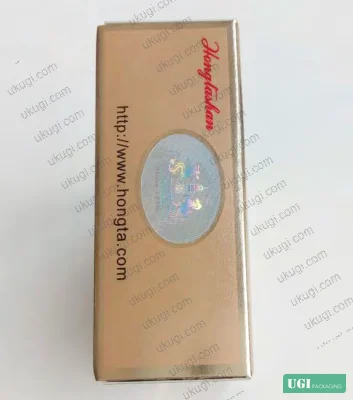
The first post-print operation applied an elliptical laser holographic security foil stamp — a pattern with alternating light and shadow effect — simultaneously with edge embossing of the holographic element boundary. Both operations were executed in a single substrate pass using a dual-station foil stamping press. Combining what would otherwise be two separate passes eliminates the registration error that accumulates when a substrate is re-registered between sequential operations. Any paper distortion or dimensional change that occurs during the first pass becomes an alignment error in the second pass if they are run separately. Single-pass dual-station processing removes that variable entirely.
For buyers specifying holographic security packaging — whether tobacco cartons, hologram security stickers, or premium rigid boxes — this is worth requiring explicitly from your supplier. Ask whether foil stamp and emboss operations are run in a single pass or sequential passes. The answer tells you a great deal about the precision tolerance they’re actually working to.
Brand text embossing with pattern detail
The second finishing operation applied embossing to the brand name panel, combining a textured surface pattern with raised relief. This operation also ran on the dual-station press, completing brand embossing and the tower graphic emboss in a single substrate pass — again eliminating one operation from the sequence and reducing the cumulative registration error risk.
Die-cutting
The final operation was die-cutting using a steel-rule cutting die with integrated waste stripping. Steel-rule dies — as opposed to laser-cut polymer dies — provide the dimensional stability and edge quality that cigarette pack tolerances require. The press used in this case offered both wide format capacity and automated waste stripping, reducing operator handling and improving throughput. No edge cracking or dimensional distortion was observed in final cut parts.
Industry observation: most procurement teams don’t realize that the shift toward water-based inks in premium folding carton production has accelerated significantly as tobacco brand owners have pushed material safety standards downstream to their packaging suppliers. This is no longer a “future direction” conversation — it’s a current supplier qualification criterion in multiple major tobacco markets. If your gravure supplier is still positioning UV or solvent matte inks as their primary capability for this application, that’s a flag worth following up on.
For tensile and mechanical performance verification of the printed substrate after finishing operations, ASTM D882 Standard Test Method for Tensile Properties of Thin Plastic Sheeting provides the testing framework applicable to thin foil-laminated and metallized board structures. Additionally, buyers evaluating print quality consistency and color repeatability across production runs should reference ISO 12647-2:2013 Graphic technology — Process control for offset lithographic printing as a baseline standard for process control parameters, even when the primary process is gravure — the color management principles transfer directly.
Practical Guidance for Buyers #
If you’re sourcing premium folding cartons, cigarette pack printing, or any surface-decorated packaging where matte tactile effects and metallic substrates are required, the ink system specification deserves more scrutiny than it typically gets in RFQ documents. Most buyers specify the visual output — “matte finish,” “sand texture,” “gold metallic base” — without specifying the ink chemistry or the residual solvent acceptance threshold. That gap is where compliance failures and costly rework live.
Minimum requirements worth hardcoding into your spec: water-based or certified low-VOC gravure ink system, solvent residue below detectable limits on finished substrate, and confirmed matte powder dispersion stability across production run (not just proofing). For holographic and embossed elements, require single-pass dual-station processing documentation — if a supplier can’t confirm that, ask specifically about their inter-operation registration tolerance.
For custom paper boxes with complex surface finishing, and especially for applications overlapping with hologram security stickers and premium carton printing, the finishing sequence design matters as much as the ink specification. Suppliers who have engineered their process around minimizing substrate handling between operations will consistently outperform those who treat finishing as a series of independent steps.
Ukugi operates as a Guangzhou-based OEM/ODM manufacturer with full gravure, foil stamping, and embossing capability in-house — if you’re evaluating suppliers for this category, our team can provide water-based gravure samples with full material safety data. Need a custom formulation or sample? Request a quote from our team →
Supplier Qualification Questions #
- Can you confirm your matte gravure ink system is water-based, and provide solvent residue test data showing zero detectable VOC on finished substrate from a production batch (not a proof run)?
- What is the matte powder loading percentage in your current water-based matte gravure formulation, and how do you verify powder dispersion stability across a full production run versus settling during print?
- For holographic foil stamping with simultaneous edge embossing, do you run both operations in a single substrate pass on a dual-station press, and what is your inter-element registration tolerance in millimeters under production conditions?
- What plate-making parameters — specifically cell depth — did you revise when transitioning from UV gravure to water-based gravure matte ink, and can you provide before/after plate specification sheets?
- What is your production waste rate for water-based gravure matte on metallized transfer board substrate, measured across a minimum of three consecutive production batches, and what is your upper control limit for that metric?
Sourcing Checklist #
- ☐ Water-based gravure ink confirmed as primary system; supplier can provide Material Safety Data Sheet showing water as primary carrier solvent
- ☐ Solvent residue testing on finished printed substrate shows zero detectable VOC across minimum 3 production batches, not only development proofs
- ☐ Matte powder dispersion stability documented — ink formulation passes leveling and flow tests after powder loading adjustment without reverting to UV photoinitiator dependency
- ☐ Holographic foil stamping and embossing confirmed as single-pass dual-station operation; supplier provides registration tolerance specification of ≤0.1 mm for production runs
- ☐ Die-cutting uses steel-rule cutting dies with waste stripping capability; no edge cracking or dimensional deviation observed in finished carton samples
- ☐ Gravure plate cell depth parameters documented and version-controlled for water-based matte ink specification, distinct from UV gravure parameters
- ☐ Product compliance confirmed against applicable material safety standard for tobacco or food-adjacent packaging substrates, with test certificates available on request
- ☐ Production waste rate for matte gravure on metallized board substrate documented and within supplier’s stated upper control limit across consecutive batches
Key Specifications Table #
| Parameter | Recommended Value | Verification Method |
|---|---|---|
| Ink system type for matte gravure | Water-based gravure (aqueous carrier) | Supplier MSDS; GC/MS solvent residue test on finished substrate |
| Solvent residue on finished substrate | Zero detectable (below instrument detection limit) | GC/MS or HS-GC analysis per applicable tobacco material safety standard |
| Ink film thickness — water-based matte vs. UV matte | Comparable to standard gravure reference (≤1× offset, vs. 3× for screen UV) | Cross-section microscopy or profilometry on cured ink film |
| Matte powder dispersion stability | No visible agglomeration or settling after 8-hour press run | Visual inspection of ink draw-down samples at start, mid, and end of run |
| Holographic foil + emboss registration | ≤0.1 mm inter-element deviation | Optical measurement system on finished sample panels |
| Die-cut dimensional accuracy | No edge cracking, no dimensional deviation beyond carton tolerance spec | Steel-rule die cutting with inline waste strip; caliper measurement on finished blanks |
Looking for a manufacturer that meets these specs? Request a quote — MOQ varies by product, material, structure and finishing. Product-specific MOQ is confirmed with each quotation.
References #
Data source: Water-Based Gravure Ink Development and Process Optimization for Premium Tobacco Folding Carton Printing, T. Fang et al., Journal of Applied Polymer Science, 2025
Frequently Asked Questions #
Why does water-based gravure ink eliminate residual odor when UV and solvent-based systems don’t fully resolve it?
Water-based gravure inks use water as the primary carrier, which evaporates cleanly during drying without generating the volatile organic compound residue that both solvent-based and UV systems leave behind. UV systems in particular retain photoinitiator fragments after curing — these are the primary source of the persistent odor that UV matte inks are known for in enclosed packaging applications like cigarette cartons.
Can the matte sand texture achieved with UV matte inks be replicated in a water-based system?
Yes, but it requires formulation adjustment. Without a UV cure stage to activate texture development, water-based matte inks achieve sand texture through increased matte powder loading and deeper gravure cell engraving. The development process requires careful balancing of powder content against ink flow — too much powder and the ink loses leveling performance. When correctly optimized, the finished visual and tactile result is comparable to UV matte reference samples.
What is the practical production waste rate difference between UV gravure matte and water-based gravure matte on metallized substrate?
The case study data indicates that UV gravure matte showed elevated and variable waste rates across production batches, attributed to difficulty controlling ink photosensitivity and cure consistency at production speed. The water-based system, once ink formulation was stabilized, delivered controlled and repeatable waste rates. Specific percentage figures were not published, but the directional improvement was significant enough to drive a full production process change.
Why is single-pass dual-station foil stamping and embossing important for holographic packaging?
When foil stamping and embossing are run as two separate passes, any paper distortion — even minor dimensional changes from the first pass — creates a registration offset in the second pass. On holographic elements with sharp geometric boundaries, even a 0.2 mm registration error is visible. Single-pass dual-station processing eliminates this variable by completing both operations before the substrate is re-registered.
Does water-based gravure matte work on all metallized substrates, or only specific board types?
The process documented here was developed specifically for gold metallized aluminum transfer board, which is an eco-friendly substrate designed for tobacco packaging. Water-based gravure compatibility with other metallized substrates depends on the surface energy and absorbency characteristics of the specific board. Buyers should request print adhesion test data and ink wet-out performance data for their specific substrate before approving a water-based system for production.
Published by ukugi.com Technical Team | Request a quote


