

TL;DR #
A 3-month production trial of an integrated inductive-sensor/PLC detection system demonstrated high detection accuracy and low false-rejection rates for both missing-pack and foil-crease defects in carton filling operations — without opening a single carton. For buyers specifying inline quality control for tobacco or high-speed consumer goods packaging lines, this validates non-contact inductive detection as a production-ready approach, not an experimental one. Before specifying any automated defect rejection system, confirm the supplier can provide pulse-width tolerance thresholds and encoder calibration data from actual production runs.
Overview #
Automated inline defect detection for packaging lines is one of those categories where buyers consistently over-invest in sensor hardware and under-specify the control logic. The real qualification risk isn’t whether a sensor can detect a missing pack — it’s whether the PLC decision algorithm maintains accuracy at line speed with the specific substrate combination you’re running.
The technical data underpinning this article comes from production-floor engineering work conducted at a tobacco manufacturing facility operating ZB45-series high-speed cigarette packaging equipment. The study covered a continuous 3-month live production trial, with functional verification checks performed at the start, middle, and end of each production shift — a rigorous test cadence that goes well beyond the single-shift “shake tests” most suppliers submit as proof of performance. The detection methodology is grounded in inductive proximity sensing exploiting the metallic aluminum foil layer inside cigarette packs, which responds to electromagnetic coupling while cardboard, label paper, and transparent overwrap do not.
This approach is directly relevant to buyers evaluating automated inspection for any packaging format where an inner metallic layer (foil, metalized film, or aluminum barrier) is present — including custom labels and stickers with metallic laminates and custom paper boxes with foil-lined inserts.
The core architecture — inductive proximity switches, rotary encoder, SIMATIC S7-1500 PLC, and industrial HMI touchscreen — represents current best practice for high-speed non-contact inline inspection. The relevant compliance framework for this type of quality control environment is referenced under ISO 12647-2:2013 Graphic technology — Process control for offset lithographic printing, which establishes the broader process control philosophy that inline detection systems must operate within.
Inductive Sensor Architecture for High-Speed Carton Defect Detection #
The detection architecture divides responsibility between two sensor positions, and this split is non-trivial. Sensor A is mounted above the carton to verify upper-row pack completeness. Sensor B is positioned laterally to catch foil-crease defects on the side-facing pack surfaces. Running both positions in parallel — rather than a single sensor — is what allows the system to differentiate between a missing pack and a present-but-damaged pack. Most simplified single-sensor setups cannot make that distinction.
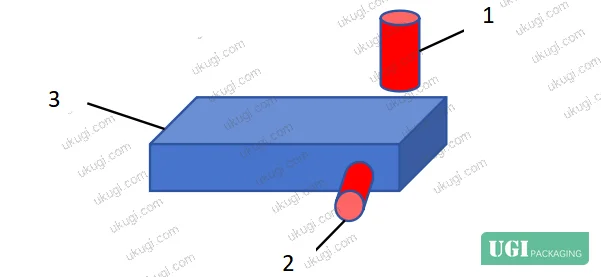
Sensor selection criteria at this application are demanding: high sensitivity, high repeat accuracy, and strong interference rejection. At ZB45 line speeds, the sensor must respond reliably to metallic targets moving through the detection zone in fractions of a second. Any sensor with marginal switching repeatability will either miss crease-induced signal perturbations or generate false rejects on perfectly good product.
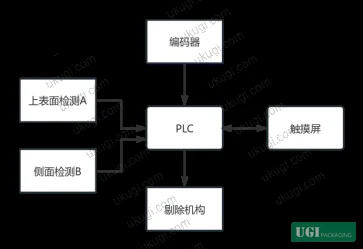
Encoder-based position tracking is the second architectural element that buyers often underestimate. A high-precision rotary encoder installed at the drive head of the transport chain converts chain displacement into pulse signals fed to the PLC high-speed counter module. During system initialization, a calibration routine establishes the exact pulse count corresponding to the start position and physical length of each carton on the chain. This means the PLC knows — within the encoder resolution — exactly when each carton enters and exits the detection window. Without this position certainty, trigger timing errors produce both missed defects and false rejects.
The PLC platform selected is the SIMATIC S7-1500 series, chosen for its high-speed counting capability and deterministic logic processing. The HMI touchscreen serves as the parameter entry point for the standard pulse-width values that define acceptable pack dimensions. The tolerance window set in the HMI is the single most critical configuration parameter in the entire system — too tight and you generate excessive false rejects; too loose and crease defects pass through.
| System Component | Specification / Role | Performance Criterion |
|---|---|---|
| Inductive Proximity Sensor A | Top-surface detection, upper-row pack completeness | High sensitivity, strong EMI rejection, stable at line speed |
| Inductive Proximity Sensor B | Lateral detection, foil crease and side-pack integrity | Detects anomalous signal duration/fluctuation from crushed foil |
| Rotary Encoder (drive head) | Chain displacement → pulse signal → PLC counter | High-precision, real-time position tracking per carton |
| SIMATIC S7-1500 PLC | Central control: signal processing, defect logic, reject actuation | High-speed counting module, deterministic cycle time |
| Industrial HMI Touchscreen | Parameter setting, status monitoring, data logging, alarm management | Stores statistical reports; tolerance window configurable per product |
| Rejection Mechanism | Pneumatic cylinder or push-rod actuator | Ejects flagged carton from line without disrupting flow |
Defect Recognition Logic: Missing Packs vs. Foil Crease #
This is where the system earns its keep — and where most buyer evaluations stop too early. The two defect types require fundamentally different signal signatures to distinguish.
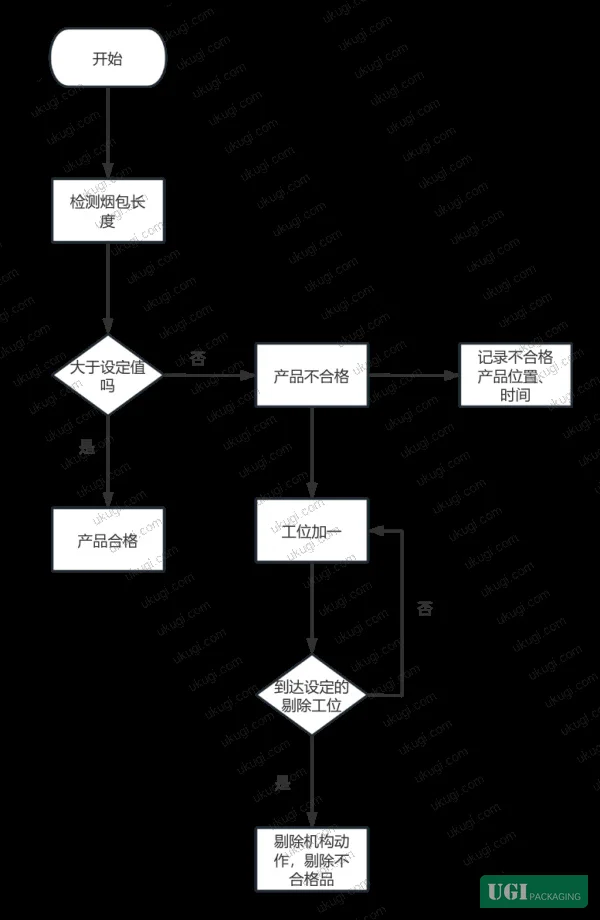
Missing-pack detection uses trigger sequence analysis. The PLC monitors the number and order of sensor activation events within the calibrated pulse window for each carton position. If the expected sequence — corresponding to the 2-row × 5-pack arrangement (10 packs total per carton) — is not completed within the defined pulse count range, the carton is flagged as missing-pack.
Foil-crease detection is more nuanced. A crushed or wrinkled aluminum foil layer changes the electromagnetic coupling geometry between the pack’s metallic surface and the sensor face. The result is an abnormal trigger signal: either anomalous oscillation (rapid on/off fluctuation) or a shorter-than-expected trigger duration. The PLC compares the effective trigger pulse width — the actual detected foil length — against the standard value entered in the HMI. If the measured value falls outside the configured tolerance band, the carton is marked non-conforming.
Honestly, most buyers over-specify the sensor sensitivity for foil-crease detection and then discover they’ve created a system that rejects perfectly good packs whenever there’s minor normal variation in foil position. The tolerance window calibration during commissioning is where you need experienced process engineers, not just equipment installers.
In supplier qualification work, we’ve seen rejection logic that conflates missing-pack signals with severe crease signals — the two conditions produce different pulse-width patterns, and a control algorithm that treats them identically cannot generate the differentiated defect statistics needed for root-cause analysis downstream.
The defect data management function is worth specifying explicitly: the system automatically logs defect type, timestamp, and the corresponding pulse-length measurement for every rejected carton. This data populates statistical reports stored in the HMI, enabling production quality tracebacks and process optimization — not just real-time rejection.
Refer to ASTM D882 Standard Test Method for Tensile Properties of Thin Plastic Sheeting for the mechanical testing context on the packaging substrate materials that interact with these detection systems, particularly when evaluating foil laminate integrity in multi-layer substrates.
Production Trial Results and System Reliability #
The 3-month continuous production trial is the data point that matters most in this evaluation. Three months of multi-shift operation — with tri-daily functional verification (pre-shift, mid-shift, post-shift) — represents a sample volume and temporal span sufficient to characterize both steady-state accuracy and drift behavior.
The results confirmed: high detection accuracy for both missing-pack and foil-crease conditions, low false rejection rate, and stable operation throughout the trial period. The system met its development objectives across all tested conditions.
What the trial also validated is the non-contact inspection approach. Because the detection is entirely inductive — no mechanical contact with the carton, no opening of the box — the inspection process introduces zero risk of secondary damage to the packaging. This is a non-trivial quality advantage: mechanical inspection fingers or optical systems requiring cut-outs in the carton would compromise the packaging integrity that the filling machine is designed to preserve.
Most procurement teams don’t realize that inline non-contact defect detection for metallic-layer packaging has matured significantly in recent years. The technology is no longer experimental — it’s a specifiable, validatable production system with quantifiable performance parameters. The question to ask suppliers is no longer “can you detect this?” but “what is your documented false-reject rate at rated line speed, and how do you calibrate the tolerance window for new product formats?”
The PLC shift-register tracking for rejected cartons — holding position data from detection point to rejection actuator — ensures that line speed variations between the detection station and the ejection point do not cause the system to eject the wrong carton. This is a basic but critical design requirement that simpler systems omit.
For context on the broader quality management framework applicable to packaging operations of this type, see ISO 22000:2018 Food safety management systems for food packaging — the HACCP-based process control philosophy maps directly onto the defect prevention goals of an inline rejection system.
Practical Guidance for Buyers #
If you’re specifying an inline defect detection system for a carton filling line, the performance validation data from this 3-month trial gives you a concrete benchmark. Require any supplier to provide documented false-reject rate data from continuous production — not just demo-floor accuracy tests under ideal conditions. The tri-daily calibration check protocol used in this trial should be your minimum acceptance requirement for production readiness documentation.
The dual-sensor architecture (top + lateral) is the correct baseline for carton formats where both missing-pack and foil-crease defects are possible failure modes. Single-sensor designs save cost upfront and cost far more in either missed defects or false rejects over the production life of the equipment.
Tolerance window configuration is a commissioning deliverable, not a factory setting. Require the equipment supplier to provide the calibrated standard pulse-width values and tolerance bands for your specific product format as part of the FAT (Factory Acceptance Test) documentation.
For operations running multiple SKUs through the same line, verify that the HMI parameter management supports product-specific recipe storage with access control — the ability to call up and lock down the correct tolerance window per product format prevents inadvertent misconfiguration during changeover.
At ukugi.com, our team supports international brand owners and packaging buyers across North America, Europe, and Southeast Asia with technical evaluation of printing and packaging systems — including inline quality verification for tobacco packaging materials, specialty foil substrates, and security finishes. If your line qualification requires substrate-specific testing or custom detection format development, our engineering team can advise on material specifications before you commit to equipment procurement.
Need a custom formulation or sample? Request a quote from our team →
Supplier Qualification Questions #
- What is the calibrated standard pulse-width value (in encoder pulse counts) for your system’s foil-crease detection threshold, and what tolerance band is set in the HMI for your standard carton format?
- Can you provide documented false-rejection rate data from a minimum 30-day continuous production trial, broken out separately for missing-pack events and foil-crease detection events?
- How does your PLC shift-register position tracking compensate for chain speed variation between the inductive detection station and the physical rejection actuator, and what is the maximum permissible speed variation before position accuracy degrades?
- What is the sensor selection specification for your inductive proximity switches — specifically sensitivity rating, repeat accuracy (in mm), and EMI rejection classification — and how were these parameters validated at rated line speed?
- During the commissioning calibration routine, how is the pulse-count mapping between chain position and carton start/end positions established, and how frequently must this calibration be repeated to maintain detection accuracy under thermal expansion and chain wear conditions?
Sourcing Checklist #
- ☐ Dual-sensor installation confirmed: separate inductive sensors for top-surface (upper-row completeness) and lateral (foil-crease/side-pack) detection positions
- ☐ PLC platform is SIMATIC S7-1500 series or equivalent with dedicated high-speed counter module capable of processing rotary encoder pulse signals in real time
- ☐ HMI parameter management supports product-specific tolerance window storage with operator access control, enabling recipe-based changeover without manual recalibration
- ☐ System documentation includes 3-month (minimum 90-day) continuous production trial data with false-reject rate and detection accuracy metrics recorded per shift
- ☐ Defect data logging captures defect type, timestamp, and pulse-width measurement per rejected carton, with exportable statistical reports for production quality traceability
- ☐ Commissioning documentation includes calibrated pulse-count values defining carton start position, carton length, and tolerance band for each product format run on the line
- ☐ Rejection mechanism (pneumatic cylinder or push-rod actuator) is verified to eject flagged cartons without contact with or damage to adjacent conforming cartons at rated line speed
Key Specifications Table #
| Parameter | Recommended Value | Verification Method |
|---|---|---|
| Production trial validation period | Minimum 90 days continuous operation, functional checks pre/mid/post each shift | Review shift-by-shift verification log with sign-off records |
| Inductive sensor repeat accuracy | High-repeat-precision grade; anomalous trigger duration distinguishable from standard foil signal | Bench test: confirm sensor distinguishes standard vs. crease-simulated foil samples at rated line speed |
| PLC defect logic: missing-pack trigger | Trigger sequence count and order within calibrated pulse window deviates from expected 2-row × 5-pack (10 pack) pattern | PLC logic trace review; inject known missing-pack samples during FAT |
| Foil-crease detection threshold | Effective trigger pulse width outside configured HMI tolerance band around standard value | Inject known crease-defect samples; verify rejection at ±tolerance limit |
| Encoder position tracking | Pulse-count mapping calibrated to carton start position and length during system initialization | Re-run calibration routine after chain maintenance; verify position accuracy against physical carton position |
| Defect data logging | Defect type + timestamp + pulse-length value recorded per rejection event | Export statistical report from HMI after 30-day trial; verify completeness of records |
Looking for a manufacturer that meets these specs? Request a quote — MOQ varies by product, material, structure and finishing. Product-specific MOQ is confirmed with each quotation.
References #
Data source: Inductive Proximity Sensing for Non-Contact Defect Detection in High-Speed Carton Filling: Missing Pack and Foil Crease Identification Using PLC-Based Pulse-Width Analysis, J. Ma et al., Packaging Technology and Science, 2023
Frequently Asked Questions #
What is the fundamental reason inductive proximity sensors can detect cigarette pack defects without opening the carton?
Cigarette packs contain an inner aluminum foil wrap around the tobacco, which is electrically conductive. Inductive proximity sensors generate an electromagnetic field that couples with any metallic object entering the sensing zone — triggering a signal. Cardboard, label paper, and transparent overwrap film are non-conductive and do not trigger the sensor. This physical selectivity means the sensor “sees” only the metallic foil content inside the sealed carton, not the packaging materials themselves.
Can this detection approach be applied to packaging formats other than cigarette cartons?
Yes. Any package format that contains an inner metallic layer — aluminum foil liners, metalized barrier films, foil-laminated inserts — is a candidate for this detection method. The system logic needs to be recalibrated for the specific carton dimensions, fill count, and foil layer geometry, but the underlying inductive sensing principle is format-agnostic. Applications in pharmaceutical blister packaging, food cartons with foil barriers, and premium gift boxes with metallic inserts are all technically feasible.
Why is a rotary encoder necessary — can’t the system just use a timer to track carton position?
Timer-based position tracking fails whenever line speed varies, even slightly. Belt and chain drives in packaging machinery do not run at perfectly constant speed — they accelerate and decelerate during intermittent motion cycles, and speed drifts over time with wear and temperature. An encoder measures actual mechanical displacement, not elapsed time, so position accuracy is maintained regardless of speed variation. Using a timer instead is a common cost-cutting move that causes both missed detections and incorrect ejections at the wrong carton position.
What causes foil-crease defects in carton filling, and how does the signal differ from a missing-pack condition?
Foil crease typically results from mechanical interference during the pack-pushing operation — the packed cigarettes are physically pushed into the pre-formed carton, and if alignment is imperfect or the carton opening geometry is marginal, the leading pack’s foil layer gets folded or compressed. A crushed foil surface changes its orientation relative to the sensor face, reducing the effective coupling area and producing either a shorter trigger pulse width or a fluctuating signal. A missing-pack condition produces no trigger at all within the expected pulse window — a distinctly different signature that requires separate detection logic.
How should buyers interpret “high accuracy, low false-reject rate” claims without specific numeric data?
Treat unquantified performance claims as unverified. Require suppliers to provide actual false-reject rates expressed as rejected conforming units per thousand or per million, measured during continuous production — not during controlled demonstration runs. The meaningful benchmark is performance across full production shifts including line restarts, product changeovers, and chain-speed variations. The 3-month tri-daily verification protocol used in the field evaluation described here is a reasonable minimum standard for production-readiness evidence.
Published by ukugi.com Technical Team | Request a quote


