

TL;DR #
Among five PPCD-based waterborne polyurethane ink formulations tested across a defined NCO:OH molar ratio range, the 4:1 ratio formulation (WPU-2) delivered the optimal balance of tensile strength (22.8 MPa), elongation at break (645%), and 100% adhesion fastness on corona-treated PET film. For buyers specifying eco-compliant screen printing inks for flexible plastic substrates, this data establishes a concrete performance benchmark that most VOC-free ink suppliers cannot yet match with published test evidence. Request adhesion fastness data on PET specifically — not just generic substrate claims — before shortlisting any waterborne ink supplier.
Overview #
Waterborne polyurethane inks have moved from “emerging alternative” to genuine competitive specification territory, and the industry data now backs that up. What’s been missing until recently is systematic, multi-variable qualification data — specifically how the hard segment ratio in CO₂-derived polyurethane binders affects real print performance on demanding substrates like PET film.
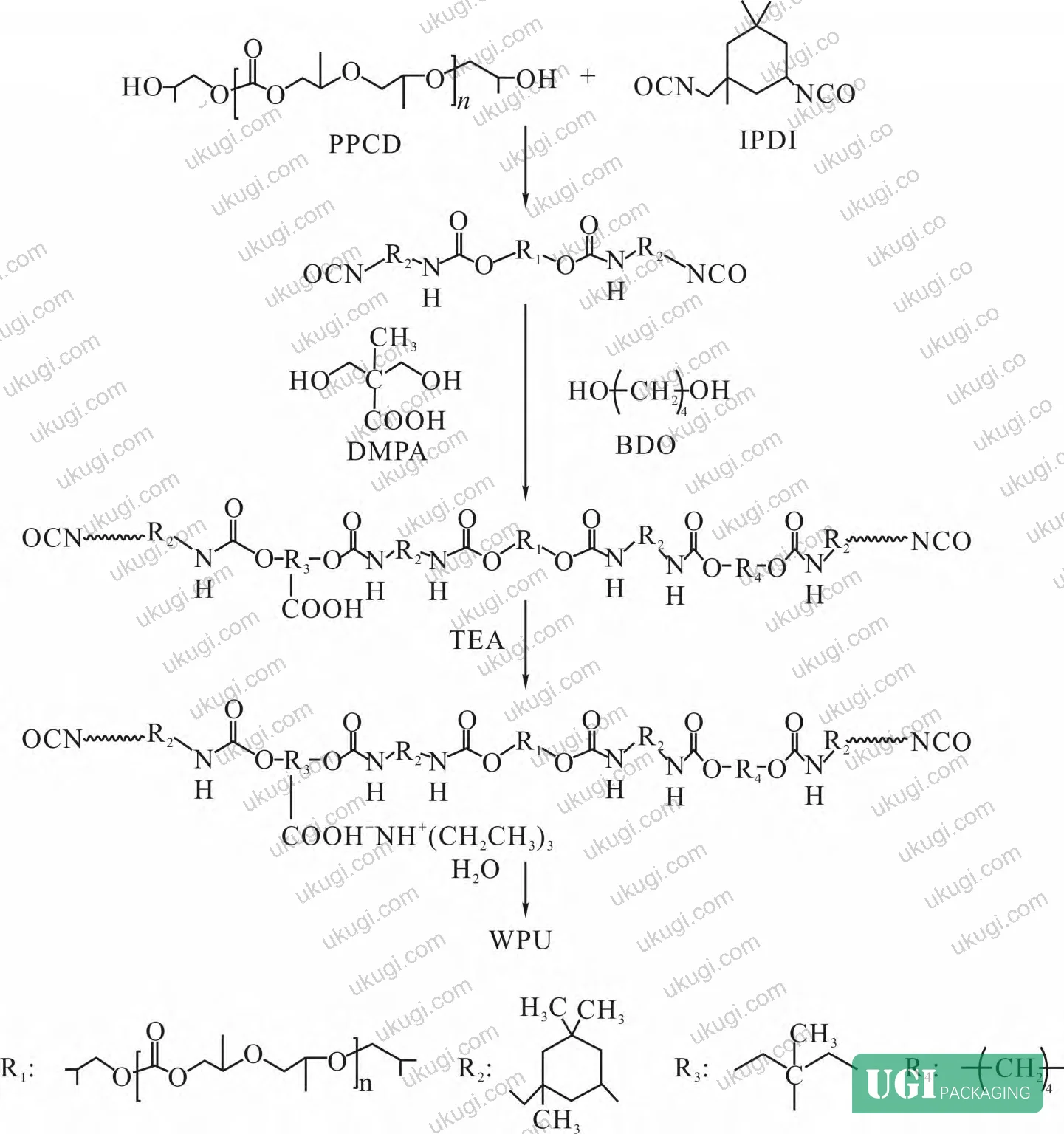
Recent laboratory work from a polymer chemistry research group — running a controlled five-formulation matrix with particle size, mechanical, adhesion, water resistance, and gloss measurements across each variable — provides exactly that. The study synthesized a series of waterborne polyurethane (WPU) emulsions using polypropylene carbonate diol (PPCD) derived from CO₂ feedstock as the soft segment, paired with isophorone diisocyanate (IPDI) as the hard segment, then formulated these into screen printing inks at varying pigment loadings. All adhesion testing followed GB/T 13217.7-2009, and film application was standardized at 75 μm ink layer thickness on corona-treated PET.
The significance for procurement: this is one of the few datasets that directly connects polymer synthesis variables to print-ready ink performance metrics — gloss units, adhesion fastness percentages, 24-hour water immersion resistance — on a substrate (PET film) that is widely used in custom labels and stickers and flexible packaging applications. The performance envelope it maps is directly applicable to buyers evaluating waterborne ink systems for decorative or functional printing on plastic films.
Waterborne Polyurethane Binder Performance: How NCO:OH Ratio Drives Print Quality #
The central variable in this system is the molar ratio of isocyanate groups (NCO) to hydroxyl groups in the PPCD soft segment (PPCD-OH). Five ratios were evaluated — 3:1 through 7:1 — and the performance tradeoffs are sharp enough to matter at the specification level.
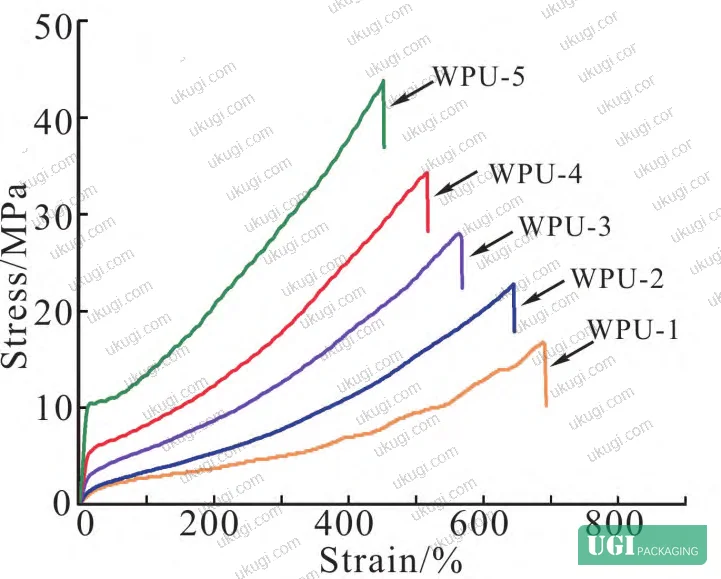
Mechanical performance shifts dramatically across the range. Tensile strength rises continuously from 16.8 MPa at 3:1 to 43.8 MPa at 7:1. Elongation at break moves in the opposite direction: 689% at 3:1 dropping to 452% at 7:1. For an ink vehicle that needs to flex with a PET substrate during handling, the upper end of that NCO ratio range is actually a liability — high tensile rigidity with insufficient elongation creates adhesion and cracking risk in real-world use.
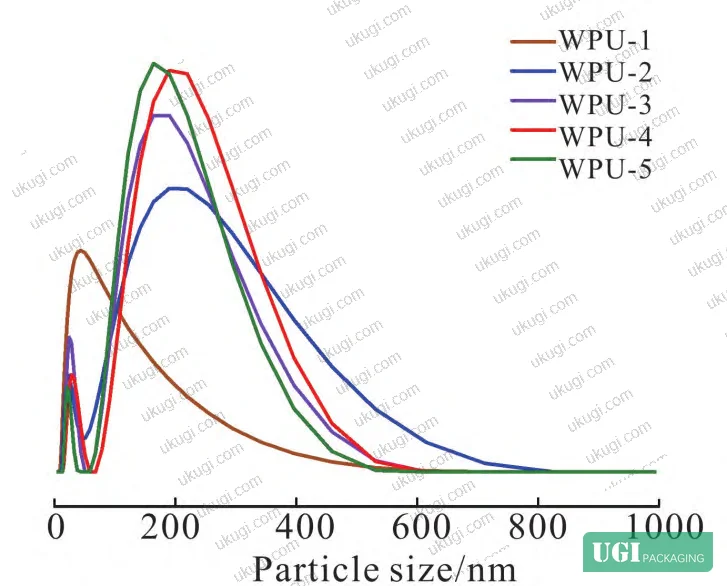
Emulsion particle size follows the same trend. WPU-1 (3:1) produced the finest emulsion at 46 nm average particle diameter, while WPU-5 (7:1) reached 124 nm. Finer emulsions are generally preferable for ink formulation — they disperse more uniformly and produce smoother printed films. Once you push past WPU-2’s 94 nm average, the emulsion transitions from translucent-blue to opalescent, which is a visible signal that the hard segment content is making the prepolymer harder to emulsify.
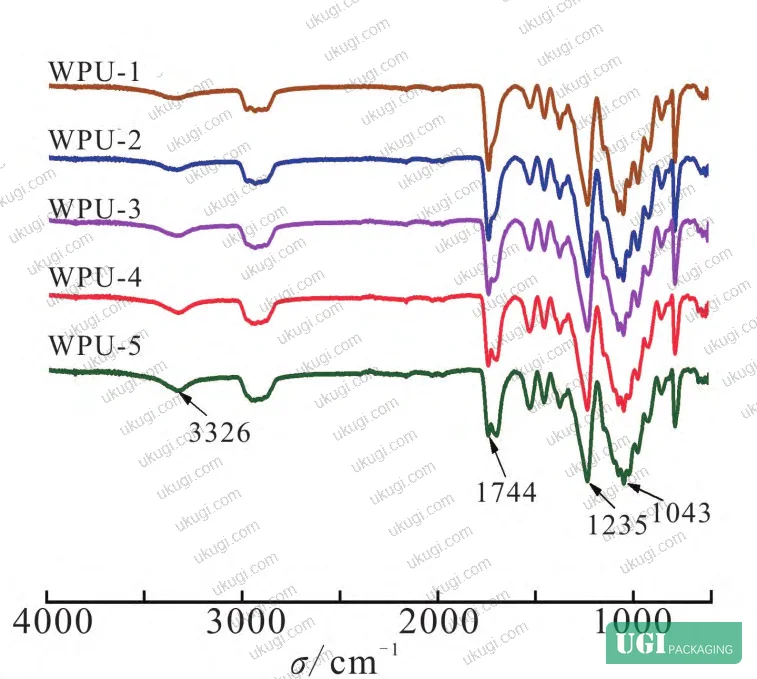
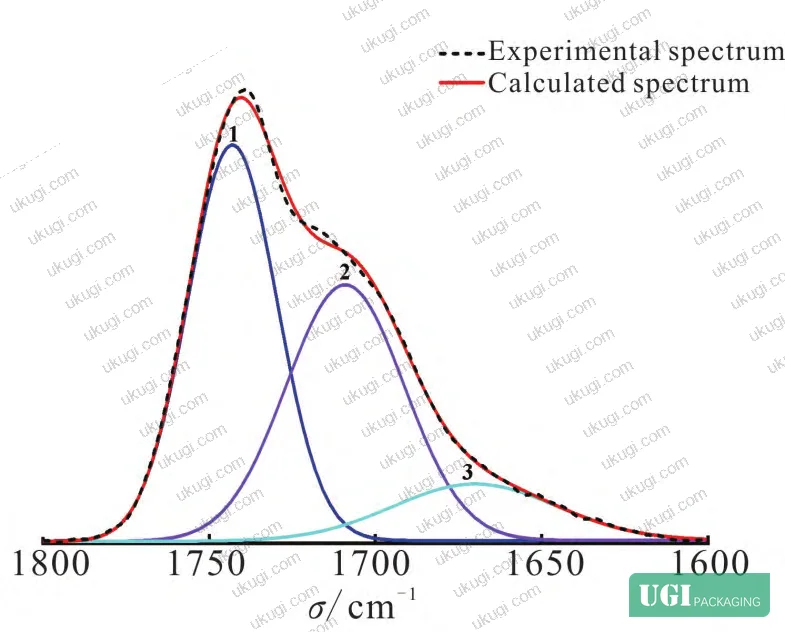
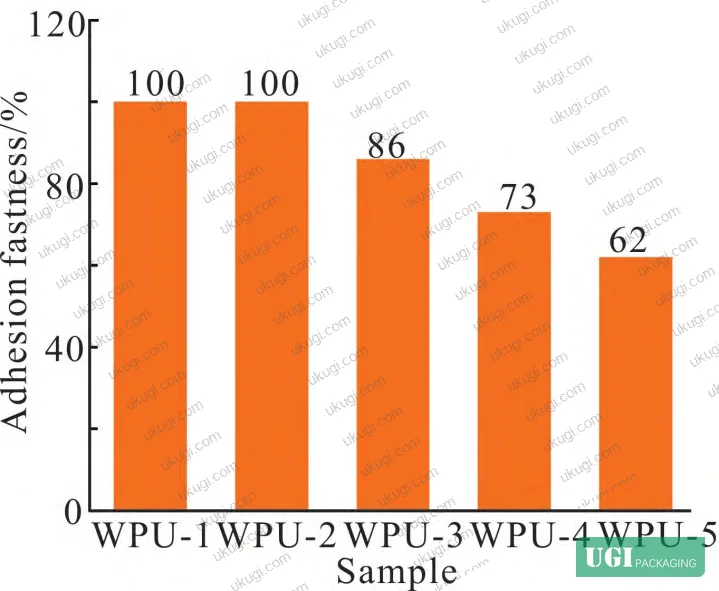
Adhesion fastness on PET tells the clearest story. WPU-1 and WPU-2 both achieved 100% adhesion (per the cross-cut tape test on 75 μm films). WPU-3 through WPU-5 showed declining fastness, dropping to 62% at the 7:1 ratio. The mechanism is counterintuitive to buyers who assume “harder = better adhesion”: excessive hard segment content increases inter-chain cohesive energy to the point where molecular chain mobility is restricted, reducing polar group contact with the PET surface. The adhesion drops not because the polymer is weaker, but because it’s too rigid to wet the substrate properly.
| Property | WPU-1 (3:1) | WPU-2 (4:1) | WPU-3 (5:1) | WPU-4 (6:1) | WPU-5 (7:1) |
|---|---|---|---|---|---|
| Tensile Strength (MPa) | 16.8 | 22.8 | 28.0 | 34.3 | 43.8 |
| Elongation at Break (%) | 689 | 645 | 565 | 516 | 452 |
| Particle Size (nm) | 46 | 94 | 97 | 114 | 124 |
| Adhesion Fastness on PET (%) | 100 | 100 | 100↓ to 62 | ↓ | 62 |
| 24h Water Absorption (%) | 56.7 | 27.6 | — | — | 3.7 |
| Water Contact Angle (°) | 63 | — | — | — | 87 |
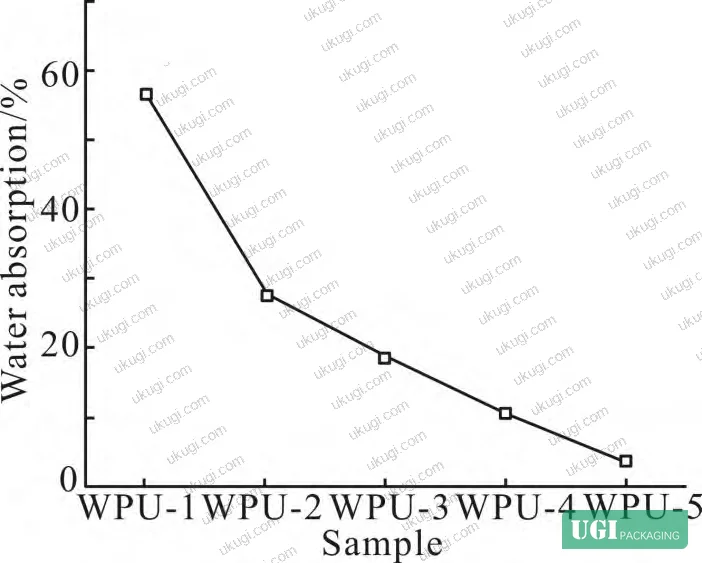
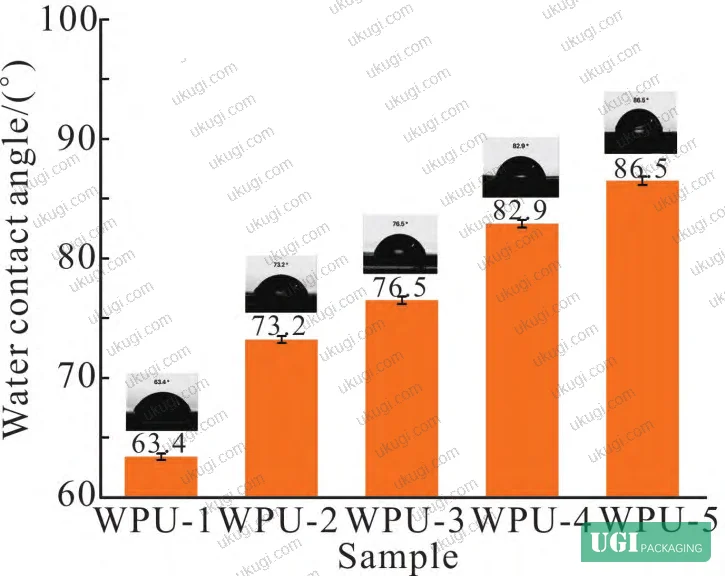
The water absorption data reinforces this. WPU-1’s 24-hour absorption of 56.7% is too high — that level of hydrophilicity will cause printed ink films to swell or soften on exposure to moisture, making it unsuitable for any end use involving humid environments or wet handling. WPU-5’s 3.7% absorption with an 87° water contact angle solves that problem, but the adhesion penalty makes it impractical. WPU-2’s 27.6% absorption at 100% adhesion fastness is the functional sweet spot: enough hydrophilicity for ink re-solubility (preventing screen clogging during printing), sufficient water resistance to prevent ink wash-off in service.
For context on test methodology: tensile testing was conducted per GB/T 1040.1-2018 at 100 mm/min crosshead speed on 20×4×0.5 mm dumbbell specimens, with three replicates per sample. This is the kind of test detail you should be asking any ink supplier to provide, not just a pass/fail adhesion claim. Refer to ASTM D882 Standard Test Method for Tensile Properties of Thin Plastic Sheeting if you need an equivalent reference standard for cross-checking supplier data against international benchmarks.
Ink Formulation Performance: Pigment Loading and Print Quality on PET Film #
With WPU-2 confirmed as the optimal binder vehicle, the second phase of this evaluation varied pigment loading across five ink formulations (Ink-1 through Ink-5), using aqueous pigment dispersion at increasing mass fractions.
All five inks achieved 100% adhesion fastness on corona-treated PET. All five remained insoluble after 24-hour immersion in deionized water. That’s a baseline performance floor that confirms WPU-2’s robustness as a vehicle regardless of pigment level — a useful data point when you’re specifying ink performance requirements for a supplier.
The differentiator is gloss. Ink-1 through Ink-3 show increasing 60° gloss as pigment content rises: 73 GU, 75 GU, 79 GU. The mechanism is interesting — aqueous pigment particles form fine channel networks within the dried film that help retain binder at the ink film surface, increasing specular reflectance. But push the pigment fraction higher (Ink-4, Ink-5) and the trend reverses: 70 GU dropping to 66 GU. Beyond a certain loading, excess pigment cannot be uniformly dispersed by the binder, and the surface becomes microscopically rougher, scattering light rather than reflecting it.
The print quality assessment confirms Ink-3 as the optimal formulation:
- Ink-1 and Ink-2: printed text/graphics appear pale and visually indistinct
- Ink-3: clear, vibrant, visually sharp output — best overall
- Ink-4 and Ink-5: print quality acceptable but gloss begins declining, and overly heavy pigment loading creates dispersion consistency risk in production
The optimal pigment mass fraction of 13.9% (Ink-3) is the number to carry forward into supplier specification discussions. This isn’t a range — it’s a formulation optimum supported by quantitative gloss, adhesion, and water resistance data across a five-point comparison.
For buyers specifying inks for applications like hologram security stickers or premium surface-printed labels, print gloss consistency matters as much as adhesion. A 13 GU swing between the optimal and worst-case ink formulations (79 GU vs. 66 GU) is plainly visible to the naked eye and will show up in brand color consistency evaluations.
Thermal Stability and Long-Term Performance Considerations #
Thermal stability is a secondary specification criterion for most screen ink buyers — but it becomes relevant when inks are oven-dried post-printing (which is standard for industrial PET film production lines), and when evaluating shelf stability in warm-climate storage.
Thermogravimetric analysis under nitrogen atmosphere at 10°C/min ramp from 30°C to 600°C shows that all five WPU formulations begin decomposing around 240°C and complete decomposition around 350°C. The 5% weight loss temperatures range from 255.7°C (WPU-1) to 265.0°C (WPU-4). The 50% weight loss temperatures cluster tightly between 302.6°C and 311.8°C. There is no operationally meaningful difference in thermal stability across the NCO:OH ratio range tested.
This is actually good news for procurement: it means you can specify WPU-2 for its mechanical and adhesion advantages without trading away heat resistance. The oven-drying step in this evaluation was 100°C for 4 hours — well within the stable range for all formulations.
The decomposition mechanism follows a two-stage pattern typical of phase-separated polyurethanes: hard segment decomposition near 250°C, soft segment decomposition near 350°C. The initial 3% mass loss observed below the main decomposition onset is attributed to residual propylene carbonate (a PPCD synthesis by-product), not to the polyurethane structure itself.
Practical Guidance for Buyers #
Most procurement teams evaluating waterborne screen printing inks focus on adhesion pass/fail and VOC content. Both matter, but they don’t capture the full performance picture — and the performance window for these inks is narrower than suppliers typically acknowledge.
The data here shows clearly that the binder formulation ratio is the critical variable. A supplier producing a PPCD-type waterborne ink at an NCO:OH ratio above 5:1 is likely sacrificing adhesion on PET substrates to gain water resistance. A ratio below 4:1 produces excellent adhesion but unacceptable water absorption — fine for controlled indoor environments, a problem for any packaging application with moisture exposure. Ask specifically about the NCO:OH ratio and get the adhesion data on PET, not just on paper or generic plastic.
Industry observation: most procurement teams don’t realize that the transition from solvent-based to waterborne polyurethane inks has accelerated substantially in recent years, driven by VOC emission regulations tightening across the EU and China. The result is a market flooded with waterborne ink claims from suppliers who are reformulating existing resin systems rather than engineering binders from the ground up. CO₂-derived PPCD-based systems represent a materially different chemistry — and the performance data, when properly collected, is distinguishable from conventional waterester or PTMG-based alternatives.
For gloss-critical applications — surface printing on gift cartons, premium label stock, specialty rigid box surfaces — specify a minimum 60° gloss of 75 GU on the submitted ink sample. That threshold sits within the verified performance range of optimally formulated PPCD inks (79 GU at Ink-3) and filters out underperforming formulations.
Honestly, most buyers over-specify water resistance while under-specifying re-solubility. An ink that is completely water-insoluble after drying sounds like a quality attribute — but if the dried ink on the screen cannot be re-dissolved by the ink vehicle during a print run restart, you get blocked mesh and scrap. The 27.6% water absorption of WPU-2 is a feature, not a deficiency. Verify re-solubility explicitly in your ink acceptance protocol.
Ukugi operates as a Guangzhou-based OEM/ODM manufacturer with full surface finishing capabilities across label, folding carton, and specialty packaging formats — including screen printing on PET and other plastic substrates. If you’re specifying ink performance criteria for a new product line or need sample prints for qualification, the team can support that conversation directly.
For print process standards context applicable to ink color consistency verification, see ISO 12647-2:2013 Graphic technology — Process control for offset lithographic printing as a reference framework for process control methodology, even where offset is not the primary process.
Need a custom formulation or sample? Request a quote from our team →
Supplier Qualification Questions #
- What is the molar ratio of NCO to PPCD-OH used in your waterborne polyurethane binder, and can you provide the corresponding adhesion fastness data on corona-treated PET film at 75 μm ink layer thickness?
- What is the measured 24-hour water absorption rate of your WPU binder film at your standard formulation ratio, and how do you balance water resistance against re-solubility for screen printing applications?
- Can you provide 60° gloss unit measurements (in GU) for your ink at the stated pigment loading, along with the pigment mass fraction used in the tested formulation?
- What is the emulsion particle size (in nm) of your WPU emulsion, and what test method and equipment are used for measurement — specifically, does your specification require the particle size distribution to remain below 100 nm for ink-grade emulsions?
- At what temperature does your WPU ink film reach 5% thermal weight loss (T5 value), and can you provide TGA data under nitrogen atmosphere at 10°C/min ramp rate to confirm thermal stability above 250°C?
Sourcing Checklist #
- ☐ WPU binder NCO:OH molar ratio confirmed at 4:1 (±0.2), with documentation from synthesis batch records
- ☐ Adhesion fastness on corona-treated PET film ≥100% per cross-cut tape test (equivalent to GB/T 13217.7-2009), measured at 75 μm ink layer thickness
- ☐ 24-hour water immersion test at room temperature confirms ink film remains insoluble in deionized water
- ☐ 60° gloss measurement ≥75 GU on dried ink film at optimal pigment loading (approximately 13–14% by mass fraction)
- ☐ Emulsion particle size ≤100 nm average diameter, confirmed by laser diffraction particle size analysis (3-replicate average)
- ☐ Thermal stability confirmed with T5 (5% weight loss temperature) ≥255°C under nitrogen atmosphere, per TGA at 10°C/min
- ☐ Tensile strength of binder film ≥22 MPa with elongation at break ≥600%, per uniaxial tensile test at 100 mm/min
Key Specifications Table #
| Parameter | Recommended Value | Verification Method |
|---|---|---|
| NCO:PPCD-OH Molar Ratio | 4:1 | Supplier batch synthesis record; confirm via FTIR (absence of residual NCO peak at ~2270 cm⁻¹) |
| Adhesion Fastness on PET | 100% | Cross-cut tape test per GB/T 13217.7-2009; 75 μm ink film on corona-treated PET, 100°C/4h cure |
| Tensile Strength (binder film) | ≥22.8 MPa | Uniaxial tensile test per GB/T 1040.1-2018; dumbbell specimen 20×4×0.5 mm, 100 mm/min |
| Elongation at Break | ≥645% | Same test as tensile strength; 3-replicate average |
| 24h Water Absorption | ≤27.6% | 1 cm × 1 cm film specimen, deionized water immersion, 100°C pre-dry/4h, weigh before and after |
| Ink Film Gloss (60°) | ≥75 GU | Multi-angle gloss meter, 60° incident angle, 3-position average on dried ink layer |
| WPU Emulsion Particle Size | ≤100 nm | Laser dynamic light scattering (DLS); 0.3% solids concentration in deionized water; 3-replicate average |
| Thermal Stability (T5) | ≥255°C | TGA under N₂ atmosphere, 10°C/min ramp 30–600°C |
Looking for a manufacturer that meets these specs? Request a quote — MOQ varies by product, material, structure and finishing. Product-specific MOQ is confirmed with each quotation.
References #
Data source: Synthesis and Performance Evaluation of Polypropylene Carbonate-Based Waterborne Polyurethane Inks for Screen Printing Applications, P.-K. Li et al., Journal of Applied Polymer Science, 2025
Frequently Asked Questions #
What makes PPCD-based waterborne polyurethane inks different from conventional waterborne PU inks?
The key difference is the soft segment chemistry. Conventional waterborne PU inks typically use petroleum-derived polyols such as polytetramethylene ether glycol (PTMG) or polyadipate esters. PPCD-based systems use a CO₂-derived polypropylene carbonate diol, which introduces carbonate groups with inherently higher cohesive energy. The practical consequence is that even at moderate hard segment contents (NCO:OH = 4:1), you get 100% adhesion on PET and a 24-hour water absorption under 28% — performance metrics that require significantly higher hard segment ratios in PTMG-based systems, which in turn compromise elongation and film flexibility.
Why does adhesion fastness drop sharply above the 4:1 NCO:OH ratio if tensile strength is still increasing?
This is one of the more counterintuitive results in the dataset. The mechanism is over-cohesion: as NCO content increases beyond 4:1, the density of urethane linkages and hydrogen bonding within the polymer rises sharply. Intermolecular cohesive energy increases to the point where polymer chain mobility is restricted. This prevents the polar functional groups from making adequate contact with the PET substrate surface, weakening the adhesive bond. At NCO:OH = 7:1, adhesion fastness dropped to 62% despite the binder film having a tensile strength of 43.8 MPa — nearly twice the value at 4:1.
What does 79 GU at 60° actually mean in practical print quality terms?
A 60° gloss reading of 79 GU places the ink film squarely in the semi-gloss to gloss range for printed films. For comparison, matte finishes typically measure below 20 GU at 60°, satin surfaces fall between 20–60 GU, and gloss surfaces are generally considered to begin around 70 GU. At 79 GU, the Ink-3 formulation produces visually vibrant, color-saturated prints with a surface reflectance that reads as commercially finished. The 13 GU drop to 66 GU seen at higher pigment loading is visible to the naked eye and would be flagged in a standard brand color review.
Can this ink system be used on substrates other than PET?
The published evaluation data covers corona-treated PET film specifically. The adhesion fastness results (100% for WPU-1 and WPU-2) are substrate-specific — the same formulation may perform differently on untreated polyolefins, BOPP, or paper. For any other substrate, fresh adhesion qualification testing is required. That said, the carbonate-group chemistry in PPCD-based PU binders has shown favorable adhesion profiles on a range of plastic films in related evaluations. See ISO 15397:2014 Printing inks — Determination of resistance to rubbing for a relevant ink film durability test method applicable across substrate types.
How do I evaluate whether a supplier’s waterborne ink has adequate re-solubility for screen printing production?
Re-solubility is the ability of dried ink residue on the screen mesh to re-dissolve when wetted with the ink vehicle — a critical property that prevents mesh blockage during production downtime. The evaluation described here used a 24-hour deionized water immersion test as a proxy for water resistance, confirming that all five ink formulations remained insoluble at 75 μm film thickness. Re-solubility, however, requires a separate test: apply a thin ink film, cure at 100°C for a shorter duration (simulating partial drying on the screen), then attempt re-dissolution with the original ink vehicle. Ask your supplier for this specific test result — the 27.6% water absorption of the WPU-2 binder at 4:1 ratio indicates sufficient residual hydrophilicity for re-solubility in this system, but production conditions will vary.
Published by ukugi.com Technical Team | Request a quote


