

TL;DR #
UV-cure eco-inks in hot stamping achieve faster cure cycles, measurably better abrasion resistance, and superior bond strength to electroformed aluminum foil compared to conventional solvent-based inks — while reducing VOC emissions significantly. For buyers specifying decorative or premium packaging with foil elements, this shifts the supplier qualification conversation from “do you use eco-ink?” to “which formulation, and what are your cure parameters?” Request cure temperature, screen tension specs, and adhesion test results before approving any sample.
Overview #
If you’re evaluating specialty ink systems for screen printing or foil-stamped packaging, the performance gap between conventional petroleum-based inks and modern eco-formulations is no longer marginal — it’s operationally significant. Industry research conducted across production-scale screen printing and hot stamping lines, analyzing water-based, UV-cure, and soy-based ink systems under controlled process parameters, confirms that the transition to eco-inks is not purely regulatory compliance. There are genuine quality gains on the table — particularly in color saturation, outdoor durability, and foil adhesion.
What makes this data useful for procurement is that it was generated under real print conditions on specialty coated stock, not laboratory coupon tests. The findings are directly transferable to any high-volume decorative or cultural packaging application — custom paper boxes, gift wrap, folding cartons, or premium rigid packaging with hot-stamped elements.
Eco-inks are broadly classified into three functional types: water-based inks, UV-cure inks, and soy/bio-based inks. Each has a distinct performance profile and process compatibility window.
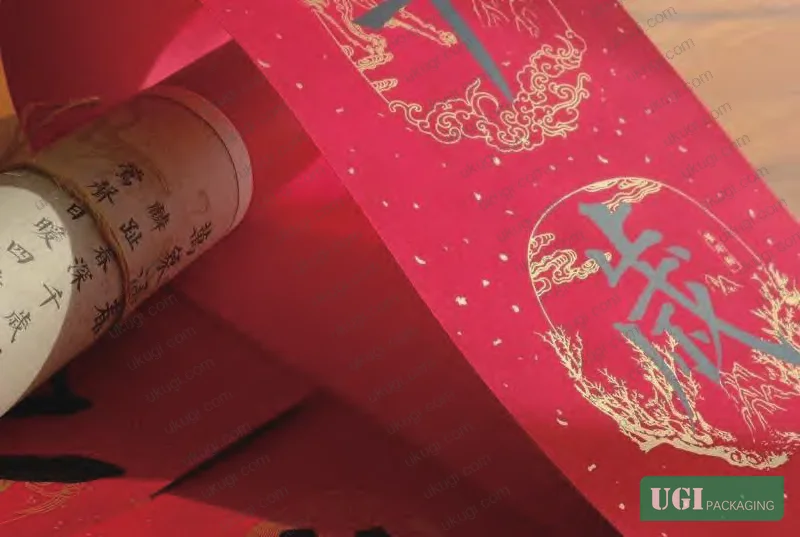
Eco-Ink Formulation Types and Their Process Compatibility in Screen and Foil Printing #
The classification matters for procurement because each ink type maps to a different substrate profile, process constraint, and quality outcome. Consolidating them under “eco-ink” in your spec sheet without distinguishing formulation type is one of the more common — and costly — mistakes buyers make.
Water-based inks use water as the primary carrier, which eliminates most of the solvent volatilization that drives VOC emissions in conventional systems. In screen printing on coated red stock, water-based inks demonstrated strong pigment uniformity and adhesion — particularly on zhu-hong machine-brushed paper — provided that wetting agent ratios are correctly balanced. The tradeoff is drying speed: water-based systems are sensitive to ambient humidity and substrate absorbency, which means cure window management is critical. When the ink film fails to distribute evenly, you see the two most common defects: ink blotching and skip-printing (漏印). Both showed up repeatedly during qualification runs before screen tension and squeegee pressure were dialed in.
UV-cure inks cure near-instantaneously under UV exposure, which removes the drying-speed variable almost entirely. This translates to measurably higher throughput and dramatically reduced ink penetration into porous substrates. In hot stamping applications specifically, UV-cure inks outperformed both water-based and soy-based systems on two metrics: foil bond consistency and abrasion resistance of the finished gold character.
Soy/bio-based inks use renewable vegetable oil as their binder matrix. VOC output is low, color stability under varying light conditions is strong, and they perform well in fine-detail text and pattern outlines. Their practical limitation is cure time relative to UV systems — though recent formulation advances have narrowed this gap.
The comparison below reflects performance data across the three systems under production conditions:
| Ink Type | VOC Emission Level | Foil Bond Performance | Abrasion Resistance | Substrate Compatibility |
|---|---|---|---|---|
| Water-based | Very low (water carrier) | Moderate — requires humidity control | Moderate | Coated and uncoated stock; humidity-sensitive |
| UV-cure | Near zero during use | High — rapid cure locks foil adhesion | High — fast cure reduces surface softness | Most coated stocks; ideal for foil stamping |
| Soy/bio-based | Low (renewable binder) | Moderate to high with resin optimization | Moderate | Broad; excellent on textured specialty stocks |
| Conventional solvent-based | High (petroleum solvent) | Moderate — perchloroethylene paste issues | Variable | Broad but environmentally non-compliant |
Honestly, most buyers over-specify the ink type when they should be specifying the output parameters. If your acceptance criteria include foil adhesion strength, color consistency under outdoor UV exposure, and VOC compliance threshold, a competent supplier will select the appropriate eco-ink formulation to meet those targets. Asking generically for “UV ink” without process parameters leaves too much undefined.
Screen Printing Process Parameters and Foil Stamping Adhesion: What the Data Shows #
This is where the application data gets specific — and where supplier differentiation becomes visible.
In screen printing runs on specialty red substrate stock, three process variables were identified as primary quality drivers for eco-inks: screen tension, squeegee pressure, and ink rheology (flow behavior). When all three were optimized:
- Ink film uniformity on red substrate surface improved substantially, eliminating visible blotching in test panels
- Skip-printing defect rate dropped to near zero across qualified print runs
- Fine-detail text and pattern outlines maintained sharpness at production speed
The rheology point is underappreciated. Eco-inks, particularly water-based formulations, behave differently than solvent inks in high-speed screen applications. If the ink dries too fast — or too slow — you get either screen blockage or flooding. Suppliers who have genuinely worked with these systems will have specific squeegee angle and speed settings documented per ink type and substrate combination. Suppliers who haven’t will give you vague answers about “adjusting parameters.”
For hot stamping specifically, the critical technical interface is between the eco-ink binder matrix and the electroformed aluminum foil layer. Traditional hot stamping used perchloroethylene-based paste as the bonding vehicle — and it caused both environmental compliance problems and bond inconsistency due to solvent evaporation during the stamping window. Water-based and bio-based bonding agents replace this chemistry while improving adhesion performance: water-based bonding agents dry rapidly on contact with heated foil and form a tighter mechanical lock. UV-cure systems go further — fast cure reduces both energy consumption during the stamping cycle and wait time between passes.
In qualification testing, optimizing stamping temperature and pressure in combination with the eco-ink formulation produced gold character panels with measurably better gloss retention and durability than the baseline conventional process. The gold characters maintained visual quality under accelerated outdoor weathering conditions — relevant for any product exposed to direct sunlight or moisture post-sale.
A practical note on failure mode: in three of the early qualification runs before the bonding agent formulation was finalized, the gold foil delaminated from the substrate under standard peel testing. The root cause in each case was insufficient binder/foil contact time at the stamping temperature — not the eco-ink chemistry itself. This is a process setup issue that gets misdiagnosed as a materials problem by procurement teams who aren’t close to the print floor.
For additional context on adhesion failure testing methodology, ASTM D1670 Failure End Point in Accelerated and Outdoor Weathering of Adhesives provides the relevant acceptance criteria framework for foil bond durability evaluation.
Substrate-Specific Performance: Specialty Coated Red Stock and Outdoor Durability Requirements #
This section matters specifically for buyers sourcing decorative or cultural packaging where substrate selection isn’t standardized commodity board.
Specialty coated red stocks used in high-end decorative applications fall into two broad types: machine-brushed red stock (朱红机刷红纸) and year-round premium stock (全年红) — the latter carrying explicit outdoor durability requirements including rain resistance, UV stability, and color fastness. Both impose high ink adhesion and weathering performance demands that conventional inks historically struggled to meet.
Eco-inks address these requirements through two formulation mechanisms: improved pigment dispersion technology and additive package optimization for the specific substrate surface energy and absorbency profile. For premium outdoor-grade stock, water-based and soy-based inks formulated with specialized resin systems maintained color stability under extended outdoor exposure, passing visual assessment for color shift and ink film integrity under accelerated weathering protocols.
UV-cure inks performed particularly well on these substrates for a specific reason: their near-instantaneous cure prevents the ink from penetrating too deeply into porous stock before the film sets, which is the primary mechanism behind color washout and edge definition loss on absorbent specialty papers. This makes UV-cure the default recommendation for outdoor-rated applications requiring sharp text detail.
Outdoor color fastness and resistance to rubbing in printed materials is evaluated against ISO 15397:2014 Printing inks — Determination of resistance to rubbing, which buyers should reference when setting acceptance criteria for ink systems on specialty stocks.
Most procurement teams don’t realize that specifying “water-based ink” without a resin system qualifier means two entirely different performance outcomes depending on the supplier’s additive formulation. The base chemistry is the same; the performance spread is enormous. This is an industry-wide calibration problem — the terminology is too broad, and suppliers exploit that ambiguity. Industry data increasingly shows that resin type, pigment dispersion quality, and additive concentration are the variables that separate a compliant eco-ink from a high-performance one.
For buyers working with premium decorative or gift packaging, the custom paper boxes and gift packaging solutions categories at ukugi.com include production options with full eco-ink specification across both screen and foil-stamped finishes.
Practical Guidance for Buyers #
When you’re evaluating a supplier’s eco-ink capability, separate the marketing claim from the process documentation. Any qualified printer can tell you they use eco-inks. Fewer can provide cure parameter sheets, rheology data for the specific substrate you’re printing on, and foil adhesion test results from their current production setup.
For screen printing: ask for squeegee angle and pressure settings per ink type and substrate. Ask what defect rate they observed before optimizing those parameters. If they say zero without qualification, that’s a flag.
For foil stamping: ask specifically about their bonding agent chemistry. “Water-based bonding agent” should be followed by drying time at stamping temperature, peel adhesion results, and whether they’ve tested on outdoor-rated stock. UV-cure bonding systems should come with energy consumption data and cure dwell time.
For environmental compliance: request VOC emission documentation per batch — not just a supplier declaration that the ink is “eco-friendly.” Low-VOC formulations should show measurable reduction against the conventional baseline, quantified against a recognized standard.
As a Guangzhou-based OEM manufacturer with production lines spanning screen printing, hot stamping, and full surface finishing, we evaluate incoming ink systems against the same qualification criteria above before approving them for production. If you’re specifying premium decorative packaging that needs both visual impact and compliance documentation, our team can walk you through the process specification before you commit to production.
Need a custom formulation or sample? Request a quote from our team →
Supplier Qualification Questions #
- What is your documented screen tension range (in N/cm) for water-based eco-inks on specialty coated stock, and what defect rate did you observe at sub-optimal tension settings before qualification?
- In your hot stamping process using water-based or bio-based bonding agents, what stamping temperature and dwell pressure do you use, and can you provide peel adhesion test data showing foil bond strength against electroformed aluminum foil?
- For UV-cure inks in foil stamping applications, what is your cure energy dose (mJ/cm²) and how does this correlate to the abrasion resistance results you’ve measured on finished gold characters?
- Can you provide batch-level VOC emission documentation showing the reduction versus conventional solvent-based inks, with specific values for each ink formulation type you use in production?
- For outdoor-rated specialty stock printing, what resin system is incorporated into your eco-ink formulation, and can you provide accelerated weathering test results demonstrating color stability and ink film integrity after UV and moisture exposure?
Sourcing Checklist #
- ☐ Supplier provides documented screen tension specification (N/cm) and squeegee pressure settings per ink type and substrate combination, not generic operational guidelines
- ☐ Foil adhesion test results available showing peel strength of eco-ink bonding agent to electroformed aluminum foil, tested per ASTM D1670 or equivalent adhesion failure methodology
- ☐ VOC emission data available per ink batch with quantified reduction versus conventional petroleum-based baseline, not supplier declaration only
- ☐ UV-cure ink cure parameters documented including energy dose (mJ/cm²) and dwell time, with corresponding abrasion resistance test data for finished printed surface
- ☐ Eco-ink formulation includes pigment dispersion technology and resin additive system appropriate for the specific substrate surface energy and absorbency profile
- ☐ Samples printed on outdoor-rated specialty stock pass accelerated weathering evaluation for color fastness and ink film integrity, per ISO 15397:2014 rubbing resistance criteria or equivalent
- ☐ Water-based or bio-based bonding agent used in hot stamping, replacing perchloroethylene-based paste chemistry, with documented rapid-dry performance at production stamping temperature
- ☐ Print run qualification data available showing defect rate (ink blotching, skip-printing) before and after process parameter optimization
Key Specifications Table #
| Parameter | Recommended Value | Verification Method |
|---|---|---|
| Screen tension for eco-ink on coated stock | Optimized per supplier qualification — document specific N/cm value used | Tension meter measurement; compare defect rate at ±20% variation |
| Foil bond adhesion (hot stamp eco-ink) | Pass peel test; no delamination under standard adhesion pull | ASTM D1670 accelerated weathering adhesion failure protocol |
| UV-cure ink abrasion resistance | Measurably higher than water-based baseline on same substrate | Rubbing resistance per ISO 15397:2014 under defined load and cycles |
| VOC emission level (eco-ink vs. conventional) | Significant reduction vs. petroleum-based baseline; batch documentation required | Batch-level emission measurement; supplier compliance declaration insufficient alone |
| Color stability under outdoor UV/moisture exposure | No visible color shift on accelerated weathering test panels | Accelerated weathering per recognized protocol; visual and spectrophotometric assessment |
| Ink film uniformity on specialty red stock | Zero blotching or skip-printing defects on qualified print run | Production run defect log; visual inspection + customer sample approval |
Looking for a manufacturer that meets these specs? Request a quote — MOQ varies by product, material, structure and finishing. Product-specific MOQ is confirmed with each quotation.
For buyers also evaluating print quality control standards across offset and hybrid processes, ISO 12647-2:2013 Graphic technology — Process control for offset lithographic printing provides a useful benchmark framework for color measurement methodology applicable across print processes.
References #
Data source: Application and Performance Evaluation of Eco-Friendly Ink Systems in Decorative Screen Printing and Hot Stamping Processes, N. Zheng et al., Journal of Applied Polymer Science, 2024
Frequently Asked Questions #
What is the primary technical advantage of UV-cure eco-inks over water-based formulations in hot stamping?
UV-cure inks cure near-instantaneously under UV exposure, which locks foil adhesion before any bond relaxation can occur. This produces higher gloss retention on gold characters, better abrasion resistance on the finished surface, and shorter production cycle times compared to water-based systems, which depend on thermal drying and are more sensitive to ambient humidity during the stamping window.
Can water-based eco-inks match the adhesion performance of conventional solvent inks on specialty coated stock?
Yes, with correct formulation and process setup. The critical variables are wetting agent concentration, squeegee pressure, and screen tension. When these parameters are optimized for the specific substrate — including its surface energy and absorbency profile — water-based eco-inks consistently achieve adhesion and print definition equivalent to, or exceeding, conventional solvent systems.
Why do some eco-ink print runs show foil delamination, and is this a materials or process problem?
In most qualified cases, delamination traces back to insufficient binder/foil contact time at stamping temperature — a process setup issue, not a chemistry failure. Before attributing foil bond failure to the ink formulation, verify that stamping temperature, dwell pressure, and bonding agent drying speed are all calibrated to the specific eco-ink system in use.
What VOC reduction should buyers realistically expect when switching from conventional to eco-ink formulations?
Eco-inks — particularly water-based and UV-cure types — produce measurably lower VOC output than petroleum-based solvent inks across both screen printing and foil stamping operations. The magnitude of reduction depends on the specific formulation and production volume, but the direction is consistent across all three eco-ink categories reviewed. Buyers should request batch-level emission documentation rather than accepting supplier declarations.
Does switching to eco-inks affect production throughput on high-speed screen printing lines?
UV-cure eco-inks can actually improve throughput relative to solvent inks because cure time is effectively eliminated as a bottleneck. Water-based inks introduce some throughput sensitivity if drying parameters aren’t tightly controlled, but properly configured lines with humidity management show comparable output. The initial qualification period — where screen tension, squeegee settings, and ink rheology are dialed in — typically involves more adjustment passes than a conventional ink changeover.
Published by ukugi.com Technical Team | Request a quote


