

TL;DR #
Validated drop-test data shows color-box packaging containing eggs maintains zero breakage at free-fall heights below 290 mm, and a Cartesian-robot case-packing line running on this constraint achieves 96.1 boxes/hour for 6-pack formats — roughly 4.76× the throughput of manual packing. For buyers specifying automated case-erecting or secondary packaging equipment for fragile product lines, these impact thresholds directly govern robot travel height, gripper release point, and carton guide geometry. Before committing to any flexible case-packing line, demand drop-test acceleration data (peak g-value at the critical height) and vibration transmissibility curves — not just a claimed throughput number.
Overview #
Most buyers evaluating secondary packaging automation for fragile goods focus almost exclusively on throughput specs. That’s the wrong starting point. The more consequential question is whether the mechanical design has been structurally validated against the actual damage thresholds of the product being packed — and that validation requires physical testing, not supplier claims.
The data reviewed here comes from a university engineering research group that built and ran a prototype flexible case-packing line for egg color-box packaging through an 11-month field trial. The study combined four distinct test regimes — drop testing, compressive load testing, sweep-frequency vibration, and random vibration — to establish the physical boundaries within which the automation could safely operate. Sample batches of 10 boxes were used for vibration trials; compressive load trials used 5-box samples with ASTM D4169-14 calculated load as the reference pressure. The prototype line handled three color-box SKUs simultaneously, which is precisely the multi-format flexibility that makes this dataset relevant to packaging buyers managing short-run, high-SKU product portfolios.
Drop Impact Thresholds and Structural Limits for Color-Box Case-Packing Lines #
This is where the engineering gets specific, and where most equipment spec sheets are silent.
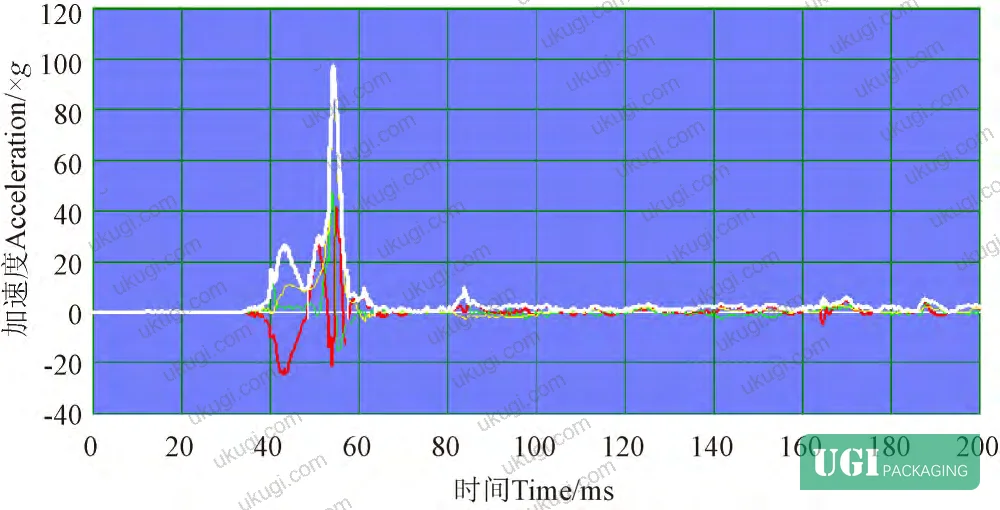
Drop testing used a Lansmont PDL 227 free-fall tester with a fixed motor lift speed of 4.88 m/min. The test sample was a 6-pack color box measuring 153 mm × 274 mm × 335 mm, average box mass 2.796 kg, with eggs placed small-end-down in pulp trays. A tri-axial capacitive accelerometer (SDI Model 2422-400, sensitivity 10 mV/g) was mounted on the top egg. Starting from 270 mm and stepping up by 10 mm increments, the free-fall height was increased until breakage appeared.
The result: breakage onset occurs at ≥290 mm free-fall onto a rigid surface. Peak composite acceleration at the critical height measured 97.30 g. Below 290 mm, egg breakage rate = 0.
For the production line, the design target kept the release-point-to-carton-base distance at 267 mm — deliberately inside the 290 mm safety margin. Three additional mechanical safeguards were incorporated: a 0.5 mm elastic steel-strip ramp at the carton mouth to decelerate the box during entry, side-wall friction from the corrugated carton, and a cushioned carton base replacing the rigid test surface. All three factors reduce effective impact energy below what the drop test simulates. Prototype trial result: zero egg breakage on-line.
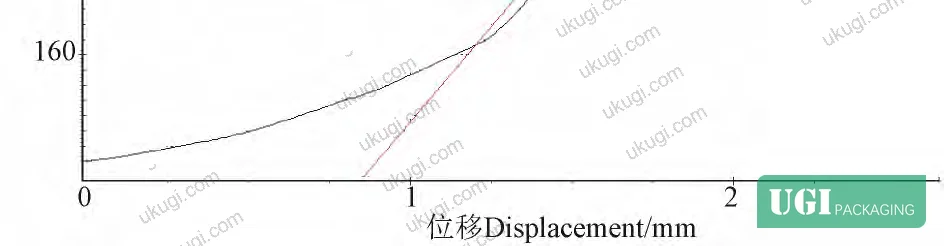
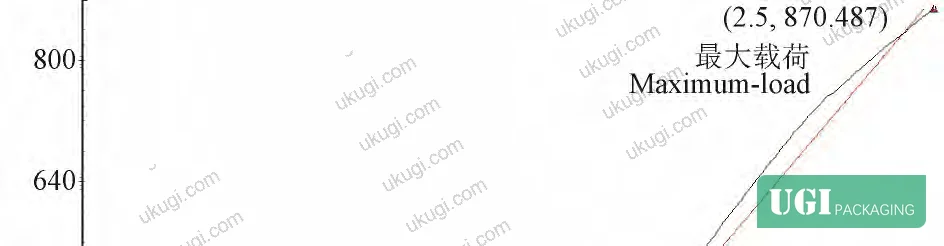
Compressive load testing used a PT-8216 pressure test system (force resolution 1:100,000; speed range 0.5–200 mm/min). The target load was calculated per ASTM D4169-14 at a stacking height of 2.7 m, yielding a predetermined test load of 870.487 N. Load-displacement data showed the first yield point at 440 N / 1.7 mm compression. At the full 870.487 N load, compression displacement reached 2.5 mm — with no visible creasing and zero egg breakage. Packaging stress at first yield: 4,067.77 N/m², rising to 9,380.67 N/m² at the design load.
For gripper design, the calculated clamping stress for the 4-pack format was 309.08 N/m² and for the 6-pack format 284.076 N/m² — both well below the first yield point of the box. This confirms the gripper specification does not risk egg damage through lateral compression, provided the clamp face is padded. The line uses 4 mm natural latex rubber on all clamp contact surfaces (friction coefficient f = 0.7), which keeps the grip secure while limiting surface pressure.
These two thresholds — 290 mm drop height and 870.487 N compressive limit — should be the first numbers you ask any automated case-packing equipment vendor to validate. If they can’t show you a load-displacement curve, that’s a significant gap.
For broader context on test methodology for corrugated and paper-based packaging structures, see ISO 2758:2014 Paper — Determination of bursting strength and TAPPI T 403 Bursting Strength of Paperboard, both of which establish the baseline vocabulary for paper packaging load behavior referenced in equipment qualification.
Vibration Characterization and Resonance Avoidance in Automated Packaging Lines #
Honestly, most buyers overlook vibration compliance entirely when evaluating secondary packaging equipment. They treat it as a transport problem, not an on-line design parameter. This is a mistake — and the test data shows exactly why.
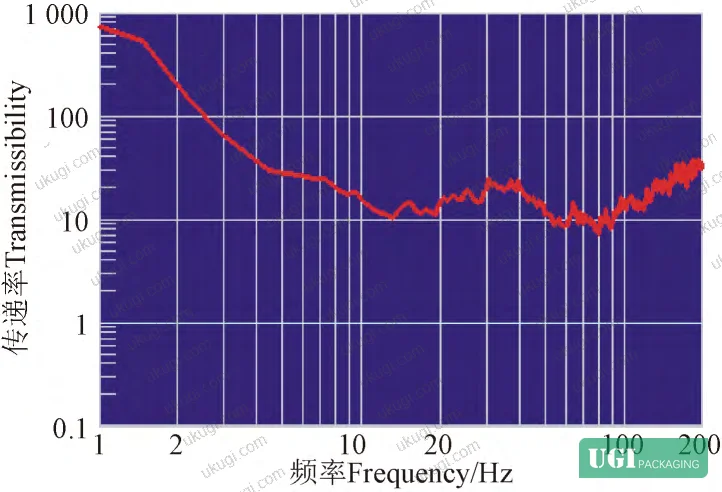
Vibration testing used an MTS 840 electro-hydraulic shaker (vertical acceleration range 0.02–5.00 g, frequency range 0.01–10 kHz) with PCB 356A24 tri-axial accelerometers (sensitivity 10 mV/g, ±15%). Two constraint conditions were tested: unconstrained and elastic-constraint. Sweep frequency range: 1–100 Hz at 0.5 g excitation.
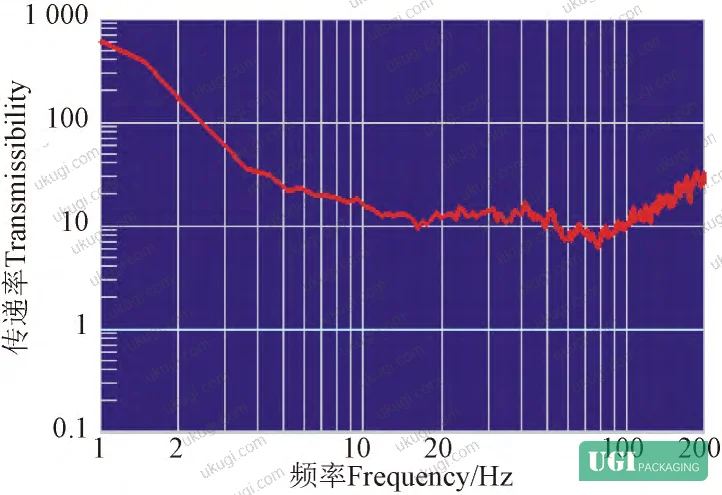
Results from Table 1 of the source data:
| Constraint Condition | Resonance Frequency (Hz) | Transmissibility | Peak Acceleration (×g) |
|---|---|---|---|
| Unconstrained | 12.258 | 2.46 | 1.23 |
| Elastic constraint | 13.205 | 2.65 | 1.32 |
| Design operating range | Outside 10–15 Hz | < 1.0 (target) | < 0.52 Grms |
The color-box assembly has a resonance band of 10–15 Hz. Both constraint conditions amplify vibration (transmissibility > 1.0), which means the packaging system amplifies rather than damps excitation in this frequency range.
Random vibration trials used ASTM D4169 Truck Level parameters. Two excitation levels were tested: Grms = 0.52 g²/Hz and Grms = 0.73 g²/Hz, each run for 3 hours at 0.01–200 Hz. Results: at 0.52 g²/Hz, egg breakage rate = 0%; at 0.73 g²/Hz, breakage rate = 2.08%. This directly sets the on-line vibration ceiling.
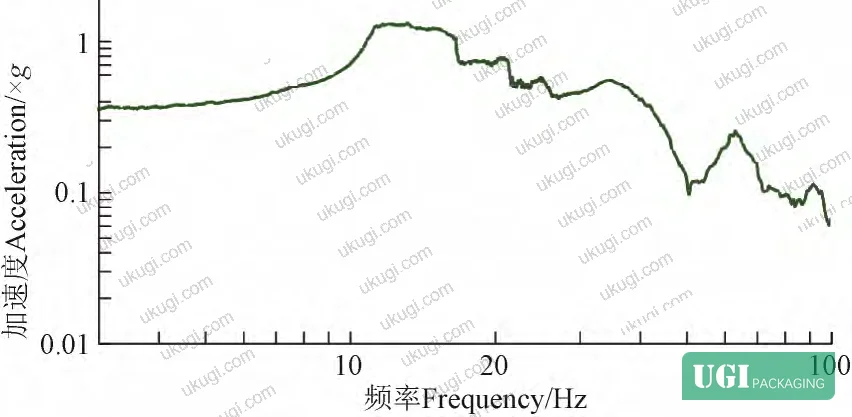
The production line drive system — a 1.5 kW sprocket chain driving 800 mm rollers — was designed so that operating frequency stays outside the 10–15 Hz resonance band. Ball-screw linear modules have natural frequencies above 160 Hz, which is well clear of the danger zone. On-line vibration excitation was verified to remain at or below the Grms = 0.52 g²/Hz road-transport threshold, resulting in zero on-line breakage.
This is a case where the mechanical design directly encodes the test result. If you’re sourcing automated packaging equipment for fragile secondary formats, ask the vendor to show you the on-line vibration profile and confirm it avoids the product’s resonance band. Most won’t have this data. That should tell you something.
For packaging drop and impact testing reference methodology, see ASTM D5276 Standard Test Method for Drop Test of Loaded Containers by Free Fall, which provides the standardized framework these line qualification tests align with.
Cartesian Robot Architecture and Multi-SKU Flexibility #
The mechanical arm is a Cartesian (rectangular coordinate) design — X, Y, Z linear axes, all ball-screw driven with a lead of 10 mm. This is a deliberate choice over articulated robots: simpler kinematics, higher repeatability on fixed-path operations, easier format changeover.
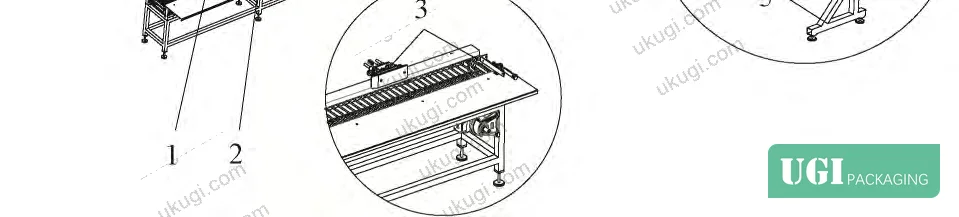
Key axis parameters:
- X-axis: maximum effective stroke 750 mm; linear speed 0–199 mm/s (adjustable)
- Z-axis: maximum effective stroke 380 mm; linear speed 0–149 mm/s (adjustable)
- Y-axis (gripper open/close): maximum stroke 200 mm; maximum speed 50 mm/s
- Rated system power: 1.5 kW
The gripper travels a 9-step cycle: descend 380 mm, close 62 mm, rise to home height, translate 701 mm to carton position, descend 380 mm again, partial release (−26 mm), rise, full release (−36 mm), rapid return to origin. This motion profile is directly derived from the kinematics matrix for the 4-pack format (box 112 mm × 310 mm × 360 mm, carton 330 mm × 540 mm × 420 mm).
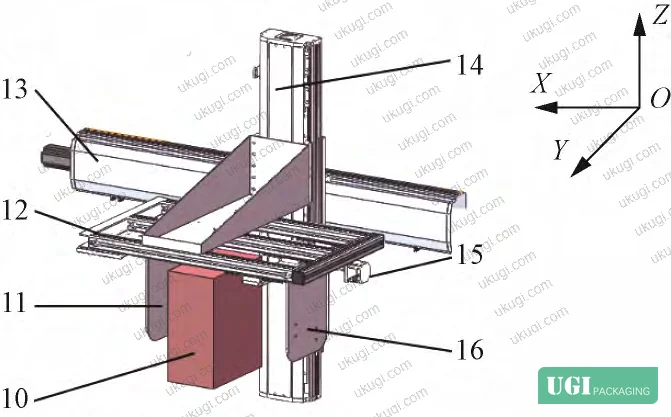
Format changeover is handled through quick-release T-bolt and butterfly-nut fixtures. Three color-box SKUs are supported without tooling modification to the main structure — only the clamp plate set and guide frame change. The 4-pack format uses single-column gripper loading; the 6-pack formats use double-column side-by-side loading. SKU parameters are changed via HMI touchscreen (MCGS TCP7062) without entering the control cabinet.
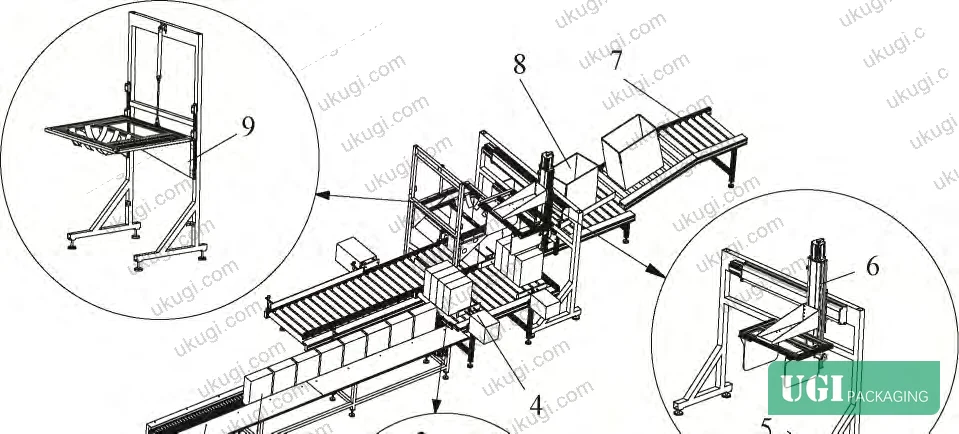
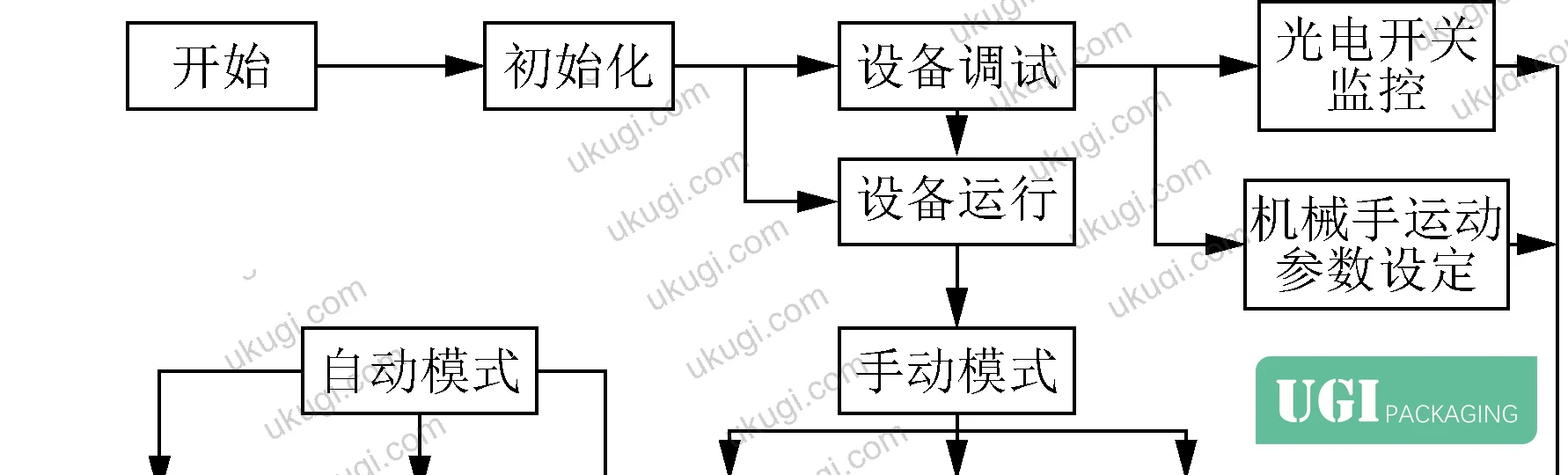
The control backbone is a Siemens S7-200 SMART (CPU ST40) PLC with power-loss data retention, 14 photoelectric switches, 10 pneumatic cylinders, and stepper motors on all axes (X/Z: Handebao 110 three-phase, rated 7 A, holding torque 23 N·m; gripper: Handebao 86 two-phase, holding torque 12.7 N·m). Absolute position control mode improves repeat positioning accuracy. The system communicates via TCP/IP, which provides the data exchange interface needed for integration with MES or production monitoring systems.
Field Trial Results and Throughput Benchmarking #
The prototype ran for 11 months in continuous production. This is the most credible data point in the entire study — 11 months of actual output, not a laboratory run.
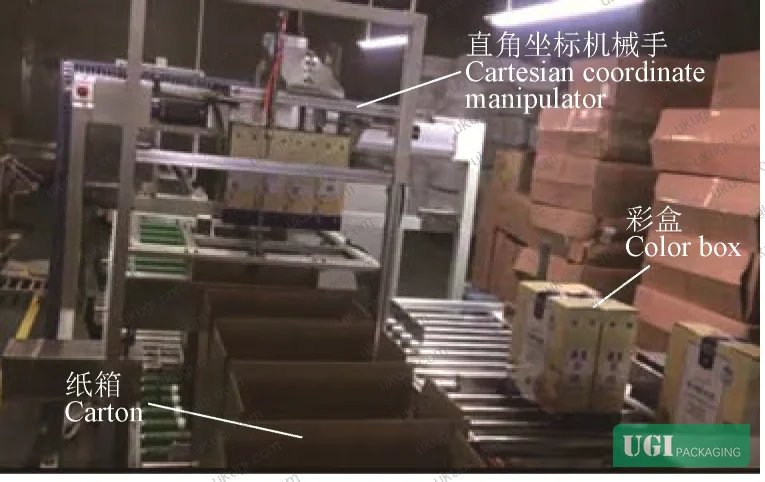
Throughput results:
| Format | Automated Line (boxes/h) | Manual Baseline (boxes/h) | Efficiency Multiplier |
|---|---|---|---|
| 6-pack color box | 96.1 | 20.2 | 4.76× |
| 4-pack color box | 120.4 | 23.0 | 5.23× |
| Egg breakage rate (on-line) | 0% | — | — |
In supplier qualification for packaging automation, we have seen projects where a vendor claimed 5× efficiency gains — and delivered them only when running a single SKU on a pre-configured line. The moment a format change was introduced, actual efficiency dropped to around 2×. The key differentiator here is that the 11-month trial covered active SKU switching across three formats, so the throughput figures are realistic production averages, not peak-condition demos.
Industry observation: most procurement teams don’t realize that flexible case-packing lines for consumer goods have historically been validated only for rigid, uniform-weight products like beverage cartons. Applying the same equipment architecture to fragile, variable-format secondary packaging — where internal product damage is invisible until the consumer opens the box — requires fundamentally different qualification criteria. The vibration and drop parameters measured here are not standard inclusions in most vendor datasheets, but current industry data shows they are becoming required validation inputs for food-grade automation procurement.
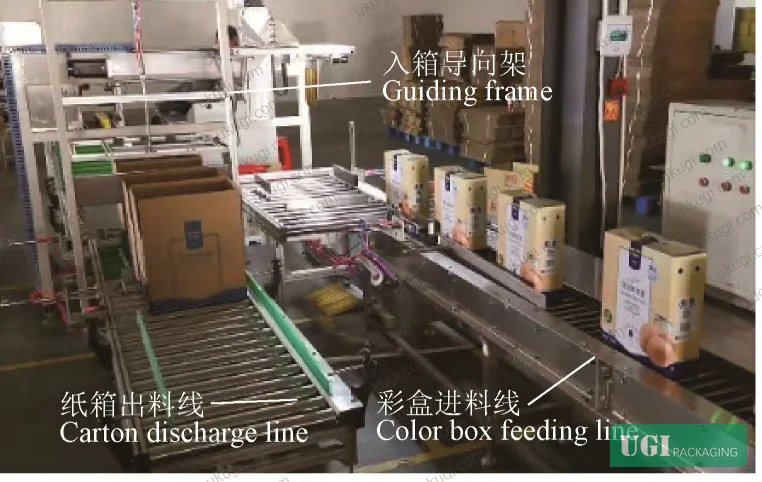
For color-box applications in decorative or gift packaging contexts, the structural requirements translate directly. Whether the carton contains eggs, cosmetics, or confectionery, the same damage mechanics apply: resonance frequency avoidance, clamping stress below the first yield point, and free-fall height control. Buyers specifying automated case-packing lines for custom paper boxes or gift packaging solutions should be applying these same test criteria when evaluating suppliers’ automation claims.
Practical Guidance for Buyers #
If you’re specifying a flexible case-packing line for color-box or secondary packaging formats, here’s what actually matters in supplier evaluation.
First, the breakage threshold is a design input, not an output. Get the drop-damage curve for your specific box and product combination before any mechanical design is finalized. The 290 mm critical height and 97.30 g peak acceleration in this trial are specific to the tested format — your product will have different numbers.
Second, vibration compliance is often the last thing specified and the first thing that causes field failures. Ask the equipment vendor for the on-line vibration profile of their conveyor system and confirm it avoids the resonance band of your packaging. If they don’t have a sweep-frequency characterization of their own equipment, that’s a red flag.
Third, format flexibility is worth less than it looks on paper. A line that claims three-SKU flexibility but requires 45-minute changeovers is only viable if your batch sizes are large enough to absorb the changeover overhead. The quick-release fixture system described here achieves SKU changes at the HMI — that’s the benchmark to hold vendors to.
At ukugi.com, our engineering team in Guangzhou works with international brand owners and packaging buyers to develop structurally validated custom paper boxes and secondary packaging formats for automated line integration — including compressive load and drop-test validation as part of the structural design process. If you’re designing for automated handling, we can align box construction to your equipment’s clamping and impact specifications from the start.
Need a custom formulation or sample? Request a quote from our team →
Technical Verification Questions #
- Can you provide drop-test data showing egg or product breakage rate versus free-fall height, with the critical zero-damage threshold confirmed at or below 290 mm, and peak impact acceleration measured at that threshold?
- What is the compressive load at first yield point of your color-box packaging structure, and can you provide a full load-displacement curve showing behavior up to the ASTM D4169-14 calculated stacking load?
- What is the measured resonance frequency band of your packaging system under sweep-frequency vibration (1–100 Hz, 0.5 g), and how does the line’s operating frequency profile avoid that resonance band?
- At what random vibration excitation level (Grms, g²/Hz) does product breakage rate exceed 0% in your validation testing, and under which ASTM D4169 truck vibration level was this measured?
- What are the maximum and adjustable speed ranges for each robot axis (X, Z, and gripper), and what is the holding torque specification for the stepper motors driving each axis?
Quality Verification Checklist #
- ☐ Drop test confirms zero product breakage at free-fall heights ≤290 mm onto a rigid surface, with peak acceleration documented at ≤97.30 g
- ☐ Compressive load test conducted per ASTM D4169-14 up to calculated stacking load (≥870 N for 2.7 m stack height), with first yield point displacement ≤2.5 mm and zero visible creasing
- ☐ Random vibration trial at Grms = 0.52 g²/Hz for ≥3 hours shows 0% product breakage; breakage rate documented at 0.73 g²/Hz for comparison
- ☐ Sweep-frequency test (1–100 Hz) confirms production line operating frequency is outside the 10–15 Hz resonance band of the packaging system
- ☐ Gripper clamping stress on box sidewall is confirmed below first yield stress (< 4,067.77 N/m²) for all supported SKU formats
- ☐ Format changeover between supported SKUs achievable via HMI parameter input and quick-release fixture swap, without disassembly of main structural components
- ☐ Automated line throughput verified ≥96 boxes/hour for 6-pack format and ≥120 boxes/hour for 4-pack format over a sustained production trial period
- ☐ On-line product breakage rate confirmed at 0% across all supported SKU formats during field validation
Key Specifications Table #
| Parameter | Recommended Value | Verification Method |
|---|---|---|
| Maximum free-fall height (zero breakage) | ≤290 mm | Drop test per ASTM D5276; 10-step increments from 270 mm, tri-axial accelerometer on product |
| Peak impact acceleration at critical height | ≤97.30 g | SDI Model 2422-400 tri-axial capacitive accelerometer, 10 mV/g sensitivity |
| Color-box compressive load at first yield | ≥440 N / 1.7 mm displacement | PT-8216 compression tester; load-displacement curve to ASTM D4169-14 calculated load |
| Maximum clamping stress (gripper on box sidewall) | ≤4,067.77 N/m² (4-pack); ≤284.076 N/m² stress level (6-pack) | Derived from gripper force / contact area; confirmed no egg breakage at design force |
| Resonance frequency band (color-box packaging) | 10–15 Hz — design must avoid this range | Sweep-frequency test, MTS 840 shaker, 1–100 Hz at 0.5 g; PCB 356A24 tri-axial sensors |
| On-line vibration excitation ceiling | ≤Grms 0.52 g²/Hz (0% breakage threshold) | Random vibration test, ASTM D4169 Truck Level, 3-hour duration, 0.01–200 Hz |
| Automated throughput — 6-pack format | ≥96 boxes/hour | 11-month production field trial, continuous operation |
| Automated throughput — 4-pack format | ≥120 boxes/hour | 11-month production field trial, continuous operation |
Looking for a manufacturer that meets these specs? Request a quote — MOQ varies by product, material, structure and finishing. Product-specific MOQ is confirmed with each quotation.
References #
Data source: Flexible Case-Packing Line Design and Validation for Multi-Format Egg Color-Box Packaging with Impact and Vibration Characterization, Y. Hou et al., Packaging Technology and Science, 2025
Frequently Asked Questions #
What is the maximum safe free-fall height for color-box packaging containing fragile products like eggs?
Validated drop-test data establishes 290 mm as the critical threshold for a 6-pack egg color-box (153 mm × 274 mm × 335 mm, 2.796 kg) onto a rigid surface. At and above 290 mm, breakage begins. The production line was designed to release boxes at 267 mm from the carton base — intentionally inside this margin — and additional mechanical safeguards (elastic entry ramp, corrugated sidewall friction, cushioned base) reduce effective impact energy below the rigid-surface test condition. The validated on-line breakage rate is 0%.
What resonance frequency range should be avoided when designing automated case-packing conveyor systems for color-box formats?
The tested color-box packaging assembly shows resonance in the 10–15 Hz band under both constrained and unconstrained conditions. In that band, transmissibility exceeds 2.46×, meaning vibration is amplified rather than absorbed. Production line operating frequencies and ball-screw linear module natural frequencies (confirmed above 160 Hz) should be designed to stay well outside this range. Ask any equipment vendor to provide sweep-frequency characterization of their conveyor system and confirm it avoids your packaging’s resonance band.
How much faster is automated case-packing compared to manual packing for color-box egg formats?
The 11-month field trial showed 96.1 boxes/hour for 6-pack formats (vs. 20.2 manual — 4.76×) and 120.4 boxes/hour for 4-pack formats (vs. 23.0 manual — 5.23×). These are production averages across multi-SKU operation, not single-format peak results.
What gripper pad material is specified, and why does it matter for clamping stress calculations?
Natural latex rubber at 4 mm thickness was used on all clamp contact surfaces, providing a friction coefficient of 0.7. This material choice directly affects the minimum clamping force needed to prevent slip — and the maximum force that can be applied before box sidewall stress approaches the first yield point. With a latex-padded gripper, the required clamping stress (309.08 N/m² for 4-pack, 284.076 N/m² for 6-pack) stays far below the structural first yield stress of 4,067.77 N/m², giving a comfortable safety margin.
Can this type of flexible line handle multiple box sizes without major hardware changes?
Yes, with the right changeover architecture. The line described here handles three SKUs — 4-pack (112 mm × 310 mm × 360 mm) and two 6-pack variants (153 mm × 274 mm × 335 mm and 133 mm × 306 mm × 336 mm) — by swapping only the clamp plate set and carton guide frame via quick-release T-bolt fixtures, then updating parameters at the HMI touchscreen. No structural disassembly is required. For other SKU sizes beyond these three, the same approach applies: modify HMI parameters, replace guide frame and clamp jaw, adjust cylinder positions. The key is designing the quick-release interface into the original build — retrofitting it is expensive.
Published by ukugi.com Technical Team | Request a quote


