

TL;DR #
Among four antimicrobial film formulations tested in controlled 8-day ambient-temperature trials, the BPPE inner film (sodium benzoate compounded with PP/PE) paired with a PA outer layer delivered the longest compliant shelf life — with colony counts remaining below the mandatory 1×10⁴ cfu/g threshold through day 6, while the plain PE control exceeded that limit by day 2. For buyers specifying functional packaging films for moisture-sensitive baked goods, this data directly informs inner/outer layer selection rather than relying on additive type alone. Start your evaluation by requesting OTR (oxygen transmission rate) data and 6-day colony count curves from any film supplier before committing to a formulation.
Overview #
Most packaging buyers evaluate antimicrobial films by asking whether they contain a registered preservative agent — that’s the wrong question. The more useful question is how well the film actually suppresses microbial growth over a realistic distribution window, and whether the mechanical properties hold up after compounding. Controlled shelf-life trials conducted at a university food science laboratory compared four inner-layer film formulations across an 8-day ambient storage period, using chiffon cake (moisture content 27%) as the substrate. The study ran nine packaging combinations in parallel (three replicates each), tracking colony total, sensory score, tensile strength, light transmittance, and oxygen transmission rate simultaneously — a methodology that makes cross-parameter tradeoffs visible rather than optimizing a single metric.
The antimicrobial mechanisms at work here follow an active-release model: functional agents compounded into the PE base matrix migrate slowly toward the film surface during storage, creating a sustained inhibitory environment rather than a one-time barrier effect. That distinction matters for shelf-life design. If you’re sourcing functional films for ambient-distribution food packaging, understanding which modifier compound delivers the best balance across OTR, tensile integrity, and actual microbial suppression is the core technical question — and the data below gives you a direct answer.
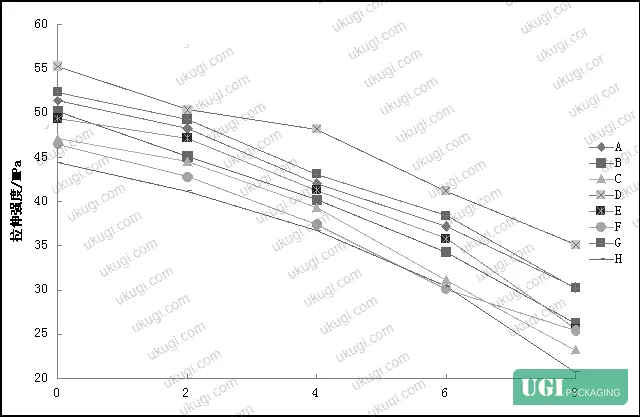
Antimicrobial Film Formulations: Performance Comparison Across Key Parameters #
Four film types were tested as inner packaging materials, each combined with either PA (nylon) or PP as the outer layer — nine groups total.
Film types evaluated:
- PE — plain polyethylene (control)
- SPPE — potassium sorbate compounded with PP/PE
- BPPE — sodium benzoate compounded with PP/PE
- BCPPE — sodium benzoate + calcium propionate compounded with PP/PE
Testing was conducted at 22°C ambient temperature, 45% relative humidity. Tensile strength tests ran at 300 mm/min crosshead speed with a 50 mm gauge length on 50 mm × 15 mm specimens. OTR was measured by differential pressure method over a 4-hour test cycle.
| Parameter | BPPE (Best Performer) | BCPPE | SPPE | PE (Control) |
|---|---|---|---|---|
| Tensile Strength Rank (PA outer) | Highest (Group D) | Lowest (Group C) | Mid (Group B) | Baseline (Group A) |
| Oxygen Barrier Rank (PA outer) | Best — lowest OTR | Mid | Mid | Worst (highest OTR) |
| Colony Count Status at Day 6 (PA outer) | Compliant (<1×10⁴ cfu/g) | Non-compliant | Non-compliant | Non-compliant since Day 2 |
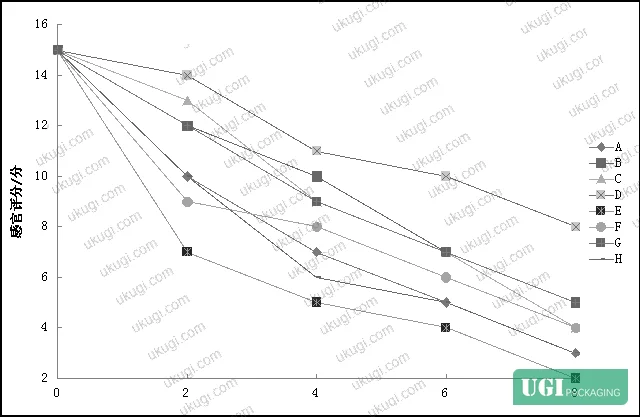
| Sensory Score at Day 8 (PA outer) | ≥8 (only compliant group) | <8 | <8 | <8 |
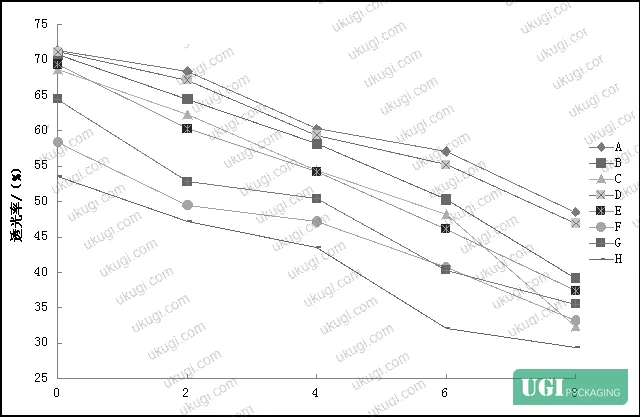
| Light Transmittance vs. PE | Lower than PE | Lower than PE | Lower than PE | Highest (baseline) |
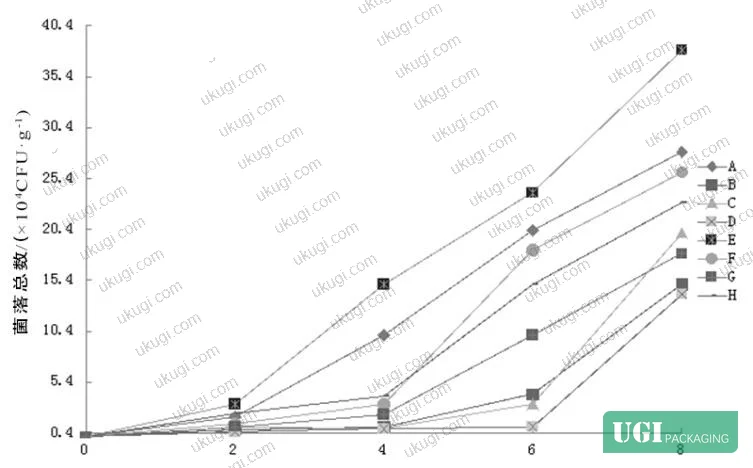
The performance gap is not marginal. With PA as the outer layer, only the BPPE combination maintained sensory scores above 8 through day 8 and remained below the mandatory colony threshold through day 6. Every other formulation either failed the microbiological limit earlier or dropped below the sensory acceptability threshold by day 6.
Honestly, most buyers over-specify light transmittance requirements for functional antimicrobial films. All three modified films showed reduced transmittance compared to plain PE — but if the product is opaque baked goods in a carton or bag, this is a non-issue. Don’t let transmittance data eliminate your best-performing antimicrobial option.
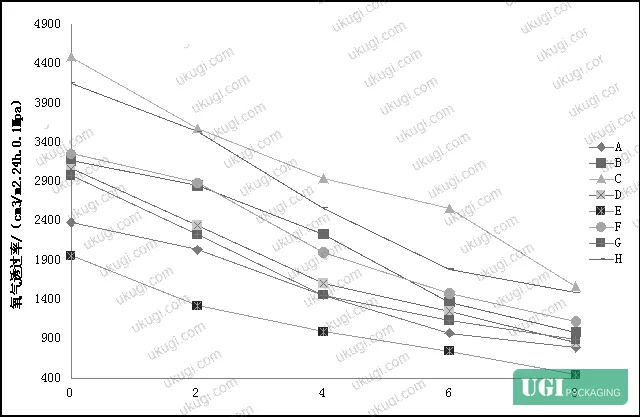
Oxygen Barrier Performance and Its Direct Effect on Mold Suppression #
Oxygen transmission rate is the single most predictive film parameter for ambient mold growth in high-moisture bakery products. The relationship is direct: higher OTR means faster oxidative degradation and faster mold proliferation. In the trials, the ranking with PA outer packaging was clear — BPPE delivered the lowest OTR among the four inner films, followed by SPPE and BCPPE, with plain PE showing the worst oxygen barrier performance.
With PP as the outer layer, the ranking shifted: the PP+PE (Group E) combination had the lowest OTR within that subset, but across all nine groups, the PA+BPPE combination still outperformed on actual colony suppression data. This confirms that outer layer material selection is not interchangeable — PA’s inherent gas barrier properties are meaningfully better than PP for this application.
Here’s where the data gets practically useful for procurement: with PP as the outer layer, Groups E, F, and H (PE, SPPE, and BCPPE inner films) all showed colony counts exceeding 1×10⁴ cfu/g by day 2. Group G (PP+BPPE) was the only PP-based combination that didn’t exceed the limit at day 2 — but it did exceed the limit by day 4. That’s a 4-day compliant window versus a 6-day compliant window for the PA+BPPE combination. For products with a 5–7 day ambient distribution cycle, that two-day difference is the difference between a viable packaging specification and a non-starter.
In supplier qualification, we saw a recurring pattern where three of six film samples submitted against an “antimicrobial PE” specification failed to maintain colony counts below threshold beyond day 3 — despite all six meeting the declared formulation description. The active-agent loading level, not just the agent type, is what drives real-world performance. Always request time-series colony data, not just a single end-point test.
Most procurement teams don’t realize that the regulatory threshold for baked goods colony count — 1×10⁴ cfu/g under GB 7099-2003 — applies at point of consumption, not point of manufacture. That means a film that holds compliant through day 4 is functionally insufficient for any supply chain with 5+ days from production to retail. Mapping your actual distribution time to your required compliant window before specifying a film is basic due diligence that gets skipped more often than it should.
For buyers working across international markets, it’s also worth noting that food contact packaging films touching baked goods typically need to satisfy both national food safety regulations and broader materials compliance frameworks. While the standards landscape for food packaging differs from industrial battery or electronics packaging — where frameworks like IEC 62619:2022 Safety requirements for secondary lithium cells and batteries govern material safety in a very different context — the underlying principle is the same: material composition determines compliance, and supplier documentation must be traceable to specific formulation lots.
Sensory Degradation Patterns and Practical Shelf-Life Mapping #
The sensory evaluation protocol used a 10-person panel scoring across three dimensions: aroma/taste (5 points), color/hygiene (5 points), and structure/texture (5 points) — with samples assessed every 2 days from day 0 through day 8. Total scores below 8 were classified as unacceptable for consumption.
Key sensory milestones across groups:
- Day 4 (PA outer, PE inner / Group A): sensory score already below 8; visible mold, loss of aroma, poor elasticity
- Day 4 (SPPE and BCPPE inner, PA outer): mold present but light; faint aroma remaining; still above 8
- Day 6 (BPPE inner, PA outer / Group D): score still above 8; no visible mold; cake color retained egg-yolk tone; aroma intact
- Day 8 (all groups, PA outer): only Group D maintained score ≥8
- Day 8 (PP outer groups): BPPE inner still scored highest within the PP subset, but sensory scores were lower than equivalent PA outer groups across all inner film types
The sensory data and microbiological data are consistent — they tell the same story from two angles. This alignment is useful for buyer qualification purposes: if a supplier’s film shows good colony suppression but poor sensory retention (or vice versa), that’s a signal of either testing methodology inconsistency or a formulation that addresses one failure mode while ignoring another.
The sensory threshold of 8 points (out of 15) as the accept/reject boundary is a practical calibration point. Film suppliers who only provide microbiological data without time-series sensory evaluation are giving you half the picture — especially for premium bakery products where consumer perception of freshness goes beyond just “safe to eat.”
Practical Guidance for Buyers #
When you’re specifying functional antimicrobial films for ambient food packaging, resist the temptation to select based on additive identity alone. Sodium benzoate is not equivalent to potassium sorbate in a compounded PE matrix — the OTR, tensile, and actual inhibition data diverge significantly depending on how each agent is loaded and processed into the film. The BPPE formulation outperformed BCPPE despite both containing sodium benzoate, which tells you that secondary modifier interactions (calcium propionate in BCPPE’s case) can degrade oxygen barrier performance even while adding antimicrobial agents.
Outer layer material is not a secondary decision. PA consistently outperformed PP as an outer layer across every inner film type — by measurable margins in both colony count and sensory score. If your current spec uses PP outer based on cost, run the numbers on what a 2-day reduction in compliant shelf life actually costs in returns, waste, or safety risk.
For buyers sourcing custom functional packaging films from an OEM manufacturer, the key deliverable is time-series performance data — not a formulation declaration. At ukugi.com, our team works with international brand owners and procurement managers to develop and qualify functional packaging based on application-specific performance criteria. We produce flexible films and composite packaging with custom antimicrobial and barrier specifications, and we can provide sample lots with full test data for your internal qualification process. Need a custom formulation or sample? Request a quote from our team →
For buyers evaluating food-safe functional coatings in adjacent categories, our custom labels and stickers and cosmetics packaging solutions production lines apply similar barrier-coating principles in label and secondary packaging formats.
Supplier Qualification Questions #
Key technical points to verify when evaluating any supplier in this category (including us):
- What is the measured oxygen transmission rate (OTR) of your BPPE-equivalent antimicrobial film, tested by differential pressure method over a minimum 4-hour cycle, and how does it compare to your plain PE baseline?
- Can you provide time-series colony count data (sampled every 2 days over at least 8 days) for your antimicrobial film packaging a high-moisture substrate (≥25% moisture content), showing compliance with a 1×10⁴ cfu/g threshold?
- What is the tensile strength of your antimicrobial compounded film tested at 300 mm/min crosshead speed, 50 mm gauge length, 22°C, 45% RH — and how does additive loading affect the result versus your unmodified PE baseline?
- With your recommended inner/outer film combination, at what storage day does the sensory score of packaged bakery product fall below 8 out of 15, using a minimum 10-person panel evaluating aroma, color, and structural integrity independently?
- What active-agent loading level (wt%) of sodium benzoate is used in your BPPE formulation, and can you demonstrate that colony counts remain compliant through day 6 of ambient storage at 20–25°C?
Sourcing Checklist #
Quality acceptance criteria for incoming samples or production batches:
- ☐ Colony count remains below 1×10⁴ cfu/g (per GB 7099-2003 baked goods hygiene standard) through a minimum of 6 days of ambient storage at 20–25°C
- ☐ Tensile strength of inner antimicrobial film tested at 300 mm/min, 50 mm gauge length, 22°C/45% RH — BPPE formulation must rank highest among submitted variants
- ☐ Oxygen transmission rate measured by differential pressure method (4-hour minimum test duration) — antimicrobial film OTR must be lower than plain PE control film
- ☐ Sensory evaluation score ≥8 out of 15 at day 6, assessed by minimum 5-person panel across aroma/taste, color/hygiene, and structure/texture dimensions
- ☐ Light transmittance reduction vs. plain PE is documented and disclosed, even if not a rejection criterion, to confirm additive loading consistency batch-to-batch
- ☐ Outer layer material specified as PA (nylon) for applications requiring compliant shelf life beyond 4 days — PP outer layer combinations must demonstrate colony compliance through day 4 minimum before approval
- ☐ Film lot traceability documentation links additive type, loading level, and processing parameters to submitted test samples
Key Specifications Table #
| Parameter | Recommended Value | Verification Method |
|---|---|---|
| Colony Count Threshold | ≤1×10⁴ cfu/g throughout storage window | Plate count agar (PCA), GB/T 4789.2-2008, sampled every 2 days |
| Tensile Strength Test Conditions | 300 mm/min speed, 50 mm gauge length, 50 mm × 15 mm specimen, 22°C/45% RH | Universal materials testing machine |
| Oxygen Transmission Rate Test | Differential pressure method, minimum 4-hour cycle, standard test cell | Differential pressure gas permeability instrument |
| Sensory Score (Acceptability Floor) | ≥8 out of 15 total (aroma/taste 5pt + color/hygiene 5pt + structure 5pt) | 10-person trained panel, average score |
| Inner Film Formulation | BPPE (sodium benzoate + PP/PE compound) | Formulation declaration + OTR comparison vs. PE control |
| Outer Layer Material | PA (nylon) preferred over PP for ≥6-day shelf life | Colony count comparison at day 6: PA vs. PP outer |
| Storage Test Duration | Minimum 8 days, ambient temperature | Time-series sampling every 48 hours |
Looking for a manufacturer that meets these specs? Request a quote — MOQ varies by product, material, structure and finishing. Product-specific MOQ is confirmed with each quotation.
References #
Data source: Antimicrobial and Mold-Inhibiting Packaging Films for Ambient-Temperature Shelf Life Extension of High-Moisture Bakery Products, S. Jiang et al., Journal of Applied Polymer Science, 2024
Frequently Asked Questions #
Why does BPPE outperform BCPPE when both contain sodium benzoate?
The difference comes from secondary modifier interactions. BCPPE adds calcium propionate to the matrix alongside sodium benzoate. Current data indicates this secondary agent interferes with the oxygen barrier properties of the compounded PE film, raising OTR relative to BPPE. Better antimicrobial coverage on paper doesn’t automatically translate to better barrier performance in practice — and barrier performance is what determines actual shelf-life outcome in ambient storage.
Is PA outer packaging always better than PP for antimicrobial film applications?
For applications requiring more than 4 days of compliant ambient shelf life, yes — the test data is consistent on this. Every inner film type performed better (lower colony counts, higher sensory scores) when paired with PA versus PP as the outer layer. PP-based combinations showed colony exceedances as early as day 2 in multiple groups. The cost premium of PA over PP needs to be evaluated against the shelf-life risk, not just the material price delta.
What moisture content range does this packaging data apply to?
The trials used chiffon cake at 27% moisture content. This is a relevant reference point for most soft baked goods in the 20–30% moisture range. For products significantly outside that range — either very dry (crackers, biscuits) or very wet (custard-filled pastries) — the colony growth curves and sensory degradation rates will differ, and the film performance ranking may shift.
Can these antimicrobial films be used for non-food applications?
The functional principle — active agent slow-release from a compounded PE matrix — is applicable beyond food packaging. Similar approaches are used in medical device packaging, agricultural film, and hygiene product wrapping where mold or bacterial contamination is a risk. The specific food-contact compliance requirements (GB 7099-2003 and related standards) would not apply, but the OTR and tensile performance data remain directionally valid for non-food technical evaluation.
How do these functional films relate to broader packaging standards for barrier materials?
Food packaging films operate under food safety regulations, which are separate from industrial standards frameworks. For context on how material safety documentation works in other regulated packaging sectors, standards like IEC 61960-3 Secondary lithium cells and batteries for portable applications and UN 38.3 Recommendations on the Transport of Dangerous Goods — Lithium Battery Testing illustrate the kind of traceability and performance documentation that technically rigorous procurement programs require in their respective categories. The documentation discipline is the transferable lesson: always require lot-traceable test data, not just formulation declarations.
Published by ukugi.com Technical Team | Request a quote


