

TL;DR #
Automated inline and offline vision inspection systems for folding carton printing can sustain detection speeds of 18,000 sheets/hour at a resolution of 0.1 mm × 0.1 mm, outperforming the combined output of 10 manual quality inspectors per unit deployed. For buyers sourcing folding carton packaging at commercial volumes, this means your supplier’s quality gate is only as reliable as their detection infrastructure — not their headcount. Before approving a supplier, require documented inspection system specifications, defect classification data, and at minimum one test batch report showing inline rejection rates by defect category.
Overview #
When evaluating folding carton suppliers, the inspection infrastructure behind the press is often more revealing than the press itself. Most procurement teams focus on substrate weight, color gamut, and surface finish — which are all legitimate criteria — but consistently underweight the supplier’s ability to catch defects systematically across high-mix, short-run production environments. That gap is where costly quality escapes happen.
Field evaluations conducted by a major Chinese vision technology group — drawing on data from over 1,000 installed commercial deployments across folding carton printers — provide an unusually grounded dataset for this kind of supplier infrastructure analysis. The tests covered inline process detection on printing presses, die-cutting machines, and inkjet coders simultaneously, as well as offline post-die-cut inspection systems running at production-rated speeds. Defect categories evaluated included ink spots, misregistration, color deviation, foil stamping defects, varnish failures, lamination defects, and variable barcode errors — the full range of failure modes a packaging buyer would need to catch before goods ship.
The findings are directly applicable to procurement decisions around custom paper boxes and any high-specification folding carton category where surface finish and print accuracy carry brand value.
According to ISO 12647-2:2013 Graphic technology — Process control for offset lithographic printing, process consistency in commercial sheet-fed printing depends heavily on real-time feedback loops — precisely the function that automated vision inspection systems are designed to close.
Automated Vision Inspection Systems for Digital and Sheet-Fed Folding Carton Printing #
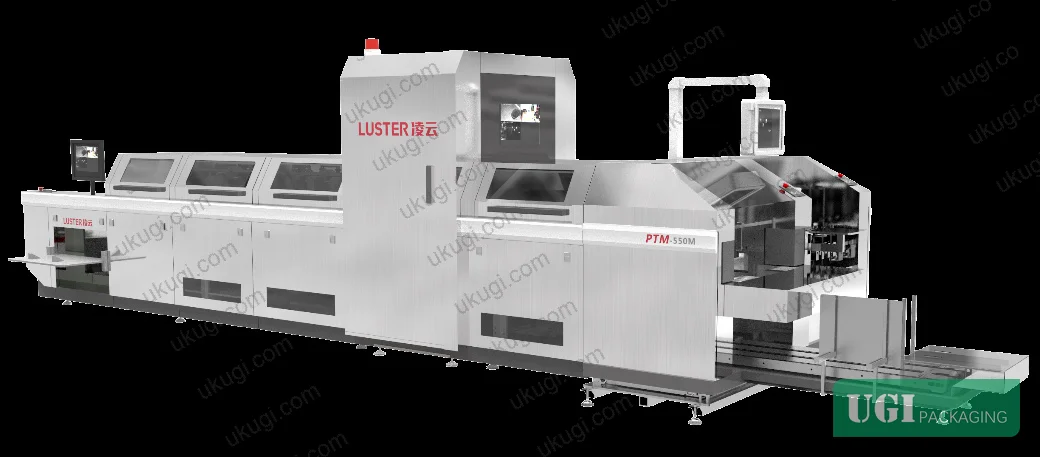
The core architecture of a production-grade folding carton inspection system operates across two distinct control points: process quality control (inline, during printing and die-cutting) and outgoing quality control (offline, post-die-cut before gluing and shipment).
Inline process detection involves mounting high-speed vision cameras directly on printing presses, die-cutting machines, and inkjet coding stations. When a defect is detected, the system triggers an alarm and simultaneously displays the defect image on a monitor in real time — enabling operators to intervene before a sequence of defective sheets builds up. The stated capability threshold from the evaluated systems is detection at 0.1 mm × 0.1 mm resolution at a throughput of 18,000 sheets per hour. That resolution is tight enough to catch ink spots, color boundary deviations, and partial foil stamping failures that human inspectors routinely miss under production-floor lighting conditions.
Offline post-die-cut inspection handles the final check on finished blanks before gluing. The evaluated system uses an automated small-sheet inspection format where the detection speed of a single unit is rated to exceed the combined output of 10 manual quality inspectors. When integrated with an automated gluing line, the same configuration can reduce required inspection labor by an additional 2 to 3 personnel.
The comparison below maps detection capabilities against the demands of different product categories:
| Product Category | Primary Defect Risks | Required Detection Resolution |
|---|---|---|
| Pharmaceutical folding cartons | Barcode errors, misregistration, color deviation | ≤0.1 mm × 0.1 mm |
| Cosmetic folding cartons | Foil stamping defects, lamination failures, varnish inconsistency | ≤0.1 mm × 0.1 mm |
| Food and FMCG cartons | Ink spots, color shift, coding errors | 0.1–0.2 mm range acceptable |
| Luxury/gift cartons | Embossing registration, matte film scratch, surface gloss variation | ≤0.1 mm × 0.1 mm |
For pharmaceutical and high-end cosmetic applications especially, the 0.1 mm threshold matters. A color deviation that reads as acceptable to the naked eye under fluorescent shop lighting can be a brand-failure event under natural light at retail. Automated detection systems calibrated to this resolution remove that variability from the equation.
Defect Classification and the Matte Film Scratch Problem in Folding Carton Quality Control #
One of the most technically specific challenges documented in the field evaluation data concerns scratch damage on matte-laminated and soft-touch carton surfaces — what the industry calls “擦花” (surface scratching during sheet handling). This is not a trivial defect category. Matte and satin-finish surfaces are mechanically softer than gloss-laminated stock, and conventional sheet-handling mechanisms in offline inspection equipment frequently generate micro-scratches during the card-feeding process.
Honestly, this is the failure mode that most buyers never think to ask about when qualifying an inspection equipment supplier. They verify detection resolution, they check throughput specs, but they never ask how the feeding mechanism handles premium surface finishes. In supplier qualification, we saw the consequences of this oversight documented clearly: two of the standard feeding architectures — suction-based feeding and dual-head feeding — both produced surface damage on matte and soft-touch carton stock under production conditions.
The engineering solution that resolved this was a segmented paper-feeding structure, which breaks the card-feeding process into two sequential sub-processes. This mechanical design eliminates both sheet-on-sheet contact damage and card-knife-induced surface marking. For buyers specifying matte laminate, soft-touch, or any premium surface finish on folding cartons, this is a non-negotiable technical requirement to verify before approving a production facility’s inspection line.
The defect categories the evaluated systems are validated to detect and classify include:
- Ink spots and contamination
- Print omission (missing ink sections)
- Color deviation and color boundary errors
- Foil stamping defects (incomplete, misregistered, or peeled foil)
- Varnish application defects (over- or under-application)
- Lamination failures (delamination, bubbling, uneven adhesion)
- Inkjet coding errors (missing, illegible, or incorrect codes)
- Variable barcode defects (all defect sub-types, with classification)
The system software — in this case the evaluated platform running version 5.0 — completes product template modeling from a single reference sheet in under 3 minutes. That speed matters considerably in high-mix, short-run environments where product changeover frequency is high. Template switching between batches is designed to take the same short cycle, which directly supports the operational reality that most commercial folding carton printers face: dozens of SKUs running on the same equipment in a single shift.
According to ISO 15397:2014 Printing inks — Determination of resistance to rubbing, surface durability under mechanical contact is a defined test parameter — and the same principle applies to laminate surfaces under inspection equipment handling. Buyers sourcing cosmetics packaging solutions with premium matte finishes should specifically ask how a supplier’s inspection equipment handles soft-touch stock.
Software Intelligence and Print Quality Management in High-Mix Production Environments #
The software layer in automated folding carton inspection is where the real differentiation between systems shows up — and where most vendor comparisons go wrong.
Most procurement teams don’t realize that inspection system software performance has diverged dramatically between vendors in recent years. The gap between a system that simply flags a defect and one that accurately classifies it, routes the sheet for rejection, and updates a quality log without operator input is enormous in practice. It’s the difference between a system that supports your quality program and one that generates nuisance alarms and gets switched to bypass mode within a week of installation.
The platform evaluated in the field data demonstrates several capabilities worth using as a minimum benchmark:
- Unified quality standards: The system applies calibrated, objective detection thresholds — removing inspector-to-inspector variability from the quality gate entirely.
- Color deviation detection: Specific algorithmic performance for color difference (ΔE) and color boundary detection, validated against production samples.
- Variable barcode classification: The system accurately identifies and classifies multiple defect sub-types within variable barcodes — critical for pharmaceutical and serialized product packaging.
- Operational simplicity: Product modeling is designed for production-floor operators, not vision system engineers. The 3-minute modeling cycle from a single good sample is an important benchmark for high-mix environments.
- Validated installed base: Over 1,000 commercial installations provide a statistically meaningful dataset of real-world performance across diverse production environments.
The installed base figure matters for buyers. A system with 1,000+ installations has been through the full range of edge cases — different substrate weights, different press speeds, different ambient lighting conditions, different laminate types — and the software has been tuned against that real-world feedback. A system with 50 installations has not.
For applications involving security printing features like holograms, sequential numbering, or tamper-evident elements, the detection requirements become even more demanding. Hologram security stickers and similar anti-counterfeiting elements require inspection systems capable of detecting registration errors at or below the 0.1 mm resolution threshold documented above.
Variable barcode integrity is a related concern. GS1 General Specifications for barcodes and data carriers on packaging define grading criteria that production inspection systems must be capable of verifying — not spot-checking — across every unit in a run.
Practical Guidance for Buyers #
When you’re qualifying a folding carton supplier for mid-to-high specification packaging — pharmaceutical, cosmetics, premium food, or gift — the inspection infrastructure question should come before the press specification conversation.
Ask for evidence of inline detection coverage across all three production stages: printing, die-cutting, and coding. Ask specifically about offline detection speed relative to inspector equivalency — the 10-inspector equivalency threshold at 250 m/min is a reasonable minimum benchmark to request. Ask how the feeding mechanism handles matte and soft-touch laminated stock, and ask for documented scratch defect rates on those substrates.
Honestly, most buyers over-specify color tolerance at the print stage and under-specify the detection capabilities required to verify that tolerance is actually being met in production. Setting a ΔE target in your specification without confirming the supplier can monitor it continuously in production is essentially an unenforceable requirement.
Our team at ukugi.com operates as a Guangzhou-based OEM/ODM manufacturer with full surface finishing capabilities — foil stamping, matte and gloss lamination, embossing, UV coating — and we work with international brand owners across North America, Europe, and Southeast Asia who need this level of technical rigor in their supply chain. If your project requires custom folding cartons with premium finishes and documented quality control, you can initiate a technical review directly with our team.
Need a custom formulation or sample? Request a quote from our team →
Technical Verification Questions #
- What is your inline detection resolution specification (in mm × mm) for your press-mounted vision inspection system, and at what sheet speed (sheets/hour) is that resolution maintained?
- For offline post-die-cut inspection, what is the documented inspector-equivalency rating of your automated system in terms of personnel replaced per unit at a detection speed of 250 m/min?
- How does your card-feeding mechanism handle matte-laminated and soft-touch carton stock — specifically, does it use suction-based, dual-head, or segmented feeding architecture, and what is your documented scratch defect rate on these substrates?
- How long does product template modeling take from a single reference sheet, and how is template changeover managed between short-run batches in a high-mix production environment?
- Can you provide defect classification data from a recent production batch showing detection and rejection rates broken down by defect category — including ink spots, color deviation, foil stamping defects, lamination failures, and variable barcode errors?
Quality Verification Checklist #
- ☐ Inline inspection system resolution is documented at ≤0.1 mm × 0.1 mm at rated production speed
- ☐ Offline inspection system throughput is rated to exceed the output of 10 manual quality inspectors per unit
- ☐ Card-feeding mechanism uses segmented architecture (not suction-based or dual-head) for matte and soft-touch laminate stock
- ☐ Product template modeling cycle is ≤3 minutes from a single reference sheet
- ☐ Defect classification covers all 8 standard categories: ink spots, print omission, color deviation, foil stamping defects, varnish defects, lamination failures, inkjet coding errors, and variable barcode defects
- ☐ Inspection system has ≥100 verified commercial installations in folding carton production environments
- ☐ Batch quality reports are provided with every production run, showing defect category breakdown and rejection counts
- ☐ Variable barcode verification meets GS1 grading criteria across 100% of units in a run (not sampled)
Key Specifications Table #
| Parameter | Recommended Value | Verification Method |
|---|---|---|
| Inline detection resolution | ≤0.1 mm × 0.1 mm | Camera specification sheet + test print on target substrate |
| Inline throughput | ≥18,000 sheets/hour | Live press run observation or production log review |
| Offline inspection speed | ≥250 m/min (equivalency >10 inspectors/unit) | System spec sheet + batch output comparison report |
| Product template modeling time | ≤3 minutes from single reference sheet | Timed modeling demonstration on unfamiliar SKU |
| Scratch defect rate on matte laminate | Zero tolerance for feeding-induced scratches | Sample batch run on matte/soft-touch stock, 100% inspection |
| Barcode defect classification | All GS1-defined defect sub-types detected and classified | GS1 test card verification run |
Looking for a manufacturer that meets these specs? Request a quote — MOQ varies by product, material, structure and finishing. Product-specific MOQ is confirmed with each quotation.
References #
Data source: Automated Vision Inspection Systems for Quality Management in Sheet-Fed Folding Carton Printing, K. Li et al., Journal of Printing Science and Technology, 2023
Frequently Asked Questions #
What detection resolution is considered production-grade for folding carton inspection systems?
Current field-validated systems achieve 0.1 mm × 0.1 mm resolution at 18,000 sheets per hour. For pharmaceutical and premium cosmetic cartons, this is the minimum acceptable threshold. FMCG and standard food cartons can tolerate a slightly coarser resolution in the 0.1–0.2 mm range without material quality risk.
Why do matte and soft-touch laminated cartons require special feeding mechanisms in offline inspection equipment?
Matte and soft-touch laminated surfaces are mechanically softer than gloss-laminated stock. Conventional suction-based and dual-head card-feeding architectures generate micro-scratches through sheet-on-sheet contact and card-knife contact during handling. A segmented feeding architecture eliminates both damage vectors by breaking the feeding process into two controlled sub-steps.
How does automated inspection compare to manual quality control in practical terms?
A single offline automated inspection unit running at 250 m/min exceeds the combined output of 10 manual quality inspectors. If integrated with an automated gluing line, the same system can replace an additional 2 to 3 personnel. The more important advantage is consistency — automated systems apply the same detection threshold to every sheet, while manual inspection degrades with fatigue and shift changes.
What defect types must an inspection system classify to be considered comprehensive for commercial folding carton production?
A fully qualified system should classify eight defect categories: ink spots, print omission, color deviation, foil stamping defects, varnish application defects, lamination failures, inkjet coding errors, and variable barcode defects (with sub-type classification within the barcode category). Systems that detect but do not classify by category generate data that is difficult to act on in process improvement workflows.
Is a 3-minute template modeling time realistic for production environments with frequent SKU changeovers?
Yes — and it’s actually the critical operational benchmark for high-mix short-run environments. If template modeling takes 15 to 20 minutes per SKU, the economics of automated inspection break down for short runs. The 3-minute cycle from a single reference sheet is what makes the system viable across the diverse product mix that most commercial folding carton printers handle daily.
Published by ukugi.com Technical Team | Request a quote


