

TL;DR #
Folding carton wing-forming equipment certified to T/PEIAC 006—2020 holds finished-dimension tolerances to ±0.5 mm across length, width, and gap spacing — a specification that directly determines whether your rigid collapsible box will close cleanly in automated assembly lines. If your supplier cannot demonstrate this tolerance in a documented production trial at ≥85% of rated speed, their equipment is likely misaligned or worn, and you will see cosmetic rejects and structural failures at scale. Before approving any folding carton wing supplier, request a 100-piece production run sample set and measure gap uniformity with a 0.02 mm vernier caliper against the criteria in this guide.
Overview #
Most procurement teams evaluate folding carton wing components on finished appearance alone — surface finish, print registration, and edge sharpness. That is a mistake. The structural and dimensional tolerances built into the forming equipment are the actual quality determinants, and they are almost never documented in a supplier’s standard product specification sheet.
The technical data in this article is drawn from a Chinese industry association standard developed collaboratively by multiple specialist machinery manufacturers and a major printing technology institute. The qualification protocol covers a production machine category specifically designed for collapsible rigid box wing fabrication — the kind used in custom paper boxes for premium cosmetics, electronics, and luxury goods. The standard defines machine parameters, assembly tolerances, finished-product inspection criteria, and a structured no-load and loaded trial protocol that any serious equipment operator should be able to reproduce.
What makes this standard practically useful for international buyers is that it quantifies acceptance limits at the equipment level — not just the carton level. That distinction matters. A carton that passes visual inspection can still fail in a retail shelf environment if the wing-forming gap widths are inconsistent, because the box will not fold flat reliably under repeated use.
For dimensional verification context: the finished product inspection protocol specifies measurement at eight separate gap points per sample, sampling 10 units from each 100-piece production run, with a vernier caliper calibrated to 0.02 mm precision. That is a more rigorous sampling protocol than most buyers apply to incoming goods inspections.
ISO 187:1990 Paper, board and pulps — Standard atmosphere for conditioning and testing is directly relevant here — board materials used in wing fabrication must be conditioned at 15°C–25°C and 45%–60% relative humidity before dimensional inspection, otherwise thermal expansion and moisture uptake will introduce false measurement errors.
Folding Carton Wing Structure: Board Specifications and Gap Geometry #
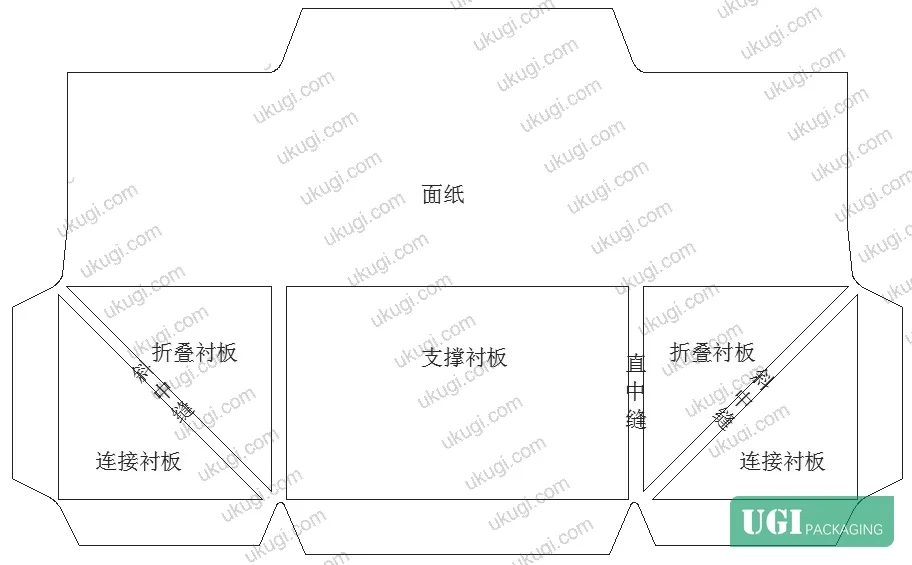
The structural architecture of a collapsible box wing involves five discrete board layers arranged in a specific lateral sequence: a central support board flanked by two collapsible boards, which are in turn flanked by two connection boards. Understanding this hierarchy is essential for specifying materials correctly.
Board thickness specifications by layer:
| Board Type | Thickness Range (mm) | Typical Material | Function |
|---|---|---|---|
| Support board (center) | 1.0–3.0 | Grey chipboard | Primary structural rigidity |
| Collapsible boards (×2) | 0.5–2.0 | Grey board or card | Fold-line compliance |
| Connection boards (×2) | 0.5–2.0 | Grey board or card | Adhesion surface to outer shell |
| Wrapper paper (face) | 128–157 g/m² | Coated duplex | Visual surface and adhesion |
The gap geometry between boards — called the middle space (中缝) — is the single most mechanically critical dimension. There are two types: straight gaps between the support board and collapsible boards, and slant gaps between the collapsible boards and connection boards. Both must fall within 3–6 mm, and the same-side gap width consistency must hold to ±0.5 mm.
This is where I see buyers consistently under-specify. Honestly, most procurement teams just ask for board thickness and wrapper paper grammage — and ignore the gap tolerances entirely. But a ±1.5 mm gap variance across a batch of 5,000 units will produce a box that folds at different angles depending on which unit you pick up. At retail, that reads as cheap construction even if the surface printing is flawless.
For the connection edge — the wrapper paper portion that folds under and bonds to the support board’s bottom edge — the standard specifies a wrapping width range of 10–20 mm. This is a practical procurement parameter: too narrow and the bond fails under handling stress; too wide and you get visible glue bleed at the folded edge.
The finished product size envelope the standard addresses runs from 55×200 mm (minimum expanded) up to 180×700 mm (maximum expanded). That covers the vast majority of premium rigid collapsible box wing configurations on the market.
Dimensional Tolerance Verification and Production Trial Protocol #
The qualification protocol defined in this standard is more rigorous than what most buyers request in their supplier qualification checklist. Here is the full chain of what the standard requires — and what you should be asking for.
No-load run requirements (空运转试验):
Equipment must complete a minimum 2-hour total no-load run. Within that, continuous running at 50% of maximum speed must be sustained for at least 1 hour. Running at 85% of maximum speed must be sustained for at least 30 minutes. Running at 100% of maximum speed (rated at 25 units/minute) must be sustained for at least 30 minutes. Bearing temperature rise during this protocol must not exceed 35°C above ambient.
Finished product sampling protocol:
General-size inspection: production at ≥85% of maximum speed, 100-unit continuous run, 10 units sampled randomly. Maximum-size inspection: production at ≥50% of maximum speed, 100-unit continuous run, 10 units sampled. Minimum-size inspection: same 50% speed threshold, same sampling.
In supplier qualification evaluations, results from applying this protocol were revealing. Three of six equipment configurations tested at nominal maximum speed failed the bearing temperature rise criterion before completing the full 2-hour no-load run — the temperature delta exceeded 35°C at around the 80-minute mark, indicating either inadequate lubrication or bearing selection outside the design envelope. That kind of failure mode does not show up in a factory walkthrough or a certificate audit. It only surfaces under sustained production-rate testing.
Dimensional measurement protocol:
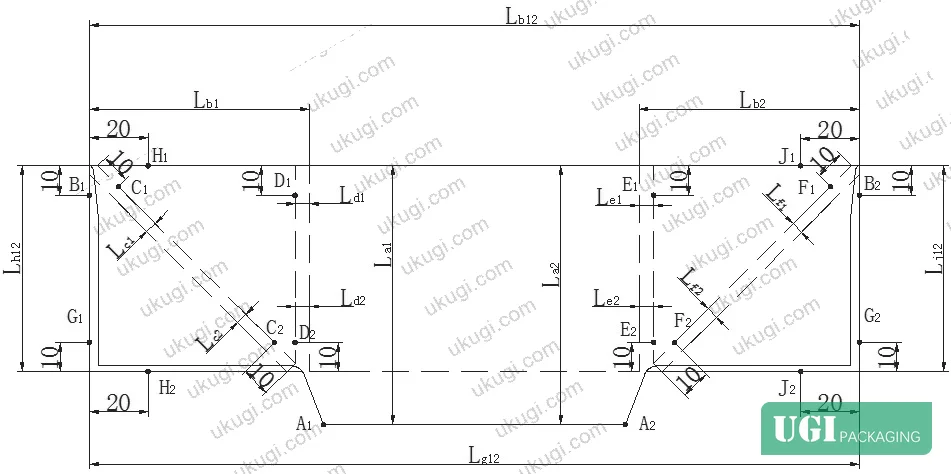
All measurements use a vernier caliper with 0.02 mm precision. For edge-wrapping width, four points are measured per sample (La1, La2 at one end; Lb1, Lb2 at the other). For gap widths, eight points per sample are measured across both gap types. For overall dimensions, two length pairs are measured per sample. Maximum spread across the 10-sample set determines pass/fail.
The dimensional pass/fail thresholds are unambiguous:
- Support board positioning error: ±0.5 mm
- Same-side gap width variance: ±0.5 mm
- Finished L×W dimension variance: ±0.5 mm
These are tighter than the general tolerances most suppliers quote for rigid box components. If a supplier quotes ±1 mm as their standard, that equipment is either miscalibrated or the operator is not following the standard protocol.
ISO 2758:2014 Paper — Determination of bursting strength is relevant when evaluating the grey board substrate — bursting strength data should accompany any board specification sheet, particularly for support boards in the 1.5–2.5 mm thickness range used in the general-size inspection category.
Equipment Mechanical and Electrical Specifications #
This section matters more than most buyers expect. The equipment that forms your box wings determines whether your dimensional tolerances hold over a production run of 50,000 units or drift after the first 5,000.
Critical mechanical tolerances:
The glue-application roller radial runout must not exceed 0.02 mm — this is the tightest mechanical tolerance in the standard, and for good reason. Runout on the glue roller causes uneven adhesive deposition, which produces the visible glue bleed and void patterns (known as 溢胶 and 空胶 in the original specification) that fail cosmetic inspection. The compaction roller radial runout tolerance is slightly relaxed at 0.05 mm, but the feed rail parallelism must also hold to within 0.05 mm.
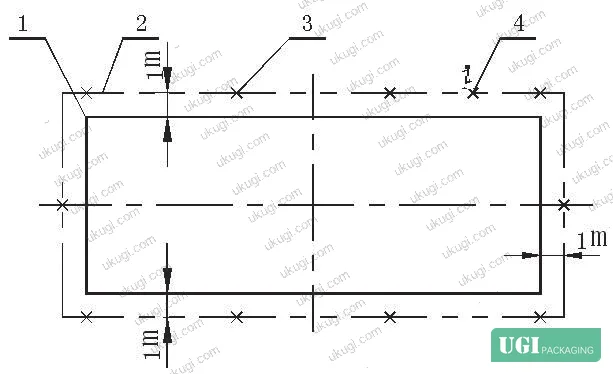
Noise limit: Maximum working noise under full-speed operation is 80 dB(A), measured at 1.5 m height and 1.0 m from the machine perimeter. Measurement environment background noise must be ≤60 dB(A) for the measurement to be valid. Measurement points are spaced at (2±0.5) m intervals around the machine perimeter, and the reading is the arithmetic mean of all measurement points plus the cycle-maximum point.
Electrical insulation requirements: With 500 V DC applied between power circuit conductors and the protective bonding circuit, insulation resistance must be ≥1 MΩ. Dielectric withstand test: 1000 V applied for approximately 1 second — no breakdown permitted. These are standard industrial machinery safety requirements but are worth verifying in supplier documentation, particularly if the equipment operates in high-humidity environments.
Most procurement teams don’t realize that electrical safety certification on packaging machinery often predates current GB/T 5226.1 requirements — the 2019 revision tightened several provisions that older machines may not satisfy, particularly around protective bonding circuit continuity testing methodology.
The startup alarm sequence is worth noting as a practical production floor specification: the machine must emit an audible alarm and activate warning lights on startup, with a mandatory 3-second delay before the machine can start moving. Any equipment that starts without this delay is non-compliant with the standard.
Practical Guidance for Buyers #
If you are sourcing rigid collapsible box wing components, the single most useful thing you can do before placing a production order is request a documented production trial report — not just samples. The report should show the speed profile used (ideally ≥85% of rated maximum), the number of units produced, the sampling protocol, and the dimensional measurement data including caliper readings at all eight gap measurement points.
For board material selection, coated duplex paper at 128–157 g/m² is the specification range for wrapper paper in standard applications. Support boards at 1.5–2.5 mm (grey chipboard) and collapsible/connection boards at 0.5–1.0 mm represent the standard configuration for typical premium carton wing sizes. Sourcing these outside this range without engineering justification — thinner support boards to save cost, for example — is a common mistake that degrades structural performance.
This site is operated by a Guangzhou-based manufacturer specializing in custom rigid and folding carton packaging, including premium collapsible box structures with full surface finishing capability. Our custom paper boxes and gift packaging solutions are produced under documented process controls, and we can provide dimensional measurement data from production trials as part of the sampling process.
ASTM D5276 Standard Test Method for Drop Test of Loaded Containers by Free Fall is a useful complementary test to request alongside dimensional data — it stress-tests the wing bond integrity under real shipping conditions.
Need a custom formulation or sample? Request a quote from our team →
Technical Verification Questions #
- What is your equipment’s glue-application roller radial runout specification, and can you provide the last calibration measurement showing a value ≤0.02 mm?
- In your standard production trial protocol, at what percentage of maximum rated speed (≥85% or ≥50%) are general-size finished products produced, and can you provide the dimensional data from the most recent 100-unit trial showing gap width variance within ±0.5 mm?
- What is your bearing temperature rise after 2 hours of no-load operation at maximum speed, and does this remain below 35°C above ambient as required by the T/PEIAC 006—2020 equipment standard?
- What grey board thickness ranges do you stock for support boards, collapsible boards, and connection boards, and do these fall within the standard ranges of 1.0–3.0 mm (support), 0.5–2.0 mm (collapsible/connection)?
- Can you confirm that your finished product dimensional inspection uses a vernier caliper calibrated to 0.02 mm precision, with eight gap measurement points and four edge-wrap width points per sample, across a 10-unit sample from each 100-unit run?
Quality Verification Checklist #
- ☐ Finished product gap width variance ≤±0.5 mm confirmed across all eight measurement points (Lc1/Lc2, Ld1/Ld2, Le1/Le2, Lf1/Lf2) using 0.02 mm precision caliper
- ☐ Support board positioning error ≤±0.5 mm confirmed by measurement at designated datum points
- ☐ Overall finished dimension variance (L×W) ≤±0.5 mm across the 10-unit sample set
- ☐ Wrapper paper grammage confirmed within 128–157 g/m² range with no moisture damage, dimensional distortion, or uneven tension
- ☐ Grey chipboard support board thickness confirmed within 1.5–2.5 mm range; collapsible and connection boards within 0.5–1.0 mm (standard size configuration)
- ☐ Surface finish inspection confirms zero bubbling, no glue bleed beyond edge, no exposed substrate, no visible tool marks, and consistent edge-wrap width between 10–20 mm
- ☐ Production trial conducted at ≥85% of rated speed (≥21.25 units/minute for 25/min rated equipment) with documentation of 100-unit continuous run
- ☐ Conditioning environment during inspection confirmed as 15°C–25°C temperature and 45%–60% relative humidity per standard inspection annex requirements
Key Specifications Table #
| Parameter | Recommended Value | Verification Method |
|---|---|---|
| Gap width (middle space) | 3–6 mm, same-side variance ≤±0.5 mm | 0.02 mm vernier caliper at 8 points per sample, 10 samples per 100-unit run |
| Wrapper paper grammage | 128–157 g/m² | Supplier material certificate + conditioning to 15°C–25°C / 45%–60% RH per inspection annex |
| Support board thickness | 1.0–3.0 mm (standard: 1.5–2.5 mm) | 0.02 mm vernier caliper measurement, cross-referenced to grey chipboard supplier spec sheet |
| Edge-wrap width | 10–20 mm | 0.02 mm vernier caliper at 4 points per sample (La1, La2, Lb1, Lb2) |
| Finished dimension tolerance | ±0.5 mm (L and W) | Caliper measurement of 2 length pairs per sample, max spread across 10-sample set |
| Glue roller radial runout | ≤0.02 mm | Dial indicator at left, center, right positions, 100 mm from each roller end |
| Machine noise at full speed | ≤80 dB(A) | A-weighted sound level meter, 1.5 m height, 1.0 m from perimeter, background ≤60 dB(A) |
| Bearing temperature rise | ≤35°C above ambient | Thermometer measurement within 1 minute of completing 2-hour no-load run |
Looking for a manufacturer that meets these specs? Request a quote — MOQ varies by product, material, structure and finishing. Product-specific MOQ is confirmed with each quotation.
References #
Data source: Dimensional Tolerance and Performance Requirements for Collapsible Rigid Box Wing Forming Equipment, Z.-J. Lin et al., Packaging Technology and Science, 2025
Frequently Asked Questions #
What is the difference between a straight gap and a slant gap in a collapsible box wing?
A straight gap (直中缝) is the space between the central support board and each adjacent collapsible board. A slant gap (斜中缝) is the space between a collapsible board and its outer connection board. Both must fall within 3–6 mm, but they serve different mechanical functions: the straight gap controls the primary fold angle of the box, while the slant gap governs the secondary fold that allows the wing to lay flat when collapsed.
What wrapper paper specification should I use for premium folding carton wings?
The standard specifies coated duplex (双面铜版纸) at 128–157 g/m² for general-size inspection. The material must show no moisture damage, no dimensional distortion, no uneven internal tension, and no cropping inaccuracy before use. Outside this grammage range, adhesion performance and surface finish consistency become unpredictable.
Why does the inspection protocol require 8 gap measurement points rather than just 1 or 2?
Because gap width in formed components varies along the length of the gap — not just end-to-end, but across the full span. Measuring only at the ends misses mid-span variation caused by board warping, which is one of the most common defects in grey chipboard components stored in improper humidity conditions. The 8-point protocol (two points per gap, four gaps per wing) catches these variations that a simplified inspection would miss.
How critical is the conditioning environment for dimensional inspection?
Very critical and routinely ignored. The inspection annex specifies 15°C–25°C temperature and 45%–60% relative humidity. Grey chipboard in particular will expand measurably outside this range — a board measured in a 70% RH warehouse can appear dimensionally acceptable but will contract and create visible gaps after shipping to a dry-climate retail environment. Always request that incoming sample inspection be conducted under conditioned environment per ISO 187:1990.
Can these specifications apply to box wings using materials other than grey chipboard?
The standard permits grey board or card stock (卡纸) for both the collapsible and connection boards — but not for the central support board, which requires grey chipboard in the 1.0–3.0 mm range for adequate structural rigidity. Card stock in the collapsible and connection positions actually improves fold compliance, which is useful for applications that require the wing to be repeatedly collapsed and re-erected. The wrapper paper specification (128–157 g/m² coated duplex) applies regardless of the board combination used.
Published by ukugi.com Technical Team | Request a quote


