

TL;DR #
Automatic bag-loading and opening systems using PLC-controlled five-mechanism architecture can process 200 pre-stacked 400 mm × 430 mm paper bags continuously, eliminating the dust exposure and dosing errors inherent in manual handling of irregular granular materials. For procurement engineers evaluating packaging automation for dense, irregularly shaped bulk materials, the critical selection criteria are vacuum suction cup hold force calculation (safety factor S = 1.5–2.0), bag-support mechanism depth (minimum 1/3 bag insertion), and environmental material grade for suction components. Specify silicone-grade corrugated vacuum cups and mechanical rodless cylinders — not magnetic-coupled variants — in your equipment RFQ if the production environment carries airborne particulate contamination.
Overview #
When procurement teams first look at automating the packaging of dense, irregular granular materials, they tend to underestimate how much the bag-handling subsystem determines overall line reliability. The fill mechanism usually gets all the attention. But in practice, field evaluations at steel additive production facilities showed that the failure point is almost always upstream: inconsistent bag separation, misaligned bag mouths, or suction cup detachment during transfer. The engineering research underpinning this article was conducted at a provincial mechanical research and design institute working in direct collaboration with a vanadium-titanium materials production facility — a real industrial environment with heavy airborne dust, not a lab simulation. The study designed and validated a full five-mechanism automatic bag loading and opening system for 5 kg kraft paper bags, addressing specifically the challenges of non-uniform bag thickness, irregular particle fill materials sintered at 1500–1800 °C, and high-particulate ambient conditions.
For packaging engineers and operations buyers, the practical value here is in the mechanism architecture decisions — each choice reflects a constraint that will appear in any analogous dense-material or irregular-granulate packaging line.

Understanding how bag geometry, suction physics, and PLC sequencing interact is what separates a packaging line that runs reliably at shift change from one that needs a technician present at all times. This is the level of detail that matters before you commit to capital equipment.
Five-Mechanism Architecture for Automatic Bag Loading #
The system is structured around five coordinated subsystems: bag storage bin (储袋仓), bag drag mechanism, bag transfer mechanism, bag opening mechanism, and bag support mechanism. Each has distinct design constraints that are non-trivial to get right.
Bag Storage Bin #
The storage bin holds up to 200 pre-stacked paper bags sized 400 mm × 430 mm. This number isn’t arbitrary — it’s calculated from packaging line throughput (M bags/hour) multiplied by planned operating hours, so the bin can be loaded once per shift without manual intervention.
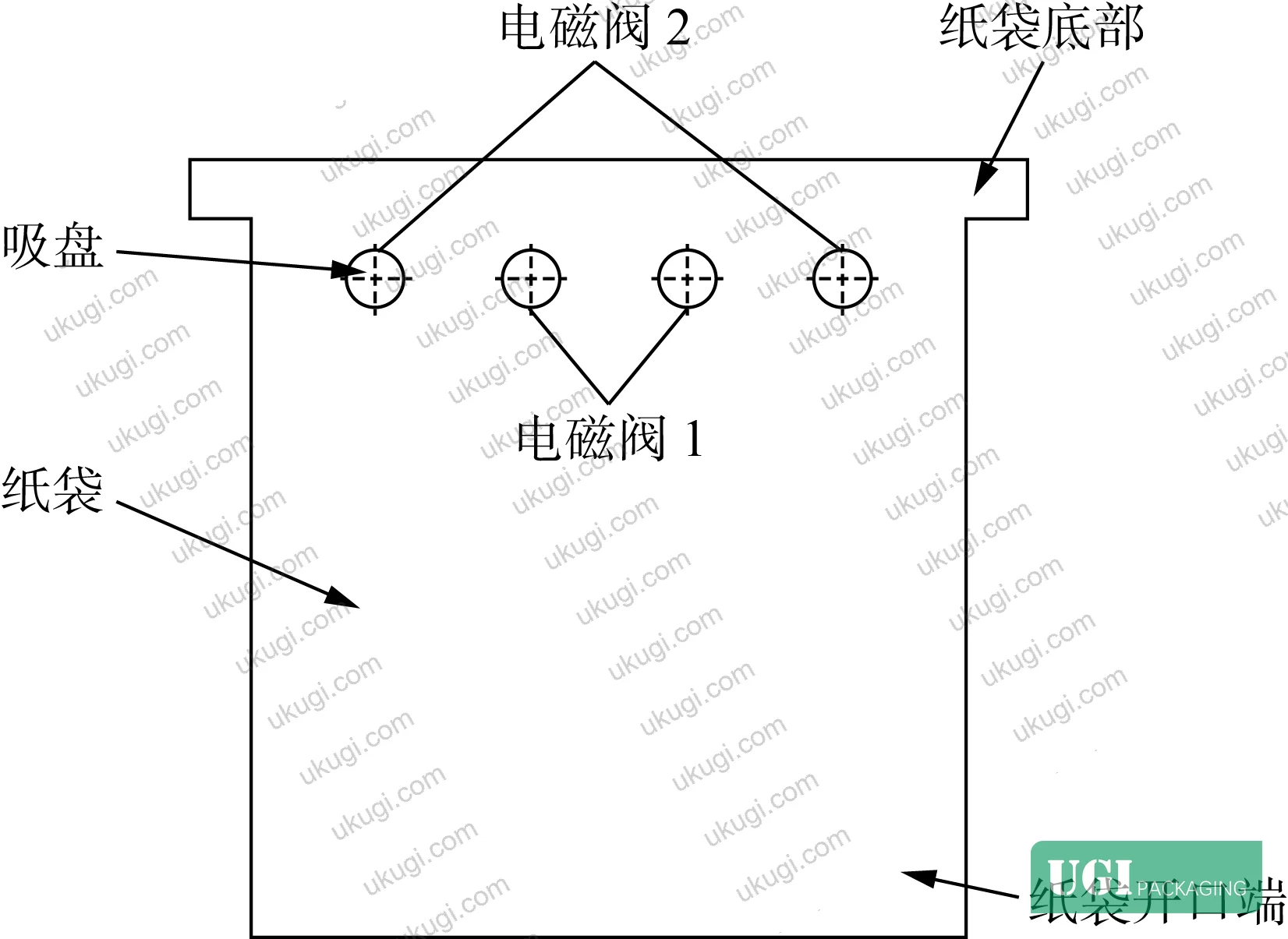
The fundamental mechanical challenge: as bags are consumed, the stack height drops, which increases the gap between the fixed-stroke cylinder and the top bag. The solution is a built-in screw-driven elevator mechanism that continuously compensates for stack depletion, maintaining constant suction cup-to-bag contact distance. Sensors at the highest and lowest elevator positions trigger alarms for manual refill or halt the line if the stack runs out.
Corrugated (bellows-type) vacuum cups are used rather than flat cups, specifically because bag thickness varies across a 200-bag stack — the corrugated profile absorbs the distance differential. Four suction cups arranged in an outward-spreading pattern operate under two separate solenoid valves, with the layout ensuring at least two cups remain active even if one circuit fails.
Bag Transfer Mechanism #
This is where equipment buyers regularly make the wrong call. The transfer mechanism uses a mechanical rodless cylinder instead of a magnetic-coupled rodless cylinder — and the reason matters. In dusty production environments (airborne vanadium nitride particulate in this case), magnetic-coupled cylinders lose coupling force over time as debris accumulates. The mechanical rodless cylinder has an axially slotted barrel with a piston yoke connecting the slider and piston directly, which is inherently immune to magnetic interference and particulate contamination of air gaps.
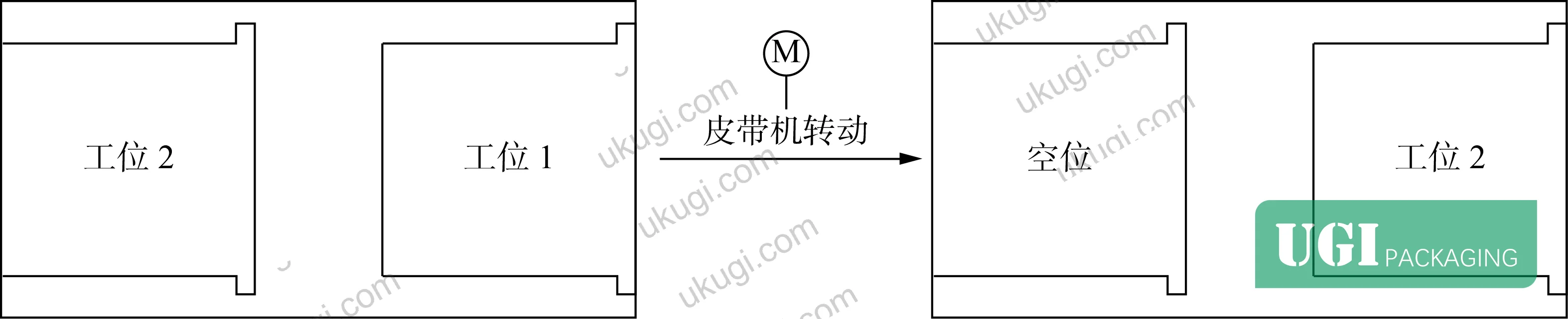
The belt conveyor in the transfer section has two stations, advancing one bag length (or slightly more) per cycle. This dual-station arrangement ensures that when station 1 delivers a bag to the opening position, station 2 simultaneously picks up the next bag — maintaining continuous throughput without idle time between cycles.
Bag Opening Mechanism #
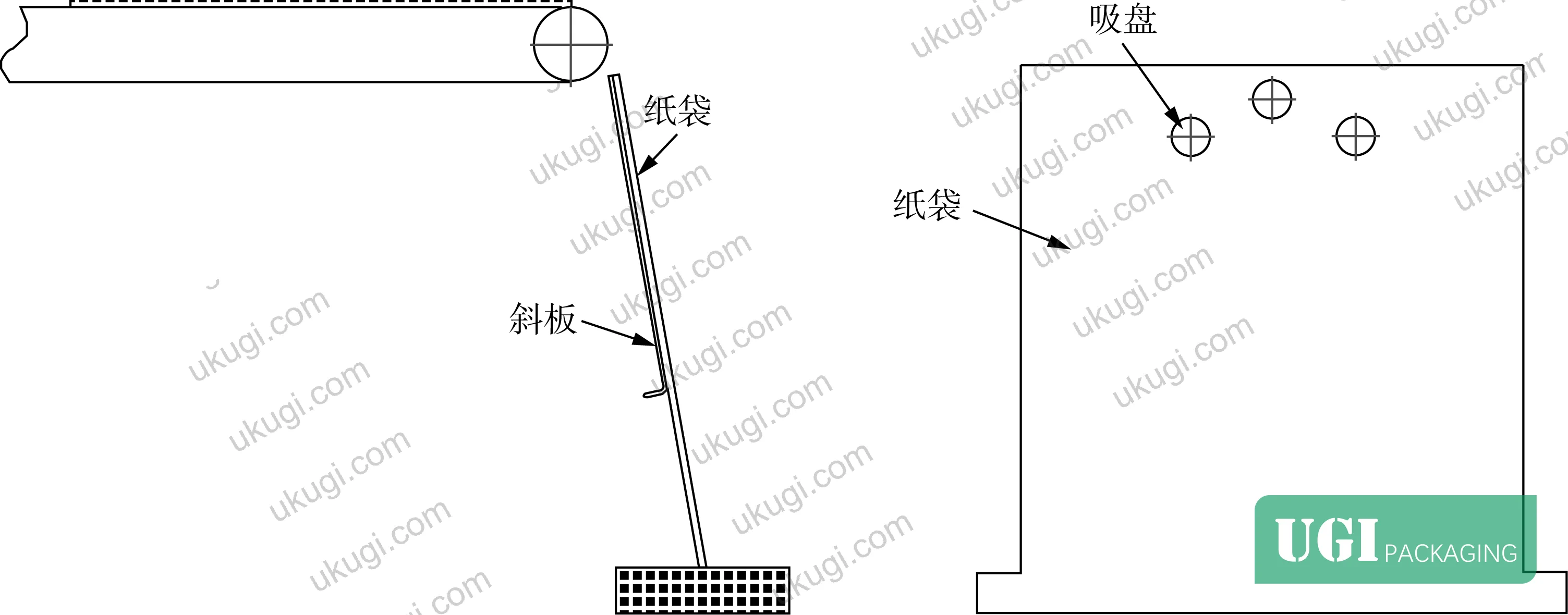
The opening method is gravity-assisted inclined-plate (斜板自溜式): bags slide by gravity onto a receiving platform and lean against an angled plate set at 10° from vertical. This angle is a deliberate design parameter — steeper and the bag deforms against the plate before the suction cups engage; shallower and the bag doesn’t self-position reliably.
Three pairs of suction cups in a conical arrangement open the bag mouth. The suction cup diameter here mirrors the storage bin specification for parts commonality. Two pairs of cylinders drive the opening action, with stroke travel determined by the required bag mouth opening dimension. The fill chute descends to 1/3 depth inside the open bag before release — not full depth, not surface contact.
A photoelectric sensor monitors bag opening confirmation. No open signal, no fill release. This interlock is not optional — without it, granular material drops onto a closed or partially open bag mouth, which causes jamming and creates exactly the kind of dust cloud the automation was designed to eliminate.
Vacuum Suction Cup Selection and Hold Force Engineering #
This section gets skipped in most procurement documents. It shouldn’t be.
The hold force (保持力, F_H) calculation depends on three operational configurations, each with a different safety factor:
- Suction cup horizontal, workpiece vertical motion: F_H = m(g + a) × S, where S = 1.5
- Suction cup horizontal, workpiece horizontal motion: F_H = m(g + a/μ) × S, where μ = 0.1 for oiled surfaces
- Suction cup vertical, workpiece vertical motion: F_H = m/μ × (g + a) × S, where S = 2.0
The standard circular suction cup parameter table used for selection covers diameters from 20 mm to 50 mm:
Suction Cup Technical Parameter Comparison #
| Cup Diameter (mm) | Release Force at –0.7 bar (N) | Cup Volume (cm³) | Mass (g) |
|---|---|---|---|
| 20 | 17.6 | 0.318 | 6 |
| 30 | 40.8 | 0.867 | 9 |
| 40 | 69.6 | 1.566 | 16 |
| 50 | 105.8 | 2.387 | 22 |
All cups use M6 × 1 thread interface. The jump from 30 mm to 40 mm diameter represents a 70% increase in release force — a significant step that matters when handling bags near the upper weight limit or with surface texture variability. For heavy or dusty environments, silicone-grade corrugated cups are specified over standard rubber to maintain suction performance across the operating temperature range of the equipment.
Honestly, most equipment buyers don’t ask for this calculation at all. They accept whatever cup size the machine builder defaults to, then wonder why they get intermittent bag drops six months into production. If your supplier can’t show you the hold force calculation for your specific bag weight and motion profile, that’s a red flag.
The operating rule derived from the compression distance: the number of bags that can be drawn before the elevator must step up is P = X/t, where X is the vacuum cup compression depth (mm) and t is individual bag thickness (mm). This means the elevator step frequency is directly predictable — and can be programmed as a PLC counter rather than relying on a sensor that may fog or coat in a dusty environment.
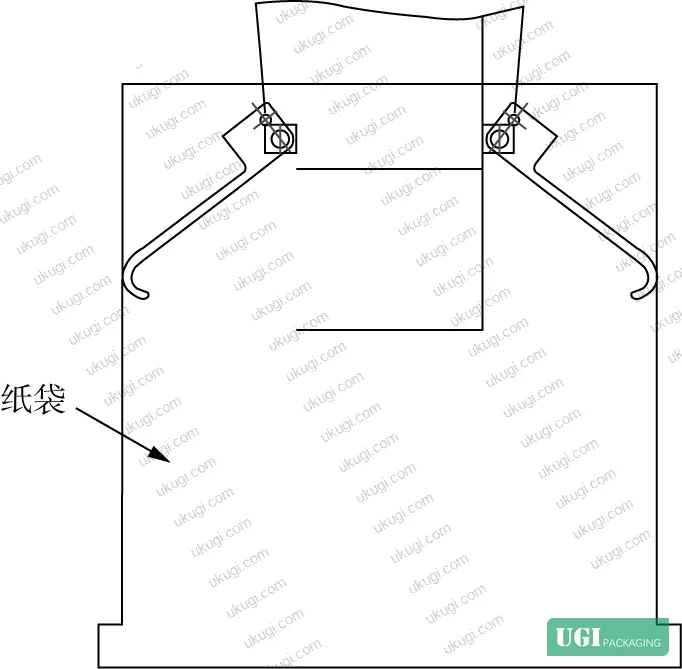
Bag Support Mechanism and Post-Fill Mouth Integrity #
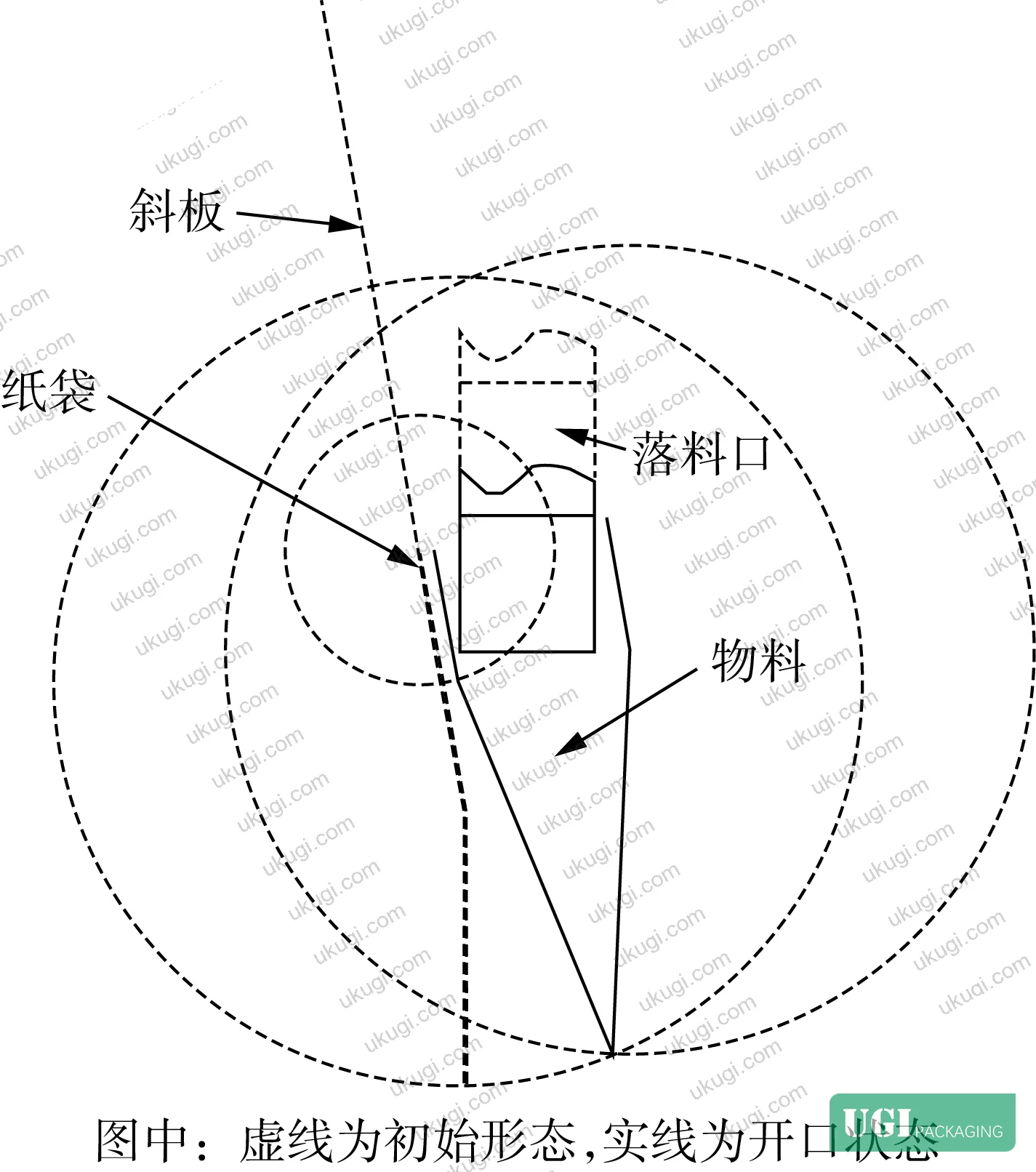
The bag support mechanism (撑袋机构) addresses a failure mode that manual packaging operators handle intuitively but automated lines routinely get wrong. When irregular granular particles — in this application, pieces up to 40 mm × 40 mm — fall into an open paper bag, the impact deforms the bag mouth. A deformed mouth means the seam sealer (缝包机) either jams, skips stitches, or seals an uneven closure that fails in transit.
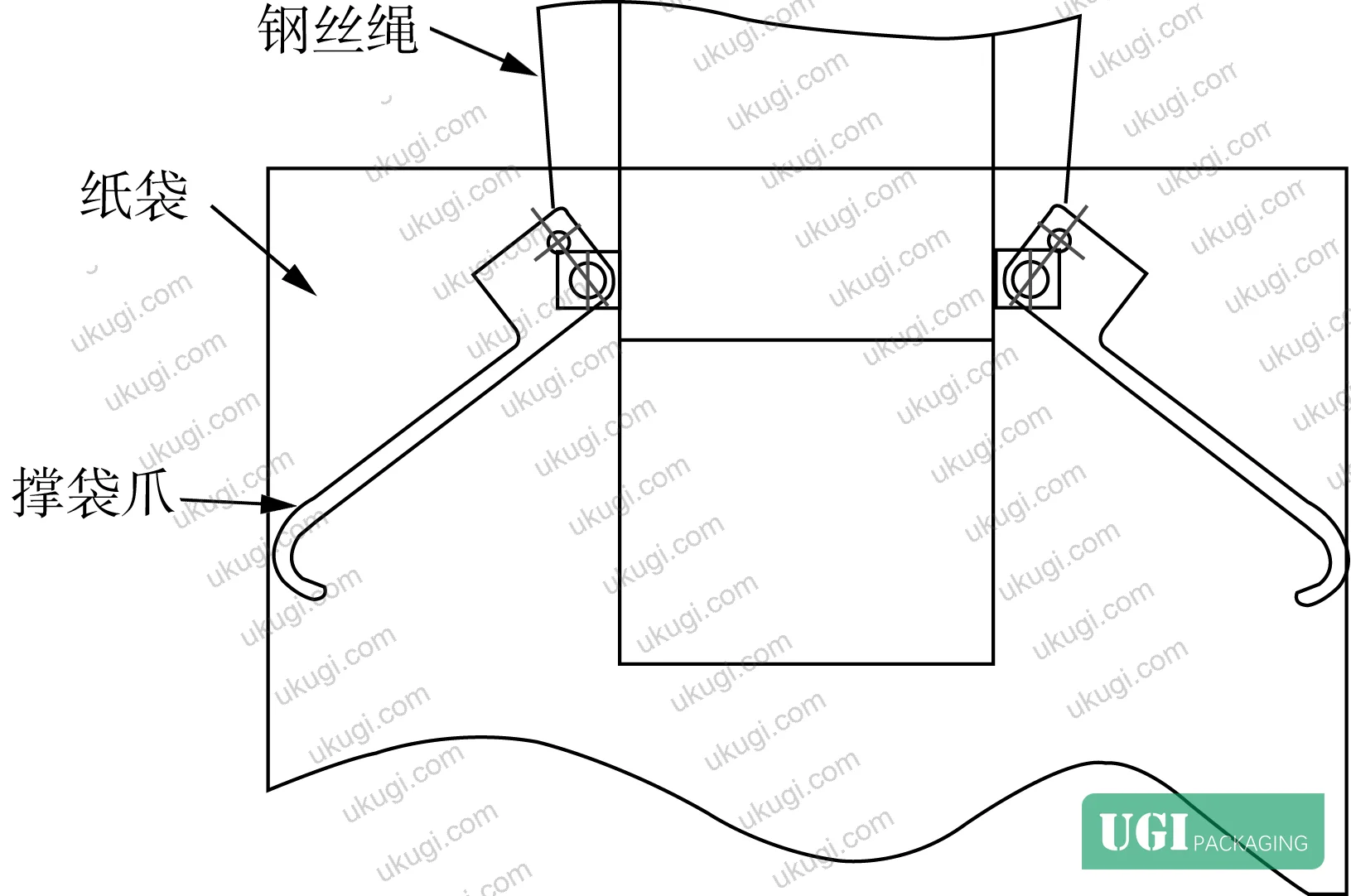
The mechanism uses a telescoping fill chute with paired swing-arm spreaders (撑袋爪) mounted on axle seats on the chute’s outer wall. In rest state, the spreader arms hang vertical under gravity. When the fill cycle activates, a cylinder extends the telescoping chute into the bag (minimum 1/3 insertion depth), and simultaneously a steel wire rope attached to the spreader arms pulls them outward, pressing against the interior fold lines of the bag sides.
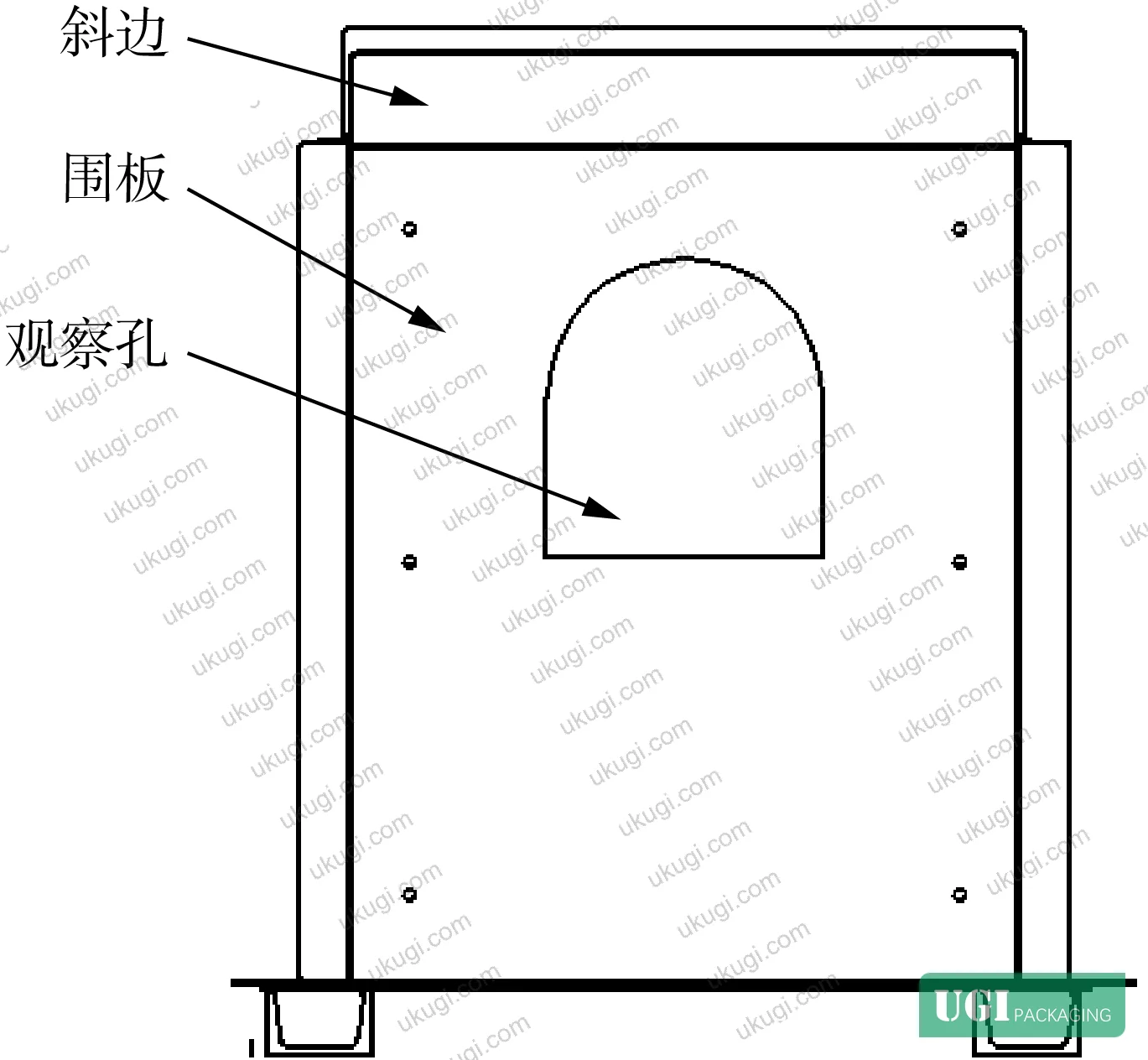
The spreader arm length constraint is: arm length c ≥ distance from the arm pivot point to the bottom of the telescoping chute. This ensures the arms can reach full vertical extension inside the bag without binding against the chute wall. The axle is retained by an axial limit ring on one end and a washer-bolt assembly on the other — a detail that prevents axial migration during repeated cycling, which is a common wear failure on cheaper implementations.
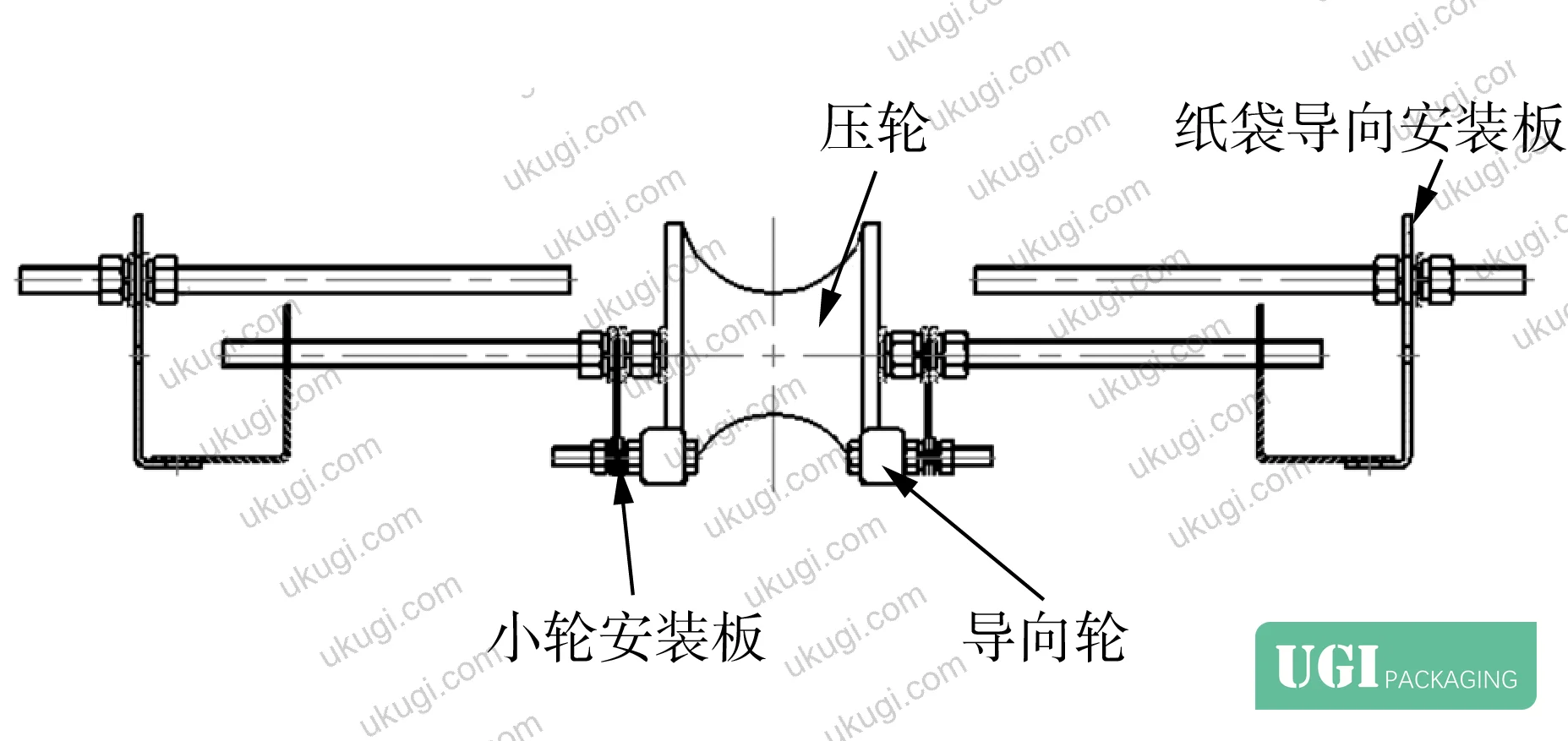
In supplier qualification, we have seen systems where the spreader arm travel was under-specified — the arm couldn’t reach the bag fold, so it just pressed the bag wall flat rather than creating any support structure. The bag mouth still deformed under fill impact. The fix required shimming the pivot mount, which wasn’t designed for field adjustment. Design this right the first time.
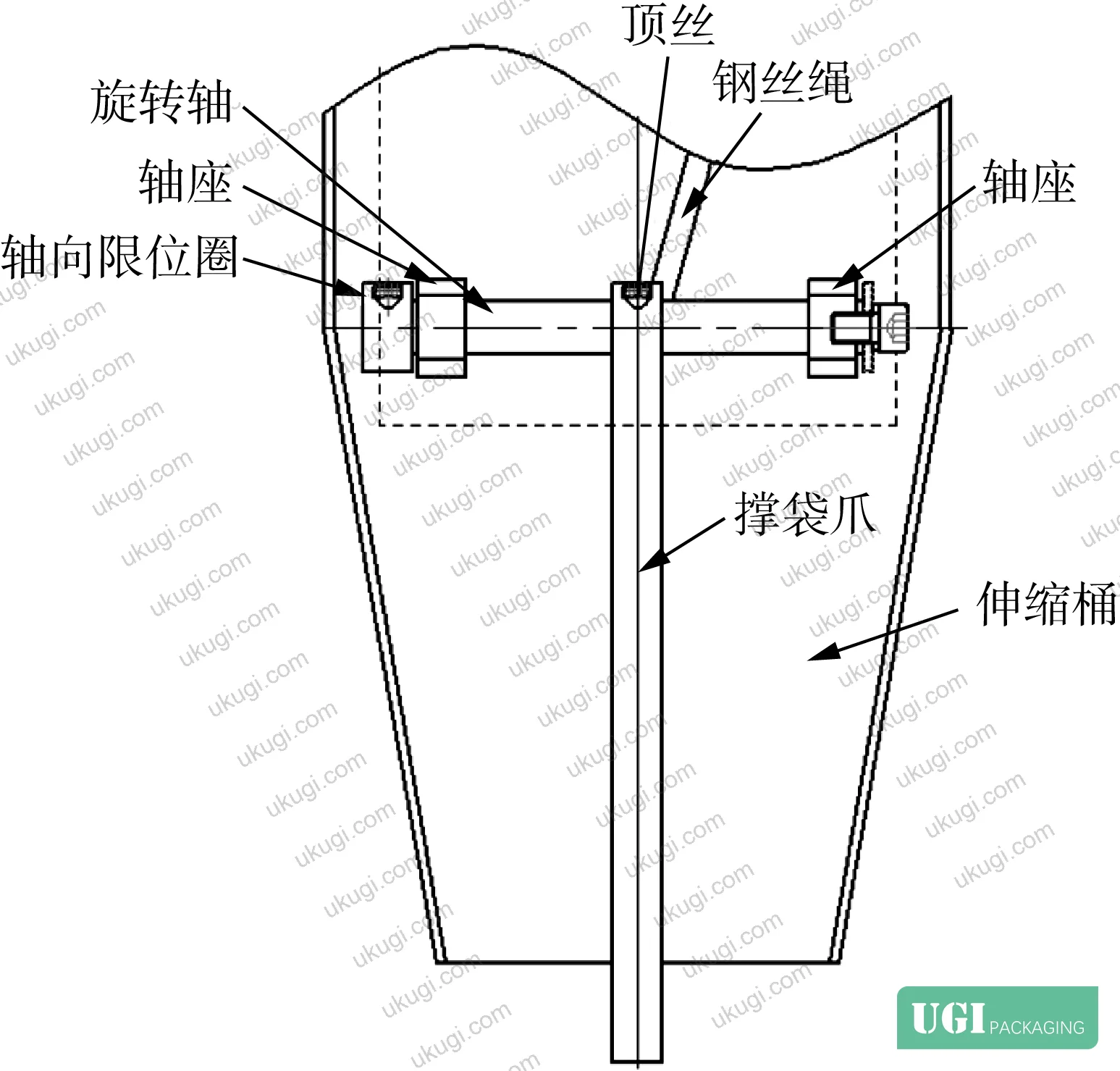
The complete bag support and fill chute assembly is shown below, with the spreader arms in active working position:
PLC Control Architecture and Operator Interface #
The control system integrates all five mechanisms under PLC programmable logic with a touchscreen HMI. This is now standard for any serious packaging automation, but the specific functions matter:
- Bag count tracking (continuous, not reset-on-shift)
- Missing bag alarm — triggers when the elevator sensor detects stack depletion below the working threshold
- Fault bag alarm — flags bags that fail to open or transfer correctly, rather than allowing a misfeed to cascade
Most procurement teams don’t realize that the transition from simple relay-based bag counters to PLC-managed multi-alarm architectures represents a significant maintenance cost reduction over the equipment lifecycle. Relay logic requires physical rewiring to change alarm setpoints; PLC parameter changes are done at the HMI in minutes. For facilities running multiple bag sizes or changing packaging specifications seasonally, this flexibility has a real dollar value that doesn’t show up in the capital equipment comparison.
The system’s designed action sequence is explicitly “no redundant motion” — each mechanism step has a clear start and end condition confirmed by sensor feedback before the next step initiates. This architecture means fault isolation is clean: if a bag fails to open, the line stops at that station, not three cycles later when the downstream sealer jams.
For packaging buyers handling materials with strict dosage requirements — pharmaceutical excipients, specialty alloy additives, high-value fine chemicals — the precision argument for this kind of sequenced automation is straightforward. Consistent bag presentation means consistent fill weight variance. The ASTM D882 tensile testing standard for thin plastic sheeting and the ASTM D1709 impact resistance method are relevant when qualifying the bag substrate itself — because bag material failure during automated handling is a separate qualification step from equipment performance.
For operations where packaging integrity is critical from a regulatory or food safety standpoint, the ISO 22000:2018 food safety management framework provides a useful process control template even outside food applications — particularly the hazard analysis approach, which maps directly onto the dust and contamination risks this automation was designed to mitigate.
Practical Guidance for Buyers #
If you’re evaluating automatic bag loading equipment for irregular granular or dense powder materials, the specification you issue needs to go several levels below “automatic bag feeder.” The five-mechanism architecture described here — storage bin, drag, transfer, opening, support — should appear explicitly in any capable supplier’s technical response. If they collapse all of this into “automatic bag feeder unit,” probe harder.
Key procurement checkpoints: specify the bag capacity of the storage bin (200-bag minimum for single-shift operation), the suction cup material grade (silicone for dusty environments, rubber only for clean rooms), cylinder type (mechanical rodless, not magnetic-coupled, for particulate-contaminated air), and bag support arm insertion depth (minimum 1/3 bag depth confirmed by mechanism drawing).
For packaging engineers at brand owners managing contract production — whether you’re sourcing custom paper boxes or paper bags and carrier bags — understanding the automation constraints on your bag format specifications matters. A bag design that works for hand-filling may not work for automated suction handling. Wall stiffness, fold-line placement, and bag mouth geometry all affect how reliably the opening mechanism engages.
Our team at ukugi.com — a Guangzhou-based OEM/ODM manufacturer with deep experience in paper bag and packaging production — works directly with operations engineers and packaging buyers to translate these technical constraints into manufacturable bag specifications. If you’re commissioning automated packaging equipment and need to validate your bag format against suction handling and support mechanism requirements, we can provide test samples and technical data to support your equipment qualification process.
Need a custom formulation or sample? Request a quote from our team →
Technical Verification Questions #
- What is the calculated hold force (F_H in Newtons) for your suction cup selection at the specified bag weight, and which safety factor (S = 1.5 or S = 2.0) is applied based on the cup orientation and workpiece motion direction?
- What is the vacuum cup compression depth (X in mm) for your corrugated suction cups, and what is the maximum number of bags (P = X/t) that can be drawn before the elevator must advance one step, based on your bag thickness specification?
- Does the bag opening mechanism use a mechanical rodless cylinder or a magnetic-coupled rodless cylinder for transfer, and what is the documented rationale for that selection given the particulate contamination level in the intended operating environment?
- What is the specified minimum insertion depth of the fill chute into the open bag (must be ≥ 1/3 of bag length) and what is the spreader arm length relative to the pivot-to-chute-bottom distance to confirm the arm reaches full vertical extension inside the bag?
- What alarms are integrated into the PLC control architecture — specifically, does the system include bag count tracking, missing bag alarm, and fault bag alarm as discrete functions, and can alarm setpoints be modified at the HMI without relay rewiring?
Quality Verification Checklist #
- ☐ Storage bin capacity confirmed at ≥ 200 bags of specified size (400 mm × 430 mm or equivalent), with elevator sensor confirmation at maximum and minimum positions
- ☐ Suction cup material specified as silicone-grade corrugated type for operating environments with airborne particulate contamination; hold force calculation documented at S ≥ 1.5 for vertical motion
- ☐ Cylinder type confirmed as mechanical rodless (not magnetic-coupled) for transfer mechanism in dusty or contaminated air environments
- ☐ Bag opening mechanism includes photoelectric sensor interlock: no confirmed bag open signal = no fill release
- ☐ Fill chute insertion depth verified at minimum 1/3 of bag length; spreader arm length confirmed as c ≥ pivot-to-chute-bottom distance
- ☐ Bag support spreader arm axle retained by limit ring + washer-bolt on opposite end; no free axial migration under repeated cycling confirmed by drawing review
- ☐ PLC control system includes three discrete alarm functions: bag count, missing bag alarm, and fault bag alarm — each independently configurable at touchscreen HMI
- ☐ Inclined plate angle set at 10° from vertical for gravity-assisted bag positioning; adjustment mechanism documented for bag format changes
Key Specifications Table #
| Parameter | Recommended Value | Verification Method |
|---|---|---|
| Bag storage bin capacity | 200 bags (400 mm × 430 mm) per load | Drawing review + physical count during commissioning run |
| Vacuum cup safety factor (vertical motion) | S = 2.0 (vertical cup / vertical workpiece motion) | Hold force calculation review: F_H = m/μ × (g + a) × S |
| Fill chute insertion depth | ≥ 1/3 of bag length | Mechanism drawing + sensor confirmation log during trial run |
| Suction cup release force (40 mm cup at –0.7 bar) | 69.6 N | Supplier data sheet vs. standard circular suction cup parameter table |
| Spreader arm length | c ≥ pivot-to-chute-bottom distance | Dimensional drawing check |
| Inclined plate angle | 10° from vertical | Protractor check at installation |
| Cylinder type for transfer mechanism | Mechanical rodless (axially slotted barrel) | Component specification sheet + visual inspection |
| Belt conveyor stations | 2 stations, advance = 1 bag length per cycle | Cycle timing test during FAT |
Looking for a manufacturer that meets these specs? Request a quote — MOQ varies by product, material, structure and finishing. Product-specific MOQ is confirmed with each quotation.
References #
Data source: Design and Implementation of an Automatic Bag Loading and Opening System for Irregular Granular Material Packaging in Industrial Production Lines, Q.-J. Hu et al., Journal of Applied Polymer Science, 2023
Frequently Asked Questions #
What is the minimum bag storage capacity recommended for single-shift operation without manual intervention?
The system is designed with a 200-bag storage bin capacity. The actual required capacity depends on the packaging line output rate M (bags/hour) multiplied by the planned operating interval h (hours), giving s = M × h. For a 40-bag/hour line running a 4-hour block between operator checks, 200 bags comfortably exceeds the minimum requirement with buffer.
Why use a mechanical rodless cylinder instead of a magnetic-coupled rodless cylinder in the bag transfer mechanism?
In environments with airborne particulate contamination — which is typical for any dense mineral or chemical packaging line — magnetic-coupled rodless cylinders lose coupling force over time as debris coats the air gap between the external slider and the internal magnet. The mechanical rodless cylinder connects the slider and piston directly through an axial slot in the barrel, which is immune to this failure mode. It’s a straightforward reliability decision, not a cost optimization.
What happens if a bag fails to open properly during the automated cycle?
The opening station includes a photoelectric sensor that confirms bag mouth opening before the fill release is permitted. If the sensor does not detect a confirmed open state, the fill cycle does not initiate and a fault bag alarm triggers at the PLC/HMI. The line halts at that station rather than propagating a misfeed downstream.
How does the bag support mechanism prevent bag mouth deformation during fill?
When the fill chute extends into the bag (minimum 1/3 insertion depth), paired swing-arm spreaders mounted on the chute’s outer wall are simultaneously pulled outward by steel wire rope connected to the actuating cylinder. The spreader arms press against the interior fold lines on both sides of the bag, maintaining the mouth geometry under the impact of falling granular material. Without this mechanism, particles up to 40 mm × 40 mm create sufficient impact to deform the bag mouth and compromise subsequent seam sealing.
Is this type of automation applicable to bags other than 5 kg kraft paper bags?
The core architecture — storage bin with elevator compensation, corrugated suction cups, belt transfer, gravity-assisted inclined-plate opening, and spreader bag support — is adaptable to other small paper bag formats. The adjustable guide roller assembly on the belt conveyor allows belt width adjustment, and suction cup sizing can be recalculated for different bag weights using the documented hold force formulas. The primary constraint is bag material stiffness: bags that are too limp may not self-position reliably on the inclined plate without additional guide modifications.
Published by ukugi.com Technical Team | Request a quote


