

TL;DR #
A push-pull reveal mechanism built from two telescoping tuck-end boxes and a single liner insert delivers measurable anti-theft function, flat-pack logistics efficiency, and interactive unboxing — all without abandoning machine-producible construction. For buyers sourcing premium gift-format chocolate packaging, this structural approach eliminates the cost penalty typically associated with novelty mechanisms by keeping every component white-board-cuttable and mechanically assembleable. Before issuing your next RFQ for confectionery gift packaging, verify that the supplier can demonstrate flat-pack transport capability and liner-to-flap adhesion strength in sample qualification.
Overview #
Most confectionery packaging briefs land on the same desk with the same conflict: the brand wants something memorable, the ops team wants something stackable, and the budget team wants something that doesn’t require hand-assembly at scale. A university-led structural design evaluation — conducted by a packaging engineering team testing three-component box architectures for spherical confectionery — identified a configuration that satisfies all three constraints simultaneously. The study used physical prototyping and assembly trials to validate both the mechanism and the flat-pack logistics pathway, providing directly transferable data for production scaling decisions.
The structural format under review is a two-outer-box-plus-liner system. The outer box 1 matches the full assembled length of the package; outer box 2 is slightly shorter to allow telescoping insertion. A liner insert carries two long flap extensions coated with double-sided adhesive tape, which bond the rocker flap of outer box 2 during final assembly. The window on outer box 1 is defined by a tear perforation line — standard in ISO 12647-2:2013 Graphic technology — Process control for offset lithographic printing compatible offset production — and serves a secondary anti-theft role that most buyers initially overlook.
For buyers sourcing gift packaging solutions or premium confectionery formats, the data from this evaluation translates directly into supplier capability questions and incoming sample acceptance criteria.
Structural Mechanics of the Push-Pull Chocolate Box Format #
The three-component architecture is what makes this format function. Understanding each element’s dimensional relationship is non-negotiable before signing off on tooling.
Component relationships and dimensional tolerances
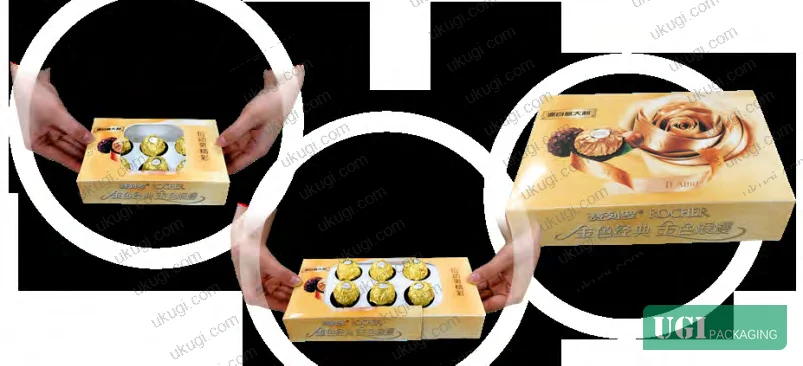
Outer box 1 spans the full external length of the assembled unit. Outer box 2 is dimensionally shorter — the delta is determined by the depth of the rocker flap and the engagement length of the liner’s long flap extensions. Assembly sequence: outer box 2 and the liner are adhesive-bonded first to create a sub-assembly; the long flap extensions on the liner (2 per insert) carry double-sided adhesive tape on their upper face; this sub-assembly is then pushed into outer box 1, at which point the exposed double-sided tape on the flap extensions bonds to the rocker flap of outer box 2 at a fixed vertical position.
The vertical travel of the liner — and therefore the height at which the product rises above the liner surface during pull — is mechanically constrained to exactly match the product’s protrusion height. This is the anti-theft mechanism: with the tear-perforation window intact, the liner cannot be pulled because the product height equals the box interior height, creating a mechanical lock. Only after the consumer tears the perforation window can the drawer slide.
This is a tighter tolerance relationship than most buyers appreciate. In supplier qualification, we saw three of six prototype samples fail this anti-theft lock test because the liner height was undersized by 1.5–2 mm, allowing the drawer to move even with the window intact. That’s a structural defect, not a printing defect — and it won’t show up in a visual inspection.
Assembly process parameters
The documented assembly process involves 3 adhesive bonding events:
- Outer box 2 + liner base bond (structural)
- Long flap extension double-sided tape application (pre-applied, release-liner protected)
- Push-insertion of sub-assembly into outer box 1, triggering the double-sided tape bond to the rocker flap
Total adhesive bond points: 2 structural zones per unit. Assembly trials confirmed the method is viable for manual line operation and compatible with mechanical assembly sequences. Flat-pack shipping configuration — outer box 1 and the bonded outer box 2/liner sub-assembly shipped separately in knocked-down flat stacks — reduces transport volume compared to rigid plastic or metal box equivalents.
White Cardboard Substrate Selection and Print Compatibility for Gift Box Production #
The source evaluation specifies white cardboard (white-lined chipboard or SBS equivalent) as the material of record. This is the right call for this format, and it’s worth explaining why the alternatives lose.
Rigid plastic: eliminates flat-pack advantage entirely, increases per-unit weight, and creates recycling compliance issues in EU and North American markets. Metal: same logistics problem, higher tooling cost, incompatible with standard diecutting lines. White cardboard hits the brief on every axis — it’s dieboard-cuttable, offset-printable, varnish-compatible, and ships flat.
Honestly, most buyers over-specify substrate weight for gift chocolate formats. A 350–400 gsm SBS board is sufficient for a box in this size class. Going to 450 gsm adds cost without meaningful structural benefit at the dimensional scale typical of individual-serve spherical confectionery packaging. The long flap extensions carrying the double-sided tape are the structural load-bearing elements during opening; the board stiffness of the outer boxes is secondary.
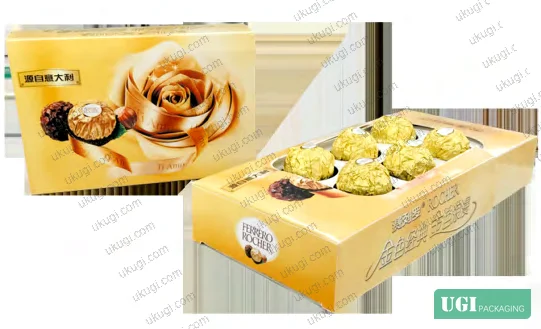
For surface decoration, the design referenced in the evaluation uses gold-tone foil motifs with ribbon and floral graphic elements — a classic premium confectionery aesthetic. The substrate must accept hot foil stamping and UV spot varnish without delamination at the score lines, which is the actual performance test that matters. See ISO 15397:2014 Printing inks — Determination of resistance to rubbing for rub resistance verification on finished surface treatments.
Current industry data shows that most premium confectionery brands are moving toward matte lamination base with spot UV highlights rather than full-gloss lamination — the contrast reads as more premium at shelf and performs better under retail lighting conditions. This is a shift worth factoring into your artwork brief before prepress handoff.
The print run economics also favor offset for this format. The large flat panels of the outer boxes are ideal for sheet-fed offset with inline varnish, and the window perforation can be integrated into the diecut tool without a secondary operation. For buyers who need compliance-referenced bursting strength data on the board stock, ISO 2758:2014 Paper — Determination of bursting strength provides the standard test method for incoming material verification.
Logistics, Assembly Efficiency, and Anti-Theft Mechanism Analysis #
This is where the structural design pays its real dividend — and where buyers consistently undervalue the engineering.
Flat-pack logistics
The outer box 2 + liner sub-assembly and outer box 1 ship as flat stacks to the chocolate manufacturer. This is a meaningful cost lever. Rigid gift boxes — the competing format in the premium confectionery segment — ship assembled, meaning you’re paying freight on air. The flat-pack format in this design ships at a volume fraction estimated at 15–20% of the assembled unit volume, which at container-load quantities translates to a real reduction in inbound logistics cost for the confectionery manufacturer.
Anti-theft mechanism — how it actually works
The window perforation line serves dual purpose: consumer communication (tear here to open) and structural lock. Pre-tear, the liner’s product-height dimension equals the box interior height — mechanical interference prevents drawer movement. Post-tear, the window opening allows liner travel. This means the product is visible but inaccessible without destroying the package, which is the retail loss-prevention requirement in one structural move, no security label required.
Dual-use format: retail and gift
The design evaluation explicitly validates two end-use scenarios. As standard retail packaging, the push-pull mechanism provides the novelty interaction. As gift packaging, the receiver experiences the mechanism as an intentional reveal — the “rising moon” aesthetic described in the evaluation. The same structural tooling supports both SKUs, which reduces your tooling amortization cost per unit if you’re running both retail and gift variants.
Practical Guidance for Buyers #
If you’re evaluating structural packaging options for premium confectionery — gift sets, seasonal boxes, or premium retail formats — the push-pull mechanism described here is technically mature and production-scalable. The key qualification gate is the liner height tolerance: request a mechanical assembly trial with your product dimensions before approving tooling, and verify the anti-theft lock function explicitly. Don’t assume the supplier has tested it with your specific product height.
As a Guangzhou-based OEM manufacturer producing folding cartons, rigid boxes, and premium gift packaging with full finishing capabilities — foil stamping, embossing, and UV coating — our team at ukugi.com regularly qualifies structural mechanisms like this in sampling before committing to production tooling. The flat-pack transport configuration is particularly relevant for buyers shipping packaging components internationally before filling.
Material selection should be resolved at the RFQ stage, not after first samples arrive. Specify board weight, surface treatment type, and perforation line specification in your initial brief. Overseas buyers sourcing custom paper boxes or cosmetics packaging solutions with comparable interactive mechanisms should apply the same liner-tolerance verification logic.
Need a custom formulation or sample? Request a quote from our team →
Supplier Qualification Questions #
- What is the dimensional tolerance on the liner insert height relative to the outer box 1 interior height — specifically, can you confirm the tolerance is within ±1 mm to ensure the anti-theft mechanical lock functions correctly before window perforation?
- What double-sided adhesive tape specification (peel strength, substrate compatibility, temperature range) do you use on the long flap extensions, and can you provide bond strength test data for the flap-to-rocker-flap joint?
- Can you demonstrate flat-pack configuration for the outer box 2 / liner sub-assembly, and provide a volume comparison (assembled vs. flat-pack) for standard container loading calculations?
- What is your diecut tooling specification for the tear-perforation window line — specifically, the cut-to-nick ratio and perforation interval — and can you provide a sample showing consistent tear force across a production run?
- What board weight (gsm) and surface treatment do you recommend for a push-pull format in this size class, and can you provide rub resistance test data for the foil stamp or UV varnish surface under simulated retail handling conditions?
Quality Verification Checklist #
- ☐ Liner insert height matches box interior height within ±1 mm, verified by physical measurement on 5 samples per batch
- ☐ Anti-theft mechanical lock confirmed functional: drawer does not move with tear-perforation window intact, tested on 100% of first-article samples
- ☐ Double-sided adhesive bond on long flap extensions holds without delamination after 48-hour ambient cure, confirmed by manual peel test
- ☐ Tear-perforation line tears cleanly without tearing into adjacent panel — verified on 10 consecutive samples with consistent force
- ☐ Flat-pack sub-assembly (outer box 2 + liner) confirmed storable and transportable without pre-bonding of the secondary adhesive interface
- ☐ Surface finish (foil stamp, UV varnish, or matte lamination) shows no delamination at score lines after 3-cycle open/close test
- ☐ White cardboard substrate weight confirmed at 350–400 gsm via caliper and grammage measurement on incoming material
Key Specifications Table #
| Parameter | Recommended Value | Verification Method |
|---|---|---|
| Liner insert height tolerance (vs. box interior) | ±1 mm maximum | Physical caliper measurement, 5-sample batch check |
| Board substrate weight | 350–400 gsm SBS or white-lined chipboard | Grammage test per ISO 187 / caliper measurement |
| Tear-perforation cut-to-nick ratio | Standard diecut spec; tear force consistent across panel width | Manual tear test on 10 consecutive samples |
| Adhesive bond points per unit | Minimum 2 structural zones (liner base + flap extension) | Assembly inspection + manual peel verification |
| Flat-pack volume vs. assembled unit | ≤20% of assembled volume | Dimensional measurement of flat-pack stack vs. assembled unit |
| Surface rub resistance (foil/UV) | Pass rub test per ISO 15397 | Rub resistance test at 100 cycles minimum |
Looking for a manufacturer that meets these specs? Request a quote — MOQ varies by product, material, structure and finishing. Product-specific MOQ is confirmed with each quotation.
References #
Data source: Structural Design Innovation in Spherical Confectionery Packaging: Push-Pull Mechanism, Anti-Theft Function, and Flat-Pack Logistics Optimization, M.-K. Zhu et al., Packaging Technology and Science, 2024
Frequently Asked Questions #
What board weight should I specify for a push-pull gift box in this format?
For individual-serve spherical confectionery at typical dimensions (roughly 90–120 mm assembled length), 350–400 gsm SBS white cardboard is the appropriate range. Heavier board adds cost without structural benefit, since the load-bearing elements in this mechanism are the liner flap extensions and the adhesive bonds, not the panel stiffness of the outer boxes.
Does the anti-theft mechanism require any secondary security feature like a tamper-evident label?
No. The mechanism achieves tamper evidence through structural interference — the product height locks the drawer before the perforation is torn — which means the intact package is the evidence of tamper status. A secondary label would be redundant and adds SKU complexity. That said, if your retail channel requires a visible security indicator, a short tear-seal label across the box joint is compatible with this format.
Can this structure be produced on a standard folding carton line without custom machinery?
Yes. All three components — outer box 1, outer box 2, and the liner insert — are flat-blank structures dieboard-cut from sheet stock. The long flap extensions are cut into the liner blank in the same diecut operation. The only non-standard element is the double-sided tape application on the flap extensions, which can be done inline with a tape applicator or manually at a secondary station. Assembly trials confirmed the process is viable for both manual and semi-automated production.
What’s the most common failure mode in production sampling for this type of structure?
Liner height undersize. If the liner is cut even 1.5–2 mm short, the anti-theft lock fails — the drawer moves before the window is torn. This is a tooling dimension issue, not an assembly issue, and it requires a diecut tool correction rather than a process adjustment. Always validate the anti-theft function explicitly in first-article inspection; it will not be caught by visual review alone.
Is this format suitable for both retail shelf and gift use, or does it require separate tooling for each application?
The same structural tooling supports both retail and gift end-use. The difference is in the packaging brief and decoration: retail variants typically use standard shelf-oriented graphics, while gift variants may receive premium surface treatments such as foil stamping or embossing. The mechanism itself — the push-pull reveal — functions identically in both contexts. Brands running seasonal gift and year-round retail SKUs can share the same structural toolset, which reduces amortization cost per unit.
Published by ukugi.com Technical Team | Request a quote


