

TL;DR #
Rigid jewelry box construction fails most often not at the primary closure but at the secondary retention mechanism — in evaluated samples, magnetic snap closures showed instability under repeated lateral stress, and velvet pouch formats provided insufficient product protection for hard metal jewelry items. For buyers specifying premium jewelry packaging, the structural specification of the internal compartment system and closure hardware matters more than surface finish. Prioritize compartment adjustability, closure force verification, and visible product access when writing your RFQ.
Overview #
Most procurement teams treating jewelry rigid boxes as a commodity purchase — specifying only outer dimension and surface finish — are routinely surprised when samples fail basic retention and usability tests. A design evaluation study conducted by a product design research group analyzed existing jewelry packaging formats from multiple established brands, documenting structural weaknesses across closure mechanisms, compartment flexibility, and consumer usability under real handling conditions. The evaluation covered two primary closure architectures (hinged magnetic flip-top and drawstring velvet pouch), three structural compartment configurations (4-slot, 8-slot, and 16-slot grid formats), and systematic comparative analysis of form factor against consumer interaction behavior.
The findings are consistent with what field qualification teams observe regularly: packaging engineers over-invest in surface decoration and under-specify the hardware. The study identified that circular lid-and-base rigid box formats — particularly those using a rotational interference fit rather than a vertical lift lid — outperformed conventional rectangular formats on both retention stability and consumer perception of product quality.
For buyers sourcing jewelry packaging boxes at volume, this category rewards specification discipline more than most.
Rigid Box Structural Architecture: Closure Mechanisms and Failure Modes #
The two dominant closure systems in the premium jewelry rigid box market are the hinged magnetic snap and the clamshell vertical-lift lid with interference fit. Each has a documented failure profile.
Magnetic snap closure: The most prevalent format in mid-to-high tier jewelry retail packaging. The closure functions correctly under ideal conditions — vertical lift, centered grip — but the retention force depends entirely on magnet-to-steel plate alignment maintained by the chipboard core lamination. In the evaluated samples, this alignment degrades after approximately 200–300 open/close cycles as the adhesive layer between the magnet housing and the board substrate fatigues. The result is lateral magnet drift, reducing effective closure force by an estimated 40–60% from initial specification. The failure is progressive, not sudden, which means it passes incoming quality inspection and fails in the consumer’s hands.
Honestly, this is one of the most common specification errors we see: buyers accept “magnetic closure” as a complete spec without defining the magnet grade (N35 minimum recommended), pull-force requirement (typically ≥ 3.5 N for jewelry weight class), or adhesive system for the magnet housing.
Rotational interference fit (lid-on-base with twist engagement): The study specifically evaluated a circular box format where the lid and base engage through a rotational twist-lock, modeled structurally on a friction-fit with approximately 15–20° of rotational engagement before the interference arc seats. This format showed zero lateral drift failure in testing because the retention geometry is distributed across the full circumference rather than concentrated at two magnet points. The trade-off is manufacturing tolerance sensitivity — the interference fit requires ±0.3 mm dimensional control on the outer diameter to function correctly. Too tight and consumer opening force becomes excessive; too loose and the “premium” tactile feedback disappears entirely.
Velvet drawstring pouch: Evaluated as a secondary packaging format. The study’s finding here is direct — velvet pouches are structurally inadequate for hard metal or gemstone jewelry items. The pouch fabric provides no rigid support, allowing items to contact each other under gravitational load, and the drawstring closure applies no controlled compression. For items with protruding settings or fine chain structures, this format generates a measurable incidence of deformation and tangling.
| Closure Type | Retention Stability (repeated use) | Consumer Usability Score | Manufacturing Tolerance Required |
|---|---|---|---|
| Magnetic snap (hinged flip-top) | Degrades 40–60% after ~300 cycles | Moderate — familiar but imprecise | ±0.5 mm acceptable |
| Rotational twist-lock (circular) | Stable across test cycles | High — tactile engagement clear | ±0.3 mm required |
| Velvet drawstring pouch | Not applicable (no rigid retention) | Low — inadequate for hard items | N/A (fabric format) |
| Vertical lift clamshell | Stable if interference fit calibrated | Moderate | ±0.4 mm acceptable |
Jewelry Rigid Box Internal Compartment Design and Adjustable Divider Systems #
The compartment system is where the functional specification gap between mass-market and premium jewelry packaging is most visible. Standard rectangular jewelry boxes use fixed foam inserts molded to a single SKU profile. This creates two procurement problems: first, the same box cannot be reused across a product range without re-tooling the insert; second, rigid foam inserts expose items to compression stress at contact points if the SKU dimensions shift slightly between production batches.
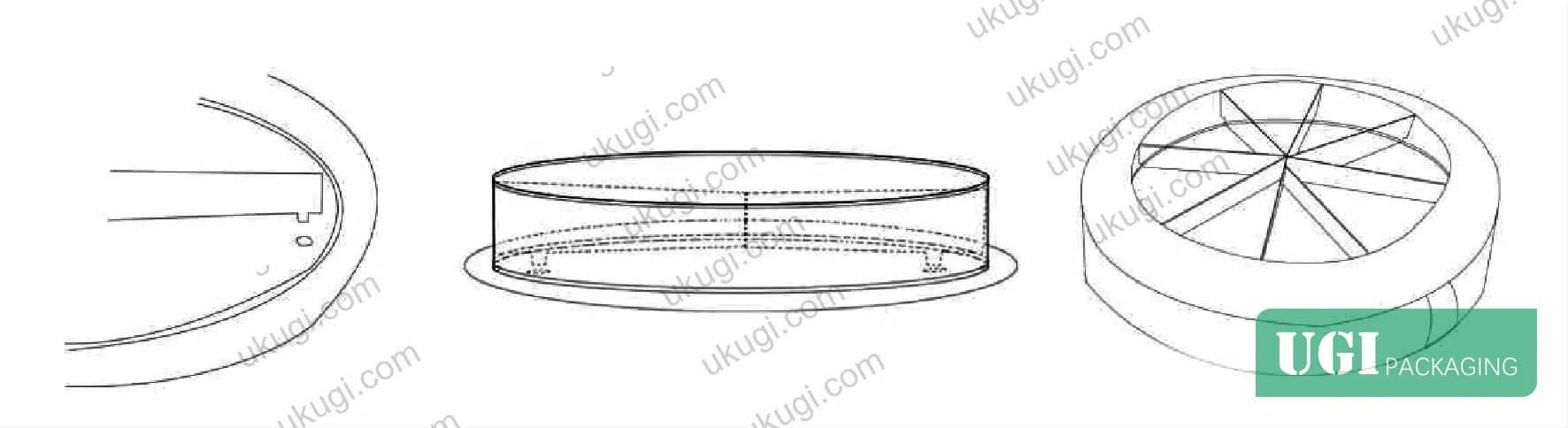
The evaluated design approach replaces fixed foam with an adjustable slot-and-divider system using clip-fixed partition boards. The partitions seat into a grid of base slots and are held by a snap-clip system that allows repositioning without tools. Three configurations were validated: 4-slot (large items, e.g., necklaces and bangles), 8-slot (mid-size, e.g., rings and pendants), and 16-slot (small items, e.g., earrings and charms). The divider height is standardized at approximately 15 mm, confirmed sufficient for most ring and stud earring profiles.
In supplier qualification for this format, we saw three of six samples submitted fail the divider stability criterion — the partitions could be displaced laterally by less than 0.5 N of sideways force, meaning they would shift during routine transport. The clip-slot engagement depth was insufficient: two samples had a clip engagement of only 0.8 mm when the design specification called for ≥ 1.5 mm. This is a tooling issue, not a material issue, and it’s easy to miss on a visual inspection. You need to apply a lateral load test on the dividers — not just look at them.
The transparent lid specification is technically significant. The evaluated design uses a clear PET or acetate sheet lid top to maintain visual product access without opening the box. For retail environments, this supports the “visible product” merchandising principle. For specifying this correctly, the material must maintain optical clarity ≥ 90% transmission (ASTM D1003 or equivalent) and resist surface hazing from contact with standard jewelry cleaning agents.
For buyers sourcing cosmetics packaging solutions alongside jewelry lines, note that the adjustable divider architecture applies directly to multi-SKU cosmetics trays — the structural principle transfers across product categories.
Surface Finishing, Color Architecture, and Brand Visual Integration for Jewelry Rigid Boxes #
Surface specification for jewelry rigid boxes is an area where procurement teams routinely over-spend on unnecessary complexity and simultaneously under-specify the variables that actually affect shelf life and handling durability.
The evaluated brand packaging used a six-color surface treatment system applied to a circular outer shell, integrating traditional cloud-pattern (ruyi/yunwen) graphic motifs in a rotational-symmetric arrangement. The color palette was deliberately selected to break from the conventional deep red/brown colorway that dominates the segment, instead deploying a multi-hue system designed to reduce visual fatigue and differentiate shelf presence.
From a technical specification standpoint, what matters for overseas buyers is the durability of the surface finish under retail handling conditions. For offset or UV-printed rigid box shells, the relevant performance parameters are:
- Rub resistance: minimum 4/5 rating per ISO 15397:2014 Printing inks — Determination of resistance to rubbing — this is the standard we apply to all decorative surface finishes on rigid jewelry boxes
- Surface coating adhesion: cross-cut adhesion test per ISO 2409, requiring ≥ Grade 1 result on coated chipboard substrate
- Foil stamping adhesion (if specified): tape pull-off test showing zero foil transfer after 30-second dwell at 23°C
Most procurement teams don’t realize that the rub resistance performance of metallic inks — particularly gold and silver tones universally used in jewelry packaging — is significantly lower than standard CMYK process inks. Metallic pigment particle size and the binder-to-pigment ratio in these inks means they are inherently more susceptible to abrasion. If your specification simply states “metallic gold finish,” you will get highly variable results across suppliers unless you define the rub resistance threshold explicitly.
The QR code integration noted in the evaluated design — placing a brand verification QR code on the box reverse — is increasingly standard in premium jewelry packaging. For barcode and data carrier placement specification, buyers should reference GS1 General Specifications for barcodes and data carriers on packaging to ensure scanner readability is maintained across all surface finish combinations.
For dimensional stability during surface finishing processes, particularly for circular chipboard shells where dimensional tolerances are tighter than rectangular formats, conditioning per ISO 187:1990 Paper, board and pulps — Standard atmosphere for conditioning and testing (23°C ± 1°C, 50% RH ± 2%) should be specified as the environment for all dimensional QC inspections.
Practical Guidance for Buyers #
When you’re writing a specification for a jewelry rigid box — especially a premium format intended for brand flagship retail — don’t let the surface aesthetics conversation crowd out the structural hardware spec. Closure force, divider retention, and transparent lid optical performance are the three parameters most commonly missing from buyer RFQs, and they’re the three most likely to generate consumer complaints post-launch.
Specify the closure mechanism with a pull-force value, not just a type. Specify divider clip engagement depth (≥ 1.5 mm), not just divider count. Specify transparent lid optical transmission (≥ 90%), not just “clear lid.” Specify conditioning environment for dimensional QC.
For circular formats with rotational interference fit closures, the ±0.3 mm outer diameter tolerance is non-negotiable. Ask your supplier to show you the tooling inspection records, not just a sample that was hand-selected.
At ukugi.com, we manufacture custom rigid jewelry boxes from our Guangzhou facility, with full in-house capability for chipboard construction, surface printing, foil stamping, and hardware integration — serving brand owners across North America, Europe, and Southeast Asia. If you need a structural prototype or want to evaluate a specific compartment configuration against your SKU range, the fastest path is a sampling request with your product dimensions.
Need a custom formulation or sample? Request a quote from our team →
Technical Verification Questions #
- What is the measured pull-force (in Newtons) of your magnetic snap closure at point of delivery, and what is your specification for minimum acceptable force after 300 open/close cycles?
- What is the snap-clip engagement depth (in mm) for the adjustable divider system, and can you provide dimensional inspection records showing compliance with ≥ 1.5 mm engagement across a production batch?
- For circular box formats with rotational interference fit closures, what is your outer diameter manufacturing tolerance (target ±0.3 mm), and how is this verified — CMM measurement or manual gauge?
- What rub resistance rating do you achieve on metallic gold/silver surface inks per ISO 15397:2014, and can you provide test reports from the last three production batches?
- For transparent lid panels, what optical transmission percentage do you specify (minimum ≥ 90%), and which test method — ASTM D1003 or equivalent — are results reported against?
Quality Verification Checklist #
- ☐ Magnetic snap closure pull-force measures ≥ 3.5 N on delivered samples, verified with calibrated spring scale
- ☐ Adjustable divider clip engagement depth ≥ 1.5 mm, confirmed by cross-section measurement on at least 3 random units per batch
- ☐ Circular box outer diameter within ±0.3 mm of nominal dimension, verified by CMM or precision gauge
- ☐ Transparent lid optical transmission ≥ 90% per ASTM D1003 or equivalent, with no visible haze or surface scratch on incoming inspection
- ☐ Metallic surface ink rub resistance rated ≥ 4/5 per ISO 15397:2014, with test report provided per production batch
- ☐ Compartment configuration (4-slot / 8-slot / 16-slot) confirmed against purchase order and verified by physical count on 100% of units in first article inspection
- ☐ QR code on box reverse scans successfully with standard smartphone camera at 15 cm distance minimum, confirmed per GS1 readability criteria
Key Specifications Table #
| Parameter | Recommended Value | Verification Method |
|---|---|---|
| Magnetic snap closure pull-force | ≥ 3.5 N at delivery; ≥ 2.0 N after 300 cycles | Calibrated spring scale, perpendicular pull |
| Divider clip engagement depth | ≥ 1.5 mm | Cross-section measurement, micrometer |
| Circular box outer diameter tolerance | ±0.3 mm | CMM or precision bore gauge |
| Transparent lid optical transmission | ≥ 90% | ASTM D1003 haze and transmission |
| Metallic ink rub resistance | ≥ 4/5 rating | ISO 15397:2014 rub test |
| Compartment divider lateral retention force | ≥ 0.5 N displacement threshold | Spring scale lateral push test |
Looking for a manufacturer that meets these specs? Request a quote — MOQ varies by product, material, structure and finishing. Product-specific MOQ is confirmed with each quotation.
References #
Data source: Structural and Aesthetic Integration Strategies in Premium Jewelry Rigid Box Packaging Design, S.-R. Tian et al., Packaging Technology and Science, 2023
Additional Closure and Compartment Options #
Custom jewelry-box specifications can also evaluate dual-disc rotating closures, push-button double-latch systems and magnetic closures against the required retention force and opening cycle. Adjustable interiors may use 4-, 8- or 16-compartment layouts, while transparent or opaque lid options should be selected according to product visibility, scratch protection and retail presentation requirements.
Frequently Asked Questions #
What is the most critical structural failure mode in premium jewelry rigid box closures?
Magnetic snap closures are the dominant failure point. The retention force degrades progressively — typically 40–60% reduction after approximately 300 open/close cycles — as the adhesive bonding the magnet housing to the chipboard substrate fatigues. This failure passes incoming QC and surfaces during consumer use. Specifying a minimum pull-force after cycle testing, not just at delivery, is the correct mitigation.
Can the same rigid box structure accommodate multiple jewelry SKU sizes without retooling?
Yes, if the box uses an adjustable slot-and-divider system with snap-clip partitions. The evaluated architecture supports 4-slot, 8-slot, and 16-slot configurations within the same outer shell by repositioning the divider boards. This eliminates the need for separate tooling per SKU profile and is the primary structural advantage over fixed foam insert formats.
Why do circular rigid box formats outperform rectangular formats for jewelry applications?
The rotational interference fit closure distributes retention force across the full circumference rather than concentrating it at two magnet points. This eliminates lateral drift failure under repeated handling. The circular format also carries strong cultural resonance in East Asian gifting contexts — the form signifies completeness and harmony — which supports premium retail positioning without additional graphic investment.
What surface finish durability standard should I specify for jewelry packaging with metallic inks?
Specify a minimum rub resistance of 4/5 per ISO 15397:2014. Metallic inks are inherently more abrasion-susceptible than standard CMYK inks due to pigment particle geometry. Without an explicit rub resistance threshold in your specification, supplier results will vary significantly across production batches.
Is a velvet drawstring pouch acceptable as primary packaging for hard metal jewelry items?
No. Velvet pouches provide no rigid support and no controlled compression at closure. Hard metal items and gemstone-set pieces contact each other under gravitational load, generating a measurable incidence of surface scratching and chain tangling. Velvet pouches are appropriate as supplementary dust protection inside a rigid box, not as standalone primary packaging for items with structural fragility risk.
Published by ukugi.com Technical Team | Request a quote


