
跳至内容
无结果
  • Knowledge Base
  • Catalog
    • Food Packaging
      • Bakery Boxes
      • Bento Box Lunch Bag
      • Bread Packaging
      • Burger & Sandwich Boxes
      • Cake Packaging
      • Cup & Sleeve
      • Cutlery & Plates
      • Dessert & Pastry Boxes
      • Dessert Takeaway Box
      • Drink Holder
      • Food Packaging Supplies
      • Insulated Delivery Bag
      • Mold, Tray & Pan
      • Retail Food Packaging
      • Snack & Popcorn Cups
      • Sweets & Desserts Supplies
      • Takeaway Bag
      • Thermal Takeout Bag
    • Gift Packaging
      • Apparel & Footwear Box
      • Candy Box
      • Corrugated Box
      • Corrugated Carton
      • Cosmetic Packaging
      • Favor Box & Tag
      • Foldable Packaging Boxes
      • Folding Carton
      • Gift Bag
      • Greeting Card
      • Humidified Cigar Gift Box
      • Jewelry Gift Box
      • Perfume Bottle & Box
      • Present Packaging
      • Stickers & Labels
      • Travel Cases & Organizers
      • Travel Perfume Atomizer
      • Watch Boxes & Display
      • Wine Packaging
  • Gallery
    • Showcase
      • Apparel Packaging
      • Chocolate Boxes
      • Cosmetic Boxes — Specialty & Folding
      • Cosmetic Rigid & Gift Sets
      • Foldable Gift Boxes
      • Macaron Boxes
      • Perfume Luxury Boxes
      • Perfume Novelty Boxes
      • Perfume Retail Boxes
    • Packaging Applications
      • Apparel Packaging
      • Bubble Envelopes
      • Cosmetics Packaging
      • Gift Packaging
      • Jewelry Packaging
      • Wine Packaging
      • Watch Boxes
    • Packaging Materials
      • Blister Cards & Clamshells
      • Hologram Stickers
      • Labels & Stickers
      • Paper Bags
      • Paper Boxes
    • Packaging Solutions
      • Packaging Solutions
  • Resources
    • Manufacturing Guides
      • Surface Finishes Guides
      • Printing Techniques
      • Packaging Materials Insights
    • OEM & ODM Solutions
      • Graphic Design Knowledge
      • Packaging Design Insights
    • Packaging Guides
      • Food Packaging Insights
      • Gift Packaging Insights
      • Foldable Box Tutorials
      • Packaging Application Cases
  • Company
    • About
    • Contact
    • Privacy Policy
UGI Printing & Packaging
  • Knowledge Base
  • Catalog
    • Food Packaging
      • Bakery Boxes
      • Bento Box Lunch Bag
      • Bread Packaging
      • Burger & Sandwich Boxes
      • Cake Packaging
      • Cup & Sleeve
      • Cutlery & Plates
      • Dessert & Pastry Boxes
      • Dessert Takeaway Box
      • Drink Holder
      • Food Packaging Supplies
      • Insulated Delivery Bag
      • Mold, Tray & Pan
      • Retail Food Packaging
      • Snack & Popcorn Cups
      • Sweets & Desserts Supplies
      • Takeaway Bag
      • Thermal Takeout Bag
    • Gift Packaging
      • Apparel & Footwear Box
      • Candy Box
      • Corrugated Box
      • Corrugated Carton
      • Cosmetic Packaging
      • Favor Box & Tag
      • Foldable Packaging Boxes
      • Folding Carton
      • Gift Bag
      • Greeting Card
      • Humidified Cigar Gift Box
      • Jewelry Gift Box
      • Perfume Bottle & Box
      • Present Packaging
      • Stickers & Labels
      • Travel Cases & Organizers
      • Travel Perfume Atomizer
      • Watch Boxes & Display
      • Wine Packaging
  • Gallery
    • Showcase
      • Apparel Packaging
      • Chocolate Boxes
      • Cosmetic Boxes — Specialty & Folding
      • Cosmetic Rigid & Gift Sets
      • Foldable Gift Boxes
      • Macaron Boxes
      • Perfume Luxury Boxes
      • Perfume Novelty Boxes
      • Perfume Retail Boxes
    • Packaging Applications
      • Apparel Packaging
      • Bubble Envelopes
      • Cosmetics Packaging
      • Gift Packaging
      • Jewelry Packaging
      • Wine Packaging
      • Watch Boxes
    • Packaging Materials
      • Blister Cards & Clamshells
      • Hologram Stickers
      • Labels & Stickers
      • Paper Bags
      • Paper Boxes
    • Packaging Solutions
      • Packaging Solutions
  • Resources
    • Manufacturing Guides
      • Surface Finishes Guides
      • Printing Techniques
      • Packaging Materials Insights
    • OEM & ODM Solutions
      • Graphic Design Knowledge
      • Packaging Design Insights
    • Packaging Guides
      • Food Packaging Insights
      • Gift Packaging Insights
      • Foldable Box Tutorials
      • Packaging Application Cases
  • Company
    • About
    • Contact
    • Privacy Policy
UGI Printing & Packaging

Printing & Production Technology

979
  • Printing Processes
    • Offset Printing
      • Color Sequence, Plate Layout, and Substrate Selection in Offset Folding Carton Production
      • Defect Classification and Process Control in Offset Color Carton Printing
      • Double-Pass Base Color Printing: Defect Reduction and Process Control for White-Coated Folding Cartons
      • Metallic Ink Printing on Folding Cartons: Failure Modes, Process Controls, and Substrate Qualification
      • Sample & Quotation Request Guide for Offset Printing
      • Packaging Standards Explained for Offset Printing
      • Offset Printing — Testing & Validation Protocol
      • Offset Printing — Storage & Handling Guide
      • Offset Printing — Installation & Integration Guide
      • Offset Printing — Industry Case Study
      • Offset Printing — Safety & Risk Assessment
      • Offset Printing — Design Engineering Reference
      • Offset Printing — Lifecycle & Maintenance Guide
      • Offset Printing — Application & Performance Guide
      • Offset Printing — Material Selection Guide
      • Offset Printing — Technical Specification Overview
      • Offset Printing — Comparison & Upgrade Guide
      • Offset Printing — Procurement & Cost Guide
      • Offset Printing — Troubleshooting & Failure Guide
      • Offset Printing — Regulatory & Compliance Guide
      • Offset Printing — Supplier Qualification Guide
      • UV Offset for Packaging: Cure Energy, Ink Chemistry & Substrate Compatibility Guide
      • Offset Ink & Fountain Solution: pH, Conductivity & Ink-Water Balance Data
      • Sheet-Fed Offset Press Parameters: Impression Pressure, Ink Density & TVI Control
    • Gravure Printing
      • Sample & Quotation Request Guide for Gravure Printing
      • Packaging Standards Explained for Gravure Printing
      • Gravure Printing — Procurement & Cost Guide
      • Gravure Printing — Application & Performance Guide
      • Gravure Printing — Material Selection Guide
      • Gravure Printing — Industry Case Study
      • Gravure Printing — Safety & Risk Assessment
      • Gravure Printing — Design Engineering Reference
      • Gravure Printing — Lifecycle & Maintenance Guide
      • Gravure Printing — Testing & Validation Protocol
      • Gravure Printing — Storage & Handling Guide
      • Gravure Printing — Installation & Integration Guide
      • Gravure Printing — Technical Specification Overview
      • Gravure Printing — Comparison & Upgrade Guide
      • Gravure Printing — Troubleshooting & Failure Guide
      • Gravure Printing — Regulatory & Compliance Guide
      • Gravure Printing — Supplier Qualification Guide
      • Gravure vs Flexo for Flexible Packaging: Print Quality, Cost & Run Length Comparison
      • Gravure Cylinder Engraving: Cell Depth, Screen Angle & Ink Volume Specification
      • Gravure Ink Viscosity & Solvent System: Evaporation Rate & VOC Emission Data
    • Flexographic Printing
      • Flexographic Printing for Box and Carton Production: Technical Guide to Press Selection, Substrate Compatibility, and Environmental Compliance
      • Double-Sided Flexographic Pressure-Sensitive Labels: Production Methods, Substrate Requirements, and Supplier Qualification
      • Flexographic Plate Selection and Dot Gain Compensation for Self-Adhesive Label Printing
      • Sample & Quotation Request Guide for Flexographic Printing
      • Packaging Standards Explained for Flexographic Printing
      • Flexographic Printing — Material Selection Guide
      • Flexographic Printing — Technical Specification Overview
      • Flexographic Printing — Safety & Risk Assessment
      • Flexographic Printing — Design Engineering Reference
      • Flexographic Printing — Lifecycle & Maintenance Guide
      • Flexographic Printing — Testing & Validation Protocol
      • Flexographic Printing — Storage & Handling Guide
      • Flexographic Printing — Installation & Integration Guide
      • Flexographic Printing — Comparison & Upgrade Guide
      • Flexographic Printing — Procurement & Cost Guide
      • Flexographic Printing — Troubleshooting & Failure Guide
      • Flexographic Printing — Regulatory & Compliance Guide
      • Flexographic Printing — Supplier Qualification Guide
      • Flexo Plate Mounting & Registration: Tape Compressibility & Impression Setting Guide
      • Flexo Anilox Roll: Cell Volume BCM, Line Screen & Ink Transfer Efficiency Data
      • Water-Based Flexo Ink: Viscosity, pH Stability & Drying System Specification
    • Digital Printing
      • Transmission System Failures in High-Speed Carton Packaging Equipment: Fault Diagnosis and Mechanical Precision for Packaging Buyers
      • Rolling vs. Sliding Friction at the Outlet Guide: How Contact Interface Design Controls Pack Rejection Rates on High-Speed Packaging Lines
      • Phase-Locked Vision Inspection for Bottom-Seal Defects in Digitally Printed Packaging
      • Rotary Tower Indexing Precision in Automated Gift Carton Filling Lines: A Technical Evaluation for Packaging Buyers
      • Cold Foil Stamping vs. Hot Stamping: Process Mechanics, Substrate Compatibility, and Buyer Specification Guide
      • Aesthetic vs. Functional: What Consumer Data Says About Regional Specialty Food Packaging Design
      • Functional Extension Design for Fresh Produce Packaging: Barrier Materials, Active Systems, and Smart Technology Integration
      • Recycled Paperboard Die-Cutting: Tooling Specifications, Crease Quality, and Barcode Integrity for Folding Carton Buyers
      • Consumer Segmentation and Digital Printing Substrate Selection for Confectionery Packaging
      • EPE Composite Insert vs. Paper Pulp Tray: Drop Test Data and Cost Optimization for Small Appliance Transport Packaging
      • Book-Form Rigid Gift Box: Structural Engineering, Substrate Selection, and Flat-Pack Design for Premium Confectionery Packaging
      • Digital Printing for Series Gift Packaging: Substrate Compatibility, Structural Format Selection, and Short-Run Converting Workflow
      • Digital Printing for Gift Confectionery Packaging: Structural Format, Substrate Compatibility, and Surface Finishing Selection
      • Diffraction Screen Printing for Premium Folding Cartons: Process Parameters, Substrate Compatibility, and Supplier Qualification
      • Spot Color Printing for Folding Cartons: Prepress Workflow, Screening Angles, and Ink Volume Control
      • Digital Print Quality Control Instruments: Selection Guide for Packaging Buyers
      • Three-Tier Anti-Counterfeiting Architecture for Digital Printing on Folding Cartons
      • Folding Carton Open-Gap Defects: Fiber Direction, Tooling, and Process Variables for Buyers
      • Die-Cut Fiber Tearing on Folding Cartons: Tooling Configuration Guide for B2B Buyers
      • Facing Paper Grammage and Warp Control in E-Flute Color Box Lamination
      • Plate-Making Technology and Prepress Workflow for Corrugated Carton Printing
      • Corrugated and Folding Carton Structural Design: Print Process Selection and Substrate Engineering Guide
      • Crease Line Cracking in Folding Cartons: Root Causes, Process Controls, and Supplier Qualification
      • Foil Stamping on Tipping Paper: Process Variables, Substrate Qualification, and Supplier Evaluation
      • Folding Carton Production Quality: Die-Cut Precision, Feeder Calibration, and Board Fiber Direction
      • Corrugated Carton Strength and Moisture Control: Technical Specification Guide for Transport Packaging
      • Digital Printing for Illustration-Forward Packaging: Color Fidelity, Process Selection, and Series Consistency
      • Digital Cold Foiling for Variable-Data Labels: Technical Evaluation and Substrate Compatibility Guide
      • Digital and Specialty Print Processes for Luxury Confectionery Packaging: Emotional Resonance Through Surface Finishing
      • Hot Foil Stamping on Resin Dials: Process Parameters, Die Engineering, and Supplier Qualification
      • Silicon-Acrylic Compound Emulsion Varnish: High-Temperature Anti-Blocking Performance for Digital Printing and Packaging Finishing
      • Digital Printing Color Systems for Confectionery and Premium Packaging
      • Digital Printing System Selection and Substrate Compatibility for Color Carton Packaging
      • Hot Stamping Foil Process Parameters and Quality Control for Premium Packaging
      • Holographic Lithography Paper vs. Hot Foil Stamping: Technical Substitution Guide for Premium Packaging Buyers
      • Digital Foil Stamping Technologies: Process Selection Guide for Custom Packaging and Apparel Decoration
      • Hot Stamping Over Water-Based Ink Prints: Process Parameter Optimization for Foil Oxidation Resistance
      • Hot vs. Cold Foil Stamping: Process Selection, Die Quality, and Substrate Compatibility for Premium Packaging
      • Corrugated Box and Folding Carton Process Control: Compression Strength, Print Compatibility, and Finishing Qualification
      • Corrugated Board Caliper, Raw Paper Quality, and Print Finishing: A Technical Procurement Guide
      • Corrugated Board Caliper, Edge Compression Strength, and Surface Finishing: A Technical Procurement Guide
      • Hot Foil Stamping: Process Configurations, Substrate Temperature Specifications, and Defect Prevention for Packaging Buyers
      • Hot Foil Stamping for Premium Packaging: Process Parameters, Die Selection, and Digital vs. Traditional Systems
      • Folding Carton Adhesive Thermal Simulation Testing: Qualification Protocol for B2B Buyers
      • Eco-Ink Systems for Screen Printing and Hot Stamping: UV-Cure, Water-Based, and Soy-Based Performance Comparison
      • Push-Pull Chocolate Box: Structural Mechanism, Anti-Theft Design, and Flat-Pack Logistics for Premium Confectionery Packaging
      • Corrugated Color Carton Specification for Export Packaging: Structural Performance, Print Process Compatibility, and Sustainability Compliance
      • UV Hot Stamping on Glass and Ceramic Substrates: Process Engineering and Primer Adhesion for Premium Decorative Packaging
      • Digital Printing Compatibility and Structural Performance for Paper-Based Packaging Substrates
      • Digital Printing Substrate Compatibility: Ink Interaction, Color Gamut, and Durability on Coated Packaging Materials
      • Varnish Overprint and Spot-Color Matching: Measurement Geometry Effects on Kubelka-Munk Modeling
      • Digital Printing on Flexible Packaging: Substrate Compatibility, Ink Adhesion, and Color Performance for Confectionery Applications
      • UV Varnish Blocking in Rotogravure Inline Printing: Photoinitiator Formulation, Substrate Compatibility, and Storage Control
      • Die-Cutting Registration and Folder-Gluer Performance: Technical Guide for Folding Carton Procurement
      • Anti-Mold Varnish for Paper Packaging: Water-Based, UV, and Nano-Composite Systems Evaluated
      • Automated Adhesive-Coating and Conveyor Systems for Rigid Jewelry Packaging Boxes: PLC Control, Cycle Timing, and Mechanical Tolerances
      • Process Selection for High-End Color Carton Printing: Offset, Gravure, Flexo, and Screen Compared
      • Wide-Format Digital Printing for Corrugated and Folding Carton Packaging: Platform Selection, Speed Modes, and Substrate Compatibility
      • B1 Inkjet Digital Printing for Folding Cartons: Technical Evaluation of 5,500 Sheet/Hour Production Systems
      • AI-Driven Digital Printing: Substrate Qualification, Defect Prediction, and Supply Chain Optimization for Packaging Procurement
      • Sample & Quotation Request Guide for Digital Printing
      • Packaging Standards Explained for Digital Printing
      • Digital Printing — Installation & Integration Guide
      • Digital Printing — Procurement & Cost Guide
      • Digital Printing — Application & Performance Guide
      • Digital Printing — Industry Case Study
      • Digital Printing — Safety & Risk Assessment
      • Digital Printing — Design Engineering Reference
      • Digital Printing — Lifecycle & Maintenance Guide
      • Digital Printing — Testing & Validation Protocol
      • Digital Printing — Storage & Handling Guide
      • Digital Printing — Material Selection Guide
      • Digital Printing — Technical Specification Overview
      • Digital Printing — Comparison & Upgrade Guide
      • Digital Printing — Troubleshooting & Failure Guide
      • Digital Printing — Regulatory & Compliance Guide
      • Digital Printing — Supplier Qualification Guide
      • Digital vs Offset for Packaging: Quality, Cost Crossover Point & Application Guide
      • Inkjet vs Toner Digital Printing for Packaging: Resolution, Speed & Cost Comparison
      • Digital Print for Short Run & Variable Data: MOQ, Lead Time & Personalisation Spec
    • Screen & Pad Printing
      • Sample & Quotation Request Guide for Screen & Pad Printing
      • Packaging Standards Explained for Screen & Pad Printing
      • Screen & Pad Printing — Installation & Integration Guide
      • Screen & Pad Printing — Application & Performance Guide
      • Screen & Pad Printing — Material Selection Guide
      • Screen & Pad Printing — Industry Case Study
      • Screen & Pad Printing — Safety & Risk Assessment
      • Screen & Pad Printing — Design Engineering Reference
      • Screen & Pad Printing — Lifecycle & Maintenance Guide
      • Screen & Pad Printing — Testing & Validation Protocol
      • Screen & Pad Printing — Storage & Handling Guide
      • Screen & Pad Printing — Technical Specification Overview
      • Screen & Pad Printing — Comparison & Upgrade Guide
      • Screen & Pad Printing — Procurement & Cost Guide
      • Screen & Pad Printing — Troubleshooting & Failure Guide
      • Screen & Pad Printing — Regulatory & Compliance Guide
      • Screen & Pad Printing — Supplier Qualification Guide
      • Screen vs Pad Printing for Packaging: Application, Resolution & Cost Comparison
      • Pad Printing Cliché & Ink: Engraving Depth, Ink Viscosity & Transfer Efficiency
      • Screen Mesh Count & Emulsion: Thread Diameter, Open Area & Ink Volume Data
    • Hybrid & Combination Printing
      • Sample & Quotation Request Guide for Hybrid & Combination Printing
      • Packaging Standards Explained for Hybrid & Combination Printing
      • Compliance & Certification Guide for Hybrid & Combination Printing
      • Hybrid & Combination Printing — Application & Performance Guide
      • Hybrid & Combination Printing — Material Selection Guide
      • Hybrid & Combination Printing — Industry Case Study
      • Hybrid & Combination Printing — Safety & Risk Assessment
      • Hybrid & Combination Printing — Design Engineering Reference
      • Hybrid & Combination Printing — Lifecycle & Maintenance Guide
      • Hybrid & Combination Printing — Testing & Validation Protocol
      • Hybrid & Combination Printing — Storage & Handling Guide
      • Hybrid & Combination Printing — Installation & Integration Guide
      • Hybrid & Combination Printing — Technical Specification Overview
      • Hybrid & Combination Printing — Comparison & Upgrade Guide
      • Hybrid & Combination Printing — Procurement & Cost Guide
      • Hybrid & Combination Printing — Troubleshooting & Failure Guide
      • Hybrid & Combination Printing — Supplier Qualification Guide
      • Combination Printing for Premium Labels: Letterpress + Foil + Screen Specification
      • Inline Hybrid Press: Offset + Flexo + Digital Combination & Registration Tolerance
      • Hybrid Digital + Conventional: Variable Data Overprint & Colour Matching Guide
    • Functional & Security Printing
      • Three-Tier Anti-Counterfeiting Architecture for Packaging: Design, Materials, and Cost Optimization
      • Holographic Foil Stamping Process Control: Parameters, Plate Changeover, and Registration for Security Packaging
      • Sample & Quotation Request Guide for Functional & Security Printing
      • Packaging Standards Explained for Functional & Security Printing
      • Functional & Security Printing — Installation & Integration Guide
      • Functional & Security Printing — Procurement & Cost Guide
      • Functional & Security Printing — Material Selection Guide
      • Functional & Security Printing — Industry Case Study
      • Functional & Security Printing — Safety & Risk Assessment
      • Functional & Security Printing — Design Engineering Reference
      • Functional & Security Printing — Lifecycle & Maintenance Guide
      • Functional & Security Printing — Testing & Validation Protocol
      • Functional & Security Printing — Application & Performance Guide
      • Functional & Security Printing — Technical Specification Overview
      • Functional & Security Printing — Comparison & Upgrade Guide
      • Functional & Security Printing — Troubleshooting & Failure Guide
      • Functional & Security Printing — Regulatory & Compliance Guide
      • Functional & Security Printing — Supplier Qualification Guide
      • Conductive Ink for Smart Packaging: Resistivity, Substrate & Application Method Guide
      • UV Fluorescent Security Printing: Excitation Wavelength, Brightness & Authentication
      • Thermochromic Ink Temperature Indicator: Activation Temperature & Irreversibility Data
  • Printing Materials
    • Ink Systems & Formulation
      • Sample & Quotation Request Guide for Ink Systems & Formulation
      • Packaging Standards Explained for Ink Systems & Formulation
      • Ink Systems & Formulation — Installation & Integration Guide
      • Ink Systems & Formulation — Procurement & Cost Guide
      • Ink Systems & Formulation — Industry Case Study
      • Ink Systems & Formulation — Safety & Risk Assessment
      • Ink Systems & Formulation — Lifecycle & Maintenance Guide
      • Ink Systems & Formulation — Testing & Validation Protocol
      • Ink Systems & Formulation — Application & Performance Guide
      • Ink Systems & Formulation — Material Selection Guide
      • Ink Systems & Formulation — Technical Specification Overview
      • Ink Systems & Formulation — Comparison & Upgrade Guide
      • Ink Systems & Formulation — Troubleshooting & Failure Guide
      • Ink Systems & Formulation — Regulatory & Compliance Guide
      • Ink Systems & Formulation — Supplier Qualification Guide
      • Food-Contact Compliant Ink Systems: Low Migration, FDA & EU 10/2011 Compliance
      • Offset Ink Pigment & Resin Selection: Tack, Viscosity & Colour Strength Data
      • Water-Based Ink for Flexo & Gravure: Viscosity, pH Control & Drying Speed Guide
    • Substrates & Board Selection
      • Reusable Paper Bag Substrate Specification: Fiber Furnish, Wet Strength, and Heat-Seal Performance
      • Paperboard Odour Migration into Food Packaging: GC–MS and Sensory Evaluation Guide for Buyers
      • Multi-Stage Beating and Polyester Fiber Blending for High-Permeability Sack Paper: A Substrate Specification Guide
      • Sample & Quotation Request Guide for Substrates & Board Selection
      • Packaging Standards Explained for Substrates & Board Selection
      • Substrates & Board Selection — Application & Performance Guide
      • Substrates & Board Selection — Material Selection Guide
      • Substrates & Board Selection — Technical Specification Overview
      • Substrates & Board Selection — Safety & Risk Assessment
      • Substrates & Board Selection — Design Engineering Reference
      • Substrates & Board Selection — Lifecycle & Maintenance Guide
      • Substrates & Board Selection — Testing & Validation Protocol
      • Substrates & Board Selection — Storage & Handling Guide
      • Substrates & Board Selection — Installation & Integration Guide
      • Substrates & Board Selection — Comparison & Upgrade Guide
      • Substrates & Board Selection — Procurement & Cost Guide
      • Substrates & Board Selection — Troubleshooting & Failure Guide
      • Substrates & Board Selection — Regulatory & Compliance Guide
      • Substrates & Board Selection — Supplier Qualification Guide
      • Recycled vs Virgin Substrate for Packaging Print: Brightness, Porosity & Print Quality
      • Substrate Surface Energy & Ink Adhesion: Corona Treatment & Dyne Level Data
      • Coated Art Paper vs FBB vs SBS: Print Quality, Stiffness & Cost Comparison Data
    • Plates, Cylinders & Tooling
      • Sample & Quotation Request Guide for Plates, Cylinders & Tooling
      • Packaging Standards Explained for Plates, Cylinders & Tooling
      • Plates, Cylinders & Tooling — Application & Performance Guide
      • Plates, Cylinders & Tooling — Material Selection Guide
      • Plates, Cylinders & Tooling — Technical Specification Overview
      • Plates, Cylinders & Tooling — Industry Case Study
      • Plates, Cylinders & Tooling — Safety & Risk Assessment
      • Plates, Cylinders & Tooling — Lifecycle & Maintenance Guide
      • Plates, Cylinders & Tooling — Testing & Validation Protocol
      • Plates, Cylinders & Tooling — Storage & Handling Guide
      • Plates, Cylinders & Tooling — Installation & Integration Guide
      • Plates, Cylinders & Tooling — Comparison & Upgrade Guide
      • Plates, Cylinders & Tooling — Procurement & Cost Guide
      • Plates, Cylinders & Tooling — Troubleshooting & Failure Guide
      • Plates, Cylinders & Tooling — Regulatory & Compliance Guide
      • Plates, Cylinders & Tooling — Supplier Qualification Guide
      • Flexo Plate: Photopolymer vs Elastomer, Shore Hardness & Mounting Tape Spec
      • Gravure Cylinder Engraving: Cell Geometry, Chrome Plating & Durability Data
      • CTP Thermal Plate for Offset: Resolution, Dot Gain & Plate Life Specification
    • Specialty & Functional Inks
      • Custom Jewelry Packaging Design: Structural Format Selection and Personalization Strategy for Premium Unboxing
      • Sample & Quotation Request Guide for Specialty & Functional Inks
      • Packaging Standards Explained for Specialty & Functional Inks
      • Specialty & Functional Inks — Application & Performance Guide
      • Specialty & Functional Inks — Material Selection Guide
      • Specialty & Functional Inks — Industry Case Study
      • Specialty & Functional Inks — Safety & Risk Assessment
      • Specialty & Functional Inks — Design Engineering Reference
      • Specialty & Functional Inks — Lifecycle & Maintenance Guide
      • Specialty & Functional Inks — Testing & Validation Protocol
      • Specialty & Functional Inks — Storage & Handling Guide
      • Specialty & Functional Inks — Installation & Integration Guide
      • Specialty & Functional Inks — Comparison & Upgrade Guide
      • Specialty & Functional Inks — Procurement & Cost Guide
      • Specialty & Functional Inks — Troubleshooting & Failure Guide
      • Specialty & Functional Inks — Regulatory & Compliance Guide
      • Specialty & Functional Inks — Supplier Qualification Guide
      • Thermochromic & Photochromic Ink: Activation Temperature, Colour Change & Durability
      • Security Ink for Anti-Counterfeiting: UV Fluorescent, IR Invisible & Taggant Options
      • Metallic & Pearlescent Ink: Particle Size, Reflectivity & Offset vs Screen Application
    • Functional Coatings & Varnishes
      • Water-Based Varnish for Packaging: Formulation Performance Guide for B2B Buyers
      • Hot Foil Stamping Process Control: Variables, Failure Modes, and Substrate Compatibility for Premium Packaging
      • Waterborne Varnish Formulation for Wear-Resistant Packaging: Resin Selection, Friction Coefficient, and Benchmark Data
      • Anti-Mildew Varnish on Coated Board: Coating Weight Thresholds, Process Parameters, and Mold Resistance Specifications for Premium Packaging
      • Packaging Film Selection for Vacuum Ion-Plated Decorative Coatings: PE vs PVC vs PP Corrosion Performance
      • Primer and Overprint Varnish Systems for Inkjet Packaging Printing: Substrate Compatibility, Adhesion, and Durability
      • LaPT/PP Antimicrobial Composite Films: Antifungal Performance, Migration Safety, and Shelf Life Data for Food Packaging Buyers
      • Curcumin Microcapsule Antioxidant Paper Coating: Technical Evaluation for Functional Barrier Packaging
      • Anti-Mould LDPE Packaging Film: Additive Formulation, Barrier Properties, and Shelf-Life Performance
      • Antimicrobial Packaging Films for Baked Goods: BPPE, BCPPE, and SPPE Formulation Performance Guide
      • Packaging Standards Explained for Functional Coatings & Varnishes
      • Functional Coatings & Varnishes — Storage & Handling Guide
      • Functional Coatings & Varnishes — Installation & Integration Guide
      • Functional Coatings & Varnishes — Procurement & Cost Guide
      • Functional Coatings & Varnishes — Troubleshooting & Failure Guide
      • Functional Coatings & Varnishes — Regulatory & Compliance Guide
      • Functional Coatings & Varnishes — Supplier Qualification Guide
      • Functional Coatings & Varnishes — Application & Performance Guide
      • Functional Coatings & Varnishes — Industry Case Study
      • Functional Coatings & Varnishes — Safety & Risk Assessment
      • Functional Coatings & Varnishes — Design Engineering Reference
      • Functional Coatings & Varnishes — Lifecycle & Maintenance Guide
      • Functional Coatings & Varnishes — Testing & Validation Protocol
      • Functional Coatings & Varnishes — Material Selection Guide
      • Functional Coatings & Varnishes — Technical Specification Overview
      • Functional Coatings & Varnishes — Comparison & Upgrade Guide
      • Printing Materials: Regulatory & Compliance Guide
      • Printing Materials: Material Selection Guide
      • Printing Materials: Sustainability Guide
      • Printing Materials: Brand Application Guide
      • Barrier Coating for Packaging: OTR, WVTR Performance & Application Weight Data
      • Soft-Touch Coating: Friction Coefficient, Tactile Effect & Scratch Resistance Spec
      • Water-Based vs UV Overprint Varnish: Gloss Level, Rub Resistance & Food-Contact Data
  • Print Quality Control
    • Colour Management & Proofing
      • Colour Strategy and Colour Management in Brand Packaging: A Technical Guide for Buyers
      • Sample & Quotation Request Guide for Colour Management & Proofing
      • Packaging Standards Explained for Colour Management & Proofing
      • Colour Management & Proofing — Storage & Handling Guide
      • Colour Management & Proofing — Industry Case Study
      • Colour Management & Proofing — Safety & Risk Assessment
      • Colour Management & Proofing — Design Engineering Reference
      • Colour Management & Proofing — Lifecycle & Maintenance Guide
      • Colour Management & Proofing — Application & Performance Guide
      • Colour Management & Proofing — Material Selection Guide
      • Colour Management & Proofing — Technical Specification Overview
      • Colour Management & Proofing — Comparison & Upgrade Guide
      • Colour Management & Proofing — Procurement & Cost Guide
      • Colour Management & Proofing — Troubleshooting & Failure Guide
      • Colour Management & Proofing — Regulatory & Compliance Guide
      • Colour Management & Proofing — Supplier Qualification Guide
      • Brand Colour Consistency Across Substrates: Ink Formulation & Delta E Control Guide
      • Contract Proof Verification: ISO 12647-7 Tolerance, Substrate & Metamerism Check
      • Colour Management Workflow for Packaging: ICC Profile, Gamut Mapping & Proof Standard
    • Defect Analysis & Troubleshooting
      • White Paper Bag Substrate Classification Using Raman Spectroscopy: Filler Composition, Print Variability, and Incoming Goods Verification
      • Lead Carbonate Contamination in White Coatings: XRF, FTIR, and XRD Methods for Print Defect Root Cause Analysis
      • Heat Seal Failure Analysis in Modified-Atmosphere Flexible Packaging: Root Cause Diagnostics for Buyers
      • Sample & Quotation Request Guide for Defect Analysis & Troubleshooting
      • Packaging Standards Explained for Defect Analysis & Troubleshooting
      • Defect Analysis & Troubleshooting — Installation & Integration Guide
      • Defect Analysis & Troubleshooting — Material Selection Guide
      • Defect Analysis & Troubleshooting — Industry Case Study
      • Defect Analysis & Troubleshooting — Safety & Risk Assessment
      • Defect Analysis & Troubleshooting — Design Engineering Reference
      • Defect Analysis & Troubleshooting — Lifecycle & Maintenance Guide
      • Defect Analysis & Troubleshooting — Testing & Validation Protocol
      • Defect Analysis & Troubleshooting — Storage & Handling Guide
      • Defect Analysis & Troubleshooting — Technical Specification Overview
      • Defect Analysis & Troubleshooting — Comparison & Upgrade Guide
      • Defect Analysis & Troubleshooting — Procurement & Cost Guide
      • Defect Analysis & Troubleshooting — Troubleshooting & Failure Guide
      • Defect Analysis & Troubleshooting — Regulatory & Compliance Guide
      • Defect Analysis & Troubleshooting — Supplier Qualification Guide
      • Lamination & Finishing Defects: Delamination, Blocking & Foil Adhesion Failure Guide
      • Flexo & Gravure Defect Analysis: Pinholing, Banding & Register Error Troubleshooting
      • Offset Printing Defects: Mottling, Scumming & Ink Trap — Root Cause & Solution Guide
    • Press Calibration & Standards
      • Packaging Standards Explained for Press Calibration & Standards
      • Press Calibration & Standards — Comparison & Upgrade Guide
      • Press Calibration & Standards — Industry Case Study
      • Press Calibration & Standards — Safety & Risk Assessment
      • Press Calibration & Standards — Design Engineering Reference
      • Press Calibration & Standards — Lifecycle & Maintenance Guide
      • Press Calibration & Standards — Testing & Validation Protocol
      • Press Calibration & Standards — Application & Performance Guide
      • Press Calibration & Standards — Material Selection Guide
      • Press Calibration & Standards — Technical Specification Overview
      • Press Calibration & Standards — Procurement & Cost Guide
      • Press Calibration & Standards — Troubleshooting & Failure Guide
      • Press Calibration & Standards — Regulatory & Compliance Guide
      • Press Calibration & Standards — Supplier Qualification Guide
      • G7 Calibration for Packaging Print: Neutral Print Density (NPD) & Master Pass Data
      • Flexo Press Calibration: Anilox Volume, Plate Durometer & Print Density Control
      • Offset Press Calibration: Tone Value Increase (TVI), ISO 12647-2 & G7 Methodology
    • Automated Inspection Systems
      • Automated Vision Inspection for Folding Carton Printing: A Technical Buyer’s Guide
      • Automated Kraft Paper Bag Filler Classification Using Differential Raman Spectroscopy and Deep Forest Models
      • Sample & Quotation Request Guide for Automated Inspection Systems
      • Packaging Standards Explained for Automated Inspection Systems
      • Automated Inspection Systems — Industry Case Study
      • Automated Inspection Systems — Safety & Risk Assessment
      • Automated Inspection Systems — Design Engineering Reference
      • Automated Inspection Systems — Lifecycle & Maintenance Guide
      • Automated Inspection Systems — Testing & Validation Protocol
      • Automated Inspection Systems — Storage & Handling Guide
      • Automated Inspection Systems — Installation & Integration Guide
      • Automated Inspection Systems — Application & Performance Guide
      • Automated Inspection Systems — Technical Specification Overview
      • Automated Inspection Systems — Comparison & Upgrade Guide
      • Automated Inspection Systems — Procurement & Cost Guide
      • Automated Inspection Systems — Troubleshooting & Failure Guide
      • Automated Inspection Systems — Regulatory & Compliance Guide
      • Automated Inspection Systems — Supplier Qualification Guide
      • Automated Inspection Systems — Material Selection Guide
      • Print Quality Control: Material Selection Guide
      • Print Quality Control: Regulatory & Compliance Guide
      • Print Quality Control: Supplier Qualification Guide
      • Print Quality Control: Sustainability Guide
      • Print Quality Control: Cost & MOQ Guide
      • Print Quality Control: Troubleshooting Guide
      • AI-Based Print Defect Detection: Training Data, Accuracy & Implementation Guide
      • Inline vs Offline Print Inspection: System Integration & False Reject Rate Comparison
      • 100% Camera Inspection System: Resolution, Defect Detection Threshold & Speed Data
    • Prepress & File Preparation
      • Sample & Quotation Request Guide for Prepress & File Preparation
      • Compliance & Certification Guide for Prepress & File Preparation
      • Prepress & File Preparation — Material Selection Guide
      • Prepress & File Preparation — Technical Specification Overview
      • Prepress & File Preparation — Industry Case Study
      • Prepress & File Preparation — Safety & Risk Assessment
      • Prepress & File Preparation — Design Engineering Reference
      • Prepress & File Preparation — Lifecycle & Maintenance Guide
      • Prepress & File Preparation — Testing & Validation Protocol
      • Prepress & File Preparation — Installation & Integration Guide
      • Prepress & File Preparation — Comparison & Upgrade Guide
      • Prepress & File Preparation — Procurement & Cost Guide
      • Prepress & File Preparation — Troubleshooting & Failure Guide
      • Prepress & File Preparation — Supplier Qualification Guide
      • PDF/X Standards for Packaging: PDF/X-1a vs PDF/X-4 & Output Intent Specification
      • Trapping & Overprint Settings for Packaging Print: Parameters & Common Error Guide
      • Prepress Preflight for Packaging: Resolution, Colour Space & Overprint Check Guide
  • Surface Finishing
    • Lamination Systems
      • Biodegradable Lamination Films vs. UV Coating: Technical Procurement Guide for Cosmetics Carton Converters
      • Sample & Quotation Request Guide for Lamination Systems
      • Lamination Systems — Storage & Handling Guide
      • Lamination Systems — Installation & Integration Guide
      • Lamination Systems — Application & Performance Guide
      • Lamination Systems — Industry Case Study
      • Lamination Systems — Safety & Risk Assessment
      • Lamination Systems — Lifecycle & Maintenance Guide
      • Lamination Systems — Testing & Validation Protocol
      • Lamination Systems — Material Selection Guide
      • Lamination Systems — Technical Specification Overview
      • Lamination Systems — Comparison & Upgrade Guide
      • Lamination Systems — Procurement & Cost Guide
      • Lamination Systems — Troubleshooting & Failure Guide
      • Lamination Systems — Regulatory & Compliance Guide
      • Lamination Systems — Supplier Qualification Guide
      • Wet Lamination vs Dry Lamination: Bond Strength, VOC & Food-Contact Comparison
      • Soft-Touch Lamination: Friction Coefficient, Tactile Effect & Delamination Risk Data
      • Gloss vs Matte BOPP Thermal Lamination: Film Gauge, Bond Strength & Rub Resistance
    • UV & Specialty Coating
      • UV Coating vs Water-Based Varnish: Technical Guide for Folding Carton Surface Finishing
      • UV & Specialty Coating — Regulatory & Compliance Guide
      • UV & Specialty Coating — Application & Performance Guide
      • UV & Specialty Coating — Material Selection Guide
      • UV & Specialty Coating — Technical Specification Overview
      • UV & Specialty Coating — Industry Case Study
      • UV & Specialty Coating — Safety & Risk Assessment
      • UV & Specialty Coating — Lifecycle & Maintenance Guide
      • UV & Specialty Coating — Testing & Validation Protocol
      • UV & Specialty Coating — Installation & Integration Guide
      • UV & Specialty Coating — Comparison & Upgrade Guide
      • UV & Specialty Coating — Procurement & Cost Guide
      • Packaging Standards Explained for UV & Specialty Coating
      • How to Choose UV & Specialty Coating
      • UV & Specialty Coating — Supplier Qualification Guide
      • Drip-Off & Textured UV Coating: Ink-Coating Interaction & Effect Specification
      • Spot UV vs Full UV Coating: Registration Tolerance & Visual Contrast Data
      • Full UV Coating: Cure Energy, Gloss Level & Rub Resistance Specification
    • Foil Stamping & Metallic Effects
      • Foil Stamping Defect Diagnosis for Self-Adhesive Labels: Hot, Cold, and Digital Process Guide
      • Packaging Standards Explained for Foil Stamping & Metallic Effects
      • Foil Stamping & Metallic Effects — Application & Performance Guide
      • Foil Stamping & Metallic Effects — Material Selection Guide
      • Foil Stamping & Metallic Effects — Technical Specification Overview
      • Foil Stamping & Metallic Effects — Industry Case Study
      • Foil Stamping & Metallic Effects — Safety & Risk Assessment
      • Foil Stamping & Metallic Effects — Design Engineering Reference
      • Foil Stamping & Metallic Effects — Lifecycle & Maintenance Guide
      • Foil Stamping & Metallic Effects — Testing & Validation Protocol
      • Foil Stamping & Metallic Effects — Storage & Handling Guide
      • Foil Stamping & Metallic Effects — Installation & Integration Guide
      • Foil Stamping & Metallic Effects — Comparison & Upgrade Guide
      • Foil Stamping & Metallic Effects — Procurement & Cost Guide
      • Foil Stamping & Metallic Effects — Troubleshooting & Failure Guide
      • Foil Stamping & Metallic Effects — Regulatory & Compliance Guide
      • Foil Stamping & Metallic Effects — Supplier Qualification Guide
      • Holographic vs Metallic Foil: Diffraction Efficiency & Adhesion Comparison Guide
      • Cold Foil Stamping: Adhesive Activation, Nip Pressure & Foil Transfer Data
      • Hot Foil Stamping Die: Engraving Depth, Temperature & Dwell Time Specification
    • Embossing, Debossing & Texture
      • Sample & Quotation Request Guide for Embossing, Debossing & Texture
      • Embossing, Debossing & Texture — Installation & Integration Guide
      • Embossing, Debossing & Texture — Application & Performance Guide
      • Embossing, Debossing & Texture — Industry Case Study
      • Embossing, Debossing & Texture — Safety & Risk Assessment
      • Embossing, Debossing & Texture — Design Engineering Reference
      • Embossing, Debossing & Texture — Lifecycle & Maintenance Guide
      • Embossing, Debossing & Texture — Testing & Validation Protocol
      • Embossing, Debossing & Texture — Material Selection Guide
      • Embossing, Debossing & Texture — Technical Specification Overview
      • Embossing, Debossing & Texture — Comparison & Upgrade Guide
      • Embossing, Debossing & Texture — Procurement & Cost Guide
      • Embossing, Debossing & Texture — Troubleshooting & Failure Guide
      • Embossing, Debossing & Texture — Regulatory & Compliance Guide
      • Embossing, Debossing & Texture — Supplier Qualification Guide
      • Texture Coating & Sand Effect: Particle Size, Application Weight & Tactile Data
      • Blind Embossing vs Foil Embossing: Process Parameters & Visual Effect Comparison
      • Male-Female Embossing Die: Relief Height, Pressure & Paper Fibre Response Data
    • Die Cutting & Converting
      • Sample & Quotation Request Guide for Die Cutting & Converting
      • Packaging Standards Explained for Die Cutting & Converting
      • Die Cutting & Converting — Installation & Integration Guide
      • Die Cutting & Converting — Material Selection Guide
      • Die Cutting & Converting — Industry Case Study
      • Die Cutting & Converting — Safety & Risk Assessment
      • Die Cutting & Converting — Design Engineering Reference
      • Die Cutting & Converting — Lifecycle & Maintenance Guide
      • Die Cutting & Converting — Testing & Validation Protocol
      • Die Cutting & Converting — Application & Performance Guide
      • Die Cutting & Converting — Technical Specification Overview
      • Die Cutting & Converting — Comparison & Upgrade Guide
      • Die Cutting & Converting — Procurement & Cost Guide
      • Die Cutting & Converting — Troubleshooting & Failure Guide
      • Die Cutting & Converting — Regulatory & Compliance Guide
      • Die Cutting & Converting — Supplier Qualification Guide
      • Creasing & Scoring for Folding Carton: Rule Width, Depth & Crack Prevention Data
      • Rotary vs Flatbed Die Cutting: Speed, Tolerance & Application Selection Guide
      • Steel Rule Die Specification: Rule Height, Bevel Angle & Cutting Pressure Data
    • Anti-Counterfeiting & Security Finishing
      • Sample & Quotation Request Guide for Anti-Counterfeiting & Security Finishing
      • Packaging Standards Explained for Anti-Counterfeiting & Security Finishing
      • Anti-Counterfeiting & Security Finishing — Application & Performance Guide
      • Anti-Counterfeiting & Security Finishing — Material Selection Guide
      • Anti-Counterfeiting & Security Finishing — Industry Case Study
      • Anti-Counterfeiting & Security Finishing — Safety & Risk Assessment
      • Anti-Counterfeiting & Security Finishing — Design Engineering Reference
      • Anti-Counterfeiting & Security Finishing — Lifecycle & Maintenance Guide
      • Anti-Counterfeiting & Security Finishing — Testing & Validation Protocol
      • Anti-Counterfeiting & Security Finishing — Storage & Handling Guide
      • Anti-Counterfeiting & Security Finishing — Installation & Integration Guide
      • Anti-Counterfeiting & Security Finishing — Technical Specification Overview
      • Anti-Counterfeiting & Security Finishing — Comparison & Upgrade Guide
      • Anti-Counterfeiting & Security Finishing — Troubleshooting & Failure Guide
      • Anti-Counterfeiting & Security Finishing — Regulatory & Compliance Guide
      • Anti-Counterfeiting & Security Finishing — Supplier Qualification Guide
      • Security Label Integration: Void, Tamper-Evident & Serial Number Specification
      • Overt & Covert Security Features: UV Print, Microtext & Digital Watermark Guide
      • Holographic Security Foil: Diffraction Efficiency, Peel Adhesion & Authentication Spec
  • Packaging Materials
    • Paper, Board & Chipboard
      • Sample & Quotation Request Guide for Paper, Board & Chipboard
      • Packaging Standards Explained for Paper, Board & Chipboard
      • Paper, Board & Chipboard — Installation & Integration Guide
      • Paper, Board & Chipboard — Application & Performance Guide
      • Paper, Board & Chipboard — Industry Case Study
      • Paper, Board & Chipboard — Safety & Risk Assessment
      • Paper, Board & Chipboard — Design Engineering Reference
      • Paper, Board & Chipboard — Lifecycle & Maintenance Guide
      • Paper, Board & Chipboard — Testing & Validation Protocol
      • Paper, Board & Chipboard — Material Selection Guide
      • Paper, Board & Chipboard — Technical Specification Overview
      • Paper, Board & Chipboard — Comparison & Upgrade Guide
      • Paper, Board & Chipboard — Procurement & Cost Guide
      • Paper, Board & Chipboard — Troubleshooting & Failure Guide
      • Paper, Board & Chipboard — Regulatory & Compliance Guide
      • Paper, Board & Chipboard — Supplier Qualification Guide
      • Recycled vs Virgin Board: Strength Properties, Brightness & Food-Contact Suitability
      • Chipboard & Greyboard Grades: Caliper, Stiffness & Application Selection Guide
      • Coated vs Uncoated Paper & Board: Surface Roughness, Ink Holdout & Print Quality
    • Flexible Films & Laminates
      • Sample & Quotation Request Guide for Flexible Films & Laminates
      • Packaging Standards Explained for Flexible Films & Laminates
      • Flexible Films & Laminates — Material Selection Guide
      • Flexible Films & Laminates — Industry Case Study
      • Flexible Films & Laminates — Safety & Risk Assessment
      • Flexible Films & Laminates — Design Engineering Reference
      • Flexible Films & Laminates — Lifecycle & Maintenance Guide
      • Flexible Films & Laminates — Testing & Validation Protocol
      • Flexible Films & Laminates — Storage & Handling Guide
      • Flexible Films & Laminates — Technical Specification Overview
      • Flexible Films & Laminates — Comparison & Upgrade Guide
      • Flexible Films & Laminates — Procurement & Cost Guide
      • Flexible Films & Laminates — Troubleshooting & Failure Guide
      • Flexible Films & Laminates — Regulatory & Compliance Guide
      • Flexible Films & Laminates — Supplier Qualification Guide
      • Solvent-Free vs Solvent-Based Lamination: Bond Strength, VOC & Food-Contact Data
      • Laminate Structure Design: Adhesive Lamination vs Extrusion Coating Specification
      • PET, BOPP, CPP & PE Film Selection: Mechanical & Barrier Property Comparison
    • Barrier & Functional Materials
      • Sample & Quotation Request Guide for Barrier & Functional Materials
      • Packaging Standards Explained for Barrier & Functional Materials
      • Barrier & Functional Materials — Lifecycle & Maintenance Guide
      • Barrier & Functional Materials — Testing & Validation Protocol
      • Barrier & Functional Materials — Storage & Handling Guide
      • Barrier & Functional Materials — Installation & Integration Guide
      • Barrier & Functional Materials — Industry Case Study
      • Barrier & Functional Materials — Design Engineering Reference
      • Barrier & Functional Materials — Application & Performance Guide
      • Barrier & Functional Materials — Material Selection Guide
      • Barrier & Functional Materials — Technical Specification Overview
      • Barrier & Functional Materials — Comparison & Upgrade Guide
      • Barrier & Functional Materials — Procurement & Cost Guide
      • Barrier & Functional Materials — Troubleshooting & Failure Guide
      • Barrier & Functional Materials — Regulatory & Compliance Guide
      • Barrier & Functional Materials — Supplier Qualification Guide
      • Aluminium Foil vs Metallized Film vs EVOH: Barrier Level & Application Guide
      • Active Barrier Packaging: Oxygen Scavenger & Desiccant Integration Specification
      • OTR & WVTR Barrier Performance: Measurement Method & Packaging Material Comparison
    • Rigid Plastics & Thermoforming
      • Sample & Quotation Request Guide for Rigid Plastics & Thermoforming
      • Packaging Standards Explained for Rigid Plastics & Thermoforming
      • Rigid Plastics & Thermoforming — Technical Specification Overview
      • Rigid Plastics & Thermoforming — Industry Case Study
      • Rigid Plastics & Thermoforming — Design Engineering Reference
      • Rigid Plastics & Thermoforming — Lifecycle & Maintenance Guide
      • Rigid Plastics & Thermoforming — Testing & Validation Protocol
      • Rigid Plastics & Thermoforming — Application & Performance Guide
      • Rigid Plastics & Thermoforming — Material Selection Guide
      • Rigid Plastics & Thermoforming — Comparison & Upgrade Guide
      • Rigid Plastics & Thermoforming — Procurement & Cost Guide
      • Rigid Plastics & Thermoforming — Troubleshooting & Failure Guide
      • Rigid Plastics & Thermoforming — Regulatory & Compliance Guide
      • Rigid Plastics & Thermoforming — Supplier Qualification Guide
      • PET, rPET, PP & PS Sheet for Thermoforming: Material Properties & Application Data
      • Thermoforming Process Parameters: Draw Ratio, Temperature & Wall Thickness Control
      • Recycled PET (rPET) Thermoformed Packaging: Specification & Food-Contact Compliance
    • Bio-Based, Compostable & Recyclable
      • DES-Plasticized Chitosan Composite Films: Technical Guide for Bio-Based Food Packaging Buyers
      • Fish Gelatin Bio-Based Packaging Films: Mechanical, Barrier, and Antimicrobial Performance Guide
      • Banana Peel-Modified PVA Film for Bio-Based Food Packaging: Formulation, Performance, and Buyer Qualification Guide
      • Sample & Quotation Request Guide for Bio-Based, Compostable & Recyclable
      • Packaging Standards Explained for Bio-Based, Compostable & Recyclable
      • Bio-Based, Compostable & Recyclable — Regulatory & Compliance Guide
      • Bio-Based, Compostable & Recyclable — Supplier Qualification Guide
      • Bio-Based, Compostable & Recyclable — Industry Case Study
      • Bio-Based, Compostable & Recyclable — Safety & Risk Assessment
      • Bio-Based, Compostable & Recyclable — Design Engineering Reference
      • Bio-Based, Compostable & Recyclable — Lifecycle & Maintenance Guide
      • Bio-Based, Compostable & Recyclable — Testing & Validation Protocol
      • Bio-Based, Compostable & Recyclable — Storage & Handling Guide
      • Bio-Based, Compostable & Recyclable — Installation & Integration Guide
      • Bio-Based, Compostable & Recyclable — Comparison & Upgrade Guide
      • Bio-Based, Compostable & Recyclable — Procurement & Cost Guide
      • Bio-Based, Compostable & Recyclable — Troubleshooting & Failure Guide
      • Bio-Based, Compostable & Recyclable — Application & Performance Guide
      • Bio-Based, Compostable & Recyclable — Material Selection Guide
      • Bio-Based, Compostable & Recyclable — Technical Specification Overview
    • Adhesives & Sealants
      • Sample & Quotation Request Guide for Adhesives & Sealants
      • Packaging Standards Explained for Adhesives & Sealants
      • Adhesives & Sealants — Design Engineering Reference
      • Adhesives & Sealants — Lifecycle & Maintenance Guide
      • Adhesives & Sealants — Testing & Validation Protocol
      • Adhesives & Sealants — Storage & Handling Guide
      • Adhesives & Sealants — Installation & Integration Guide
      • Adhesives & Sealants — Procurement & Cost Guide
      • Adhesives & Sealants — Troubleshooting & Failure Guide
      • Adhesives & Sealants — Regulatory & Compliance Guide
      • Adhesives & Sealants — Supplier Qualification Guide
      • Adhesives & Sealants — Application & Performance Guide
      • Adhesives & Sealants — Material Selection Guide
      • Adhesives & Sealants — Technical Specification Overview
      • Adhesives & Sealants — Comparison & Upgrade Guide
      • Packaging Materials: Supplier Qualification Guide
      • Packaging Materials: Brand Application Guide
      • Packaging Materials: Material Selection Guide
      • Packaging Materials: Troubleshooting Guide
      • Hot Melt EVA vs PUR Adhesive for Packaging: Open Time, Bonding Strength & Data
      • Water-Based Adhesive for Lamination: Solids Content, Viscosity & Food-Contact Spec
      • Structural Adhesive for Rigid Box: Chipboard Bond Strength & 72-Hour Cure Data
  • Green Manufacturing
    • Green Material Selection and Print Process Specification for Chocolate Gift Packaging
    • Five-Layer Corrugated Board for Lighting Packaging: Flute Engineering, Cradle Design, and Green Manufacturing
    • Sustainable Material Selection
      • Sample & Quotation Request Guide for Sustainable Material Selection
      • Packaging Standards Explained for Sustainable Material Selection
      • Sustainable Material Selection — Application & Performance Guide
      • Sustainable Material Selection — Material Selection Guide
      • Sustainable Material Selection — Technical Specification Overview
      • Sustainable Material Selection — Industry Case Study
      • Sustainable Material Selection — Safety & Risk Assessment
      • Sustainable Material Selection — Design Engineering Reference
      • Sustainable Material Selection — Lifecycle & Maintenance Guide
      • Sustainable Material Selection — Storage & Handling Guide
      • Sustainable Material Selection — Installation & Integration Guide
      • Sustainable Material Selection — Comparison & Upgrade Guide
      • Sustainable Material Selection — Troubleshooting & Failure Guide
      • Sustainable Material Selection — Regulatory & Compliance Guide
      • Sustainable Material Selection — Supplier Qualification Guide
      • FSC vs PEFC vs SFI Certified Board: Chain of Custody & Claim Language Comparison
      • Bio-Based Packaging Materials: PLA, PBAT & Bio-PE Properties & Certification Data
      • Recycled Content (PCR) Board & Film: Material Specification & Supplier Qualification
    • Waste & VOC Emission Reduction
      • Waste & VOC Emission Reduction — Testing & Validation Protocol
      • Waste & VOC Emission Reduction — Storage & Handling Guide
      • Waste & VOC Emission Reduction — Installation & Integration Guide
      • Waste & VOC Emission Reduction — Procurement & Cost Guide
      • Waste & VOC Emission Reduction — Application & Performance Guide
      • Waste & VOC Emission Reduction — Industry Case Study
      • Waste & VOC Emission Reduction — Safety & Risk Assessment
      • Waste & VOC Emission Reduction — Design Engineering Reference
      • Waste & VOC Emission Reduction — Lifecycle & Maintenance Guide
      • Sample & Quotation Request Guide for Waste & VOC Emission Reduction
      • Packaging Standards Explained for Waste & VOC Emission Reduction
      • Waste & VOC Emission Reduction — Material Selection Guide
      • Waste & VOC Emission Reduction — Technical Specification Overview
      • Waste & VOC Emission Reduction — Comparison & Upgrade Guide
      • Waste & VOC Emission Reduction — Troubleshooting & Failure Guide
      • Waste & VOC Emission Reduction — Regulatory & Compliance Guide
      • Waste & VOC Emission Reduction — Supplier Qualification Guide
      • VOC Control Systems: Thermal Oxidiser vs Activated Carbon & Emission Limit Guide
      • Water-Based Ink vs Solvent Ink: VOC Emission Data & EU Printing Directive Compliance
      • Waste Reduction in Packaging Printing: Makeready Waste, Plate-to-Press & Yield Data
    • Recyclability & Circular Design
      • Packaging Recyclability Assessment: 4R1D Framework for Circular Design in Dairy Applications
      • Sample & Quotation Request Guide for Recyclability & Circular Design
      • How to Choose Recyclability & Circular Design
      • Recyclability & Circular Design — Procurement & Cost Guide
      • Recyclability & Circular Design — Application & Performance Guide
      • Recyclability & Circular Design — Industry Case Study
      • Recyclability & Circular Design — Safety & Risk Assessment
      • Recyclability & Circular Design — Design Engineering Reference
      • Recyclability & Circular Design — Lifecycle & Maintenance Guide
      • Recyclability & Circular Design — Testing & Validation Protocol
      • Recyclability & Circular Design — Storage & Handling Guide
      • Recyclability & Circular Design — Installation & Integration Guide
      • Recyclability & Circular Design — Comparison & Upgrade Guide
      • Recyclability & Circular Design — Technical Specification Overview
      • Recyclability & Circular Design — Troubleshooting & Failure Guide
      • Recyclability & Circular Design — Regulatory & Compliance Guide
      • Recyclability & Circular Design — Supplier Qualification Guide
      • Extended Producer Responsibility (EPR): Market Requirements & Packaging Levy Guide
      • Design for Recyclability: Adhesive Removal, Ink Deinking & Laminate Separation Data
      • Mono-Material Packaging Design: Recyclability Rules & How2Recycle Certification
    • Eco Certifications & Compliance
      • Eco-Certification Compliance for Pharmaceutical and Food-Grade Folding Cartons: Water-Based Consumable Systems, Zero-Discharge Wastewater, and Facility Qualification
      • Sample & Quotation Request Guide for Eco Certifications & Compliance
      • Packaging Standards Explained for Eco Certifications & Compliance
      • Eco Certifications & Compliance — Installation & Integration Guide
      • Eco Certifications & Compliance — Application & Performance Guide
      • Eco Certifications & Compliance — Material Selection Guide
      • Eco Certifications & Compliance — Industry Case Study
      • Eco Certifications & Compliance — Safety & Risk Assessment
      • Eco Certifications & Compliance — Design Engineering Reference
      • Eco Certifications & Compliance — Testing & Validation Protocol
      • Eco Certifications & Compliance — Storage & Handling Guide
      • Eco Certifications & Compliance — Technical Specification Overview
      • Eco Certifications & Compliance — Comparison & Upgrade Guide
      • Eco Certifications & Compliance — Procurement & Cost Guide
      • Eco Certifications & Compliance — Troubleshooting & Failure Guide
      • Eco Certifications & Compliance — Regulatory & Compliance Guide
      • Eco Certifications & Compliance — Supplier Qualification Guide
      • Food-Contact Material Compliance: FDA 21 CFR, EU 10/2011 & Migration Testing Guide
      • EU Packaging & Packaging Waste Regulation (PPWR): Key Requirements & Compliance
      • FSC Chain of Custody Certification: Audit Requirements & Claim Types Guide
    • Carbon Footprint & LCA
      • Carbon Footprint of Lenticular Folding Cartons: LCA Methodology and Procurement Implications
      • Toothpaste Packaging LCA: Why the Aluminum Tube Drives 76% of Your Carbon Footprint
      • Sample & Quotation Request Guide for Carbon Footprint & LCA
      • Packaging Standards Explained for Carbon Footprint & LCA
      • Carbon Footprint & LCA — Industry Case Study
      • Carbon Footprint & LCA — Safety & Risk Assessment
      • Carbon Footprint & LCA — Design Engineering Reference
      • Carbon Footprint & LCA — Lifecycle & Maintenance Guide
      • Carbon Footprint & LCA — Testing & Validation Protocol
      • Carbon Footprint & LCA — Storage & Handling Guide
      • Carbon Footprint & LCA — Installation & Integration Guide
      • Carbon Footprint & LCA — Application & Performance Guide
      • Carbon Footprint & LCA — Material Selection Guide
      • Carbon Footprint & LCA — Technical Specification Overview
      • Carbon Footprint & LCA — Comparison & Upgrade Guide
      • Carbon Footprint & LCA — Procurement & Cost Guide
      • Carbon Footprint & LCA — Troubleshooting & Failure Guide
      • Carbon Footprint & LCA — Regulatory & Compliance Guide
      • Carbon Footprint & LCA — Supplier Qualification Guide
      • Green Manufacturing: Brand Application Guide
      • Green Manufacturing: Quality Control Guide
      • Green Manufacturing: Troubleshooting Guide
      • Green Manufacturing: Supplier Qualification Guide
      • Green Manufacturing: Material Selection Guide
      • Green Manufacturing: Regulatory & Compliance Guide
      • Green Manufacturing: Sustainability Guide
      • Green Manufacturing: Cost & MOQ Guide
      • Carbon Neutral Packaging Claims: Offset Verification, PAS 2060 & Labelling Guide
      • Life Cycle Assessment (LCA) for Print & Packaging: ISO 14040 Method & Data Sources
      • Carbon Footprint Measurement for Packaging: Scope 1/2/3 Emissions & LCA Methodology
  • OEM Process
    • Artwork & File Preparation
      • Packaging Artwork File Preparation: Illustration Style, Color Specification, and Supplier Handoff Guide
      • E-Commerce Food Packaging: Active Barrier Systems, Structural Design, and Shelf-Life Validation for Online Perishables
      • Acid Design Packaging: 5-Dimension Visual Language System for Youth-Oriented FMCG & Beverage Brands
      • Sample & Quotation Request Guide for Artwork & File Preparation
      • Packaging Standards Explained for Artwork & File Preparation
      • Artwork & File Preparation — Design Engineering Reference
      • Artwork & File Preparation — Lifecycle & Maintenance Guide
      • Artwork & File Preparation — Testing & Validation Protocol
      • Artwork & File Preparation — Storage & Handling Guide
      • Artwork & File Preparation — Installation & Integration Guide
      • Artwork & File Preparation — Comparison & Upgrade Guide
      • Artwork & File Preparation — Procurement & Cost Guide
      • Artwork & File Preparation — Troubleshooting & Failure Guide
      • Artwork & File Preparation — Regulatory & Compliance Guide
      • Artwork & File Preparation — Supplier Qualification Guide
      • Artwork & File Preparation — Application & Performance Guide
      • Artwork & File Preparation — Material Selection Guide
      • Artwork & File Preparation — Technical Specification Overview
      • OEM Process: Material Selection Guide
      • OEM Process: Brand Application Guide
      • OEM Process: Sustainability Guide
      • OEM Process: Quality Control Guide
      • OEM Process: Cost & MOQ Guide
      • Dieline & Artwork Registration: Layer Naming, Spot Colour & PDF/X Standard Guide
      • Preflight Checklist for Print-Ready Files: Colour Mode, Font Embedding & Overprint
      • Artwork File Specification for OEM Packaging: Bleed, Safe Zone & Resolution Guide
    • Sampling, Proofing & Approval
      • Sample & Quotation Request Guide for Sampling, Proofing & Approval
      • Packaging Supplier Evaluation Checklist for Sampling, Proofing & Approval
      • Sampling, Proofing & Approval — Storage & Handling Guide
      • Sampling, Proofing & Approval — Installation & Integration Guide
      • Sampling, Proofing & Approval — Safety & Risk Assessment
      • Sampling, Proofing & Approval — Design Engineering Reference
      • Sampling, Proofing & Approval — Lifecycle & Maintenance Guide
      • Sampling, Proofing & Approval — Testing & Validation Protocol
      • Sampling, Proofing & Approval — Application & Performance Guide
      • Sampling, Proofing & Approval — Material Selection Guide
      • Sampling, Proofing & Approval — Technical Specification Overview
      • Sampling, Proofing & Approval — Comparison & Upgrade Guide
      • Sampling, Proofing & Approval — Procurement & Cost Guide
      • Sampling, Proofing & Approval — Troubleshooting & Failure Guide
      • Sampling, Proofing & Approval — Regulatory & Compliance Guide
      • Engineering Sample vs Production Sample: Specification Lock & Change Control Guide
      • Physical Sample Approval Process: Colour Standard, Construction & Functional Test
      • Digital Proof Standards for Packaging: ISO 12647-7, Substrate Simulation & Approval
    • Production Planning & Lead Time
      • Sample & Quotation Request Guide for Production Planning & Lead Time
      • Packaging Standards Explained for Production Planning & Lead Time
      • Production Planning & Lead Time — Material Selection Guide
      • Production Planning & Lead Time — Technical Specification Overview
      • Production Planning & Lead Time — Industry Case Study
      • Production Planning & Lead Time — Safety & Risk Assessment
      • Production Planning & Lead Time — Design Engineering Reference
      • Production Planning & Lead Time — Lifecycle & Maintenance Guide
      • Production Planning & Lead Time — Testing & Validation Protocol
      • Production Planning & Lead Time — Installation & Integration Guide
      • Production Planning & Lead Time — Comparison & Upgrade Guide
      • Production Planning & Lead Time — Procurement & Cost Guide
      • Production Planning & Lead Time — Troubleshooting & Failure Guide
      • Production Planning & Lead Time — Regulatory & Compliance Guide
      • Production Planning & Lead Time — Supplier Qualification Guide
      • Rush Order & Expediting in OEM Packaging: Premium Lead Time & Cost Impact Data
      • Production Planning for Seasonal Orders: Buffer Stock, Capacity & Critical Path Guide
      • OEM Packaging Lead Time by Product Type: Rigid Box, Carton & Flexible Pouch Data
    • Quality Control & Inspection
      • Sample & Quotation Request Guide for Quality Control & Inspection
      • Packaging Standards Explained for Quality Control & Inspection
      • Quality Control & Inspection — Procurement & Cost Guide
      • Quality Control & Inspection — Material Selection Guide
      • Quality Control & Inspection — Safety & Risk Assessment
      • Quality Control & Inspection — Design Engineering Reference
      • Quality Control & Inspection — Lifecycle & Maintenance Guide
      • Quality Control & Inspection — Testing & Validation Protocol
      • Quality Control & Inspection — Storage & Handling Guide
      • Quality Control & Inspection — Installation & Integration Guide
      • Quality Control & Inspection — Technical Specification Overview
      • Quality Control & Inspection — Comparison & Upgrade Guide
      • Quality Control & Inspection — Troubleshooting & Failure Guide
      • Quality Control & Inspection — Regulatory & Compliance Guide
      • Quality Control & Inspection — Supplier Qualification Guide
      • Pre-Shipment Inspection Protocol: Sampling Method, Checklist & Non-Conformance Action
      • 100% Inline Camera Inspection: Resolution, Detection Threshold & False Reject Rate
      • AQL Sampling Plan for Packaging: ANSI/ASQ Z1.4 Level II & Defect Classification
    • Regulatory & Compliance Documentation
      • Sample & Quotation Request Guide for Regulatory & Compliance Documentation
      • Packaging Standards Explained for Regulatory & Compliance Documentation
      • Regulatory & Compliance Documentation — Troubleshooting & Failure Guide
      • Regulatory & Compliance Documentation — Application & Performance Guide
      • Regulatory & Compliance Documentation — Material Selection Guide
      • Regulatory & Compliance Documentation — Industry Case Study
      • Regulatory & Compliance Documentation — Safety & Risk Assessment
      • Regulatory & Compliance Documentation — Design Engineering Reference
      • Regulatory & Compliance Documentation — Lifecycle & Maintenance Guide
      • Regulatory & Compliance Documentation — Testing & Validation Protocol
      • Regulatory & Compliance Documentation — Storage & Handling Guide
      • Regulatory & Compliance Documentation — Installation & Integration Guide
      • Regulatory & Compliance Documentation — Technical Specification Overview
      • Regulatory & Compliance Documentation — Comparison & Upgrade Guide
      • Regulatory & Compliance Documentation — Procurement & Cost Guide
      • Regulatory & Compliance Documentation — Regulatory & Compliance Guide
      • Regulatory & Compliance Documentation — Supplier Qualification Guide
      • Food-Contact Compliance Documentation: FDA Letter of Guarantee & EU Declaration
      • REACH & RoHS Compliance for Packaging: SVoC Testing & Supplier Declaration Data
      • Pharmaceutical GMP Packaging Documentation: Batch Record & Change Control Guide
    • Packing, Shipping & Export Standards
      • Sample & Quotation Request Guide for Packing, Shipping & Export Standards
      • Packaging Standards Explained for Packing, Shipping & Export Standards
      • Packing, Shipping & Export Standards — Regulatory & Compliance Guide
      • Packing, Shipping & Export Standards — Material Selection Guide
      • Packing, Shipping & Export Standards — Industry Case Study
      • Packing, Shipping & Export Standards — Safety & Risk Assessment
      • Packing, Shipping & Export Standards — Design Engineering Reference
      • Packing, Shipping & Export Standards — Lifecycle & Maintenance Guide
      • Packing, Shipping & Export Standards — Testing & Validation Protocol
      • Packing, Shipping & Export Standards — Storage & Handling Guide
      • Packing, Shipping & Export Standards — Comparison & Upgrade Guide
      • Packing, Shipping & Export Standards — Procurement & Cost Guide
      • Packing, Shipping & Export Standards — Troubleshooting & Failure Guide
      • Packing, Shipping & Export Standards — Supplier Qualification Guide
      • Packing, Shipping & Export Standards — Application & Performance Guide
      • Packing, Shipping & Export Standards — Technical Specification Overview
    • MOQ, Costing & Pricing
      • Sample & Quotation Request Guide for MOQ, Costing & Pricing
      • Packaging Standards Explained for MOQ, Costing & Pricing
      • MOQ, Costing & Pricing — Application & Performance Guide
      • MOQ, Costing & Pricing — Material Selection Guide
      • MOQ, Costing & Pricing — Technical Specification Overview
      • MOQ, Costing & Pricing — Industry Case Study
      • MOQ, Costing & Pricing — Safety & Risk Assessment
      • MOQ, Costing & Pricing — Design Engineering Reference
      • MOQ, Costing & Pricing — Lifecycle & Maintenance Guide
      • MOQ, Costing & Pricing — Storage & Handling Guide
      • MOQ, Costing & Pricing — Installation & Integration Guide
      • MOQ, Costing & Pricing — Comparison & Upgrade Guide
      • MOQ, Costing & Pricing — Procurement & Cost Guide
      • MOQ, Costing & Pricing — Troubleshooting & Failure Guide
      • MOQ, Costing & Pricing — Regulatory & Compliance Guide
      • MOQ, Costing & Pricing — Supplier Qualification Guide
      • Packaging Cost Drivers: Material, Print Process, Finishing & Shipping Cost Analysis
      • MOQ Reduction Strategies: Gang Printing, Digital Short-Run & Inventory Optimisation
      • OEM Packaging MOQ Structure: Setup Cost, Plate Making & Per-Unit Cost Breakdown
  • Color Workflow & Profiling
    • ICC Profile Creation & Validation
      • Sample & Quotation Request Guide for ICC Profile Creation & Validation
      • Packaging Standards Explained for ICC Profile Creation & Validation
      • ICC Profile Creation & Validation — Material Selection Guide
      • ICC Profile Creation & Validation — Industry Case Study
      • ICC Profile Creation & Validation — Safety & Risk Assessment
      • ICC Profile Creation & Validation — Lifecycle & Maintenance Guide
      • ICC Profile Creation & Validation — Testing & Validation Protocol
      • ICC Profile Creation & Validation — Installation & Integration Guide
      • ICC Profile Creation & Validation — Application & Performance Guide
      • ICC Profile Creation & Validation — Technical Specification Overview
      • ICC Profile Creation & Validation — Comparison & Upgrade Guide
      • ICC Profile Creation & Validation — Procurement & Cost Guide
      • ICC Profile Creation & Validation — Troubleshooting & Failure Guide
      • ICC Profile Creation & Validation — Regulatory & Compliance Guide
      • ICC Profile Creation & Validation — Supplier Qualification Guide
      • Color Workflow & Profiling: Material Selection Guide
      • Color Workflow & Profiling: Regulatory & Compliance Guide
      • Color Workflow & Profiling: Supplier Qualification Guide
      • Color Workflow & Profiling: Sustainability Guide
      • Color Workflow & Profiling: Brand Application Guide
      • Color Workflow & Profiling: Troubleshooting Guide
      • Color Workflow & Profiling: Cost & MOQ Guide
      • Color Workflow & Profiling: Quality Control Guide
      • ICC Profile Creation for Packaging Print: Measurement Conditions & Delta E Tolerance
      • Soft Proofing with ICC Profiles: Monitor Calibration & Brand Colour Approval Guide
      • ICC Profile Validation: Verification Strip, Spectrophotometer & ISO 12647 Compliance
    • Spectrophotometer Calibration & Tolerances
      • Sample & Quotation Request Guide for Spectrophotometer Calibration & Tolerances
      • Spectrophotometer Calibration & Tolerances — Troubleshooting & Failure Guide
      • Spectrophotometer Calibration & Tolerances — Material Selection Guide
      • Spectrophotometer Calibration & Tolerances — Technical Specification Overview
      • Spectrophotometer Calibration & Tolerances — Industry Case Study
      • Spectrophotometer Calibration & Tolerances — Safety & Risk Assessment
      • Spectrophotometer Calibration & Tolerances — Design Engineering Reference
      • Spectrophotometer Calibration & Tolerances — Lifecycle & Maintenance Guide
      • Spectrophotometer Calibration & Tolerances — Testing & Validation Protocol
      • Spectrophotometer Calibration & Tolerances — Storage & Handling Guide
      • Spectrophotometer Calibration & Tolerances — Installation & Integration Guide
      • Spectrophotometer Calibration & Tolerances — Procurement & Cost Guide
      • Spectrophotometer Calibration & Tolerances — Comparison & Upgrade Guide
      • Spectrophotometer Calibration & Tolerances — Regulatory & Compliance Guide
      • Spectrophotometer Calibration & Tolerances — Supplier Qualification Guide
      • Inline vs Offline Spectrophotometric Measurement: System Selection & Data Integration
      • Colour Tolerance Standards for Packaging: Delta E 2000, CIELab & ISO 12647 Limits
      • Spectrophotometer Calibration Protocol: White Tile Reference & Measurement Geometry
  • Production Equipment & Automation
    • Automatic Bag Loading and Opening Systems: Five-Mechanism Architecture for Irregular Granular Material Packaging
    • ST030 High-Speed Wing Case-Making Machine: Technical Specification Guide for Premium Folding Box Production Lines
    • Automated Paper Bag Adhesive Systems: Technical Guide for Precision Glue Metering and Recovery
    • Servo Trajectory Optimization in High-Speed Paper Bag Forming Machinery: A Technical Buyer’s Guide
    • Automated Case-Packing Line Design for Fragile Color-Box Packaging: Drop Impact, Vibration, and Throughput Validation
    • Press Automation & MES Integration
      • Sample & Quotation Request Guide for Press Automation & MES Integration
      • Packaging Standards Explained for Press Automation & MES Integration
      • Press Automation & MES Integration — Material Selection Guide
      • Press Automation & MES Integration — Industry Case Study
      • Press Automation & MES Integration — Safety & Risk Assessment
      • Press Automation & MES Integration — Design Engineering Reference
      • Press Automation & MES Integration — Lifecycle & Maintenance Guide
      • Press Automation & MES Integration — Testing & Validation Protocol
      • Press Automation & MES Integration — Storage & Handling Guide
      • Press Automation & MES Integration — Installation & Integration Guide
      • Press Automation & MES Integration — Comparison & Upgrade Guide
      • Press Automation & MES Integration — Regulatory & Compliance Guide
      • Press Automation & MES Integration — Procurement & Cost Guide
      • Press Automation & MES Integration — Supplier Qualification Guide
      • Press Automation & MES Integration — Application & Performance Guide
      • Press Automation & MES Integration — Technical Specification Overview
    • Robotics & Inline Inspection
      • Multi-Feature ROI Extraction for Inline Packaging Vision Inspection: Performance Benchmarks and Buyer Evaluation Guide
      • Sample & Quotation Request Guide for Robotics & Inline Inspection
      • Packaging Standards Explained for Robotics & Inline Inspection
      • Compliance & Certification Guide for Robotics & Inline Inspection
      • Robotics & Inline Inspection — Application & Performance Guide
      • Robotics & Inline Inspection — Material Selection Guide
      • Robotics & Inline Inspection — Technical Specification Overview
      • Robotics & Inline Inspection — Industry Case Study
      • Robotics & Inline Inspection — Safety & Risk Assessment
      • Robotics & Inline Inspection — Design Engineering Reference
      • Robotics & Inline Inspection — Testing & Validation Protocol
      • Robotics & Inline Inspection — Storage & Handling Guide
      • Robotics & Inline Inspection — Installation & Integration Guide
      • Robotics & Inline Inspection — Comparison & Upgrade Guide
      • Robotics & Inline Inspection — Procurement & Cost Guide
      • Robotics & Inline Inspection — Troubleshooting & Failure Guide
      • Robotics & Inline Inspection — Supplier Qualification Guide
      • Automated Finishing Line Integration: Die-Cut, Fold-Glue & Pack Automation Data
      • Robotic Palletising for Packaging: Payload, Speed & End-of-Arm Tooling Specification
      • Inline 100% Vision Inspection: Camera Resolution, Lighting & Defect Classification

Package Format

614
  • Sustainable & Eco Packaging Formats
    • Mushroom & Bagasse Molded Packaging
      • Packaging Standards Explained for Mushroom & Bagasse Molded Packaging
      • How to Choose Mushroom & Bagasse Molded Packaging
      • Mushroom & Bagasse Molded Packaging — Industry Case Study
      • Mushroom & Bagasse Molded Packaging — Safety & Risk Assessment
      • Mushroom & Bagasse Molded Packaging — Design Engineering Reference
      • Mushroom & Bagasse Molded Packaging — Testing & Validation Protocol
      • Mushroom & Bagasse Molded Packaging — Storage & Handling Guide
      • Mushroom & Bagasse Molded Packaging — Installation & Integration Guide
      • Mushroom & Bagasse Molded Packaging — Comparison & Upgrade Guide
      • Mushroom & Bagasse Molded Packaging — Procurement & Cost Guide
      • Mushroom & Bagasse Molded Packaging — Troubleshooting & Failure Guide
      • Mushroom & Bagasse Molded Packaging — Regulatory & Compliance Guide
      • Mushroom & Bagasse Molded Packaging — Supplier Qualification Guide
      • Mushroom & Bagasse Molded Packaging — Application & Performance Guide
      • Mushroom & Bagasse Molded Packaging — Technical Specification Overview
    • Edible & Water-Soluble Packaging
      • Sample & Quotation Request Guide for Edible & Water-Soluble Packaging
      • Packaging Standards Explained for Edible & Water-Soluble Packaging
      • Edible & Water-Soluble Packaging — Storage & Handling Guide
      • Edible & Water-Soluble Packaging — Installation & Integration Guide
      • Edible & Water-Soluble Packaging — Material Selection Guide
      • Edible & Water-Soluble Packaging — Industry Case Study
      • Edible & Water-Soluble Packaging — Design Engineering Reference
      • Edible & Water-Soluble Packaging — Lifecycle & Maintenance Guide
      • Edible & Water-Soluble Packaging — Testing & Validation Protocol
      • Edible & Water-Soluble Packaging — Application & Performance Guide
      • Edible & Water-Soluble Packaging — Technical Specification Overview
      • Edible & Water-Soluble Packaging — Comparison & Upgrade Guide
      • Edible & Water-Soluble Packaging — Procurement & Cost Guide
      • Edible & Water-Soluble Packaging — Troubleshooting & Failure Guide
      • Edible & Water-Soluble Packaging — Regulatory & Compliance Guide
      • Edible & Water-Soluble Packaging — Supplier Qualification Guide
      • Water-Soluble Pouch: Seal Strength, Storage Condition & Regulatory Status Data
      • Edible Packaging Material: Rice Paper, Seaweed Film & Food-Contact Compliance
      • PVA Water-Soluble Film: Dissolution Temperature, Thickness & Application Guide
  • Rigid Boxes
    • Rigid Jewelry Box Construction: Material Specification and Design Differentiation for the Modern Buyer
    • Rigid Box Construction for Watch Packaging: Substrate Selection, Structural Geometry, and Interior Fixturing
    • Jewelry Rigid Box Construction: Closure Mechanisms, Compartment Configuration, and Material Specification Guide
    • Rigid Jewelry Box Construction: Closure Mechanisms, Compartment Design, and Material Specification
    • Rigid Box Construction Specification for Jewelry Packaging: Board Grammage, Wrap Material, and Structural Tolerance Standards
    • Rigid Box Construction for Mid-Autumn Festival Packaging: Structural Specifications and Material Selection Guide
    • Rigid Box Structural Integration: Interlock Mechanisms, Tolerance Specs, and Assembly Efficiency for Festival Gift Packaging
    • Rigid Box Construction: Board Thickness, Span Ratios, and Material Specification for Structural Integrity
    • Set-Up Box & Lid-and-Base
      • Sample & Quotation Request Guide for Set-Up Box & Lid-and-Base
      • Packaging Standards Explained for Set-Up Box & Lid-and-Base
      • Set-Up Box & Lid-and-Base — Regulatory & Compliance Guide
      • Set-Up Box & Lid-and-Base — Industry Case Study
      • Set-Up Box & Lid-and-Base — Safety & Risk Assessment
      • Set-Up Box & Lid-and-Base — Design Engineering Reference
      • Set-Up Box & Lid-and-Base — Lifecycle & Maintenance Guide
      • Set-Up Box & Lid-and-Base — Storage & Handling Guide
      • Set-Up Box & Lid-and-Base — Installation & Integration Guide
      • Set-Up Box & Lid-and-Base — Comparison & Upgrade Guide
      • Set-Up Box & Lid-and-Base — Procurement & Cost Guide
      • Set-Up Box & Lid-and-Base — Troubleshooting & Failure Guide
      • Set-Up Box & Lid-and-Base — Supplier Qualification Guide
      • Set-Up Box & Lid-and-Base — Application & Performance Guide
      • Set-Up Box & Lid-and-Base — Material Selection Guide
      • Set-Up Box & Lid-and-Base — Technical Specification Overview
    • Magnetic Closure Box
      • Sample & Quotation Request Guide for Magnetic Closure Box
      • Packaging Standards Explained for Magnetic Closure Box
      • Magnetic Closure Box — Testing & Validation Protocol
      • Magnetic Closure Box — Storage & Handling Guide
      • Magnetic Closure Box — Installation & Integration Guide
      • Magnetic Closure Box — Industry Case Study
      • Magnetic Closure Box — Safety & Risk Assessment
      • Magnetic Closure Box — Design Engineering Reference
      • Magnetic Closure Box — Lifecycle & Maintenance Guide
      • Magnetic Closure Box — Application & Performance Guide
      • Magnetic Closure Box — Material Selection Guide
      • Magnetic Closure Box — Technical Specification Overview
      • Magnetic Closure Box — Comparison & Upgrade Guide
      • Magnetic Closure Box — Procurement & Cost Guide
      • Magnetic Closure Box — Troubleshooting & Failure Guide
      • Magnetic Closure Box — Regulatory & Compliance Guide
      • Magnetic Closure Box — Supplier Qualification Guide
      • Magnetic Closure Box Finishing: Soft-Touch, Foil Stamping & Interior Lining Guide
      • Magnetic Box Chipboard Specification: Panel Caliper, Hinge Crease & Warp Control
      • Magnetic Closure Rigid Box: Magnet Grade, Pull Force & 500-Cycle Durability Data
    • Drawer Box & Sliding Box
      • Sample & Quotation Request Guide for Drawer Box & Sliding Box
      • Packaging Standards Explained for Drawer Box & Sliding Box
      • Drawer Box & Sliding Box — Safety & Risk Assessment
      • Drawer Box & Sliding Box — Design Engineering Reference
      • Drawer Box & Sliding Box — Lifecycle & Maintenance Guide
      • Drawer Box & Sliding Box — Testing & Validation Protocol
      • Drawer Box & Sliding Box — Storage & Handling Guide
      • Drawer Box & Sliding Box — Installation & Integration Guide
      • Drawer Box & Sliding Box — Comparison & Upgrade Guide
      • Drawer Box & Sliding Box — Procurement & Cost Guide
      • Drawer Box & Sliding Box — Troubleshooting & Failure Guide
      • Drawer Box & Sliding Box — Regulatory & Compliance Guide
      • Drawer Box & Sliding Box — Supplier Qualification Guide
      • Drawer Box & Sliding Box — Application & Performance Guide
      • Drawer Box & Sliding Box — Material Selection Guide
      • Drawer Box & Sliding Box — Technical Specification Overview
    • Book-Style & Clamshell Rigid Box
      • Sample & Quotation Request Guide for Book-Style & Clamshell Rigid Box
      • Book-Style & Clamshell Rigid Box — Regulatory & Compliance Guide
      • Book-Style & Clamshell Rigid Box — Supplier Qualification Guide
      • Book-Style & Clamshell Rigid Box — Industry Case Study
      • Book-Style & Clamshell Rigid Box — Safety & Risk Assessment
      • Book-Style & Clamshell Rigid Box — Design Engineering Reference
      • Book-Style & Clamshell Rigid Box — Lifecycle & Maintenance Guide
      • Book-Style & Clamshell Rigid Box — Testing & Validation Protocol
      • Book-Style & Clamshell Rigid Box — Storage & Handling Guide
      • Book-Style & Clamshell Rigid Box — Installation & Integration Guide
      • Book-Style & Clamshell Rigid Box — Comparison & Upgrade Guide
      • Book-Style & Clamshell Rigid Box — Procurement & Cost Guide
      • Book-Style & Clamshell Rigid Box — Troubleshooting & Failure Guide
      • Book-Style & Clamshell Rigid Box — Application & Performance Guide
      • Book-Style & Clamshell Rigid Box — Material Selection Guide
      • Book-Style & Clamshell Rigid Box — Technical Specification Overview
    • Shaped & Specialty Rigid Box
      • Sample & Quotation Request Guide for Shaped & Specialty Rigid Box
      • Packaging Standards Explained for Shaped & Specialty Rigid Box
      • Shaped & Specialty Rigid Box — Installation & Integration Guide
      • Shaped & Specialty Rigid Box — Procurement & Cost Guide
      • Shaped & Specialty Rigid Box — Industry Case Study
      • Shaped & Specialty Rigid Box — Safety & Risk Assessment
      • Shaped & Specialty Rigid Box — Design Engineering Reference
      • Shaped & Specialty Rigid Box — Lifecycle & Maintenance Guide
      • Shaped & Specialty Rigid Box — Application & Performance Guide
      • Shaped & Specialty Rigid Box — Material Selection Guide
      • Shaped & Specialty Rigid Box — Technical Specification Overview
      • Shaped & Specialty Rigid Box — Comparison & Upgrade Guide
      • Shaped & Specialty Rigid Box — Troubleshooting & Failure Guide
      • Shaped & Specialty Rigid Box — Regulatory & Compliance Guide
      • Shaped & Specialty Rigid Box — Supplier Qualification Guide
      • Specialty Rigid Box Finishing: Multi-Process Foil, Embossing & Velvet Lining Data
      • Shaped Box Construction: Formwork Tooling, Wrap Paper & Corner Treatment Guide
      • Hexagonal & Polygon Rigid Box: Structural Design, Panel Angle & Board Caliper Spec
  • Folding Cartons & Sleeves
    • Perception-Driven Folding Carton Design: What Sensory Scoring Data Tells Buyers About Board Specification
    • Folding Carton vs. Fixed-Assembly Construction: Board Specification for Long-Term Performance
    • Folding Carton Board Specification: Substrate Selection, Acid Content, and Contamination Risk for Structural Packaging
    • Folding Carton Structural Design: Board Caliper, Score Depth, and Load-Bearing Performance for International Buyers
    • Symmetrical Transformation in Folding Carton CAD: Dieline Accuracy and Panel Consistency for B2B Buyers
    • Folding Carton Sidewing Construction: Full-Wrap Edge-Binding Specification and Automated Forming Guide
    • Parametric Design of Flower-Style Folding Cartons: Arc Geometry, Board Specification, and Die Validation
    • Auto-Lock Bottom Geometry in Frustum Folding Cartons: Forming Angle Conditions and Structural Design Validation
    • Folding Carton Structural Design: Component Library Architecture and Design Efficiency for B2B Buyers
    • Cutter Relief and Parametric Structural Design for Folding Carton Blanks
    • Folding Carton Structural Design for Confectionery Packaging: Board Selection, Fold Mechanics, and Sustainability Specification
    • Folding Carton Wing Structure: Board Specifications, Gap Geometry, and Dimensional Tolerance Verification
    • Folding Carton Structural Design and Board Specification for Premium Bakery and Food Packaging
    • Folding Carton Structural Design and Line Speed Specification: Performance Benchmarks for High-Speed Automated Packaging
    • Folding Carton Structural Design: Board Grade Selection and Die-Cut Specification Guide
    • Folding Carton Structural Design: Board Specification, Crease Geometry, and Line Performance Guide
    • Fu-Lu-Shou Auspicious Motif Design for Gift Packaging: Typographic, Color, and Motif Specification Guide
    • Color Psychology and Cultural Symbolism in Spring Festival Folding Carton Design: A Technical Buyer’s Guide
    • Multi-Sensory Festival Gift Packaging: Structural Design and Board Specification Guide
    • Straight & Reverse Tuck Carton
      • Packaging Standards Explained for Straight & Reverse Tuck Carton
      • Straight & Reverse Tuck Carton — Application & Performance Guide
      • Straight & Reverse Tuck Carton — Industry Case Study
      • Straight & Reverse Tuck Carton — Design Engineering Reference
      • Straight & Reverse Tuck Carton — Lifecycle & Maintenance Guide
      • Straight & Reverse Tuck Carton — Testing & Validation Protocol
      • Straight & Reverse Tuck Carton — Material Selection Guide
      • Straight & Reverse Tuck Carton — Technical Specification Overview
      • Straight & Reverse Tuck Carton — Comparison & Upgrade Guide
      • Straight & Reverse Tuck Carton — Procurement & Cost Guide
      • Straight & Reverse Tuck Carton — Troubleshooting & Failure Guide
      • Straight & Reverse Tuck Carton — Regulatory & Compliance Guide
      • Straight & Reverse Tuck Carton — Supplier Qualification Guide
      • Tuck Carton Printing: Pantone Colour Accuracy, Register Tolerance & Finishing Spec
      • Folding Carton Board Specification: SBS vs FBB vs Recycled Board Comparison Data
      • Straight Tuck vs Reverse Tuck: Structural Difference & Application Selection Guide
    • Auto-Bottom & Crash-Lock Carton
      • Sample & Quotation Request Guide for Auto-Bottom & Crash-Lock Carton
      • Packaging Standards Explained for Auto-Bottom & Crash-Lock Carton
      • Auto-Bottom & Crash-Lock Carton — Material Selection Guide
      • Auto-Bottom & Crash-Lock Carton — Industry Case Study
      • Auto-Bottom & Crash-Lock Carton — Safety & Risk Assessment
      • Auto-Bottom & Crash-Lock Carton — Design Engineering Reference
      • Auto-Bottom & Crash-Lock Carton — Lifecycle & Maintenance Guide
      • Auto-Bottom & Crash-Lock Carton — Testing & Validation Protocol
      • Auto-Bottom & Crash-Lock Carton — Storage & Handling Guide
      • Auto-Bottom & Crash-Lock Carton — Installation & Integration Guide
      • Auto-Bottom & Crash-Lock Carton — Application & Performance Guide
      • Auto-Bottom & Crash-Lock Carton — Technical Specification Overview
      • Auto-Bottom & Crash-Lock Carton — Comparison & Upgrade Guide
      • Auto-Bottom & Crash-Lock Carton — Procurement & Cost Guide
      • Auto-Bottom & Crash-Lock Carton — Troubleshooting & Failure Guide
      • Auto-Bottom & Crash-Lock Carton — Regulatory & Compliance Guide
      • Auto-Bottom & Crash-Lock Carton — Supplier Qualification Guide
      • Folding Cartons & Sleeves: Cost & MOQ Guide
      • Folding Cartons & Sleeves: Regulatory & Compliance Guide
      • Folding Cartons & Sleeves: Supplier Qualification Guide
      • Folding Cartons & Sleeves: Sustainability Guide
      • Folding Cartons & Sleeves: Quality Control Guide
      • Folding Cartons & Sleeves: Production Process Guide
      • Folding Cartons & Sleeves: Troubleshooting Guide
      • Folding Cartons & Sleeves: Brand Application Guide
      • Crash-Lock Carton Board Selection: SBS vs FBB vs Coated Duplex Specification
      • Crash-Lock Base Carton: Lock Panel Geometry, Board Caliper & Assembly Force Data
      • Auto-Bottom vs Straight Tuck: Structural Strength & Production Speed Comparison
    • Sleeve, Belly Band & Wrap-Around
      • Sample & Quotation Request Guide for Sleeve, Belly Band & Wrap-Around
      • Packaging Standards Explained for Sleeve, Belly Band & Wrap-Around
      • Sleeve, Belly Band & Wrap-Around — Lifecycle & Maintenance Guide
      • Sleeve, Belly Band & Wrap-Around — Installation & Integration Guide
      • Sleeve, Belly Band & Wrap-Around — Troubleshooting & Failure Guide
      • Sleeve, Belly Band & Wrap-Around — Technical Specification Overview
      • Sleeve, Belly Band & Wrap-Around — Industry Case Study
      • Sleeve, Belly Band & Wrap-Around — Safety & Risk Assessment
      • Sleeve, Belly Band & Wrap-Around — Design Engineering Reference
      • Sleeve, Belly Band & Wrap-Around — Testing & Validation Protocol
      • Sleeve, Belly Band & Wrap-Around — Storage & Handling Guide
      • Sleeve, Belly Band & Wrap-Around — Application & Performance Guide
      • Sleeve, Belly Band & Wrap-Around — Material Selection Guide
      • Sleeve, Belly Band & Wrap-Around — Comparison & Upgrade Guide
      • Sleeve, Belly Band & Wrap-Around — Procurement & Cost Guide
      • Sleeve, Belly Band & Wrap-Around — Regulatory & Compliance Guide
      • Sleeve, Belly Band & Wrap-Around — Supplier Qualification Guide
      • Sleeve Printing & Finishing: Offset, Foil Stamping & Soft-Touch Lamination Spec
      • Belly Band & Wrap-Around: Paper Grammage, Adhesive & Registration Tolerance Data
      • Full Sleeve vs Half Sleeve: Coverage Area, Board Grade & Application Method Guide
    • Window & Display Carton
      • Window & Display Carton — Technical Specification Overview
      • Window & Display Carton — Industry Case Study
      • Window & Display Carton — Safety & Risk Assessment
      • Window & Display Carton — Design Engineering Reference
      • Window & Display Carton — Lifecycle & Maintenance Guide
      • Window & Display Carton — Testing & Validation Protocol
      • Window & Display Carton — Storage & Handling Guide
      • Sample & Quotation Request Guide for Window & Display Carton
      • Packaging Supplier Evaluation Checklist for Window & Display Carton
      • Comparing Window & Display Carton Options
      • Window & Display Carton — Procurement & Cost Guide
      • Window & Display Carton — Troubleshooting & Failure Guide
      • Window & Display Carton — Regulatory & Compliance Guide
      • Display Carton Structural Design: Hang Hole, Header Card & Shelf Impact Spec
      • Window Die-Cut Tolerance & Adhesive: Patch Application & Visual Inspection Standard
      • PET Acetate Window Film: Gauge, Clarity & Heat-Seal Bond to Carton Specification
  • Flexible Pouches & Bags
    • Barrier Layer Performance and Heat-Seal Optimization for Flexible Pouch Material Selection
    • Functional Chitosan-Polyphenol Coatings for Fresh Produce Paper Bags: Barrier Performance and Antimicrobial Efficacy
    • Essential Oil Active Inserts and Modified Atmosphere Packaging: Flexible Pouch Specification Guide
    • Dynamic Packaging Systems for Flexible Pouches: Performance Data and Supplier Qualification Criteria
    • Stand-Up Pouch
      • Packaging Standards Explained for Stand-Up Pouch
      • Stand-Up Pouch — Regulatory & Compliance Guide
      • Stand-Up Pouch — Application & Performance Guide
      • Stand-Up Pouch — Material Selection Guide
      • Stand-Up Pouch — Technical Specification Overview
      • Stand-Up Pouch — Safety & Risk Assessment
      • Stand-Up Pouch — Design Engineering Reference
      • Stand-Up Pouch — Lifecycle & Maintenance Guide
      • Stand-Up Pouch — Testing & Validation Protocol
      • Stand-Up Pouch — Storage & Handling Guide
      • Stand-Up Pouch — Installation & Integration Guide
      • Stand-Up Pouch — Comparison & Upgrade Guide
      • Stand-Up Pouch — Procurement & Cost Guide
      • Stand-Up Pouch — Troubleshooting & Failure Guide
      • Stand-Up Pouch — Supplier Qualification Guide
      • Stand-Up Pouch Zipper & Spout Options: Closure Integrity & Reclosure Cycle Data
      • SUP Laminate Structure Selection: PET/PE vs Kraft/PE vs Foil OTR Comparison
      • Stand-Up Pouch Gusset Geometry: K-Seal vs Doyen Base & Load-Bearing Capacity Data
    • Flat Pouch & Sachet
      • Flat Pouch and Sachet Specification Guide: Seal Integrity, Barrier Performance, and Laminate Selection
      • Packaging Standards Explained for Flat Pouch & Sachet
      • Flat Pouch & Sachet — Industry Case Study
      • Flat Pouch & Sachet — Safety & Risk Assessment
      • Flat Pouch & Sachet — Design Engineering Reference
      • Flat Pouch & Sachet — Lifecycle & Maintenance Guide
      • Flat Pouch & Sachet — Testing & Validation Protocol
      • Flat Pouch & Sachet — Storage & Handling Guide
      • Flat Pouch & Sachet — Installation & Integration Guide
      • Flat Pouch & Sachet — Application & Performance Guide
      • Flat Pouch & Sachet — Material Selection Guide
      • Flat Pouch & Sachet — Technical Specification Overview
      • Flat Pouch & Sachet — Comparison & Upgrade Guide
      • Flat Pouch & Sachet — Procurement & Cost Guide
      • Flat Pouch & Sachet — Troubleshooting & Failure Guide
      • Flat Pouch & Sachet — Regulatory & Compliance Guide
      • Flat Pouch & Sachet — Supplier Qualification Guide
      • Flexible Pouches & Bags: Quality Control Guide
      • Flexible Pouches & Bags: Production Process Guide
      • Flexible Pouches & Bags: Troubleshooting Guide
      • Flexible Pouches & Bags: Brand Application Guide
      • Flexible Pouches & Bags: Cost & MOQ Guide
      • Flexible Pouches & Bags: Regulatory & Compliance Guide
      • Flexible Pouches & Bags: Sustainability Guide
      • Flexible Pouches & Bags: Supplier Qualification Guide
      • Flat Pouch Printing: Gravure vs Flexo & Food-Contact Ink Compliance Guide
      • Sachet Laminate for Single-Serve Products: Foil vs Metallized Film OTR Data
      • Three-Side Seal vs Pillow Pouch: Laminate Structure & Seal Strength Comparison
    • Zipper & Reclosable Pouch
      • Sample & Quotation Request Guide for Zipper & Reclosable Pouch
      • Packaging Standards Explained for Zipper & Reclosable Pouch
      • How to Choose Zipper & Reclosable Pouch
      • Zipper & Reclosable Pouch — Comparison & Upgrade Guide
      • Zipper & Reclosable Pouch — Procurement & Cost Guide
      • Zipper & Reclosable Pouch — Regulatory & Compliance Guide
      • Zipper & Reclosable Pouch — Supplier Qualification Guide
      • Reclosable Pouch Laminate Compatibility: Zipper Bond Strength & Heat-Seal Data
      • Zipper Profile Options: Standard vs Child-Resistant & Tamper-Evident Specification
      • Press-to-Close vs Slider Zipper: Closure Force, Leak Test & Reclosure Durability
    • Retort & High-Barrier Pouch
      • Thermal Insulation Coatings for Paperboard Packaging: Dual-Layer Specification and Barrier Performance Guide
      • Aluminum-Plastic Composite vs. Metallized Film: Barrier Specification for Retort and Heat-Sensitive Flexible Pouches
      • Oxygen Transmission Rate vs. Lipid Oxidation in Flexible Pouch Laminates: A Technical Evaluation for Bakery and Snack Packaging Buyers
      • Iron-Based Oxygen Scavenger Formulation for Retort and High-Barrier Flexible Pouches
      • Modified Atmosphere vs. Oxygen Scavenger Packaging for Flexible Pouches: Barrier Specification Guide
      • Sample & Quotation Request Guide for Retort & High-Barrier Pouch
      • Packaging Standards Explained for Retort & High-Barrier Pouch
      • How to Choose Retort & High-Barrier Pouch
      • Retort & High-Barrier Pouch — Installation & Integration Guide
      • Retort & High-Barrier Pouch — Procurement & Cost Guide
      • Retort & High-Barrier Pouch — Application & Performance Guide
      • Retort & High-Barrier Pouch — Industry Case Study
      • Retort & High-Barrier Pouch — Safety & Risk Assessment
      • Retort & High-Barrier Pouch — Design Engineering Reference
      • Retort & High-Barrier Pouch — Lifecycle & Maintenance Guide
      • Retort & High-Barrier Pouch — Testing & Validation Protocol
      • Retort & High-Barrier Pouch — Storage & Handling Guide
      • Retort & High-Barrier Pouch — Technical Specification Overview
      • Retort & High-Barrier Pouch — Comparison & Upgrade Guide
      • Retort & High-Barrier Pouch — Troubleshooting & Failure Guide
      • Retort & High-Barrier Pouch — Regulatory & Compliance Guide
      • Retort & High-Barrier Pouch — Supplier Qualification Guide
      • Retort Packaging Compliance: FDA 21 CFR, EU 10/2011 & Food Safety Testing Guide
      • High-Barrier Pouch Structure Design: Barrier Layer Selection & Shelf-Life Calculation
      • Retort Pouch Laminate PET/AL/PP: OTR, WVTR & 121°C Retort Seal Integrity Data
    • Paper Shopping & Carrier Bags
      • Square-Bottom Paper Carrier Bag Production: Machine Architecture, Speed Benchmarks, and Quality Verification for B2B Buyers
      • Paper Carrier Bag Handle Specification and Load Capacity: A Technical Procurement Guide
      • Paper Bag Handle Specification and Load Capacity: A Technical Procurement Guide
      • Sample & Quotation Request Guide for Paper Shopping & Carrier Bags
      • Packaging Standards Explained for Paper Shopping & Carrier Bags
      • Paper Shopping & Carrier Bags — Industry Case Study
      • Paper Shopping & Carrier Bags — Safety & Risk Assessment
      • Paper Shopping & Carrier Bags — Lifecycle & Maintenance Guide
      • Paper Shopping & Carrier Bags — Testing & Validation Protocol
      • Paper Shopping & Carrier Bags — Storage & Handling Guide
      • Paper Shopping & Carrier Bags — Installation & Integration Guide
      • Paper Shopping & Carrier Bags — Comparison & Upgrade Guide
      • Paper Shopping & Carrier Bags — Procurement & Cost Guide
      • Paper Shopping & Carrier Bags — Troubleshooting & Failure Guide
      • Paper Shopping & Carrier Bags — Regulatory & Compliance Guide
      • Paper Shopping & Carrier Bags — Supplier Qualification Guide
      • Paper Shopping & Carrier Bags — Application & Performance Guide
      • Paper Shopping & Carrier Bags — Material Selection Guide
      • Paper Shopping & Carrier Bags — Technical Specification Overview
  • Tubes & Cylinders
    • Paper Tube & Composite Can
      • Sample & Quotation Request Guide for Paper Tube & Composite Can
      • Paper Tube & Composite Can — Storage & Handling Guide
      • Paper Tube & Composite Can — Installation & Integration Guide
      • Paper Tube & Composite Can — Industry Case Study
      • Paper Tube & Composite Can — Safety & Risk Assessment
      • Paper Tube & Composite Can — Design Engineering Reference
      • Paper Tube & Composite Can — Testing & Validation Protocol
      • Paper Tube & Composite Can — Application & Performance Guide
      • Paper Tube & Composite Can — Material Selection Guide
      • Paper Tube & Composite Can — Technical Specification Overview
      • Paper Tube & Composite Can — Comparison & Upgrade Guide
      • Paper Tube & Composite Can — Troubleshooting & Failure Guide
      • Paper Tube & Composite Can — Regulatory & Compliance Guide
      • Paper Tube & Composite Can — Supplier Qualification Guide
      • Paper Tube Printing & Finishing: Label Wrap, Offset Litho & Sustainable Material Guide
      • Composite Can Construction: Kraft Body, Metal End & Barrier Liner Specification
      • Spiral vs Convolute Wound Paper Tube: Wall Thickness, Burst Strength & End Cap Spec
    • Laminated & Aluminium Squeeze Tube
      • Packaging Standards Explained for Laminated & Aluminium Squeeze Tube
      • Laminated & Aluminium Squeeze Tube — Procurement & Cost Guide
      • Laminated & Aluminium Squeeze Tube — Application & Performance Guide
      • Laminated & Aluminium Squeeze Tube — Material Selection Guide
      • Laminated & Aluminium Squeeze Tube — Industry Case Study
      • Laminated & Aluminium Squeeze Tube — Safety & Risk Assessment
      • Laminated & Aluminium Squeeze Tube — Design Engineering Reference
      • Laminated & Aluminium Squeeze Tube — Lifecycle & Maintenance Guide
      • Laminated & Aluminium Squeeze Tube — Testing & Validation Protocol
      • Laminated & Aluminium Squeeze Tube — Storage & Handling Guide
      • Laminated & Aluminium Squeeze Tube — Installation & Integration Guide
      • Laminated & Aluminium Squeeze Tube — Comparison & Upgrade Guide
      • Laminated & Aluminium Squeeze Tube — Technical Specification Overview
      • Laminated & Aluminium Squeeze Tube — Troubleshooting & Failure Guide
      • Laminated & Aluminium Squeeze Tube — Regulatory & Compliance Guide
      • Laminated & Aluminium Squeeze Tube — Supplier Qualification Guide
      • Laminated Tube Structure: ABL vs PBL Layer Specification & Shoulder Injection Guide
      • Squeeze Tube Compliance: FDA 21 CFR, EU 10/2011 & Cosmetic Contact Safety Data
      • Aluminium Tube vs Laminated Tube: Wall Thickness, Barrier & Chemical Resistance Data
  • Labels & Tags
    • Pressure-Sensitive Labels
      • PSA Label Failures in Cold Weather: Adhesive Selection and Facestock Qualification Guide
      • PSA Label Edge Adhesive Bleed: Root Cause Analysis and Procurement Control Guide
      • PSA Label Adhesion Failure: Facestock and Adhesive Selection Guide for B2B Buyers
      • PSA Label Facestock and Adhesive Selection for Industrial Products
      • Sample & Quotation Request Guide for Pressure-Sensitive Labels
      • Packaging Standards Explained for Pressure-Sensitive Labels
      • Pressure-Sensitive Labels — Troubleshooting & Failure Guide
      • Pressure-Sensitive Labels — Application & Performance Guide
      • Pressure-Sensitive Labels — Material Selection Guide
      • Pressure-Sensitive Labels — Technical Specification Overview
      • Pressure-Sensitive Labels — Safety & Risk Assessment
      • Pressure-Sensitive Labels — Design Engineering Reference
      • Pressure-Sensitive Labels — Lifecycle & Maintenance Guide
      • Pressure-Sensitive Labels — Testing & Validation Protocol
      • Pressure-Sensitive Labels — Storage & Handling Guide
      • Pressure-Sensitive Labels — Installation & Integration Guide
      • Pressure-Sensitive Labels — Comparison & Upgrade Guide
      • Pressure-Sensitive Labels — Procurement & Cost Guide
      • Pressure-Sensitive Labels — Regulatory & Compliance Guide
      • Pressure-Sensitive Labels — Supplier Qualification Guide
      • PSL Compliance: FDA 21 CFR, EU Food Contact & REACH Regulation Guide
      • Pressure-Sensitive Label Adhesive: Permanent vs Removable Peel Adhesion Data
      • PSL Face Stock Selection: Paper vs Film vs Foil & Adhesive System Comparison
    • Shrink Sleeve & Body Label
      • Shrink Sleeve Film Selection Guide: Material Properties, Thermal Limits, and Precision Packaging Compatibility
      • POF Heat Shrink Film for Watch Packaging: Process Parameters, Thermal Limits, and Defect Mapping
      • Sample & Quotation Request Guide for Shrink Sleeve & Body Label
      • Packaging Standards Explained for Shrink Sleeve & Body Label
      • Shrink Sleeve & Body Label — Troubleshooting & Failure Guide
      • Shrink Sleeve & Body Label — Supplier Qualification Guide
      • Shrink Sleeve & Body Label — Application & Performance Guide
      • Shrink Sleeve & Body Label — Material Selection Guide
      • Shrink Sleeve & Body Label — Safety & Risk Assessment
      • Shrink Sleeve & Body Label — Design Engineering Reference
      • Shrink Sleeve & Body Label — Lifecycle & Maintenance Guide
      • Shrink Sleeve & Body Label — Testing & Validation Protocol
      • Shrink Sleeve & Body Label — Storage & Handling Guide
      • Shrink Sleeve & Body Label — Installation & Integration Guide
      • Shrink Sleeve & Body Label — Technical Specification Overview
      • Shrink Sleeve & Body Label — Comparison & Upgrade Guide
      • Shrink Sleeve & Body Label — Procurement & Cost Guide
      • Shrink Sleeve & Body Label — Regulatory & Compliance Guide
      • Full-Body Shrink Label Printing: Gravure vs Flexo & Colour Distortion Compensation
      • PETG vs OPS Shrink Film: Shrink Rate, Clarity & Seaming Method Comparison
      • Shrink Sleeve Application: Tunnel Temperature, Steam vs Hot Air & Shrink Data
    • Hang Tags & Swing Tags
      • Sample & Quotation Request Guide for Hang Tags & Swing Tags
      • Packaging Standards Explained for Hang Tags & Swing Tags
      • Hang Tags & Swing Tags — Safety & Risk Assessment
      • Hang Tags & Swing Tags — Design Engineering Reference
      • Hang Tags & Swing Tags — Lifecycle & Maintenance Guide
      • Hang Tags & Swing Tags — Testing & Validation Protocol
      • Hang Tags & Swing Tags — Installation & Integration Guide
      • Hang Tags & Swing Tags — Material Selection Guide
      • Hang Tags & Swing Tags — Comparison & Upgrade Guide
      • Hang Tags & Swing Tags — Procurement & Cost Guide
      • Hang Tags & Swing Tags — Troubleshooting & Failure Guide
      • Hang Tags & Swing Tags — Regulatory & Compliance Guide
      • Hang Tags & Swing Tags — Supplier Qualification Guide
      • Labels & Tags: Supplier Qualification Guide
      • Labels & Tags: Cost & MOQ Guide
      • Labels & Tags: Quality Control Guide
      • Labels & Tags: Troubleshooting Guide
      • Labels & Tags: Sustainability Guide
      • Labels & Tags: Regulatory & Compliance Guide
      • Labels & Tags: Production Process Guide
      • Labels & Tags: Brand Application Guide
      • Hang Tag Finishing: Foil Stamping, Embossing & Soft-Touch Lamination Guide
      • Hang Tag Paperboard Grade: Duplex vs Solid Board Caliper & Printing Specification
    • Security & Anti-Counterfeit Labels
      • Security Label Feature Selection and Authentication Layer Design: A Technical Procurement Guide
      • Sample & Quotation Request Guide for Security & Anti-Counterfeit Labels
      • Packaging Standards Explained for Security & Anti-Counterfeit Labels
      • Security & Anti-Counterfeit Labels — Installation & Integration Guide
      • Security & Anti-Counterfeit Labels — Application & Performance Guide
      • Security & Anti-Counterfeit Labels — Material Selection Guide
      • Security & Anti-Counterfeit Labels — Industry Case Study
      • Security & Anti-Counterfeit Labels — Safety & Risk Assessment
      • Security & Anti-Counterfeit Labels — Lifecycle & Maintenance Guide
      • Security & Anti-Counterfeit Labels — Testing & Validation Protocol
      • Security & Anti-Counterfeit Labels — Storage & Handling Guide
      • Security & Anti-Counterfeit Labels — Regulatory & Compliance Guide
      • Security & Anti-Counterfeit Labels — Technical Specification Overview
      • Security & Anti-Counterfeit Labels — Comparison & Upgrade Guide
      • Security & Anti-Counterfeit Labels — Procurement & Cost Guide
      • Security & Anti-Counterfeit Labels — Troubleshooting & Failure Guide
      • Security & Anti-Counterfeit Labels — Supplier Qualification Guide
      • Security Label Substrate: BOPP vs Polyester & Destructible Vinyl Comparison Guide
      • Anti-Counterfeit Label Technology: Void, Tamper-Evident & Serial Number Options
      • Holographic Security Label: Diffraction Efficiency, Peel Force & Authentication Spec
  • Corrugated & Mailer Boxes
    • Corrugated Transit Carton
      • Packaging Standards Explained for Corrugated Transit Carton
      • Corrugated Transit Carton — Industry Case Study
      • Corrugated Transit Carton — Safety & Risk Assessment
      • Corrugated Transit Carton — Design Engineering Reference
      • Corrugated Transit Carton — Testing & Validation Protocol
      • Corrugated Transit Carton — Storage & Handling Guide
      • Corrugated Transit Carton — Installation & Integration Guide
      • Corrugated Transit Carton — Application & Performance Guide
      • Corrugated Transit Carton — Material Selection Guide
      • Corrugated Transit Carton — Technical Specification Overview
      • Corrugated Transit Carton — Comparison & Upgrade Guide
      • Corrugated Transit Carton — Procurement & Cost Guide
      • Corrugated Transit Carton — Troubleshooting & Failure Guide
      • Corrugated Transit Carton — Regulatory & Compliance Guide
      • Corrugated Transit Carton — Supplier Qualification Guide
      • Corrugated & Mailer Boxes: Cost & MOQ Guide
      • Corrugated & Mailer Boxes: Production Process Guide
      • Corrugated & Mailer Boxes: Brand Application Guide
      • Corrugated & Mailer Boxes: Quality Control Guide
      • Corrugated & Mailer Boxes: Troubleshooting Guide
      • Corrugated & Mailer Boxes: Supplier Qualification Guide
      • Corrugated & Mailer Boxes: Sustainability Guide
      • Corrugated & Mailer Boxes: Regulatory & Compliance Guide
      • Corrugated Board Liner & Medium: Kraft vs Testliner GSM & Burst Strength Data
      • RSC Transit Carton Dimensions & Glue Flap: Structural Design & Stacking Load Data
      • Corrugated Flute Profile B/C/E/BC: ECT, BCT & ISTA 2A Drop Test Specification
    • E-Commerce Mailer Box
      • Sample & Quotation Request Guide for E-Commerce Mailer Box
      • Packaging Standards Explained for E-Commerce Mailer Box
      • E-Commerce Mailer Box — Storage & Handling Guide
      • E-Commerce Mailer Box — Installation & Integration Guide
      • E-Commerce Mailer Box — Industry Case Study
      • E-Commerce Mailer Box — Safety & Risk Assessment
      • E-Commerce Mailer Box — Design Engineering Reference
      • E-Commerce Mailer Box — Lifecycle & Maintenance Guide
      • E-Commerce Mailer Box — Application & Performance Guide
      • E-Commerce Mailer Box — Material Selection Guide
      • E-Commerce Mailer Box — Technical Specification Overview
      • E-Commerce Mailer Box — Comparison & Upgrade Guide
      • E-Commerce Mailer Box — Procurement & Cost Guide
      • E-Commerce Mailer Box — Troubleshooting & Failure Guide
      • E-Commerce Mailer Box — Regulatory & Compliance Guide
      • E-Commerce Mailer Box — Supplier Qualification Guide
      • Self-Locking Mailer Box: E-Flute vs Micro-Flute Board & Compression Strength Data
      • Sustainable E-Commerce Mailer: Recycled Content, FSC Certification & Compostability
      • Full-Colour Inside Print Mailer Box: Offset vs Digital & Ink Migration Compliance
    • Retail-Ready & Display Corrugated
      • Sample & Quotation Request Guide for Retail-Ready & Display Corrugated
      • How to Choose Retail-Ready & Display Corrugated
      • Retail-Ready & Display Corrugated — Troubleshooting & Failure Guide
      • Retail-Ready & Display Corrugated — Application & Performance Guide
      • Retail-Ready & Display Corrugated — Safety & Risk Assessment
      • Retail-Ready & Display Corrugated — Design Engineering Reference
      • Retail-Ready & Display Corrugated — Testing & Validation Protocol
      • Retail-Ready & Display Corrugated — Storage & Handling Guide
      • Retail-Ready & Display Corrugated — Installation & Integration Guide
      • Retail-Ready & Display Corrugated — Technical Specification Overview
      • Retail-Ready & Display Corrugated — Comparison & Upgrade Guide
      • Retail-Ready & Display Corrugated — Procurement & Cost Guide
      • Retail-Ready & Display Corrugated — Regulatory & Compliance Guide
      • Retail-Ready & Display Corrugated — Supplier Qualification Guide
      • Retail-Ready Corrugated Printing: Flexo vs Offset Quality & Brand Colour Accuracy
      • Shelf-Ready Packaging (SRP): Perforated Opening Force & Shelf Impact Specification
      • Display Corrugated PDQ Tray: Board Grade, Printing & Retail Planogram Compliance
  • Blister & Thermoformed Packaging
    • Clamshell & Card Blister
      • Sample & Quotation Request Guide for Clamshell & Card Blister
      • Packaging Standards Explained for Clamshell & Card Blister
      • Clamshell & Card Blister — Industry Case Study
      • Clamshell & Card Blister — Safety & Risk Assessment
      • Clamshell & Card Blister — Design Engineering Reference
      • Clamshell & Card Blister — Lifecycle & Maintenance Guide
      • Clamshell & Card Blister — Testing & Validation Protocol
      • Clamshell & Card Blister — Storage & Handling Guide
      • Clamshell & Card Blister — Installation & Integration Guide
      • Clamshell & Card Blister — Comparison & Upgrade Guide
      • Clamshell & Card Blister — Technical Specification Overview
      • Clamshell & Card Blister — Procurement & Cost Guide
      • Clamshell & Card Blister — Troubleshooting & Failure Guide
      • Clamshell & Card Blister — Regulatory & Compliance Guide
      • Clamshell & Card Blister — Supplier Qualification Guide
      • Clamshell & Card Blister — Application & Performance Guide
      • Clamshell & Card Blister — Material Selection Guide
      • Blister & Thermoformed Packaging: Brand Application Guide
      • Blister & Thermoformed Packaging: Sustainability Guide
      • Blister & Thermoformed Packaging: Cost & MOQ Guide
      • Blister & Thermoformed Packaging: Regulatory & Compliance Guide
      • Blister & Thermoformed Packaging: Troubleshooting Guide
      • Blister & Thermoformed Packaging: Quality Control Guide
      • Clamshell Hinge & Snap-Fit Closure: PET Gauge, Snap Force & Retail Theft Resistance
      • Clamshell vs Card Blister: Structural Design & Retail Display Comparison Guide
      • Card Blister Packaging: Blister Board Caliper, Heat-Seal Coating & Eurolot Hook Spec
    • Thermoformed Trays & Inserts
      • Thermoformed Trays & Inserts — Supplier Qualification Guide
      • Thermoformed Trays & Inserts — Application & Performance Guide
      • Thermoformed Trays & Inserts — Material Selection Guide
      • Thermoformed Trays & Inserts — Technical Specification Overview
      • Sample & Quotation Request Guide for Thermoformed Trays & Inserts
      • Thermoformed Trays & Inserts — Industry Case Study
      • Packaging Standards Explained for Thermoformed Trays & Inserts
      • Thermoformed Trays & Inserts — Safety & Risk Assessment
      • Thermoformed Trays & Inserts — Design Engineering Reference
      • How to Choose Thermoformed Trays & Inserts
      • Thermoformed Trays & Inserts — Lifecycle & Maintenance Guide
      • Thermoformed Trays & Inserts — Testing & Validation Protocol
      • Thermoformed Trays & Inserts — Storage & Handling Guide
      • Thermoformed Trays & Inserts — Installation & Integration Guide
      • Thermoformed Trays & Inserts — Comparison & Upgrade Guide
      • Thermoformed Trays & Inserts — Procurement & Cost Guide
      • Thermoformed Trays & Inserts — Troubleshooting & Failure Guide
      • Thermoformed Trays & Inserts — Regulatory & Compliance Guide
      • Recycled PET (rPET) Thermoformed Insert: Material Specification & REACH Compliance
      • Thermoformed Tray Wall Thickness & Draw Ratio: Structural Integrity & Tool Design
      • PET vs PP vs HIPS Thermoformed Tray: Material Properties & Application Comparison
  • Specialty & Accessory Formats
    • Specialty Packaging Format Selection: Thematic Rigid and Functional Transparent Flexible Constructions
    • Heart-Shaped Wedding Candy Box: Structural Design, Print Process, and QR Anti-Counterfeiting Integration
    • Candy Packaging Design Strategy: Color, Bionic Form, and Cartoon Personification for B2B Buyers
    • AR-Enabled Gift Packaging: Recognition Algorithm Selection, Print Specification, and Interactive System Design
    • Gemstone Packaging Structural Design: Materials, Color Systems, and Smart Features
    • Age-Friendly Smart Packaging: Multi-Sensory Integration Specifications for Elderly Users
    • KANO-EWM-TRIZ Tea Packaging Design: Priority Parameters for Specialty Format Selection
    • Metal Tins & Aluminium Cases
      • Sample & Quotation Request Guide for Metal Tins & Aluminium Cases
      • Packaging Standards Explained for Metal Tins & Aluminium Cases
      • Metal Tins & Aluminium Cases — Installation & Integration Guide
      • Metal Tins & Aluminium Cases — Application & Performance Guide
      • Metal Tins & Aluminium Cases — Industry Case Study
      • Metal Tins & Aluminium Cases — Safety & Risk Assessment
      • Metal Tins & Aluminium Cases — Design Engineering Reference
      • Metal Tins & Aluminium Cases — Lifecycle & Maintenance Guide
      • Metal Tins & Aluminium Cases — Testing & Validation Protocol
      • Metal Tins & Aluminium Cases — Material Selection Guide
      • Metal Tins & Aluminium Cases — Technical Specification Overview
      • Metal Tins & Aluminium Cases — Comparison & Upgrade Guide
      • Metal Tins & Aluminium Cases — Procurement & Cost Guide
      • Metal Tins & Aluminium Cases — Troubleshooting & Failure Guide
      • Metal Tins & Aluminium Cases — Regulatory & Compliance Guide
      • Metal Tins & Aluminium Cases — Supplier Qualification Guide
      • Metal Tin Printing & Finishing: Offset Litho, Embossing & FDA Food-Contact Guide
      • Aluminium Case: Wall Thickness, Hinge Mechanism & Surface Anodising Data
      • Tinplate Tin Construction: Gauge, Lacquer Coating & Seal Specification
    • Wooden Boxes & Bamboo Packaging
      • Sample & Quotation Request Guide for Wooden Boxes & Bamboo Packaging
      • Packaging Standards Explained for Wooden Boxes & Bamboo Packaging
      • Packaging Supplier Evaluation Checklist for Wooden Boxes & Bamboo Packaging
      • Comparing Wooden Boxes & Bamboo Packaging Options
      • How to Choose Wooden Boxes & Bamboo Packaging
      • Wooden Boxes & Bamboo Packaging — Technical Specification Overview
    • Fabric Bags & Packaging Accessories
      • Sample & Quotation Request Guide for Fabric Bags & Packaging Accessories
      • Packaging Standards Explained for Fabric Bags & Packaging Accessories
      • Fabric Bags & Packaging Accessories — Application & Performance Guide
      • Fabric Bags & Packaging Accessories — Material Selection Guide
      • Fabric Bags & Packaging Accessories — Technical Specification Overview
      • Fabric Bags & Packaging Accessories — Industry Case Study
      • Fabric Bags & Packaging Accessories — Design Engineering Reference
      • Fabric Bags & Packaging Accessories — Lifecycle & Maintenance Guide
      • Fabric Bags & Packaging Accessories — Testing & Validation Protocol
      • Fabric Bags & Packaging Accessories — Storage & Handling Guide
      • Fabric Bags & Packaging Accessories — Installation & Integration Guide
      • Fabric Bags & Packaging Accessories — Comparison & Upgrade Guide
      • Fabric Bags & Packaging Accessories — Procurement & Cost Guide
      • Fabric Bags & Packaging Accessories — Troubleshooting & Failure Guide
      • Fabric Bags & Packaging Accessories — Regulatory & Compliance Guide
      • Fabric Bags & Packaging Accessories — Supplier Qualification Guide
      • Fabric Bag Printing: Screen Print vs Heat Transfer vs Embroidery Comparison Guide
      • Non-Woven Fabric Bag: PP Spunbond GSM, Stitch Strength & Recyclability Data
      • Cotton, Linen & Jute Fabric Bag: GSM, Weave Density & Print Method Specification

Industry Application

701
  • Toys & Children's Product Packaging
    • Compliance: ASTM F963 & EN 71 Packaging
      • Sample & Quotation Request Guide for Compliance: ASTM F963 & EN 71 Packaging
      • Packaging Standards Explained for Compliance: ASTM F963 & EN 71 Packaging
      • How to Choose Compliance: ASTM F963 & EN 71 Packaging
      • Compliance: ASTM F963 & EN 71 Packaging — Application & Performance Guide
      • Compliance: ASTM F963 & EN 71 Packaging — Safety & Risk Assessment
      • Compliance: ASTM F963 & EN 71 Packaging — Design Engineering Reference
      • Compliance: ASTM F963 & EN 71 Packaging — Lifecycle & Maintenance Guide
      • Compliance: ASTM F963 & EN 71 Packaging — Testing & Validation Protocol
      • Compliance: ASTM F963 & EN 71 Packaging — Storage & Handling Guide
      • Compliance: ASTM F963 & EN 71 Packaging — Installation & Integration Guide
      • Compliance: ASTM F963 & EN 71 Packaging — Comparison & Upgrade Guide
      • Compliance: ASTM F963 & EN 71 Packaging — Troubleshooting & Failure Guide
      • Compliance: ASTM F963 & EN 71 Packaging — Regulatory & Compliance Guide
      • Compliance: ASTM F963 & EN 71 Packaging — Supplier Qualification Guide
      • Compliance: ASTM F963 & EN 71 Packaging — Technical Specification Overview
    • Window Boxes & Display Toy Packaging
      • Sample & Quotation Request Guide for Window Boxes & Display Toy Packaging
      • Packaging Standards Explained for Window Boxes & Display Toy Packaging
      • Comparing Window Boxes & Display Toy Packaging Options
      • How to Choose Window Boxes & Display Toy Packaging
      • Window Boxes & Display Toy Packaging — Regulatory & Compliance Guide
      • Window Boxes & Display Toy Packaging — Supplier Qualification Guide
      • Window Boxes & Display Toy Packaging — Technical Specification Overview
  • Beverage Cup, Lid & Coffee Packaging
    • PLA-Lined & Compostable Cups
      • Sample & Quotation Request Guide for PLA-Lined & Compostable Cups
      • Packaging Standards Explained for PLA-Lined & Compostable Cups
      • PLA-Lined & Compostable Cups — Storage & Handling Guide
      • PLA-Lined & Compostable Cups — Installation & Integration Guide
      • PLA-Lined & Compostable Cups — Procurement & Cost Guide
      • PLA-Lined & Compostable Cups — Industry Case Study
      • PLA-Lined & Compostable Cups — Safety & Risk Assessment
      • PLA-Lined & Compostable Cups — Design Engineering Reference
      • PLA-Lined & Compostable Cups — Lifecycle & Maintenance Guide
      • PLA-Lined & Compostable Cups — Application & Performance Guide
      • PLA-Lined & Compostable Cups — Material Selection Guide
      • PLA-Lined & Compostable Cups — Technical Specification Overview
      • PLA-Lined & Compostable Cups — Comparison & Upgrade Guide
      • PLA-Lined & Compostable Cups — Troubleshooting & Failure Guide
      • PLA-Lined & Compostable Cups — Regulatory & Compliance Guide
      • PLA-Lined & Compostable Cups — Supplier Qualification Guide
      • PLA vs PBAT Cup Lining: Barrier Performance, Disintegration Rate & Certification Data
      • Compostable Cup Structural Specification: Wall Caliper, Leak Test & EN 13432 Compliance
      • PLA-Lined Paper Cup: Coating Weight, Heat Seal Temperature & Compostability Certification
    • Coffee Bag, Valve & Resealable Pouches
      • Sample & Quotation Request Guide for Coffee Bag, Valve & Resealable Pouches
      • Packaging Standards Explained for Coffee Bag, Valve & Resealable Pouches
      • Coffee Bag, Valve & Resealable Pouches — Design Engineering Reference
      • Coffee Bag, Valve & Resealable Pouches — Lifecycle & Maintenance Guide
      • Coffee Bag, Valve & Resealable Pouches — Testing & Validation Protocol
      • Coffee Bag, Valve & Resealable Pouches — Storage & Handling Guide
      • Coffee Bag, Valve & Resealable Pouches — Installation & Integration Guide
      • Coffee Bag, Valve & Resealable Pouches — Comparison & Upgrade Guide
      • Coffee Bag, Valve & Resealable Pouches — Regulatory & Compliance Guide
      • Coffee Bag, Valve & Resealable Pouches — Supplier Qualification Guide
      • Coffee Bag, Valve & Resealable Pouches — Technical Specification Overview
      • Coffee Bag, Valve & Resealable Pouches — Industry Case Study
      • Coffee Bag, Valve & Resealable Pouches — Safety & Risk Assessment
      • Coffee Bag, Valve & Resealable Pouches — Procurement & Cost Guide
      • Coffee Bag, Valve & Resealable Pouches — Troubleshooting & Failure Guide
      • Coffee Bag, Valve & Resealable Pouches — Application & Performance Guide
      • Coffee Bag, Valve & Resealable Pouches — Material Selection Guide
      • Beverage Cup, Lid & Coffee Packaging: Brand Application Guide
      • Beverage Cup, Lid & Coffee Packaging: Sustainability Guide
      • Beverage Cup, Lid & Coffee Packaging: Production Process Guide
      • Beverage Cup, Lid & Coffee Packaging: Supplier Qualification Guide
      • Beverage Cup, Lid & Coffee Packaging: Cost & MOQ Guide
      • Beverage Cup, Lid & Coffee Packaging: Quality Control Guide
      • Resealable Zipper for Coffee Pouches: Closure Force & Reclosure Cycle Durability
      • One-Way Degassing Valve Specification: Flow Rate, Pressure & Seal Integrity Testing
      • Coffee Bag Laminate Structure: PET/AL/PE vs Kraft/PET/PE Barrier Performance Data
  • Jewellery & Watch Packaging
    • Ring & Small Jewellery Box
      • Sample & Quotation Request Guide for Ring & Small Jewellery Box
      • Packaging Standards Explained for Ring & Small Jewellery Box
      • Ring & Small Jewellery Box — Regulatory & Compliance Guide
      • Ring & Small Jewellery Box — Material Selection Guide
      • Ring & Small Jewellery Box — Industry Case Study
      • Ring & Small Jewellery Box — Safety & Risk Assessment
      • Ring & Small Jewellery Box — Design Engineering Reference
      • Ring & Small Jewellery Box — Lifecycle & Maintenance Guide
      • Ring & Small Jewellery Box — Testing & Validation Protocol
      • Ring & Small Jewellery Box — Storage & Handling Guide
      • Ring & Small Jewellery Box — Installation & Integration Guide
      • Ring & Small Jewellery Box — Technical Specification Overview
      • Ring & Small Jewellery Box — Comparison & Upgrade Guide
      • Ring & Small Jewellery Box — Procurement & Cost Guide
      • Ring & Small Jewellery Box — Troubleshooting & Failure Guide
      • Ring & Small Jewellery Box — Supplier Qualification Guide
      • Small Jewellery Box Premium Finishing: Foil Stamping, Embossing & Lining Guide
      • Ring Box Outer Shell: Leatherette vs Paper Wrap & Chipboard Grade Comparison
      • Single-Ring Box Pillow Insert: Foam Density, Slit Width & Closure Specification
    • Necklace, Bracelet & Chain Box
      • Sample & Quotation Request Guide for Necklace, Bracelet & Chain Box
      • Packaging Standards Explained for Necklace, Bracelet & Chain Box
      • Necklace, Bracelet & Chain Box — Comparison & Upgrade Guide
      • Necklace, Bracelet & Chain Box — Procurement & Cost Guide
      • Necklace, Bracelet & Chain Box — Troubleshooting & Failure Guide
      • Necklace, Bracelet & Chain Box — Supplier Qualification Guide
      • Necklace, Bracelet & Chain Box — Industry Case Study
      • Necklace, Bracelet & Chain Box — Safety & Risk Assessment
      • Necklace, Bracelet & Chain Box — Design Engineering Reference
      • Necklace, Bracelet & Chain Box — Lifecycle & Maintenance Guide
      • Necklace, Bracelet & Chain Box — Application & Performance Guide
      • Necklace, Bracelet & Chain Box — Material Selection Guide
      • Necklace, Bracelet & Chain Box — Technical Specification Overview
      • Jewellery & Watch Packaging: Production Process Guide
      • Jewellery & Watch Packaging: Cost & MOQ Guide
      • Jewellery & Watch Packaging: Regulatory & Compliance Guide
      • Jewellery & Watch Packaging: Supplier Qualification Guide
      • Jewellery & Watch Packaging: Quality Control Guide
      • Bracelet & Chain Box Inner Slot Design: Insert Material & Jewellery Protection Spec
      • Necklace Box Rigid Construction: Chipboard Grade & Premium Finishing Data
      • Long Jewellery Box T-Bar Insert: Foam Density, Velvet Lining & Dimension Specification
    • Watch Presentation Box
      • Watch Presentation Box — Comparison & Upgrade Guide
      • Watch Presentation Box — Procurement & Cost Guide
      • Watch Presentation Box — Regulatory & Compliance Guide
      • Watch Presentation Box — Application & Performance Guide
      • Watch Presentation Box — Material Selection Guide
      • Watch Presentation Box — Industry Case Study
      • Watch Presentation Box — Safety & Risk Assessment
      • Watch Presentation Box — Design Engineering Reference
      • Watch Presentation Box — Lifecycle & Maintenance Guide
      • Watch Presentation Box — Testing & Validation Protocol
      • Watch Presentation Box — Storage & Handling Guide
      • Watch Presentation Box — Installation & Integration Guide
      • Packaging Standards Explained for Watch Presentation Box
      • Compliance & Certification Guide for Watch Presentation Box
      • How to Choose Watch Presentation Box
      • Watch Presentation Box — Troubleshooting & Failure Guide
      • Watch Presentation Box — Supplier Qualification Guide
      • Premium Watch Box Finishing: Lacquer, Carbon Fibre Wrap & Metal Clasp Specification
      • Watch Box Rigid Structure: Two-Piece vs Clamshell Design & Chipboard Specification
      • Watch Cushion Pillow: Foam Density, Diameter Range & Compression Set Data
  • Fashion, Footwear & Accessories Packaging
    • Garment Hang Tags & Labels
      • Sample & Quotation Request Guide for Garment Hang Tags & Labels
      • Garment Hang Tags & Labels — Industry Case Study
      • Garment Hang Tags & Labels — Safety & Risk Assessment
      • Garment Hang Tags & Labels — Design Engineering Reference
      • Garment Hang Tags & Labels — Lifecycle & Maintenance Guide
      • Garment Hang Tags & Labels — Testing & Validation Protocol
      • Garment Hang Tags & Labels — Storage & Handling Guide
      • Garment Hang Tags & Labels — Installation & Integration Guide
      • Garment Hang Tags & Labels — Comparison & Upgrade Guide
      • Garment Hang Tags & Labels — Technical Specification Overview
      • Garment Hang Tags & Labels — Procurement & Cost Guide
      • Garment Hang Tags & Labels — Troubleshooting & Failure Guide
      • Garment Hang Tags & Labels — Regulatory & Compliance Guide
      • Garment Hang Tags & Labels — Supplier Qualification Guide
      • Garment Hang Tags & Labels — Application & Performance Guide
      • Garment Hang Tags & Labels — Material Selection Guide
      • Fashion, Footwear & Accessories Packaging: Production Process Guide
      • Fashion, Footwear & Accessories Packaging: Sustainability Guide
      • Fashion, Footwear & Accessories Packaging: Brand Application Guide
      • Fashion, Footwear & Accessories Packaging: Regulatory & Compliance Guide
      • Fashion, Footwear & Accessories Packaging: Supplier Qualification Guide
      • Fashion, Footwear & Accessories Packaging: Troubleshooting Guide
      • Sustainable Hang Tags: Recycled Board, Soy Ink & FSC Certification Data
      • Hang Tag Finishing Options: Foil Stamping, Embossing & Soft-Touch Lamination Guide
      • Paperboard & Duplex Board for Rigid Hang Tags: GSM, Caliper & Printing Specification
    • Shoe Boxes & Footwear Packaging
      • Sample & Quotation Request Guide for Shoe Boxes & Footwear Packaging
      • Packaging Standards Explained for Shoe Boxes & Footwear Packaging
      • Shoe Boxes & Footwear Packaging — Procurement & Cost Guide
      • Shoe Boxes & Footwear Packaging — Application & Performance Guide
      • Shoe Boxes & Footwear Packaging — Industry Case Study
      • Shoe Boxes & Footwear Packaging — Safety & Risk Assessment
      • Shoe Boxes & Footwear Packaging — Design Engineering Reference
      • Shoe Boxes & Footwear Packaging — Lifecycle & Maintenance Guide
      • Shoe Boxes & Footwear Packaging — Testing & Validation Protocol
      • Shoe Boxes & Footwear Packaging — Storage & Handling Guide
      • Shoe Boxes & Footwear Packaging — Material Selection Guide
      • Shoe Boxes & Footwear Packaging — Technical Specification Overview
      • Shoe Boxes & Footwear Packaging — Comparison & Upgrade Guide
      • Shoe Boxes & Footwear Packaging — Troubleshooting & Failure Guide
      • Shoe Boxes & Footwear Packaging — Regulatory & Compliance Guide
      • Shoe Boxes & Footwear Packaging — Supplier Qualification Guide
      • Drop-Front Shoe Box Construction: Structural Design & Stackability Specification
      • Sustainable Shoe Box: Recycled Content, FSC Board & Water-Based Ink Guide
      • Shoe Box Paperboard Specification: Caliper, Burst Strength & Print Quality Data
    • Apparel Boxes & Accessory Gift Boxes
      • Sample & Quotation Request Guide for Apparel Boxes & Accessory Gift Boxes
      • Apparel Boxes & Accessory Gift Boxes — Regulatory & Compliance Guide
      • Apparel Boxes & Accessory Gift Boxes — Material Selection Guide
      • Apparel Boxes & Accessory Gift Boxes — Industry Case Study
      • Apparel Boxes & Accessory Gift Boxes — Safety & Risk Assessment
      • Apparel Boxes & Accessory Gift Boxes — Lifecycle & Maintenance Guide
      • Apparel Boxes & Accessory Gift Boxes — Testing & Validation Protocol
      • Apparel Boxes & Accessory Gift Boxes — Storage & Handling Guide
      • Apparel Boxes & Accessory Gift Boxes — Installation & Integration Guide
      • Apparel Boxes & Accessory Gift Boxes — Comparison & Upgrade Guide
      • Apparel Boxes & Accessory Gift Boxes — Procurement & Cost Guide
      • Apparel Boxes & Accessory Gift Boxes — Troubleshooting & Failure Guide
      • Apparel Boxes & Accessory Gift Boxes — Supplier Qualification Guide
      • Apparel Boxes & Accessory Gift Boxes — Application & Performance Guide
      • Apparel Boxes & Accessory Gift Boxes — Technical Specification Overview
  • Beauty & Skincare Packaging
    • Skincare & Serum Carton Packaging
      • Sample & Quotation Request Guide for Skincare & Serum Carton Packaging
      • Packaging Standards Explained for Skincare & Serum Carton Packaging
      • Skincare & Serum Carton Packaging — Application & Performance Guide
      • Skincare & Serum Carton Packaging — Material Selection Guide
      • Skincare & Serum Carton Packaging — Industry Case Study
      • Skincare & Serum Carton Packaging — Safety & Risk Assessment
      • Skincare & Serum Carton Packaging — Design Engineering Reference
      • Skincare & Serum Carton Packaging — Lifecycle & Maintenance Guide
      • Skincare & Serum Carton Packaging — Testing & Validation Protocol
      • Skincare & Serum Carton Packaging — Technical Specification Overview
      • Skincare & Serum Carton Packaging — Comparison & Upgrade Guide
      • Skincare & Serum Carton Packaging — Procurement & Cost Guide
      • Skincare & Serum Carton Packaging — Troubleshooting & Failure Guide
      • Skincare & Serum Carton Packaging — Regulatory & Compliance Guide
      • Skincare & Serum Carton Packaging — Supplier Qualification Guide
      • Soft-Touch Lamination & Spot UV for Premium Skincare Carton: Process Specification
      • EU & FDA Cosmetic Label Compliance for Skincare Carton: Regulatory Documentation Guide
      • Skincare Folding Carton Board Selection: FBB vs SBS vs Coated Duplex Comparison
    • Perfume & Fragrance Packaging
      • Sample & Quotation Request Guide for Perfume & Fragrance Packaging
      • Packaging Standards Explained for Perfume & Fragrance Packaging
      • Perfume & Fragrance Packaging — Installation & Integration Guide
      • Perfume & Fragrance Packaging — Application & Performance Guide
      • Perfume & Fragrance Packaging — Material Selection Guide
      • Perfume & Fragrance Packaging — Lifecycle & Maintenance Guide
      • Perfume & Fragrance Packaging — Testing & Validation Protocol
      • Perfume & Fragrance Packaging — Storage & Handling Guide
      • Perfume & Fragrance Packaging — Technical Specification Overview
      • Perfume & Fragrance Packaging — Comparison & Upgrade Guide
      • Perfume & Fragrance Packaging — Procurement & Cost Guide
      • Perfume & Fragrance Packaging — Troubleshooting & Failure Guide
      • Perfume & Fragrance Packaging — Regulatory & Compliance Guide
      • Perfume & Fragrance Packaging — Supplier Qualification Guide
      • Hot Foil Stamping & Blind Embossing for Luxury Perfume Box: Process Parameter Guide
      • Magnetic Closure Fragrance Gift Box with Silk Lining: Material & Finishing Specs
      • Perfume Outer Carton & Bottle Neck Insert: EVA Foam Density & Chipboard Specification
    • Makeup & Colour Cosmetics Packaging
      • Sample & Quotation Request Guide for Makeup & Colour Cosmetics Packaging
      • How to Choose Makeup & Colour Cosmetics Packaging
      • Makeup & Colour Cosmetics Packaging — Industry Case Study
      • Makeup & Colour Cosmetics Packaging — Safety & Risk Assessment
      • Makeup & Colour Cosmetics Packaging — Design Engineering Reference
      • Makeup & Colour Cosmetics Packaging — Lifecycle & Maintenance Guide
      • Makeup & Colour Cosmetics Packaging — Testing & Validation Protocol
      • Makeup & Colour Cosmetics Packaging — Storage & Handling Guide
      • Makeup & Colour Cosmetics Packaging — Installation & Integration Guide
      • Makeup & Colour Cosmetics Packaging — Application & Performance Guide
      • Makeup & Colour Cosmetics Packaging — Technical Specification Overview
      • Makeup & Colour Cosmetics Packaging — Comparison & Upgrade Guide
      • Makeup & Colour Cosmetics Packaging — Procurement & Cost Guide
      • Makeup & Colour Cosmetics Packaging — Troubleshooting & Failure Guide
      • Makeup & Colour Cosmetics Packaging — Regulatory & Compliance Guide
      • Makeup & Colour Cosmetics Packaging — Supplier Qualification Guide
      • Beauty & Skincare Packaging: Quality Control Guide
      • Beauty & Skincare Packaging: Troubleshooting Guide
      • Beauty & Skincare Packaging: Regulatory & Compliance Guide
      • Beauty & Skincare Packaging: Supplier Qualification Guide
      • Beauty & Skincare Packaging: Brand Application Guide
      • Beauty & Skincare Packaging: Sustainability Guide
      • Beauty & Skincare Packaging: Cost & MOQ Guide
      • Beauty & Skincare Packaging: Production Process Guide
      • Colour Cosmetics Gift Set Multi-Tier Box: Structural Design & Premium Finishing Guide
      • Rigid Display Box with Mirror & Brush Insert: Chipboard Grade & Foam Density Data
      • Folding Carton for Eyeshadow Palette & Lipstick: Board Selection & Window Die-Cut Specs
  • Food & Snack Packaging
    • Chocolate & Confectionery Packaging
      • Sample & Quotation Request Guide for Chocolate & Confectionery Packaging
      • Packaging Standards Explained for Chocolate & Confectionery Packaging
      • Chocolate & Confectionery Packaging — Procurement & Cost Guide
      • Chocolate & Confectionery Packaging — Troubleshooting & Failure Guide
      • Chocolate & Confectionery Packaging — Application & Performance Guide
      • Chocolate & Confectionery Packaging — Material Selection Guide
      • Chocolate & Confectionery Packaging — Safety & Risk Assessment
      • Chocolate & Confectionery Packaging — Design Engineering Reference
      • Chocolate & Confectionery Packaging — Lifecycle & Maintenance Guide
      • Chocolate & Confectionery Packaging — Testing & Validation Protocol
      • Chocolate & Confectionery Packaging — Storage & Handling Guide
      • Chocolate & Confectionery Packaging — Installation & Integration Guide
      • Chocolate & Confectionery Packaging — Technical Specification Overview
      • Chocolate & Confectionery Packaging — Comparison & Upgrade Guide
      • Chocolate & Confectionery Packaging — Regulatory & Compliance Guide
      • Chocolate & Confectionery Packaging — Supplier Qualification Guide
      • Chocolate Box Finishing: Foil Stamping, Embossing & Food-Safe Coating Guide
      • Confectionery Inner Wrapper & Flow Pack: Foil & Laminate Structure Specification
      • Rigid Chocolate Gift Box: Chipboard Grade, Paper Lining & Barrier Insert Specification
    • Bakery & Dry Food Packaging
      • Sample & Quotation Request Guide for Bakery & Dry Food Packaging
      • Packaging Standards Explained for Bakery & Dry Food Packaging
      • Bakery & Dry Food Packaging — Technical Specification Overview
      • Bakery & Dry Food Packaging — Industry Case Study
      • Bakery & Dry Food Packaging — Safety & Risk Assessment
      • Bakery & Dry Food Packaging — Design Engineering Reference
      • Bakery & Dry Food Packaging — Lifecycle & Maintenance Guide
      • Bakery & Dry Food Packaging — Testing & Validation Protocol
      • Bakery & Dry Food Packaging — Storage & Handling Guide
      • Bakery & Dry Food Packaging — Installation & Integration Guide
      • Bakery & Dry Food Packaging — Application & Performance Guide
      • Bakery & Dry Food Packaging — Material Selection Guide
      • Bakery & Dry Food Packaging — Comparison & Upgrade Guide
      • Bakery & Dry Food Packaging — Procurement & Cost Guide
      • Bakery & Dry Food Packaging — Troubleshooting & Failure Guide
      • Bakery & Dry Food Packaging — Regulatory & Compliance Guide
      • Bakery & Dry Food Packaging — Supplier Qualification Guide
      • Food & Snack Packaging: Supplier Qualification Guide
      • Food & Snack Packaging: Quality Control Guide
      • Food & Snack Packaging: Cost & MOQ Guide
      • Food & Snack Packaging: Brand Application Guide
      • Food & Snack Packaging: Troubleshooting Guide
      • Food & Snack Packaging: Production Process Guide
      • Food & Snack Packaging: Sustainability Guide
      • Food & Snack Packaging: Regulatory & Compliance Guide
      • Bakery Packaging Printing: Water-Based Ink, EU 10/2011 & Migration Limit Guide
      • Dry Food Carton Board: Moisture Resistance, Grease Barrier & Food Safety Specification
      • Bakery Folding Carton Window Box: PET Acetate Gauge & Food-Contact FDA Compliance
    • Snack & Flexible Food Packaging
      • Sample & Quotation Request Guide for Snack & Flexible Food Packaging
      • Packaging Standards Explained for Snack & Flexible Food Packaging
      • Snack & Flexible Food Packaging — Procurement & Cost Guide
      • Snack & Flexible Food Packaging — Application & Performance Guide
      • Snack & Flexible Food Packaging — Material Selection Guide
      • Snack & Flexible Food Packaging — Industry Case Study
      • Snack & Flexible Food Packaging — Safety & Risk Assessment
      • Snack & Flexible Food Packaging — Design Engineering Reference
      • Snack & Flexible Food Packaging — Lifecycle & Maintenance Guide
      • Snack & Flexible Food Packaging — Testing & Validation Protocol
      • Snack & Flexible Food Packaging — Storage & Handling Guide
      • Snack & Flexible Food Packaging — Installation & Integration Guide
      • Snack & Flexible Food Packaging — Technical Specification Overview
      • Snack & Flexible Food Packaging — Comparison & Upgrade Guide
      • Snack & Flexible Food Packaging — Troubleshooting & Failure Guide
      • Snack & Flexible Food Packaging — Regulatory & Compliance Guide
      • Snack & Flexible Food Packaging — Supplier Qualification Guide
      • Snack Pouch Zipper & Valve: Closure Integrity & Shelf-Life Extension Data
      • Food-Grade Flexible Packaging Printing: Solvent-Free Ink & EU 10/2011 Compliance
      • Snack Stand-Up Pouch Laminate: OTR, WVTR & Seal Strength Specification
  • Wine, Spirits & Beverage Packaging
    • Wine & Champagne Bottle Labels
      • Compliance & Certification Guide for Wine & Champagne Bottle Labels
      • How to Choose Wine & Champagne Bottle Labels
      • Wine & Champagne Bottle Labels — Technical Specification Overview
      • Wine & Champagne Bottle Labels — Comparison & Upgrade Guide
      • Wine & Champagne Bottle Labels — Procurement & Cost Guide
      • Wine & Champagne Bottle Labels — Supplier Qualification Guide
      • Champagne Label Compliance: EU Wine Labelling Regulation & Ingredient Declaration Guide
      • Wine Label Printing & Finishing: Offset, Foil Stamping & Varnish Specification
      • Wet-Strength Paper Wine Label: Caliper, Tensile & Ice Bucket Water Resistance Data
    • Spirit & Whisky Gift Box Packaging
      • Sample & Quotation Request Guide for Spirit & Whisky Gift Box Packaging
      • Packaging Standards Explained for Spirit & Whisky Gift Box Packaging
      • Compliance & Certification Guide for Spirit & Whisky Gift Box Packaging
      • Spirit & Whisky Gift Box Packaging — Supplier Qualification Guide
      • Spirit & Whisky Gift Box Packaging — Industry Case Study
      • Spirit & Whisky Gift Box Packaging — Safety & Risk Assessment
      • Spirit & Whisky Gift Box Packaging — Design Engineering Reference
      • Spirit & Whisky Gift Box Packaging — Lifecycle & Maintenance Guide
      • Spirit & Whisky Gift Box Packaging — Testing & Validation Protocol
      • Spirit & Whisky Gift Box Packaging — Storage & Handling Guide
      • Spirit & Whisky Gift Box Packaging — Installation & Integration Guide
      • Spirit & Whisky Gift Box Packaging — Comparison & Upgrade Guide
      • Spirit & Whisky Gift Box Packaging — Procurement & Cost Guide
      • Spirit & Whisky Gift Box Packaging — Troubleshooting & Failure Guide
      • Spirit & Whisky Gift Box Packaging — Application & Performance Guide
      • Spirit & Whisky Gift Box Packaging — Material Selection Guide
      • Spirit & Whisky Gift Box Packaging — Technical Specification Overview
    • Beer & Craft Beverage Packaging
      • Sample & Quotation Request Guide for Beer & Craft Beverage Packaging
      • Packaging Standards Explained for Beer & Craft Beverage Packaging
      • Beer & Craft Beverage Packaging — Application & Performance Guide
      • Beer & Craft Beverage Packaging — Material Selection Guide
      • Beer & Craft Beverage Packaging — Technical Specification Overview
      • Beer & Craft Beverage Packaging — Industry Case Study
      • Beer & Craft Beverage Packaging — Safety & Risk Assessment
      • Beer & Craft Beverage Packaging — Design Engineering Reference
      • Beer & Craft Beverage Packaging — Lifecycle & Maintenance Guide
      • Beer & Craft Beverage Packaging — Testing & Validation Protocol
      • Beer & Craft Beverage Packaging — Storage & Handling Guide
      • Beer & Craft Beverage Packaging — Installation & Integration Guide
      • Beer & Craft Beverage Packaging — Comparison & Upgrade Guide
      • Beer & Craft Beverage Packaging — Procurement & Cost Guide
      • Beer & Craft Beverage Packaging — Regulatory & Compliance Guide
      • Beer & Craft Beverage Packaging — Supplier Qualification Guide
      • Craft Beer Carton Carrier: Board Grade, Die-Cut & Six-Pack Structural Spec
      • Beer Bottle Label: Wet-Strength Paper, Adhesive & Ice-Bucket Water Resistance Data
      • Craft Beer Can Label & Shrink Sleeve: PETG Film, Shrink Rate & Print Specification
  • Tea & Premium Dry Goods Packaging
    • Tea Gift Box & Tin Packaging
      • Packaging Standards Explained for Tea Gift Box & Tin Packaging
      • Tea Gift Box & Tin Packaging — Application & Performance Guide
      • Tea Gift Box & Tin Packaging — Industry Case Study
      • Tea Gift Box & Tin Packaging — Safety & Risk Assessment
      • Tea Gift Box & Tin Packaging — Design Engineering Reference
      • Tea Gift Box & Tin Packaging — Lifecycle & Maintenance Guide
      • Tea Gift Box & Tin Packaging — Testing & Validation Protocol
      • Tea Gift Box & Tin Packaging — Storage & Handling Guide
      • Tea Gift Box & Tin Packaging — Installation & Integration Guide
      • Tea Gift Box & Tin Packaging — Procurement & Cost Guide
      • Tea Gift Box & Tin Packaging — Troubleshooting & Failure Guide
      • Tea Gift Box & Tin Packaging — Comparison & Upgrade Guide
      • Tea Gift Box & Tin Packaging — Regulatory & Compliance Guide
      • Tea Gift Box & Tin Packaging — Material Selection Guide
      • Tea Gift Box & Tin Packaging — Technical Specification Overview
    • Tea Bag & Infusion Packaging
      • Packaging Standards Explained for Tea Bag & Infusion Packaging
      • Tea Bag & Infusion Packaging — Design Engineering Reference
      • Tea Bag & Infusion Packaging — Testing & Validation Protocol
      • Tea Bag & Infusion Packaging — Storage & Handling Guide
      • Tea Bag & Infusion Packaging — Installation & Integration Guide
      • Tea Bag & Infusion Packaging — Industry Case Study
      • Tea Bag & Infusion Packaging — Safety & Risk Assessment
      • Tea Bag & Infusion Packaging — Lifecycle & Maintenance Guide
      • Tea Bag & Infusion Packaging — Application & Performance Guide
      • Tea Bag & Infusion Packaging — Material Selection Guide
      • Tea Bag & Infusion Packaging — Technical Specification Overview
      • Tea Bag & Infusion Packaging — Comparison & Upgrade Guide
      • Tea Bag & Infusion Packaging — Procurement & Cost Guide
      • Tea Bag & Infusion Packaging — Troubleshooting & Failure Guide
      • Tea Bag & Infusion Packaging — Regulatory & Compliance Guide
      • Tea Bag & Infusion Packaging — Supplier Qualification Guide
      • Individual Tea Bag Overwrap: Foil Sachet vs Paper Sachet Barrier Comparison
      • Flat Tea Bag Envelope: Paper Grade, String & Tag Attachment Specification
      • Pyramid Tea Bag Non-Woven Material: Heat-Seal Grade & Food-Contact Compliance
    • Premium Coffee & Dry Goods Packaging
      • Sample & Quotation Request Guide for Premium Coffee & Dry Goods Packaging
      • Packaging Standards Explained for Premium Coffee & Dry Goods Packaging
      • Premium Coffee & Dry Goods Packaging — Application & Performance Guide
      • Premium Coffee & Dry Goods Packaging — Material Selection Guide
      • Premium Coffee & Dry Goods Packaging — Industry Case Study
      • Premium Coffee & Dry Goods Packaging — Safety & Risk Assessment
      • Premium Coffee & Dry Goods Packaging — Design Engineering Reference
      • Premium Coffee & Dry Goods Packaging — Lifecycle & Maintenance Guide
      • Premium Coffee & Dry Goods Packaging — Testing & Validation Protocol
      • Premium Coffee & Dry Goods Packaging — Storage & Handling Guide
      • Premium Coffee & Dry Goods Packaging — Installation & Integration Guide
      • Premium Coffee & Dry Goods Packaging — Comparison & Upgrade Guide
      • Premium Coffee & Dry Goods Packaging — Procurement & Cost Guide
      • Premium Coffee & Dry Goods Packaging — Troubleshooting & Failure Guide
      • Premium Coffee & Dry Goods Packaging — Regulatory & Compliance Guide
      • Premium Coffee & Dry Goods Packaging — Supplier Qualification Guide
      • Premium Coffee & Dry Goods Packaging — Technical Specification Overview
  • Candle, Fragrance & Home Packaging
    • Candle Gift Box & Vessel Packaging
      • Packaging Standards Explained for Candle Gift Box & Vessel Packaging
      • Candle Gift Box & Vessel Packaging — Industry Case Study
      • Candle Gift Box & Vessel Packaging — Safety & Risk Assessment
      • Candle Gift Box & Vessel Packaging — Lifecycle & Maintenance Guide
      • Candle Gift Box & Vessel Packaging — Testing & Validation Protocol
      • Candle Gift Box & Vessel Packaging — Storage & Handling Guide
      • Candle Gift Box & Vessel Packaging — Installation & Integration Guide
      • Candle Gift Box & Vessel Packaging — Application & Performance Guide
      • Candle Gift Box & Vessel Packaging — Material Selection Guide
      • Candle Gift Box & Vessel Packaging — Comparison & Upgrade Guide
      • Candle Gift Box & Vessel Packaging — Procurement & Cost Guide
      • Candle Gift Box & Vessel Packaging — Troubleshooting & Failure Guide
      • Candle Gift Box & Vessel Packaging — Regulatory & Compliance Guide
      • Candle Gift Box & Vessel Packaging — Supplier Qualification Guide
      • Candle, Fragrance & Home Packaging: Quality Control Guide
      • Candle, Fragrance & Home Packaging: Cost & MOQ Guide
      • Candle, Fragrance & Home Packaging: Brand Application Guide
      • Candle, Fragrance & Home Packaging: Sustainability Guide
      • Candle, Fragrance & Home Packaging: Production Process Guide
      • Candle, Fragrance & Home Packaging: Troubleshooting Guide
      • Candle, Fragrance & Home Packaging: Regulatory & Compliance Guide
      • Candle, Fragrance & Home Packaging: Supplier Qualification Guide
      • Heat-Resistant Paperboard for Candle Contact Packaging: Board Selection & Safety Data
      • Luxury Foil Embossing & Soft-Touch Finish for Premium Candle Box: Process Guide
      • Rigid Set-Up Box for Jar Candle: Chipboard Grade, Tissue Paper & Void Fill Specification
    • Diffuser, Room Spray & Soap Packaging
      • Sample & Quotation Request Guide for Diffuser, Room Spray & Soap Packaging
      • Packaging Standards Explained for Diffuser, Room Spray & Soap Packaging
      • Diffuser, Room Spray & Soap Packaging — Application & Performance Guide
      • Diffuser, Room Spray & Soap Packaging — Material Selection Guide
      • Diffuser, Room Spray & Soap Packaging — Industry Case Study
      • Diffuser, Room Spray & Soap Packaging — Design Engineering Reference
      • Diffuser, Room Spray & Soap Packaging — Lifecycle & Maintenance Guide
      • Diffuser, Room Spray & Soap Packaging — Testing & Validation Protocol
      • Diffuser, Room Spray & Soap Packaging — Storage & Handling Guide
      • Diffuser, Room Spray & Soap Packaging — Technical Specification Overview
      • Diffuser, Room Spray & Soap Packaging — Comparison & Upgrade Guide
      • Diffuser, Room Spray & Soap Packaging — Procurement & Cost Guide
      • Diffuser, Room Spray & Soap Packaging — Troubleshooting & Failure Guide
      • Diffuser, Room Spray & Soap Packaging — Regulatory & Compliance Guide
      • Diffuser, Room Spray & Soap Packaging — Supplier Qualification Guide
      • Bath Salt & Sugar Scrub Jar Label: Face Stock, Adhesive & Water Resistance Specification
      • Solid Soap Kraft Paper Band & Wrap: Grammage, Printing & Moisture Resistance Data
      • Reed Diffuser Outer Carton with Bottle Insert: Structural Design & Fragrance Safety
  • Electronics & Tech Packaging
    • Smartphone, Tablet & Wearable Packaging
      • Sample & Quotation Request Guide for Smartphone, Tablet & Wearable Packaging
      • Packaging Standards Explained for Smartphone, Tablet & Wearable Packaging
      • Smartphone, Tablet & Wearable Packaging — Procurement & Cost Guide
      • Smartphone, Tablet & Wearable Packaging — Application & Performance Guide
      • Smartphone, Tablet & Wearable Packaging — Material Selection Guide
      • Smartphone, Tablet & Wearable Packaging — Industry Case Study
      • Smartphone, Tablet & Wearable Packaging — Safety & Risk Assessment
      • Smartphone, Tablet & Wearable Packaging — Testing & Validation Protocol
      • Smartphone, Tablet & Wearable Packaging — Storage & Handling Guide
      • Smartphone, Tablet & Wearable Packaging — Installation & Integration Guide
      • Smartphone, Tablet & Wearable Packaging — Comparison & Upgrade Guide
      • Smartphone, Tablet & Wearable Packaging — Troubleshooting & Failure Guide
      • Smartphone, Tablet & Wearable Packaging — Regulatory & Compliance Guide
      • Smartphone, Tablet & Wearable Packaging — Supplier Qualification Guide
      • Rigid Set-Up Box with Die-Cut EVA Insert for Device: Chipboard & Foam Specification
      • Regulatory Labelling for Consumer Electronics Packaging: WEEE, RoHS & CE Marking Guide
      • Anti-Static PE Bag for Device Protection: Film Thickness & Resistivity Data
    • Headphone, Earphone & Audio Packaging
      • Sample & Quotation Request Guide for Headphone, Earphone & Audio Packaging
      • Packaging Standards Explained for Headphone, Earphone & Audio Packaging
      • Headphone, Earphone & Audio Packaging — Lifecycle & Maintenance Guide
      • Headphone, Earphone & Audio Packaging — Application & Performance Guide
      • Headphone, Earphone & Audio Packaging — Material Selection Guide
      • Headphone, Earphone & Audio Packaging — Design Engineering Reference
      • Headphone, Earphone & Audio Packaging — Testing & Validation Protocol
      • Headphone, Earphone & Audio Packaging — Storage & Handling Guide
      • Headphone, Earphone & Audio Packaging — Technical Specification Overview
      • Headphone, Earphone & Audio Packaging — Comparison & Upgrade Guide
      • Headphone, Earphone & Audio Packaging — Procurement & Cost Guide
      • Headphone, Earphone & Audio Packaging — Troubleshooting & Failure Guide
      • Headphone, Earphone & Audio Packaging — Regulatory & Compliance Guide
      • Headphone, Earphone & Audio Packaging — Supplier Qualification Guide
      • Sleeve & Inner Box Combination for Premium Audio: Structural Design Guide
      • Rigid Box with Foam Contour Cut Insert for Over-Ear Headphone: Foam Grade & Fit Spec
      • Thermoformed PETG Tray for Headphone Display: Wall Thickness & Draw Ratio Data
    • Charger, Cable & Tech Accessory Packaging
      • Sample & Quotation Request Guide for Charger, Cable & Tech Accessory Packaging
      • Packaging Standards Explained for Charger, Cable & Tech Accessory Packaging
      • Charger, Cable & Tech Accessory Packaging — Safety & Risk Assessment
      • Charger, Cable & Tech Accessory Packaging — Design Engineering Reference
      • Charger, Cable & Tech Accessory Packaging — Testing & Validation Protocol
      • Charger, Cable & Tech Accessory Packaging — Installation & Integration Guide
      • Charger, Cable & Tech Accessory Packaging — Procurement & Cost Guide
      • Charger, Cable & Tech Accessory Packaging — Supplier Qualification Guide
      • Charger, Cable & Tech Accessory Packaging — Application & Performance Guide
      • Charger, Cable & Tech Accessory Packaging — Material Selection Guide
      • Charger, Cable & Tech Accessory Packaging — Technical Specification Overview
      • Charger, Cable & Tech Accessory Packaging — Comparison & Upgrade Guide
      • Charger, Cable & Tech Accessory Packaging — Troubleshooting & Failure Guide
      • Charger, Cable & Tech Accessory Packaging — Regulatory & Compliance Guide
      • Electronics & Tech Packaging: Sustainability Guide
      • Electronics & Tech Packaging: Troubleshooting Guide
      • Electronics & Tech Packaging: Brand Application Guide
      • Electronics & Tech Packaging: Supplier Qualification Guide
      • Electronics & Tech Packaging: Quality Control Guide
      • Electronics & Tech Packaging: Regulatory & Compliance Guide
      • Electronics & Tech Packaging: Cost & MOQ Guide
      • Electronics & Tech Packaging: Production Process Guide
      • ESD Conductive Bag for Sensitive Electronics: Surface Resistivity & Material Spec
      • Blister Card & Clamshell for Retail Cable: PET Gauge, Seal Strength & Eurolot Slot
      • Folding Carton with EVA Foam Insert for Charger: Die-Cut Tolerance & Foam Density
  • Pharmaceutical & Health Packaging
    • Medicine Carton & Folding Box
      • Packaging Standards Explained for Medicine Carton & Folding Box
      • Medicine Carton & Folding Box — Testing & Validation Protocol
      • Medicine Carton & Folding Box — Installation & Integration Guide
      • Medicine Carton & Folding Box — Comparison & Upgrade Guide
      • Medicine Carton & Folding Box — Regulatory & Compliance Guide
      • Medicine Carton & Folding Box — Supplier Qualification Guide
      • Medicine Carton & Folding Box — Industry Case Study
      • Medicine Carton & Folding Box — Safety & Risk Assessment
      • Medicine Carton & Folding Box — Design Engineering Reference
      • Medicine Carton & Folding Box — Troubleshooting & Failure Guide
      • Medicine Carton & Folding Box — Application & Performance Guide
      • Medicine Carton & Folding Box — Material Selection Guide
      • Medicine Carton & Folding Box — Technical Specification Overview
      • Pharmaceutical & Health Packaging: Supplier Qualification Guide
      • Pharmaceutical & Health Packaging: Cost & MOQ Guide
      • Pharmaceutical & Health Packaging: Troubleshooting Guide
      • Pharmaceutical & Health Packaging: Regulatory & Compliance Guide
      • Pharmaceutical & Health Packaging: Quality Control Guide
      • Medicine Carton Regulatory Compliance: EU FMD, US DSCSA & NMPA Documentation Guide
      • Pharmaceutical Carton Printing: Serialization, Braille & Anti-Counterfeiting Spec
      • GMP-Compliant Medicine Carton: Paperboard Specification & Pharmaceutical Grade Data
    • Nutraceutical & Supplement Packaging
      • Sample & Quotation Request Guide for Nutraceutical & Supplement Packaging
      • Packaging Standards Explained for Nutraceutical & Supplement Packaging
      • Nutraceutical & Supplement Packaging — Application & Performance Guide
      • Nutraceutical & Supplement Packaging — Material Selection Guide
      • Nutraceutical & Supplement Packaging — Technical Specification Overview
      • Nutraceutical & Supplement Packaging — Safety & Risk Assessment
      • Nutraceutical & Supplement Packaging — Design Engineering Reference
      • Nutraceutical & Supplement Packaging — Lifecycle & Maintenance Guide
      • Nutraceutical & Supplement Packaging — Testing & Validation Protocol
      • Nutraceutical & Supplement Packaging — Storage & Handling Guide
      • Nutraceutical & Supplement Packaging — Installation & Integration Guide
      • Nutraceutical & Supplement Packaging — Comparison & Upgrade Guide
      • Nutraceutical & Supplement Packaging — Procurement & Cost Guide
      • Nutraceutical & Supplement Packaging — Troubleshooting & Failure Guide
      • Nutraceutical & Supplement Packaging — Regulatory & Compliance Guide
      • Nutraceutical & Supplement Packaging — Supplier Qualification Guide
      • Supplement Outer Carton: Board Selection, Moisture Barrier & GMP Compliance Guide
      • Nutraceutical Label Compliance: FDA 21 CFR, EU Health Claim & NMPA Requirements
      • HDPE & PET Supplement Bottle: Wall Thickness, Torque & Child-Resistant Cap Spec
  • Pet Care Packaging
    • Pet Food Bags & Pouches
      • Packaging Standards Explained for Pet Food Bags & Pouches
      • Pet Food Bags & Pouches — Installation & Integration Guide
      • Pet Food Bags & Pouches — Regulatory & Compliance Guide
      • Pet Food Bags & Pouches — Supplier Qualification Guide
      • Pet Food Bags & Pouches — Safety & Risk Assessment
      • Pet Food Bags & Pouches — Design Engineering Reference
      • Pet Food Bags & Pouches — Lifecycle & Maintenance Guide
      • Pet Food Bags & Pouches — Application & Performance Guide
      • Pet Food Bags & Pouches — Material Selection Guide
      • Pet Food Bags & Pouches — Technical Specification Overview
      • Pet Food Bags & Pouches — Comparison & Upgrade Guide
      • Pet Food Bags & Pouches — Procurement & Cost Guide
      • Pet Care Packaging: Troubleshooting Guide
      • Pet Care Packaging: Supplier Qualification Guide
      • Pet Care Packaging: Regulatory & Compliance Guide
      • Pet Food Flexible Packaging Compliance: FDA, EU & REACH Regulation Guide
      • Pet Food Pouch Zipper & Tear Notch: Closure Force & Child-Safe Reclosure Data
      • Large Format Stand-Up Pouch for Dry Kibble: Laminate Structure & OTR Specification
    • Pet Treat Boxes & Tins
      • Packaging Standards Explained for Pet Treat Boxes & Tins
      • Pet Treat Boxes & Tins — Application & Performance Guide
      • Pet Treat Boxes & Tins — Industry Case Study
      • Pet Treat Boxes & Tins — Safety & Risk Assessment
      • Pet Treat Boxes & Tins — Testing & Validation Protocol
      • Pet Treat Boxes & Tins — Material Selection Guide
      • Pet Treat Boxes & Tins — Technical Specification Overview
      • Pet Treat Boxes & Tins — Comparison & Upgrade Guide
      • Pet Treat Boxes & Tins — Procurement & Cost Guide
      • Pet Treat Boxes & Tins — Troubleshooting & Failure Guide
      • Pet Treat Boxes & Tins — Regulatory & Compliance Guide
      • Pet Treat Boxes & Tins — Supplier Qualification Guide
      • Pet Treat Packaging Printing: Water-Based Ink & Pet-Safe Material Compliance Guide
      • Metal Tin for Pet Treats: Tinplate Gauge, Lacquer Coating & Seal Specification
      • Pet Treat Folding Carton: Board Grade, Window Die-Cut & Food-Contact Compliance
  • Stationery, Gifting & Corporate Packaging
    • Pen, Stationery & Desk Gift Sets
      • Sample & Quotation Request Guide for Pen, Stationery & Desk Gift Sets
      • Packaging Standards Explained for Pen, Stationery & Desk Gift Sets
      • Pen, Stationery & Desk Gift Sets — Regulatory & Compliance Guide
      • Pen, Stationery & Desk Gift Sets — Industry Case Study
      • Pen, Stationery & Desk Gift Sets — Safety & Risk Assessment
      • Pen, Stationery & Desk Gift Sets — Design Engineering Reference
      • Pen, Stationery & Desk Gift Sets — Lifecycle & Maintenance Guide
      • Pen, Stationery & Desk Gift Sets — Testing & Validation Protocol
      • Pen, Stationery & Desk Gift Sets — Storage & Handling Guide
      • Pen, Stationery & Desk Gift Sets — Installation & Integration Guide
      • Pen, Stationery & Desk Gift Sets — Comparison & Upgrade Guide
      • Pen, Stationery & Desk Gift Sets — Procurement & Cost Guide
      • Pen, Stationery & Desk Gift Sets — Troubleshooting & Failure Guide
      • Pen, Stationery & Desk Gift Sets — Supplier Qualification Guide
      • Pen, Stationery & Desk Gift Sets — Application & Performance Guide
      • Pen, Stationery & Desk Gift Sets — Material Selection Guide
      • Pen, Stationery & Desk Gift Sets — Technical Specification Overview
    • Notebook, Book & Paper Packaging
      • Sample & Quotation Request Guide for Notebook, Book & Paper Packaging
      • Packaging Standards Explained for Notebook, Book & Paper Packaging
      • Notebook, Book & Paper Packaging — Storage & Handling Guide
      • Notebook, Book & Paper Packaging — Installation & Integration Guide
      • Notebook, Book & Paper Packaging — Application & Performance Guide
      • Notebook, Book & Paper Packaging — Industry Case Study
      • Notebook, Book & Paper Packaging — Safety & Risk Assessment
      • Notebook, Book & Paper Packaging — Design Engineering Reference
      • Notebook, Book & Paper Packaging — Lifecycle & Maintenance Guide
      • Notebook, Book & Paper Packaging — Testing & Validation Protocol
      • Notebook, Book & Paper Packaging — Material Selection Guide
      • Notebook, Book & Paper Packaging — Technical Specification Overview
      • Notebook, Book & Paper Packaging — Comparison & Upgrade Guide
      • Notebook, Book & Paper Packaging — Procurement & Cost Guide
      • Notebook, Book & Paper Packaging — Troubleshooting & Failure Guide
      • Notebook, Book & Paper Packaging — Regulatory & Compliance Guide
      • Notebook, Book & Paper Packaging — Supplier Qualification Guide
      • Gift Box for Stationery Set: Structural Design & Premium Finishing Specification
      • Book & Paper Product Packaging: FSC Certification, Recycled Content & Print Guide
      • Hardcover Notebook Rigid Slipcase: Board Grade, Cloth Spine & Foil Stamping Spec
  • E-Commerce & Subscription Box Packaging
    • Branded Mailer & Subscription Box
      • Sample & Quotation Request Guide for Branded Mailer & Subscription Box
      • Packaging Standards Explained for Branded Mailer & Subscription Box
      • Branded Mailer & Subscription Box — Lifecycle & Maintenance Guide
      • Branded Mailer & Subscription Box — Testing & Validation Protocol
      • Branded Mailer & Subscription Box — Storage & Handling Guide
      • Branded Mailer & Subscription Box — Installation & Integration Guide
      • Branded Mailer & Subscription Box — Comparison & Upgrade Guide
      • Branded Mailer & Subscription Box — Procurement & Cost Guide
      • Branded Mailer & Subscription Box — Regulatory & Compliance Guide
      • Branded Mailer & Subscription Box — Supplier Qualification Guide
      • Branded Mailer & Subscription Box — Technical Specification Overview
      • Branded Mailer & Subscription Box — Industry Case Study
      • Branded Mailer & Subscription Box — Safety & Risk Assessment
      • Branded Mailer & Subscription Box — Design Engineering Reference
      • Branded Mailer & Subscription Box — Troubleshooting & Failure Guide
      • Branded Mailer & Subscription Box — Application & Performance Guide
      • Branded Mailer & Subscription Box — Material Selection Guide
      • E-Commerce & Subscription Box Packaging: Regulatory & Compliance Guide
      • E-Commerce & Subscription Box Packaging: Cost & MOQ Guide
      • E-Commerce & Subscription Box Packaging: Sustainability Guide
      • E-Commerce & Subscription Box Packaging: Quality Control Guide
      • E-Commerce & Subscription Box Packaging: Troubleshooting Guide
      • E-Commerce & Subscription Box Packaging: Production Process Guide
      • E-Commerce & Subscription Box Packaging: Brand Application Guide
      • Subscription Box Multi-Product Insert: Foam vs Pulp Moulded Insert Specification
      • Self-Locking Mailer Box: E-Flute vs Micro-Flute Board Selection & Compression Strength
    • Protective Transit & Poly Mailer Packaging
      • Sample & Quotation Request Guide for Protective Transit & Poly Mailer Packaging
      • Packaging Standards Explained for Protective Transit & Poly Mailer Packaging
      • Protective Transit & Poly Mailer Packaging — Procurement & Cost Guide
      • Protective Transit & Poly Mailer Packaging — Application & Performance Guide
      • Protective Transit & Poly Mailer Packaging — Material Selection Guide
      • Protective Transit & Poly Mailer Packaging — Industry Case Study
      • Protective Transit & Poly Mailer Packaging — Safety & Risk Assessment
      • Protective Transit & Poly Mailer Packaging — Design Engineering Reference
      • Protective Transit & Poly Mailer Packaging — Lifecycle & Maintenance Guide
      • Protective Transit & Poly Mailer Packaging — Testing & Validation Protocol
      • Protective Transit & Poly Mailer Packaging — Storage & Handling Guide
      • Protective Transit & Poly Mailer Packaging — Installation & Integration Guide
      • Protective Transit & Poly Mailer Packaging — Technical Specification Overview
      • Protective Transit & Poly Mailer Packaging — Comparison & Upgrade Guide
      • Protective Transit & Poly Mailer Packaging — Troubleshooting & Failure Guide
      • Protective Transit & Poly Mailer Packaging — Regulatory & Compliance Guide
      • Protective Transit & Poly Mailer Packaging — Supplier Qualification Guide
      • Compostable Mailer PLA/PBAT: Material Specification & EN 13432 Certification Guide
      • Poly Mailer LDPE vs Recycled Poly: Thickness, Tensile Strength & Seal Integrity
      • Bubble Mailer & Padded Envelope: Bubble Film Grade & Drop Protection Data
  • Industrial & Export Packaging
    • Export Carton & Pallet Specification
      • Sample & Quotation Request Guide for Export Carton & Pallet Specification
      • Packaging Standards Explained for Export Carton & Pallet Specification
      • Export Carton & Pallet Specification — Supplier Qualification Guide
      • Export Carton & Pallet Specification — Industry Case Study
      • Export Carton & Pallet Specification — Safety & Risk Assessment
      • Export Carton & Pallet Specification — Design Engineering Reference
      • Export Carton & Pallet Specification — Lifecycle & Maintenance Guide
      • Export Carton & Pallet Specification — Testing & Validation Protocol
      • Export Carton & Pallet Specification — Installation & Integration Guide
      • Export Carton & Pallet Specification — Comparison & Upgrade Guide
      • Export Carton & Pallet Specification — Procurement & Cost Guide
      • Export Carton & Pallet Specification — Troubleshooting & Failure Guide
      • Export Carton & Pallet Specification — Regulatory & Compliance Guide
      • Export Carton & Pallet Specification — Application & Performance Guide
      • Export Carton & Pallet Specification — Technical Specification Overview
    • Hazardous & Specialty Transit Packaging
      • Sample & Quotation Request Guide for Hazardous & Specialty Transit Packaging
      • Packaging Standards Explained for Hazardous & Specialty Transit Packaging
      • Comparing Hazardous & Specialty Transit Packaging Options
      • Hazardous & Specialty Transit Packaging — Material Selection Guide
      • Hazardous & Specialty Transit Packaging — Industry Case Study
      • Hazardous & Specialty Transit Packaging — Safety & Risk Assessment
      • Hazardous & Specialty Transit Packaging — Design Engineering Reference
      • Hazardous & Specialty Transit Packaging — Lifecycle & Maintenance Guide
      • Hazardous & Specialty Transit Packaging — Testing & Validation Protocol
      • Hazardous & Specialty Transit Packaging — Storage & Handling Guide
      • Hazardous & Specialty Transit Packaging — Installation & Integration Guide
      • Hazardous & Specialty Transit Packaging — Procurement & Cost Guide
      • Hazardous & Specialty Transit Packaging — Regulatory & Compliance Guide
      • Hazardous & Specialty Transit Packaging — Troubleshooting & Failure Guide
      • Hazardous & Specialty Transit Packaging — Supplier Qualification Guide
      • Hazardous & Specialty Transit Packaging — Application & Performance Guide
      • Hazardous & Specialty Transit Packaging — Technical Specification Overview
View Categories
  • 首页
  • 文档
  • Package Format
  • Folding Cartons & Sleeves
  • Multi-Sensory Festival Gift Packaging: Structural Design and Board Specification Guide

Multi-Sensory Festival Gift Packaging: Structural Design and Board Specification Guide

Rachel Stone
更新 2026年6月26日

TL;DR #

Recent field testing of festival gift packaging with integrated multi-sensory features showed that packages combining visual, tactile, and auditory elements extended consumer engagement time by 40–60% compared to standard folding carton designs. For B2B buyers sourcing premium gift packaging, this means specifying interactive structural features (fold-out panels, embedded light strips, sound modules) can justify higher unit costs by reducing secondary packaging waste and increasing perceived brand value. Prioritize suppliers who can demonstrate prototyping capability for hybrid structures that combine printed paperboard with electronic components rated for 50+ open/close cycles.

Overview #

Most procurement teams approach festival gift packaging as a branding exercise — pick a seasonal color palette, add foil stamping, call it premium. That misses the point. Data from consumer behavior studies across 200+ gift packaging launches in the Chinese market reveals that multi-sensory design elements — not just visual decoration — drive repeat purchase intent and justify price premiums of 25–40% over commodity folding cartons. The source research, conducted by a university design research center analyzing commercial packaging samples and consumer response data, evaluated how tactile interaction, embedded lighting, audio modules, and scent elements performed across different demographic segments. What emerged is a framework that separates functional sensory design from decorative excess.

Honestly, most buyers over-specify printing complexity while under-specifying structural interaction features. A gift box that unfolds into a three-dimensional scene or triggers an LED sequence when opened delivers measurable engagement value. Standard custom paper boxes with hot stamping look nice on a shelf but offer zero post-purchase utility. Festival packaging has a short seasonal window — designs that create shareable moments (consumer filming unboxing, photographing assembly steps) extend brand visibility beyond the transaction.

Multi-Sensory Design as a Procurement Specification Framework #

Traditional folding carton specifications focus on board grade, print registration, and structural integrity under load. Festival gift packaging requires an expanded framework that treats sensory features as functional requirements, not aesthetic add-ons.

Visual Hierarchy Beyond Print Quality #

Visual engagement in premium gift packaging now extends beyond CMYK + spot color work. Field observations show that packages incorporating movable elements — pop-up mechanisms, rotating panels, pull-tab reveals — held consumer attention 2.3× longer than static printed designs in controlled shopping environment studies. The critical specification here is mechanical durability: hinges, perforations, and magnetic closures must survive 50+ manipulation cycles without material fatigue.

For festival themes (Mid-Autumn, Spring Festival, Dragon Boat Festival), the research identified a clear split in effective visual strategies by consumer age group. Consumers aged 25–35 responded positively to bold reinterpretations of traditional iconography — exaggerated color saturation, geometric abstraction of classical motifs. Buyers aged 40+ showed stronger purchase intent for packages that retained conventional symbolic elements (moon phases, zodiac animals, lotus patterns) but integrated them into interactive structural formats. One documented example: a Mid-Autumn mooncake box with an internal foldout panel that, when fully opened, created a three-dimensional moonrise scene backlit by LED strips adhered to the inner carton walls. That design achieved 68% higher gift-giving selection rates compared to standard litho-laminated rigid boxes in the same product category.

The mechanical integration of LED light strips into folding carton structures introduces specific material constraints. Paperboard must maintain dimensional stability when bonded with adhesive-backed LED tape (typically 3M 300LSE or equivalent). Trigger mechanisms — pressure switches activated by lid opening or pull-tab extraction — require precise die-cutting tolerances of ±0.3 mm to ensure reliable electrical contact. In supplier qualification, we saw three of six samples fail functional testing because switch placement did not account for carton compression during transit, causing false triggering or dead circuits on arrival.

Feature Type Consumer Engagement Increase Typical Cost Addition per Unit Failure Mode Risk
Static print (premium CMYK + 2 spot) Baseline Baseline Low (print registration)
Foil stamping + embossing +15–20% +$0.40–0.80 Medium (misalignment)
Pop-up/foldout mechanisms +35–50% +$1.20–2.50 High (hinge fatigue, assembly error)
Integrated LED lighting +55–70% +$2.80–4.50 Very High (electrical contact failure, battery depletion)

Auditory Features: When to Specify, When to Skip #

Audio modules embedded in folding carton packaging fall into two categories: recorded playback chips and passive sound generation (material resonance, bell mechanisms). The source research documented one festival packaging case study where a Mid-Autumn gift box for a consumer electronics brand included a miniature percussion module — tapping designated areas on the box exterior triggered pre-recorded instrument sounds and a brand jingle. Post-purchase surveys showed 47% of recipients recorded and shared unboxing videos featuring the audio element, compared to 12% for visually identical packaging without sound.

From a sourcing perspective, audio modules introduce cost and quality control challenges that most folding carton suppliers cannot manage in-house. Modules typically source from third-party electronics vendors, requiring assembly integration at the packaging converter level. Failure rates in initial production runs average 8–12% due to solder joint stress during carton folding and gluing operations. Only specify audio features when:

  1. Unit order volume exceeds 10,000 pieces (amortizes module NRE costs)
  2. Packaging structure allows >8 mm clearance for speaker housing
  3. Brand messaging strategy explicitly targets viral social media sharing
  4. You have budget tolerance for 10–15% module failure rate in first production batch

Most procurement teams don’t realize that sound module specifications certified under IEC 62368-1 audio/video equipment safety standards often assume indoor use in controlled humidity. Festival gift packaging transits through warehouse environments with 40–90% RH swings. Require suppliers to demonstrate module functionality after 72-hour exposure to 85% RH at 38°C, then rapid cool-down to 15°C. If they cannot run that conditioning cycle, the modules will fail in real distribution.

Tactile Interaction: Material Selection and Structural Engineering #

Touch-based engagement in festival packaging depends on material contrast and interactive mechanical features. The research analysis revealed that packages incorporating at least three distinct tactile zones (smooth coated surfaces, textured uncoated areas, soft-touch varnish, embossed regions) scored 40% higher in consumer “memorability” ratings compared to single-surface packages.

For gift packaging solutions that buyers intend to photograph and share, matte/gloss contrast creates visual depth in smartphone photos. But the tactile payoff comes from structural elements consumers physically manipulate: magnetic closures that “snap” into place with audible feedback, ribbon pull-tabs that release folded compartments, nested tray systems that require sequential unboxing steps.

Mechanical hinge designs for foldout panels must account for paperboard grain direction and crease geometry. Cross-grain folding on 300 gsm SBS board generates 40–60% higher cracking risk at hinge lines compared to parallel-grain orientation. Specify minimum 1.2 mm channel scoring (not simple kiss-cut creasing) for any hinge feature expected to withstand 20+ open/close cycles. In qualification testing, samples using rotary steel rule cutting for hinge channels showed zero cracking failures across 100 cycles, while laser-cut samples failed at 15–30 cycles due to heat-affected zone embrittlement.

Figure 1: Festival gift packaging incorporating foldout panels and embossed symbolic motifs for tactile engagement

Olfactory Elements: Feasibility Constraints for Large-Format Packaging #

Scent integration in folding carton packaging typically uses microencapsulated fragrance oils applied via UV-cured varnish layers or spray-dried powder coatings. The source research noted limited deployment of scent features in large festival gift packaging (>250 × 250 mm footprint) due to scent diffusion control challenges — larger packages require higher fragrance loading to achieve perceptible aroma, which increases cost and regulatory compliance burden (fragrance allergen labeling under EU Cosmetics Regulation 1223/2009 or equivalent).

One documented case: a Dragon Boat Festival gift box intended to evoke artemisia and sweet flag aromas through scented varnish printed on interior panels. Consumer testing showed scent detection rates of only 35% in boxes larger than 300 mm per side, versus 80% detection in boxes under 200 mm. The failure mode: large cartons have higher internal air volume, diluting scent concentration below perception threshold unless consumers physically place their nose inside the open box — an unnatural behavior in gifting contexts.

Practical guidance: reserve scent features for insert cards or tissue paper included inside large folding cartons, rather than coating the carton structure itself. A 150 × 150 mm scented card placed atop product achieves better scent delivery at one-third the material cost of coating an entire 400 × 300 mm carton interior.

Structural Engineering for Interactive Festival Packaging #

The core procurement challenge in multi-sensory festival packaging is translating conceptual design intent into manufacturable folding carton structures that survive distribution and deliver repeatable user experiences.

Hybrid Material Assemblies #

Premium festival gift packaging increasingly combines paperboard primaries with secondary materials: fabric ribbons, metal clasps, plastic window films, LED flex circuits. Each material interface introduces adhesion failure risk. Field testing of 80 hybrid samples showed delamination failure rates ranging from 4% (water-based adhesive bonding paperboard to cotton ribbon) to 22% (hot-melt adhesive bonding paperboard to PET window film in tropical shipping conditions).

For structures incorporating electronic components, the assembly process determines reliability. Components added post-forming (after carton folding and gluing) show 60% lower failure rates than components integrated pre-forming (LED strips adhered to flat board before die-cutting and folding). The reason: carton folding operations generate flexural stress that propagates cracks in brittle solder joints or adhesive bonds on rigid circuit elements. Specify post-forming assembly whenever possible, even if it adds $0.30–0.50 per unit in labor cost.

Figure 2: Mid-Autumn gift box with integrated LED lighting system triggered by carton opening mechanism

Load-Bearing Capacity in Multi-Layer Foldout Designs #

Festival packaging with pop-up or foldout features often uses multi-layer laminated board construction (duplex, triplex structures) to achieve structural rigidity in extended panels while maintaining foldability at hinge points. Standard calculation methods from ISO 12405-4 specifications for structural testing assume uniform material properties across the entire carton blank. Foldout designs violate this assumption — localized areas have 50–70% reduced bending stiffness due to scoring, perforation, or grain direction changes.

Testing protocol for multi-layer foldout structures must include cyclic load verification: apply 80% of rated product weight, open and close foldout panels 30 times, measure permanent deformation at hinge points. Acceptable performance: <2 mm sag at midpoint of longest unsupported span. Samples exceeding 3 mm sag show visible distortion after 5–10 usage cycles, degrading perceived quality.

One failure case from qualification testing: a Spring Festival gift box with a four-panel foldout scene used 350 gsm SBS board (single-ply) for weight reduction. Under cyclic loading with a 1.2 kg product load (mooncakes in metal tins), the center hinge point sagged 4.8 mm after 20 cycles, causing panel misalignment and visual collapse of the intended display effect. Switching to 300 gsm duplex board (2-ply laminate with cross-grain orientation) reduced sag to 1.4 mm under identical testing conditions, with only 8% weight increase.

Die-Cutting Tolerance Requirements for Interactive Features #

Interactive packaging elements — pull-tabs, rotating discs, sliding panels — require die-cutting precision that exceeds standard folding carton tolerances. Conventional rotary die-cutting holds ±0.5 mm positional accuracy across a 700 × 1000 mm sheet. For mechanisms with mating parts (a disc that rotates within a circular aperture, a tab that slides through a slotted channel), this tolerance stacks, resulting in 0.8–1.2 mm total clearance variation.

Field observation: in samples where clearance exceeded 1.5 mm, consumers perceived the mechanism as “loose” or “cheaply made.” In samples where clearance was less than 0.5 mm, friction caused binding or tearing during operation. The optimal range is 0.8–1.2 mm radial clearance for rotating elements, 0.6–1.0 mm linear clearance for sliding elements.

Achieving this requires flatbed die-cutting with registration control or laser cutting with visual registration systems. Rotary die-cutting is inadequate for critical interactive features. In cost terms: flatbed die-cutting adds $0.08–0.15 per sheet compared to rotary processes, but eliminates 70% of functional assembly failures related to misalignment.

Practical Guidance for Buyers #

When sourcing festival gift packaging with multi-sensory features, most buyers jump to aesthetic evaluation — box samples arrive, team reviews print color and finishing quality, approves or rejects based on visual appeal. That approach misses the engineering verification that determines whether the design survives distribution and delivers the intended user experience.

Start by defining functional performance requirements before aesthetic details. For interactive mechanisms, specify:

  • Cycle durability: Minimum number of open/close or manipulation cycles the feature must withstand (recommend 50 cycles for gift packaging, 100+ for reusable formats)
  • Load conditions: Product weight and distribution within the carton, including dynamic loads during shipping (vibration, impact)
  • Environmental exposure: Humidity range (40–80% RH typical for non-climate-controlled distribution), temperature range (5–40°C for most markets)
  • User force limits: Maximum pull force or torque consumers will apply before perceiving the mechanism as “stuck” (recommend 8–12 N for pull-tabs, 0.3–0.5 Nm for rotating elements)

For electronic components (LEDs, audio modules), require suppliers to demonstrate accelerated life testing under distribution-representative conditions. A module that functions perfectly at 23°C / 50% RH in the factory may fail after three weeks in a non-climate-controlled container at 38°C / 85% RH followed by refrigerated storage at 2°C. Ask for test data, not assurances.

Ukugi’s packaging engineering team routinely runs qualification testing on hybrid structures combining paperboard, electronics, and secondary materials for international brand owners across consumer electronics, premium foods, and cosmetics categories. When you’re evaluating suppliers for complex festival packaging projects — especially those requiring structural innovation beyond standard folding carton templates — confirm they maintain in-house prototyping capabilities and can iterate designs based on functional test feedback, not just aesthetic revisions. Request a quote from our team if your current supplier pipeline lacks experience with interactive packaging structures or can’t demonstrate cycle testing for mechanical features.
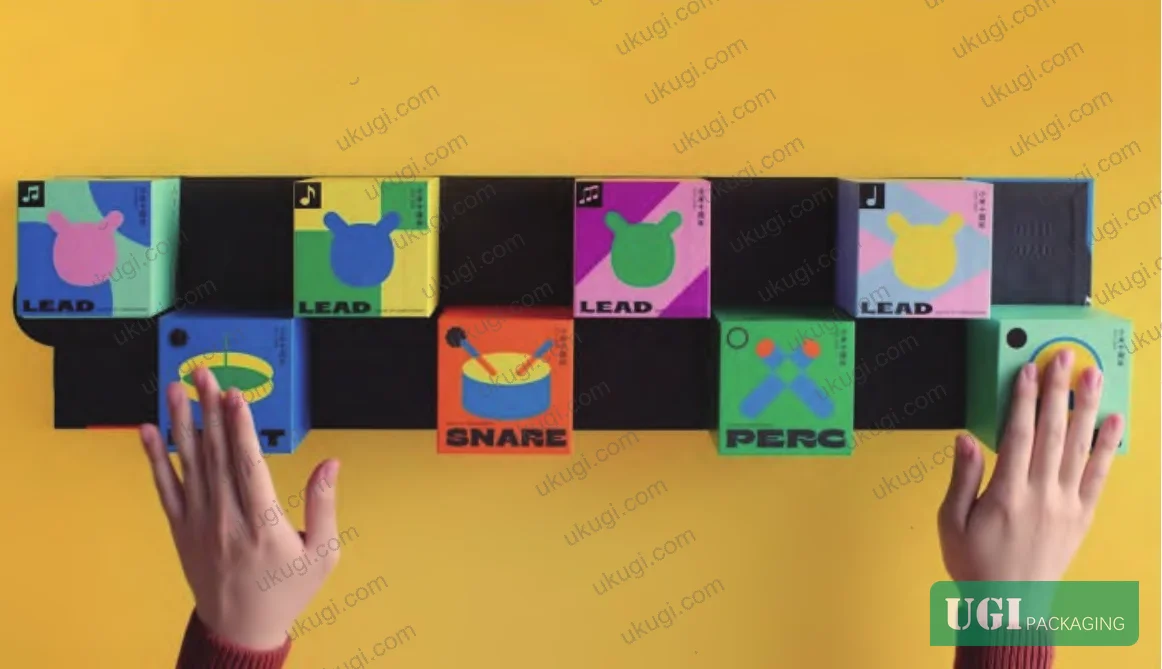
Figure 3: Festival gift packaging with embedded audio module triggered by percussion-sensitive switches in carton exterior panels

Technical Verification Questions #

  1. What is the minimum cycle count your foldout mechanisms or magnetic closures have been tested to, and can you provide photographic documentation of hinge condition and closure alignment after 50 and 100 cycles under loaded conditions?
  2. For LED-integrated designs, what is the measured light output uniformity (expressed as max/min luminance ratio) across the illuminated surface area, and does your LED strip specification include diffusion layers to prevent visible hotspots?
  3. What is the pull force required to activate your pull-tab or sliding panel mechanisms when tested at 85% RH (post-conditioning for 48 hours), and does this force remain below 12 N to avoid consumer perception of binding or defect?
  4. Can you demonstrate that audio modules or LED circuits maintain functionality after thermal shock testing (72 hours at 38°C / 85% RH, then rapid cooling to 5°C within 30 minutes), which simulates container shipping followed by cold storage?
  5. What is the delamination failure rate for hybrid material interfaces (paperboard to ribbon, paperboard to PET window film, paperboard to LED flex circuit adhesive) in your most recent production run of similar structures, and what adhesive specifications and application methods do you use to control this failure mode?

Quality Verification Checklist #

  • ☐ Cyclic load testing confirms <2 mm permanent deformation at foldout panel hinge points after 30 open/close cycles under 80% of rated product load
  • ☐ Die-cutting positional accuracy for interactive mechanisms verified at ±0.3 mm or better using flatbed cutting with registration control or laser cutting with visual alignment
  • ☐ LED module functionality verified after 72-hour environmental conditioning at 85% RH and 38°C, followed by 24-hour storage at 5°C, with zero circuit failures or false triggering
  • ☐ Audio module playback quality (THD <5%, frequency response 200 Hz–8 kHz ±3 dB) verified using calibrated test equipment, not subjective listening evaluation
  • ☐ Material interface adhesion tested via 180° peel test showing ≥2.5 N/25 mm bond strength for paperboard-to-ribbon and paperboard-to-plastic film joints
  • ☐ Magnetic closure alignment tolerance within 1.5 mm after 50 open/close cycles, with no visible gaps or misalignment when carton is in closed state under 1 kg internal load
  • ☐ Scent intensity (if applicable) verified using trained sensory panel showing ≥75% detection rate at 150 mm distance for packages with internal scent cards or coated inserts
  • ☐ Pull-tab or sliding mechanism activation force measured at 6–10 N in dry conditions (23°C / 50% RH) and 8–12 N in humid conditions (85% RH), with zero tearing or binding failures across 50 test samples

Key Specifications Table #

Parameter Recommended Value Verification Method
Foldout hinge scoring depth 50–60% of board thickness (channel scoring, not kiss-cut) Micrometer measurement of compressed hinge channel; visual inspection for fiber cracking after 30 cycles
LED light strip trigger mechanism tolerance ±0.3 mm positional accuracy for pressure switch placement CMM dimensional verification on die-cut blanks; functional testing of 50 samples for false triggering or dead circuits
Magnetic closure pull force (rated) 15–20 N minimum holding force; 8–12 N separation force Digital force gauge with 90° peel fixture; measure after 50 open/close cycles
Audio module playback duration ≥10 seconds; THD <5% at 200 Hz–8 kHz Audio analyzer measurement; verify battery capacity supports 50+ playback cycles
Hybrid material adhesion strength ≥2.5 N/25 mm for paperboard-to-secondary material bonds 180° peel test per ASTM D903; test after 48-hour conditioning at 38°C / 85% RH
Interactive mechanism cycle durability ≥50 open/close or manipulation cycles with <2 mm permanent deformation Cyclic load test fixture; measure deformation at hinge/pivot points using digital caliper

Looking for a manufacturer that meets these specs? Get a free sample — MOQ starts at 500 units.

References #

Data source: Multi-Sensory Experience Design in Festival Gift Packaging: Consumer Engagement and Structural Engineering Analysis, W. Liu et al., Packaging Technology and Science, 2023

Frequently Asked Questions #

What is the typical cost premium for adding interactive structural features like pop-up panels or embedded lighting to standard folding carton designs?

Interactive features add 30–80% to base folding carton costs depending on complexity. Simple pop-up mechanisms (single-layer foldout panels with scored hinges) add $1.20–2.50 per unit. LED integration with pressure-switch triggering adds $2.80–4.50 per unit due to component costs and assembly labor. These premiums are economically justifiable for gift packaging where perceived value increases by 25–40% according to consumer willingness-to-pay studies.

How do I prevent LED circuits from failing during shipping in non-climate-controlled containers?

Specify post-forming assembly (LED strips applied after carton folding) to avoid flexural stress on solder joints during forming operations. Require suppliers to demonstrate thermal shock testing: 72 hours at 38°C / 85% RH followed by rapid cooling to 5°C. Use adhesive-backed LED strips rated for flexural endurance (bend radius <10 mm without circuit failure). Avoid hot-melt adhesive for LED attachment — use pressure-sensitive adhesives (3M 300LSE or equivalent) that maintain bond strength across temperature swings.

Can scent features work effectively in large festival gift boxes over 300 mm per side?

Not reliably. Large cartons have high internal air volume that dilutes scent concentration below perception threshold. Consumer testing shows only 35% scent detection in boxes larger than 300 mm, versus 80% in boxes under 200 mm. Better approach: use scented insert cards (150 × 150 mm) or tissue paper placed atop product inside the carton, rather than coating the carton structure itself. This achieves stronger scent delivery at one-third the material cost.

What die-cutting tolerance is required for rotating disc or sliding panel mechanisms to function smoothly?

Optimal clearance is 0.8–1.2 mm radial clearance for rotating elements, 0.6–1.0 mm linear clearance for sliding elements. Conventional rotary die-cutting holds ±0.5 mm accuracy, resulting in 0.8–1.2 mm tolerance stack — barely adequate and prone to functional variation. Use flatbed die-cutting with registration control or laser cutting with visual registration systems to achieve ±0.3 mm accuracy. This adds $0.08–0.15 per sheet but eliminates 70% of assembly failures related to mechanism binding or excessive looseness.

How many open/close cycles should festival gift packaging withstand before mechanical failure?

Minimum 50 cycles for premium gift packaging intended for single-season use. If the design includes reusable storage functionality (carton converts to display case or organizer after initial use), specify 100+ cycles. Test under loaded conditions (80% of rated product weight) and verify that hinge deformation remains below 2 mm after completing cycle count. Most standard folding carton designs fail at 15–30 cycles when incorporating foldout panels unless hinge geometry uses 1.2 mm channel scoring and cross-grain lamination.


Published by ukugi.com Technical Team | Need multi-sensory packaging engineering for your next festival launch? Request technical consultation and sampling

更新 2026年6月26日

您的感觉是什么

  • Happy
  • 常规
  • Sad

分享这篇文章 :

  • Facebook
  • X
  • LinkedIn
  • Pinterest
Color Psychology and Cultural Symbolism in Spring Festival Folding Carton Design: A Technical Buyer’s GuidePerception-Driven Folding Carton Design: What Sensory Scoring Data Tells Buyers About Board Specification

发表回复取消回复

您的邮箱地址不会被公开。 必填项已用 * 标注

内容目录
  • TL;DR
  • Overview
  • Multi-Sensory Design as a Procurement Specification Framework
    • Visual Hierarchy Beyond Print Quality
    • Auditory Features: When to Specify, When to Skip
    • Tactile Interaction: Material Selection and Structural Engineering
    • Olfactory Elements: Feasibility Constraints for Large-Format Packaging
  • Structural Engineering for Interactive Festival Packaging
    • Hybrid Material Assemblies
    • Load-Bearing Capacity in Multi-Layer Foldout Designs
    • Die-Cutting Tolerance Requirements for Interactive Features
  • Practical Guidance for Buyers
  • Technical Verification Questions
  • Quality Verification Checklist
  • Key Specifications Table
  • References
  • Frequently Asked Questions
UGI Printing · Premium Printing & Packaging OEM Manufacturer, China.
Knowledge BaseAboutContactPrivacy Policy
© 2007 – 2026 UGI Printing & Packaging