

TL;DR #
Sheet-fed square-bottom bag machines operating at 100 bags/min with servo-controlled handle attachment represent the current performance ceiling for premium carrier bag production — below this threshold, handle alignment defects and gusset inconsistency rates climb significantly. Buyers specifying paper carrier bags for retail or gift applications must understand that production method (web-fed vs. sheet-fed) directly determines surface quality, handle attachment precision, and whether bottom reinforcement cards are even mechanically possible. Before issuing an RFQ, confirm your supplier’s machine type and bag-per-minute rating — these two numbers will tell you more about quality ceiling than any ISO certificate alone.
Overview #
If you’ve been evaluating paper carrier bag suppliers purely on gsm specification and print finish, you’re missing the most consequential variable in this category: the bag-making machine architecture. Equipment capability determines whether your bags can carry structural bottom cards, whether the mouth can be reverse-folded cleanly, and whether handle loops will be positioned consistently across a production run. Buyers who skip this technical layer routinely receive samples that look fine but fail under 3–5 kg load conditions in retail — not because the paper was wrong, but because the production process was.
The analysis here draws on a comprehensive equipment survey conducted by a polytechnic research institution in collaboration with an industrial machinery manufacturer, covering the full range of commercially deployed paper bag production platforms across domestic and export markets. The study benchmarks web-fed and sheet-fed systems against each other across speed, dimensional range, substrate weight, and structural output capability — giving buyers a rare side-by-side view of what different machine classes can and cannot produce.
Sustainable paper carrier bags are now deployed across apparel, food, pharmaceutical, gift, and retail sectors, with flat-bottom (square-bottom) designs with handles being the dominant format for premium applications. Structurally, these bags are produced in two fundamentally different ways — and the choice of production method has cascading effects on every quality parameter that matters to a finished brand experience. For buyers sourcing paper bags and carrier bags for branded retail use, understanding this equipment split is not optional background knowledge — it’s the core procurement decision.
Web-Fed vs. Sheet-Fed Paper Bag Production: Performance Ceiling and Structural Limitations #
The most fundamental divide in paper carrier bag manufacturing is between web-fed (roll-fed) and sheet-fed production systems. These are not interchangeable; they produce structurally different outputs, and conflating them is one of the most expensive mistakes a packaging buyer can make.
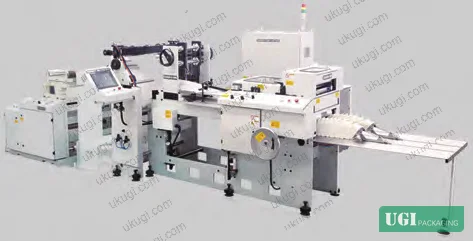
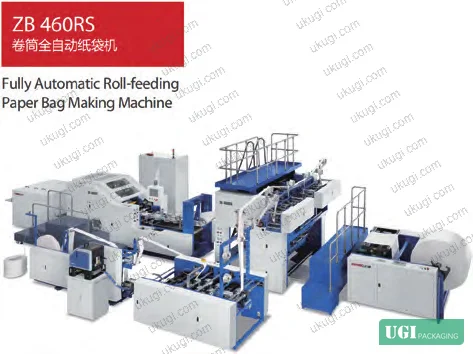
Web-fed systems draw from pre-printed or unprinted paper rolls, typically in the 30–80 g/m² range for pointed-bottom bags and 30–150 g/m² for square-bottom variants. The process is continuous: the paper feeds through handle attachment, tube forming, cut-off, and bottom forming in one pass. Production speeds are impressive — the top-rated web-fed pointed-bottom machines reach 550 bags/min, with most commercial square-bottom web-fed units running at 200–500 bags/min across bag widths from 150 mm to 550 mm and gusset depths from 60 mm to 260 mm.
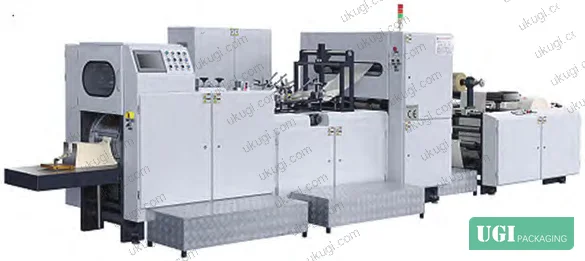
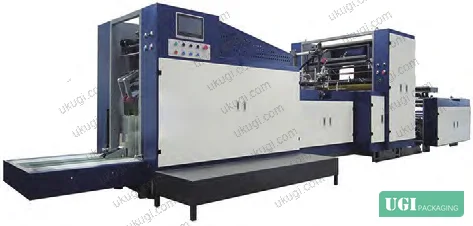
The structural trade-off is significant: because web-fed machines form the bag shape before cutting individual units, the process requires mechanical clamping during tube formation. This leaves visible crease marks on the bag surface, prevents clean top-mouth folding, and — critically — cannot accommodate bottom reinforcement cards inline. For premium retail and gift applications, this disqualifies web-fed systems outright, regardless of speed.
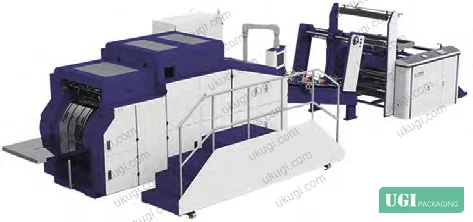
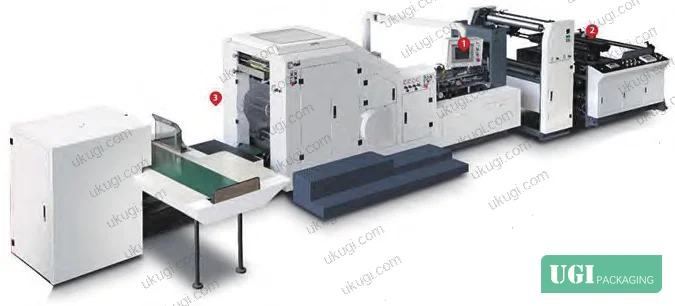
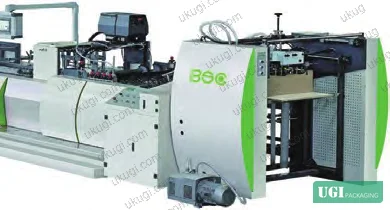
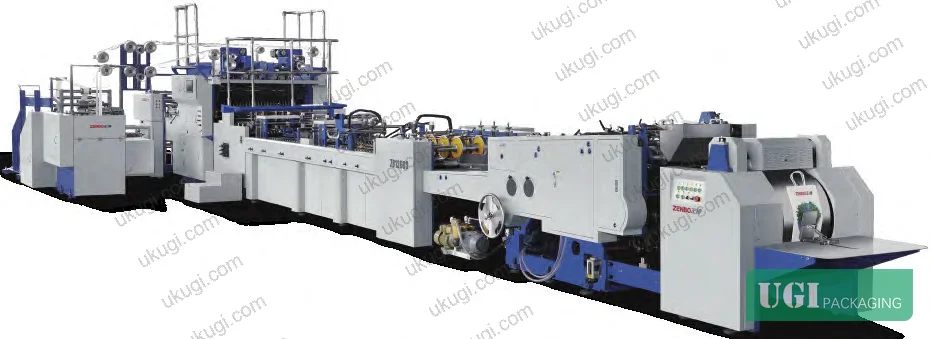
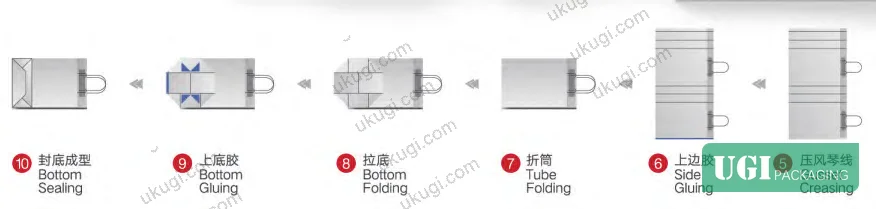
Sheet-fed systems work from pre-die-cut sheets in the 70–200 g/m² range (premium variants up to 250–400 g/m²), fed intermittently via feeder mechanisms. The process sequence — sheet feed, tube creasing, mouth fold, side gluing, tube formation, bag inversion, bottom forming, bottom card insertion, and bottom sealing — is longer and more mechanically complex. Production speeds reflect this: the highest-performing sheet-fed systems with handle attachment reach 100–130 bags/min, with most commercial units running 40–100 bags/min. The Japanese-developed systems that established this category originally peaked at 70 bags/min.
The structural advantage is decisive: sheet-fed bags have no mechanical crease marks, support clean top-mouth reverse folds, and can integrate both head reinforcement cards (top) and bottom stiffener cards inline. Handle attachment is servo-controlled, ensuring consistent loop positioning. These are the bags that work for fashion retail, cosmetics, wine, and gift packaging.
| Parameter | Web-Fed System | Sheet-Fed System |
|---|---|---|
| Substrate weight range | 30–150 g/m² | 70–400 g/m² |
| Max production speed | Up to 550 bags/min | Up to 130 bags/min |
| Surface crease marks | Present (process-inherent) | Absent |
| Top-mouth fold possible | No | Yes |
| Bottom card integration | Not possible | Yes (inline) |
| Handle attachment precision | Mechanical (lower accuracy) | Servo-controlled |
| Typical application | Food bags, commodity use | Retail, gift, premium apparel |
| Minimum bag width | 70 mm | 150 mm |
| Maximum bag width | 550 mm | 550 mm |
Honestly, most buyers over-specify paper weight when they should be specifying production method. A 157 g/m² kraft bag made on a web-fed machine will have surface creases and a weak bottom that no gsm rating can compensate for. Specify sheet-fed for any application where the bag is customer-facing.
For structural testing of the paper substrates themselves, buyers should reference ASTM D882 Standard Test Method for Tensile Properties of Thin Plastic Sheeting as an analog framework for tensile verification methodology, and ISO 2758:2014 Paper — Determination of bursting strength for substrate burst qualification at incoming inspection.
Handle Attachment Technology and Structural Load Capacity in Paper Carrier Bags #
The handle is the highest-stress component in any paper carrier bag. It is where most field failures originate, and it is the parameter most poorly defined in standard procurement specifications. Getting this wrong means your bags fail in-store or, worse, in a customer’s hand.
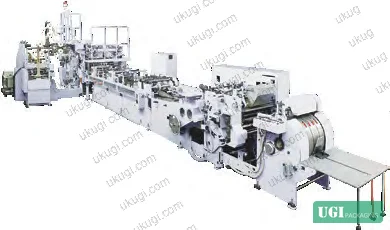
Sheet-fed machines with integrated handle attachment operate across bag widths of 150–450 mm with gusset ranges of 60–170 mm. The handle integration process in advanced servo-driven units handles this at 40–100 bags/min for standard configurations. The key performance differentiator is whether handle loop threading and gluing is mechanically linked (older systems) or servo-driven — the servo approach eliminates the handle material waste and positioning inconsistency that plague older mechanical-linkage handle feeders.
For oversized bag specifications — those exceeding the dimensional limits of standard die-cutting presses — a double-sheet (dual-ply) construction process is used, where two sheets are joined to form a single bag. Commercial dual-sheet machines reach production speeds of 85 bags/min across bag widths of 160–550 mm and gusset ranges of 55–185 mm. These are typically used for large retail carrier bags and premium gift packaging where single-sheet die-cut limits are exceeded.
In supplier qualification evaluations, we’ve seen multiple batches fail specifically at the handle attachment bond — not due to paper failure, but because handle threading was done on a mechanical-linkage system at the upper speed limit, causing adhesive under-application on the loop anchor points. This is a process failure, not a material failure, and it won’t appear in any paper test certificate. The fix is to confirm that handle attachment is servo-controlled and to request a peel-strength test on the handle bond specifically. Most suppliers cannot tell you their handle bond peel strength — that alone tells you something.
Most procurement teams don’t realize that the shift toward servo-controlled handle feeding systems has fundamentally changed quality expectations in this category. Older mechanical-linkage systems that dominated production lines for years are still in widespread use among lower-tier suppliers, and there is no standard certification that differentiates them. Buyers who have only ever sampled bags don’t see this — the difference shows up in production consistency across a full run, not in a 10-piece sample.
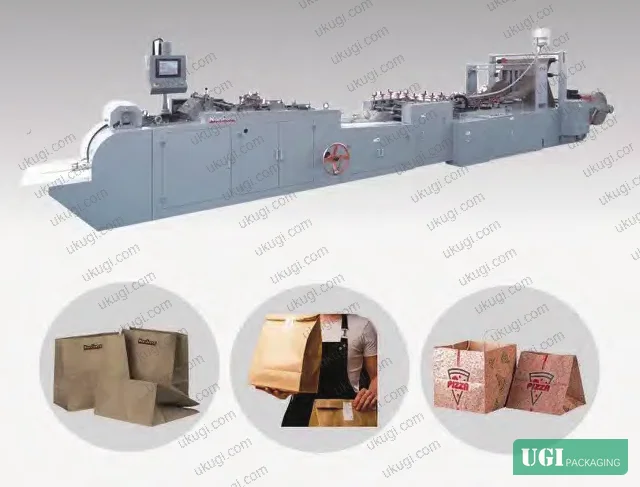
For buyers sourcing bags for gift packaging solutions or premium retail use, the substrate weight floor for structural handle-bearing bags is 120 g/m², with premium gift formats typically running 250–400 g/m². Bottom card integration requires sheet-fed production and adds meaningful structural rigidity to the base — this is non-negotiable for bags carrying products over 2 kg.
Bag surface printing quality — relevant for branded carrier bags — should be evaluated against ISO 12647-2:2013 Graphic technology — Process control for offset lithographic printing where offset printing is used on the substrate prior to bag conversion.
Practical Guidance for Buyers #
Start with your application load requirement and work backward to machine specification. If your bags need to carry more than 2 kg, require a folded top mouth, or need to carry a bottom card for stiffness, you need sheet-fed production — full stop. Web-fed is acceptable only for commodity food bags, grain packaging, and low-cost single-use applications where surface aesthetics are secondary.
For substrate weight, the practical ranges are: 70–120 g/m² for light-duty bags with no bottom card, 120–200 g/m² for standard retail carrier bags, and 250–400 g/m² for premium gift bags requiring structural rigidity. Always request that your supplier declares the production method and machine type — not just the paper gsm and print spec.
When evaluating dimensional capability, check that your required bag width, gusset, and bottom dimensions fall within the machine’s rated operating range — not just within its maximum range. Machines running at the edge of their dimensional limits show higher defect rates on fold geometry and adhesive coverage.
Our team at ukugi.com manufactures custom paper bags and carrier bags across the full range of sheet-fed square-bottom formats, with integrated handle attachment, bottom card options, and full surface finishing capabilities. If you’re specifying a carrier bag for a branded retail launch and need to verify that your dimensional and substrate requirements are achievable at your target MOQ, Request a quote from our team →
Technical Verification Questions #
- Does your square-bottom carrier bag production use sheet-fed or web-fed machine architecture, and what is the rated production speed (bags/min) of your handle attachment station specifically?
- Is your handle attachment mechanism servo-controlled or mechanical-linkage driven — and can you provide handle bond peel-strength data from your last production batch?
- What is the minimum substrate weight (g/m²) your equipment can process for sheet-fed square-bottom bags with integrated bottom card and top-mouth fold — and have you run production at 250–400 g/m² for premium gift formats?
- For oversized bag formats requiring dual-sheet construction, what is your maximum bag width capability and your verified production speed (bags/min) on that configuration?
- What is your inline quality rejection rate for handle positioning defects and bottom seal failures, and at what bags/min rate was that data collected?
Quality Verification Checklist #
- ☐ Supplier confirms sheet-fed production for any bag requiring top-mouth fold, bottom card, or substrate weight above 120 g/m²
- ☐ Handle attachment is servo-controlled (not mechanical-linkage); supplier can provide peel-strength data for handle bond per production batch
- ☐ Substrate weight is within confirmed machine operating range — not just within maximum dimensional capacity (verify actual rated gsm range, e.g., 120–250 g/m² for standard retail)
- ☐ Bag surface shows no visible mechanical crease marks; confirmed by visual inspection under raking light on 10-piece incoming sample
- ☐ Bottom card integration is confirmed as inline (not manually inserted post-production); verify via process documentation or factory audit
- ☐ Gusset dimension is within 70–170 mm range for standard sheet-fed handle-bearing formats; measure with calipers on incoming sample, tolerance ±2 mm
- ☐ For dual-sheet (double-ply) bags, production speed is confirmed at or below 85 bags/min maximum rated capacity to maintain joint integrity
- ☐ Print substrate has been evaluated for offset print process control per ISO 12647-2:2013 where pre-printed sheets are used
Key Specifications Table #
| Parameter | Recommended Value | Verification Method |
|---|---|---|
| Substrate weight — standard retail carrier bag | 120–200 g/m² | Weigh 10 cut samples per ISO 536; confirm gsm declaration matches actual |
| Substrate weight — premium gift carrier bag | 250–400 g/m² | Weigh 10 cut samples; cross-reference against machine-rated substrate range |
| Production speed — sheet-fed with handle | 40–100 bags/min | Request machine spec sheet; confirm model number against published ratings |
| Bag width range — sheet-fed square bottom | 150–450 mm | Measure 10 bags with calipers; tolerance ±3 mm acceptable |
| Gusset depth range | 60–170 mm | Measure 10 bags with calipers; check fold sharpness visually |
| Bottom card presence | Required for bags >2 kg load | Pull-test: load bag with rated weight for 30 seconds; inspect bottom for deformation |
| Handle bond integrity | No delamination under 5 kg static load | Static load test: hang filled bag for 5 minutes; inspect anchor point for peel or tear |
| Dual-sheet bag maximum production speed | ≤85 bags/min | Verify via factory records or production audit |
Looking for a manufacturer that meets these specs? Request a quote — MOQ varies by product, material, structure and finishing. Product-specific MOQ is confirmed with each quotation.
References #
Data source: Advances in Automated Production Technology and Equipment for Eco-Friendly Paper Carrier Bags, P.-T. Kong et al., Journal of Applied Polymer Science, 2025
Frequently Asked Questions #
What is the practical difference between web-fed and sheet-fed paper bag production for a retail buyer?
Web-fed machines produce bags faster — up to 550 bags/min for pointed-bottom formats — but cannot produce a clean top-mouth fold, cannot integrate a bottom stiffener card, and leave mechanical crease marks on the bag surface. Sheet-fed machines run at 40–130 bags/min but produce structurally complete, mark-free bags suitable for retail, gift, and premium carrier applications. If your bags will be seen by end customers, sheet-fed is the only viable method.
Can I specify a paper carrier bag with a bottom reinforcement card from any supplier?
No. Bottom card integration requires sheet-fed production with an inline card insertion station. Web-fed machines cannot do this. You need to confirm production method before requesting this feature — otherwise you will receive a quote for a bag that the supplier physically cannot produce to spec on their equipment.
What substrate weight should I specify for a paper carrier bag intended to hold a 3 kg product?
For a bag carrying 3 kg, specify a minimum of 157–200 g/m² with a bottom card. The bottom card is as important as the paper weight — it distributes load across the base and prevents the bottom seam from opening under sustained weight. Substrate alone is not sufficient without structural bottom reinforcement.
What does “gusset” mean in paper bag specification, and what range should I request?
The gusset is the side fold depth — it determines how much the bag can expand laterally when filled. Standard retail carrier bags run 70–170 mm gussets on sheet-fed equipment. Wider gussets (up to 185 mm on some dual-sheet machines) accommodate bulkier products. Specify gusset based on your largest product dimension plus 20–30 mm clearance.
How do I evaluate handle quality beyond visual inspection?
Request a static load test: fill the bag to its intended maximum load, hang it for a minimum of 5 minutes, and inspect the handle anchor points for any peel, tear, or delamination. Also ask your supplier whether handle attachment is servo-driven or mechanical-linkage — servo systems maintain consistent adhesive application across the full production run, while mechanical systems show increasing variability at higher speeds. Suppliers using servo handle attachment should be able to provide peel-strength data from their process validation records.
Published by ukugi.com Technical Team | Request a quote


