

TL;DR #
If you’re sourcing foil stamping services or specifying metallic effects for pressure-sensitive (self-adhesive) labels, the difference between a reliable supplier and a recurring quality problem often comes down to three variables: temperature, pressure, and speed — and how well their operators understand the interaction between all three. Most buyers focus on visual output samples and price. That’s a mistake that shows up six weeks into production, not during qualification.
Manufacturers requiring metallic label finishes can source custom labels and stickers with foil lamination options, as well as decorative hologram stickers for premium packaging. Ukugi also provides sticker labels for gift and retail product lines.
Hot foil, cold foil, and digital foil stamping each present distinct failure modes. Understanding them at the process level gives procurement and quality teams a real advantage when writing specs, auditing suppliers, and managing non-conformances. This guide covers the practical defect patterns for all three methods, with specific diagnostic thresholds and decision logic drawn from production floor experience.
Hot Foil Stamping: Defect Patterns and Process Thresholds #
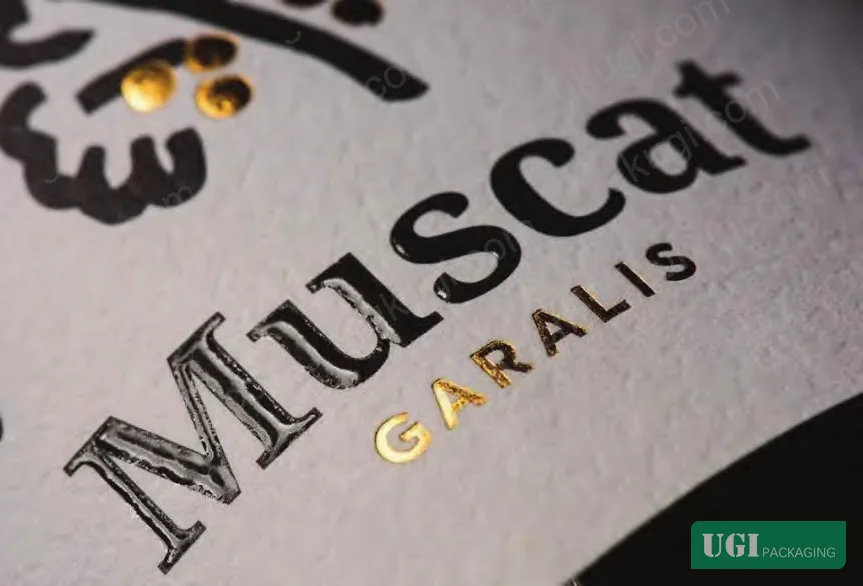
Hot foil stamping transfers metalite (electroformed aluminum, 电化铝) from a carrier film to the substrate surface using a heated die under pressure. It remains the benchmark for metallic luminosity and adhesion strength on self-adhesive labels — cold foil simply does not match it on those two dimensions.
Typical hot stamping temperature range sits between 120°C and 150°C. That range is a starting point, not a fixed spec. Different electroformed foil grades have different heat-activation thresholds, and buyers who write a single temperature value into their purchase orders are setting up their suppliers for either under-transfer or over-heating failures.
Edge Serration and Burring #
Jagged, uneven edges on foil-stamped graphics are the most common hot foil complaint we see in qualification audits. The primary cause is insufficient temperature — the foil doesn’t fully release from the carrier. Secondary causes are pressure set too low, or stamping speed too fast for the foil grade in use. The diagnostic sequence matters:
- First, increase stamping pressure
- If unresolved, reduce stamping speed
- If still unresolved, increase temperature incrementally
- If none of the above resolves it, trial a different electroformed foil grade
Skipping straight to temperature adjustment is the most common operator error. It wastes time and risks overheating the foil.
Foil Delamination After Stamping #
Delamination — where the foil image lifts off during handling, die-cutting, or label application — is nearly always a substrate surface energy problem. In production qualification, we saw three of six substrate samples fail adhesion retention when surface energy tested below 38 dynes/cm using a dyne pen. Below that threshold, the electroformed aluminum cannot form a durable bond with the substrate surface regardless of temperature or pressure settings.
The corrective path: corona treatment of the substrate surface, or application of a primer/coating layer prior to stamping. Specifying a substrate with surface energy ≥38 dynes/cm should be a hard requirement in your material specification, not an assumption.
Delamination can also originate from a poor foil-substrate compatibility match. A process that works fine with one foil brand may fail with a substitute. During development, test a minimum of three electroformed foil grades against your substrate and select on compatibility, not just on unit price.
Brightness Deficit #
Honestly, most buyers over-specify metallic brightness without understanding what destroys it at the process level. The cause of low post-stamp brightness is almost always temperature too high — not too low. Excessive heat damages the reflective coating layer on the electroformed aluminum surface. The fix is straightforward: reduce stamping temperature. If brightness is a core specification for your label design, build a temperature ceiling into your process control documentation, not just a floor.
Incomplete Transfer (Ghost Images and Voids) #
Ghost images and localized non-transfer are typically a pressure-temperature mismatch. Increase pressure first, then temperature. If the substrate begins to show impression marks before the foil transfers cleanly, that’s a signal to change foil grade — the substrate is the limiting factor.
Hot Foil vs. Cold Foil vs. Digital Foil: Key Comparison #
| Characteristic | Hot Foil Stamping | Cold Foil Stamping | Digital Foil Stamping |
|---|---|---|---|
| Metallic brightness / gloss | Highest | Moderate | Moderate–High (raised) |
| Halftone / dot capability | Not possible | Yes | Yes |
| Variable data capability | No | No | Yes (QR codes, serials) |
| Typical process speed | Medium–High | High | Low (few m/min to ~15 m/min) |
| Primary failure mode | Edge serration, delamination | UV adhesive cure, dot plugging | UV cure failure, QR distortion |
| Tooling requirement | Heated die (brass/magnesium) | Printing plate for UV adhesive | Digital inkjet head |
| Surface energy requirement | ≥38 dynes/cm | ≥38 dynes/cm | ≥38 dynes/cm |
Cold Foil Stamping: UV Adhesive Control is Everything #
Cold foil stamping works by printing a UV-curable adhesive in the desired pattern, laminating the electroformed foil roll against it under a nip roller, then UV-curing to lock the foil to the adhesive. No heated die. The foil stays wherever the cured adhesive is; everywhere else it strips away.
The absence of heat removes one variable but introduces a different and arguably more demanding one: UV adhesive rheology and cure state.
Pattern Voids and Ghost Images (Cold Process) #
In cold foil, missing pattern areas have nothing to do with temperature. They are caused by either poor adhesive printing coverage or adhesive shrinkage on low-surface-energy substrates. Adhesive shrinkage is visually identifiable — you can see it pulling away from the printed image edges before the foil is even applied. If you see that, the substrate needs inline corona treatment, or you need a higher surface-energy substrate. That’s the complete diagnosis.
Foil Adhesion Failure (Cold Process) #
Cold foil delamination under friction or handling stress points directly to incomplete UV cure. Root causes: expired adhesive, UV lamp intensity degradation, or adhesive layer deposited too thick to cure through fully. The cure window for cold foil adhesive is unforgiving — too thin and you lose coverage; too thick and the UV energy doesn’t penetrate to the adhesive–substrate interface.
Check adhesive expiry dates before each production run. It sounds basic. It still gets missed.
Halftone Dot Plugging #
This is where cold foil genuinely outperforms hot foil — it can reproduce halftone dot patterns. Hot foil cannot. But that advantage disappears when the adhesive is applied too heavily. Excess adhesive flows between dots during the brief interval between printing and nip lamination, merging dots and destroying halftone resolution. Excessive impression pressure has the same effect. For dot work in cold foil, tighter adhesive deposit control is non-negotiable.
Most procurement teams don’t realize that cold foil halftone capability is heavily dependent on the press operator’s adhesive viscosity and laydown settings — it’s not guaranteed just because the equipment is rated for it. Ask suppliers specifically how they control adhesive deposit weight for halftone jobs, and request print proofs at the specification dot percentage before committing to production volumes.
Digital Foil Stamping: Advantages, Limits, and Where It Fails #
Digital foil stamping is a cold foil variant where the UV adhesive is deposited by an inkjet head rather than a printing plate. That single change enables two things that neither hot nor cold foil can match: variable data (unique QR codes, serial numbers, personalization) and a tactile raised effect from the thicker adhesive deposit.
The raised-relief aesthetic from digital foil can exceed what traditional embossing delivers. For premium self-adhesive labels, this matters. But the same adhesive thickness that creates that relief is also the process’s primary liability.
Cure Failure and Delamination (Digital Process) #
Digital foil machines use a two-stage UV cure: a pre-cure immediately after adhesive jetting to lock the pattern geometry while retaining surface tack, followed by a full cure after foil lamination. If either cure stage is inadequate — most commonly because machine speed exceeds the cure window — the adhesive remains partially uncured, and foil adhesion fails under any friction load.
Current digital foil machines on the market run at a few meters per minute up to approximately 15 m/min. That’s slow compared to hot or cold foil lines. If a supplier is quoting digital foil lead times that imply higher throughput, probe their speed settings and cure documentation.
Variable QR Code Illegibility #
Digital foil’s variable data capability is genuinely useful for track-and-trace, anti-counterfeiting, and serialized label programs. But it has a hard constraint: adhesive deposit volume must be strictly controlled when printing QR codes or other machine-readable patterns. The inkjet head deposits adhesive in relatively thick layers by design. At the margins of fine-pitch QR code modules, that excess adhesive causes pattern distortion — modules merge, quiet zones shrink, and scanner read rates drop below acceptable thresholds.
Ordinary decorative patterns are forgiving of slight adhesive over-deposition. Scannable codes are not. If you are specifying digital foil for any variable data application, require the supplier to demonstrate verified scan rates — not just visual quality — at your target code density and scanning distance. Reference ISO/IEC 18004 for QR code specification and ISO/IEC 15415 for 2D bar code print quality grading.
Substrate and Foil Compatibility: The Specification Gap Most Buyers Leave Open #
Surface energy is the single most under-specified parameter in foil stamping procurement. The 38 dynes/cm threshold applies across all three foil methods — below it, adhesion risk is elevated regardless of process. Yet most label substrate specifications I review don’t mention surface energy at all.
For electroformed aluminum (电化铝) foil selection, compatibility testing with the actual substrate is mandatory before production approval. Testing three or more foil grades per substrate is standard practice. Foil grade selection based solely on supplier recommendation or previous project experience with a different substrate is a frequent root cause of early production failures.
Substrate surface treatments also decay over time. Corona-treated films that have been stored for extended periods can lose effective surface energy before use. Build shelf-life limits into your incoming material inspection criteria, and verify surface energy with dyne pen testing at goods receipt. Refer to ASTM D2578 for standard test methods for wetting tension of polyethylene and polypropylene films — the same methodology applies to label substrates.
For label material qualification frameworks more broadly, ISO 11948 and your converter’s internal process documentation should both be active references during supplier audits. For ink and coating adhesion on self-adhesive substrates, FINAT Test Method FTM 1 covers peel adhesion under defined conditions and is widely used across the European and Asian label supply chain.
For more on substrate selection for specialty label applications, see Substrates & Board Selection and for surface coating interactions, Functional Coatings & Varnishes.
Practical Guidance for Buyers #
Start with surface energy. If you take nothing else from this guide, make ≥38 dynes/cm a hard requirement in every substrate specification for foil-stamped labels — hot, cold, or digital. It costs nothing to specify and prevents the most common adhesion failures.
For supplier qualification, run a three-foil-grade compatibility trial against your production substrate before approving a process. Don’t accept a single-sample demonstration. Ask to see the process parameter documentation — specifically temperature range, pressure settings, and speed — and verify they are recorded per job, not estimated.
For digital foil with variable data, insist on scan rate verification, not just visual inspection. Use ISO/IEC 15415 grading as the acceptance criterion.
Cold foil halftone jobs need adhesive deposit weight control evidence. Ask for it before approving print proofs.
Finally, if you are evaluating a supplier switching from hot foil to cold foil for cost reasons, understand that the brightness and adhesion performance levels are not equivalent. The switch may be commercially justified, but it requires explicit re-approval against your brand specification — not a simple process substitution.
Frequently Asked Questions #
Q: What temperature range should I specify for hot foil stamping on self-adhesive labels?
A: The standard operating range is 120°C to 150°C, but the correct temperature for any given job depends on the specific electroformed foil grade being used. Some grades require higher activation temperatures, others lower. Specifying a fixed temperature in your PO without identifying the foil grade is a common procurement error. The right approach is to qualify temperature range by foil grade during the process approval stage, not lock it into a universal spec.
Q: How do I test whether a substrate is suitable for foil stamping before committing to production?
A: Use a dyne pen to test surface energy at goods receipt. If the substrate measures below 38 dynes/cm, adhesion risk is real across all foil methods. For a more precise measurement, use the ASTM D2578 wetting tension method. If the substrate is marginal, corona treatment or a primer coat can bring it into range — but that adds a process step that needs to be validated and controlled.
Q: Can cold foil reproduce halftone gradients?
A: Yes — and this is one of the genuine technical advantages cold foil has over hot foil, which cannot produce halftones at all. But the quality of the halftone reproduction is directly controlled by adhesive deposit weight and impression pressure. Over-deposition causes dot plugging. Tight operator control of adhesive viscosity and laydown is required. Don’t assume halftone capability from equipment specs alone; ask for production proofs.
Q: What causes QR codes stamped with digital foil to fail scanner reads?
A: Excess UV adhesive deposition. The inkjet head in digital foil deposits adhesive in a relatively thick layer, and at the fine pitch of QR code modules, that excess can distort module geometry enough to drop scan rates below threshold. The fix is strict adhesive volume control when running variable data jobs. Require suppliers to demonstrate verified scan rates per ISO/IEC 15415 before production approval.
Q: Is digital foil stamping suitable for high-volume production runs?
A: Not currently. Most digital foil machines on the market run at only a few meters per minute up to around 15 m/min — significantly slower than hot or cold foil lines. Digital foil is best suited for short-run, variable-data, or premium tactile applications where speed is less critical than personalization capability. For high-volume commodity label runs, hot or cold foil will be more cost-effective.
Published by ukugi.com Technical Team | Request a sourcing quote
Content reviewed by claire.morgan | © ukugi.com — All rights reserved. Unauthorized reproduction prohibited.


