

TL;DR #
UV varnish blocking in rotogravure-inline applications is not primarily a drying equipment failure — it is an incomplete deep-cure problem masked by a surface-dry appearance, and it manifests only after 28–63 days in storage under load. Buyers specifying UV-coated flexible packaging must verify compound photoinitiator formulation and anti-misting agent ratios before approving any supplier’s process, not just lamp wattage. Require a 36-day compression test at 1,542 kg load before releasing any UV varnish formulation to mass production.
Overview #
Most quality teams catch UV varnish blocking at the wrong stage — either immediately after printing (when nothing has gone wrong yet) or after a customer complaint (when the damage is already done). The real failure window is 28 to 63 days post-print, under warehouse stack pressure, and it’s almost never visible at goods receipt. That’s the procurement problem this article addresses.
Field evaluation data drawn from a production-scale investigation at a commercial rotogravure facility — running an eight-color Bobst press with inline UV — tested six distinct photoinitiator and anti-misting formulations against a 36-day, 1,542 kg compression protocol. The study covered two paper grades (97 g/m² laser holographic transfer paper and 237 g/m² laser holographic transfer board) and print speeds from 150 to 200 m/min. Results were cross-validated between two UV varnish suppliers and four formulation variants per supplier.
The findings are directly applicable to any buyer sourcing UV-coated flexible carton components, cigarette-style soft pack structures, or premium folding carton shells where surface gloss and stacking durability are simultaneously specified. For reference on standardized print quality control parameters, ISO 12647-2:2013 Graphic technology — Process control for offset lithographic printing provides a useful baseline for understanding surface finish consistency requirements, even when the press technology differs.
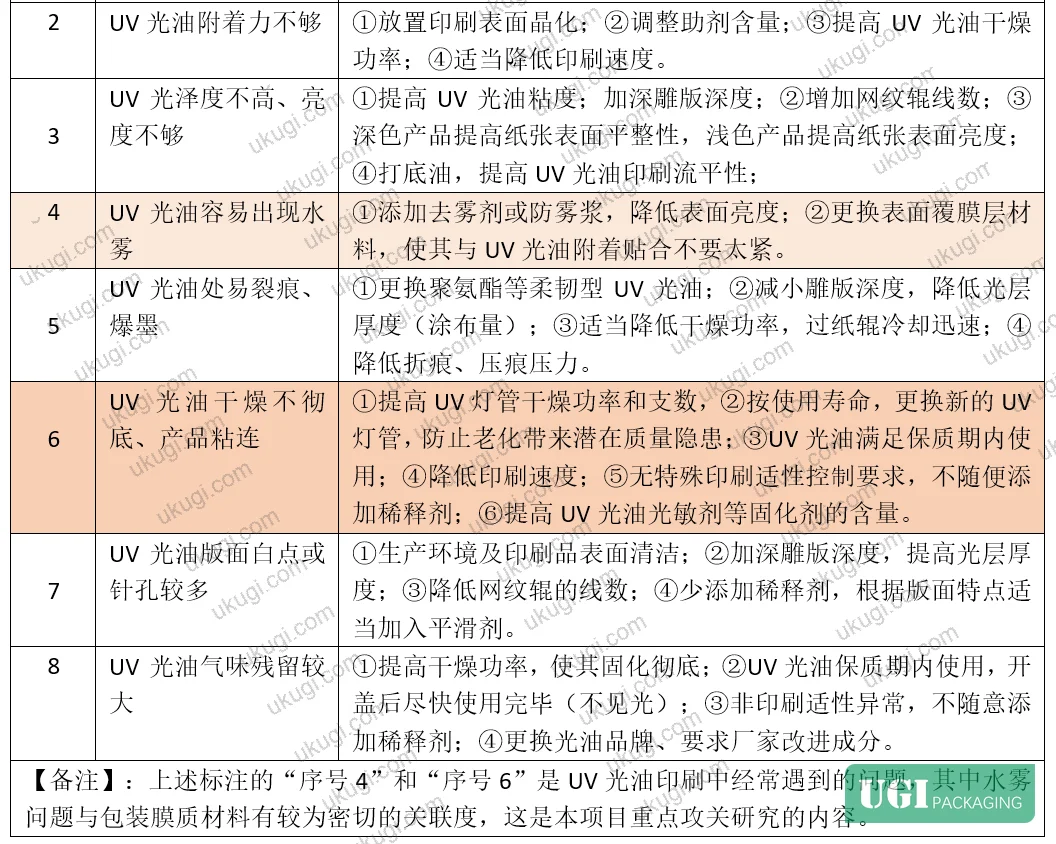
UV Varnish Blocking in Rotogravure Inline Printing: Root Causes and Failure Mechanisms #
Blocking — the adhesion of stacked printed sheets face-to-back — is not a random defect. In UV-coated rotogravure work, it follows a predictable failure chain, and understanding that chain is the only way to specify your way out of it.
The “False Dry” Problem #
UV varnish dries via photopolymerization, not solvent evaporation. Under UV irradiation, the photoinitiator absorbs photons, generates free radicals, and triggers cross-linking between prepolymers and reactive monomers — forming a three-dimensional polymer network. The surface layer cures almost instantly. The deeper film does not.
This is the “false dry” phenomenon: surface-hard, interior-soft. At inline press speeds of 175–200 m/min on a rotogravure line, the UV exposure window per unit area is extremely short. Even with a full complement of lamps at rated power, deep-layer cure completion is not guaranteed — and this is where most blocking problems originate.
Critically, the false dry state is invisible at inspection. Blocking was undetected during printing, post-press processing, inspection, and packing. It only became apparent at 28 days (minor blocking, separable by gentle shaking) and severe at 63+ days (sheets bonded together, requiring significant force to separate, with ink layer transfer and product loss).
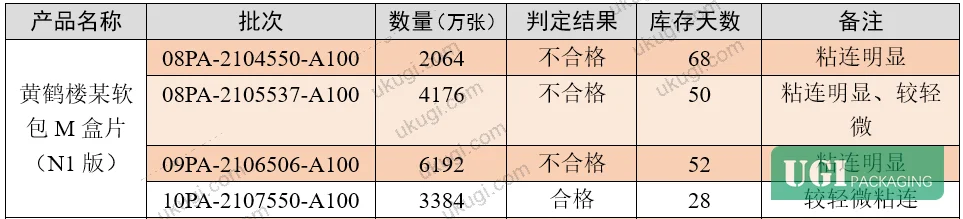
Print Speed Is a Direct Blocking Risk Variable #
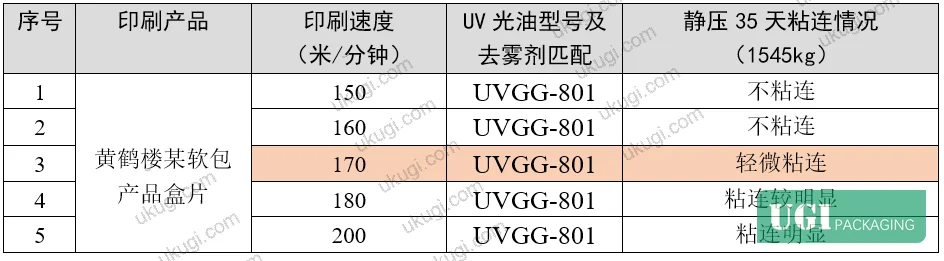
Speed testing across 150, 160, 170, 180, and 200 m/min — using identical UV varnish, anti-misting agent, and photoinitiator content from the same supplier — showed a clear threshold: blocking appeared at 170 m/min after 35 days under 1,545 kg compression load, and became obvious at 200 m/min. This is a hard data point most procurement specs don’t capture.
Photoinitiator Type and Concentration #
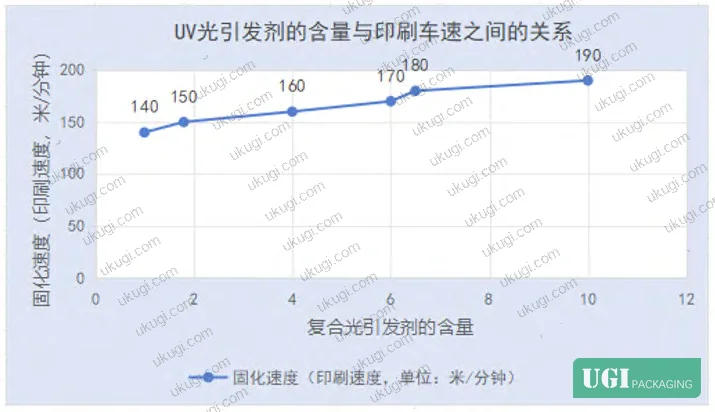
Single-component photoinitiators cannot achieve complete through-cure at production speeds. Even when print speed was reduced, single-initiator formulations still produced blocking after 35 days storage. The fix requires compound (multi-component) photoinitiator systems — combined with appropriate concentration adjustment — to achieve instantaneous full-depth cross-linking.
The relationship between photoinitiator content and print speed is nonlinear: at 175 m/min, a compound initiator at the correct ratio eliminated blocking entirely in the 36-day test. A single-component system at the same speed still failed.
Gloss Level as a Secondary Cause #
High-gloss UV varnish surfaces — approaching mirror-reflective finish — increase contact area between stacked sheets, amplifying blocking risk. This is a secondary cause, but it’s an important one for premium packaging specifications that demand ≥85% gloss. Anti-misting agents and wax additive ratio adjustment can reduce the surface to a micro-diffuse (matte-particle) texture without visually degrading the perceived finish. This creates air gaps at the stack interface, reducing adhesion pressure per unit area.
Substrate Back-Coating and Storage Conditions: The Compounding Factors in UV Varnish Blocking #
Back-Coating Quantity and Paper Grade #
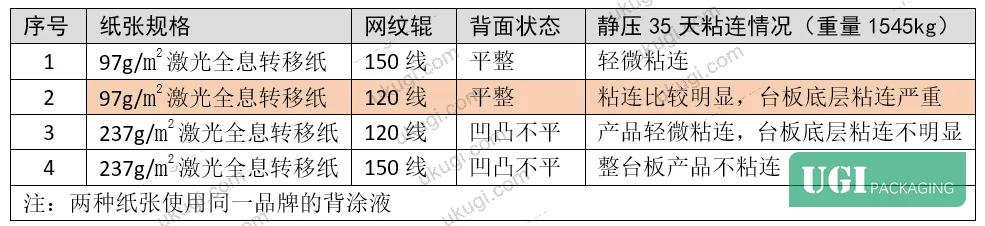
Two paper grades were compared: 90 g/m² coated art paper (smooth reverse face) used in soft-pack structures, and 230 g/m² white board (textured, tactile roughness on reverse) used in rigid carton formats.
The data is clear — and somewhat counterintuitive to buyers who haven’t worked with this substrate class. High back-coating quantity on the smooth 90 g/m² soft-pack paper significantly increased blocking tendency. The 230 g/m² board with its naturally rough reverse face showed no significant blocking response regardless of back-coat level.
The mechanism: a smooth, heavily back-coated reverse surface makes full contact with the UV varnish face of the sheet below it. There’s no air gap. Add heat, humidity, and any residual uncured varnish molecules, and you have a chemical and physical bond forming in the stack. The solution for soft-pack structures is to use 180–200 line anilox rollers for back-coat application — keeping the coating functional for dimensional stability while reducing the contact surface uniformity.
Storage Environment #
Temperature and humidity are the activation conditions for residual blocking. At 35–42°C with 60–85% RH (summer warehouse conditions in many Asian facilities), residual uncured varnish molecules and back-coat liquid molecules become mobile and adsorb together — producing severe “re-blocking” or reversion blocking. The same products stored at 25–30°C with 55 ±5% RH showed markedly reduced blocking.
Recommended storage conditions: spring/summer — 25–30°C, 50 ±5% RH; autumn/winter — 5–20°C, 20–35% RH. Maximum shelf life without blocking risk: 2 months (60 days). Stack height: single pallet only — stacking two pallets (adding ~1,542 kg compression) significantly worsens lower-layer blocking.
Industry observation worth flagging: most procurement teams specify UV varnish performance based on immediate post-press testing — scratch resistance, gloss, adhesion. Almost no standard incoming quality check tests for blocking under storage-realistic conditions. This is a systematic blind spot in how UV-coated packaging components are qualified, and it’s the reason blocking failures consistently appear as warehouse or logistics problems rather than print defects.
Formulation Validation: Six-Scheme Press Trial Results #
Six formulation schemes were tested on the Bobst eight-color rotogravure press at 170 m/min, full UV lamp power (five lamps), 36-day compression at 1,542 kg. The schemes covered two UV varnish suppliers and multiple photoinitiator/anti-misting agent combinations.
| Formulation Scheme | Supplier | 36-Day Compression Result | Water Misting | Production Viable? |
|---|---|---|---|---|
| Y1-2 (UVGG-1629 + 7% anti-mist) | Supplier A | No blocking | None detected | Yes — mass production approved |
| Y1-1 (UVGG-1629 + reduced anti-mist) | Supplier A | Very slight blocking | None detected | Marginal — further monitoring required |
| Y2 (UVGG-1629 variant) | Supplier A | Very slight blocking | None detected | Marginal — not for mass production |
| Y3 (UVGG-1629 lower photoinitiator) | Supplier A | Slight blocking | None detected | No — fails quality threshold |
| S1-1 | Supplier B | Obvious blocking | None detected | No — requires dedicated reformulation |
| S1-2 | Supplier B | Obvious blocking | None detected | No — requires dedicated reformulation |
In supplier qualification for this project, three of six formulation schemes failed the 36-day compression test — and both schemes from Supplier B showed obvious blocking, suggesting that the varnish base chemistry, not just the additive ratio, was incompatible with the substrate and press parameters. This is the friction point most buyers don’t anticipate: switching UV varnish supplier mid-production carries genuine blocking risk even if the new product meets all specified optical properties.
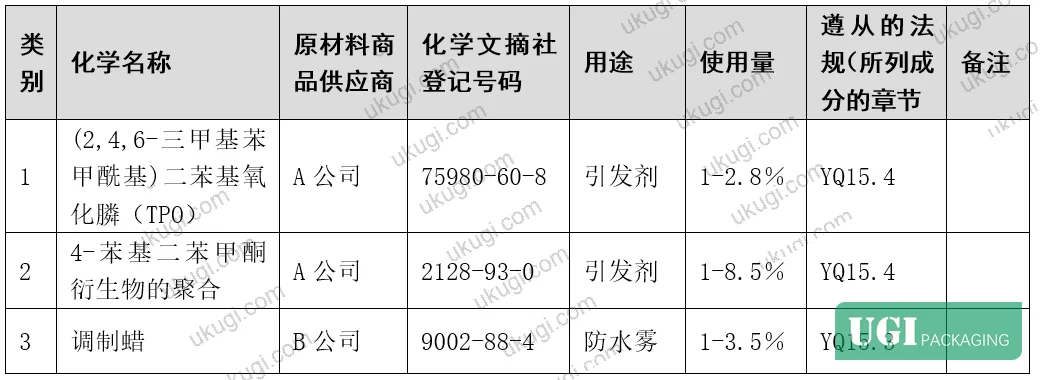
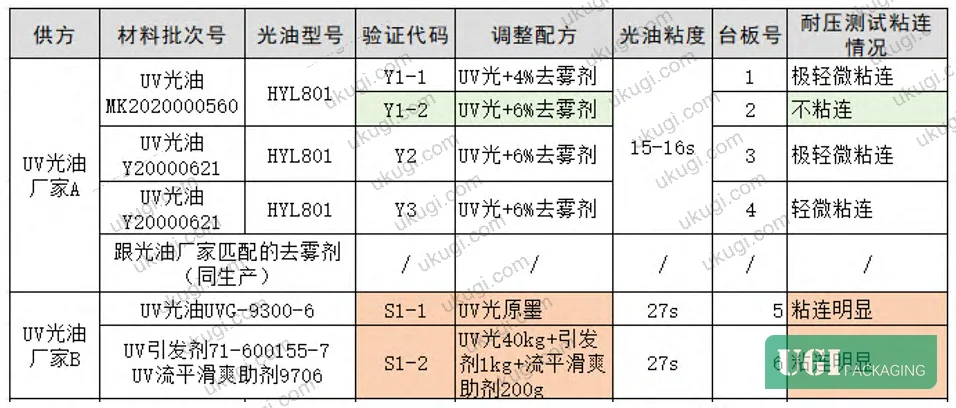
The validated solution: Supplier A’s reformulated UVGG-1629 with 7% anti-misting agent addition. This formulation deepened through-cure, increased surface dryness and slip, and maintained acceptable gloss under compression and high-humidity storage. Under microscopic examination, the varnish surface retains micro-particulate texture — creating natural air gaps at the stacking interface that prevent adhesion.
Honestly, most buyers over-specify UV gloss level (insisting on ≥85% with no tolerance) without realizing that mirror-smooth high-gloss finishes are structurally predisposed to blocking under stack pressure. A controlled micro-diffuse surface — visually indistinguishable from high-gloss at normal viewing distance — reduces blocking risk substantially without any perceivable quality compromise.
For packaging applications where tensile and barrier properties must also be verified alongside surface finish, ASTM D882 Standard Test Method for Tensile Properties of Thin Plastic Sheeting provides a complementary test framework applicable to flexible substrate components, and conditioning requirements should align with ISO 187:1990 Paper, board and pulps — Standard atmosphere for conditioning and testing to ensure test reproducibility across supplier facilities.
Practical Guidance for Buyers #
If you’re sourcing UV-coated flexible carton components — especially soft-pack structures, holographic transfer paper applications, or any format where the print face and substrate reverse are in direct contact under warehouse stack pressure — you need to build blocking validation into your sampling protocol, not your post-delivery claims process.
The minimum viable qualification test is a 36-day compression trial at conditions representative of your actual warehouse environment. Specify the test load (≥1,500 kg is realistic for pallet stacking), temperature (25–30°C for temperate climates, or summer conditions if your 3PL operates in Southeast Asia or the Middle East), and humidity (50–60% RH). Any varnish formulation that shows blocking under those conditions at 36 days will definitely fail at 60 days under real logistics conditions.
Key parameters to lock into your purchase specification: compound photoinitiator system (not single-component), anti-misting agent at 5–7% with 7% as the validated upper bound for soft-pack substrates, print speed cap at 170 m/min for inline UV on holographic transfer papers, and storage temperature control at 25–30°C / 50 ±5% RH with 60-day maximum inventory before consumption. Do not allow pallet double-stacking in any storage zone designated for UV-varnished soft-pack components.
We produce UV-coated flexible and rigid packaging components — including custom paper boxes and cosmetics packaging solutions — from our Guangzhou OEM/ODM facility, with full surface finishing capabilities and controlled storage conditions designed for international brand requirements. If your current supply chain is showing blocking complaints or you’re qualifying a new UV varnish specification, our team can walk you through formulation parameters before sampling.
Need a custom formulation or sample? Request a quote from our team →
Supplier Qualification Questions #
- What is your photoinitiator system type for inline UV varnish — single-component or compound? Can you provide the compound initiator blend ratio and demonstrate that it achieves complete through-cure at print speeds above 170 m/min?
- What is the validated anti-misting agent addition percentage in your UV varnish formulation for soft-pack substrates, and can you confirm it falls within the 5–7% effective range without compromising gloss below 85%?
- Can you provide 36-day compression test data at ≥1,500 kg load showing no blocking outcome for your production UV varnish on 90–97 g/m² coated or holographic transfer paper substrates?
- At what back-coat anilox line count do you specify soft-pack substrate application — and can you confirm the use of 180–200 line anilox rollers to limit back-coat smoothness and reduce face-to-back contact area?
- What are your validated UV varnish storage temperature and humidity parameters, and can you confirm that product shipped to warehouse environments operating at 35°C / 80% RH will not exhibit blocking within a 60-day inventory cycle?
Sourcing Checklist #
- ☐ UV varnish formulation uses a compound (multi-component) photoinitiator system, not a single-component initiator
- ☐ Anti-misting agent or anti-fog paste addition ratio confirmed at 5–7% (7% for soft-pack substrates) per validated formulation data
- ☐ 36-day compression test at ≥1,500 kg load shows no blocking on target substrate (90–97 g/m² coated or holographic transfer paper)
- ☐ Print speed for inline UV application on soft-pack structures capped at ≤170 m/min; blocking onset confirmed above this threshold in speed trials
- ☐ Back-coat anilox specification for soft-pack paper confirmed at 180–200 line count to prevent over-smooth reverse surface
- ☐ Finished product storage conditions specified: 25–30°C, 50 ±5% RH (spring/summer), no double-pallet stacking
- ☐ UV lamp service life managed with forced retirement at 800–1,000 hours (well within rated life of 1,200–1,500 hours) to prevent cure degradation
- ☐ Maximum inventory-to-use cycle confirmed at ≤60 days for UV-varnished soft-pack components under controlled warehouse conditions
Key Specifications Table #
| Parameter | Recommended Value | Verification Method |
|---|---|---|
| Anti-misting agent addition (soft-pack) | 5–7%, typically 7% | Formulation disclosure sheet; weight ratio verification at mixing stage |
| Maximum print speed for through-cure | ≤170 m/min on inline UV | Speed-vs-blocking trial: 35-day compression at 1,545 kg, observe blocking onset |
| UV lamp forced retirement threshold | 800–1,000 hours service life | Lamp hour meter log; rated life 1,200–1,500 h (IST-type lamps) |
| Storage temperature (spring/summer) | 25–30°C, 50 ±5% RH | Warehouse temperature/humidity data logger |
| Storage temperature (autumn/winter) | 5–20°C, 20–35% RH | Warehouse temperature/humidity data logger |
| Maximum inventory cycle (soft-pack UV) | ≤60 days before use | Stock rotation tracking; FIFO enforcement |
| Back-coat anilox line count (soft-pack) | 180–200 lines | Anilox specification confirmation from paper supplier |
| Compression test load (blocking qualification) | ≥1,542 kg, 36 days | Stack weight calculation; visual and tactile blocking assessment at test end |
Looking for a manufacturer that meets these specs? Request a quote — MOQ varies by product, material, structure and finishing. Product-specific MOQ is confirmed with each quotation.
References #
Data source: Blocking Control in Rotogravure Inline UV Varnish Applications: Photoinitiator Formulation, Substrate Back-Coating, and Storage Condition Effects, Z.-J. Fang et al., Journal of Applied Polymer Science, 2025
Frequently Asked Questions #
What is “false dry” in UV varnish printing and why does it matter for packaging buyers?
False dry refers to a UV varnish film that is surface-hardened but incompletely cured at depth. The surface passes immediate scratch and adhesion tests, but residual uncured polymer in the interior remains reactive. Under stack pressure and warm, humid storage conditions, this uncured layer adsorbs to the back-coated substrate surface of the sheet above it, causing blocking. It matters for buyers because it passes all standard incoming quality checks and only manifests as a warehouse or logistics failure weeks later.
How do I know if my UV varnish supplier is using a compound photoinitiator vs. a single-component system?
Ask for the formulation disclosure sheet or component data sheet for their UV varnish. A compound photoinitiator system will list two or more distinct photoinitiator chemical types (typically a Type I and Type II initiator, or multiple UV-absorption wavelength components). If the supplier cannot or will not provide this information, treat that as a technical qualification failure — a competent UV varnish manufacturer will have this data readily available.
Does reducing UV varnish gloss level to prevent blocking affect the visual quality of premium packaging?
Not perceptibly at normal viewing distances. The anti-misting agent modification that creates micro-diffuse surface texture operates at a microscopic scale — the particle structure creates air gaps between stacked sheets but does not visibly dull the finish when viewed at arm’s length. Gloss measurement (typically ≥85% at 60°) is retained within specification. The visual change is more apparent under raking light or close-up photography, which is rarely how finished packaging is evaluated.
What paper types are most vulnerable to UV varnish blocking?
Smooth, heavily back-coated soft-pack substrates — particularly coated art papers in the 90–97 g/m² range — show the highest blocking susceptibility. The smooth reverse surface creates full face-to-back contact with the UV varnish layer of the adjacent sheet. Heavier board grades (230+ g/m²) with naturally textured reverse faces are significantly less prone to blocking because the surface roughness creates inherent air gaps in the stack. Specifying 180–200 line anilox back-coating for soft-pack paper substrates partially mitigates this risk.
Can UV lamp replacement alone solve blocking problems in an existing production line?
No — and this is a costly assumption many facilities make first. Replacing UV lamps with new units removes one contributing variable (light intensity decay after 1,000+ hours of service), but if the formulation is single-component photoinitiator, or the print speed exceeds the cure threshold, or the back-coating is too heavy, blocking will continue regardless of lamp condition. The production trial in this evaluation ran with lamps within their forced-retirement window (under 1,000 hours of service) and still produced blocking — confirming that formulation and process parameters, not lamp aging, were the primary causes.
Published by ukugi.com Technical Team | Request a quote


