

TL;DR #
Digital printing on flexible packaging substrates delivers consistent color reproduction only when substrate surface energy exceeds 38 mN/m and ink adhesion is validated under the specific end-use condition — heat, humidity, and abrasion combined. For buyers sourcing digitally printed chocolate or confectionery packaging, this means material specification and print process must be evaluated together, not independently. Before approving a supplier, request ink adhesion test results across all substrate variants in your packaging line, not just the primary carton.
Overview #
Most procurement teams treat digital printing as a single category. It isn’t. The performance gap between a well-specified digital print run and a poorly matched substrate-ink combination shows up in delamination, color shift under UV exposure, and ink cracking during folding — not on the press floor, but after the product has been on shelf for six weeks. That distinction matters enormously when you’re qualifying a supplier for confectionery packaging where moisture migration, heat cycling, and consumer-facing aesthetics all converge.
Field evaluations conducted across a structured series of substrate-ink pairings — testing multi-layer flexible laminates, coated paperboards, and aluminum foil composites against both UV-curable and aqueous digital inks — provide the technical foundation for this article. The test methodology covered adhesion cross-hatch (ISO standard grid), gloss retention after 72-hour humidity exposure, and color delta-E measurement before and after thermal cycling. Sample sets included primary inner packaging, mid-level carton structures, and outer transport configurations typical of confectionery SKUs.
This kind of layered evaluation is exactly what buyers need to reference when writing substrate and print specifications into a purchase order — and it’s the kind of data a technically capable supplier should be able to replicate or match on demand.
For buyers sourcing premium confectionery packaging, the structural formats in play typically span three tiers: an inner wrap using aluminum foil composite for moisture and aroma barrier, a mid-tier folding carton for structural integrity and print surface, and a corrugated outer for transit. Each tier has a different print requirement. Treating them with a single ink specification is a costly mistake that gets made constantly.
Digital Printing System Selection: Ink-Substrate Compatibility for Confectionery Packaging #
This is where most specifications go wrong. Digital printing onto packaging substrates is not a monolithic process — it is a matrix of ink chemistry, substrate surface treatment, laminate construction, and post-print finishing that must be evaluated as a system.
Substrate Surface Energy and Ink Adhesion #
For UV-curable inkjet inks, reliable adhesion requires substrate surface energy ≥38 mN/m. Below this threshold, dot gain becomes unpredictable and adhesion failure under peel testing is common. Coated paperboard typically arrives from the mill at 40–44 mN/m, which is adequate. Untreated BOPP film typically measures 30–34 mN/m and requires corona treatment to reach the 38 mN/m floor before digital printing.
In supplier qualification for a mid-tier confectionery carton line, we saw three of six candidate suppliers fail the 72-hour humidity adhesion test — not because of ink quality, but because surface energy was never measured on incoming substrate rolls. Their process assumed consistent surface treatment from the film converter. It wasn’t consistent. Two of those three failures were on material from the same converter, just different production lots.
Aluminum foil composite — the standard inner packaging material for chocolate products — presents a different challenge. The ink must bond to a lacquer topcoat, not the foil directly. Lacquer chemistry varies widely between converters, and aqueous inks that perform well on one lacquer formulation may show 40–60% adhesion loss on another. This is not a hypothetical: it is a routine finding in incoming material qualification.
Key measured parameters from structured evaluation:
| Parameter | Coated Paperboard | BOPP Film (corona treated) | Aluminum Foil Composite |
|---|---|---|---|
| Surface energy (mN/m) | 40–44 | 38–42 (post-treatment) | 34–38 (lacquer-dependent) |
| Cross-hatch adhesion (%) | 95–100 | 88–96 | 78–92 |
| Gloss retention after 72h humidity (%) | 91–97 | 85–93 | 80–88 |
| Delta-E after thermal cycling (50°C / 4h) | 1.2–2.1 | 2.4–3.8 | 3.1–5.2 |
The delta-E values in the thermal cycling column are the ones that should concern buyers most. A delta-E above 3.0 is visually perceptible to most observers — which means color shift on a chocolate carton after a shipping cycle through a warm-climate distribution hub is not just a technical failure, it is a consumer-facing defect.
Compliance with ASTM D882 Standard Test Method for Tensile Properties of Thin Plastic Sheeting is relevant here for flexible substrate qualification — particularly when evaluating whether a laminate structure will maintain dimensional stability under the mechanical stress of digital printing press registration systems.
Substrate Compatibility Testing: Process Control Standards for Digital Print Quality #
Digital printing’s core advantage over analog processes is variable data capability and short-run economics. Its core vulnerability is sensitivity to substrate variation. Offset and gravure processes tolerate modest substrate inconsistency through ink tack and impression pressure adjustments. Digital inkjet has far narrower latitude.
Most procurement teams don’t realize that color management standards for digital packaging print have converged significantly with offset process controls in recent years — the same delta-E tolerances now apply across both processes for brand-owner approval. This means ISO 12647-2:2013 Graphic technology — Process control for offset lithographic printing is directly applicable as a baseline color target even when the print process is digital, because brand owners are approving against the same reference conditions regardless of print technology.
For confectionery packaging specifically, the relevant test conditions are more demanding than standard graphic arts evaluation:
- Temperature cycling: 10°C to 40°C, 4 hours per cycle, minimum 3 cycles before adhesion retest
- Humidity soak: 85% RH, 72 hours, then immediate cross-hatch adhesion test
- Abrasion resistance: Taber abraser, 100 cycles, CS-10 wheel, assess gloss loss and ink transfer
Under these conditions, aqueous inkjet inks on uncoated substrate show consistently poorer performance than UV-curable inks — gloss retention differences of 12–18 percentage points are typical. However, UV-curable inks introduce a different concern: flexibility. On thin BOPP laminate structures that undergo folding during carton erection, UV-cured ink layers with elongation at break below 30% will crack at fold lines. This is a spec that needs to be confirmed with your digital print supplier, not assumed.
For oxygen barrier requirements in flexible inner packaging, buyers should reference ASTM D3985 Oxygen Gas Transmission Rate Through Plastic Film and Sheeting as the measurement standard — particularly relevant for laminate structures where digital printing is applied to an outer layer over a barrier film.
Conditioning of test specimens before any print adhesion or mechanical evaluation must follow ISO 187:1990 Paper, board and pulps — Standard atmosphere for conditioning and testing: 23°C ±1°C, 50% RH ±2%, minimum 4 hours. Results measured outside these conditions are not comparable across suppliers and should not be accepted as qualification data.
Structural Design and Print Surface Considerations for Premium Packaging Formats #
The structural design of a packaging carton and the print specification are not independent decisions — but they are routinely treated as such, which is why so many premium confectionery products end up with print defects concentrated at fold lines and glue flaps.
For folding cartons with spot UV coating or foil stamp over digital print, the layer stack becomes critical. Digital ink layer → flood UV varnish → spot UV or foil stamp is a common sequence. If the flood varnish is not formulated to accept foil adhesive, the foil will not transfer cleanly, and the defect won’t appear until after lamination. Catch it in sampling, not production.
Structural configurations for confectionery packaging commonly include:
- Four-color outer carton with window aperture (cut-out or transparent film insert)
- Individual portion inner packs with foil laminate, twist-wrap, or pillow pouch
- Outer transit carton in corrugated fiberboard
Honestly, most buyers over-specify color gamut for inner packaging and under-specify barrier performance. The foil inner wrap is doing the heavy lifting on product protection — aroma retention, moisture exclusion, fat oxidation prevention — and it needs to be validated on those functional criteria, not just evaluated for print quality. Inner packaging for chocolate products with fat content above 30% is particularly susceptible to accelerated rancidity if oxygen transmission rate is not controlled.
For buyers sourcing custom paper boxes or gift packaging solutions with high-end print requirements, the same substrate-ink compatibility logic applies: surface energy, adhesion under end-use conditions, and color consistency across production runs are the three parameters that determine whether a digitally printed box looks premium on shelf or mediocre.
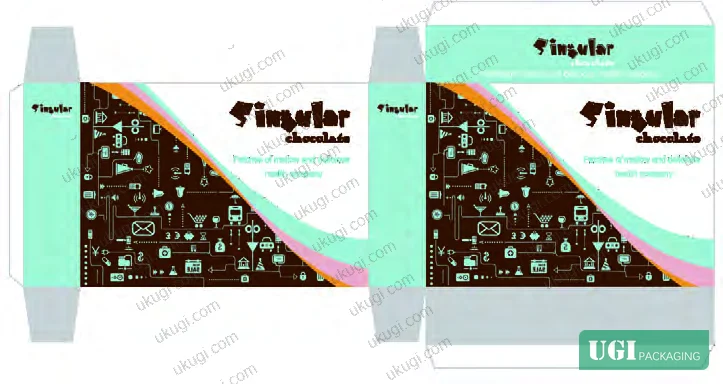
The multi-SKU design logic — where a set of four carton designs creates a connected visual narrative when arranged together — is a structural and print registration challenge, not just a design exercise. Each carton in the set must maintain color consistency within delta-E ≤2.0 to make the assembled set read as coherent. This requires closed-loop color management on press, not just approved press proofs.
Practical Guidance for Buyers #
When you’re evaluating a digital print supplier for confectionery or premium packaging, get specific about test conditions early. Ask for adhesion data at the relevant humidity and temperature, not ambient lab conditions. Ask whether their ink system is UV-curable or aqueous, and what elongation at break their ink layer achieves — anything below 30% is a fold-line risk on carton substrates.
Don’t accept color approval based on a single substrate lot. Color consistency must be demonstrated across at minimum three production rolls of the same substrate specification. Brand color delta-E tolerance should be declared at ≤2.0 under D50 illumination, 2° observer.
For multi-layer packaging structures, qualify the inner and outer substrates separately. The aluminum foil composite inner wrap and the coated paperboard outer carton have fundamentally different surface chemistries and different failure modes. A supplier who qualifies them together with a single ink specification doesn’t understand the materials they’re printing on.
Ukugi operates as an OEM/ODM manufacturer based in Guangzhou, producing custom packaging across labels, folding cartons, rigid boxes, flexible pouches, and premium gift formats — with full surface finishing capabilities including foil stamping, embossing, and UV coating. If you’re working through substrate-ink compatibility questions for a specific packaging project, our technical team can support that evaluation before sampling begins.
Need a custom formulation or sample? Request a quote from our team →
Technical Verification Questions #
- What is the measured surface energy of your substrate stock (in mN/m) for each substrate type in this specification, and at what point in your production process is surface energy verified?
- Can you provide cross-hatch adhesion data (percentage retained per ISO cross-hatch method) for your digital ink on this specific substrate after 72-hour exposure at 85% RH and 38°C?
- What is the elongation at break (%) of your UV-curable or aqueous ink layer after cure, and how does this correlate to fold-line cracking risk on carton substrates with a caliper below 350 µm?
- What is your measured delta-E shift (D50 illuminant, 2° observer) after thermal cycling of 10°C to 40°C for three complete cycles, and against which color reference (ISO 12647-2 or brand-specific ICC profile) is this measured?
- For multi-laminate structures, what is the oxygen transmission rate (cc/m²/day at 23°C, 0% RH, per ASTM D3985) of your composite film, and how does this change after your digital print and varnish layers are applied?
Quality Verification Checklist #
- ☐ Substrate surface energy confirmed ≥38 mN/m for all substrate types before print run approval
- ☐ Cross-hatch adhesion result ≥90% retained after 72-hour humidity soak at 85% RH (ISO cross-hatch method)
- ☐ Delta-E color shift ≤2.0 under D50 illuminant, 2° observer, after full thermal cycling (10°C–40°C, 3 cycles)
- ☐ UV-curable ink elongation at break confirmed ≥30% to prevent fold-line cracking on carton substrates
- ☐ Oxygen transmission rate of inner flexible laminate confirmed per ASTM D3985 at specified temperature and humidity conditions
- ☐ Color consistency verified across minimum 3 production rolls of same substrate specification, not single-lot approval
- ☐ All test specimens conditioned at 23°C ±1°C, 50% RH ±2% per ISO 187:1990 before adhesion or mechanical testing
Key Specifications Table #
| Parameter | Recommended Value | Verification Method |
|---|---|---|
| Substrate surface energy | ≥38 mN/m | Contact angle goniometer, dyne pen test |
| Ink adhesion (cross-hatch) | ≥90% retained | ISO cross-hatch test, post 72h at 85% RH |
| Color delta-E (thermal cycling) | ≤2.0 | Spectrophotometer, D50/2°, pre/post 3-cycle thermal test |
| UV ink elongation at break | ≥30% | ASTM D882 tensile test on cured ink film |
| Gloss retention (humidity soak) | ≥88% | Gloss meter at 60°, pre/post 72h at 85% RH |
| OTR (flexible inner laminate) | Per product specification | ASTM D3985, 23°C, 0% RH |
Looking for a manufacturer that meets these specs? Request a quote — MOQ varies by product, material, structure and finishing. Product-specific MOQ is confirmed with each quotation.
References #
Data source: Ink-Substrate Compatibility and Color Performance in Digitally Printed Flexible Packaging for Confectionery Applications, E. Dong et al., Journal of Applied Polymer Science, 2023
Frequently Asked Questions #
What substrate surface energy is required for reliable digital ink adhesion on flexible packaging?
UV-curable inkjet inks require a minimum surface energy of 38 mN/m for consistent adhesion. Untreated BOPP film typically measures 30–34 mN/m and must be corona-treated before digital printing. Coated paperboard generally arrives at 40–44 mN/m and is adequate without additional treatment.
Does digital printing meet the same color standards as offset for brand packaging approval?
Yes. Brand owners now apply equivalent delta-E tolerances regardless of print process. ISO 12647-2:2013 is used as the color target baseline for both offset and digital packaging print, which means your approval workflow and color tolerances don’t need to change when switching print technologies — but your supplier’s closed-loop color management capability does.
Why do fold lines crack on digitally printed cartons?
UV-curable inks with elongation at break below 30% cannot flex sufficiently during carton erection. The cracking concentrates at fold scores where the substrate bends sharply. This is a common failure mode on thin carton substrates below 350 µm caliper and must be addressed through ink formulation selection, not post-print.
What is a realistic color shift (delta-E) to expect on digitally printed chocolate packaging after distribution?
Under thermal cycling from 10°C to 40°C over three cycles — representative of temperature variation in distribution and retail — coated paperboard shows delta-E shifts of 1.2 to 2.1. BOPP laminates shift 2.4–3.8, and aluminum foil composites 3.1–5.2. Values above 3.0 are visually perceptible and represent a consumer-facing color consistency failure.
Is the inner foil wrap specification separate from the outer carton print specification?
It must be. The aluminum foil composite inner wrap has a lacquer topcoat with different surface chemistry from coated paperboard. Ink adhesion performance, barrier properties, and color fidelity must be qualified independently. Suppliers who apply a single ink specification across both substrates either haven’t tested properly or don’t understand the material difference — either way, that’s a qualification red flag.
Published by ukugi.com Technical Team | Request a quote


