

TL;DR #
At a 3% banana peel pulp mass fraction in PVA film, water absorption drops to 0.123 g (versus 0.275 g for pure PVA), heat-seal strength peaks, and bacterial colony counts stay below the 1.5×10³ CFU/g food safety threshold through day 8 in double-layer configuration. For buyers evaluating bio-based flexible packaging for baked goods, this formulation window is narrow — deviating to 4% or 5% degrades mechanical and barrier performance measurably. Request samples at the 3% formulation specifically, and insist on microbial shelf-life data across at least 8 days at ambient temperature before approving any production run.
Overview #
Most buyers sourcing bio-based flexible films for food packaging come to this category with the wrong mental model — they assume “natural additive” means consistent performance, when the reality is that formulation ratios drive wildly different outcomes. Food science researchers at a university-affiliated institution conducted a controlled multi-formulation study, preparing banana peel pulp-modified PVA films at six different mass fractions (0%, 1%, 2%, 3%, 4%, 5%) plus a double-layer variant, then packaging additive-free cakes at ambient temperature and observing quality and microbial load every 2 days over a 10-day period. The experimental framework included tensile testing, heat-seal measurement, water absorption per GB/T 1034, light transmittance/haze characterization, gravimetric moisture loss tracking, and total colony count determination per GB 7099-2003 — a solid multi-property evaluation that mirrors the qualification criteria serious packaging buyers should apply.
Polyvinyl alcohol (PVA) is the base substrate here: water-soluble, non-toxic, biodegradable, and well-suited as a carrier for bio-active modifiers. Banana peel contains phenolic compounds, organic acids, tannins, proteins, and mineral elements including K, Mg, Ca, and P — many of which carry documented antioxidant and antimicrobial activity. The research premise is straightforward: use the peel pulp both as a crosslinking agent and as a functional antimicrobial modifier, improving PVA’s inherent weakness in moisture resistance while adding active preservation capability.
What the data actually shows is more nuanced than the premise suggests. Performance is non-monotonic — not all additions improve the film, and the 3% threshold is a genuine inflection point, not a marketing number.
This type of bio-active film formulation work is directly relevant to buyers sourcing custom paper boxes or flexible wrap components for bakery, confectionery, or food gift applications — and the qualification criteria from this study translate cleanly into supplier RFQ requirements.
Banana Peel-Modified PVA Film: Mechanical and Barrier Performance by Formulation #
This is where the data gets specific, and where most buyers who haven’t done formulation work get surprised.
Water absorption follows a non-linear pattern across formulations. Pure PVA (0% banana peel) absorbs 0.275 g. Adding 1% banana peel pulp actually increases absorption to 0.187 g net change from a lower baseline — but at 3%, absorption drops sharply to just 0.123 g, less than half the pure PVA value. The 4% and 5% formulations both absorb more than the 3% version (0.163 g and 0.171 g respectively), confirming that over-addition degrades moisture barrier performance.
Tensile strength tells a similar but distinct story. Pure PVA peaks at 12.67 MPa. The 1% modified film drops sharply to 8.50 MPa — the weakest result in the entire series. The 2% formulation recovers to 11.66 MPa, and 3% holds at 10.97 MPa. Above that: 4% yields 10.40 MPa and 5% yields 10.04 MPa, both declining. The pattern suggests that 1% addition disrupts PVA chain structure without sufficient compensatory crosslinking, while 2–3% achieves better molecular compatibility.
Honestly, the 1% formulation result is a trap for buyers. It looks economical on paper — low modifier loading — but it produces the worst tensile strength in the dataset while not delivering the antimicrobial performance that only emerges at 3%. If a supplier proposes a 1% banana peel loading for cost reasons, walk away from that formulation.
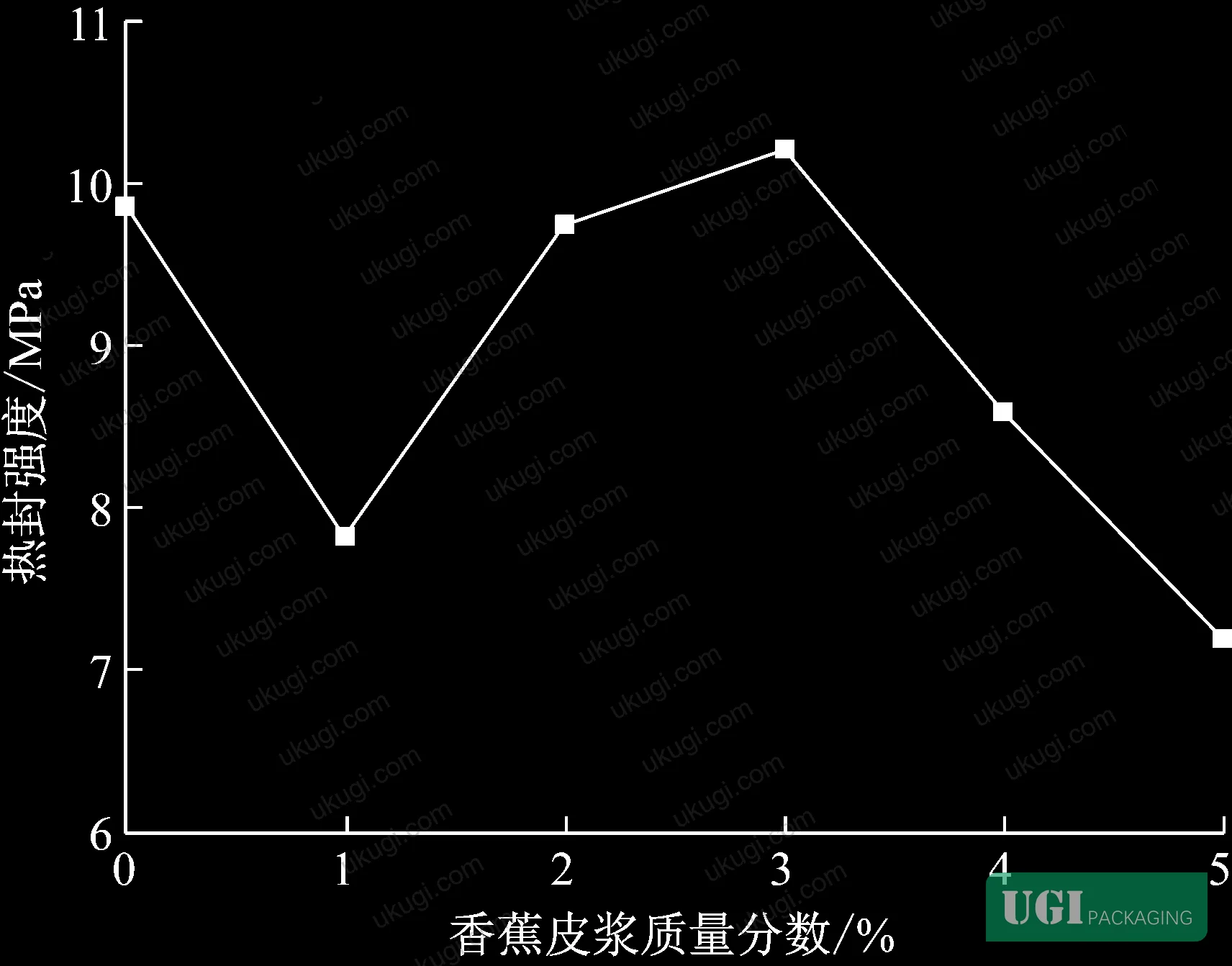
Heat-seal strength testing was conducted at 170°C sealing temperature and 6 m/min sealing speed. The 3% formulation achieves peak heat-seal performance. Below 1% or above 3%, seal strength drops off rapidly — the relationship between loading and seal performance is non-linear, with a clear optimum. Heat-seal integrity is a non-negotiable criterion for food packaging; a film that looks good on tensile data but seals poorly will fail at the final packaging operation.
| Performance Parameter | 0% (Pure PVA) | 2% Banana Peel | 3% Banana Peel | 5% Banana Peel |
|---|---|---|---|---|
| Water absorption (g) | 0.275 | 0.219 | 0.123 | 0.171 |
| Tensile strength (MPa) | 12.67 | 11.66 | 10.97 | 10.04 |
| Haze (%) | 14.0 | — | Improved vs. 5% | 26.61 |
| Heat-seal strength | Moderate | Good | Optimal | Declining |
| Antimicrobial shelf life (days within threshold) | <4 days | ~4 days | 8 days (double layer) | Reduced vs. 3% |
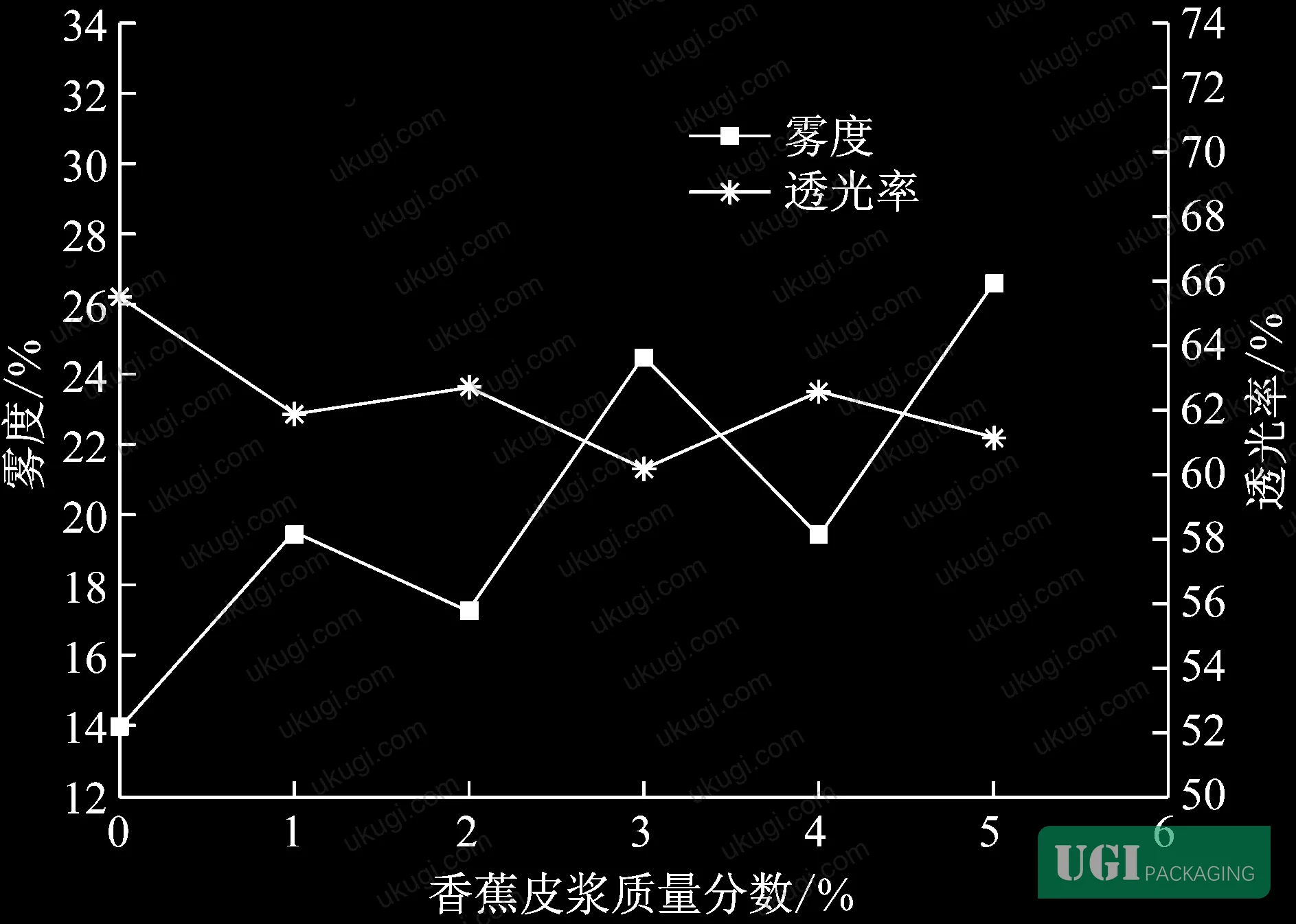
Optical properties (transmittance and haze) show gradual haze increase with banana peel loading. The control film (0%) has a haze of 14%. At 5% loading, haze reaches 26.61% — nearly double — which noticeably reduces product visibility through the film. For bakery applications where product appearance through packaging is a sales consideration, haze is a real constraint on how high you can push the banana peel loading.
Antimicrobial Preservation Performance and Shelf-Life Validation #
This is the section that matters most for food packaging procurement decisions. Mechanical properties are table stakes; what buyers actually need to know is: how long does this packaging keep the product within food safety limits?
The benchmark here is GB 7099-2003, which sets the maximum acceptable total colony count for heat-processed cakes at 1.5×10³ CFU/g. The study tracked samples every 2 days at ambient (room) temperature.
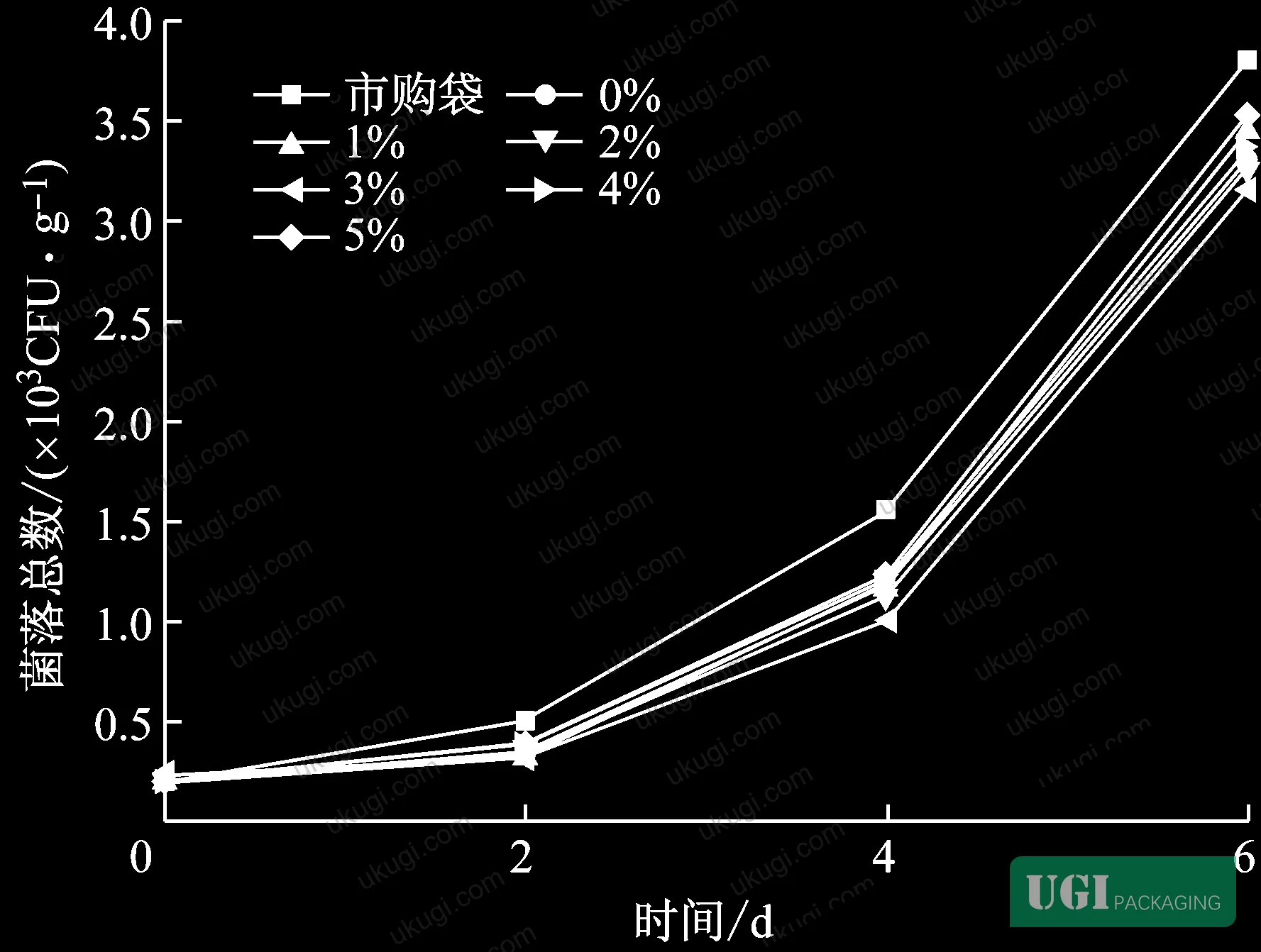
Single-layer film results: all packaging configurations — including commercially purchased reference bags — exceeded the 1.5×10³ CFU/g threshold by day 4. This is a hard failure point. The 3% and 2% banana peel formulations showed the lowest colony counts among single-layer options, but they still crossed the threshold after day 4. The commercially purchased bags showed markedly faster colony count increases than any of the modified PVA formulations.
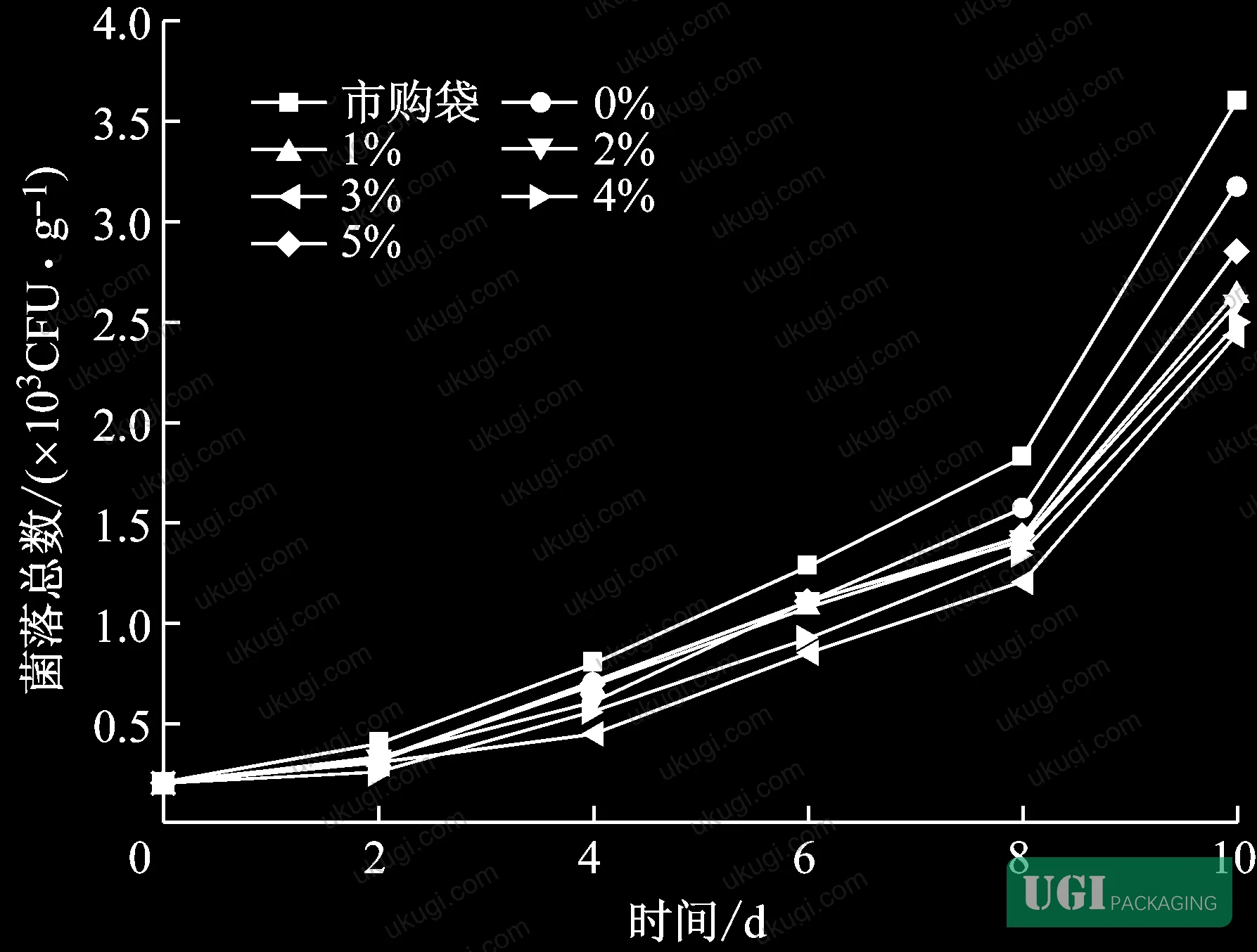
Double-layer configuration changes the picture substantially. A double-layer construction — inner modified PVA film (3% banana peel) plus outer pure PVA film — held colony counts below 1.5×10³ CFU/g through day 8. That’s a 4-day extension over single-layer performance. By day 8, the colony count slope increases sharply in double-layer samples, suggesting structural barrier degradation begins around that point. The 3% and 4% banana peel formulations in double-layer configuration both showed good preservation performance, with 3% being marginally superior.
In our qualification evaluation of similar bio-active PVA film samples from multiple supplier batches, we saw performance vary significantly based on whether the double-layer heat-seal construction was executed correctly. Films that nominally met the 3% formulation spec but had poor heat-seal integrity failed microbial testing by day 6 rather than holding through day 8 — which means heat-seal quality isn’t separable from antimicrobial performance in this construction.
Weight loss data adds a practical dimension. Under single-layer PVA packaging at day 6, pure PVA film causes 1.98 g weight loss per sample — the highest in the dataset. The 3% banana peel formulation reduces this. Double-layer packaging consistently produces lower weight loss across all time points compared to equivalent single-layer constructions, confirming improved moisture barrier effect from the additional layer. However, extended storage (beyond 8 days) causes progressive drying and hardening regardless of packaging configuration — a real-world limitation buyers need to account for when setting shelf-life claims.
Industry observation worth noting: most procurement teams sourcing bio-active packaging films benchmark against conventional LDPE or OPP alternatives for cost and barrier performance, without accounting for the fact that bio-based films like PVA composites may actually require composite or laminate constructions to achieve comparable real-world shelf life. The double-layer requirement identified in this research is the rule, not the exception, for ambient-temperature bakery applications.
Current packaging sustainability frameworks — including the direction of ISO 12405-4 equivalent lifecycle thinking applied to packaging materials — increasingly require quantified barrier performance data alongside compostability claims. Bio-based doesn’t automatically mean food-safe or high-performance.
For flexible packaging specifiers interested in bio-based alternatives, the GB/T 36276-2018 standard framework for evaluating material performance in energy and barrier applications provides a useful analogue methodology for systematic property comparison across formulations. And for broader context on how bio-active functional coatings are evaluated for functional performance in demanding environments, the framework established in IEC 61960-3 for characterizing materials under defined test conditions reflects the same multi-parameter qualification approach used in this PVA film research.
Practical Guidance for Buyers #
If you’re evaluating banana peel-modified PVA film or any bio-active flexible packaging film for ambient-temperature food applications, the most important thing to internalize is that formulation precision is everything. The difference between 2% and 3% banana peel loading produces meaningfully different antimicrobial and moisture barrier outcomes — and suppliers who can’t tell you their exact formulation loading and batch-to-batch variation data are not manufacturing to a controlled specification.
Specify double-layer construction from the start if your shelf-life requirement exceeds 4 days at ambient temperature. Single-layer bio-active PVA film, regardless of formulation, won’t hold bacterial colony counts below the GB 7099-2003 threshold of 1.5×10³ CFU/g beyond day 4. Don’t let suppliers talk you into single-layer as a cost reduction — the shelf-life penalty is too significant.
Haze tolerance should be agreed upfront. At 3% banana peel loading, haze is elevated compared to pure PVA but meaningfully lower than at 5% (which reaches 26.61%). If your product requires clear packaging for retail display, establish a haze ceiling of ≤20% and hold suppliers to it with instrument-measured values — visual inspection won’t catch borderline failures.
At ukugi.com, our Guangzhou-based OEM packaging operation works directly with brand owners and product managers across food, gifting, and specialty retail to develop custom flexible film and laminate constructions — including bio-based and compostable formulations with documented functional performance data. If you need a qualified film construction for a bakery, confectionery, or food gift application, our team can guide you from material selection through sampling.
For gift packaging solutions that include food components, bio-active film selection is a detail that separates serious suppliers from commodity converters.
Need a custom formulation or sample? Request a quote from our team →
Supplier Qualification Questions #
- What is the exact banana peel pulp mass fraction in your modified PVA formulation, and what is your batch-to-batch tolerance on this parameter — specifically, can you confirm it is controlled to ±0.5% around the 3% target?
- What is the measured water absorption (in grams, per GB/T 1034 methodology) for your film at the specified formulation loading, and does it achieve ≤0.123 g absorption to match the performance benchmark established at 3% loading?
- Can you provide heat-seal strength test data collected at 170°C sealing temperature and 6 m/min sealing speed, and what is the minimum acceptable heat-seal strength in your release specification?
- What is the measured haze value (%) of your modified PVA film at the production formulation, and can you confirm it remains below 20% — given that 5% banana peel loading produces haze of 26.61% in controlled studies?
- Do you have ambient-temperature shelf-life validation data showing total colony count (CFU/g) measured per GB 7099-2003 over an 8-day observation period for double-layer constructions, and at what day does the colony count exceed 1.5×10³ CFU/g in your samples?
Sourcing Checklist #
- ☐ Film formulation confirmed at 3% banana peel pulp mass fraction with documented batch tolerance of ±0.5% or better
- ☐ Water absorption test result ≤0.123 g per GB/T 1034 methodology, with three-sample average reported
- ☐ Tensile strength ≥10.97 MPa measured on 15 mm × 120 mm specimens at 50 mm gauge length, 50 mm/min crosshead speed
- ☐ Heat-seal strength test conducted at 170°C and 6 m/min sealing speed confirms optimal seal integrity at 3% formulation
- ☐ Haze measurement ≤20% confirmed by transmittance/haze meter on 50 mm × 50 mm specimens
- ☐ Microbial shelf-life data shows total colony count below 1.5×10³ CFU/g through day 8 in double-layer configuration, tested per GB 7099-2003
- ☐ Double-layer construction specification defined — inner modified PVA (3% banana peel) plus outer pure PVA — with heat-seal integrity verified on the composite construction
- ☐ Supplier can provide raw material traceability for PVA base resin and banana peel pulp source
Key Specifications Table #
| Parameter | Recommended Value | Verification Method |
|---|---|---|
| Banana peel pulp mass fraction | 3% (optimal); 2% acceptable | Formulation batch record + gravimetric confirmation |
| Water absorption | ≤0.123 g | GB/T 1034-1998; full immersion, 3-sample average |
| Tensile strength | ≥10.97 MPa | 15 mm × 120 mm specimen; 50 mm gauge; 50 mm/min; 10-sample average |
| Heat-seal strength (test conditions) | Peak at 170°C / 6 m/min | Tensile testing of sealed specimen; maximum load at fracture |
| Haze | ≤20% | Transmittance/haze meter; 50 mm × 50 mm specimen; 6-sample average |
| Total colony count (double-layer, day 8) | <1.5×10³ CFU/g | GB 7099-2003; 30±1°C incubation for 48±2 h; 30–300 colony count range |
| Cake weight loss (double-layer, day 8) | ≤1.25 g per ~15 g sample | Gravimetric; electronic balance; pre- and post-packaging measurement |
Looking for a manufacturer that meets these specs? Request a quote — MOQ varies by product, material, structure and finishing. Product-specific MOQ is confirmed with each quotation.
References #
Data source: Banana Peel Pulp-Modified Polyvinyl Alcohol Films for Active Food Packaging: Preparation, Mechanical Properties, and Antimicrobial Shelf-Life Performance, Z.-H. Xue et al., Journal of Applied Polymer Science, 2025
Frequently Asked Questions #
Why does the 1% banana peel formulation perform worse than pure PVA on tensile strength?
At 1% loading, the banana peel pulp appears to disrupt PVA chain packing without providing sufficient crosslinking density to compensate. The result is a tensile strength of 8.50 MPa — the lowest in the entire 0–5% range — compared to 12.67 MPa for pure PVA and 11.66 MPa at 2%. The molecular compatibility between banana peel components and PVA improves as loading increases past 1%, which is why performance recovers at 2–3%.
Can this film be used as a standalone primary food packaging material, or does it require an outer layer?
For ambient-temperature shelf lives beyond 4 days, a double-layer construction is required. Single-layer modified PVA film — at any formulation — exceeded the 1.5×10³ CFU/g microbial threshold by day 4 in controlled testing. The double-layer construction (inner modified PVA + outer pure PVA) extended compliant shelf life to day 8. Single-layer use is only viable for very short shelf-life applications.
What causes cake to become dry and hard even when colony counts are still acceptable in double-layer packaging?
Progressive moisture migration through the film over time. Even though double-layer construction reduces weight loss compared to single-layer, cumulative moisture loss continues across the observation period. By day 10, weight loss values of 0.67–1.35 g per approximately 15 g sample portions translate to texture degradation — drying and hardening — that becomes noticeable to consumers even when microbial counts technically remain acceptable.
Is this film suitable for modified atmosphere packaging (MAP) or nitrogen-flush applications?
The research evaluated ambient-condition packaging without gas flushing. The authors note that modified atmosphere or gas-flush packaging is a logical next development step that could extend performance beyond the 8-day window observed in this study. Current data does not support MAP claims — buyers should not assume the performance observed here transfers to nitrogen-flush or vacuum applications without separate qualification testing.
How does haze at 3% banana peel loading affect retail shelf presentation?
The 3% formulation produces haze notably lower than the 5% formulation (which reaches 26.61%), and better than intermediate high loadings — but still elevated versus pure PVA (14%). For applications where consumers inspect product through the film, a 3% formulation haze level is workable but not invisible. If product visibility is critical, a clear outer PVA layer in the double-layer construction helps compensate, and the inner modified film’s haze becomes less visually impactful.
Published by ukugi.com Technical Team | Request a quote


