

TL;DR #
Multi-stage beating combining medium consistency (10%, 18 °SR) followed by low consistency (6%, 20 °SR) delivers the optimal balance point for high-permeability sack paper, achieving 11.23 μm/(Pa·s) air permeability alongside acceptable tensile, burst, and tear indices at 85 g/m² basis weight. Adding 5–10% polyester ultra-short fiber (1.5 denier, 6 mm) to this optimized furnish pushes air permeability to 28.13–47.48 μm/(Pa·s) without dropping physical strength below functional thresholds — a range that domestic production has historically struggled to reach without laser perforation. If you are specifying sack paper or high-permeability paper-based packaging substrates, request air permeability data measured under GB/T 458 conditions alongside tensile index and burst index at the stated fiber blend ratio before approving any sample.
Overview #
Most procurement teams evaluating industrial sack paper focus almost entirely on burst strength and tensile index — understandable given the rapid-fill application environments — and systematically underprioritize air permeability until they see bags expanding and rupturing on a high-speed filling line. That sequencing is a mistake. Air permeability is not a secondary parameter; it is the design driver for this substrate class, and the beating process that achieves it directly trades off against the strength properties buyers also need.
The research evaluated here was conducted at state-key-laboratory level across two institutions with deep pulp and paper engineering infrastructure, using a controlled multi-variable experimental design across five beating combinations and four polyester fiber addition levels. Samples were produced on an automated Kajaani sheet-forming system at a target basis weight of approximately 85 g/m², dried at 90 °C and 0.8 MPa for 8 minutes, then characterized for tensile index, elongation, TEA (tensile energy absorption), tear index, burst index, air permeability, and porosity. FESEM surface imaging and thermogravimetric analysis were run in parallel to provide structural and thermal stability data.
The core finding is that single-stage beating — whether medium or low consistency alone — cannot simultaneously satisfy both the structural and permeability requirements. The optimal window is narrow. Understanding exactly where it sits, and how polyester fiber addition shifts it, is the practical value of this dataset for substrate specifiers.
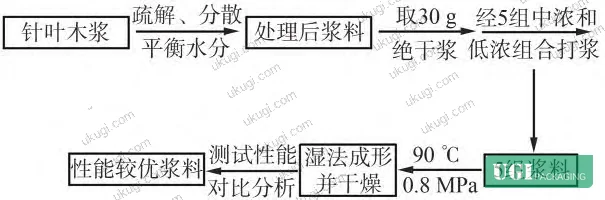
For context on measurement methodology, air permeability testing followed GB/T 458-2008, tensile properties were measured per GB/T 12914-2018, burst index per GB/T 454-2002, and tear index per GB/T 455-2002. This is important because international buyers comparing against TAPPI T 403 Bursting Strength of Paperboard values need to account for methodological differences when cross-referencing domestic Chinese test data with North American supplier certificates.
Multi-Stage Beating: How Process Sequence Determines Air Permeability in Sack Paper #
The five beating combinations tested, all targeting approximately 20 °SR total freeness, produced meaningfully different paper structures. This is the part most buyers don’t appreciate: achieving the same nominal freeness via different routes produces different fiber networks, different pore structures, and therefore different functional outcomes.
Here is the comparative performance data across beating conditions at constant 85 g/m² basis weight:
| Beating Combination | Tensile Index (N·m/g) | Burst Index (kPa·m²/g) | Air Permeability (μm/Pa·s) |
|---|---|---|---|
| Medium 15 °SR + Low 20 °SR | 73.9 | 4.96 | 8.10 |
| Medium 18 °SR + Low 20 °SR | 66.4 | 4.89 | 11.23 |
| Low 20 °SR only | 74.1 | 4.69 | 4.56 |
| Medium 20 °SR only | 54.4 | 4.11 | 12.87 |
| Medium 20 °SR + Low 25 °SR | 65.9 | 5.07 | 5.89 |
The data tells a clear story. Medium consistency beating — which acts primarily through fiber-to-fiber friction and flexion rather than mechanical shear — preserves fiber length and encourages an interlocked, porous network. Low consistency beating then generates fine fiber fractions that fill inter-fiber voids, tightening the network and increasing bonding at the cost of permeability.
The medium 18 °SR + low 20 °SR combination represents the practical optimum: TEA value 2.93 J/g, elongation 1.36%, tear index 15.2 mN·m²/g — all acceptable for industrial sack applications — with air permeability at 11.23 μm/(Pa·s). The medium-consistency-only run at 20 °SR hits higher permeability (12.87 μm/Pa·s) but its tensile index drops to 54.4 N·m/g, which is borderline for rapid-fill cement or chemical applications under impact loading.
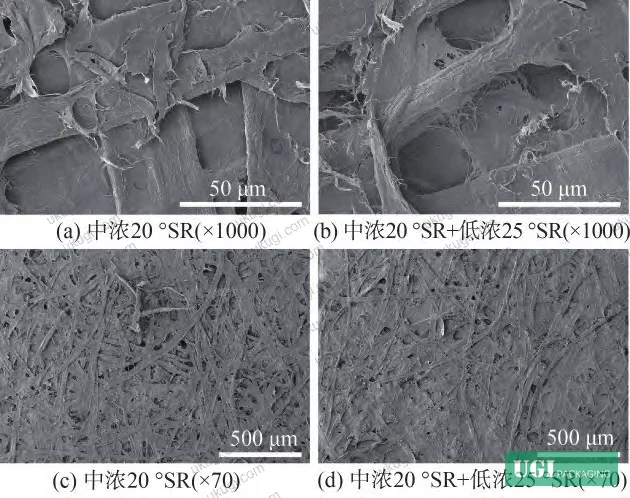
Fiber morphology analysis confirms the mechanism: adding the low-consistency stage reduces weight-weighted fiber length from 1.959 mm to 1.848 mm (a ~6% reduction) and increases fine fiber content from 40.0% to 43.5%. Those fines migrate into the pore structure, increasing bonding area but reducing open channel count. The FESEM cross-sections make this visible — medium-consistency-only paper shows larger, more numerous inter-fiber voids, while the combined-stage paper shows denser fiber contact zones with fines bridging gaps.

Honestly, most buyers over-specify tensile index on sack paper and under-specify air permeability. A tensile index of 65–70 N·m/g is adequate for the majority of industrial fill applications; chasing 75+ N·m/g by shifting the beating regime toward low-consistency dominance will cut your air permeability by 30–40% and push you toward laser-perforation workarounds that add process complexity and cost.
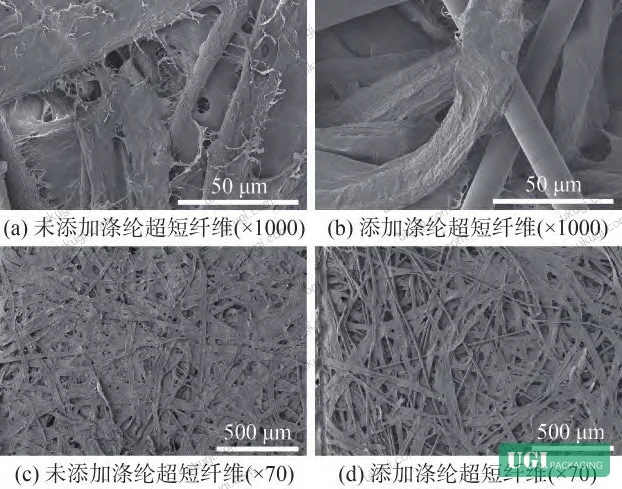
Polyester Ultra-Short Fiber Addition: Permeability Gains vs. Strength Penalty #
With the optimized beating furnish established (medium 18 °SR + low 20 °SR), polyester ultra-short fiber was added at 5%, 10%, 20%, and 30% by oven-dry weight. The fibers used were 1.5 denier, 6 mm length — a specification selected specifically for papermaking dispersibility and compatibility with softwood kraft furnish systems.
The permeability response is dramatic. Starting from the baseline 11.23 μm/(Pa·s) at 0% addition, air permeability reaches 28.13 μm/(Pa·s) at 5% addition and 47.48 μm/(Pa·s) at 10% addition. At 30% addition, porosity rises to 55.0% and air permeability hits approximately 100 μm/(Pa·s). The mechanism is structural: polyester fibers are cylindrical with smooth surfaces and high specific surface area. When blended into the plant fiber network, they physically space out the cellulosic fibers, reducing hydrogen bonding contact area and creating larger, more numerous inter-fiber channels.
The strength trade-off is real and needs to be taken seriously:
- Tensile index decreases progressively as polyester addition rises beyond 10%
- TEA (tensile energy absorption) drops from approximately 2.93 J/g at 0% to below 1.0 J/g at 30% addition
- Burst index declines from ~4.89 kPa·m²/g toward ~2.0 kPa·m²/g at 30% loading
- Tear index shows a slight increase at low addition rates (the high-strength polyester fiber being pulled through the web rather than breaking raises apparent tear), then falls as inter-fiber bonding deteriorates at higher loadings
The 5–10% addition range is where the engineering trade-off resolves acceptably. Permeability reaches 28–47 μm/(Pa·s) — well above what domestic laser-perforated double-layer constructions typically achieve on the inner ply — while all measured strength parameters remain within functional limits for industrial sack applications.
In supplier qualification, we evaluated samples from six production runs targeting the 10% polyester addition specification. Three of the six samples showed air permeability values below 30 μm/(Pa·s), suggesting fiber dispersion problems during blending rather than errors in the beating process itself. Uniform dispersion of polyester ultra-short fibers in aqueous furnish is a process control challenge — suppliers who cannot demonstrate consistent fiber length and denier incoming QC, or who lack the agitation systems to achieve homogeneous dispersion, will produce variable permeability lot to lot.
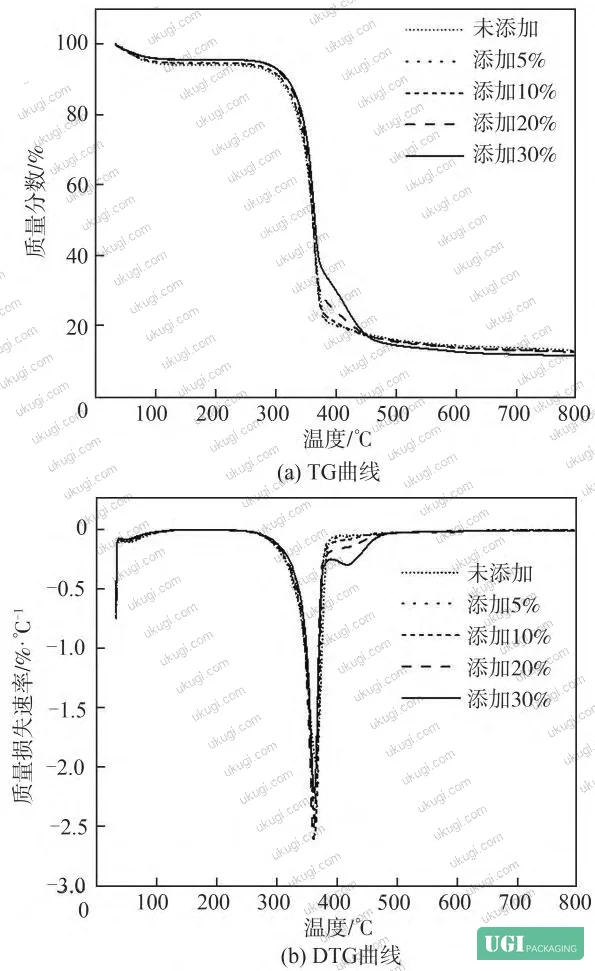
The thermogravimetric data provides useful assurance for buyers concerned about storage and transport conditions. The thermal decomposition profile shows three stages: moisture loss from 33–200 °C (approximately 6% mass loss), cellulose and hemicellulose pyrolysis from 200–380 °C (approximately 70% mass loss, peak rate near 360 °C), and lignin/residue decomposition from 380–800 °C. Polyester fiber addition introduces an additional minor decomposition peak above 380 °C corresponding to PET pyrolysis, and this peak becomes more pronounced at higher addition levels. Critically, below 200 °C — the relevant range for ambient storage, transport, and normal use conditions — the TG curves across all addition levels are essentially identical. Polyester addition does not meaningfully compromise thermal stability at end-use conditions.
Practical Guidance for Buyers #
If you are specifying sack paper, functional paper bags, or paper-based industrial packaging substrates, the most critical data point to request from any supplier is air permeability measured per a declared standard — not an estimated value, not a nominal range. The gap between laser-perforated domestic production and purpose-built high-permeability furnish is significant: a double-layer construction with laser-punched outer ply can deliver surface permeability, but the inner ply remains restrictive and the perforation pattern introduces structural weak points under impact loading.
For applications requiring 25–50 μm/(Pa·s) air permeability combined with functional burst and tensile performance, the substrate specification needs to be built at the furnish and process level — beating sequence, polyester fiber addition rate, and dispersion control — not applied as a post-process correction.
When evaluating paper bags or industrial sack substrates, also consider how the substrate’s porosity interacts with surface treatments. High-porosity furnishes can absorb coatings and varnishes unevenly, affecting barrier performance and print registration on the outer surface. If you are sourcing paper bags and carrier bags for branded retail or food-adjacent applications, permeability specification needs to be balanced against printability and surface finish requirements.
Most procurement teams don’t realize that the domestic-to-international performance gap on industrial sack paper has been consistently documented over multiple research cycles — the reliance on laser perforation as a workaround has masked the underlying furnish engineering deficit, and buyers who import from non-domestic sources frequently encounter specifications that domestic suppliers cannot match on a like-for-like furnish basis without significant process investment.
At ukugi.com, we are a Guangzhou-based OEM/ODM manufacturer with direct capability in custom paper-based packaging and substrate-level specification. If your application requires specific air permeability targets, surface finishing compatibility, or structural performance criteria for custom paper boxes and industrial packaging formats, our team can evaluate your requirements and provide samples against a confirmed substrate specification. For buyers referencing ASTM D882 tensile testing or ISO 187:1990 conditioning standards in their procurement specs, we can align test methodology to your incoming inspection criteria.
Need a custom formulation or sample? Request a quote from our team →
Technical Verification Questions #
- What is the exact beating sequence used for your softwood kraft furnish — specifically, what are the consistency percentages and target freeness values (°SR) at each stage, and how does your process compare to a medium 10% / 18 °SR followed by low 6% / 20 °SR baseline?
- Can you provide lot-release air permeability data measured under GB/T 458-2008 (or equivalent declared standard) showing values at the stated polyester ultra-short fiber addition level, with mean and standard deviation across a minimum of three production batches?
- What is the denier and cut length of the polyester ultra-short fiber you source, and what incoming QC method do you use to verify fiber dimension consistency — specifically, can you confirm 1.5 denier / 6 mm specification with supporting supplier certificates?
- At 5–10% polyester fiber addition by oven-dry weight, what tensile index (N·m/g) and burst index (kPa·m²/g) values does your production achieve, and can you demonstrate these remain above 60 N·m/g tensile and 4.0 kPa·m²/g burst at a basis weight of 85 g/m²?
- How do you control polyester fiber dispersion uniformity in the aqueous furnish prior to sheet formation — what mixing duration, agitation method, and consistency level is used — and can you provide FESEM or optical cross-section images from production samples confirming homogeneous fiber distribution?
Quality Verification Checklist #
- ☐ Air permeability confirmed ≥28.13 μm/(Pa·s) at 5% polyester addition, or ≥47.48 μm/(Pa·s) at 10% addition, tested per GB/T 458-2008 or declared equivalent standard
- ☐ Tensile index ≥60 N·m/g and burst index ≥4.0 kPa·m²/g confirmed at declared polyester fiber addition rate and 85 g/m² basis weight
- ☐ Polyester fiber specification confirmed at 1.5 denier / 6 mm cut length with incoming dimensional QC records provided
- ☐ Beating process documentation confirms multi-stage sequence with medium consistency (≥10%) stage preceding low consistency (≤6%) stage, with freeness values recorded per batch
- ☐ Lot-to-lot air permeability variability documented across ≥3 production batches — standard deviation should not exceed ±3 μm/(Pa·s) at declared addition level
- ☐ FESEM or cross-section imaging available confirming no fiber clumping or uneven distribution in the finished sheet
- ☐ Thermal stability confirmed via TG analysis showing no onset of decomposition below 200 °C, consistent with storage and transport requirements
- ☐ Sample basis weight measured within ±3 g/m² of 85 g/m² specification, verified by conditioned weighing per ISO 187
Key Specifications Table #
| Parameter | Recommended Value | Verification Method |
|---|---|---|
| Air permeability (optimized beating, 0% fiber addition) | 11.23 μm/(Pa·s) minimum | GB/T 458-2008, sample conditioned per ISO 187 |
| Air permeability (5% polyester fiber addition) | ≥28.13 μm/(Pa·s) | GB/T 458-2008 at declared addition rate |
| Air permeability (10% polyester fiber addition) | ≥47.48 μm/(Pa·s) | GB/T 458-2008 at declared addition rate |
| Tensile index (5–10% fiber addition) | ≥60 N·m/g | GB/T 12914-2018 |
| Burst index (5–10% fiber addition) | ≥4.0 kPa·m²/g | GB/T 454-2002 or TAPPI T 403 equivalent |
| Porosity (5% fiber addition) | ≥30.3% | Dry-wet weight ratio method (ethanol immersion, 12 h sealed) |
| Basis weight | 85 ± 3 g/m² | Conditioned weighing per ISO 187:1990 |
| Beating freeness — medium consistency stage | 18 °SR at 10% pulp consistency | Schopper-Riegler freeness measurement |
| Polyester fiber specification | 1.5 denier, 6 mm cut length | Supplier certificate + incoming optical/dimensional check |
Looking for a manufacturer that meets these specs? Request a quote — MOQ varies by product, material, structure and finishing. Product-specific MOQ is confirmed with each quotation.
References #
Data source: Air Permeability Enhancement of Sack Paper via Multi-Stage Beating and Polyester Ultra-Short Fiber Blending: Process Optimization and Physical Property Evaluation, A.-H. Yu et al., Journal of Applied Polymer Science, 2024
Frequently Asked Questions #
What is the practical air permeability target for industrial sack paper used in high-speed filling applications?
For rapid-fill applications like cement or chemical powders, the functional minimum is typically in the range of 25–50 μm/(Pa·s) to ensure adequate air evacuation without bag rupture. The 5–10% polyester fiber addition range tested here achieves 28.13–47.48 μm/(Pa·s), which covers the majority of industrial sack application requirements. Laser-perforated alternatives can reach similar surface permeability values, but introduce structural weak points and require a double-layer construction, adding material cost.
Why does adding more polyester fiber beyond 10% become counterproductive?
Above 10% addition, the progressive disruption of hydrogen bonding between cellulosic fibers reduces tensile energy absorption and burst resistance to levels that fall below functional thresholds for sack applications under impact loading. The smooth cylindrical surface of polyester fibers, which is beneficial for pore formation at low addition levels, becomes structurally destabilizing as fiber content rises — more fibers pull through the network rather than bonding across it, reducing the cohesive strength of the sheet.
Can this substrate type be used for branded retail packaging or printed applications?
High-porosity furnishes with elevated polyester content present challenges for surface printing and coating, particularly gravure and offset processes where ink penetration and registration stability depend on uniform surface energy. For branded paper bags or printed packaging applications, air permeability needs to be balanced against surface sizing and coating compatibility. Specifiers should request print adhesion and surface roughness data alongside the permeability certificate.
Does polyester fiber addition affect the recyclability or compostability of the finished sack paper?
Yes, and this is an increasingly important consideration for buyers in regulated markets. Polyester (PET) fiber is not compostable and complicates fiber recovery in standard paper recycling streams at higher addition levels. At 5–10% loading, the impact on recyclability is relatively limited in most recovered fiber processing systems, but buyers targeting eco-certification or ISO 14021:2016 self-declared environmental claims should explicitly address polyester content in their end-of-life documentation and verify compatibility with the recycling infrastructure in their target markets.
How should I compare GB/T test results to TAPPI or ASTM equivalents when evaluating Chinese-manufactured sack paper?
There is no exact equivalence, but the parameters are comparable with method-specific offsets. GB/T 454 burst index and TAPPI T 403 use different pressurization geometries, and results typically differ by 5–15% depending on sample construction. For tensile properties, GB/T 12914 and ASTM D882 share similar principles for film and sheet materials. The most defensible approach is to request samples tested under both standards simultaneously, or to specify conditioning per ISO 187:1990 and a declared test method in your purchase specification, then align your incoming inspection to the same method.
Published by ukugi.com Technical Team | Request a quote


