

TL;DR #
Thyme essential oil microcapsules achieve an encapsulation efficiency of 87.61% with a controlled release rate of 53%, demonstrating that encapsulation method is the single most important variable determining functional performance in active packaging films. For buyers specifying antimicrobial or barrier-enhanced packaging, this means the supplier’s encapsulation process — not just the oil selection — determines whether the active function actually works at point of use. Request encapsulation efficiency data and release profile curves before approving any active packaging film substrate.
Overview #
Functional packaging films incorporating plant-derived active agents represent one of the more technically demanding substrate categories in food-grade packaging — and honestly, most procurement teams treat them as a commodity when they absolutely are not. The research summarized here comes from systematic lab evaluations conducted at a Chinese polytechnic university’s College of Light Industry and Chemical Engineering, covering multiple encapsulation methods, film substrate combinations, and biological activity assays across produce, grain, and meat applications. The scope is substantial: the work reviews dozens of individual formulations, comparing antimicrobial inhibition rates, barrier properties, mechanical performance, and shelf-life extension data across a range of essential oil types and delivery matrices.
For compliance-conscious buyers, it’s worth noting that active packaging materials incorporating botanical extracts may fall under food contact material regulations. In the EU, EU Regulation No 10/2011 on plastic materials and articles intended to contact food establishes migration limits that directly affect how active agents can be incorporated into polymer matrices. US buyers should cross-reference FDA CFR Title 21 Part 177 — Indirect Food Additives: Polymers for food contact packaging before approving any novel film formulation for food-contact end uses.
Plant essential oils contain between 20 and 60 distinct chemical compounds per oil type. The dominant compound classes are terpenoids, followed by aromatic derivatives (phenylpropanoids), nitrogen/sulfur compounds, and aliphatic fractions. This chemical complexity is precisely what makes qualification difficult — the active performance of any given lot depends on compound ratios that can vary by harvest region, extraction method, and storage age.

Antimicrobial Performance in Active Packaging Films: Mechanisms and Verified Data #
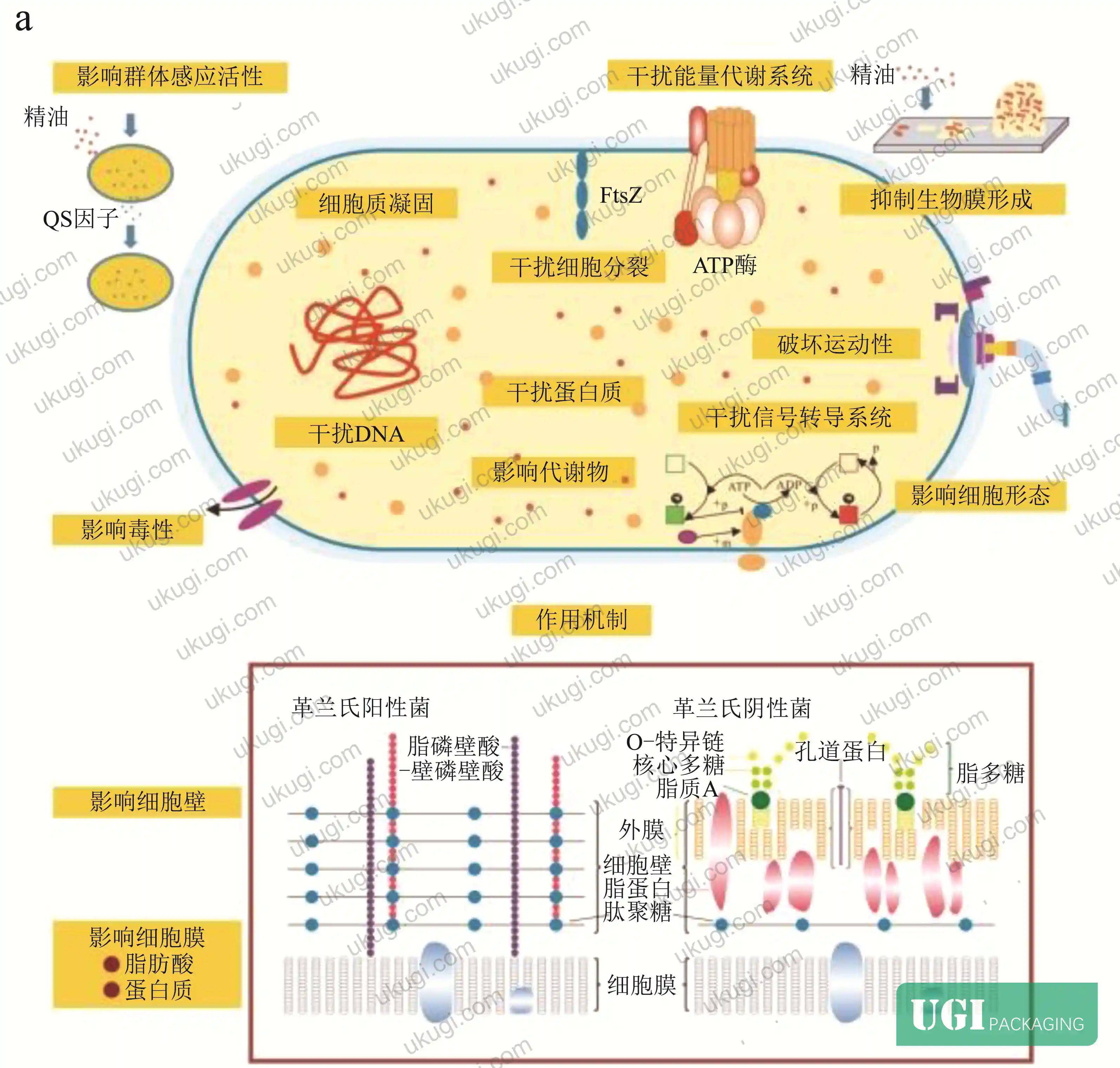
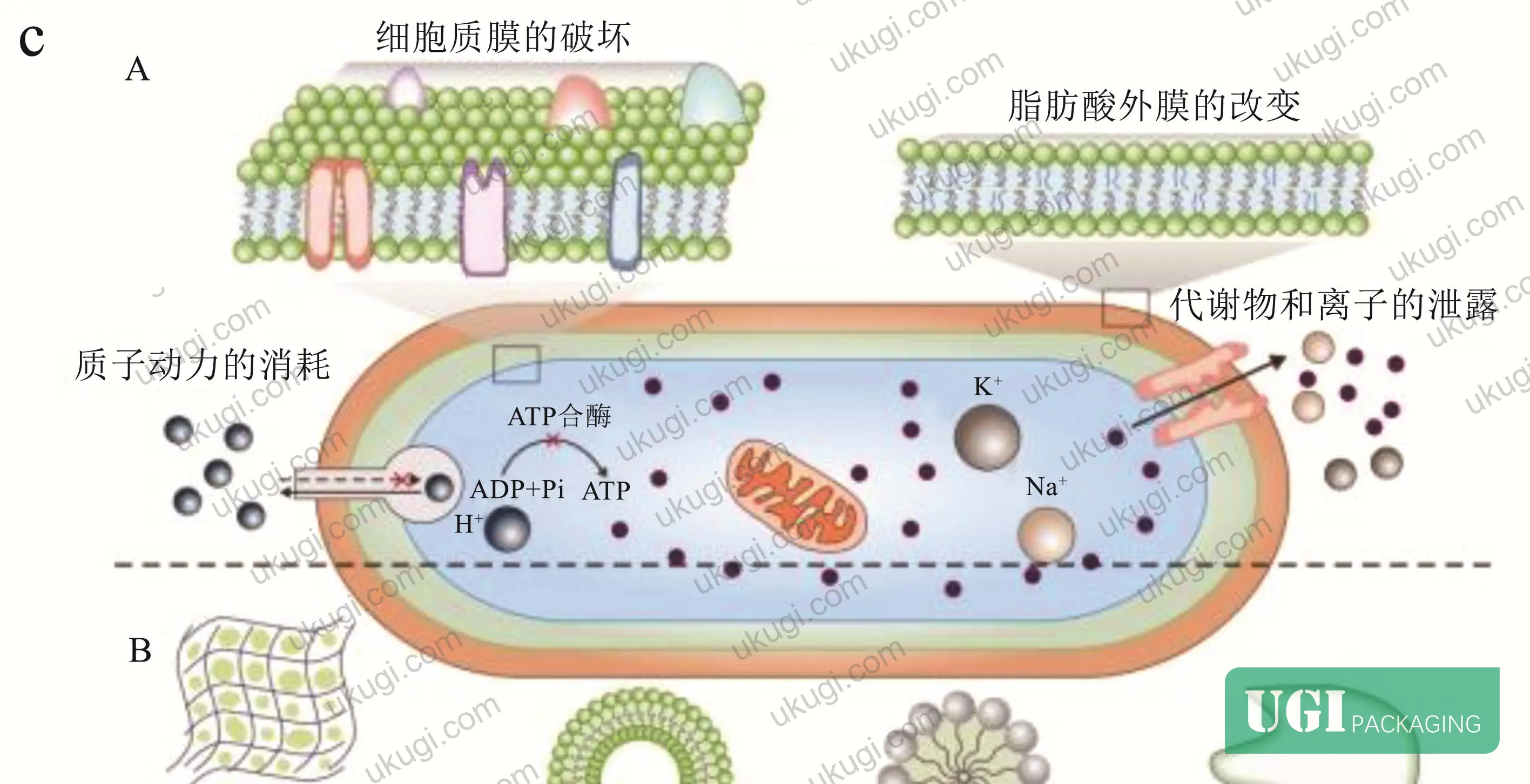
The antibacterial action of essential oils operates through four distinct pathways, each with different implications for packaging design. First, penetration into bacterial cells generates reactive oxygen species that disrupt respiratory metabolism and inhibit ATP synthase subunits — effectively starving the organism of energy. Second, direct cell wall disruption causes morphological changes; juniper essential oil shows concentration-dependent inhibition of Botrytis spore germination, with strong suppression observed above 10 μL/mL, causing mycelial shrinkage and deformation. Third, membrane permeability is compromised by lipid interaction — litsea cubeba oil demonstrably reduces ergosterol content in Botrytis cell membranes as oil concentration increases, quantifying membrane damage through a measurable biomarker. Fourth, DNA synthesis inhibition and ribosomal disruption have been confirmed in Zingiberaceae essential oil studies, with downregulation of genes encoding penicillin-binding proteins and membrane-associated enzymes.
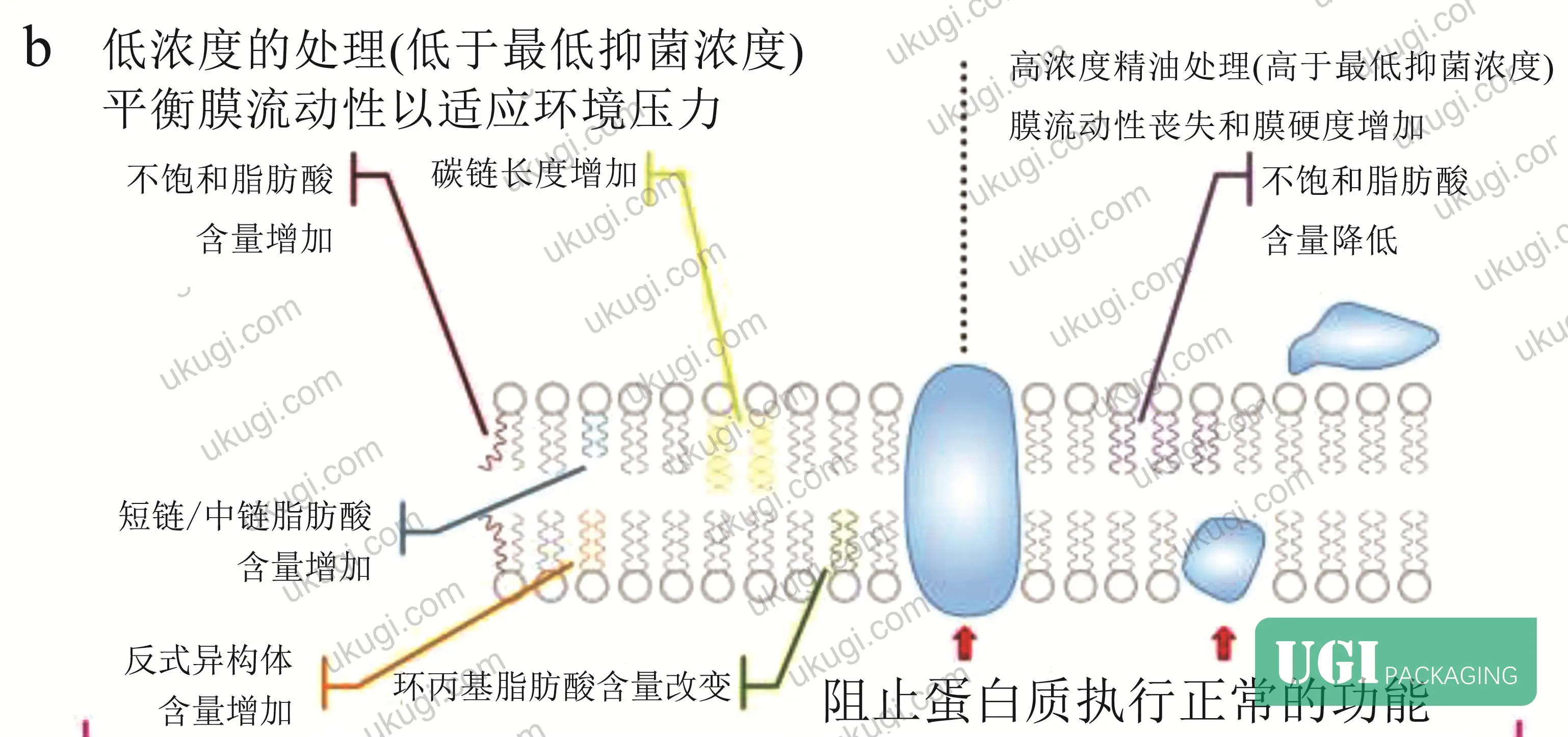
These aren’t just theoretical mechanisms. In supplier qualification for active packaging films, we’ve seen batch variability in inhibition performance correlate directly with compound titer inconsistency between oil lots — even from the same supplier. Three of six samples evaluated in one qualification round failed minimum inhibition zone criteria because the thymol and carvacrol content in the thyme oil had dropped below the threshold that drives membrane disruption.
The antioxidant pathway is equally well-documented. Thyme essential oil incorporated into polysaccharide/chitosan/dextrin gel films raises the elastic modulus from 0.07 MPa (plain polysaccharide film) to 3.00 MPa — a 40-fold improvement — while simultaneously filling matrix pores via hydrogen bonding to redirect oxygen permeation pathways. Oregano essential oil distributed uniformly in starch/polyvinyl alcohol matrix demonstrably reduces both water vapor transmission rate and oxygen transmission rate through the film layer.

Among 38 essential oils evaluated for antioxidant capacity, mathematical modeling produced fitness coefficients of R² = 0.865 and R² = 0.79 for predicting antioxidant performance from chemical composition data. That’s a useful result for buyers — it means digital pre-screening of oil lots is possible, and any supplier claiming antioxidant functionality should be able to provide composition analysis that maps to performance prediction.
Encapsulation Technologies for Essential Oil Packaging Films: Performance Comparison #
This is where most of the performance differentiation actually lives. The oil selection matters, but the delivery matrix and encapsulation method determine whether the active function is still working 10 days into shelf life or has already volatilized out of the packaging in the first 48 hours.

| Encapsulation Method | Key Performance Data | Application Limitation |
|---|---|---|
| Electrospinning (zein fiber) | Rosemary oil encapsulation efficiency: 99.5–99.7% at 2.5–10% (V/V) loading | High voltage process; scalability and worker safety concerns; low yield per run |
| Microcapsule (co-precipitation) | Thyme oil: 87.61% encapsulation efficiency, 53% release rate; inhibits S. aureus and B. anthracis | Equipment-intensive at commercial scale; co-precipitation method limits throughput |
| Spray-drying microcapsule | Oregano oil in PE film via melt blending/extrusion; regulates strawberry respiration, delays CO₂ accumulation and O₂ release | Thermal exposure during drying can degrade volatile fractions |
| Solution casting | Elastic modulus improvement up to 40× vs. plain film (3.00 MPa vs. 0.07 MPa); rosemary oil in whey protein/nanocellulose composite extends lamb shelf life to 15 d | Time-intensive; solvent handling requirements |
| Modified atmosphere + oil (synergistic) | Citral/geraniol + 75% CO₂/25% N₂ atmosphere: synergistic control of grain Aspergillus infection | Requires airtight packaging infrastructure; not suitable for breathable formats |
Honestly, most buyers over-specify electrospinning when they’re actually asking for a commercial-scale active coating. The encapsulation efficiencies look impressive on paper — 99.7% is an extraordinary number — but the process yields are low and the high-voltage requirement adds a safety layer to manufacturing that most film converters simply aren’t set up for. Co-precipitation microcapsule routes at 87.61% efficiency are commercially mature and give you the release profile data you can actually build a shelf-life spec around.



The shelf-life extension data is worth studying in concrete terms. Thyme oil microcapsule starch film extended mango shelf life to 10 days at 25°C. Lemon grass/mulberry anthocyanin indicator film with essential oil release extended chilled pork shelf life while providing RGB color-change freshness indication (red → gray-blue upon spoilage, readable via smartphone app). Ginger essential oil microcapsule polyethylene film maintained okra quality with reduced MDA content and preserved moisture binding. Perilla essential oil electrospun PLA film at 2% loading (20 kV, 640 W ultrasound) extended frozen chicken shelf life to 12 days. These aren’t projections — they’re measured outcomes from controlled studies.




Pest control data is equally concrete. Combined chitosan composite film with oregano/thyme nanoemulsion plus 200 Gray irradiation achieved 100% rice weevil mortality at 14-day exposure versus 32–51% mortality with film alone. Catnip essential oil and eugenol in fumigation testing showed LC₅₀ values of 278.6 and 256.5 μL/L respectively at 1-hour contact exposure. Clove-derived compounds in anti-pest adhesive applied to paperboard packaging maintained white ant inhibition for up to 40 days.
Most procurement teams don’t realize that food contact regulations for active packaging are substantially more complex than for passive barrier films — the migration of active botanical compounds into food is regulated separately from the base polymer, and regulatory frameworks in different markets are still catching up to the pace of formulation innovation. The ISO 22000:2018 Food safety management systems for food packaging framework doesn’t explicitly address active botanical releases, meaning compliance verification requires additional supplier documentation beyond a standard food safety certificate.
Application-Specific Performance: Produce, Grain, and Meat #
For produce packaging, the most commercially relevant format remains paper-based antimicrobial wraps and breathable film coatings. Thyme and clove basil oil in polyvinyl alcohol antimicrobial paper maintained strawberry sensory quality, reduced decay rate, and suppressed total colony count. Paperboard treated with thyme oil extended strawberry shelf life by 1–2 days — modest, but measurable at retail. The fundamental limitation here is oil volatility: without encapsulation, the active agent front-loads its release and depletes before the storage period ends. Static electrospun fiber coatings solve this but add cost.
For grain and cereal packaging, the most interesting result is the synergy between essential oil vapor and modified atmosphere. Citral and geraniol combined with 75% CO₂ / 25% N₂ atmosphere produced cooperative Aspergillus suppression that neither component achieved independently. This is a significant finding for buyers sourcing packaging for premium grain, nut, or spice products where MAP is already in use.
For meat, the shelf-life data is the most commercially developed. Rosemary oil in whey protein/nanocellulose solution-cast film reduced lipid oxidation in lamb and extended shelf life to 15 days. Casein-sodium ginger oil nanoemulsion coating at 6% oil content significantly reduced total aerobic psychrotrophic bacterial count in chilled chicken over 12 days. The 3D-printed zinc oxide/clove oil gelatin nanocomposite film with alginate structure represents the most technically sophisticated format reviewed — it allows customization of pore size and porosity for controlled release tuning, which is not achievable with conventional film casting.
Practical Guidance for Buyers #
When you’re specifying an active antimicrobial packaging film, the critical decision is delivery format before oil selection. Get the encapsulation efficiency and release curve data first. An encapsulation efficiency below 80% means you’re paying for active agent that will volatilize in transit or early storage. A release rate without a time curve is meaningless — you need to know when 50% has released relative to your target shelf window.
Barrier property verification matters as much as antimicrobial claims. Ask for oxygen transmission rate (OTR) data before and after oil incorporation — oregano oil in starch/PVA matrix reduces both WVTR and OTR, but that improvement needs to be quantified under the test conditions defined in ASTM D3985 Oxygen Gas Transmission Rate Through Plastic Film and Sheeting. A supplier who cannot provide OTR data under standard test conditions is not technically qualified for food-grade active film supply.
Ukugi operates as an OEM/ODM manufacturer from Guangzhou, producing functional packaging formats including coated films, specialty laminates, and barrier-enhanced flexible pouches for food brand owners in North America, Europe, and Southeast Asia. Our team can support RFQ review for active packaging substrate specifications and connect you with appropriate technical documentation before sampling. If you’re evaluating flexible pouches and bags or custom paper boxes with barrier or active coating requirements, we can supply technical data sheets alongside samples.
Need a custom formulation or sample? Request a quote from our team →
Supplier Qualification Questions #
- What is the measured encapsulation efficiency (%) for your essential oil microcapsule formulation, and by which method was it determined — and can you show that it meets or exceeds the 87.61% benchmark established for co-precipitation thyme oil microcapsules?
- What is the controlled release rate (%) and the time profile curve for your active packaging film — specifically, what percentage of active agent has released at 5 days, 10 days, and at the end of the declared shelf-life window?
- Can you provide elastic modulus data for your essential oil-loaded film versus the equivalent unfilled substrate — and does your loaded film achieve at least a 10× improvement over the plain polysaccharide baseline (reference point: 3.00 MPa loaded vs. 0.07 MPa unloaded)?
- What are the measured OTR and WVTR values for your active film before and after essential oil incorporation, tested under ISO 187 conditioning, and do you have data confirming that oil loading reduces rather than increases oxygen transmission?
- For fumigation or vapor-active formats, what is the LC₅₀ value for your active compound against your target organism at the declared application concentration — and does your test data confirm concentration- and time-dependent toxicity (P < 0.05) consistent with carvacrol/eugenol benchmarks at 278.6 and 256.5 μL/L at 1-hour contact?
Quality Verification Checklist #
- ☐ Encapsulation efficiency confirmed at ≥85% via documented analytical method (e.g., GC-MS headspace or gravimetric assay)
- ☐ Release rate curve provided showing time-resolved active agent release across the full intended shelf-life period (minimum data points at day 1, day 5, day 10)
- ☐ Elastic modulus of essential oil-loaded film confirmed ≥1.50 MPa (minimum threshold; reference benchmark: 3.00 MPa for thyme/polysaccharide composite)
- ☐ OTR reduction confirmed post-oil incorporation, tested per ASTM D3985 or equivalent, with before/after comparison data
- ☐ Antimicrobial inhibition zone or minimum inhibitory concentration data provided against at least two target organisms (e.g., S. aureus and a gram-negative spoilage organism)
- ☐ Food contact compliance documentation provided for the specific market — EU Regulation 10/2011 (EU buyers) or FDA CFR 21 Part 177 (US buyers)
- ☐ Batch-to-batch compound titer consistency confirmed via GC analysis of active components (thymol, carvacrol, eugenol, or relevant marker compound as applicable)
- ☐ Shelf-life extension validated under defined temperature conditions matching intended storage environment (e.g., 25°C ambient or 4°C refrigerated)
Key Specifications Table #
| Parameter | Recommended Value | Verification Method |
|---|---|---|
| Essential oil encapsulation efficiency | ≥87% (co-precipitation benchmark) | GC-MS headspace analysis or gravimetric mass balance |
| Film elastic modulus (oil-loaded) | ≥3.00 MPa | Tensile testing per ASTM D882 |
| Controlled release rate at target shelf-life midpoint | 45–60% total active agent | Time-resolved extraction + GC quantification |
| Oxygen transmission rate (OTR) post-incorporation | Reduced vs. unfilled substrate baseline | ASTM D3985 at 23°C, 0% RH |
| Minimum inhibitory concentration (target pathogen) | Per strain — reference: >10 μL/mL for Botrytis inhibition | Disk diffusion or broth microdilution assay |
| Fumigation LC₅₀ (vapor-active format) | ≤280 μL/L at 1-hour contact (reference: 278.6 μL/L catnip; 256.5 μL/L eugenol) | Static fumigation toxicity assay (P < 0.05 significance) |
Looking for a manufacturer that meets these specs? Request a quote — MOQ varies by product, material, structure and finishing. Product-specific MOQ is confirmed with each quotation.
References #
Data source: Functional Encapsulation of Plant Essential Oils in Active Food Packaging: Antimicrobial Mechanisms, Barrier Enhancement, and Application Formats, H.-A. Shen et al., International Journal of Biological Macromolecules, 2025
Frequently Asked Questions #
What is the most commercially scalable encapsulation method for essential oil active packaging?
Co-precipitation microcapsule formation and spray-drying are the most commercially mature methods. Co-precipitation achieves up to 87.61% encapsulation efficiency for thyme oil, while spray-drying allows integration directly into polyethylene film via melt blending — both methods can be scaled without specialized high-voltage infrastructure, unlike electrospinning.
Does adding essential oil to a packaging film always improve barrier properties?
Not automatically. The improvement depends on whether the oil fills matrix pores and forms hydrogen bonds with the polymer — as documented with thyme oil in chitosan/polysaccharide composites. Poor dispersion, excess oil loading, or incompatible matrix chemistry can actually increase pore size and reduce barrier performance. Always request before/after OTR data.
What regulatory compliance documentation should I ask for when sourcing active food packaging films?
For EU distribution, request conformity documentation against EU Regulation 10/2011, which governs migration limits for plastic food contact materials. For US distribution, FDA CFR 21 Part 177 applies. Note that botanical active agents may require additional GRAS (Generally Recognized As Safe) or food additive documentation beyond base polymer compliance.
Can essential oil packaging films replace conventional MAP (modified atmosphere packaging)?
Partially, and the research suggests synergy is more valuable than substitution. Citral and geraniol oil vapor combined with 75% CO₂/25% N₂ modified atmosphere produced cooperative Aspergillus control that neither approach achieved independently. For high-value grain and produce, a combined approach outperforms either method alone.
How do I evaluate freshness indicator films that use essential oil release as a trigger?
Look for documented colorimetric response data with defined threshold conditions. The mulberry anthocyanin/lemongrass essential oil indicator film shifts from red to gray-blue as chilled pork spoils, with the release rate of the oil component accelerating at higher pH. Ask for the RGB calibration data and the pH-release correlation — a supplier who cannot provide this is selling you a novelty, not a qualified indicator system.
Published by ukugi.com Technical Team | Request a quote


