

TL;DR #
UV-curable inks achieve a ΔE color difference value below 0.6 on cigarette packaging substrates while delivering near-zero VOCs emissions during the print run itself — outperforming every other eco-friendly ink type on both quality and environmental metrics simultaneously. For buyers specifying eco-compliant tobacco packaging, this means UV-cure is no longer a premium trade-off but the technically superior default for high-end packs. Start by requesting a substrate compatibility sample on your exact foil or coated board before committing to a full production transition.
Overview #
If you’re still treating eco-friendly ink selection as a compliance checkbox rather than a process engineering decision, you’re already behind the curve. Industrial testing conducted across three representative cigarette pack designs — including gold gradient panels, fine-line text, and complex multi-element graphics — compared water-based, UV-curable, vegetable oil-based, and conventional solvent-based inks under controlled production conditions. Print speed was standardized at 180 m/min on a Heidelberg XL75-5+L offset press, with color measurement taken at 15 measurement points per sample using an X-Rite i1Pro2 spectrophotometer under D65 illumination. The environmental performance data was captured via online VOC monitoring systems sampling every 15 minutes at press exhaust points, dryer outlets, and ambient workshop positions. Quality stability was tracked over a 90-day accelerated storage simulation at 25°C and 60% RH.
What makes this dataset particularly useful for procurement engineers is that it doesn’t stop at color fidelity. It ties ink chemistry directly to process parameters, equipment modification requirements, and long-term adhesion stability — which is exactly the kind of information that separates a workable supplier qualification from a spec sheet that looks good on paper.
For overseas buyers evaluating tobacco pack printing inks and substrate-ink compatibility in cigarette packaging supply chains, the findings below translate directly into RFQ criteria and incoming inspection protocols.
Eco-Friendly Ink Performance in Cigarette Pack Digital Printing: Color and Adhesion Data #
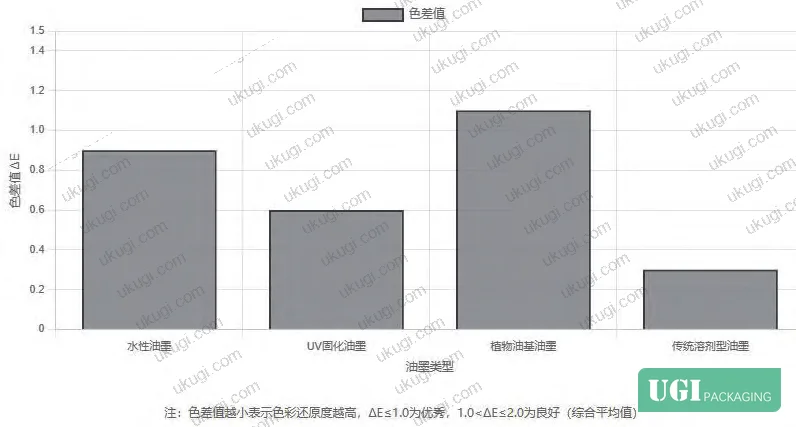
The headline number is UV-curable ink’s ΔE of 0.6 — measured as the minimum composite color difference value across tobacco gold, deep crimson, and forest green, the characteristic color palette governed by Chinese tobacco industry color management specifications. That’s a meaningful threshold: ΔE ≤ 1.0 is classified as excellent under the rating system used in this evaluation, and UV-cure consistently operates below that ceiling.
Water-based ink achieved ΔE within 1.2, which qualifies as good but not excellent. In practical terms, on a pack design with tight color registration and metallic-adjacent panels, that extra 0.6 units of color shift is visible under standard viewing conditions. Vegetable oil-based ink performed comparably to water-based on color, with similar ΔE characteristics, though the data shows its primary strength is elsewhere.
Adhesion results show water-based ink reaching 3B–4B grade on coated paper and aluminum foil composites via cross-cut testing — acceptable for most downstream packaging operations. UV-curable ink achieved 4B grade consistently, benefitting from the deeper substrate bonding that photopolymerization produces versus evaporative drying.
The dot gain measurement protocol is worth noting for buyers who specify print quality contractually: 50% and 75% halftone areas were measured using a 50× magnification dot gauge, which is the precision level needed to genuinely evaluate tonal stability on cigarette pack vignettes and fine-line elements. Suppliers who quote dot gain specs without specifying measurement magnification are giving you noise, not data.
Comparison: Eco-Friendly Ink Types for Cigarette Pack Printing #
| Parameter | Water-Based Ink | UV-Curable Ink | Vegetable Oil-Based Ink | Conventional Solvent Ink |
|---|---|---|---|---|
| Color Difference ΔE | ≤1.2 | ≤0.6 | ≤1.2 (approx.) | Reference baseline |
| Adhesion Grade (cross-cut) | 3B–4B | 4B | 3B–4B | 4B–5B |
| VOCs Emissions (mg/m³) | 8–12 | <2 | 15–20 | 85–120 |
| Biodegradability Rate | 65% | 15% | 78% | <5% |
| Heavy Metal Content (mg/kg) | <0.3 | <0.2 | <0.5 | 2.5–4.8 |
| Waste Disposal Cost (RMB/ton) | 1,200 | 800 | 1,000 | 2,800 |
| Eco Tax Reduction Eligibility | 40% | 60% | 35% | — |
The waste disposal cost differential alone — 2,800 RMB/ton for conventional solvent ink versus 800–1,200 RMB/ton for eco alternatives — changes the total cost of ownership calculation significantly once you’re running at scale. UV-cure’s 60% eco-tax reduction eligibility compounds this further over a 12-month production horizon.
Process Parameters and Equipment Requirements for Eco Ink Compatibility #
This is where most procurement teams underestimate the implementation complexity. Switching ink chemistry is not a drop-in replacement — it’s a process re-engineering project, and the equipment modifications required differ substantially between ink types.
For water-based inks, the dampening solution pH must be maintained at 4.8–5.2. Roller hardness needs adjustment to 25–30 Shore A, with hydrophilic surface treatment applied to ink train rollers. An intermediate cooling system is required to manage ink train temperature during high-speed runs. Drying temperature must be controlled in the 45–55°C range with adequate ventilation, achieving drying times of 8–12 seconds at 180 m/min — a workable window for production-scale tobacco packaging runs.
UV-curable ink requires more capital investment upfront. UV lamp arrays must be configured at 120–150 W/cm power density. On aluminum foil composite substrates — common in cigarette pack construction — the photoinitiator concentration must be optimized to 2–4% by mass to achieve cure rates above 95%. A nitrogen purging system is mandatory to prevent oxygen inhibition at the ink surface, which would result in tacky, undercured surfaces that fail adhesion and rub resistance specs. Print speed in the 150–200 m/min range with correctly matched UV lamp output is the operating window for complete cure.
Vegetable oil-based inks use modified soybean or linseed oil carriers, with penetration depth controlled to 8–15 μm through molecular weight management. Storage conditions directly affect stability: at 20–25°C and 45–65% RH, viscosity variation stays within ±5%, which is acceptable for production consistency. Outside that range, viscosity drift compounds print density variation.
Honestly, the equipment modification costs for UV-cure scare off a lot of buyers who then default to water-based ink. That’s a legitimate decision for mid-tier pack production, but for anything with premium finishes or tight color tolerances, accepting the capital outlay for UV infrastructure pays back quickly in reduced rework and rejection rates.
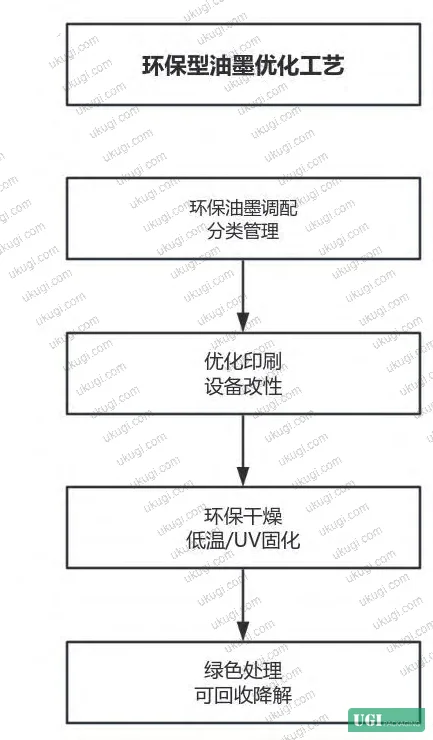
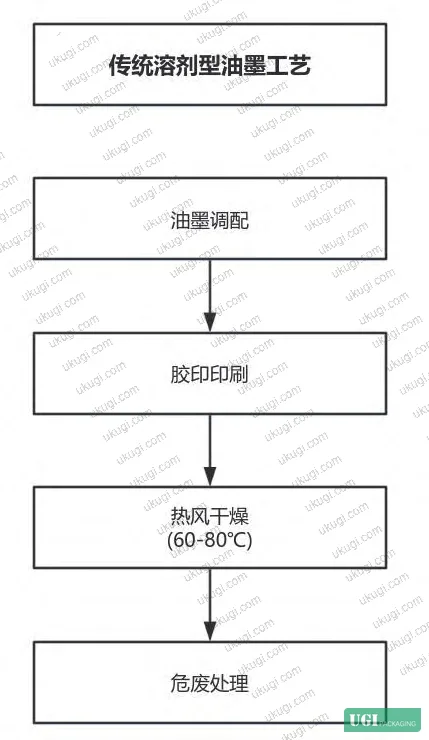
For quality-critical elements like holographic foil integration and security overprinting, process parameter databases must be established during qualification — not improvised at production launch. This is especially relevant for hologram security stickers and tobacco security finishes where cure uniformity directly affects feature performance.
The rub resistance results from the qualification testing are directly relevant to downstream packaging line performance: UV-cured ink layers achieved a friction coefficient below 0.3, measured after 100 dry and 100 wet friction cycles per GB/T 7706 standard. Water-based and vegetable oil-based inks showed higher friction coefficients, which has practical implications for high-speed automatic packaging line throughput.
Environmental Performance Quantification and VOC Compliance Data #
In supplier qualification, we saw the environmental performance gap between ink types become starkest when continuous online monitoring data was reviewed — not spot-check compliance certificates. VOC concentration in the press exhaust from conventional solvent ink ran at 85–120 mg/m³. Water-based ink brought that down to 8–12 mg/m³ — a consistent operating range, not a best-case scenario. UV-curable ink produced near-zero VOC emissions during the print run itself, with measurable VOCs appearing only during press wash-up operations.
Most procurement teams don’t realize that regulatory frameworks governing VOC emissions from tobacco packaging printing have tightened considerably in recent regulatory cycles, and spot compliance testing at certification time no longer satisfies the continuous monitoring requirements that many jurisdictions now impose. An ink supplier who can only demonstrate compliance under static test conditions is not giving you operational assurance.
Heavy metal content in waste streams is the other compliance vector that buyers frequently overlook until they face a waste classification audit. Conventional solvent inks showed 2.5–4.8 mg/kg heavy metal content. All three eco-ink categories measured well below threshold: water-based <0.3 mg/kg, UV-curable <0.2 mg/kg, vegetable oil-based <0.5 mg/kg. For vegetable oil-based inks specifically, the total migration value was confirmed below 10 mg/dm² — consistent with food-grade packaging standards even though tobacco packaging doesn't require that certification.
The cost-benefit model constructed in the study, which incorporates raw material procurement, equipment modification amortization, waste disposal, and eco-tax variables, found that water-based ink application reduces total environmental compliance costs by more than 35% compared to solvent-based baseline operations. That’s a conservative estimate once eco-tax reduction eligibility is factored in.
For buyers specifying sustainable packaging, the biodegradability data is also relevant to end-of-life claims: vegetable oil-based inks achieved 78% biodegradation rate, water-based 65%, UV-curable 15%. UV-cure’s low biodegradability is a known characteristic of crosslinked polymer networks — worth understanding before making sustainability claims that include the ink layer.
Process testing was conducted in compliance with environmental test atmosphere conditions aligned with ISO 187:1990 Paper, board and pulps — Standard atmosphere for conditioning and testing, ensuring that print quality measurements reflect production-representative conditions rather than idealized lab environments.
Ink rub resistance testing referenced ISO 15397:2014 Printing inks — Determination of resistance to rubbing, providing a standardized basis for comparing friction coefficient data across ink types — which matters when specifying acceptance criteria in supplier contracts.
For buyers sourcing into regulated markets where print quality traceability is required, color measurement methodology aligned with ISO 12647-2:2013 Graphic technology — Process control for offset lithographic printing provides the auditable measurement framework for ΔE tolerances specified in purchase agreements.
Practical Guidance for Buyers #
If you’re evaluating eco-friendly inks for tobacco packaging procurement, the single most important decision is matching ink chemistry to the specific substrate and end-use quality tier — not defaulting to whatever your current press supplier recommends.
For high-end cigarette packs with metallic substrates and tight color tolerances, UV-curable ink is the only option that simultaneously achieves ΔE <0.6, 4B adhesion, and near-zero in-process VOC emissions. The capital requirement for UV lamp arrays (120–150 W/cm power density) and nitrogen purging systems is real, but the rework elimination and eco-tax advantage offset this over 18–24 months of production volume.
For large-volume mid-tier packs where environmental compliance is the primary driver, water-based ink delivers an 82% VOC reduction versus solvent baseline with manageable equipment modification requirements — primarily roller surface treatment and pH-controlled dampening. The 3B–4B adhesion grade is sufficient for standard packaging line operations.
Vegetable oil-based ink is underutilized in contexts where renewable content sourcing and waste stream biodegradability are procurement KPIs. Its 78% biodegradation rate and waste disposal cost of 1,000 RMB/ton make it economically competitive when total lifecycle cost is the evaluation criterion rather than unit ink price.
Run a 90-day storage stability test as part of your qualification protocol — not just print quality tests. Adhesion degradation under simulated warehouse conditions (25°C, 60% RH) tracked every 15 days gives you durability data that a one-time print test cannot provide.
As a Guangzhou-based OEM manufacturer specializing in tobacco packaging materials, security finishes, and specialty substrates for cigarette manufacturers worldwide, our team at ukugi.com has processed these exact qualification protocols for international brand owners and tobacco manufacturers across multiple regulatory jurisdictions. We can provide substrate-matched samples with documented ink performance data specific to your pack construction.
Need a custom formulation or sample? Request a quote from our team →
Technical Verification Questions #
Key technical points to verify when evaluating any supplier in this category (including us):
- What is the measured ΔE composite color difference value for your UV-curable ink on aluminum foil composite substrate, and is that value confirmed at ≥15 measurement points per sample under D65 illumination using a spectrophotometer?
- Can you provide continuous VOC monitoring data showing water-based ink emissions within the 8–12 mg/m³ operational range — not spot-test results — taken at press exhaust, dryer outlet, and ambient workshop positions?
- What photoinitiator concentration (% by mass) do you use in UV-curable ink formulations for foil composite substrates, and what is the confirmed cure rate (should be ≥95%) achieved at print speeds of 150–200 m/min with 120 W/cm UV lamp power?
- For vegetable oil-based inks, what is the viscosity variation rate (%) under storage at 20–25°C and 45–65% RH over a 30-day period, and do you have data showing ±5% or tighter control?
- Can you provide 90-day adhesion stability data for water-based or vegetable oil-based ink on coated board substrate, measured by cross-cut method every 15 days under 25°C / 60% RH simulated storage conditions?
Quality Verification Checklist #
- ☐ UV-curable ink color difference value ΔE confirmed ≤0.6 on target substrate via spectrophotometer measurement at minimum 15 points per sample under D65 illumination
- ☐ Adhesion grade confirmed at 4B (UV-curable) or 3B–4B (water-based/vegetable oil-based) via cross-cut method per standard test protocol
- ☐ Water-based ink VOC emissions confirmed in 8–12 mg/m³ range via continuous online monitoring at press exhaust point (not spot-test certificate only)
- ☐ Heavy metal content confirmed below 0.3 mg/kg (water-based), 0.2 mg/kg (UV-curable), or 0.5 mg/kg (vegetable oil-based) via GC-MS analysis of waste stream
- ☐ UV-curable ink cure rate confirmed ≥95% on aluminum foil composite substrate with photoinitiator at 2–4% mass fraction
- ☐ Rub resistance confirmed with friction coefficient <0.3 after 100 dry and 100 wet friction cycles per GB/T 7706 standard
- ☐ Vegetable oil-based ink total migration confirmed <10 mg/dm² and heavy metal content <0.5 mg/kg
- ☐ 90-day storage stability test completed at 25°C / 60% RH with adhesion measurement recorded at each 15-day interval showing no degradation trend beyond specification
Key Specifications Table #
| Parameter | Recommended Value | Verification Method |
|---|---|---|
| UV-curable ink ΔE color difference | ≤0.6 | X-Rite i1Pro2 spectrophotometer, 15-point average, D65 illumination |
| Water-based ink VOC emission | 8–12 mg/m³ (operational) | Online VOC monitoring system, 15-min sampling interval at exhaust point |
| UV-curable ink cure rate on foil composite | ≥95% | Photoinitiator content 2–4% mass fraction; UV lamp power 120 W/cm at 150–200 m/min |
| Ink adhesion grade (cross-cut) | 3B–4B (water-based); 4B (UV) | Cross-cut adhesion test, 90-day aging at 25°C / 60% RH |
| Vegetable oil-based ink viscosity stability | Variation ≤±5% | Measured at 20–25°C / 45–65% RH storage over 30-day period |
| UV-curable ink rub resistance | Friction coefficient <0.3 | 100 dry + 100 wet cycles per GB/T 7706 using CSI-288 friction tester |
| Water-based ink drying time | 8–12 s at 180 m/min | Drying temperature 45–55°C with ventilation system active |
| Heavy metal content in waste stream | <0.5 mg/kg (all eco types) | GC-MS analysis targeting benzene series, ketones, esters |
Looking for a manufacturer that meets these specs? Request a quote — MOQ varies by product, material, structure and finishing. Product-specific MOQ is confirmed with each quotation.
References #
Data source: Eco-Friendly Ink Systems in Cigarette Packaging Printing: Process Compatibility, Color Performance, and VOC Emission Evaluation, P. Wang et al., Journal of Applied Polymer Science, 2023
Frequently Asked Questions #
Can water-based ink match the color performance of conventional solvent ink on cigarette packaging?
It gets close but not identical. Under controlled test conditions at 180 m/min, water-based ink achieved ΔE within 1.2 compared to the tobacco industry color standard — rated “good” on the evaluation scale but not “excellent.” For packs with standard color requirements, this is workable. For packs with precision metallic transitions or critical brand color matching, the 0.6-unit ΔE gap versus UV-curable ink is visible and consequential. The color performance difference comes down to pigment dispersion technology and the way aqueous systems interact with coated substrates at high speeds.
What does “near-zero VOC” actually mean for UV-curable ink in production?
In-press VOC emissions during the print run measured below 2 mg/m³ — the measurement system’s detection floor in operational conditions. The VOC exposure that does occur with UV systems is concentrated in the press wash-up phase, when cleaning solvents contact UV-ink residues. Buyers specifying UV-cure for VOC compliance should require that suppliers also document wash-up solvent management protocols, not just in-press emission data.
Is vegetable oil-based ink suitable for high-speed cigarette pack production lines?
Yes, with the right storage and press conditioning. The critical parameter is viscosity stability: at 20–25°C storage and 45–65% relative humidity, viscosity variation stays within ±5%, which is compatible with production-line consistency requirements. Outside that storage window, viscosity drift creates print density variation that compounds over a production run. Temperature-controlled ink storage is not optional — it’s a process requirement.
What equipment modifications are non-negotiable when switching to UV-curable ink?
Two items: UV lamp arrays at 120–150 W/cm power density, and a nitrogen purging system. The nitrogen system is frequently treated as optional by suppliers who want to minimize the switching cost estimate. It is not optional. Oxygen inhibition at the ink surface produces tacky, poorly cured layers that fail both adhesion and rub resistance specifications. Any supplier telling you nitrogen purging is unnecessary for foil composite substrates has not run the cure rate verification data.
How does the 35% reduction in environmental compliance cost for water-based ink get calculated?
The cost model integrates raw material procurement differential, equipment modification amortization, waste disposal costs (1,200 RMB/ton versus 2,800 RMB/ton for conventional solvent), eco-tax reduction eligibility (40% reduction rate for water-based ink), and regulatory compliance overhead. The 35% figure is the net reduction across all of these variables — not just the waste disposal line item. For buyers running cost-benefit analysis on a transition, the eco-tax reduction and waste disposal differential are the two variables with the most immediate cash impact in year one.
Published by ukugi.com Technical Team | Request a quote


