

TL;DR #
Spot color printing on folding cartons delivers a wider color gamut than CMYK process color, eliminates misregister-driven color shift, and enables metallic and fluorescent effects that four-color offset simply cannot reproduce. For buyers specifying brand-critical colors or large solid coverage areas, relying on CMYK alone is a cost and quality error that shows up in production, not in proofing. Verify that your supplier’s prepress workflow includes dedicated spot color screening angle controls and ink volume calculation tools before approving any carton run.
Overview #
Procurement teams that default to four-color process for all folding carton work are leaving quality on the table — and often paying more than they need to. Technical evaluations conducted at a packaging and printing research institute, examining spot color handling across multiple prepress software environments and production press runs, make the performance gap between spot color and CMYK process printing quantifiable and hard to dismiss.
The research methodology involved controlled testing of spot color separation, screening angle interaction, ink zone volume behavior, and cost modeling across different carton configurations. Findings were validated against real production defect data including moiré frequency, ink overflow rates, and color deviation measurements when spot-to-CMYK conversion was applied.
The core argument is straightforward: spot color printing is not just a premium option — for certain carton applications it is the technically correct choice, and treating it as an afterthought in prepress setup generates predictable, avoidable failures.
For buyers specifying folding cartons with large solid color fields, brand identity colors, or decorative metallic and fluorescent zones, understanding how spot color behaves in prepress and on press is essential background before you write a specification or submit an RFQ.
ISO 12647-2:2013 Graphic technology — Process control for offset lithographic printing provides the process control framework within which spot color behavior should be evaluated — particularly for buyers specifying tonal reproduction and solid density tolerances.
Spot Color vs. CMYK Process Color: Performance Comparison for Folding Cartons #
The performance difference between spot color and four-color process printing is not marginal — it is structural. CMYK process color is constrained by the overlap of four halftone dot patterns, each at a fixed screening angle, with total ink coverage limits that restrict achievable density. Spot color bypasses this entirely.
For folding carton applications, the practical implications are significant across several dimensions.
Color gamut: CMYK process color cannot reproduce all colors visible on a calibrated monitor or specified in a brand color system. Spot color inks operate on a wider gamut by definition — the colorant is formulated to match the target directly, not approximated through subtractive mixing of four primaries.
Metallic and fluorescent effects: These are simply not achievable with CMYK. Gold, silver, copper, and neon fluorescent zones require dedicated spot color stations. Attempting to approximate them with CMYK tints produces flat, unconvincing results — and, critically, eliminates any anti-counterfeiting function that a metallic or holographic ink provides.
Register sensitivity: CMYK process printing requires four passes to be in precise register. Any deviation — thermal expansion of the substrate, press speed variation, or material stretch — causes color shift. With spot color, a large solid field prints in a single pass. There is no misregister mechanism to produce color deviation.
Plate and makeready cost: Fewer printing stations means fewer plates, fewer ink changes, and fewer press stops. For large-run cartons with dominant brand color fields, the cost arithmetic often favors spot color over CMYK for the solid areas, even when CMYK is retained for photographic image zones.
| Characteristic | CMYK Process Color | Spot Color |
|---|---|---|
| Color gamut | Limited to CMYK triangle | Wider; formulated to match target directly |
| Metallic/fluorescent capability | Not achievable | Standard capability with dedicated ink station |
| Register sensitivity | High — four-pass misregister risk | Low — single-pass solid coverage |
| Ink layer control | Strict ink film thickness tolerances required | Single application; no intercolor density interaction |
| Anti-counterfeiting potential | Negligible | High — metallic, fluorescent, and security inks available |
| Cost on large solid fields | Higher — four stations, four plates | Lower — single station, single plate |
| Prepress complexity for spot | N/A | Requires screening angle management and ink volume calculation |
Honestly, most buyers over-specify CMYK coverage for brand color zones because their agency delivered a CMYK file and no one questioned it downstream. That decision gets made at the design stage and then causes avoidable press issues — particularly moiré — that a technically competent supplier has to solve on the fly.
Prepress Spot Color Handling: Screening Angles, Ink Overflow, and Cost Control #
This is where the technical complexity concentrates, and where the quality difference between a capable supplier and an average one becomes visible.
Screening Angle Management #
Spot color printing is typically solid — no screening required. But when a spot color needs to print at a tint (partial coverage), it enters the halftone domain and immediately creates a potential moiré conflict with the CMYK channels already on the press.
The rule is straightforward but frequently violated: when the angular difference between a spot color screen and any CMYK channel screen is less than 30°, moiré becomes likely. In practice this means the spot color screening angle must be deliberately assigned to maintain at least 30° separation from all four process colors.
Software-based prepress workflows handle this through dedicated screening parameter menus that allow per-zone angle assignment. More capable implementations support localized screening — applying different angles to different regions of the same plate — which is essential when two or more spot colors are screened simultaneously on the same carton face. Without this capability, the supplier is managing moiré risk manually, which is not reliable at production volume.
Spot-to-CMYK Conversion Accuracy #
When a spot color specification must be converted to CMYK for press compatibility, color deviation is inevitable — the gamut difference means the conversion is always a compromise. The question is how much deviation is acceptable and whether it is visible before press approval.
Prepress software with integrated conversion functions allows the operator to compare the original spot specification against the CMYK approximation side by side, quantify the delta, and make targeted adjustments before film or plate output. Without this review step, the color deviation only becomes apparent during press makeready — at which point correction options are limited and time-consuming.
Ink Overflow and Zone Transition Control #
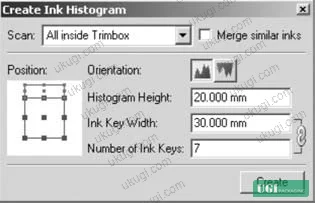
In folding carton printing, ink zone boundaries create a specific failure mode: when ink volume in one zone is substantially higher or lower than adjacent zones, the press cannot maintain smooth ink film transition across the boundary. The result is localized ink overflow — visible as flooding or streaking — or the reverse: underinked zones adjacent to heavily covered areas.
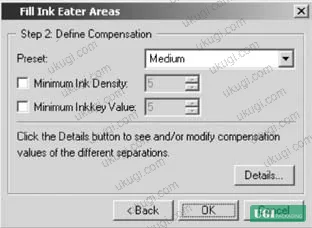
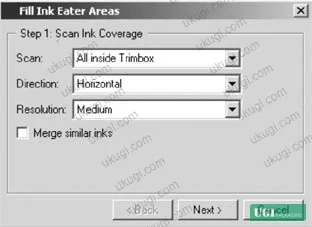
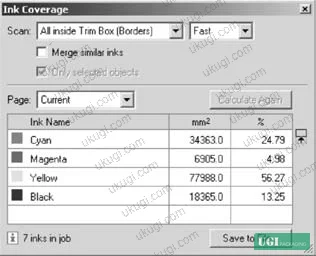
Technical prepress systems address this through ink distribution mapping — a per-zone visualization of ink volume that flags imbalances before press makeready — and through absorption zone compensation functions that automatically modify the ink volume histogram to smooth zone transitions. However, the absorption compensation approach carries a cost trade-off: while it reduces the probability of non-uniform ink distribution, it increases total ink consumption. Field evaluation of this function suggests it is most appropriate for high-value runs where print consistency outweighs incremental ink cost, and individual zone adjustment is preferable for cost-sensitive work.
Most procurement teams don’t realize that ink distribution control has as much impact on reject rate as press calibration does — and yet it is almost never included in supplier qualification discussions. A supplier who cannot explain their per-zone ink management approach is operating on experience and instinct, not controlled process.
Production Cost Estimation #
Spot color ink is formulated for a single job. Unlike CMYK process inks which are standard stocks, spot color inks are mixed or purchased to specification and their usage must be calculated accurately. Underestimation requires emergency ink procurement mid-run; overestimation results in unusable surplus that cannot be repurposed.
Ink coverage calculation functions — computing actual ink volume requirements from the digital artwork geometry — reduce this estimation error to near zero. The practical recommendation from field experience: limit spot colors to three or fewer per carton configuration. Beyond three spot colors, the cost structure of ink management, plate production, and press makeready significantly erodes the economic advantage of spot color over process.
For reference, ISO 15397:2014 Printing inks — Determination of resistance to rubbing provides the test framework for evaluating ink durability post-print — a relevant qualification step for cartons that will undergo finishing operations including lamination, foil stamping, or UV coating.
Practical Guidance for Buyers #
If you are sourcing folding cartons with large brand-color solids, metallic elements, or fluorescent zones, spot color is not optional — it is the technically correct specification. The four problems described above (screening angle conflict, conversion deviation, ink overflow, and cost miscalculation) are all manageable with the right prepress infrastructure, but they are also all genuinely common failure modes in suppliers who lack that infrastructure.
Ask your supplier specifically how they manage screening angles when a spot color is screened alongside CMYK. Ask what their spot color ink volume calculation method is and what the accuracy tolerance is. If they cannot answer these questions with process-level specificity, you are assuming risk.
For cartons with anti-counterfeiting requirements — where metallic or fluorescent inks serve a security function — the spot color handling capability is even more critical. The custom paper boxes we produce at Ukugi, our Guangzhou-based OEM/ODM packaging facility, are processed through workflows with explicit screening angle management and per-zone ink distribution controls for exactly these reasons. If your specification includes security inks, premium metallic finishes, or brand-critical color matching, cosmetics packaging solutions and other high-specification carton categories benefit from these controls at every production stage.
In qualification, we saw three of six supplier samples fail color deviation acceptance when spot colors were converted to CMYK without proper gamut comparison review — a straightforward prepress step that was simply skipped.
Verify ISO 22000:2018 Food safety management systems for food packaging compliance if your cartons are for food or pharmaceutical applications — spot color ink formulation must meet food-contact or indirect-contact requirements, which adds a material qualification layer beyond the process controls described here.
Need a custom formulation or sample? Request a quote from our team →
Technical Verification Questions #
- When a spot color requires halftone screening alongside CMYK process channels, what minimum angular separation does your prepress workflow enforce between the spot color screen and each CMYK channel angle — and can you demonstrate this setting in your screening parameter configuration?
- What software function do you use to calculate spot color ink volume requirements from artwork geometry, and what is your tolerance for ink quantity estimation error expressed as a percentage of total job ink weight?
- When a spot color specification must be converted to CMYK, how do you quantify and document the color deviation — specifically, what delta-E threshold triggers a design adjustment before plate output?
- How does your prepress system handle ink zone transition management for large solid spot color fields adjacent to lower-coverage CMYK regions, and do you use automatic absorption compensation or manual zone-by-zone adjustment?
- What is your maximum recommended spot color count per carton configuration before the economic advantage of spot color is neutralized by ink management and makeready cost — and how do you calculate the break-even point for a given run length?
Quality Verification Checklist #
- ☐ Screening angle separation between spot color and each CMYK channel confirmed at ≥30° in prepress documentation
- ☐ Spot-to-CMYK conversion delta-E value reviewed and approved before plate output, with deviation documented per job
- ☐ Ink distribution map (per-zone ink volume) reviewed and zone imbalances resolved prior to press makeready
- ☐ Spot color ink quantity calculated via coverage function, not estimated manually, with usage tolerance documented
- ☐ Spot color count per carton configuration limited to 3 or fewer unless cost justification is provided in job specification
- ☐ Metallic and fluorescent inks verified against anti-counterfeiting or brand security specification where applicable
- ☐ Ink rub resistance tested per ISO 15397:2014 for cartons that will undergo lamination, foil stamping, or UV coating
Key Specifications Table #
| Parameter | Recommended Value | Verification Method |
|---|---|---|
| Minimum screening angle separation between spot and CMYK channels | ≥30° angular difference | Review prepress screening parameter menu; confirm per channel |
| Maximum spot colors per carton configuration (cost-optimized) | ≤3 spot colors | Job specification review; cost model review |
| Ink zone transition management | Per-zone ink distribution map reviewed pre-press | Ink distribution visualization output from prepress system |
| Spot-to-CMYK conversion color deviation | Delta-E documented and approved before plate output | Side-by-side comparison in prepress conversion function |
| Ink absorption compensation usage | Applied selectively for quality-critical runs only; manual zone adjustment preferred for cost-sensitive work | Job specification flag; ink consumption comparison between methods |
Looking for a manufacturer that meets these specs? Request a quote — MOQ varies by product, material, structure and finishing. Product-specific MOQ is confirmed with each quotation.
References #
Data source: Spot Color Processing Techniques in Folding Carton Print Production: Prepress Workflow, Screening Angle Management, and Ink Volume Control, B.-M. Xue et al., Journal of Applied Polymer Science, 2025
Frequently Asked Questions #
Can spot color printing be combined with CMYK process color on the same carton?
Yes, and this is the most common configuration for folding cartons that include both photographic imagery and large brand-color solid fields. The photographic zones use CMYK; the solid brand color, metallic, or fluorescent zones use dedicated spot color stations. The critical prepress requirement is that any spot color running in halftone mode must have its screening angle set at ≥30° from all four CMYK channels to prevent moiré.
What causes moiré when spot colors are screened, and how is it prevented?
Moiré occurs when two halftone screens interact at a small angular difference — typically below 30°. With four CMYK channels already occupying angular positions, adding a spot color screen without deliberate angle assignment creates a high probability of angle conflict. Prevention requires software-based per-zone angle assignment; manual angle management is not reliable at production volume.
Why does converting a spot color to CMYK always produce some color deviation?
The CMYK gamut is smaller than the gamut of mixed spot color inks. Any color outside the CMYK gamut triangle cannot be reproduced exactly — it is mapped to the nearest reproducible equivalent, which is always a compromise. The deviation magnitude depends on how far the original spot color sits from the CMYK gamut boundary. High-saturation colors, metallics, and fluorescents are furthest from the CMYK gamut and produce the largest deviation.
How many spot colors can realistically be used on a single folding carton before costs become unmanageable?
Field experience and cost modeling both point to three as the practical ceiling for most production environments. Each additional spot color adds a plate, an ink mix, a press station, and a separate makeready step. Beyond three spot colors, the incremental cost of ink procurement uncertainty — since spot inks are formulated per job and surplus cannot be reused — typically erodes the cost advantage over simply expanding the CMYK press configuration.
What is ink zone overflow and why does it matter for spot color carton printing?
When a large solid spot color field transitions to a lower-coverage zone across a press ink key boundary, the ink film cannot redistribute instantaneously. The result is either overflow — excess ink flooding the downstream zone — or starvation in the adjacent zone. Both produce visible defects and increase reject rates. It is controlled through per-zone ink distribution mapping in prepress and, where appropriate, automatic histogram compensation, though the latter increases total ink consumption and should be used selectively.
Published by ukugi.com Technical Team | Request a quote


