

TL;DR #
Temperature control is the single most critical variable in hot foil stamping: a deviation of more than 10°C from the optimal window causes either oxidation and gloss loss (too high) or incomplete transfer and poor adhesion (too low). For buyers specifying foil-stamped packaging, this means substrate type, foil grade, and press configuration must be co-specified — not treated as independent decisions. Before approving any sample, verify that your supplier can demonstrate stable temperature control within ±10°C across a full production run, with documented dwell time and pressure settings matched to your specific substrate.
Overview #
Hot foil stamping is one of those finishing processes that looks straightforward on a spec sheet and becomes genuinely complex the moment you move from flat paper to curved surfaces, large solid areas, or UV-coated substrates. Procurement teams that treat it as a commodity add-on — just another line in the finishing spec — consistently get back samples that either look dull, show bubble defects, or fail adhesion tests within weeks of delivery.
The technical data reviewed here comes from systematic process engineering studies conducted at an industrial printing research institution, covering multiple substrate types and all four major press configurations (round-on-flat, round-on-round, flat-on-flat, and flat-on-round). The research includes documented temperature tables for six plastic substrate families, failure mode analysis across large-area and curved-surface stamping scenarios, and process parameter interaction data for temperature, pressure, and dwell time.
Hot stamping works by transferring a metallic or pigmented foil layer from a carrier film onto a substrate using a combination of heat and pressure. The foil structure consists of a PET carrier film, a silicone release layer, a metallic or color layer, and a hot-melt adhesive layer. During stamping, the adhesive melts and bonds to the substrate surface while the release layer — a silicone resin — loses adhesion to the carrier, allowing clean separation of the transfer layer. The entire transfer window is tight: too much heat and the silicone flows excessively, trapping air and oxidizing the metal layer; too little heat and the adhesive never fully wets the substrate surface.
This process is applicable across paper, board, wood, and most plastics, but is generally not suitable for metal, ceramic, or glass substrates without specialized foil and adhesive systems. For packaging buyers sourcing custom paper boxes or premium gift packaging solutions, understanding these constraints upfront prevents costly rework at the sampling stage.
Hot Foil Stamping Process Configurations and Substrate Compatibility #
There are four distinct press configurations in commercial use, and the choice of configuration has a direct impact on what substrate geometries and production volumes are achievable.
Round-on-flat (cylinder-on-flat): The stamping die is mounted on a rotating cylinder that rolls across a flat substrate. The substrate moves laterally on a work table while the foil advances at a synchronized rate. This configuration is well-suited to high-volume flat sheet work and offers good die-to-substrate contact consistency. The action sequence is: set temperature → install foil → lower stamping roller → lateral table movement completes transfer → raise roller → advance foil by set increment.
Round-on-round (cylinder-on-cylinder): Both the die carrier and the substrate are cylindrical. This is the configuration used for stamping on cylindrical objects — bottles, tubes, pens. Friction between the stamping roller and the workpiece drives rotation of the cylindrical substrate. The workpiece center axis must be parallel to the table travel direction, and the die contact line must be perpendicular to table movement. This configuration is mechanically the most complex: Swiss-manufactured round-on-round machines are considered the industry benchmark for precision, and the structural complexity puts this equipment in a different cost tier entirely.
Flat-on-flat: Both die and substrate are flat. The press action is purely vertical — no lateral movement of the work table. This is the simplest configuration mechanically and is well-suited to short-run, complex die shapes. Dwell time and pressure are the primary control variables since there is no rolling contact dynamics to account for.
Flat-on-round: A flat die stamps onto a curved substrate surface. This is used for partial-surface decoration on cylindrical or spherical objects. The positioning fixture design for this configuration borrows principles from pad printing and screen printing positioning — the workpiece must rotate freely with radial runout not exceeding 1 mm and axial play not exceeding 0.2 mm. The centerline downward deflection after press contact must not exceed 0.2 mm. These tolerances are tighter than most buyers realize, and imprecise fixture design is a primary cause of pressure imbalance on curved substrates.
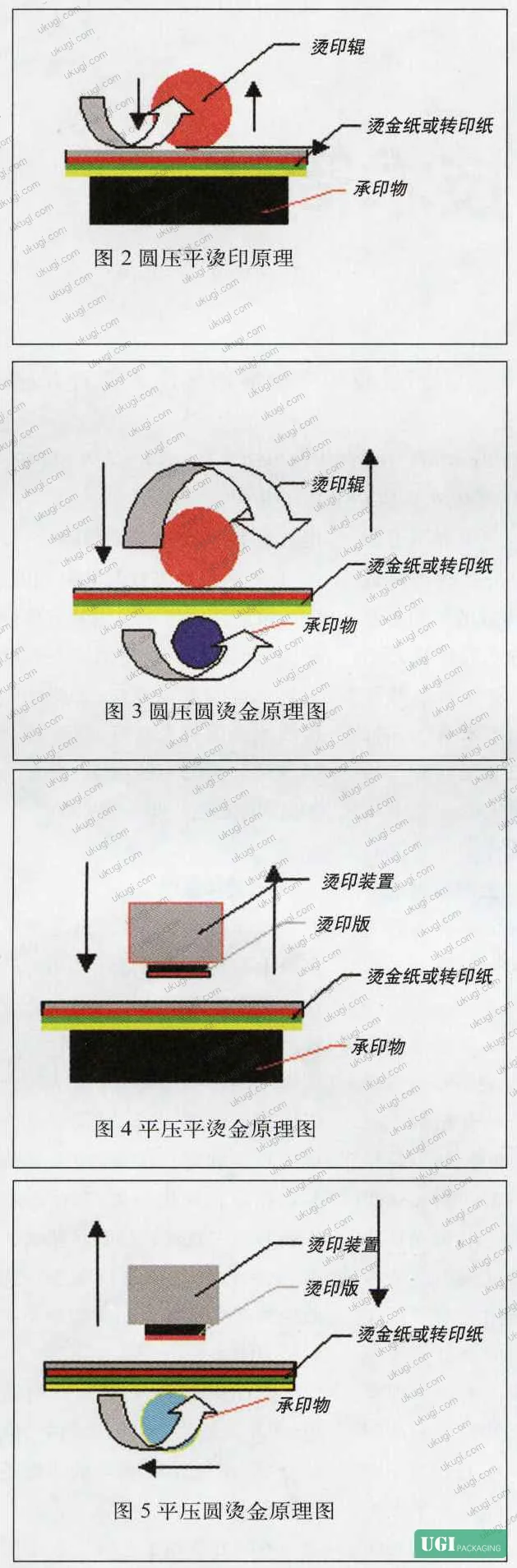
The table below compares the four configurations across the parameters that matter most in a procurement context:
| Configuration | Substrate Geometry | Complexity | Typical Application |
|---|---|---|---|
| Round-on-flat | Flat sheet / board | Medium | Paper boxes, cartons, book covers |
| Round-on-round | Cylindrical workpieces | High | Bottles, tubes, cosmetic caps |
| Flat-on-flat | Flat sheet / board | Low | Short-run, complex die shapes |
| Flat-on-round | Curved surface, partial | Medium-High | Pens, cylindrical containers |
Honestly, most buyers over-specify the press configuration in their RFQ without realizing it. Specifying “round-on-round” when your product is a flat folding carton lid just signals to the supplier that you’ve copied a spec from somewhere else. Focus on substrate geometry and the area of the stamped zone — let a competent supplier specify the press type.
Temperature, Pressure, and Dwell Time: The Three Process Variables That Determine Foil Quality #
This is where the real technical complexity lives, and where the majority of defect complaints originate.
Temperature is the dominant variable. The general operating principle is that stamping temperature must be high enough to melt the hot-melt adhesive and cause the silicone release layer to change state — enabling clean transfer — but must not be so high that it melts the substrate, oxidizes the metal layer, or causes the adhesive to invade and discolor the foil’s color protection layer.
The research documents recommended stamping temperatures for six plastic substrate materials:
| Material | Recommended Stamping Temperature |
|---|---|
| PP (polypropylene) | 180°C |
| ABS | 170°C |
| PS (polystyrene) | 150°C |
| PC (polycarbonate) | 150°C |
| Acrylic (PMMA) | 155°C |
| PVC | 170°C |
| PE (polyethylene) | 150°C |
| Nylon | 160°C |
A critical operational note: the temperature displayed on the machine’s instrument panel is not the actual temperature at the die surface. There is a measurable differential between set temperature and actual die temperature. In practice, operators should set slightly higher than the nominal target to compensate. Automatic stamping processes can maintain temperature stability within ±10°C, and this tolerance will not compromise stamping consistency.
PP is worth singling out: it has inherently poor adhesion characteristics, making the process difficult to control at any temperature. PS, by contrast, has excellent printability and is among the easiest substrates to foil stamp reliably.
Pressure is the hardest parameter to get right, particularly for flat-on-flat configuration on curved or irregular surfaces. On paper and board substrates, the soft compressibility of the material naturally compensates for minor pressure non-uniformity — which is why pressure management on paper is relatively forgiving. On hard plastic substrates, curved surfaces, or large solid stamping areas, pressure non-uniformity becomes the primary failure driver.
For large-area solid stamping and for curved surfaces, the recommended approach is to cast silicone rubber directly onto the die face — this creates a compliant surface layer that distributes pressure more evenly than a rigid die alone. Die hardness selection also matters: harder substrates should be paired with softer dies; softer substrates with harder dies. This counterintuitive pairing is one of the more commonly misunderstood aspects of foil stamping specification.
Dwell time interacts strongly with temperature. The governing principle is: large-area graphics → higher temperature + longer dwell; fine text and small graphics → lower temperature + shorter dwell. For round-on-round configuration, dwell time correlates with the length of time the roller is in contact with the workpiece surface during rotation — which is determined by the graphic’s length along the rotation axis. Setting dwell time too long is wasteful; setting it too short results in incomplete graphic transfer.
In supplier qualification, we saw three of six samples fail adhesion testing when the supplier had used a single temperature/dwell setting across different graphic sizes on the same panel — fine text was over-heated and showed edge bleed, while large solid areas showed incomplete transfer in the center. This is a direct consequence of not adjusting parameters by zone.
For buyers referencing international standards on substrate conditioning before testing, ISO 187:1990 Paper, board and pulps — Standard atmosphere for conditioning and testing provides the baseline environmental conditions that should be specified for incoming sample evaluation.
Common Defect Modes in Foil Stamping and Their Root Causes #
Understanding failure modes is more useful for procurement than understanding the ideal process. Defects in foil stamping fall into four recurring categories:
Stamped image lacks gloss / matte appearance: Almost always caused by temperature set too high. The metal layer undergoes oxidation when overheated, and the color protection layer is penetrated by the adhesive, destroying the reflective surface. First corrective action: reduce temperature. If reducing temperature causes adhesion failure, the issue is die hardness — switch to a softer die and retest.
Poor adhesion / foil lifting: Temperature too low — the hot-melt adhesive has not fully melted and penetrated the substrate surface. Also seen when the release layer has not fully transitioned, causing the foil to partially remain on the carrier film. On UV-coated substrates, cured acrylic resin (from UV varnish) is inherently difficult to bond to, and there is currently no reliable universal solution. The practical approach is to use solvent-based varnish where foil stamping is planned, and to position stamping zones before UV coating application where the print process sequence allows.
Bubble defects in large-area stamping: Air entrapment during transfer. This is a geometry and pressure distribution problem, not a temperature problem. For large solid areas, the solution is to add 150–175 lines/cm screen relief to the die face — this creates microchannels for air to escape during pressing. For curved surfaces, drilling micro-holes of approximately 1 mm diameter in the non-image areas of the die achieves the same air evacuation function.
Incomplete transfer / ragged edges on fine text: Usually a combination of insufficient dwell time and pressure that is too low for the substrate hardness. Fine text edges are also the most vulnerable to temperature-induced bleed when temperature is set too high for the overall panel.
Most procurement teams don’t realize that the interaction between UV coating and foil stamping is one of the most common sources of rework in premium packaging production. The standard advice — “just adjust the temperature” — does not solve a chemistry compatibility problem. When specifying both UV coating and foil stamping on the same panel, the sequence and the varnish chemistry must be explicitly co-specified with the supplier. This is one of those cases where a technically detailed RFQ prevents a very expensive surprise.
For quality verification of finished foil-stamped surfaces, ISO 15397:2014 Printing inks — Determination of resistance to rubbing provides relevant test methodology for evaluating foil durability under abrasion conditions.
Practical Guidance for Buyers #
When evaluating foil stamping suppliers, the single most important qualification test is not a visual inspection — it’s an adhesion test on your actual substrate, with your specified foil grade, at production speed. Request samples that include at least one large solid area, one zone of fine text (below 8pt), and one curved surface if applicable to your packaging geometry.
Substrate declaration matters more than most buyers acknowledge. PP substrates require temperatures around 180°C and are inherently difficult — if your packaging uses PP components, budget for extended process development time and higher rejection rates during run-up. ABS and PVC at 170°C are more manageable. PS at 150°C is the easiest plastic substrate to work with.
For foil stamping on post-printed surfaces, always clarify whether the ink system has been fully cured before stamping. Incomplete ink curing — particularly with oil-based inks containing drying oils and mineral spirits — causes bubble formation during stamping as volatile components off-gas under heat. This is documented and predictable; it is not acceptable as a defect excuse from a qualified supplier.
Fixture positioning tolerances for curved-surface stamping (radial runout ≤1 mm, axial play ≤0.2 mm, centerline deflection ≤0.2 mm after press contact) should be part of your machine capability questionnaire for any round-on-round or flat-on-round application.
Our team at ukugi.com — a Guangzhou-based OEM/ODM manufacturer with full post-press finishing capabilities including foil stamping, embossing, and UV coating — works regularly with international brand owners who need these parameters locked in before production commitment. If you’re specifying foil stamping on a complex substrate or geometry, the fastest path to a reliable sample is a direct technical conversation about your substrate chemistry and graphic requirements.
For adhesion performance benchmarks relevant to foil-stamped packaging, ASTM D1670 Failure End Point in Accelerated and Outdoor Weathering of Adhesives provides a useful reference framework for defining acceptance criteria.
Need a custom formulation or sample? Request a quote from our team →
Technical Verification Questions #
- What stamping temperature range do you use for PP substrates, and what instrument-to-die-surface temperature differential have you measured on your equipment? (Expected answer: ~180°C nominal, with documented offset between display and actual die temperature.)
- For large-area solid foil stamping exceeding 50 cm², what air evacuation method do you apply — screen relief on the die face (what line frequency, in lines/cm?) or micro-hole drilling in non-image areas?
- Can you demonstrate temperature stability within ±10°C across a full production run, and what closed-loop control system do you use to maintain this?
- What is your process for foil stamping over UV-coated substrates — do you use solvent-based varnish in the stamping zone, and at what sequence in the finishing line?
- For curved-surface (round-on-round or flat-on-round) applications, what are your fixture tolerance specifications for radial runout, axial play, and centerline deflection after press contact?
Quality Verification Checklist #
- ☐ Foil adhesion passes tape peel test on the specified substrate (paper, ABS, PS, PP, etc.) with no lifting in fine text zones below 8pt
- ☐ Temperature control documented within ±10°C of target throughout production run, verified by run log or thermocouple record
- ☐ Large-area solid stamping (>50 cm²) shows no bubble defects; supplier can reference die relief method used (150–175 lines/cm screen or ≥1 mm micro-holes in non-image areas)
- ☐ For PP substrates, stamping temperature confirmed at approximately 180°C with documented process notes on adhesion performance
- ☐ Curved-surface fixture specifications confirmed: radial runout ≤1 mm, axial play ≤0.2 mm, centerline deflection ≤0.2 mm post-contact
- ☐ Foil stamping over UV coating confirmed to use solvent-based varnish in stamping zones, or stamping is sequenced prior to UV application
- ☐ Fine text edges examined under 10× loupe — no bleed, no incomplete transfer, no ragged edge on characters at target size
Key Specifications Table #
| Parameter | Recommended Value | Verification Method |
|---|---|---|
| Temperature stability (auto process) | Within ±10°C of set point | Run log / thermocouple comparison; instrument vs. actual die surface differential documented |
| PP substrate stamping temperature | ~180°C | Trial run with adhesion tape peel test at 24h post-stamping |
| PS substrate stamping temperature | ~150°C | Trial run; visual gloss check + tape peel |
| Radial runout (curved fixture, round-on-round) | ≤1 mm | Dial indicator measurement at workpiece center axis |
| Axial play (curved fixture) | ≤0.2 mm | Dial indicator measurement |
| Centerline deflection after press contact | ≤0.2 mm | Measurement under press load condition |
| Air relief screen for large-area solid zones | 150–175 lines/cm | Die specification document or physical inspection under loupe |
| Micro-hole diameter for curved die air evacuation | ~1 mm in non-image areas | Physical inspection of die face |
Looking for a manufacturer that meets these specs? Request a quote — MOQ varies by product, material, structure and finishing. Product-specific MOQ is confirmed with each quotation.
References #
Data source: Process Parameter Optimization and Defect Analysis in Hot Foil Stamping Across Multiple Substrate Types and Press Configurations, N. Sun et al., Journal of Applied Polymer Science, 2024
Frequently Asked Questions #
Can hot foil stamping be applied to any substrate?
No. The process works reliably on paper, board, wood, and most plastics, but is generally not applicable to metal, ceramic, or glass without highly specialized foil and adhesive systems. Among plastics, PP is the most difficult due to its poor natural adhesion characteristics — expect a longer process development phase and higher initial rejection rates. PS is the most cooperative plastic substrate for foil stamping.
Why does my foil-stamped surface look dull instead of metallic?
This is almost always a temperature issue — specifically, temperature set too high. Excessive heat allows the adhesive to penetrate the foil’s color protection layer, and the metal layer undergoes oxidation, destroying the mirror-like reflective surface. Reduce stamping temperature and retest. If reducing temperature causes adhesion failure, the problem is die hardness — switch to a softer die.
What causes bubble defects in large solid foil areas?
Air entrapment during the transfer. As the die contacts a large flat area, air cannot escape fast enough from the edges. The fix is to add a 150–175 lines/cm screen texture to the die surface, which creates microchannels for air evacuation. On curved surfaces, drilling approximately 1 mm diameter micro-holes in the non-image areas of the die achieves the same result. This is a die specification issue, not a temperature or pressure issue.
Can foil stamping be done over UV coating?
It is technically possible but problematic. Cured acrylic resin from UV varnish is inherently difficult to bond to with standard hot-melt adhesives, and there is currently no universally reliable solution. The practical options are: use solvent-based varnish in planned stamping zones instead of UV varnish, or sequence foil stamping before UV coating application. Any supplier claiming UV-over-foil compatibility without specifying the exact varnish chemistry and sequence should be asked to provide documented adhesion test data.
How do I specify dwell time correctly for fine text versus large graphics on the same panel?
The governing principle is that large-area graphics need higher temperature and longer dwell time, while fine text needs lower temperature and shorter dwell. The problem arises when a supplier uses a single setting for the whole panel — this produces bleed on fine text and incomplete transfer in large solid areas simultaneously. The solution is zone-specific parameter settings or, where the press cannot do this, separating fine text and large solid elements onto different stamping passes. This is a process planning question to raise explicitly with your supplier before approving the die layout.
Published by ukugi.com Technical Team | Request a quote


