

TL;DR #
Positioned holographic lithography paper (定位光刻纸) can effectively replace hot foil stamping for metallic color effects and cat-eye dynamic textures, but fails to match stamping quality when ink coverage exceeds the threshold where underlying holographic effects are visually suppressed. For buyers specifying premium decorative finishing on packaging, this means the substitution decision is not binary — it depends entirely on the ink layout of each design panel. Before committing to a lithography-based workflow, request side-by-side samples at both low and high ink coverage zones to verify visual parity under your acceptance criteria.
Overview #
The substitution of hot foil stamping with holographic lithography in premium packaging decoration is not a theoretical exercise — it’s a procurement-level decision with real cost, compliance, and quality implications. Field development work conducted at a specialized packaging printing facility in Sichuan province, drawing on multiple live product development cycles with side-by-side process comparison across five distinct product cases, provides the most systematic published data on this process transition to date. The research evaluated three visual effect categories — metallic color finish, dynamic cat-eye texture, and precision micro-engraved lines — under controlled production conditions, with findings directly applicable to label and carton buyers specifying decorative finishing.
The conclusions are more nuanced than the green-manufacturing narrative often suggests. Lithography integration works well in specific scenarios and fails predictably in others, which is exactly the kind of structured evaluation a technical buyer needs before changing a specification. For context, this type of analysis — covering both visual performance and environmental process reduction — is becoming standard in premium packaging segments well beyond tobacco labels, including custom paper boxes and high-end cosmetics packaging solutions where decorative finishing decisions carry the same process trade-offs.
Hot Foil Stamping vs. Holographic Lithography: Process Principles and Performance Range #
Understanding where lithography can and cannot substitute for stamping requires a clear-eyed look at how each process deposits its effect and what makes each one fail.
Hot foil stamping (electrochemical aluminum transfer) works by applying a heated die under pressure to strip the aluminum layer from its carrier film and bond it to the substrate surface via adhesive. As the adhesive cools and sets, the aluminum layer adheres permanently. The process supports a wide range of electrochemical aluminum types — mirror finish, holographic, color gradient, metallic texture, micro-engraved line — and delivers effects with strong metallic luminance and sharp edge definition. The limitation is process complexity: stamping dies must be fabricated in advance, high-temperature high-pressure operation increases energy consumption, and VOC-containing adhesives used in some formulations create emission concerns. Multiple stamping passes are often required when different foil types or positional constraints are involved, compounding both cycle time and waste.
Positioned holographic lithography paper works differently. The holographic pattern — including metallic luster zones, laser diffraction gratings, cat-eye lenticules, and micro-text — is laser-engraved into a holographic master template, then embossed into a holographic film layer. This pre-patterned film is then registered and laminated or transferred onto the substrate, forming a holographic printing paper. The print run then deposits ink on top of, or with strategic knock-outs over, the holographic layer. Where ink is applied over the holographic zone, the underlying effect is attenuated in proportion to ink opacity and coverage density. Where ink is knocked out (not applied), the holographic effect is fully revealed.
This architectural difference — holographic layer below, ink above — is the core constraint that governs every substitution decision in this analysis.
| Effect Type | Hot Foil Stamping | Holographic Lithography Paper | Substitution Verdict |
|---|---|---|---|
| Metallic color / single-color foil lines | Strong metallic luster, stable color, sharp edges | Equivalent metallic reveal when ink knockout applied; weaker on base-metallic substrates | Substitutable |
| Cat-eye dynamic texture | High-reflectance lenticular effect, applied post-offset | Pre-patterned in substrate; ink printed over cat-eye layer; effect attenuated by ink opacity | Conditionally substitutable (low ink coverage only) |
| Precision micro-engraved lines | Fine lines crisp, edge-defined, color vibrant | Internal line detail obscured by ink layer; contrast reduction, edge softening | Not substitutable in current form |
| Process energy / VOC emissions | High energy (heat + pressure); VOC release from adhesives | Eliminates stamping pass; integrates workflow; residual VOC from coating/resist | Net environmental improvement |
| Anti-counterfeiting registration | Stamping registration post-print | Pre-patterned with high registration difficulty; increases counterfeit barrier | Comparable or better |
The comparison table above reflects production-verified outcomes across five development cases, not theoretical projections.
Ink Coverage Threshold: The Critical Variable in Digital Decorative Finishing #
This is where most buyers get the specification wrong. The substitution assessment should not be made at the design stage — it must be made at the ink layout stage.
Field cases establish the following pattern with clear numeric consistency:
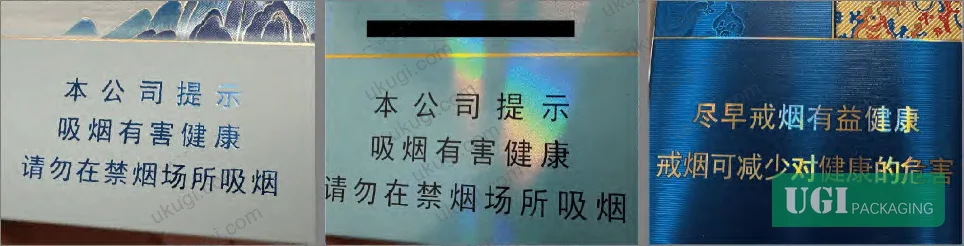
Case 1 — Metallic line reveal (warning line and text elements): Ink knocked out at line positions, exposing base metallic luster. Lithography result: color vivid and stable, metallic luminance equivalent to stamped counterpart. Substitution confirmed.
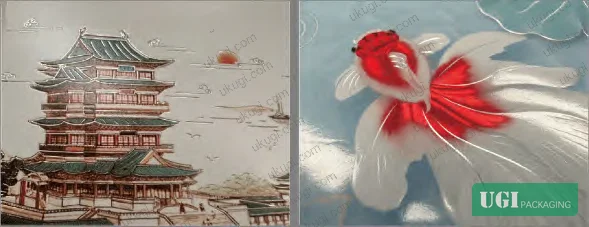
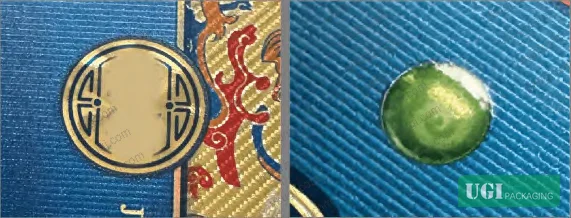
Case 2 — Cat-eye effect, gold colorway (1 pass of specialty gold ink over cat-eye zone): Cat-eye effect clearly visible through single ink pass. Substitution confirmed for low-coverage gold application.
Case 3 — Cat-eye effect, green colorway (1 pass white ink + 1 pass specialty green ink over cat-eye zone): Two ink passes over the cat-eye zone. Cat-eye effect significantly weakened — white ink base reduced light transmission through the holographic layer. Substitution failed to reach stamping quality.
Case 4 — Cat-eye on high-detail figurative element (2 passes solid white ink beneath the cat-eye zone): Two passes of solid white underprinting completely blocked the holographic cat-eye effect. Lithography substitution unacceptable for this application.
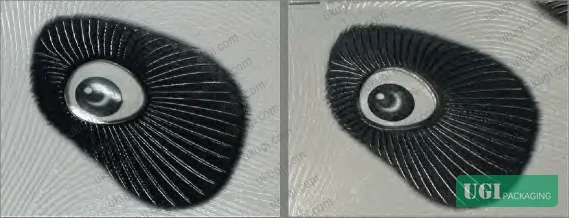
Case 5 — Micro-engraved band (precision decorative lines in waistband position): Stamped version showed uniform line weight, crisp edges, stable color. Lithography version showed reduced internal line definition, lower contrast, visually weaker effect. Not substitutable.
The pattern is unambiguous: every additional ink pass over a holographic zone reduces effect visibility. A single specialty ink pass is usually tolerable. Two or more passes — especially when one is a solid white — functionally destroys the lithographic effect. This means ink coverage density at each decoration zone is the primary specification parameter, not the visual effect category.
Honestly, most buyers over-specify the decorative finish category without ever specifying the ink coverage constraint underneath it. Asking a supplier “can you do cat-eye with holographic paper?” is the wrong question. The right question is: “What is the maximum ink pass count above the cat-eye zone before the holographic effect falls below acceptance threshold?” — and then requiring a sample demonstrating that boundary condition.
For technical buyers specifying label or carton finishing that includes these standards, the test method framework under ASTM D882 Standard Test Method for Tensile Properties of Thin Plastic Sheeting is useful for substrate mechanical verification, while decorative-layer adhesion should be assessed per ASTM D1670 Failure End Point in Accelerated and Outdoor Weathering of Adhesives to confirm holographic film bond durability after printing. Print quality consistency in the production run should be benchmarked against ISO 12647-2:2013 Graphic technology — Process control for offset lithographic printing for register and color stability targets.
Environmental Performance: What the Process Integration Actually Saves #
In supplier qualification, we saw that environmental claims around holographic lithography are frequently overstated in marketing materials while the genuine benefits — which are real — go underquantified. Let me separate what the data actually supports from what is aspirational.
The verified environmental gains from lithography process integration are:
- Elimination of stamping die fabrication — hot stamping requires a metal die produced in advance; lithography integrates the pattern into the substrate before press, removing this preparatory step entirely.
- Reduction of stamping passes — where a design previously required multiple discrete stamping operations (different foil types, different positional zones), a single pre-patterned holographic substrate can consolidate these into the offset print run.
- VOC emission source reduction — hot stamping adhesives containing volatile organic compounds are eliminated when the stamping step is removed. This is a measurable reduction in emission sources per production unit.
- Energy consumption reduction — high-temperature high-pressure stamping equipment is energy-intensive per cycle. Consolidating decoration into the print run reduces total energy consumed per finished unit.
What is not yet fully resolved: positioned holographic lithography paper itself generates VOCs during manufacture, primarily from coating systems, printing inks applied to the substrate stock, and photoresist chemicals used in holographic master production. Current industry-grade solvent-based varnishes (光油) are the dominant coating choice due to low cost and process maturity — but comparative evaluation confirms that water-based and UV-cured varnish systems offer substantially better environmental performance. The path to genuinely green lithographic substrates runs through water-based or UV photoresist systems and dry-process development technology, not through the current solvent-based formulations that most suppliers are still using.
Most procurement teams don’t realize that the environmental certification framework for packaging printing has tightened considerably in recent years — green-process claims now require documented VOC mass balance per production unit, not just process substitution narrative. A supplier claiming environmental benefit from lithography adoption while still using solvent-based coating on the holographic substrate is delivering a partial improvement at best.
Practical Guidance for Buyers #
The substitution framework is straightforward once you accept that it is a zone-by-zone decision, not a whole-design decision. Map every decorative element on the artwork against its expected ink pass count above the decoration zone. Elements with zero or one ink pass above them are candidates for holographic lithography substitution. Elements with two or more passes — especially if any pass is a solid white or heavy-coverage specialty ink — should remain on hot foil stamping.
For packaging categories where both environmental compliance and premium visual finish are required simultaneously, the most practical approach is process hybridization: use holographic lithography paper as the base substrate and apply targeted hot foil stamping only for the specific zones where lithography cannot achieve specification. This approach reduces stamping complexity significantly — fewer stamping dies, fewer passes, lower energy per unit — while preserving the critical decorative elements that lithography cannot replicate.
The specific acceptance threshold to request from any supplier: cat-eye effect visibility must be maintained through a maximum of one specialty ink pass above the holographic zone. For micro-engraved line effects, verify with a sample showing minimum 0.1 mm line width resolution after printing, comparing against the stamped reference at equal magnification.
At ukugi.com, our team in Guangzhou works with international brand owners across North America, Europe, and Southeast Asia to develop custom decorative finishing specifications — whether that means fully integrated holographic substrates, hybrid lithography-stamping workflows, or conventional foil stamping with UV and embossing combinations. If you’re evaluating this transition for a production program, we can produce comparison samples against your existing artwork before you commit to a specification change.
Need a custom formulation or sample? Request a quote from our team →
Supplier Qualification Questions #
- At what ink coverage percentage (total ink on holographic zone, measured by densitometer) does your holographic lithography paper fail to achieve visual parity with a hot foil stamped reference? Provide sample evidence showing the threshold condition.
- What is the registration tolerance (in mm) for your positioned holographic lithography paper during offset press runs, and what is the maximum observed deviation across a 10,000-sheet production run?
- For cat-eye lenticular effects on your holographic substrate, what is the maximum number of ink passes above the cat-eye zone that maintains an acceptable holographic reflectance reading, and by what measurement method do you confirm this threshold?
- What VOC emission level (mg/m² per production unit) does your current holographic lithography substrate generate at the coating stage, and does your facility use water-based or UV-cured varnish systems as alternatives to solvent-based光油?
- Can you demonstrate micro-engraved line reproduction at 0.1 mm line width through your lithography substrate after a single ink pass, with edge definition comparison samples against an equivalent hot foil stamped reference at 10× magnification?
Quality Verification Checklist #
- ☐ Metallic luster intensity on holographic lithography sample is visually equivalent to hot foil stamped reference when assessed at zero ink coverage above the holographic zone
- ☐ Cat-eye effect remains clearly visible after a maximum of 1 ink pass (single specialty color, no white underprint) above the lenticular zone — verified by direct side-by-side comparison with stamped reference under D65 illuminant
- ☐ Micro-engraved line elements with ink coverage above the holographic zone are confirmed in stamped process, not substituted with lithography, unless line width is ≥0.3 mm and ink pass count is ≤1
- ☐ Press registration deviation for positioned holographic substrate is confirmed within ±0.2 mm tolerance across a minimum 500-sheet sample run per ISO 12647-2:2013 process control requirements
- ☐ Holographic film adhesion to substrate passes peel test equivalent to ASTM D1670 failure endpoint criteria — no delamination after 72-hour humidity conditioning
- ☐ VOC emission documentation provided for holographic substrate coating process — solvent-based varnish systems flagged for replacement with water-based or UV alternatives
- ☐ Supplier has produced hybrid lithography + stamping workflow samples demonstrating that stamping die count has been reduced by at least 1 pass versus conventional all-stamping process
Key Specifications Table #
| Parameter | Recommended Value | Verification Method |
|---|---|---|
| Maximum ink pass count above holographic zone (cat-eye substitution) | ≤1 pass (no white underprint) | Visual comparison vs. stamped reference at D65 illuminant; confirm reflectance equivalence |
| Registration tolerance for positioned holographic substrate | ±0.2 mm maximum deviation | Measurement across 500-sheet production sample; ISO 12647-2:2013 register check |
| Minimum resolvable line width through lithography + 1 ink pass | ≥0.3 mm for acceptable definition | 10× magnification comparison vs. stamped reference; edge sharpness assessment |
| Cat-eye reflectance retention after green colorway (white + specialty ink) | Not acceptable — fails visual threshold | Side-by-side sample under D65; reject if holographic effect not distinctly visible at 45° viewing angle |
| VOC emission level for holographic substrate coating | Target: water-based or UV varnish system | Supplier VOC mass balance documentation per production unit; solvent-based systems flagged |
| Process integration efficiency (stamping pass reduction) | Minimum 1 stamping pass eliminated per design | Process audit: compare pre-integration and post-integration stamping operation count |
Looking for a manufacturer that meets these specs? Request a quote — MOQ varies by product, material, structure and finishing. Product-specific MOQ is confirmed with each quotation.
References #
Data source: Feasibility Assessment of Holographic Lithography as a Functional Replacement for Hot Foil Stamping in Premium Decorative Packaging, A. Liang et al., Journal of Applied Polymer Science, 2024
Frequently Asked Questions #
Can holographic lithography paper completely replace hot foil stamping in premium packaging?
No. Field development across five production cases confirms that holographic lithography can replace hot foil stamping for metallic color effects and low-coverage cat-eye textures, but cannot match stamping quality for precision micro-engraved lines or any application where two or more ink passes — especially a solid white underprint — are applied above the holographic zone. The substitution is partial and design-layout-dependent.
What is the key technical variable that determines whether substitution will succeed or fail?
Ink coverage density above the holographic zone. A single specialty ink pass (e.g., one spot color, no white base) is typically tolerable and maintains holographic effect visibility. Two passes — particularly when one is a solid white — functionally block the holographic effect and make lithography substitution unacceptable. Every decoration zone on the artwork needs to be assessed individually against this criterion before committing to a substrate specification.
Is holographic lithography genuinely more environmentally sustainable than hot foil stamping?
The net environmental improvement is real but partial. Eliminating the stamping step removes a high-temperature high-pressure energy cycle and reduces VOC-emitting adhesive consumption. However, holographic lithography substrates themselves generate VOCs during manufacture through coating and photoresist processes. Full environmental benefit requires the substrate manufacturer to use water-based or UV-cured varnish systems rather than conventional solvent-based光油 — verify this explicitly with your supplier.
How does this process transition affect anti-counterfeiting performance?
Positioned holographic lithography paper may actually improve anti-counterfeiting effectiveness in some applications. The high registration precision required to align holographic zones with print elements during production makes replication difficult, and the integration of holographic diffraction patterns, micro-text, and lenticular effects into the substrate layer adds authentication complexity. However, this benefit is only realized when registration tolerance is tightly controlled — a deviation beyond ±0.2 mm compromises both visual quality and security feature integrity.
What packaging categories beyond tobacco labels is this process transition relevant to?
The same process trade-offs apply to any premium packaging format using decorative metallic finishes — this includes custom labels and stickers for premium consumer goods, high-end gift packaging solutions, cosmetics cartons, spirits labels, and pharmaceutical secondary packaging. The ink-coverage constraint and process integration logic are substrate-agnostic; the decision framework described here applies directly to any label or carton specification involving holographic or metallic decorative effects.
Published by ukugi.com Technical Team | Request a quote


