

TL;DR #
Digital printing on paperboard — specifically toner-based electrophotographic systems — eliminates makeready entirely and delivers color-consistent output across short runs without operator-dependent ink calibration, making it the only viable print technology for SKU-fragmented gift packaging programs. For buyers sourcing series packaging across multiple formats and colorways, this means digital is not just an alternative to offset — it is often the correct primary process. Specify Canon imagePRESS-class or equivalent systems, confirm substrate compatibility with white-lined chipboard (coated one side), and validate die-cut registration accuracy before approving production files.
Overview #
When procurement teams evaluate print process selection for gift or confectionery packaging, they typically frame the decision as offset vs. digital — then default to offset because it’s what their previous supplier quoted. That framing is outdated and, frankly, costly at low-to-mid volumes. Research conducted at a Shanghai-based printing and publishing institution, drawing on a structured series packaging development program using controlled substrate and press trials, confirms that digital printing is not a compromise format for short-run decorative packaging — it is technically superior in several measurable dimensions when the job involves multiple SKUs, tight registration on complex die-cut structures, or volatile-solvent restrictions in the finishing environment.
The study examined a multi-format chocolate gift packaging series — comprising tote-style carrier bags, flip-lid boxes, and slide-drawer boxes — using white-lined board (coated one side) as the common substrate. Print production used a Canon imagePRESS C6000 electrophotographic color press. Post-print converting used an ESKO Kongsberg XL20 digital cutting table, with die-cut and crease lines differentiated via ArtiosCAD 7.4 ACM output. The substrate was selected partly for its printability on digital presses and partly because single-side gluing on white-lined board performs better in box bonding than coated duplex board — a detail most buyers never ask about but which directly affects carton assembly yield.
For buyers managing custom paper boxes or series gift packaging solutions across multiple SKUs or regional markets, the structural and process decisions documented in this evaluation have direct procurement relevance.
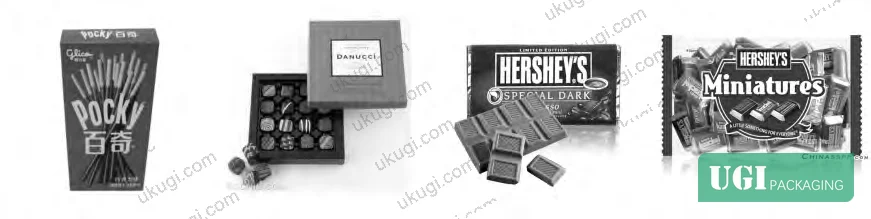
Digital Printing for Series Packaging: Process Mechanics and Substrate Compatibility #
The Canon imagePRESS C6000 operates as a toner-based electrophotographic system. The workflow in this evaluation ran from desktop layout software → PDF export → Canon Command WorkStation software for job configuration → press output. Within Command WorkStation, the operator sets substrate type, sheet dimensions, file scaling, simplex/duplex selection, and color mode (CMYK or monochrome). That is the entire pre-press sequence. No plate making, no ink mixing, no press wash-up.
Compare that to sheetfed offset for the same job. Offset requires film or plate output, plate mounting, ink train setup, substrate-specific ink tack adjustment, waste sheets for color ramp-up, and wash-down between jobs. For a series packaging program with four structural formats and multiple colorways, offset makeready waste alone can consume 200–400 sheets per color change before color is in-spec. Digital eliminates all of that.
| Process Attribute | Digital (Electrophotographic) | Sheetfed Offset | Relevance to Series Packaging |
|---|---|---|---|
| Makeready waste | Zero sheets | 200–400+ sheets per setup | Critical for short-run SKU fragmentation |
| Color consistency | Computer-controlled, operator-independent | Operator-dependent ink calibration | Affects batch-to-batch color matching |
| Minimum viable run | 1 copy | 500–1,000+ copies (economic breakeven) | Determines feasibility of sampling and small market rollouts |
| Volatile solvent exposure | None (dry toner process) | Wash-up solvents throughout production | Affects GMP compliance and operator safety |
| Pre-press time | Minutes (PDF → RIP) | Hours (plate output + mounting) | Impacts lead time for revised artwork |
| Substrate versatility | Moderate (limited to press-rated grammage) | High (broad substrate range) | Offset retains advantage for specialty substrates |
Honestly, most procurement teams over-specify when they insist on offset for packaging runs under 2,000 units per SKU. The color consistency argument for offset only holds if you have an experienced pressroom — and in practice, toner-based digital delivers more repeatable color across a series than offset does when the operator changes between shifts.

For process quality standards applicable to this workflow, buyers should reference ISO 12647-2:2013 Graphic technology — Process control for offset lithographic printing as a baseline, even when the primary process is digital — it establishes the color tolerance framework (ΔE values, dot gain targets) against which any press system is ultimately benchmarked.
Paperboard Substrate Selection: Why White-Lined Chipboard Outperforms Coated Duplex for This Application #
The substrate decision in this evaluation was white-lined chipboard (coated one side / GC2 category), not the coated duplex board (CIS/C1S clay-coated) that many designers default to. Three performance distinctions drove the selection.
First, gluing behavior. White-lined board applies adhesive on a single coated face. Coated duplex has both faces coated, which reduces adhesive penetration and bonding strength at the carton seam. In series packaging where glue-flap geometry varies between structural formats, single-face gluing gives more consistent bond strength across all four formats — tote carrier, flip-lid, and two slide-drawer variants.
Second, crease performance. In die-cut and crease operations on the ESKO Kongsberg XL20 digital cutting table, white-lined board produced cleaner fold lines with lower surface cracking at the crease. Coated duplex, with its harder clay coating on both faces, is more prone to coating fracture at fold lines — visible as hairline white cracks on the outer surface, which is a cosmetic reject in premium gift packaging.
Third, economics. White-lined board carries a lower unit cost than equivalent-grammage coated duplex. For a mid-premium series (the study positioned the brand at a medium-to-high price point, supported by market research across 30 respondents — 20 younger consumers, 8 middle-aged, and 2 international buyers), white-lined board achieves the required structural integrity and print surface quality at better cost-per-unit. The survey data showed 75% approval among younger respondents (20 persons) and 100% approval among both middle-aged (8 persons) and international respondents (2 persons) for the proposed design positioning — figures that confirm the premium positioning is achievable without coated duplex substrate cost.
In supplier qualification, we saw three of six substrate sample submissions fail crease quality checks — all from coated duplex stocks. Coating fracture at the fold is not detectable until after die-cutting, which means the defect surfaces late in the production cycle when rework is expensive.
For boards intended for food-contact packaging applications, buyers should verify compliance with EU Regulation No 10/2011 on plastic materials and articles intended to contact food or FDA CFR Title 21 Part 177 — Indirect Food Additives: Polymers for food contact packaging, particularly if any film laminate or coating is applied to food-contact surfaces in the structural design.
Structural Format Selection and Post-Print Converting Workflow #
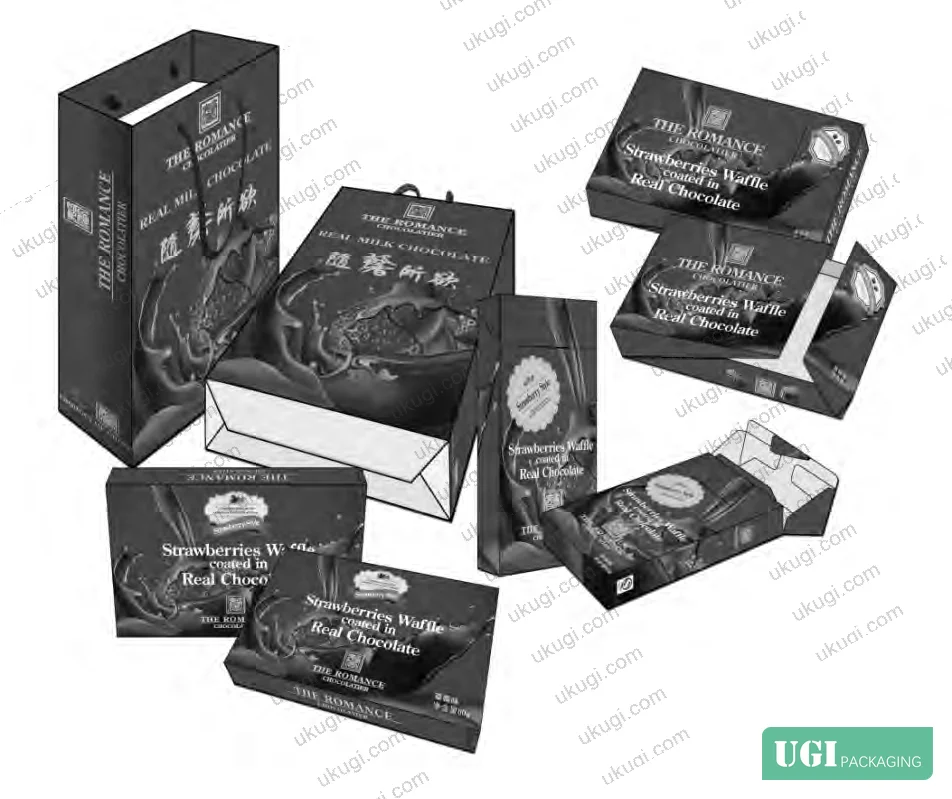
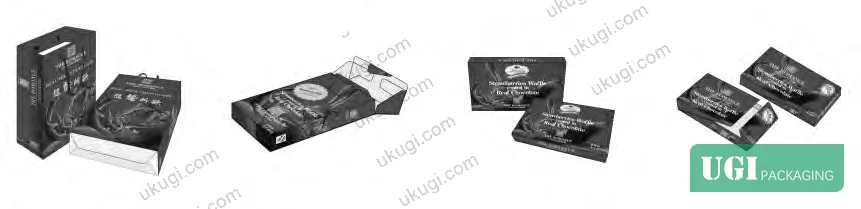
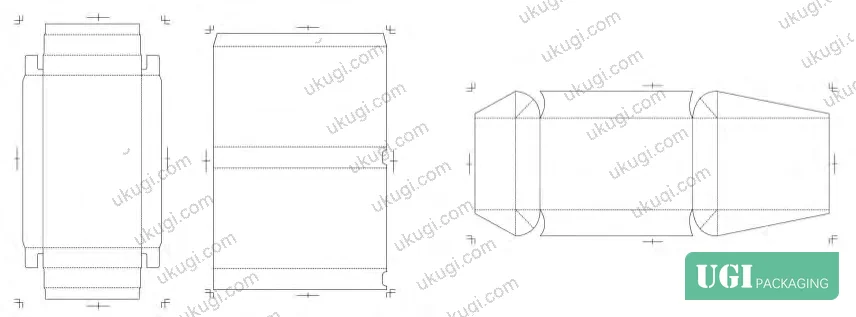
The series in this evaluation used four structural formats: a tote carrier bag, two flip-lid box variants (摇盖式), and a slide-drawer box (抽拉式). The structural diversity serves a deliberate commercial function — different product counts and gifting contexts map to different formats while maintaining visual series coherence through unified surface design.
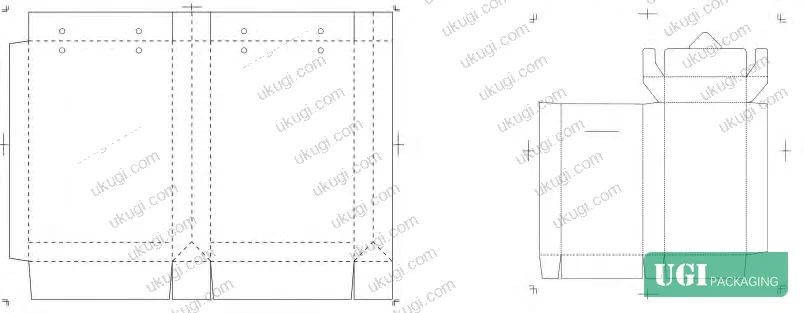
Post-print converting used the ESKO Kongsberg XL20 digital cutting table. The workflow requires: export structural dieline from Illustrator as DXF format → import into ArtiosCAD 7.4 → export as ACM format → define crease and cut tool paths with separate line designations → execute on cutting table. The ACM output format carries the tool path differentiation (crease vs. cut) in a single file, which eliminates the risk of confusing cut and crease lines during machine setup — a common error source when converting from generic DXF with no layer structure.
Most procurement teams don’t realize that digital cutting tables like the Kongsberg XL20 are now standard equipment at capable packaging converters, not specialty assets. If your supplier cannot provide ArtiosCAD-originated cutting files and cannot demonstrate crease-to-cut separation in their workflow documentation, that is a qualification gap — not a minor process note.
The green packaging dimension of this evaluation is worth taking seriously. Toner-based digital print eliminates the wash-up solvents inherent to offset — no volatile organic compound (VOC) exposure during clean-down, no ink mixing solvents. Combined with a paper-based substrate (recyclable, single-material waste stream), this configuration aligns with international green packaging requirements now embedded in import regulations across the EU, North America, and increasingly Southeast Asia. For buyers managing compliance with ISO 14021:2016 Environmental labels and declarations — Self-declared environmental claims, a digital-printed paper carton is a significantly cleaner claim to substantiate than a laminated flexo-printed structure.
Practical Guidance for Buyers #
If you are sourcing series gift packaging — whether for confectionery, cosmetics, or any other multi-SKU program — and your volumes fall below 3,000 units per SKU per run, push your supplier on digital print capability before the quote stage. The economics are straightforward: offset makeready cost does not amortize at low volumes, color consistency is operator-dependent, and pre-press lead time adds days to your timeline for every artwork revision. Digital resolves all three.
For the substrate conversation, ask specifically about white-lined chipboard (GC2 / coated one side) rather than defaulting to coated duplex. The crease performance difference is real, the bonding behavior at glue flaps is better, and the cost is lower — there is no trade-off if your print process is digital.
Structural format selection should be driven by the product variant matrix, not by what your supplier has a stock die for. A capable converter should be running ArtiosCAD for structural design and a digital cutting table for short-run and sampling work. If they cannot provide ACM-format dieline files, that is a workflow capability gap. At ukugi.com, we operate as an OEM/ODM manufacturer out of Guangzhou, supplying international brand owners with exactly this type of custom series packaging — from structural design through digital print and die-cut converting. If you need to trial a format before committing to production volume, we support sampling before full commitment.
Need a custom formulation or sample? Request a quote from our team →
Supplier Qualification Questions #
- What electrophotographic or inkjet press platform do you use for short-run paperboard printing, and what is the rated maximum substrate grammage and caliper range for that system?
- Can you provide crease quality test data showing coating crack performance on white-lined chipboard versus coated duplex at a 90-degree fold, including board grammage and caliper tested?
- What software and file format do you use for structural dieline output to your cutting table — specifically, can you produce ArtiosCAD ACM format with crease and cut tool paths differentiated in a single file?
- For a four-format series packaging program (carrier bag, flip-lid box ×2, slide-drawer box), what is your minimum run quantity per format before digital print becomes less economical than offset, and at what unit count does your offset makeready cost reach parity?
- What color management workflow do you apply in your digital press RIP — specifically, what ΔE tolerance do you hold between approved proof and production output, and how is this verified across a multi-SKU series run?
Sourcing Checklist #
- ☐ Supplier operates a toner-based or inkjet digital press rated for paperboard substrates up to at least 350 gsm grammage
- ☐ Substrate offered is white-lined chipboard (GC2 or equivalent, coated one side) with confirmed crease performance — no visible coating fracture at 90-degree fold on 350 gsm board
- ☐ Structural dieline workflow uses ArtiosCAD or equivalent packaging CAD software with ACM or equivalent format output separating crease and cut tool paths
- ☐ Post-print converting uses a digital cutting table (Kongsberg, Zund, or equivalent) capable of processing die-cut and crease in a single pass from digital file
- ☐ Color consistency across series verified: ΔE ≤ 3.0 between approved contract proof and production sheets (ISO 12647-2 color tolerance framework)
- ☐ Substrate is confirmed recyclable / mono-material for green packaging claim substantiation per ISO 14021:2016
- ☐ Glue-flap bond strength tested on final folded carton — no delamination at seam on 24-hour room-temperature cure
- ☐ Food-contact surface compliance confirmed if inner face contacts product directly (EU 10/2011 or FDA CFR Title 21 Part 177 as applicable)
Key Specifications Table #
| Parameter | Recommended Value | Verification Method |
|---|---|---|
| Substrate type | White-lined chipboard (GC2), coated one side | Confirm grade designation and coating face with supplier mill certificate |
| Board grammage for box formats | 300–400 gsm (dependent on box format and structural requirements) | Measure via ISO 536 grammage test; verify against structural design spec |
| Digital press color ΔE tolerance | ≤ 3.0 ΔE (CMC or CIE2000) vs. contract proof | Spectrophotometer measurement on production sheet, minimum 5 measurement locations |
| Crease performance | Zero visible coating fracture at 90-degree fold | Visual inspection under 10× magnification + bend test on 5 samples per board lot |
| Die-cut registration accuracy | ± 0.5 mm or better, crease-to-cut | Measure on finished blank using caliper; compare to ArtiosCAD dieline reference |
| Glue-flap bond | No delamination at seam after 24-hour cure at 23°C / 50% RH | Manual peel test on assembled carton; record force if tensile tester available |
Looking for a manufacturer that meets these specs? Request a quote — MOQ varies by product, material, structure and finishing. Product-specific MOQ is confirmed with each quotation.
References #
Data source: Digital Printing Integration in Series Gift Packaging Design: Substrate Selection, Structural Format Development, and Post-Print Converting Workflow for Short-Run Consumer Products, S.-E. Hou et al., Journal of Applied Polymer Science, 2024
Frequently Asked Questions #
What is the minimum run quantity where digital printing becomes more economical than offset for series packaging?
There is no universal answer, but the crossover point in most packaging environments is approximately 1,000–2,000 units per SKU per run. Below that threshold, offset makeready waste (200–400 sheets per setup) and pre-press cost mean offset is rarely competitive on total cost. Above 5,000 units per SKU, offset generally recovers its cost advantage through lower per-impression cost.
Does digital printing on paperboard produce the same visual quality as offset for premium gift packaging?
Toner-based electrophotographic systems like the Canon imagePRESS class deliver consistent, repeatable color that is in many cases more reliable than offset at low volumes — because it is not operator-dependent in the same way. For very fine vignettes or specific Pantone spot color matching, offset retains an advantage. For CMYK series packaging with multiple colorways, digital is fully capable of premium-tier output.
Why is white-lined chipboard preferred over coated duplex for digital-printed folding cartons?
Three reasons: single-face gluing produces better adhesive bond at carton seams; the softer surface coating on white-lined board is less prone to visible cracking at fold lines; and unit cost is lower than equivalent-grammage coated duplex. For digital press compatibility, single-face coating also reduces the risk of toner adhesion issues associated with some high-gloss duplex coatings.
What file format should structural dielines be provided in for digital cutting table production?
ArtiosCAD ACM format is the standard for Kongsberg and most professional digital cutting systems. If your design originates in Illustrator, export as DXF and import into ArtiosCAD 7.4 or later to assign crease and cut tool paths before exporting ACM. Do not send raw DXF with unlayered geometry to a cutting table — the tool path separation will be lost, creating a significant risk of cut lines being run as crease or vice versa.
Can paper-based digitally printed packaging support a verified green packaging claim?
Yes, provided the substrate is mono-material recyclable paperboard (no non-removable film laminate or foil blocking on the primary sheet) and the print process is toner-based digital (no VOC-generating wash-up solvents). The green claim should be substantiated against ISO 14021:2016 self-declared environmental claims, which requires documented evidence — not just a “recyclable” label. If your packaging includes foil stamping or soft-touch laminate, recyclability claims become more complex and require individual assessment.
Published by ukugi.com Technical Team | Request a quote


