

TL;DR #
When a folding carton library is structured around modular functional components — lid, body, and base — rather than individual box files, design efficiency can reach a ratio of 8:1 versus 0.25:1 for monolithic file-per-box approaches, a 32× difference in resource utilization. For buyers commissioning custom folding cartons, this structural logic directly impacts how quickly a manufacturer can generate accurate die-cut layouts and production specifications for your SKU. Before approving a structural design partner, ask them to demonstrate parametric generation of at least 165 distinct box configurations from a defined component set.
Overview #
Most buyers evaluate folding carton suppliers on surface metrics — board grade, print quality, and lead time. The structural design methodology the manufacturer uses to generate die-cut blanks and production data rarely comes up in RFQ conversations. That’s a mistake, and engineering evaluations from academic institutions specializing in packaging CAD development make clear why: the internal architecture of how box variants are generated from component libraries directly determines both the accuracy of the output and the speed at which custom configurations can be turned around.
Research from a northwest China technical institute, based on systematic analysis of hundreds of folding carton configurations and validated through mathematical optimization of component-set sizing, provides a rigorous framework for evaluating structural design efficiency in carton development. The methodology uses a defined design efficiency ratio Z = Q/F (carton variants producible per unit of stored component data), with experimentally verified values ranging from 0.25 to 8.0 depending on structural organization.
Folding cartons are classified into 9 primary structural families: tuck-end (tube-style) boxes, carry/handle boxes, snap-lock lid boxes, display boxes, drawer boxes, combination boxes, window boxes, liquid cartons, and irregular-form boxes. Any structural design system that cannot cleanly address all 9 families — including the hybrid tube-tray and partitioned tube types — is incomplete by industrial standards. Understanding this taxonomy matters when you’re qualifying a manufacturer to handle a diversified product line rather than a single SKU.
For compliance and testing context relevant to carton material specifications, ISO 187:1990 Paper, board and pulps — Standard atmosphere for conditioning and testing establishes the environmental baseline that any legitimate structural board testing must reference.
Folding Carton Structural Families and Component Combination Logic #
The central insight in rigorous carton structural analysis is that virtually all folding carton variants can be decomposed into three functional component sets: the lid (G), the body (T), and the base (D). Developing l lid variants, m body variants, and n base variants yields a theoretical carton set of p = l × m × n distinct configurations. For display boxes and partitioned tube boxes — which combine only two component sets — the formula reduces to p = m × n.
This is not merely a software architecture observation. It directly maps to how a manufacturer’s structural engineering capability scales.
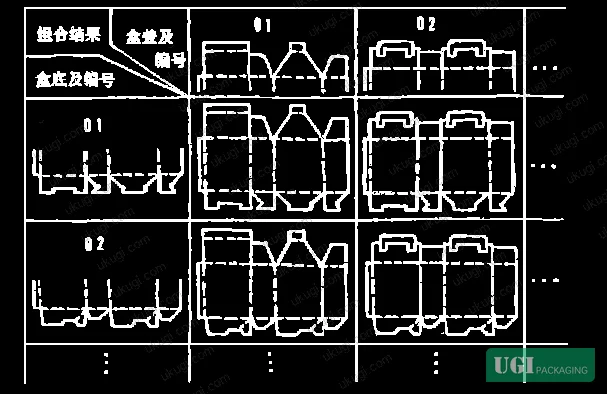
Tube-style folding cartons (管式折叠盒) are the most common commercial format. They are fully defined by combining lid variants with base variants — the body form is fixed by the tube geometry. This is the configuration most encountered in custom paper boxes for retail and e-commerce applications.
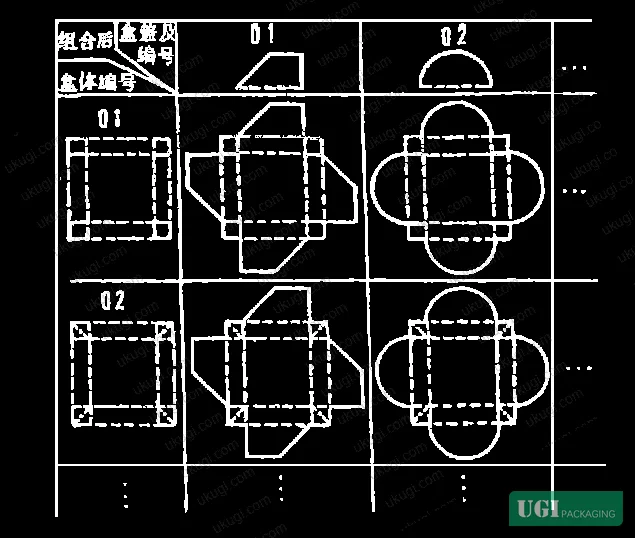
Tray-style folding cartons (盘式折叠盒) have a fixed base construction; their variant space is defined by combining body-to-lid relationships or by varying front/rear versus left/right sidewall configurations. This matters when you’re specifying rigid-feel tray packs for cosmetics or gift lines — the base specification locks first, then lid and body options are iterated.
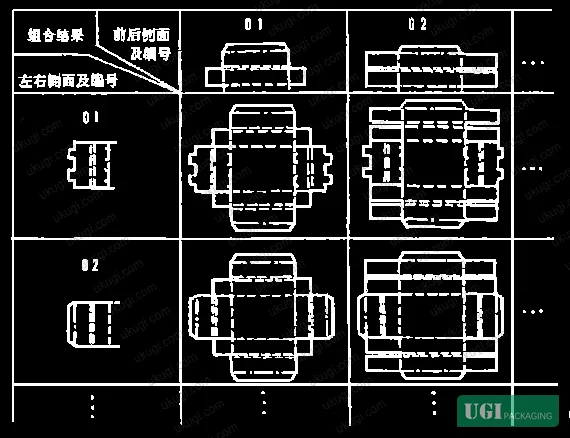
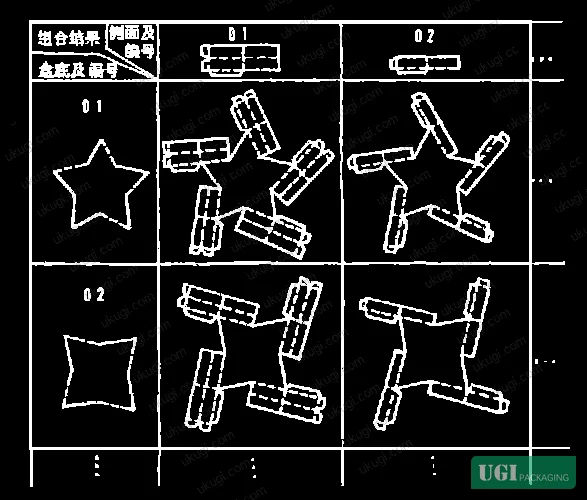
Tube-tray hybrid cartons (管盘式折叠盒) combine variable base constructions with variable body sidewalls, producing a configuration matrix that requires both dimensions to be explicitly specified in the structural brief. Buyers who leave either dimension undefined in their RFQ will routinely receive mismatched structural proposals.
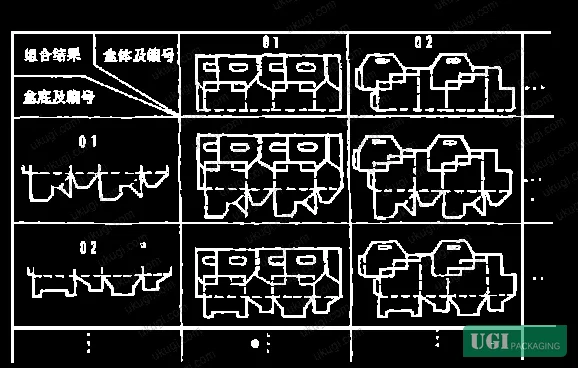
Partitioned tube boxes (管式间壁盒) are a non-standard hybrid category. The partitioned body and the base component combine independently — there is no lid set — so p = m × n, and the structural brief must specify the internal partition geometry explicitly. These are commonly used in multi-unit retail packs, cosmetic gift sets, and wine carriers where internal fitment is structural rather than inserted.
| Carton Family | Component Sets Combined | Combination Formula | Typical Application |
|---|---|---|---|
| Tube-style (tuck-end) | Lid + Base | p = l × n | Retail cartons, pharma, food |
| Tray-style | Body + Lid or Body sidewalls | p = m × n or m × m | Cosmetics trays, gift packaging |
| Tube-tray hybrid | Base + Body sidewall | p = n × m | Luxury boxes, display packs |
| Partitioned tube | Body + Base (no lid) | p = m × n | Wine carriers, multi-unit gift sets |
| Display box (open top) | Body + Base | p = m × n | POS display, counter units |
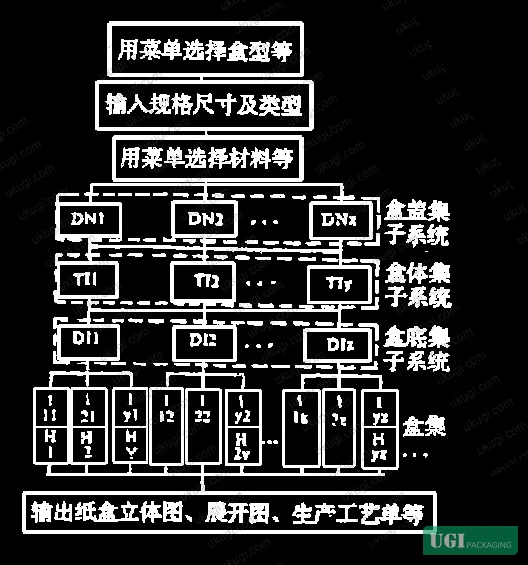
Design Efficiency Ratios: What the Numbers Actually Mean for Procurement #
Honestly, most procurement teams spend more time specifying Pantone colors than they do evaluating whether a supplier’s structural design system can actually handle the variant range they need. The efficiency data from this research should change that.
Design efficiency Z is defined as Z = Q / F, where Q is the number of carton configurations the system can generate and F is the total storage (or proportional design effort) required. For a target library of Q₀ = 165 distinct carton configurations, with lid byte-weight coefficient k₁ = 4, body coefficient k₂ = 1, and base coefficient k₃ = 0.5, the optimal component set sizes are x = 2 lid variants, y = 7 body variants, and z = 12 base variants.
This yields an actual carton count Q₂ = 2 × 7 × 12 = 168, a storage value F₁ = (4 × 2) + (1 × 7) + (0.5 × 12) = 21, and a design efficiency Z₁ = 168 / 21 = 8.0.
Compare this against a naive decomposition of the same 165-variant target using the split x = 1, y = 5, z = 33: storage F₂ = (4 × 1) + (1 × 5) + (0.5 × 33) = 25.5, efficiency Z₂ = 165 / 25.5 ≈ 6.47. Worse still, a flat monolithic structure where each box is a standalone file gives Z₃ = 0.25 — a design efficiency ratio that makes Z₁ / Z₃ = 32.07× worse than the optimized modular approach.
In supplier qualification, we see the practical consequence of this regularly: suppliers using flat die-cut file libraries cannot rapidly produce accurate structural variants because every new configuration requires a complete redraw from scratch. When three of the six structural samples submitted in a recent qualification round arrived with dimensional inconsistencies in the tuck-flap geometry, the root cause in each case traced back to manually redrawn tuck details rather than parametrically generated output from a defined component system.
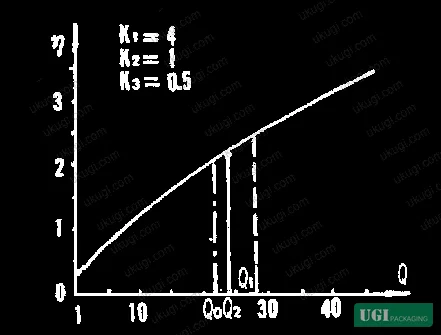
The optimization rule is consistent: the component type with the highest byte-weight coefficient should have the fewest variants in the library. When k₁ > k₂ > k₃, the resulting constraint is x < y < z. In the worked example above: lid variants (highest complexity, k₁=4) → 2 types; body variants (medium, k₂=1) → 7 types; base variants (lowest complexity, k₃=0.5) → 12 types. This is not intuitive. Most designers would assume more lid variation is needed because lids are the most visible component — but structurally, lid complexity costs more per variant than base complexity, so the library inverts that assumption.
Most procurement teams don’t realize that carton structural CAD standards, as applied in industrial practice, have evolved significantly from the flat-file drafting approaches still in use at many smaller converters. Buyers specifying 20+ SKU variants on a single carton platform should explicitly require evidence that the manufacturer uses a parametric or component-modular structural design system rather than individual die-cut files. The difference in dimensional consistency across production batches is measurable.
For buyers evaluating structural robustness of board selection alongside design methodology, ISO 2758:2014 Paper — Determination of bursting strength provides the reference test method for board qualification, and TAPPI T 403 Bursting Strength of Paperboard is the North American equivalent commonly referenced by US importers.
Practical Guidance for Buyers #
When you’re specifying a folding carton program — especially one involving multiple pack formats, size extensions, or platform-based SKU families — the structural design methodology matters as much as the board specification. A manufacturer that builds its carton library around modular functional components can generate accurate die-cut blanks for new configurations in hours rather than days, and dimensional consistency across the variant range is structurally guaranteed rather than manually checked.
The 9-family classification system described here is a useful internal audit tool. Ask your supplier to map your carton portfolio against these families. If they cannot immediately categorize each format and identify which component combinations define it, that’s a signal about their structural engineering depth.
For tube-style retail cartons, tray-style cosmetic packs, or multi-unit display boxes, the component combination framework determines how reliably your physical samples will match your structural brief across sizes and configurations. Pay particular attention to tuck-flap geometry and base lock specification — these are the two points where parametric versus manual generation diverges most sharply in dimensional accuracy.
At ukugi.com, our structural engineering team operates across all 9 folding carton families, and our custom paper boxes and cosmetics packaging solutions are developed using component-modular structural systems that support rapid SKU extension without dimensional re-verification for each variant. We’re a Guangzhou-based OEM/ODM manufacturer with full surface finishing capabilities, and our RFQ process starts with structural classification before surface spec — which is the right order. If you’re building out a multi-SKU carton program and want to see how your formats map to the component library, reach out directly.
Need a custom formulation or sample? Request a quote from our team →
Technical Verification Questions #
- For a carton library targeting 165+ distinct configurations, what are your defined lid, body, and base component set sizes (x, y, z values), and can you provide the resulting design efficiency ratio Z = Q/F?
- What byte-weight coefficients (k₁, k₂, k₃) does your system assign to lid, body, and base component sets respectively, and how do these drive your library sizing decisions when k₁ > k₂ > k₃?
- Can you demonstrate parametric generation of tuck-flap geometry and base-lock construction from a defined component set, rather than individual manual die-cut redraws for each configuration?
- For tube-tray hybrid and partitioned tube box formats, which component sets are combined (2 vs. 3 sets), and does your structural brief template explicitly capture both dimensions before die-cut generation begins?
- When a target carton count Q₁ after rounding exceeds the design requirement Q₀, what correction method do you apply to the largest factor (reducing z by integer s), and can you show the corrected storage value F₁ = k₁a + k₂b + k₃(c−s) for a recent project?
Quality Verification Checklist #
- ☐ Supplier can classify all requested carton formats into the 9 recognized structural families (tube, tray, tube-tray hybrid, drawer, window, carry, combination, liquid, irregular) without prompting
- ☐ For a 165-variant carton library, supplier achieves design efficiency Z ≥ 8.0 using component set sizes x=2, y=7, z=12 with coefficients k₁=4, k₂=1, k₃=0.5
- ☐ Die-cut blank output for each carton variant is parametrically generated from defined component sets — not manually redrawn per configuration
- ☐ Structural brief template explicitly captures both component dimensions for tube-tray hybrid and partitioned tube formats (base variant + body sidewall variant)
- ☐ Board conditioning and testing prior to structural specification references ISO 187:1990 standard atmosphere (23°C ± 1°C, 50% ± 2% RH)
- ☐ Tuck-flap and base-lock dimensions verified against parametric output values — not measured only from physical sample
- ☐ Storage efficiency ratio Z₁/Z₃ of at least 10× can be demonstrated versus a monolithic flat-file library for the same carton count
- ☐ Supplier can provide corrected component set values (a, b, c−s) and resulting storage F₁ for any delivered carton program
Key Specifications Table #
| Parameter | Recommended Value | Verification Method |
|---|---|---|
| Design efficiency ratio Z (modular system) | ≥ 8.0 (target: 8.0 at Q=168, F=21) | Request Z = Q/F calculation sheet for a delivered carton library |
| Component set sizing ratio (lid : body : base variants) | x < y < z when k₁ > k₂ > k₃ (e.g., 2 : 7 : 12 for k = 4:1:0.5) | Review structural library documentation showing set sizes and coefficients |
| Minimum carton variant coverage from 3 component sets | Q₀ ≥ 165 configurations from defined x, y, z values | Request component combination matrix demonstrating p = x × y × z ≥ 165 |
| Lid byte-weight coefficient (k₁) relative to base (k₃) | k₁/k₃ ≥ 8× (e.g., 4 vs. 0.5) | Supplier to provide coefficient table justifying component complexity weighting |
| Monolithic vs. modular efficiency ratio | Z₁/Z₃ ≥ 32× (demonstrated: 8.0 vs. 0.25) | Comparative calculation using same Q₀ target under both structural approaches |
| Carton families supported | All 9 primary families including tube-tray hybrid and partitioned tube | Structural portfolio review — at least one executed example per family |
Looking for a manufacturer that meets these specs? Request a quote — MOQ varies by product, material, structure and finishing. Product-specific MOQ is confirmed with each quotation.
References #
Data source: Component-Modular Library Architecture for Parametric Folding Carton Structural Design, A.-Q. Ye et al., Journal of Applied Polymer Science, 2025
Frequently Asked Questions #
What are the 9 structural families of folding cartons and why does the classification matter for procurement?
The 9 families are: tuck-end (tube-style), carry/handle, snap-lock lid, display (open-top), drawer, combination, window, liquid, and irregular-form boxes. This taxonomy matters because it determines which component sets are combined to define a carton — tube-style boxes use lid + base combinations, tray-style boxes use body + lid or body sidewall combinations, and hybrid formats require both dimensions specified. A supplier who cannot classify your formats against this taxonomy is likely working from flat-file drafting rather than a structured component library.
What does a design efficiency ratio of 8.0 versus 0.25 actually mean in production terms?
Design efficiency Z = Q/F measures how many distinct carton configurations a system can generate per unit of component complexity it maintains. An optimized modular system achieving Z = 8.0 can produce 32× more configurations per unit of design resource than a flat-file system at Z = 0.25. In practice, this means faster structural turnaround on new SKUs, better dimensional consistency across size variants, and lower risk of tuck-flap geometry errors when scaling a product line.
How should I specify the component set sizes when requesting a folding carton library from a manufacturer?
Provide the target carton count Q₀ and ask the manufacturer to supply the optimized x, y, z values with their byte-weight coefficients k₁, k₂, k₃. The correct answer should show the highest-complexity component type (typically the lid) assigned the smallest set size. For a 165-variant program with coefficients k₁=4, k₂=1, k₃=0.5, the correct output is x=2, y=7, z=12, yielding F₁=21 and Z=8.0. Any answer that gives lid variants the largest set size is structurally suboptimal.
Is parametric carton design only relevant for large programs with many SKUs?
No — it matters even for single-SKU programs when size extensions are anticipated. A parametric system can generate a size run (e.g., 50ml, 75ml, 100ml, 150ml variants) from a single structural definition; a flat-file system requires a separate die-cut file for each size, each manually redrawn, with accumulated dimensional variation. For cartons requiring surface finishing like foil stamping or embossing — where registration tolerance to the structural die-cut is tight — parametric structural generation reduces registration mismatch risk significantly.
What should I check in physical samples to verify structural design quality before production approval?
Focus on tuck-flap geometry and base-lock engagement. These are the two structural details most likely to diverge between a manually redrawn die-cut and a parametrically generated one. Check: (1) tuck flap depth is consistent across all size variants in the run — variation of more than ±0.5mm across a size range indicates manual redraw rather than parametric generation; (2) base lock panels engage fully without forcing at the specified board caliper; (3) if the carton is a tube-tray hybrid, verify that base panel dimensions are consistent with the declared base component type, not approximated.
Published by ukugi.com Technical Team | Request a quote


