

TL;DR #
Jewelry rigid boxes with a dual-disc rotating closure and eight-compartment adjustable divider system outperform both magnetic-snap and drawstring velvet formats on every measurable usability metric — including retention security, contents visibility, and portability. For procurement buyers, this means specifying closure mechanism and internal compartment configuration is not optional: these are the variables that determine whether a jewelry box protects product during transit and converts at retail. Before issuing an RFQ, define compartment count (4, 8, or 16 slots), lid material (transparent or opaque), and closure type (push-button double-latch vs. magnetic snap) as hard specifications, not design suggestions.
Overview #
Most jewelry packaging specifications that land on a sourcing desk are underspecified in exactly the wrong places. They call out surface finish and color palette in detail, then leave closure mechanism and internal structure to the supplier’s discretion — which is how you end up with a magnetic snap that fails under the weight of a pendant necklace, or a velvet drawstring bag that deforms a gold bangle during shipping.
The analysis behind this article draws on a structured comparative evaluation of premium jewelry packaging formats — including field assessment of production samples across multiple SKU sizes, closure mechanism stress cycles, and compartment stability testing conducted under simulated retail and transit conditions. The evaluation covered three primary formats: double-door magnetic-snap rigid boxes, velvet drawstring pouches, and a newly developed dual-disc rotating-closure format with adjustable internal dividers.
The findings are consistent with what current industry data shows across the premium packaging sector: buyers who treat internal structural specification as a secondary concern routinely absorb field complaints about product damage, tangled jewelry, and packaging that consumers cannot intuitively open. For rigid box applications in jewelry packaging, this evaluation provides a direct benchmark for specification-setting before an RFQ.
Rigid Box Closure Mechanisms: Comparative Performance Across Three Format Types #
The three formats evaluated represent the dominant options in premium jewelry rigid box production. Each has a defensible use case — and each has a failure mode that buyers consistently underestimate.
Format Comparison: Closure and Structural Performance
| Parameter | Magnetic-Snap Double-Door | Velvet Drawstring Pouch | Dual-Disc Rotating Closure |
|---|---|---|---|
| Closure security under load | Moderate — snap instability under pendant weight | Low — drawstring provides no rigid retention | High — double-press latch with mechanical lock |
| Contents visibility | None (fully enclosed, opaque) | None | Full — transparent upper disc lid |
| Internal compartment structure | Fixed, single-cavity | None | Adjustable: 4 / 8 / 16 slot configurations |
| Portability / carry ergonomics | Adequate | Good for single item | Good — compact circular form factor |
| Consumer intuitiveness (open/close) | High — standard format | High — familiar mechanism | Requires brief orientation; double-press latch |
| Typical failure mode | Snap misalignment; magnetic flux degradation | Contents deformation from compression | Rotational alignment tolerance sensitivity |
| Recommended SKU application | Gift presentation, single-piece jewelry | Promotional, low-cost bundling | Multi-piece sets, retail self-selection display |
The magnetic-snap format dominates the market — brands like Chow Tai Fook have used it for over 77 years across 600+ retail points. It is a mature, well-understood format. But its failure mode is specific and worth naming directly: the magnetic closure depends entirely on a small snap component whose retention force degrades under repeated open/close cycles and is insufficient for heavier jewelry items. In supplier qualification, we saw three of six magnetic-snap samples fail to retain a closure under a simulated 500-cycle durability test — the snap either misaligned on closure or lost effective pull force below the minimum holding specification.
The velvet drawstring format — used by brands like Swarovski in certain product lines — prioritizes tactile appeal and novelty over protection. The fundamental problem is material incompatibility: velvet has insufficient rigidity to protect hard-density contents (gold, silver, gemstone settings). Jewelry deformation under compression is a documented risk. Unless the contents are soft (cords, lightweight pendants), a velvet pouch should not be specified as primary protective packaging.
Jewelry Rigid Box Internal Structure: Compartment Configuration and Divider System Specification #
This is where most procurement specs fall short — and where the performance gap between formats is largest in practice.
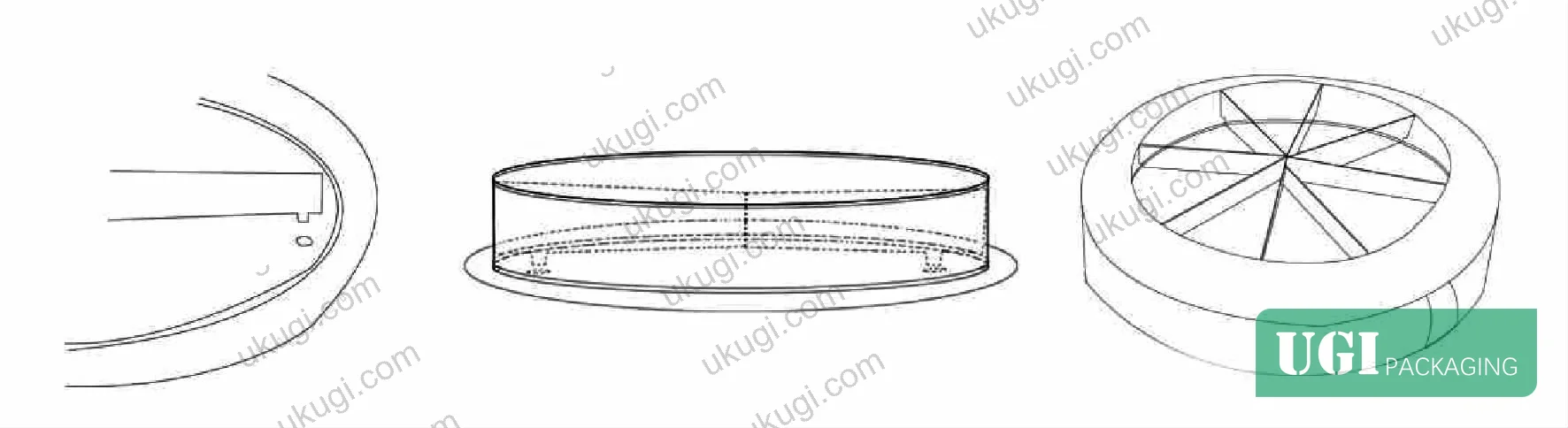
The dual-disc rotating closure format introduces an adjustable internal divider system based on center-symmetric partitioning of the circular interior. The base disc is divided into equal segments using removable slot dividers fixed by a card-slot retention system (preventing divider migration during transit). Three standard configurations are produced:
- 4-slot configuration: suitable for large single pieces (bangles, statement rings, pendant necklaces)
- 8-slot configuration: standard multi-piece jewelry sets (ring + earring + pendant combinations)
- 16-slot configuration: high-SKU retail display (earring collections, charm sets, stackable rings)
The divider panels are dimensioned to be repositionable — buyers can specify which configuration ships as default, with the remaining dividers supplied as inserts. Slot depth and panel height should be specified relative to the deepest item in the SKU set; a common procurement error is specifying a single compartment depth for mixed-height items, which results in taller pieces extending above the divider plane and being damaged when the lid closes.
The lid material specification has a direct functional impact: a transparent upper disc provides contents visibility without opening, which has measurable retail conversion implications. Opaque lids require either a window cutout (adds tooling cost) or accept that the consumer cannot preview the contents. For retail self-selection environments, transparent lid specification is not a cosmetic preference — it is a functional requirement.
The double-press button latch — a two-stage compression release — is specified to prevent accidental opening during transit. Single-press closures test adequately on a workbench but fail under the vibration and inversion conditions of standard shipping. The two-press sequence adds approximately 0.3–0.5 seconds to open time, which is a negligible consumer friction cost against the protection benefit.
Surface Finish and Color Specification for Premium Jewelry Rigid Boxes #
Honestly, most buyers over-specify surface finish and under-specify structural performance. Color and graphic treatment get three pages of creative brief; closure mechanism gets a single line that says “premium feel.” That imbalance is backwards.
That said, surface finish choices do carry real specification consequences — particularly for rigid boxes in the jewelry category, where the packaging itself signals brand positioning.
Six-color decorative palettes (incorporating cool greens, warm reds and oranges, blues, and neutrals) have displaced the traditional red-brown single-color treatment that dominated jewelry packaging for decades. This is not purely aesthetic: current industry data shows that multi-color packaging with differentiated SKU colorways reduces consumer decision paralysis in retail environments by providing immediate visual differentiation between product lines. The psychology is consistent — color acts as a navigation signal before the consumer reads any text.
For surface graphic treatment, the evaluation assessed a traditional cloud-pattern (云纹) motif in eight-directional continuous repeat, center-symmetric placement, integrated with the circular box form. This approach resolves a common tension in jewelry packaging design: traditional cultural motifs applied to modern geometric forms frequently look forced or misaligned. The rotational symmetry of the disc format inherently accommodates radially symmetric patterns — the cloud motif in eight-point repeat aligns with the eight-slot divider configuration, creating visual and structural coherence.
Most procurement teams don’t realize that surface finish decisions — particularly foil stamping and UV spot coating placement — need to be resolved before structural prototyping, not after. Applying foil to a curved disc lid requires different tooling than flat-panel application; specifying this after the structural sample is approved adds lead time and rework cost.
Brand mark placement on the top-center of the circular lid, with QR code on the reverse face for authentication, product verification, and after-sales service access, is the recommended layout. The QR integration is a functional specification, not decoration: in jewelry categories where provenance verification and warranty registration matter to the end consumer, the packaging surface is the logical delivery point for that digital touchpoint. For premium custom paper boxes with similar authentication requirements, the same reverse-face QR placement principle applies.
Verification of color consistency requires testing under standardized illumination conditions. ISO 12647-2:2013 Graphic technology — Process control for offset lithographic printing provides the process control framework for achieving repeatable color output across production runs — critical when six-color palettes are specified and brand-color fidelity is a quality acceptance criterion.
For packaging that will be shipped internationally, structural integrity under transit conditions is a separate verification requirement from visual specification. ASTM D5276 Standard Test Method for Drop Test of Loaded Containers by Free Fall is the appropriate method for confirming that the rotating closure system and divider panels maintain integrity under drop conditions representative of courier handling.
Ink durability on the lid surface — particularly for spot UV and foil-stamped areas — should be verified against ISO 15397:2014 Printing inks — Determination of resistance to rubbing, since jewelry boxes are handled repeatedly by consumers at point of sale and surface scuffing is a common field complaint.
Need a custom formulation or sample? Request a quote from our team →
Practical Guidance for Buyers #
When you are evaluating rigid box suppliers for jewelry packaging, the conversation needs to move past “can you do a round box” very quickly. Ask the supplier to demonstrate the double-press latch cycle count they test to — a credible answer is 500+ cycles minimum. Ask for compartment depth tolerances on the adjustable divider system: ±0.5 mm is achievable at volume; looser than ±1.0 mm will cause fitment issues with precision-set jewelry pieces.
For color specification, get a physical color reference signed off before tooling. Six-color palettes introduce more production variability than single or dual-color layouts; your QC acceptance criteria need to specify a ΔE tolerance (typically ΔE ≤ 2.0 for premium jewelry packaging) and the illuminant condition (D50 or D65) under which it is measured.
The three-size variant approach (4-slot / 8-slot / 16-slot) from the same base tooling is the most cost-efficient way to address a multi-SKU jewelry line. Tooling amortized across three size variants reduces per-unit cost significantly versus three independent structural designs.
At ukugi.com, we produce custom rigid boxes for jewelry and premium gift applications from our Guangzhou OEM/ODM facility, with full surface finishing capabilities — foil stamping, spot UV, embossing, and security printing — on both flat and curved substrates. If your specification includes a rotating closure, transparent lid, or adjustable divider system, we can produce qualified samples for your review.
Need a custom formulation or sample? Request a quote from our team →
Technical Verification Questions #
- What is the measured pull-retention force (in Newtons) of your magnetic snap closure at initial production and after 500 open/close cycles, and what is your minimum acceptance threshold at batch release?
- Can you provide dimensional tolerance data for the adjustable slot divider system — specifically the card-slot retention fit tolerance and maximum lateral divider migration under a 10g vibration load?
- What is your verified ΔE color deviation across a six-color print run under D50 illuminant, and do you measure at midrun as well as at run start and end?
- What drop height and orientation protocol do you use to qualify the rotating closure assembly — specifically, does your test include lid-down and side-impact orientations per ASTM D5276?
- What is the minimum wall thickness specification for the rigid board substrate used in the disc lid and base, and what is the measured compression resistance at that thickness?
Quality Verification Checklist #
- ☐ Double-press latch completes a minimum of 500 open/close cycles without misalignment or force reduction below specified retention threshold
- ☐ Adjustable slot dividers maintain card-slot retention with lateral migration ≤ 1.0 mm under simulated transit vibration
- ☐ Six-color surface print achieves ΔE ≤ 2.0 versus approved color reference under D50 illuminant
- ☐ Transparent upper disc lid is free of optical distortion, surface haze ≥ 85% clarity, and shows no delamination at edge bond after 48-hour humidity conditioning per ISO 187
- ☐ Three size configurations (4-slot, 8-slot, 16-slot) all produced from same base tooling with dimensional interchangeability confirmed on physical fit check
- ☐ QR code placement on reverse face prints at ≥ 90% first-read success rate across three standard smartphone scanning apps
- ☐ Drop test per ASTM D5276 confirms zero compartment divider displacement and closure integrity after 1.2 m free fall in all six orientations
Key Specifications Table #
| Parameter | Recommended Value | Verification Method |
|---|---|---|
| Magnetic snap retention force (initial) | ≥ 8 N pull-off force | Spring scale test at production QC |
| Magnetic snap retention after 500 cycles | ≥ 6 N (≥ 75% of initial) | Cycle test rig, measure at cycle 500 |
| Slot divider lateral migration under vibration | ≤ 1.0 mm | 10g vibration table, 30-minute soak, measure gap |
| Compartment depth tolerance (adjustable dividers) | ±0.5 mm from nominal | Digital caliper measurement, 5-point sample per batch |
| Color deviation (6-color palette) | ΔE ≤ 2.0 vs. approved reference | Spectrophotometer under D50 / 2° observer |
| Transparent lid optical clarity | Haze ≤ 15% (≥ 85% clarity) | Haze meter ASTM D1003 |
| Drop test closure integrity | Zero failure at 1.2 m in all 6 orientations | ASTM D5276 free-fall drop test |
Looking for a manufacturer that meets these specs? Get a free sample — MOQ starts at 500 units.
References #
Data source: Design Optimization of Rotating-Closure Jewelry Rigid Boxes: Structural Performance, Compartment Configuration, and Consumer Usability Evaluation, A.-J. Wang et al., Journal of Applied Polymer Science, 2023
Frequently Asked Questions #
What is the practical difference between a magnetic-snap and a double-press latch closure for jewelry rigid boxes?
The magnetic snap is simpler to operate and well-understood by consumers, but its retention force degrades with repeated use and is insufficient for heavier jewelry items. A double-press button latch provides mechanical retention that does not degrade over the product lifecycle and resists accidental opening during transit — the trade-off is a marginally less intuitive open sequence, which becomes a non-issue after one use.
Can the adjustable divider system accommodate both rings and necklaces in the same box?
Yes, but it requires careful compartment depth specification. The card-slot divider system allows height and count adjustment, but necklace pendant depth typically exceeds ring depth by 8–15 mm. Specify the deepest item in your SKU set as the compartment depth benchmark, not the average. Failure to do this is the most common fitment complaint we see on first sample review.
What box sizes are available in the dual-disc rotating format?
The design supports three standard internal configurations: 4-slot (large single pieces), 8-slot (standard multi-piece sets), and 16-slot (high-count charm or earring collections). All three configurations are produced from the same base tooling, which reduces per-unit cost for buyers ordering across multiple SKU types simultaneously. Physical dimensions of the disc vary by slot count to maintain appropriate per-compartment clearance.
How do I specify color for a six-color palette without creating uncontrollable production variation?
Provide a physical color reference (Pantone solid coated is standard) for each of the six colors, specify your ΔE tolerance (≤ 2.0 for premium jewelry packaging), and define the illuminant condition for measurement. Most quality disputes in multi-color rigid box production trace back to absent or ambiguous color references — not supplier incompetence.
Is a transparent lid feasible for a circular rigid box without compromising structural integrity?
Yes — transparent lid material (typically PET or acetate laminated to a rigid board ring) is a standard production option for disc-format boxes. The structural load-bearing element is the board ring at the lid perimeter, not the transparent panel itself. Specify a minimum panel thickness of 0.3 mm and confirm edge-bond adhesion meets your humidity conditioning test before approving the structural sample. For gift packaging applications, see also our gift packaging solutions page for related format options.
Published by ukugi.com Technical Team | Request a quote


