

TL;DR #
Paperboard substrates exhibit measurable odour similarity to hexanal (48%) and benzaldehyde (36%) — two volatile compounds with olfactory thresholds low enough to affect sensitive food products at trace concentrations. For buyers sourcing paper packaging for chocolate, confectionery, or any flavour-sensitive application, this means odour migration is not a theoretical concern but a quantifiable, testable failure mode. Before approving any paperboard substrate for food-contact use, require GC–MS quantification of hexanal and benzaldehyde migration, with acceptance thresholds verified against baseline chocolate content (39.2 mg/kg hexanal, 0.6 mg/kg benzaldehyde).
Overview #
Most buyers treat paperboard odour as a subjective complaint — something that shows up in a customer review, not a supplier audit. That framing is a mistake. Controlled evaluation work conducted at a university packaging engineering institute, testing six commercially sourced paperboard grades across a 14-person sensory panel combined with GC–MS quantification, shows that odour migration from paper packaging into flavour-sensitive food is both detectable and measurable at concentration levels just above the baseline content found in untreated chocolate.
The study design is worth understanding because it reflects real procurement risk. Six paperboard samples were tested — a mix of food-contact and non-food-grade grades, sourced from China, the United States, and Sweden, covering CTMP (chemical thermomechanical pulp), SBS (solid bleached sulfate), and C2S (coated two-side) board types, all at approximately 300 g/m². Evaluators conducted odour similarity scoring against hexanal and benzaldehyde reference standards, followed by the Robinson Test — the standard sensory protocol for assessing packaging material impact on food flavour — at three odour simulant concentrations: 0.05%, 1%, and 10% (v/v). GC–MS analysis with ultrasound-assisted ethanol extraction then quantified actual compound migration into chocolate samples.
This kind of dual-method validation — sensory panel cross-checked against instrumental analysis — is exactly what you want to see before signing off on a paper substrate for a food-sensitive SKU. It gives you both the human perception signal and the hard chemistry to back it up.
For buyers evaluating board grades for applications like cosmetics packaging solutions or flavour-sensitive food gift sets, the substrate odour profile is a specification variable, not an afterthought.
Paperboard Odour Migration into Food Packaging: What GC–MS Data Actually Shows #
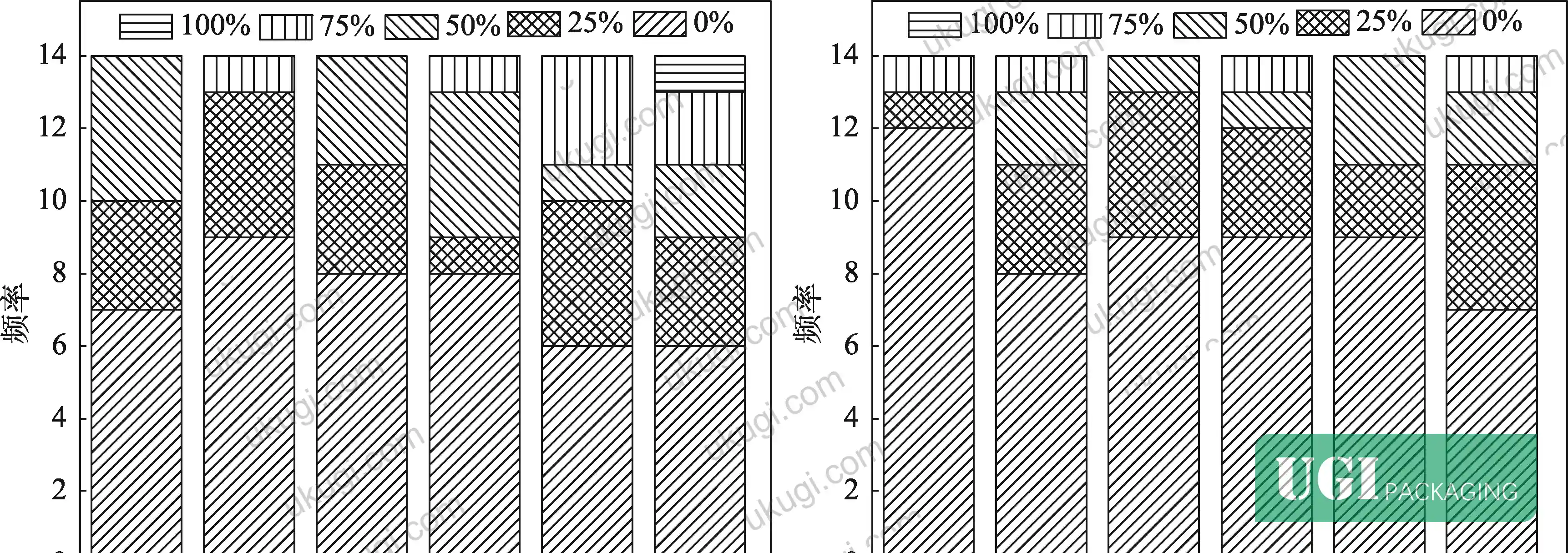
The sensory scoring results are direct: across 14 evaluators, paperboard samples showed odour similarity to hexanal of 48% and to benzaldehyde of 36%. These aren’t alarming numbers on their own — roughly half the panel found the hexanal comparison meaningful, while about a third found the benzaldehyde comparison credible. What makes this significant is the low olfactory threshold of both compounds. Hexanal presents as a sharp grassy note; benzaldehyde at low concentrations carries an almond character that is detectable well below concentrations most buyers would consider “contamination.”

The six board grades break down by pulp type and origin as follows:
| Sample | Grade / Pulp Type | Basis Weight (g/m²) | Food-Contact Rated? |
|---|---|---|---|
| S1 | CTMP | 300 | Yes (China) |
| S2 | CTMP | 300 | No (China) |
| S3 | SBS (Solid Bleached Sulfate) | 296 | Yes (USA) |
| S4 | CTMP | 300 | No (China) |
| S5 | C2S (Coated Two-Side) | 300 | Yes (Sweden) |
| S6 | CTMP | 300 | No (China) |
The important observation here is that food-contact certification does not automatically correlate with lower odour contribution. The data does not show a clean split between food-grade and non-food-grade boards on odour similarity scores — which is the finding that should concern procurement teams most. Food-contact compliance addresses regulatory migration limits, not sensory thresholds, and those two things are not the same specification.
Most procurement teams don’t realize that food-contact certification frameworks — including EU Regulation No 10/2011 on plastic materials and articles intended to contact food and equivalent paper-specific guidance — were developed primarily around chemical safety migration limits, not organoleptic performance. A substrate can pass regulatory compliance testing and still produce a detectable flavour change in your product. For chocolate and confectionery specifically, that gap in the standards is where most quality failures originate.
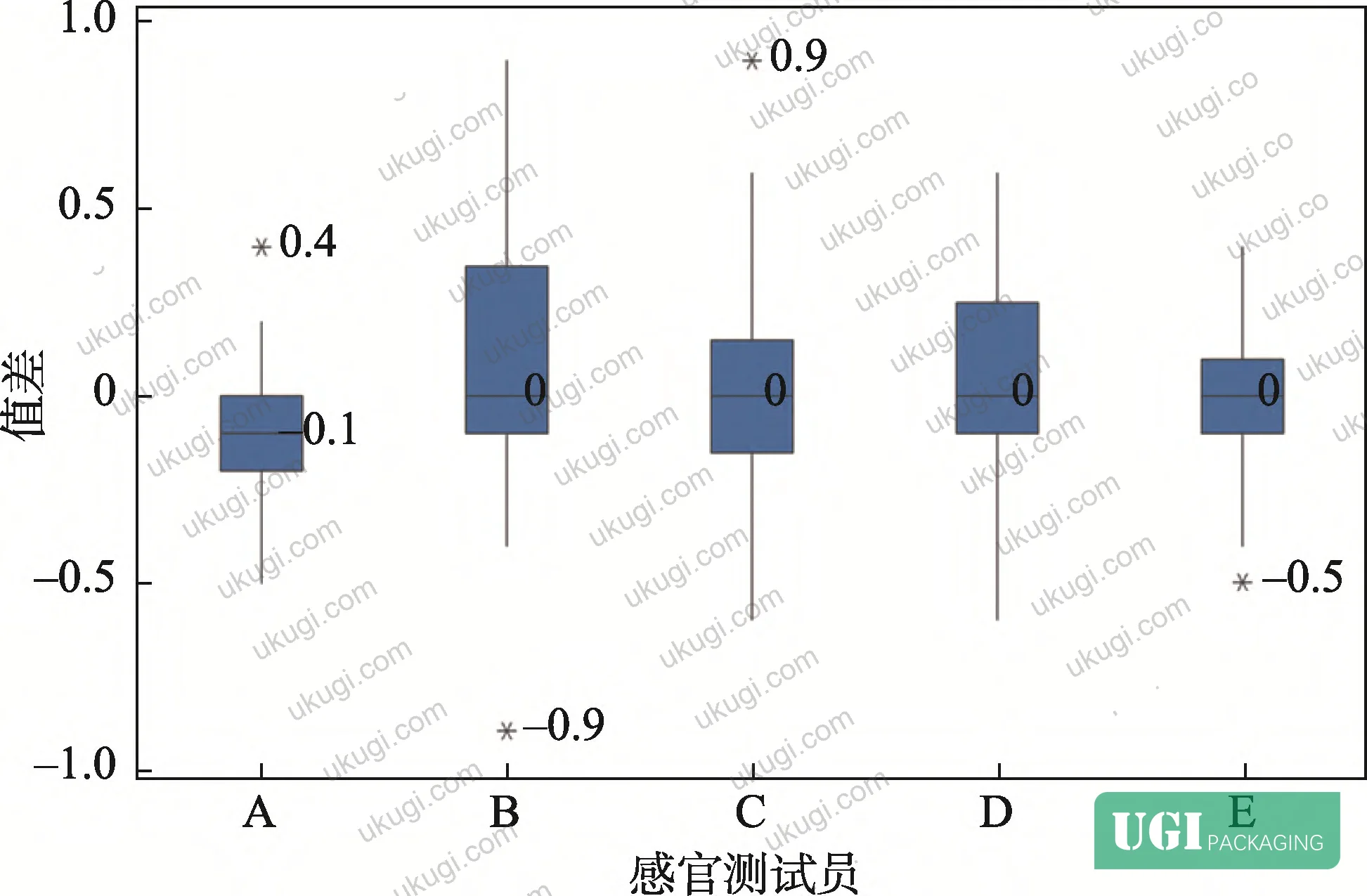
After the Robinson Test exposures at all three concentrations, the five trained sensory evaluators returned tasting scores predominantly between 0.5 and 1.0 on a 0–4 scale — meaning panellists could detect an abnormal flavour but could not precisely identify it. No panellist scored above 1.0 for hexanal at any concentration. Benzaldehyde at 1% produced a single score of 1.0 from one evaluator; all other scores across both compounds and all three concentrations remained at 0.5. The consistency across the 0.05%, 1%, and 10% concentration range is notable — it suggests that even at very low exposure, the sensory signal is already present, and increasing concentration does not dramatically amplify the perceived impact. This implies a threshold effect rather than a dose-response relationship, which has practical implications for how you set your acceptance criteria.
GC–MS Quantification: Validated Migration Data for Procurement Specifications #
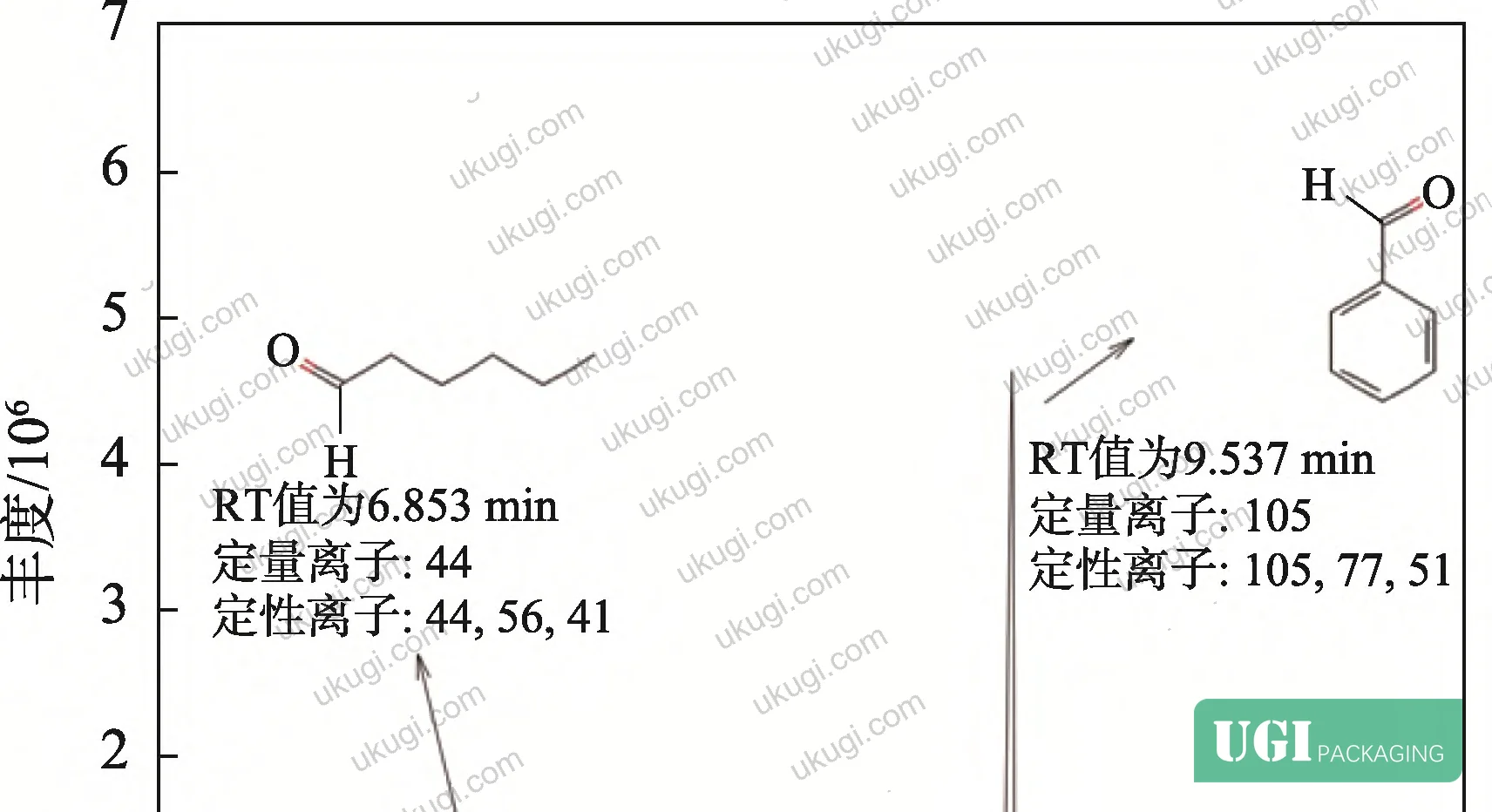
The GC–MS analysis used an Agilent 7890A–5975C instrument with a DB-3MS column (30 m × 0.25 mm × 0.25 μm), running in Selected Ion Monitoring (SIM) mode. Hexanal eluted at 6.853 min; benzaldehyde at 9.537 min. The two compounds showed no co-elution interference in SIM mode, which is the minimum acceptable condition for reliable quantification in this type of migration study.

Linear calibration was established across two separate ranges to avoid quantification errors from wide-range extrapolation:
- Hexanal: linear range 0.8–40 mg/L, R² = 0.9984
- Benzaldehyde: linear range 0.005–0.1 mg/L, R² = 0.9978
Detection limits were established at S/N = 3, and quantification limits at S/N = 10:
- Hexanal LOD: 0.06 μg/L; LOQ: 0.19 μg/L
- Benzaldehyde LOD: 0.04 μg/L; LOQ: 0.13 μg/L
Spike-and-recovery validation across three concentration levels (n = 3 each) returned results of 78–96% recovery for both compounds, with RSD values within 2–8%. That performance meets standard method validation criteria and confirms the data is analytically reliable.
The quantification results from Robinson Test samples are the most procurement-relevant numbers in the entire dataset. Untreated (blank) chocolate baseline content measured at 39.2 mg/kg for hexanal and 0.6 mg/kg for benzaldehyde — confirming that both compounds exist naturally in the product matrix at measurable levels. After Robinson Test exposure across all three simulant concentrations, hexanal content in exposed samples remained below 45.0 mg/kg, and benzaldehyde stayed below 1.0 mg/kg. The incremental migration above baseline — roughly 5.8 mg/kg for hexanal and 0.4 mg/kg for benzaldehyde at maximum — is the actual migration contribution from paper contact.
Honestly, most buyers over-specify odour requirements using vague language like “no off-odour” without ever defining what that means analytically. The numbers above give you a defensible quantitative basis: if a paperboard substrate drives hexanal content in your product above 45.0 mg/kg or benzaldehyde above 1.0 mg/kg under Robinson Test conditions, that substrate fails your incoming material specification regardless of what the supplier’s certificate says.
In our supplier qualification work, we’ve seen this pattern repeatedly: a board grade arrives with full food-contact documentation, passes visual and dimensional checks, but introduces a detectable grassy or almond note into the packaged product within weeks of filling. The cause, when traced via GC–MS, is almost always hexanal or benzaldehyde migration from the fiber matrix — not from inks or coatings as buyers typically assume.
For applications requiring verifiable barrier performance, ASTM D3985 Oxygen Gas Transmission Rate Through Plastic Film and Sheeting provides a complementary testing framework that can be adapted when evaluating coated paperboards where barrier layers are intended to limit volatile transmission.
The ISO 22000:2018 Food safety management systems for food packaging framework is also directly relevant here — it requires systematic identification of hazards including chemical migration, which under a rigorous implementation would capture odour-active volatile migration as a control point.
Practical Guidance for Buyers #
If you’re sourcing paperboard for any flavour-sensitive food application — chocolate, confectionery, coffee, tea, baked goods — the substrate odour specification needs to be a hard technical requirement, not a soft preference. The data is clear: paperboard exhibits measurable hexanal and benzaldehyde character, and those compounds will migrate into your product at concentrations detectable by trained panellists even at the lowest exposure concentrations tested.
The most actionable step is to require Robinson Test data alongside standard food-contact compliance documentation. Ask for GC–MS quantification of hexanal and benzaldehyde in the exposed product matrix, not just in headspace or material extracts. The numbers you need to benchmark against are 39.2 mg/kg (hexanal baseline in chocolate) and 0.6 mg/kg (benzaldehyde baseline) — any substrate that pushes those values significantly higher under Robinson Test conditions is a risk to your product quality.
Board selection also matters. CTMP grades consistently show higher volatile content than SBS or C2S boards due to residual lignin-derived oxidation products in the fiber. If you’re working with a specification-critical product, SBS or high-quality C2S board is the technically defensible choice, and that selection should be written into your material specification, not left to supplier discretion.
Our team at ukugi.com — a Guangzhou-based OEM/ODM manufacturer producing custom paper boxes, folding cartons, and premium gift packaging for international brand owners — evaluates substrate odour performance as part of our material qualification process. We can guide substrate selection based on application requirements and food-contact compliance needs, including custom formulations for sensitive product categories. Buyers evaluating substrates for custom paper boxes or gift packaging solutions can request technical samples with full substrate traceability.
Need a custom formulation or sample? Request a quote from our team →
Technical Verification Questions #
- Can you provide GC–MS quantification data for hexanal and benzaldehyde in your paperboard grade, with detected levels in the final substrate below the migration threshold that would push exposed chocolate content above 45.0 mg/kg hexanal or 1.0 mg/kg benzaldehyde under Robinson Test conditions?
- What pulp type is used in this board grade — CTMP, SBS, or C2S — and do you have comparative odour similarity data showing sensory panel scores below 50% similarity to hexanal or benzaldehyde reference standards?
- Can you confirm that Robinson Test validation was conducted at a minimum of three simulant concentrations (including 0.05% and 10% v/v), with trained sensory panellist tasting scores documented on a 0–4 scale with 0.5-point resolution?
- What are the spike-and-recovery rates for your GC–MS hexanal and benzaldehyde quantification method, and can you confirm results fall within 78–96% recovery range with RSD values ≤8% (n=3)?
- What is the LOQ for hexanal and benzaldehyde in your analytical method — specifically, can you confirm detection at 0.06 μg/L (hexanal) and 0.04 μg/L (benzaldehyde) using SIM-mode GC–MS with a minimum R² of 0.997 for both calibration curves?
Quality Verification Checklist #
- ☐ Paperboard substrate has documented GC–MS analysis confirming hexanal content migration does not increase exposed product hexanal above 45.0 mg/kg under Robinson Test conditions
- ☐ Benzaldehyde migration confirmed to keep exposed product below 1.0 mg/kg — compared to baseline 0.6 mg/kg in untreated chocolate
- ☐ Sensory odour similarity score for hexanal does not exceed 50% similarity rating across panel evaluation (study baseline: 48% mean similarity)
- ☐ Robinson Test conducted at 23–25 °C, 75% relative humidity, 48-hour exposure, with 15 g test product and 1 dm² substrate at 3 cm separation — per standard Robinson Test protocol
- ☐ GC–MS method validated with spike-and-recovery in range 78–96%, RSD ≤8%, n=3 replicates
- ☐ Calibration R² ≥ 0.997 for both hexanal (range 0.8–40 mg/L) and benzaldehyde (range 0.005–0.1 mg/L)
- ☐ Board grade identified as SBS or C2S type for maximum-sensitivity applications (CTMP grades flagged for additional odour qualification)
- ☐ Food-contact compliance documentation covers sensory/organoleptic performance requirements, not only chemical migration limits per regulatory frameworks
Key Specifications Table #
| Parameter | Recommended Value | Verification Method |
|---|---|---|
| Hexanal migration (post-Robinson Test) | < 45.0 mg/kg in exposed product | GC–MS SIM mode, DB-3MS column, ethanol extraction, calibration R² ≥ 0.9984 |
| Benzaldehyde migration (post-Robinson Test) | < 1.0 mg/kg in exposed product | GC–MS SIM mode, elution at 9.537 min, calibration range 0.005–0.1 mg/L |
| Hexanal odour similarity score | < 50% mean panel similarity | 14-evaluator sensory panel, 0/25/50/75/100% scoring scale vs. reference standard |
| Benzaldehyde odour similarity score | < 40% mean panel similarity | 14-evaluator sensory panel, 0/25/50/75/100% scoring scale vs. reference standard |
| Robinson Test tasting score | ≤ 0.5 (perceptible but unidentifiable) | Trained 5-person sensory panel, 0–4 scale, 0.5-point resolution, 48h at 23–25 °C |
| GC–MS method recovery rate | 78–96% | Spike-and-recovery at 3 concentrations, n=3 replicates, RSD ≤ 8% |
| Board basis weight (food-contact grades) | 296–300 g/m² | Gravimetric measurement per ISO 536 |
Looking for a manufacturer that meets these specs? Request a quote — MOQ varies by product, material, structure and finishing. Product-specific MOQ is confirmed with each quotation.
References #
Data source: Volatile Odour Compound Migration from Paperboard Packaging and Its Effect on Chocolate Flavour: A GC–MS and Sensory Evaluation Study, Z. Han et al., Food Packaging and Shelf Life, 2025
Frequently Asked Questions #
What is the Robinson Test and why does it matter for paperboard packaging?
The Robinson Test is a standardized sensory evaluation method for assessing whether chemical compounds from a packaging material can alter the flavour of a food product in contact with it. In this context, 15 g of chocolate is placed in a sealed glass vessel alongside a 1 dm² piece of test substrate or odour-impregnated filter paper, maintained at 23–25 °C and 75% relative humidity for 48 hours, then evaluated by trained tasters on a 0–4 scale. It matters because it simulates real-world packaging contact conditions and produces a human perception result that correlates with GC–MS quantification data.
Why do CTMP boards typically show higher odour contribution than SBS or C2S grades?
CTMP (chemical thermomechanical pulp) retains more residual lignin than fully bleached SBS (solid bleached sulfate) or coated C2S grades. Lignin oxidation during storage and converting generates aldehydes — including hexanal — as degradation byproducts. SBS and C2S boards undergo more aggressive bleaching and calendering processes that reduce these volatile precursors. Honestly, most buyers don’t specify pulp type in their board standards, and that omission is exactly where odour complaints start.
Can a paperboard be food-contact compliant and still cause flavour off-notes?
Yes, and this is one of the more persistent misunderstandings in food packaging procurement. Regulatory food-contact frameworks address specific chemical migration safety limits — they are not designed to capture all sensory-relevant migration events. A board can meet full regulatory compliance and still produce a tasting score of 0.5–1.0 on a Robinson Test panel, meaning trained evaluators detect something abnormal. Odour-active compounds like hexanal and benzaldehyde operate at olfactory thresholds below most regulatory migration limits.
What baseline hexanal and benzaldehyde levels should buyers expect in natural chocolate?
The quantification data shows untreated commercial milk chocolate contains approximately 39.2 mg/kg hexanal and 0.6 mg/kg benzaldehyde naturally — both compounds are endogenous flavour-active components in chocolate. This baseline matters because it sets the reference point for evaluating packaging contribution. Any migration that elevates these values measurably above baseline constitutes a packaging-induced flavour change, even if absolute concentrations remain low.
How many evaluators are needed for a credible Robinson Test sensory panel?
For odour similarity scoring, this study used 14 non-specialist evaluators, which provides adequate statistical distribution for frequency analysis. For tasting/flavour change scoring (the actual Robinson Test component), 5 trained panellists with documented consistency scores were used. The training consistency requirement is the key criterion — all 5 panellists demonstrated scoring deviation within ±1 point of group mean across 25 prior evaluation sessions, confirming panel reliability before results are treated as actionable data.
Published by ukugi.com Technical Team | Request a quote


