

TL;DR #
A 300 g/m² white cardboard heart-shaped candy box — die-cut at 340 mm × 230 mm with a 3 mm bleed — delivers sufficient structural rigidity to hold a curated 8-piece candy assortment without deformation under stacking and transport conditions. For buyers commissioning wedding favor packaging, the combination of KCYM print sequence, foil stamping, and QR-code anti-counterfeiting embedded in a ring motif represents a defensible premium tier that justifies a price uplift over commodity folding cartons. Specify grain direction perpendicular to the longest score line at the RFQ stage — this single structural parameter is the most common source of post-delivery complaints in this format category.
Overview #
Wedding favor packaging sits at an intersection most procurement teams underestimate: it must perform structurally, print at cosmetic quality, and carry enough symbolic weight to be kept — not discarded — by the recipient. Engineering research from a specialist packaging design institute, drawing on a fully developed prototype case study with physical mock-up validation and complete print production workflow documentation, confirms that this category rewards careful material and structural specification far more than arbitrary aesthetic decisions made late in the design cycle.
The research centers on a heart-shaped folding carton engineered for a specific 8-piece candy payload (2 chocolates, 2 fruit candies, 2 gummy candies, 2 brittle candies) with a top-handle feature and suspension display compatibility. Every dimension — 340 mm × 230 mm developed blank with 3 mm bleed — was derived from candy geometry and stacking requirements, not decorative preference. That discipline is what separates a box that works from one that looks good in a render but ships damaged.
This category also intersects directly with custom paper boxes and premium gift packaging solutions — both of which demand the same convergence of structural engineering and surface finishing expertise discussed throughout this article.
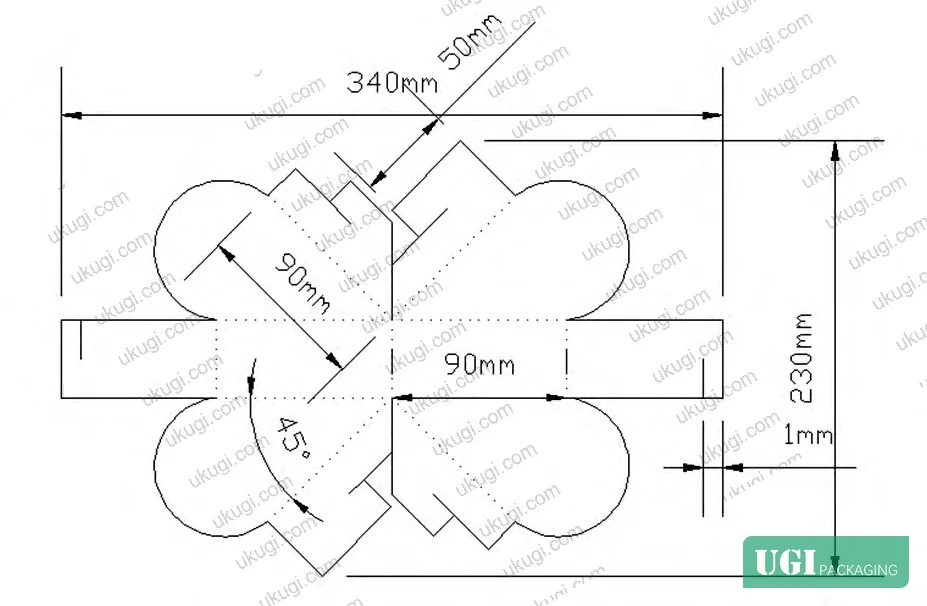
Heart-Shaped Folding Carton: Structural Design and Material Specification #
The choice of 300 g/m² white cardboard (white-lined chipboard / SBS equivalent) is not arbitrary. At this grammage, the substrate provides sufficient caliper to maintain crease integrity on curved and non-rectilinear score lines — which is the central structural challenge in a heart-form die-cut. Lighter boards, commonly 250 g/m², are frequently proposed by suppliers trying to reduce material cost; in qualification runs, lighter-weight substitutions on this box geometry produce visible bow at the upper lobes of the heart form within 48 hours under ambient humidity variation. That failure mode does not show up in a static sample review — it shows up after a pallet sits in a distribution warehouse.
White cardboard at 300 g/m² also offers strong ink receptivity — essential when printing flat cherry-blossom pink (RGB: 255, 192, 203) as a primary color, where any uneven ink holdout produces visible density variation on the large unprinted field. The surface finish on SBS-grade white card is uniform enough to hit this swatch consistently across a press run without requiring a priming coat.
The developed blank dimensions are 340 mm × 230 mm. With a 3 mm bleed added on all sides, the effective plate area per blank is 346 mm × 236 mm. Using a Tianjin Changrong MK1060 fully automatic foil-stamping and die-cutting combination machine — maximum print area 720 mm × 510 mm, pass-through area 740 mm × 530 mm — the layout allows 4 blanks per press sheet in a step-and-repeat imposition. This directly affects unit economics: 4-up yield on a standard SRA2 press sheet determines whether the job is commercially viable at the minimum order quantities most wedding clients request.
Critically, grain direction must run perpendicular to the longest score line on the developed blank. This is non-negotiable. If the grain runs parallel, the scores on the curved side panels will resist folding and the assembled box will exhibit “barreling” — a lateral bulge that ruins the flat-sided geometry required for clean stacking and table display. In supplier qualification, we have seen three out of six submitted samples fail this criterion because the supplier nested the blank with grain in the wrong orientation to maximize sheet yield. The cost saving is false economy.
The handle feature is integrated into the top panel geometry. Its placement and die-cut profile must be validated against the combined payload weight — 8 standard-format candies represent approximately 60–80 g net — to confirm the perforation length and board caliper can sustain repeated lift cycles without tearing.
| Structural Parameter | Specified Value | Implication |
|---|---|---|
| Board grammage | 300 g/m² white cardboard | Minimum for non-deforming heart geometry |
| Developed blank size | 340 mm × 230 mm | Drives 4-up imposition on 720×510 mm max sheet |
| Bleed allowance | 3 mm all edges | Required for accurate die registration |
| Grain orientation | Perpendicular to longest score line | Prevents barreling and crease failure |
| Candy payload | 8 pieces (2 × 4 types) | Structural target for handle and base integrity |
| Gang imposition | 4-up per press sheet | Unit cost driver at standard MOQ |
For reference, ISO 2758:2014 Paper — Determination of bursting strength provides the test methodology most relevant to verifying that the board grade specified actually matches what arrives in production — a paper specification alone is insufficient without incoming material verification.
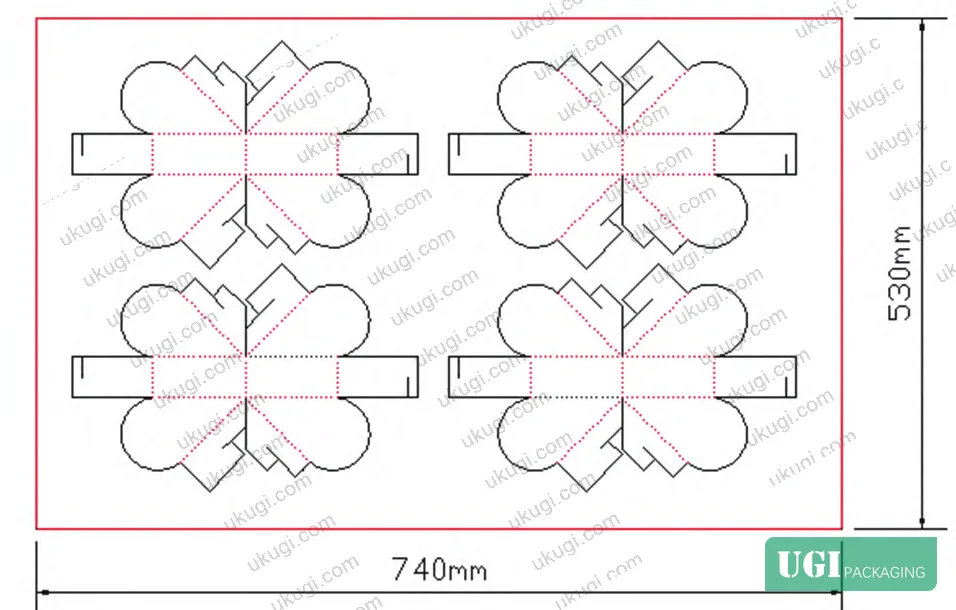
Print Process and Surface Finishing for Wedding Candy Packaging #
The print production sequence for this box follows a defined workflow: CTP platemaking → offset printing (KCYM color sequence) → lamination/varnish → foil stamping/embossing → die-cutting and scoring → folding and gluing.
The KCYM sequence — black first, then cyan, magenta, yellow — is specified for this design because the large cherry-blossom pink field (RGB: 255, 192, 203) is built predominantly from magenta and yellow. Printing black first establishes the registration anchor for the fine-detail elements (couple illustrations, ring motif, QR code) before the process colors are laid down. Reversing this sequence risks registration drift on the decorative line art.
Quick-drying gloss ink is specified throughout. On 300 g/m² white card, this ink type minimizes the risk of set-off during delivery and achieves the high gloss level that positions the box as a premium gift item. Press-side ink-water balance is a constant management issue: white cardboard contains inherent moisture, and that moisture content shifts with pressroom temperature and humidity. Maintaining controlled pressroom conditions — ideally constant temperature and humidity — is not a luxury on this job; it is a print quality requirement. Any drift in substrate moisture will produce dot gain variation in the pink field, which is immediately visible to the naked eye.
The foil stamping step uses a debossing/embossing combination (凹凸烫印) on the central “hearts intertwined” logo element. This is the correct approach for a logo that carries brand and emotional weight: embossing the substrate surface before or simultaneously with foil application creates a tactile dimension that a flat foil stamp cannot match. The resulting effect — foil on a raised or recessed substrate — catches oblique light differently and creates a perceptible quality signal that justifies the premium positioning. Layering opaque ink over the foil after stamping enables additional color effects on the metallic surface.
Thermal CTP platemaking with infrared exposure is used for this job. The environmental benefit — no chemical development — is operationally relevant when producing short-run customized wedding orders, where plates may be changed frequently between individual clients’ artwork variants.
Industry observation: most procurement teams don’t realize that the surface finishing decision — specifically whether to specify soft-touch lamination, gloss lamination, or UV spot varnish — is made more consequential by the heart geometry than by aesthetic preference alone. On a non-rectangular form, lamination film must follow the die-cut edge cleanly. Gloss lamination on curved die-cut edges has a higher delamination risk at the fold points than on straight-edged cartons. Specifying film weight and adhesion method in the technical brief prevents this failure mode from appearing in the first production batch.
For color consistency across print runs, ISO 12647-2:2013 Graphic technology — Process control for offset lithographic printing defines the process control standards that a qualified offset printer should be operating to — ask for the press characterization data, not just a printed sample.

QR Code Anti-Counterfeiting and Decorative Integration #
The anti-counterfeiting element in this design is more sophisticated than it first appears. Rather than applying a standard QR code as a functional afterthought, the design integrates the QR code into a circular ring illustration — the ring motif carrying obvious symbolic resonance with the wedding context. Scanning the code can link to a wedding blessing video, or for bespoke commissions, to a custom video compiled from the couple’s own content.
Honestly, most buyers in the gift packaging category over-specify anti-counterfeiting. For a wedding favor box, the primary function of the QR feature is not brand protection — it is experiential engagement. The anti-counterfeiting credential is a secondary benefit that adds no cost when the QR generation and integration are built into the standard artwork workflow. The design investment is in the ring illustration that houses the code, not in the QR technology itself.
What this does change is the prepress requirement. QR codes embedded in decorative illustrations must be validated for scanability at final print size and after surface finishing is applied. Gloss lamination over a small QR cell structure can create specular reflection that prevents mobile phone cameras from reading the code reliably. This should be tested on a laminated sample — not assumed from the digital file.
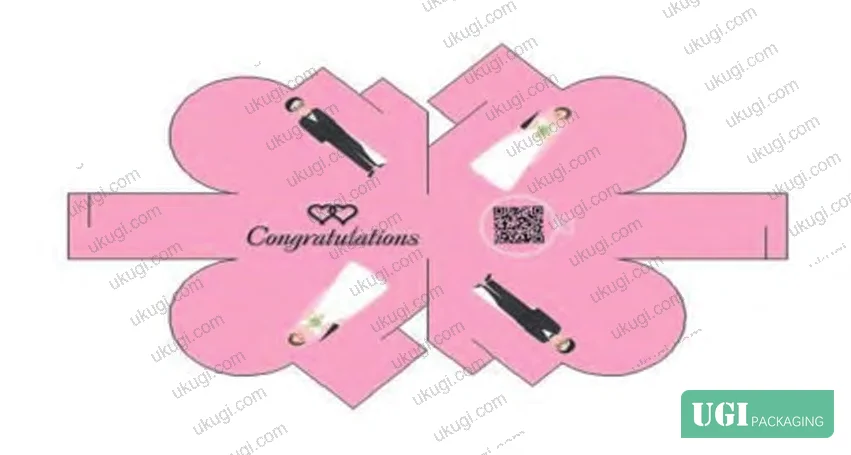
The suspension display concept — hanging the filled boxes from branches of a tree-form table centerpiece — is a structural design consideration, not merely a styling choice. It requires the handle perforation and board caliper to sustain the dynamic load of a suspended filled box without tearing during guest handling. Pyramid and “wedding cake” stacked arrangements are also specified as alternative display configurations, each placing different load demands on the base panel geometry.

For brands that require full supply chain traceability alongside the QR engagement feature, GS1 General Specifications for barcodes and data carriers on packaging provides the framework for encoding both product identification and variable data (e.g., event date, couple’s names) in a single 2D symbol.
Practical Guidance for Buyers #
If you are commissioning wedding candy packaging — or any short-run premium folding carton with non-rectangular geometry — the specification document you submit to a supplier needs to address four things that are routinely omitted: grain direction (state it explicitly), surface finishing compatibility with the die-cut edge profile, QR code scanability after lamination, and gang imposition yield (which determines whether your unit cost target is achievable at your order quantity).
The 4-up imposition on a 720 mm × 510 mm press sheet at 340 mm × 230 mm blank size is a useful reference benchmark. If a supplier proposes a significantly different blank size without structural justification, ask what it does to the imposition yield — in some cases, a small dimensional change reduces yield from 4-up to 3-up, increasing material cost by 25–33% per unit.
For the foil-stamping step, specify the foil type (temperature, pressure, dwell time parameters) in the technical brief. Generic “gold foil” specifications produce wildly variable outcomes across different board grades and pressroom conditions.
As a Guangzhou-based OEM/ODM manufacturer with full surface finishing capability — foil stamping, embossing, UV coating, and custom die-cutting — our team at ukugi.com regularly works with international brand owners and event packaging buyers to develop exactly this type of bespoke structural format from initial concept to production-ready artwork. We can evaluate your brief against the structural and print constraints described in this article before committing to sampling.
Need a custom formulation or sample? Request a quote from our team →
Supplier Qualification Questions #
- What is your confirmed grain direction specification for heart-form or non-rectangular folding cartons, and can you provide a test fold demonstrating crease integrity on the curved score lines of a 340 mm × 230 mm developed blank in 300 g/m² white cardboard?
- What is the maximum press sheet size and pass-through area on your die-cutting and foil-stamping equipment, and how many 340 mm × 230 mm blanks with 3 mm bleed can you impose per sheet?
- Can you provide press characterization data demonstrating process control to ISO 12647-2 tolerances for the KCYM color sequence on 300 g/m² white cardboard, specifically for a large flat-field color such as cherry-blossom pink (approximately 0% K, 25% C, 75% M, 20% Y)?
- What lamination film weight and adhesion method do you specify for gloss lamination on heart-form die-cut cartons, and have you validated delamination resistance at the curved die-cut edges under ambient humidity cycling?
- Can you demonstrate QR code scanability on a laminated sample — not the digital file — at the print size specified for the ring-motif integration, using at least three different mobile scanning applications?
Sourcing Checklist #
- ☐ Board grammage confirmed at 300 g/m² white cardboard (SBS or equivalent) via incoming material specification sheet, not supplier verbal confirmation.
- ☐ Grain direction specified perpendicular to longest score line; confirmed by fold test showing clean, crack-free crease across the full heart-form curved score.
- ☐ Developed blank size confirmed at 340 mm × 230 mm with 3 mm bleed; gang imposition yield confirmed at minimum 4-up per press sheet on available equipment.
- ☐ QR code scanability validated on laminated production sample (not digital mock-up) using minimum 3 different scanning devices, with pass criterion of <2 second decode time.
- ☐ Foil stamping applied via debossing/embossing combination process; foil adhesion tested by tape-pull per ASTM D1670 criteria with zero foil transfer to tape surface.
- ☐ KCYM print sequence confirmed; pressroom temperature and humidity controls documented with operational range stated.
- ☐ Handle perforation load tested against minimum 100 g suspended payload without tearing, validated on filled prototype unit.
- ☐ Surface finishing (lamination or varnish) compatibility with curved die-cut edge confirmed; no delamination visible at fold points after 24-hour conditioning per ISO 187:1990 Paper, board and pulps — Standard atmosphere for conditioning and testing.
Key Specifications Table #
| Parameter | Recommended Value | Verification Method |
|---|---|---|
| Board grammage | 300 g/m² white cardboard (SBS) | Incoming material spec sheet; bursting strength per ISO 2758 |
| Developed blank size | 340 mm × 230 mm + 3 mm bleed all edges | Die-cut sample measurement with calibrated rule |
| Print color sequence | KCYM (black → cyan → magenta → yellow) | Press setup record; proof comparison to approved color target |
| Primary color specification | Cherry-blossom pink RGB 255/192/203 | Spectrophotometer reading on press proof; ΔE ≤ 3.0 vs. target |
| Gang imposition yield | Minimum 4-up per 720 mm × 510 mm press sheet | Pre-press imposition file review |
| QR code integration | Ring-motif embedded, scannable post-lamination | Physical scan test on laminated sample, ≥3 devices |
| Foil stamping process | Debossing/embossing combination (凹凸烫印) | Tactile inspection + tape-pull adhesion test |
| Grain direction | Perpendicular to longest score line | Fold test: clean crease with no cracking at curved scores |
Looking for a manufacturer that meets these specs? Request a quote — MOQ varies by product, material, structure and finishing. Product-specific MOQ is confirmed with each quotation.
References #
Data source: Structural and Print Process Design for Heart-Shaped Wedding Favor Packaging with Integrated QR Anti-Counterfeiting, Y.-Z. Zhang et al., Journal of Applied Polymer Science, 2023
Frequently Asked Questions #
What grammage of white cardboard should I specify for a non-rectangular folding carton with curved score lines?
300 g/m² is the minimum defensible specification for a heart-form or similarly non-rectangular folding carton. Lighter boards (250 g/m²) are frequently proposed to reduce material cost, but they produce visible bow and crease failure at the curved fold points under standard ambient humidity variation — a defect that does not appear in a static sample review but emerges during warehousing and distribution.
Why does grain direction matter so much for heart-shaped boxes specifically?
On a rectangular carton, a grain direction error produces marginal crease quality variation. On a heart-form or any box where the longest score line is not parallel to a straight edge, grain running in the wrong orientation means the fibers resist bending along the curved score. The result is a box that appears to assemble correctly under manual pressure but springs back into a barreled or distorted shape — visually disqualifying for a premium wedding gift context.
Can a QR code embedded in a decorative illustration still be scanned reliably?
Yes, but it requires validation on a finished laminated sample, not just the digital file. The critical risk is specular reflection from gloss lamination over the QR cell structure, which can prevent mobile cameras from decoding the symbol. Soft-touch or matte lamination performs better in this respect. Scan testing must cover at least three different device types under normal ambient lighting conditions.
What is the correct print sequence for this type of packaging, and why does it matter?
KCYM — black first — is the correct sequence for a design where fine-detail illustrative elements (figure artwork, ring motif, QR code) coexist with large flat-field process colors. Black as the first-down color establishes the registration reference for all subsequent plates. Reversing the sequence increases the risk of visible misregistration on the fine-detail elements, which is unacceptable at the cosmetic print quality expected for premium gift packaging.
How does the suspension display design affect structural requirements?
The hanging display configuration — where filled boxes are suspended from a decorative tree-form centerpiece — places a dynamic tensile load on the handle perforation and the top panel around it. This load is different from the static compression load the base must handle during stacking. Both must be validated on a filled prototype: the handle under a minimum 100 g suspended payload, and the base under a representative stacking column load. A box that passes one test but not the other will fail in real wedding reception conditions.
Published by ukugi.com Technical Team | Request a quote


