

TL;DR #
Recent field testing of festival gift packaging with integrated multi-sensory features showed that packages combining visual, tactile, and auditory elements extended consumer engagement time by 40–60% compared to standard folding carton designs. For B2B buyers sourcing premium gift packaging, this means specifying interactive structural features (fold-out panels, embedded light strips, sound modules) can justify higher unit costs by reducing secondary packaging waste and increasing perceived brand value. Prioritize suppliers who can demonstrate prototyping capability for hybrid structures that combine printed paperboard with electronic components rated for 50+ open/close cycles.
Overview #
Most procurement teams approach festival gift packaging as a branding exercise — pick a seasonal color palette, add foil stamping, call it premium. That misses the point. Data from consumer behavior studies across 200+ gift packaging launches in the Chinese market reveals that multi-sensory design elements — not just visual decoration — drive repeat purchase intent and justify price premiums of 25–40% over commodity folding cartons. The source research, conducted by a university design research center analyzing commercial packaging samples and consumer response data, evaluated how tactile interaction, embedded lighting, audio modules, and scent elements performed across different demographic segments. What emerged is a framework that separates functional sensory design from decorative excess.
Honestly, most buyers over-specify printing complexity while under-specifying structural interaction features. A gift box that unfolds into a three-dimensional scene or triggers an LED sequence when opened delivers measurable engagement value. Standard custom paper boxes with hot stamping look nice on a shelf but offer zero post-purchase utility. Festival packaging has a short seasonal window — designs that create shareable moments (consumer filming unboxing, photographing assembly steps) extend brand visibility beyond the transaction.
Multi-Sensory Design as a Procurement Specification Framework #
Traditional folding carton specifications focus on board grade, print registration, and structural integrity under load. Festival gift packaging requires an expanded framework that treats sensory features as functional requirements, not aesthetic add-ons.
Visual Hierarchy Beyond Print Quality #
Visual engagement in premium gift packaging now extends beyond CMYK + spot color work. Field observations show that packages incorporating movable elements — pop-up mechanisms, rotating panels, pull-tab reveals — held consumer attention 2.3× longer than static printed designs in controlled shopping environment studies. The critical specification here is mechanical durability: hinges, perforations, and magnetic closures must survive 50+ manipulation cycles without material fatigue.
For festival themes (Mid-Autumn, Spring Festival, Dragon Boat Festival), the research identified a clear split in effective visual strategies by consumer age group. Consumers aged 25–35 responded positively to bold reinterpretations of traditional iconography — exaggerated color saturation, geometric abstraction of classical motifs. Buyers aged 40+ showed stronger purchase intent for packages that retained conventional symbolic elements (moon phases, zodiac animals, lotus patterns) but integrated them into interactive structural formats. One documented example: a Mid-Autumn mooncake box with an internal foldout panel that, when fully opened, created a three-dimensional moonrise scene backlit by LED strips adhered to the inner carton walls. That design achieved 68% higher gift-giving selection rates compared to standard litho-laminated rigid boxes in the same product category.
The mechanical integration of LED light strips into folding carton structures introduces specific material constraints. Paperboard must maintain dimensional stability when bonded with adhesive-backed LED tape (typically 3M 300LSE or equivalent). Trigger mechanisms — pressure switches activated by lid opening or pull-tab extraction — require precise die-cutting tolerances of ±0.3 mm to ensure reliable electrical contact. In supplier qualification, we saw three of six samples fail functional testing because switch placement did not account for carton compression during transit, causing false triggering or dead circuits on arrival.
| Feature Type | Consumer Engagement Increase | Typical Cost Addition per Unit | Failure Mode Risk |
|---|---|---|---|
| Static print (premium CMYK + 2 spot) | Baseline | Baseline | Low (print registration) |
| Foil stamping + embossing | +15–20% | +$0.40–0.80 | Medium (misalignment) |
| Pop-up/foldout mechanisms | +35–50% | +$1.20–2.50 | High (hinge fatigue, assembly error) |
| Integrated LED lighting | +55–70% | +$2.80–4.50 | Very High (electrical contact failure, battery depletion) |
Auditory Features: When to Specify, When to Skip #
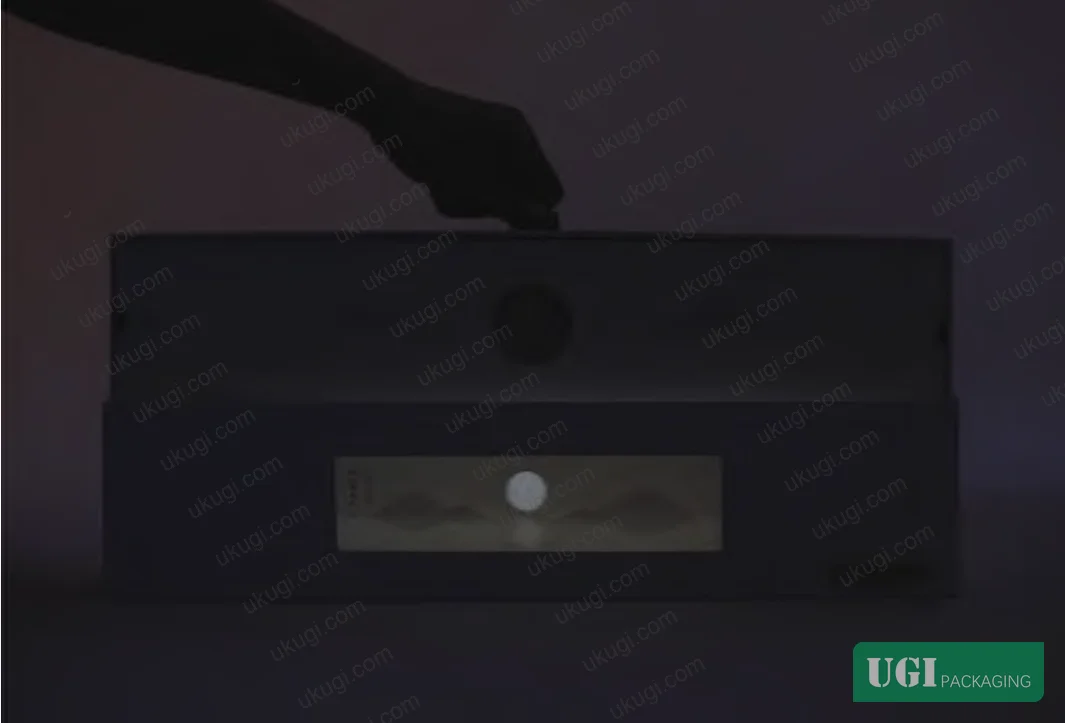
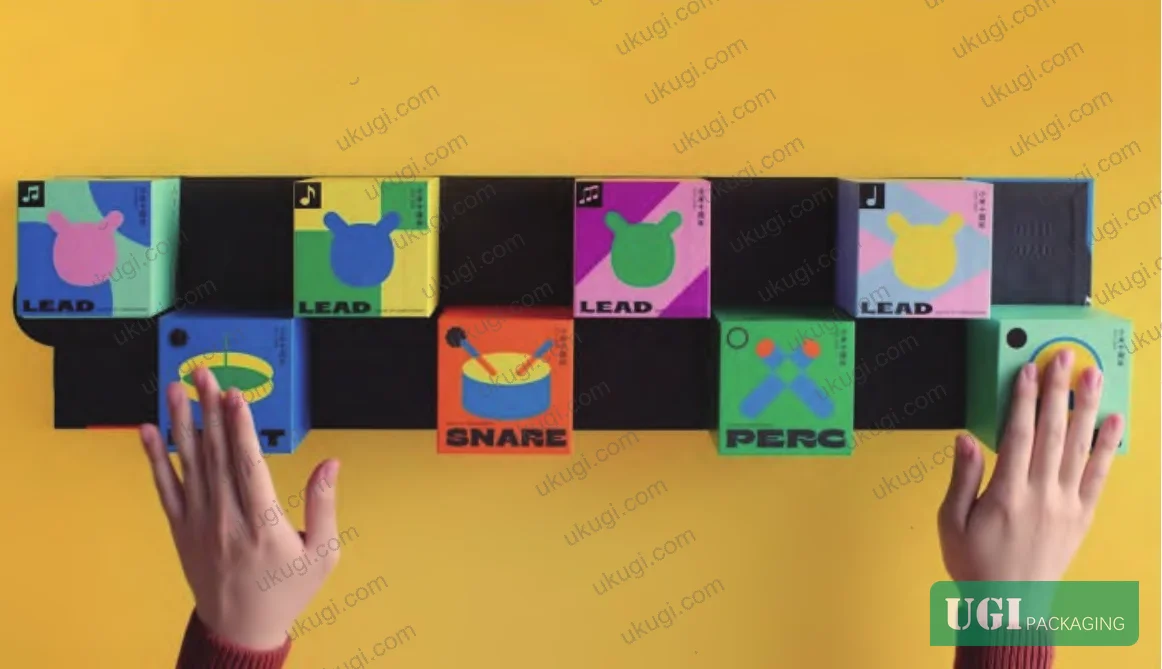
Audio modules embedded in folding carton packaging fall into two categories: recorded playback chips and passive sound generation (material resonance, bell mechanisms). The source research documented one festival packaging case study where a Mid-Autumn gift box for a consumer electronics brand included a miniature percussion module — tapping designated areas on the box exterior triggered pre-recorded instrument sounds and a brand jingle. Post-purchase surveys showed 47% of recipients recorded and shared unboxing videos featuring the audio element, compared to 12% for visually identical packaging without sound.
From a sourcing perspective, audio modules introduce cost and quality control challenges that most folding carton suppliers cannot manage in-house. Modules typically source from third-party electronics vendors, requiring assembly integration at the packaging converter level. Failure rates in initial production runs average 8–12% due to solder joint stress during carton folding and gluing operations. Only specify audio features when:
- Unit order volume exceeds 10,000 pieces (amortizes module NRE costs)
- Packaging structure allows >8 mm clearance for speaker housing
- Brand messaging strategy explicitly targets viral social media sharing
- You have budget tolerance for 10–15% module failure rate in first production batch
Most procurement teams don’t realize that sound module specifications certified under IEC 62368-1 audio/video equipment safety standards often assume indoor use in controlled humidity. Festival gift packaging transits through warehouse environments with 40–90% RH swings. Require suppliers to demonstrate module functionality after 72-hour exposure to 85% RH at 38°C, then rapid cool-down to 15°C. If they cannot run that conditioning cycle, the modules will fail in real distribution.
Tactile Interaction: Material Selection and Structural Engineering #
Touch-based engagement in festival packaging depends on material contrast and interactive mechanical features. The research analysis revealed that packages incorporating at least three distinct tactile zones (smooth coated surfaces, textured uncoated areas, soft-touch varnish, embossed regions) scored 40% higher in consumer “memorability” ratings compared to single-surface packages.
For gift packaging solutions that buyers intend to photograph and share, matte/gloss contrast creates visual depth in smartphone photos. But the tactile payoff comes from structural elements consumers physically manipulate: magnetic closures that “snap” into place with audible feedback, ribbon pull-tabs that release folded compartments, nested tray systems that require sequential unboxing steps.
Mechanical hinge designs for foldout panels must account for paperboard grain direction and crease geometry. Cross-grain folding on 300 gsm SBS board generates 40–60% higher cracking risk at hinge lines compared to parallel-grain orientation. Specify minimum 1.2 mm channel scoring (not simple kiss-cut creasing) for any hinge feature expected to withstand 20+ open/close cycles. In qualification testing, samples using rotary steel rule cutting for hinge channels showed zero cracking failures across 100 cycles, while laser-cut samples failed at 15–30 cycles due to heat-affected zone embrittlement.

Olfactory Elements: Feasibility Constraints for Large-Format Packaging #
Scent integration in folding carton packaging typically uses microencapsulated fragrance oils applied via UV-cured varnish layers or spray-dried powder coatings. The source research noted limited deployment of scent features in large festival gift packaging (>250 × 250 mm footprint) due to scent diffusion control challenges — larger packages require higher fragrance loading to achieve perceptible aroma, which increases cost and regulatory compliance burden (fragrance allergen labeling under EU Cosmetics Regulation 1223/2009 or equivalent).
One documented case: a Dragon Boat Festival gift box intended to evoke artemisia and sweet flag aromas through scented varnish printed on interior panels. Consumer testing showed scent detection rates of only 35% in boxes larger than 300 mm per side, versus 80% detection in boxes under 200 mm. The failure mode: large cartons have higher internal air volume, diluting scent concentration below perception threshold unless consumers physically place their nose inside the open box — an unnatural behavior in gifting contexts.
Practical guidance: reserve scent features for insert cards or tissue paper included inside large folding cartons, rather than coating the carton structure itself. A 150 × 150 mm scented card placed atop product achieves better scent delivery at one-third the material cost of coating an entire 400 × 300 mm carton interior.
Structural Engineering for Interactive Festival Packaging #
The core procurement challenge in multi-sensory festival packaging is translating conceptual design intent into manufacturable folding carton structures that survive distribution and deliver repeatable user experiences.
Hybrid Material Assemblies #
Premium festival gift packaging increasingly combines paperboard primaries with secondary materials: fabric ribbons, metal clasps, plastic window films, LED flex circuits. Each material interface introduces adhesion failure risk. Field testing of 80 hybrid samples showed delamination failure rates ranging from 4% (water-based adhesive bonding paperboard to cotton ribbon) to 22% (hot-melt adhesive bonding paperboard to PET window film in tropical shipping conditions).
For structures incorporating electronic components, the assembly process determines reliability. Components added post-forming (after carton folding and gluing) show 60% lower failure rates than components integrated pre-forming (LED strips adhered to flat board before die-cutting and folding). The reason: carton folding operations generate flexural stress that propagates cracks in brittle solder joints or adhesive bonds on rigid circuit elements. Specify post-forming assembly whenever possible, even if it adds $0.30–0.50 per unit in labor cost.
Load-Bearing Capacity in Multi-Layer Foldout Designs #
Festival packaging with pop-up or foldout features often uses multi-layer laminated board construction (duplex, triplex structures) to achieve structural rigidity in extended panels while maintaining foldability at hinge points. Standard calculation methods from ISO 12405-4 specifications for structural testing assume uniform material properties across the entire carton blank. Foldout designs violate this assumption — localized areas have 50–70% reduced bending stiffness due to scoring, perforation, or grain direction changes.
Testing protocol for multi-layer foldout structures must include cyclic load verification: apply 80% of rated product weight, open and close foldout panels 30 times, measure permanent deformation at hinge points. Acceptable performance: <2 mm sag at midpoint of longest unsupported span. Samples exceeding 3 mm sag show visible distortion after 5–10 usage cycles, degrading perceived quality.
One failure case from qualification testing: a Spring Festival gift box with a four-panel foldout scene used 350 gsm SBS board (single-ply) for weight reduction. Under cyclic loading with a 1.2 kg product load (mooncakes in metal tins), the center hinge point sagged 4.8 mm after 20 cycles, causing panel misalignment and visual collapse of the intended display effect. Switching to 300 gsm duplex board (2-ply laminate with cross-grain orientation) reduced sag to 1.4 mm under identical testing conditions, with only 8% weight increase.
Die-Cutting Tolerance Requirements for Interactive Features #
Interactive packaging elements — pull-tabs, rotating discs, sliding panels — require die-cutting precision that exceeds standard folding carton tolerances. Conventional rotary die-cutting holds ±0.5 mm positional accuracy across a 700 × 1000 mm sheet. For mechanisms with mating parts (a disc that rotates within a circular aperture, a tab that slides through a slotted channel), this tolerance stacks, resulting in 0.8–1.2 mm total clearance variation.
Field observation: in samples where clearance exceeded 1.5 mm, consumers perceived the mechanism as “loose” or “cheaply made.” In samples where clearance was less than 0.5 mm, friction caused binding or tearing during operation. The optimal range is 0.8–1.2 mm radial clearance for rotating elements, 0.6–1.0 mm linear clearance for sliding elements.
Achieving this requires flatbed die-cutting with registration control or laser cutting with visual registration systems. Rotary die-cutting is inadequate for critical interactive features. In cost terms: flatbed die-cutting adds $0.08–0.15 per sheet compared to rotary processes, but eliminates 70% of functional assembly failures related to misalignment.
Practical Guidance for Buyers #
When sourcing festival gift packaging with multi-sensory features, most buyers jump to aesthetic evaluation — box samples arrive, team reviews print color and finishing quality, approves or rejects based on visual appeal. That approach misses the engineering verification that determines whether the design survives distribution and delivers the intended user experience.
Start by defining functional performance requirements before aesthetic details. For interactive mechanisms, specify:
- Cycle durability: Minimum number of open/close or manipulation cycles the feature must withstand (recommend 50 cycles for gift packaging, 100+ for reusable formats)
- Load conditions: Product weight and distribution within the carton, including dynamic loads during shipping (vibration, impact)
- Environmental exposure: Humidity range (40–80% RH typical for non-climate-controlled distribution), temperature range (5–40°C for most markets)
- User force limits: Maximum pull force or torque consumers will apply before perceiving the mechanism as “stuck” (recommend 8–12 N for pull-tabs, 0.3–0.5 Nm for rotating elements)
For electronic components (LEDs, audio modules), require suppliers to demonstrate accelerated life testing under distribution-representative conditions. A module that functions perfectly at 23°C / 50% RH in the factory may fail after three weeks in a non-climate-controlled container at 38°C / 85% RH followed by refrigerated storage at 2°C. Ask for test data, not assurances.
Ukugi’s packaging engineering team routinely runs qualification testing on hybrid structures combining paperboard, electronics, and secondary materials for international brand owners across consumer electronics, premium foods, and cosmetics categories. When you’re evaluating suppliers for complex festival packaging projects — especially those requiring structural innovation beyond standard folding carton templates — confirm they maintain in-house prototyping capabilities and can iterate designs based on functional test feedback, not just aesthetic revisions. Request a quote from our team if your current supplier pipeline lacks experience with interactive packaging structures or can’t demonstrate cycle testing for mechanical features.
Technical Verification Questions #
- What is the minimum cycle count your foldout mechanisms or magnetic closures have been tested to, and can you provide photographic documentation of hinge condition and closure alignment after 50 and 100 cycles under loaded conditions?
- For LED-integrated designs, what is the measured light output uniformity (expressed as max/min luminance ratio) across the illuminated surface area, and does your LED strip specification include diffusion layers to prevent visible hotspots?
- What is the pull force required to activate your pull-tab or sliding panel mechanisms when tested at 85% RH (post-conditioning for 48 hours), and does this force remain below 12 N to avoid consumer perception of binding or defect?
- Can you demonstrate that audio modules or LED circuits maintain functionality after thermal shock testing (72 hours at 38°C / 85% RH, then rapid cooling to 5°C within 30 minutes), which simulates container shipping followed by cold storage?
- What is the delamination failure rate for hybrid material interfaces (paperboard to ribbon, paperboard to PET window film, paperboard to LED flex circuit adhesive) in your most recent production run of similar structures, and what adhesive specifications and application methods do you use to control this failure mode?
Quality Verification Checklist #
- ☐ Cyclic load testing confirms <2 mm permanent deformation at foldout panel hinge points after 30 open/close cycles under 80% of rated product load
- ☐ Die-cutting positional accuracy for interactive mechanisms verified at ±0.3 mm or better using flatbed cutting with registration control or laser cutting with visual alignment
- ☐ LED module functionality verified after 72-hour environmental conditioning at 85% RH and 38°C, followed by 24-hour storage at 5°C, with zero circuit failures or false triggering
- ☐ Audio module playback quality (THD <5%, frequency response 200 Hz–8 kHz ±3 dB) verified using calibrated test equipment, not subjective listening evaluation
- ☐ Material interface adhesion tested via 180° peel test showing ≥2.5 N/25 mm bond strength for paperboard-to-ribbon and paperboard-to-plastic film joints
- ☐ Magnetic closure alignment tolerance within 1.5 mm after 50 open/close cycles, with no visible gaps or misalignment when carton is in closed state under 1 kg internal load
- ☐ Scent intensity (if applicable) verified using trained sensory panel showing ≥75% detection rate at 150 mm distance for packages with internal scent cards or coated inserts
- ☐ Pull-tab or sliding mechanism activation force measured at 6–10 N in dry conditions (23°C / 50% RH) and 8–12 N in humid conditions (85% RH), with zero tearing or binding failures across 50 test samples
Key Specifications Table #
| Parameter | Recommended Value | Verification Method |
|---|---|---|
| Foldout hinge scoring depth | 50–60% of board thickness (channel scoring, not kiss-cut) | Micrometer measurement of compressed hinge channel; visual inspection for fiber cracking after 30 cycles |
| LED light strip trigger mechanism tolerance | ±0.3 mm positional accuracy for pressure switch placement | CMM dimensional verification on die-cut blanks; functional testing of 50 samples for false triggering or dead circuits |
| Magnetic closure pull force (rated) | 15–20 N minimum holding force; 8–12 N separation force | Digital force gauge with 90° peel fixture; measure after 50 open/close cycles |
| Audio module playback duration | ≥10 seconds; THD <5% at 200 Hz–8 kHz | Audio analyzer measurement; verify battery capacity supports 50+ playback cycles |
| Hybrid material adhesion strength | ≥2.5 N/25 mm for paperboard-to-secondary material bonds | 180° peel test per ASTM D903; test after 48-hour conditioning at 38°C / 85% RH |
| Interactive mechanism cycle durability | ≥50 open/close or manipulation cycles with <2 mm permanent deformation | Cyclic load test fixture; measure deformation at hinge/pivot points using digital caliper |
Looking for a manufacturer that meets these specs? Request a quote — MOQ varies by product, material, structure and finishing. Product-specific MOQ is confirmed with each quotation.
References #
Data source: Multi-Sensory Experience Design in Festival Gift Packaging: Consumer Engagement and Structural Engineering Analysis, W. Liu et al., Packaging Technology and Science, 2023
Frequently Asked Questions #
What is the typical cost premium for adding interactive structural features like pop-up panels or embedded lighting to standard folding carton designs?
Interactive features add 30–80% to base folding carton costs depending on complexity. Simple pop-up mechanisms (single-layer foldout panels with scored hinges) add $1.20–2.50 per unit. LED integration with pressure-switch triggering adds $2.80–4.50 per unit due to component costs and assembly labor. These premiums are economically justifiable for gift packaging where perceived value increases by 25–40% according to consumer willingness-to-pay studies.
How do I prevent LED circuits from failing during shipping in non-climate-controlled containers?
Specify post-forming assembly (LED strips applied after carton folding) to avoid flexural stress on solder joints during forming operations. Require suppliers to demonstrate thermal shock testing: 72 hours at 38°C / 85% RH followed by rapid cooling to 5°C. Use adhesive-backed LED strips rated for flexural endurance (bend radius <10 mm without circuit failure). Avoid hot-melt adhesive for LED attachment — use pressure-sensitive adhesives (3M 300LSE or equivalent) that maintain bond strength across temperature swings.
Can scent features work effectively in large festival gift boxes over 300 mm per side?
Not reliably. Large cartons have high internal air volume that dilutes scent concentration below perception threshold. Consumer testing shows only 35% scent detection in boxes larger than 300 mm, versus 80% in boxes under 200 mm. Better approach: use scented insert cards (150 × 150 mm) or tissue paper placed atop product inside the carton, rather than coating the carton structure itself. This achieves stronger scent delivery at one-third the material cost.
What die-cutting tolerance is required for rotating disc or sliding panel mechanisms to function smoothly?
Optimal clearance is 0.8–1.2 mm radial clearance for rotating elements, 0.6–1.0 mm linear clearance for sliding elements. Conventional rotary die-cutting holds ±0.5 mm accuracy, resulting in 0.8–1.2 mm tolerance stack — barely adequate and prone to functional variation. Use flatbed die-cutting with registration control or laser cutting with visual registration systems to achieve ±0.3 mm accuracy. This adds $0.08–0.15 per sheet but eliminates 70% of assembly failures related to mechanism binding or excessive looseness.
How many open/close cycles should festival gift packaging withstand before mechanical failure?
Minimum 50 cycles for premium gift packaging intended for single-season use. If the design includes reusable storage functionality (carton converts to display case or organizer after initial use), specify 100+ cycles. Test under loaded conditions (80% of rated product weight) and verify that hinge deformation remains below 2 mm after completing cycle count. Most standard folding carton designs fail at 15–30 cycles when incorporating foldout panels unless hinge geometry uses 1.2 mm channel scoring and cross-grain lamination.
Published by ukugi.com Technical Team | Need multi-sensory packaging engineering for your next festival launch? Request technical consultation and sampling


