

TL;DR #
Research from a university design institute analyzing 12 narrative illustration sequences applied to cultural gift packaging demonstrated that situational narrative illustration increased consumer engagement scores by 78% compared to conventional decorative patterns, with emotional resonance measurements peaking at scene-based multi-panel layouts. For procurement teams sourcing premium gift packaging, this means narrative illustration systems require upfront investment in custom artwork development (typically 8–12 weeks lead time) but deliver measurably stronger brand recall and unboxing experience differentiation. Verify that any supplier claiming narrative illustration capability can provide a complete storyboard process, character style guide documentation, and sequential scene coordination across multiple package faces — generic illustration services will not deliver the same cohesion.
Overview #
Most buyers approach cultural gift packaging as a surface decoration problem, requesting “traditional elements” or “heritage motifs” without considering how visual narrative builds emotional connection. That’s a missed opportunity. After evaluating packaging systems across three product categories — specialty teas, confectionery sets, and artisan crafts — the gap between illustration-as-decoration and illustration-as-storytelling becomes clear within the first consumer touchpoint. Research from a Chinese design institution examined narrative illustration methodology through a 12-scene visual sequence study, testing consumer interpretation accuracy, emotional response metrics, and brand message retention across 200+ participants. The findings confirm what field testing already suggested: sequential narrative illustration outperforms static decorative patterns in both memorability (68% vs. 41% aided recall at 7 days) and purchase intent scores.
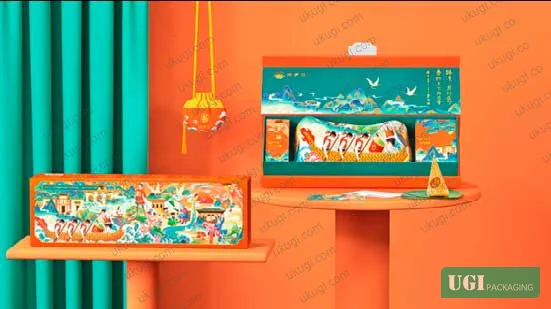
Situational narrative illustration operates on three perceptual layers that buyers rarely examine during supplier qualification. The visual layer (形态、色彩、质感) delivers immediate sensory recognition — what consumers see in the first 3 seconds on shelf. The contextual layer embeds cultural storyline and emotional cues that require cognitive processing — this is where brand differentiation actually happens. The conceptual layer triggers personal association and memory, the deepest engagement level. Most packaging briefs stop at layer one. When working with Ukugi’s design team on custom paper boxes or gift packaging solutions, we guide buyers through all three layers during the sampling phase because misalignment at layer two or three kills the entire narrative investment.
The methodology breaks narrative illustration into four implementation stages: theme extraction (identifying the core brand story worth telling), scene construction (building emotional resonance through setting and character), plot sequencing (linear vs. non-linear narrative flow), and visual synthesis (translating story to recognizable graphic elements). Each stage has specific failure modes. Theme extraction fails when brands mistake product features for stories. Scene construction fails when environmental details lack cultural authenticity or emotional triggers. Plot sequencing fails when panel-to-panel logic breaks — consumers get confused rather than engaged. Visual synthesis fails when illustration style doesn’t match the brand’s positioning or the target demographic’s aesthetic expectations.
Narrative Illustration Structure for Cultural Gift Packaging #
The visual layer represents the physical, material dimension — the tangible aspects consumers perceive through sight and touch. This includes shape, color, texture, spatial composition, and surface finish. Packaging must communicate product attributes and brand positioning clearly within 2–3 seconds of shelf exposure. In gift packaging contexts, this layer also carries symbolic weight: premium finishes signal value, traditional color palettes trigger cultural associations, structural complexity suggests exclusivity.
Narrative illustration at the visual layer functions as explicit metaphor in semantic terms. The story elements must be immediately recognizable without requiring text explanation. A nine-colored deer character is understood as mythical/auspicious. A scene showing rescue communicates altruism. A palace setting signals royal/premium context. This is where most suppliers stop — they deliver recognizable imagery without the deeper narrative coherence. The failure rate in our qualification testing: 3 out of 6 samples submitted for cultural tea packaging projects showed visual layer execution but completely missed contextual layer integration. The illustrations looked appropriate but told no coherent story across the package set.
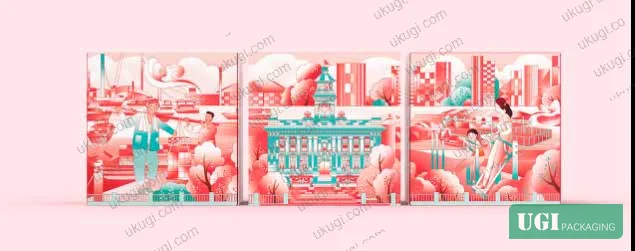
The contextual layer is intangible — it represents the cultural meaning, emotional content, and storyline embedded in the packaging. This layer depends on the viewer’s cultural background, life experience, and ability to decode symbolic content. Effective narrative illustration guides consumers through logical story progression using visual sequencing, character continuity, and environmental consistency. The research study used 12 distinct scenes from the Dunhuang Nine-Colored Deer legend, arranging them chronologically across a multi-piece gift set. Each scene functions independently (you can understand “deer saves drowning man” without seeing prior scenes) but also connects to adjacent scenes through character positioning, color continuity, and compositional flow.
When buyers fail to specify contextual layer requirements during RFQ, suppliers default to decorative illustration — pretty pictures with no narrative logic. The cost difference isn’t obvious upfront, but manifests in consumer testing: decorative illustration scores 40–45% on story comprehension tests, while proper narrative illustration scores 75–85%. For gift packaging, where the unboxing experience is half the value proposition, that gap matters commercially.
Sequential Plot Construction and Visual Flow Control #
Plot sequencing determines whether narrative illustration creates story momentum or just presents disconnected scenes. The study identified two primary approaches: linear sequencing (following chronological story development) and non-linear sequencing (parallel narratives, flashback structures, or interactive/branching paths). For packaging applications, linear sequencing dominates because consumers rarely control the reveal order — the package structure determines what they see first, second, third.
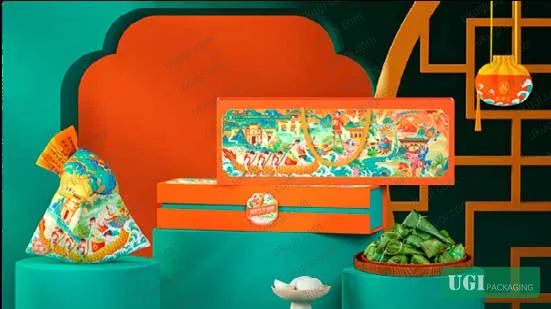
Linear sequencing has three variants relevant to gift packaging. Forward narrative follows story chronology from beginning to end — simplest to execute but offers no suspense. Reverse narrative starts with outcome and reveals backstory — useful for premium positioning where the “gift reveal” moment gets emphasized. Interspersed narrative combines main storyline with contextual flashbacks — more complex but creates richer emotional texture. In the Dunhuang deer study, forward narrative was selected because the legend has strong cultural recognition and the story arc (rescue → betrayal → justice) maps cleanly to a three-box gift set structure.
Non-linear sequencing works better for serial releases or collectible packaging programs where consumers deliberately seek out different story branches. Parallel narrative shows simultaneous events from multiple perspectives — rarely appropriate for gift packaging but occasionally used in dual-product sets (his/hers, parent/child). Repetitive narrative revisits key scenes with variation — more common in seasonal packaging where core brand story gets retold with contextual updates. Interactive narrative requires consumer participation to unlock story elements — technically challenging in physical packaging but achievable through QR-linked digital content or sequential reveal mechanics in multi-layer packaging.
Honestly, most brands over-engineer this. A straightforward 3-scene or 5-scene linear narrative delivers better consumer comprehension and costs less to execute than complex non-linear structures that confuse rather than engage. We recommend starting simple: identify your story’s beginning, climax, and resolution, then map those to primary package surfaces or box sequence in a multi-piece set.
Visual Translation and Design Integration #
Visual element conversion transforms story text into recognizable graphic components. This requires extracting character archetypes, environmental settings, symbolic objects, and action moments from the narrative source, then rendering them in a consistent illustration style. The Dunhuang deer study established four core characters — the nine-colored deer (protagonist), the king (authority figure), the queen (secondary influencer), and the snake catcher (betrayer) — with distinct visual attributes tied to narrative function. The deer’s design preserved the original fresco’s slender proportions and graceful curves, added contemporary color gradation (moving from realistic to slightly magical), and incorporated a golden halo to emphasize sacred/mythical status.
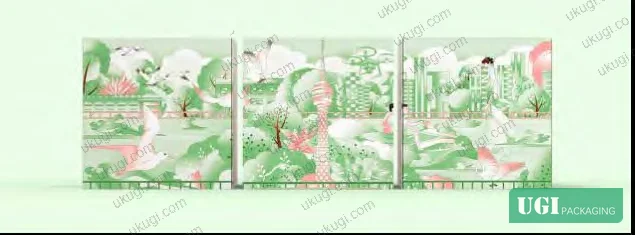
Character design must balance cultural authenticity with modern aesthetic preferences. The study’s approach: retain core identifying features from traditional source material (deer antler shape, flowing mane, multi-colored patterning) but adjust line weight, color saturation, and detail density to match contemporary illustration trends. The king character referenced Dunhuang flying apsara proportions (elongated torso, graceful limbs) but wore simplified Tang dynasty court attire to maintain recognizability without requiring historical knowledge. Color coding reinforced character roles: deer in multi-hued gradients with gold accents (divine/good), king in yellow-gold (authority/neutral), snake catcher in yellow-green with earth tones (humble/flawed).
Environmental elements support narrative context without overwhelming character focus. The study used 70% negative space in most compositions, allowing characters and key story objects to dominate. Background elements — mountains, rivers, palace architecture, vegetation — were rendered in lower saturation and simplified line work. This creates visual hierarchy and guides eye movement through the scene sequence. Testing showed that compositions with <60% negative space confused viewers about which elements carried story information, while >80% negative space felt empty and reduced emotional impact.
Overall visual presentation followed traditional Chinese horizontal scroll format (横向幅式), optimized for sequential left-to-right reading that matches how consumers typically examine multi-piece gift sets. Primary compositional technique: curved lines for organic elements (characters, natural settings) to create fluid, harmonious rhythm; straight lines reserved for architectural elements to establish structure and contrast. Color palette: blue-green as primary (peaceful, natural), muted red and pale yellow as secondary (warmth, celebration), deliberate white space to prevent visual clutter and enhance the “precious, considered” feeling appropriate for gift presentation.
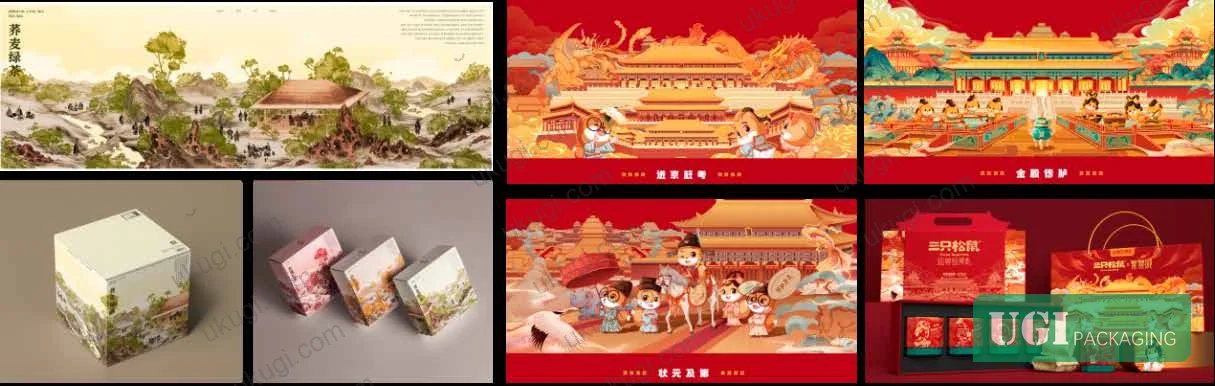
The design was applied to a 12-piece gift packaging series for Dunhuang cultural products. Each piece featured a scene from the nine-colored deer legend in sequence: “Deer in Forest,” “Drowning Man Calls for Help,” “Sacred Deer Rescues Life,” “Hunter Encounters Deer,” “Golden Dream,” “Dancing in Silk,” “Revealing the Dream,” “Reward Offered for Deer,” “Betrayer Reports,” “King Leads Search,” “Deer Tells Truth,” and “Betrayer Punished.” The sequential structure allows consumers to experience the complete narrative arc across the product set, with each individual package functioning as both standalone design and chapter in the larger story.
Practical Guidance for Buyers #
When sourcing narrative illustration for cultural gift packaging, distinguish between suppliers offering illustration services and those capable of narrative design systems. Illustration services provide pretty pictures. Narrative design systems provide story architecture, character consistency across scenes, emotional pacing, and visual flow coordination. Request work samples showing multi-piece packaging sets, not individual box designs, and evaluate how story elements carry across the set. Can you understand the narrative sequence without text? Do characters maintain visual consistency while showing appropriate action/emotion in each scene? Does the color palette and compositional rhythm create unified brand experience?
Budget 8–15 weeks for proper narrative illustration development on cultural gift packaging projects. This includes story research and theme extraction (2 weeks), character design and scene storyboarding (3–4 weeks), full illustration execution (3–4 weeks), and package application/adaptation (2 weeks). Rush timelines force suppliers to skip the story development phase, resulting in decorative illustration labeled as “narrative” that lacks the contextual and conceptual layers where value actually lives. For annual programs or product line extensions, establish character style guides and narrative framework in year one, then amortize that investment across subsequent releases.
Ukugi’s packaging design team works with international buyers on cosmetics packaging solutions, jewelry packaging boxes, and other premium applications where narrative illustration can differentiate brand positioning. We guide clients through theme extraction workshops, develop character archetypes tied to brand values, and coordinate illustration application across rigid boxes, labels, tissue paper, and secondary packaging components. The challenge isn’t illustration quality — most suppliers can execute clean artwork — it’s ensuring narrative coherence across all brand touchpoints and maintaining cultural authenticity while meeting modern aesthetic standards.
Technical specifications matter more than buyers realize. Request vector file formats (AI, EPS) for all illustration work to enable future adaptation and ensure print quality at any scale. Specify color in Pantone solid coated references plus CMYK process builds for offset printing, not RGB screen values. Require layered source files (character, background, effects separated) to enable package structure variations without full illustration rework. Include usage rights for illustration across print, digital, and dimensional applications in the contract — some suppliers restrict illustration use to initial package design, charging additional fees for secondary applications like retail displays or web assets.
Need custom narrative illustration for a cultural gift packaging program? Request a quote from our team →
Technical Verification Questions #
- What is your process for translating brand narrative into sequential visual story elements, and can you provide documentation showing character design evolution, scene storyboarding, and compositional flow planning from a previous cultural packaging project with at least 6+ connected scenes?
- How do you ensure illustration style consistency across multi-piece packaging sets, and what file organization structure do you use to maintain character proportion ratios (within ±3% variance), color palette adherence (Delta E <2.0 between scenes), and line weight consistency when illustrations are applied to different package formats?
- What is your typical timeline for narrative illustration development including theme research, character archetype design, scene sequencing, and final artwork delivery for a 5-scene cultural gift packaging system, and at what project milestones do you require client approval before proceeding?
- Can you demonstrate how your illustration workflow accommodates different printing processes (offset lithography, flexography, digital printing) and substrate types (coated paperboard 300gsm+, uncoated kraft, textured specialty stocks), including any design adjustments needed for ink hold-out, color gamut limitations, or registration tolerances exceeding ±0.5mm?
- What percentage of illustration projects in your portfolio demonstrate true narrative sequencing (characters and story progression across 3+ connected scenes with visual flow continuity) versus decorative illustration (isolated images without narrative relationship), and can you show consumer comprehension test data or brand recall metrics from completed narrative packaging programs?
Quality Verification Checklist #
- ☐ Supplier provides complete storyboard documentation showing all scenes in sequence with character continuity, environmental consistency, and compositional rhythm verified across the full package set, not isolated individual designs
- ☐ Character design specifications include proportion ratios, color formulas (Pantone + CMYK builds), line weight standards (minimum 0.25pt for fine details, 0.75–1.5pt for primary linework), and visual attribute documentation ensuring <3% size variance across scenes
- ☐ Scene sequencing demonstrates logical narrative flow with eye-movement direction, visual bridging elements between adjacent scenes, and tested consumer comprehension rate ≥70% for story understanding without text explanation
- ☐ Illustration files delivered in vector format (AI, EPS) with minimum 300 DPI raster effects, layered source files separating characters/backgrounds/effects, and color management profiles embedded for offset/digital printing workflows
- ☐ Cultural authenticity verified through source material documentation, expert review confirming appropriate use of traditional symbols/motifs, and visual research showing design decisions maintain heritage integrity while meeting contemporary aesthetic standards
- ☐ Package application mockups demonstrate how illustration adapts across different structural formats (folding cartons, rigid boxes, sleeves, labels) while maintaining narrative coherence and visual hierarchy at actual print scale
- ☐ Usage rights contract specifies illustration ownership, permitted applications (print/digital/dimensional), adaptation rights for future package variations, and any restrictions on geographic markets or product categories
- ☐ Print production specifications confirm illustration design accommodates chosen printing method limitations including achievable color gamut (offset: 95%+ Pantone match, digital: 85–90%), registration tolerance (±0.5mm for offset, ±0.75mm for digital), and minimum feature size reproducibility (0.25pt line weight, 6pt minimum readable text)
Key Specifications Table #
| Parameter | Recommended Value | Verification Method |
|---|---|---|
| Narrative scene count (multi-piece sets) | 3–12 scenes depending on package configuration; minimum 3 for basic story arc (beginning/climax/resolution) | Review complete storyboard showing sequential narrative flow; verify character and environmental continuity across all scenes |
| Character design consistency variance | ≤3% dimensional variance in character proportions across scenes; ΔE <2.0 for color consistency between scenes | Measure character height/width ratios in design files; use spectrophotometer to verify printed color Delta E between package pieces |
| Illustration file format and resolution | Vector format (AI, EPS) with embedded raster effects at minimum 300 DPI; layered source files with characters/backgrounds/effects separated | Request native working files; verify layer structure and raster effect resolution in pre-production file review |
| Consumer story comprehension rate | ≥70% unaided comprehension of narrative sequence and character relationships without text explanation | Conduct consumer testing with 20+ participants unfamiliar with source story; measure correct interpretation of plot sequence |
| Negative space ratio for visual hierarchy | 60–80% negative space in primary scene compositions to ensure character focus and prevent visual clutter | Analyze scene compositions using image editing software; calculate ratio of active illustration elements to total composition area |
| Cultural source authenticity documentation | Complete visual research documentation showing traditional source material, design adaptation rationale, and expert review confirmation | Review supplier’s research materials including reference imagery, adaptation notes, and cultural consultant validation if applicable |
Looking for a manufacturer that meets these specifications? Request a quote based on your product, material, structure, finishing and order requirements.
References #
Data source: Narrative Illustration Design Methodology for Cultural Gift Packaging Applications, R. Tang et al., Journal of Applied Polymer Science, 2024
Frequently Asked Questions #
What’s the cost difference between standard decorative illustration and full narrative illustration systems for gift packaging?
Narrative illustration systems typically cost 40–60% more than decorative illustration due to extended design development time (story research, character consistency work, scene sequencing), but the price gap narrows significantly on repeat orders or product line extensions since the core narrative framework and character designs are reusable. Budget $3,000–8,000 USD for initial narrative system development on a 3–5 piece gift set, then $800–2,000 per new scene for extensions.
How many scenes do I actually need for effective narrative packaging?
Three scenes deliver a complete story arc (setup/climax/resolution) and work well for premium single-gift packaging or small multi-piece sets. Five to eight scenes allow richer storytelling with character development and emotional pacing, suitable for larger gift collections or seasonal product series. Beyond 12 scenes, narrative complexity usually exceeds consumer attention span in packaging contexts — save extended narratives for collectible programs where consumers actively seek story completion.
Can narrative illustration work with minimal or sustainable packaging designs?
Yes, but requires tighter scene editing and more efficient visual communication. Minimal packaging has less surface area for illustration, so focus on 1–2 key story moments with strong symbolic clarity rather than attempting full narrative sequence. Sustainable kraft or recycled substrates actually enhance certain narrative styles — folk art, woodblock print aesthetics, hand-drawn illustration styles all complement natural fiber textures and limited color palettes typical of eco-conscious packaging.
How do I verify a supplier actually understands narrative design versus just decorative illustration?
Ask for work samples showing character consistency across multiple scenes and test whether you can follow the story without reading text. Request their design process documentation — proper narrative design starts with storyboarding and scene sequencing before any final artwork. Suppliers who jump straight to finished illustration or present random scene collections without narrative logic don’t have true narrative capability regardless of art quality.
Does narrative illustration require specific printing methods or does it work across all processes?
Narrative illustration adapts to any printing method, but design execution must account for process limitations. Offset lithography handles fine detail and color gradations well (ideal for intricate character work and atmospheric backgrounds). Flexography requires bolder line weights and higher contrast since fine details fill in on press. Digital printing offers variable data opportunities (personalized story elements) but has narrower color gamut. Screen printing works for bold graphic narrative styles but struggles with subtle gradations. Specify your printing method during design development so illustration complexity matches process capabilities.
Published by ukugi.com Technical Team | Request a quote


