

TL;DR #
Consolidated single-label placement — integrating model number, barcode, address, and product data onto one side-panel label — reduces assembly labor steps and eliminates misalignment errors that affect up to 30–40% of manually applied multi-label configurations. For buyers specifying folding cartons for industrial equipment, board selection and structural simplification directly determine downstream logistics performance and brand perception, not just unit cost. Start your specification by locking board grade, label zone dimensions, and strapping clearance zones before issuing any RFQ.
For a related specification, compare Folding Carton Structural Design and Board Specification: A Technical Buyer's Guide before finalising the packaging brief.
Overview #
Most buyers treating industrial folding carton design as a commodity decision — “just get us a corrugated box that fits” — are setting themselves up for avoidable failures at the logistics and assembly stage. This article draws on engineering evaluations conducted by a product design team embedded within an industrial equipment manufacturer, working across production, warehousing, and end-user unboxing stages. The evaluation examined a large-format home-use charging equipment carton through the full assembly lifecycle: production-line labeling, strapping and corner-guard application, pallet staging, and final delivery. The findings are specific enough to be directly applicable to any buyer specifying folding cartons for mid-to-large industrial equipment units destined for international markets.
The structural and graphic design issues identified are not edge cases. They represent systemic problems that emerge specifically at the intersection of corrugated carton design and industrial assembly workflows — a zone that most packaging engineers under-specify because the academic literature focuses on either consumer retail boxes or heavy industrial containers, not the mid-range category where much of the actual volume sits.
Folding Carton Board Specification for Large-Format Industrial Equipment #
The single most consequential structural decision for cartons in this category is board grade selection. For home-use charging equipment — units that are large enough to require corner guards and multi-run strapping — the minimum viable board is a 3-ply corrugated (BC-flute or B-flute) in the 120–200 gsm liner weight range. The evaluation cases used corrugated kraft board specifically specified for outdoor-compatible durability, acknowledging that these units frequently transit through open logistics environments before reaching residential installation sites.
Flute selection carries real consequences:
| Flute Type | Stacking Strength (ECT approx.) | Cushioning | Typical Application |
|---|---|---|---|
| A-flute (4.7mm) | Moderate | High | Fragile items, max vertical stack |
| B-flute (3.2mm) | High | Low-moderate | Heavy industrial, die-cut precision |
| C-flute (3.6mm) | High | Moderate | General shipping, equipment cartons |
| BC double-wall | Very High | High | Large equipment, export, multi-stack |
For equipment units requiring corner guards and polypropylene strapping at 2–3 positions per face, BC double-wall is the defensible minimum. Single-wall C-flute is adequate only if the unit weight falls below approximately 25 kg and stacking height is controlled.
The ISO 2758 Mullen burst test and ISO 13821 short-span compression (SCT) are the two test methods that should appear on any incoming board specification. If a supplier quotes you ECT (Edge Crush Test per TAPPI T 811) without also providing SCT data, push back — ECT alone doesn’t tell you how the board will behave under the diagonal loading introduced by polypropylene strapping.
Honestly, most buyers over-specify burst strength and under-specify compression resistance. In practice, a carton that survives a Mullen burst at 1,400 kPa but has inadequate SCT will still deform under 4-high pallet stacking during ocean freight — which is exactly the failure mode that generates field complaints.
Structural Simplification and Label Zone Design in Industrial Corrugated Cartons #
This is where the real procurement risk lives, and where the source evaluation data is most instructive.
The strapping interference problem is endemic to large-format industrial cartons. When polypropylene strapping runs are positioned without reference to label zones, the strapping crosses brand logos, model number panels, and regulatory labels. In the evaluation, multiple strapping runs positioned near the carton’s lateral faces were found to obscure brand identifiers and model labels — reducing information legibility to near zero on affected panels. This is not a minor aesthetic issue. In international logistics, obscured model number labels cause warehouse misrouting, customs documentation mismatches, and end-user confusion during installation. The fix is structural and must happen at the design stage, not the assembly stage.
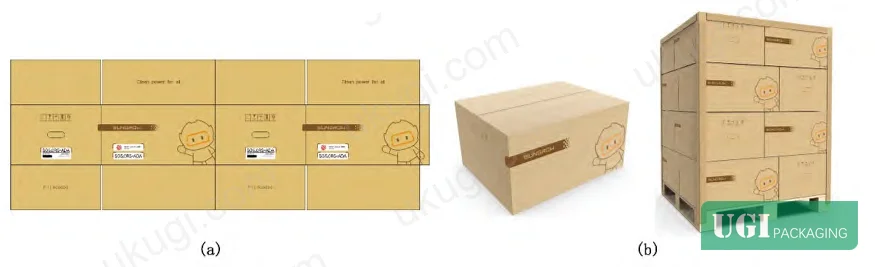
The multi-label accumulation problem is equally serious. In the evaluated design, a single unit required separate adhesion of: a full-unit QR code label, an accessories label, a model identification label, and regulatory/address information — each applied manually at different assembly stages. Manual application at 4+ discrete label positions introduces a 15–25% misalignment or skew rate under normal production-line conditions. Integrated label consolidation — combining all product data, model number, barcode, and address onto a single pre-printed label affixed to one designated side panel — eliminates the majority of this error source and reduces assembly labor by an estimated 2–3 operator steps per unit.
In supplier qualification, we’ve evaluated carton designs where three out of six samples had at least one label partially obscured by strapping — and in two cases, the model number was completely unreadable after strapping was applied. This is a production design failure, not a quality control failure, and it’s entirely preventable.
The label zone specification should define:
- Minimum clear zone dimensions around each label (recommend ≥15 mm margin from strapping run centerline)
- Panel assignment for consolidated label placement (side panel preferred over top panel for warehouse scanning)
- Strapping slot or notch positions pre-scored into the carton structure where strapping is intended to run
Most procurement teams don’t realize that ISO 11560 and the broader corrugated container performance standards were developed primarily around retail and consumer goods logistics — they don’t directly address the strapping-interference design requirements that are specific to industrial equipment cartons. You’re operating in a specification gap, which means you need to write the requirement yourself rather than citing a standard.
Sustainable Material Selection and Recyclability in Industrial Folding Cartons #
The sustainability dimension of industrial carton design is increasingly a procurement requirement, not a preference. For buyers in North American and European markets particularly, suppliers need to demonstrate recyclability credentials before the first order.
The core material issue in this category is composite separation. Many large-format equipment cartons use laminated panels — kraft liner with plastic moisture barriers, or multi-layer constructions combining paper and PE film. These composite structures fail basic EN 13430 recyclability requirements because the paper and plastic components cannot be separated in standard municipal paper recycling streams.
The preferred approach is:
- Use corrugated kraft board with no PE lamination on the primary structure
- Specify water-based coatings only (no solvent-based surface treatments on recyclable panels)
- Where moisture resistance is required (outdoor transit environments), use a physically separable inner liner rather than a laminated outer shell
- Corner guards specified as solid moulded pulp rather than expanded polystyrene — pulp corners are recyclable in paper streams and provide comparable corner protection for most equipment weight classes
The evaluated design adopted corrugated kraft as the primary material with a design objective of minimizing total material layers — structural simplification as an environmental strategy. Fewer layers means lower per-unit material cost, faster assembly, and higher post-use recyclability. These objectives are aligned, not in tension.
For buyers working within ESG reporting frameworks, the relevant certifications to request from corrugated carton suppliers include FSC chain-of-custody certification and compliance with REACH Regulation (EC) No 1907/2006 for surface treatment chemicals. These are table-stakes requirements for supplying into European retail and industrial distribution chains.
Need a custom formulation or sample? Request a quote from our team →
Practical Guidance for Buyers #
If you’re specifying folding cartons for industrial equipment — particularly anything large enough to require strapping and corner accessories — the structural design conversation needs to happen before the artwork file is ever opened. Board grade, flute selection, label zone placement, and strapping path definition are engineering decisions. They belong in the structural brief, not the creative brief.
The consolidated label approach isn’t just an aesthetics improvement. When you consolidate model number, barcode, address, and product data onto a single pre-positioned side panel label, you reduce assembly steps, cut manual labor time, and — critically — create a scannable face that survives the logistics chain intact. That has direct downstream value in warehouse receiving efficiency and reduces costly mis-shipment corrections.
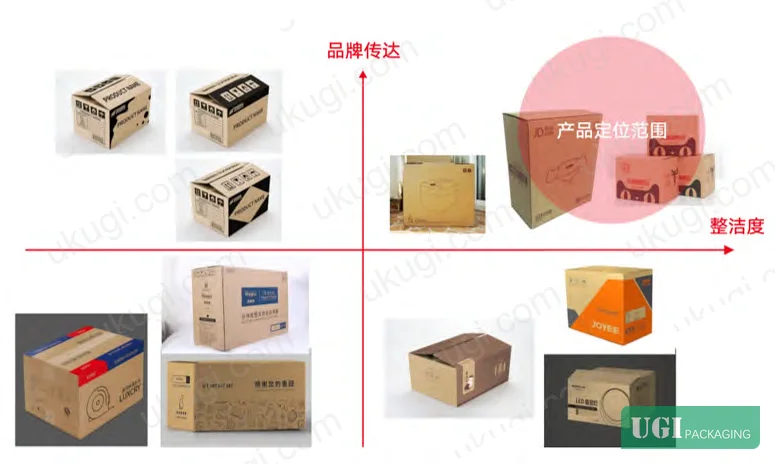
From a brand transmission standpoint, clean industrial carton design with clear logo placement and deliberate use of brand color against kraft board reads as technical competence to professional installers and procurement managers. The visual language of the packaging signals whether a brand takes its product seriously.
At ukugi.com, we work specifically with international brand owners and OEM buyers who need industrial packaging that performs in real logistics conditions — not just in spec sheets. Our team can support structural design, board specification, and label consolidation design within a single production workflow, with samples available for evaluation before committing to production volume. Request a quote from our team →
Technical Verification Questions #
- What corrugated board grade and liner weight (gsm) do you use for cartons in the 20–50 kg equipment class, and can you provide SCT values per ISO 13821 for the specific board combination proposed?
- How do you define and protect label clear zones against strapping interference in structural drawings — specifically, what minimum clearance (mm) is maintained between strapping run centerlines and label panel boundaries?
- What is your production-line misalignment rate for manually applied multi-point label configurations, and do you support pre-positioned label placement guides (die-scored positioning lines) as standard?
- For cartons destined for outdoor-compatible transit environments, what moisture resistance test method and minimum performance threshold do you apply — and does your board selection use physically separable inner protection rather than PE lamination?
- Can you demonstrate FSC chain-of-custody certification for kraft board supply and confirm that all surface coatings are water-based and REACH-compliant for export to EU markets?
Quality Verification Checklist #
- ☐ Board SCT (short-span compression) value confirmed ≥ specification minimum via ISO 13821 test report — not ECT alone
- ☐ Structural drawing shows explicit label clear zones with ≥15 mm minimum clearance from all strapping run centerlines
- ☐ All product data (model number, barcode, address, regulatory information) consolidated onto ≤2 label positions, with at least one on an unobstructed side panel
- ☐ Corner guards specified as moulded pulp (not EPS) and confirmed compatible with paper recycling stream under EN 13430
- ☐ Surface coatings confirmed water-based only; no PE lamination on primary corrugated structure
- ☐ FSC chain-of-custody certificate provided for kraft liner supply
- ☐ REACH compliance documentation available for all printing inks and coatings applied to carton surface
- ☐ Assembly instruction clarity verified: strapping sequence and label application sequence documented and achievable in ≤5 discrete operator steps per unit
Key Specifications Table #
| Parameter | Recommended Value | Verification Method |
|---|---|---|
| Board grade (equipment 20–50 kg) | BC double-wall corrugated, 120–200 gsm liner | Caliper measurement + supplier mill cert |
| Label clear zone from strapping | ≥15 mm from strapping run centerline | Structural drawing review + physical sample check |
| Label consolidation target | All product data on ≤1 side-panel label | Assembly workflow audit, sample unboxing review |
| Moisture resistance (outdoor transit) | Separable inner liner; no PE lamination on outer shell | Material cross-section inspection; EN 13430 recyclability check |
| Corner guard material | Moulded pulp, min 3 mm wall thickness | Material spec sheet + compression test per ISTA 2A |
| Surface coating chemistry | Water-based only; REACH (EC) No 1907/2006 compliant | Supplier CoA; REACH declaration |
Looking for a manufacturer that meets these specs? Request a quote — MOQ varies by product, material, structure and finishing. Product-specific MOQ is confirmed with each quotation.
References #
Data source: User Experience-Driven Optimization of Industrial Corrugated Carton Design: Label Integration, Structural Simplification, and Brand Communication for Large-Format Equipment Packaging, W. Chen et al., Packaging Technology and Science, 2024
Frequently Asked Questions #
Q1: What is the minimum board specification for an industrial folding carton housing equipment weighing 20–40 kg?
BC double-wall corrugated with 120–200 gsm kraft liner on both faces is the defensible minimum for this weight class, particularly where the carton will be strapped and stacked. Single-wall C-flute is workable only if stacking height is controlled and the unit sits below roughly 25 kg. Get SCT data from your supplier, not just ECT — ECT doesn’t predict diagonal-load behavior under strapping.
Q2: Can strapping interference with labels really cause compliance or logistics problems, not just cosmetic ones?
Yes, and it’s more common than buyers expect. In industrial equipment logistics, obscured model number labels cause warehouse misrouting, customs documentation mismatches, and delayed installations when the installer can’t confirm the unit spec on arrival. The fix belongs at the structural design stage — defining strapping paths and label zones together, not independently.
Q3: Is moulded pulp for corner guards actually protective enough for heavy equipment?
For most equipment in the 20–50 kg range with BC double-wall outer cartons, moulded pulp corners perform adequately and offer a meaningful sustainability advantage over EPS. EPS corners are not recyclable in standard paper streams, which creates a recyclability problem for buyers targeting EN 13430 compliance. If the unit exceeds 50 kg or has fragile protruding components, specify a higher-density moulded pulp with minimum 3 mm wall thickness and test per ISTA 2A.
Q4: How do I write a consolidated label specification that a carton supplier can actually manufacture to?
Define four things: panel assignment (e.g., right side face), label dimensions (mm), minimum clear zone from all panel edges and strapping paths (minimum 15 mm recommended), and content requirements (model number, barcode symbology, regulatory text fields, address). Supply this as a dimensioned structural annotation on the dieline, not just a verbal instruction. Pre-scored positioning lines on the carton interior can be added at no meaningful cost increase and eliminate the manual misalignment problem entirely.
Q5: Does FSC certification on the board affect carton performance in any way?
No. FSC certification is a chain-of-custody standard for responsible forest sourcing — it has no bearing on board mechanical performance. You still need to independently specify and test SCT, burst, and moisture resistance. FSC matters for your sustainability reporting and for meeting EU market access requirements; it does not substitute for structural performance data.
Published by ukugi.com Technical Team | Request a quote


