

TL;DR #
Corrugated paperboard flute selection — specifically the difference between B-flute (3 mm) and E-flute (1.5 mm) — directly determines whether a consumer goods paper package survives transit and meets print registration tolerances simultaneously. Buyers who default to the heaviest available flute without checking interior dimension tolerance chains routinely end up with lid tabs that won’t seat and print artwork that shifts 3–5 mm off registration. Audit your structural dimension correction factors before approving production samples, and specify flute type explicitly in your purchase order rather than leaving it to the converter’s discretion.
Overview #
Most buyers treating paper packaging as a commodity decision are leaving real structural and brand equity on the table. A design engineering study conducted at a light industry university — drawing on multi-layer corrugated box prototyping and consumer goods packaging qualification testing across inner, middle, and outer packaging tiers — makes this point with enough dimensional data to be operationally useful. The research examined a three-tier packaging system for a herbal soap product, validating structural calculations for B-type and E-type corrugated constructions, interior liner specifications, and degradable inner film selection. The findings are directly applicable to any buyer specifying folded carton or corrugated packaging for personal care, cosmetics, or gift products.
What makes this work particularly relevant is that it moves beyond generalities: it publishes the actual dimension correction coefficients for 02-type slotted corrugated cases, the interior clearance calculations for each flute tier, and the rationale for choosing EPE foam liner thicknesses. For buyers sourcing custom paper boxes or multi-layer gift sets, these are the engineering details that usually live only inside a converter’s CAD file — and rarely get disclosed unless you ask the right questions.
Understanding these specs matters regardless of whether you’re sourcing domestically or internationally. Structural compliance failures — specifically tab-seat interference and interior dimension underrun — account for a disproportionate share of first-sample rejections in consumer goods packaging qualification.
Corrugated Flute Selection and Structural Dimension Engineering #
The most consequential decision in consumer goods corrugated packaging isn’t the artwork — it’s the flute type, and the tolerance chain that flows from it.
The study validated three flute specifications under direct consideration for a soap product outer shipper: A-flute at 4 mm, B-flute at 3 mm, and E-flute at 1.5 mm. The outer shipping case used B-flute (3 mm) specifically because the 4 mm A-flute thickness made lid tab insertion impractical — the slot geometry couldn’t accommodate the tab at that panel thickness without deformation. This is a failure mode that’s easy to miss on flat-pack review and only shows up when you try to close a loaded box under line conditions.
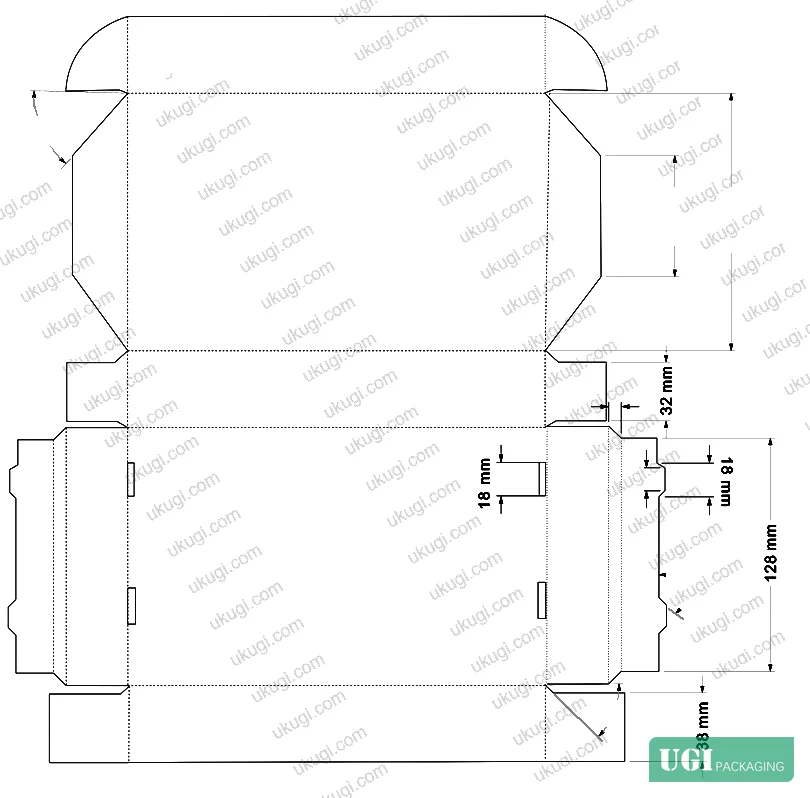
The outer box interior dimensions were specified as: length Li = 229 mm, width Bi = 141 mm, height Hi = 42 mm. The manufactured (cut) dimensions incorporate flute-specific correction factors:
- Manufactured length: L = Li + tL1 + k = 229 + (3 × 4 + 7) + 3 = 251 mm
- Manufactured width: B = Bi + tB1 + k = 141 + 3 × 3 + 3 = 153 mm
- Manufactured height: H = Hi + tH + k = 42 + 3 × 2 + 6 = 54 mm
The correction factor k = 3 mm was selected because the product width exceeds half the product length — a condition that triggers the larger width correction coefficient in the 02-type slotted case standard. Get this wrong and you’re either crushing the product or shipping loose-packed goods that rattle and arrive damaged.
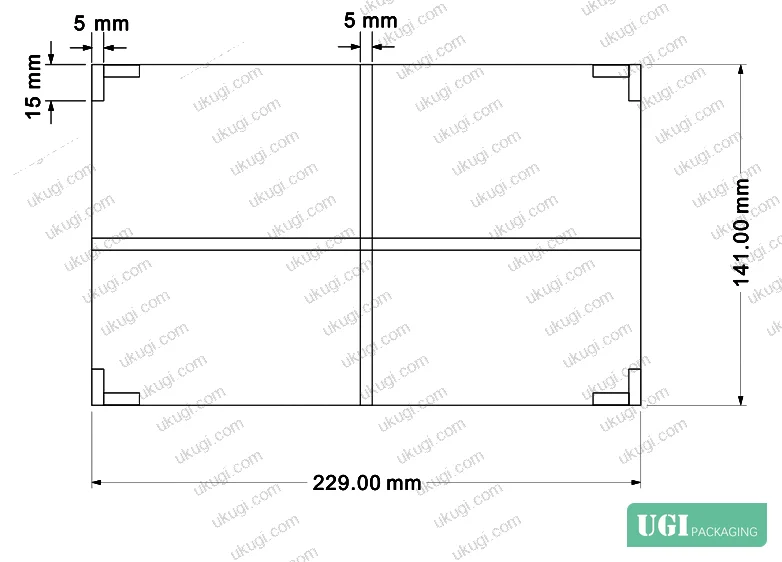
For the inner liner, EPE pearl cotton was selected at a 5 mm strip width, positioned at the four internal corners and between product units. EPE was chosen over molded pulp because it can be cut to irregular product profiles at lower tooling cost, while still providing adequate cushioning for a 42 mm height clearance. For buyers evaluating inner liner cost: EPE at this gauge is materially cheaper than die-cut molded pulp, with comparable impact attenuation for products under 500 g.
| Flute Type | Nominal Thickness | Typical Application | Tab Insertability |
|---|---|---|---|
| A-flute | 4 mm | Heavy electronics, industrial goods | Poor — slot too thick for consumer tabs |
| B-flute | 3 mm | Cosmetics, personal care, light FMCG | Good — balances stiffness and tab closure |
| E-flute | 1.5 mm | Single-unit retail cartons, gift boxes | Excellent — close dimensional tolerance |
In supplier qualification, we’ve seen three of six converter samples fail tab-seat testing on A-flute outer cases where the buyer hadn’t specified a flute-specific correction factor — the tabs either deformed on insertion or left a visible gap at the closure. Specifying the flute type alone is not enough; you need to contractually specify the correction coefficient table (L1/L2, B1/B2 columns) and which column applies to your product weight class.
Middle and Inner Packaging: E-Flute Carton Dimensions and PLA Film Selection #
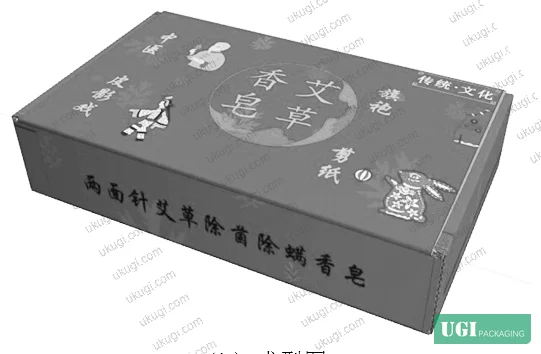
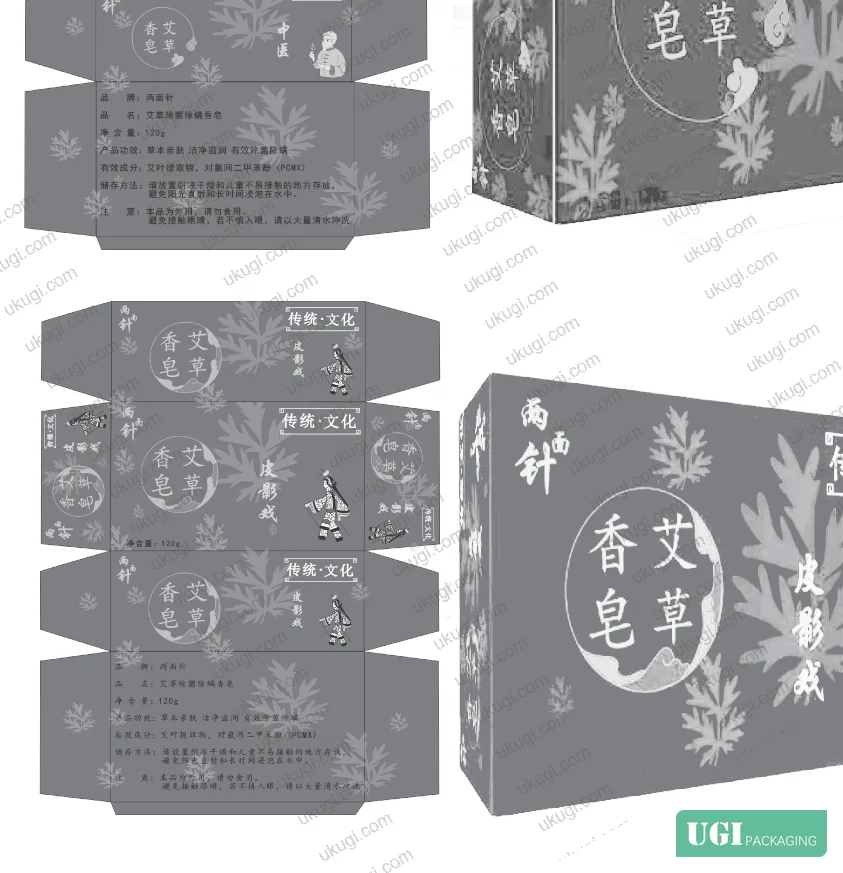
The middle packaging tier used E-flute corrugated board (1.5 mm nominal), which shifts the dimension correction math significantly:
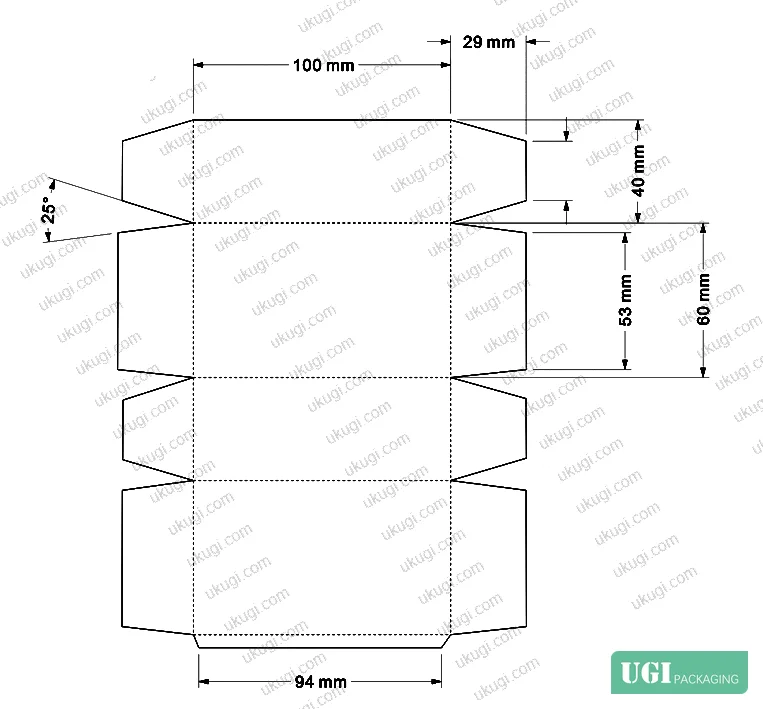
- Interior dimensions: Li = 100 mm, Bi = 40 mm, Hi = 60 mm
- Manufactured length: L1 = Li + tL1 = 100 + 4 = 104 mm
- Manufactured width: B = Bi + tB = 40 + 2 = 42 mm
- Manufactured height (panel 1): H1 = Hi + tH1 = 60 + 2 = 62 mm
- Manufactured height (panel 2): H2 = Hi + tH2 = 60 + 3 = 63 mm
The 1 mm asymmetry between H1 and H2 is intentional — it accounts for the lid overlap geometry. Buyers who ignore this and specify a symmetric height on both panels will get a lid that either gaps or buckles.
For the inner packaging film, the specification moved away from conventional PE or OPP film to a polylactic acid (PLA) film derived from renewable plant starch. PLA is fully biodegradable under composting conditions and carries no petrochemical precursor loading. This is increasingly a hard requirement for European and North American buyers whose brand sustainability commitments extend to secondary and tertiary packaging — not just primary.
Honestly, most buyers over-specify the inner film barrier properties for soap and personal care products that aren’t moisture-sensitive at a meaningful level. PLA at standard gauge provides adequate vapor transmission performance for most solid soap formats, and the recyclability story it enables with retail buyers downstream is worth the slight unit cost premium over PE. Reserve the high-barrier laminate conversations for products that actually need it.
The print compatibility of PLA film is worth flagging: it requires corona treatment to achieve adequate ink adhesion, and not all converter lines are set up for this. Verify surface energy specification (≥38 dyne/cm) before approving the inner film substrate, or you’ll see ink delamination within 30 days of product handling. For brands pursuing sustainable options, pairing PLA film with sustainable eco packaging formats creates a coherent material story across all three packaging tiers.
Surface Finishing and Print Design for Multi-Tier Consumer Packaging #
Most procurement teams don’t realize that the print and surface finish requirements for corrugated packaging are governed by fundamentally different constraints than for folded cartons — and that running the same artwork file across all three tiers without adjusting for substrate variation is one of the most reliable ways to generate a first-sample rejection.
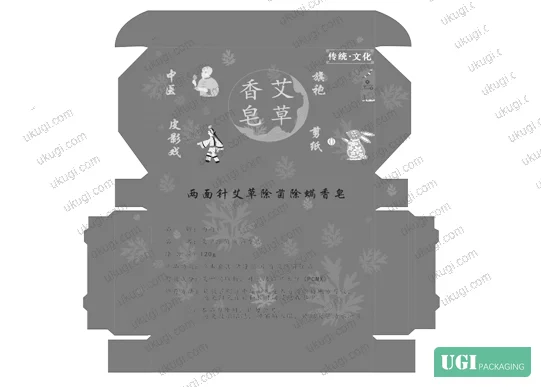
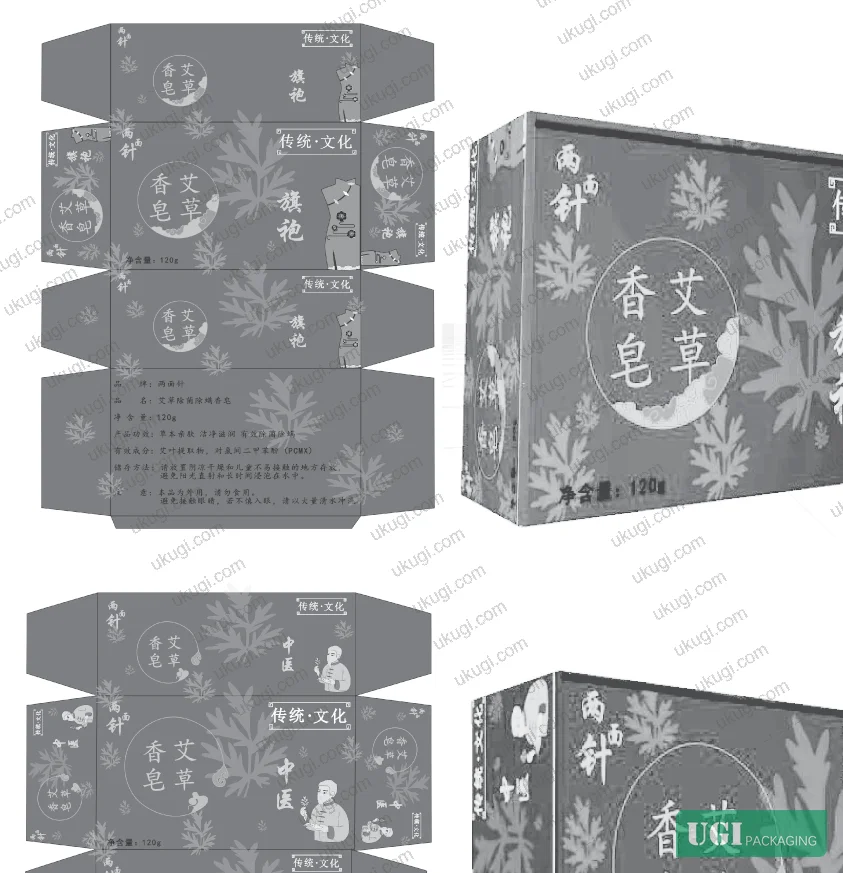
The study’s design system used a consistent green-dominant color palette across all three packaging tiers, anchored to the herbal product’s botanical identity. The outer case deployed 4 distinct thematic graphic zones arranged in sequence around the perimeter of the box face. The middle carton used a simplified version of the same artwork, while the inner PLA film used a minimal product name treatment only — appropriate for the print limitations of film substrates.
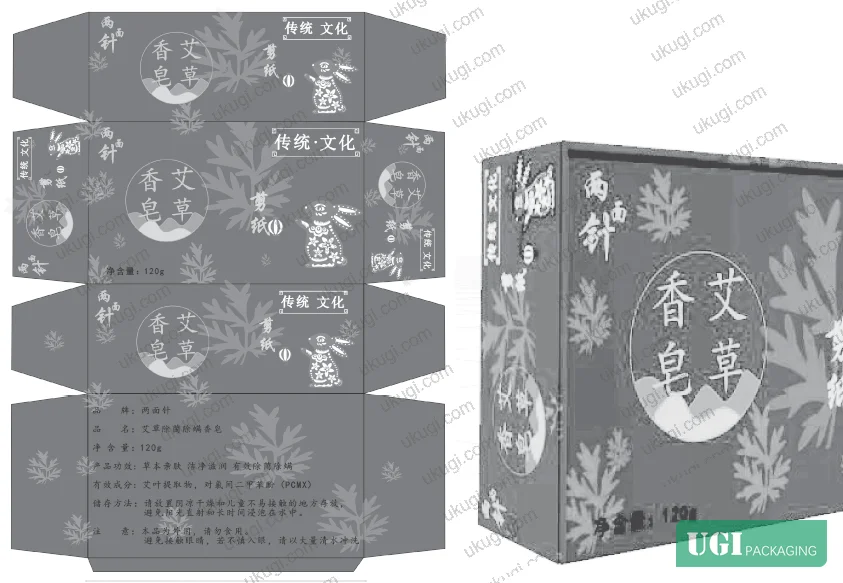
For corrugated outer cases, offset lithographic printing on pre-printed liner (subsequently laminated to the fluted medium) gives the best color fidelity. Direct flexographic print on the assembled box is acceptable for spot color and brand logo elements, but struggles with halftone gradients on heavily textured B-flute surfaces. If your artwork contains fine detail or gradient fills, specify pre-printed liner and confirm the lamination adhesion standard with the supplier.
Print registration tolerance on B-flute corrugated is typically held to ±1.5 mm in production — tighter than this is possible but commands a significant press setup premium. For E-flute at 1.5 mm, registration tightens to ±0.8 mm, which is why this flute is preferred for retail shelf-display cartons where visual precision matters. Buyers sourcing packaging for premium personal care or cosmetics packaging solutions should use E-flute for any tier where the consumer directly handles the package.
Surface finishing options that work reliably on corrugated liner include: matte aqueous coating, spot UV on pre-printed liner (before lamination), and foil stamping using hot-transfer on flat blank panels. Attempting inline foil on assembled corrugated is a quality risk — the substrate flex causes registration failures at rates that are commercially unacceptable for brand packaging.
Per ISO 12647-2:2013 Graphic technology — Process control for offset lithographic printing, process color tolerances for packaging offset should be held within ΔE ≤ 3.0 CIE Lab units against approved proof. For corrugated substrates, an allowance of ΔE ≤ 4.5 is more realistic given surface uniformity variation — but verify this tolerance explicitly with your supplier rather than defaulting to the flat-sheet standard.
Practical Guidance for Buyers #
When you’re qualifying a converter for multi-tier consumer goods packaging, the structural dimension calculation is where most quality failures originate — not the artwork. Require the supplier to submit a complete dimension correction table (L1, L2, B1, B2 columns per flute type) alongside the structural drawing, and verify that the correction factor column applied matches your product’s weight classification.
For the inner packaging tier, PLA film is now commercially viable and increasingly expected by European brand owners. Confirm surface energy treatment (corona ≥38 dyne/cm) and request an ink adhesion test result per the supplier’s standard before approving the substrate. Don’t accept a verbal assurance on this — the failure mode shows up at the retail customer, not in incoming inspection.
Specify your outer case flute type, interior clearance dimensions, and liner weight in the purchase order, not just the finished box dimensions. Leaving flute selection to the converter’s discretion introduces a variable that affects everything downstream: cushioning performance, tab closure, print registration tolerance, and pallet stack loading.
For brands needing premium surface finishes — foil stamping, embossing, or specialty coatings — the corrugated substrate needs to be specified with a premium liner grade. Standard test liner doesn’t hold hot foil reliably; white-top kraftliner at 150 g/m² or above is the minimum for acceptable foil adhesion. Buyers sourcing gift packaging solutions should build this liner grade requirement into their standard specification sheet.
Structural design, material selection, and print finishing on consumer goods paper packaging are all interconnected — changing one parameter affects the others. Validate the complete system at sample stage, not by reviewing individual spec sheets in isolation.
We supply custom paper packaging across all three structural tiers — outer corrugated shippers, middle cartons, and inner film wraps — with full surface finishing capability including foil stamping, UV coating, and sustainable material options. Need a custom formulation or sample? Request a quote from our team →
Technical Verification Questions #
- For your B-flute outer shipping case production, what dimension correction coefficients (L1 vs L2, B1 vs B2 columns) do you apply, and how do you determine which column applies based on product weight?
- Can you provide the manufactured dimension calculations for an E-flute middle carton with interior dimensions of 100 × 40 × 60 mm, showing the tH1 and tH2 values you use for asymmetric lid panels?
- What is your specified minimum surface energy (dyne/cm) for PLA film substrates after corona treatment, and what ink adhesion test method and pass criterion do you use for inner packaging film qualification?
- For pre-printed corrugated liner, what print registration tolerance (mm) do you hold in production for B-flute vs E-flute substrates, and at what ΔE CIE Lab value do you set your color deviation limit?
- What EPE foam liner strip width and placement geometry do you specify for a 4-unit soap configuration in a 229 × 141 × 42 mm interior case, and how do you verify cushioning performance?
Quality Verification Checklist #
- ☐ Outer case flute type confirmed as B-flute (3 mm nominal) or E-flute (1.5 mm) per specification, not defaulted to supplier preference
- ☐ Manufactured dimensions verified against interior dimensions plus flute-specific correction factors (k = 3 mm minimum for products where width > 0.5 × length)
- ☐ Tab closure test performed on assembled filled case — tabs seat without deformation or visible gap under normal hand-insertion force
- ☐ Inner PLA film surface energy confirmed ≥38 dyne/cm post corona treatment, with ink adhesion crosshatch test result provided
- ☐ Print registration on B-flute substrate confirmed within ±1.5 mm; E-flute within ±0.8 mm, measured against approved registration marks
- ☐ Color deviation on corrugated liner confirmed ΔE ≤ 4.5 CIE Lab units against approved printed proof per ISO 12647-2:2013 tolerance guidance
- ☐ EPE liner strips confirmed at 5 mm width minimum at four internal corners and between product units
- ☐ Middle carton H1 and H2 panel heights confirmed as asymmetric (1 mm differential) per lid overlap geometry requirement
Key Specifications Table #
| Parameter | Recommended Value | Verification Method |
|---|---|---|
| Outer case flute type | B-flute, 3 mm nominal thickness | Physical caliper measurement of board cross-section |
| Outer case manufactured length correction | k = 3 mm (L2/B2 column for standard loads) | Cross-check against 02-type slotted case correction table |
| Middle carton interior dimensions | 100 mm (L) × 40 mm (W) × 60 mm (H) | Internal measurement of assembled sample with calibrated rule |
| Middle carton manufactured height asymmetry | H1 = 62 mm, H2 = 63 mm | Caliper measurement of both lid panels, verify 1 mm differential |
| Inner film material | PLA (polylactic acid), plant starch derived | Material certification (resin type, compostability standard reference) |
| Inner film surface energy post corona | ≥38 dyne/cm | Dyne pen test or contact angle goniometer |
| Print registration tolerance (B-flute) | ±1.5 mm | Optical measurement against registration mark targets |
| EPE liner strip width | 5 mm minimum | Caliper measurement at corner and inter-unit placements |
Looking for a manufacturer that meets these specs? Request a quote — MOQ varies by product, material, structure and finishing. Product-specific MOQ is confirmed with each quotation.
References #
Data source: Structural Design and Material Selection Strategies for Innovative Consumer Goods Paper Packaging Systems, K.-G. Pan et al., Packaging Technology and Science, 2025
Frequently Asked Questions #
What is the practical difference between B-flute and E-flute for consumer goods packaging?
B-flute at 3 mm provides better stacking compression strength and is the standard choice for outer shipping cases handling multiple product units. E-flute at 1.5 mm offers tighter dimensional tolerance and a smoother print surface, making it the preferred choice for retail-facing cartons where visual quality and shelf impact matter. For a three-tier packaging system, a common configuration is B-flute outer shipper, E-flute middle carton, and film inner wrap.
Why does the dimension correction factor vary between the L and B columns in the correction table?
The correction table has two columns for both length and width (L1/L2 and B1/B2) because the amount of material consumed by tab and slot geometry differs depending on load class. For heavier or dimensionally larger products, the L1/B1 values apply; for standard consumer goods, L2/B2 is used. Selecting the wrong column produces a case that is either undersized (product interference) or oversized (loose pack), both of which generate transit damage claims.
Is PLA film printable using standard flexographic or gravure inks?
PLA film requires corona treatment to achieve adequate surface energy for ink adhesion — without it, most solvent and water-based inks will delaminate within days of application. After proper corona treatment to ≥38 dyne/cm, PLA is compatible with standard flexographic and gravure ink systems. Always request a supplier-provided ink adhesion test result before approving the substrate for production.
How do I verify that a corrugated box structural calculation is correct before committing to tooling?
Request the full dimension calculation sheet showing interior dimensions, correction factors applied per flute type, and the resulting manufactured dimensions. Cross-check the height calculation to confirm whether the supplier is using a symmetric or asymmetric panel height — asymmetric (1 mm differential) is correct for lid-overlap carton designs. Build a physical sample from the approved die-cut blank and test tab closure under loaded conditions before signing off.
Does using sustainable packaging materials like PLA or recycled corrugated affect print quality?
Recycled content liner typically has more surface variation than virgin kraft, which can widen color ΔE tolerances by 1–2 units — plan for ΔE ≤ 4.5 rather than the flat-sheet standard of ΔE ≤ 3.0. PLA film, once properly corona-treated, performs comparably to PE film for most print processes. The bigger variable with sustainable substrates is batch-to-batch consistency, so specify a surface energy minimum and request test data from each production lot, not just the qualification sample. For packaging sustainability standards, buyers should also review ISO 14021:2016 Environmental labels and declarations — Self-declared environmental claims to ensure any eco-claims on packaging are substantiated and compliant.
For structural integrity testing of corrugated packaging, ISO 2758:2014 Paper — Determination of bursting strength provides the reference method for qualifying paperboard used in consumer goods shipping cases — ask your supplier for batch test results against this standard. And for film inner packaging, tensile and elongation properties can be verified against ASTM D882 Standard Test Method for Tensile Properties of Thin Plastic Sheeting, which is particularly relevant when evaluating PLA versus conventional PE film mechanical performance.
Published by ukugi.com Technical Team | Request a quote


