

TL;DR #
Retrofitting variable QR codes onto finished flat-pack cartons using a three-head inline inkjet platform — with a dedicated primer white head, a coverage white head, and a black variable-data head — achieves scan grades of 3.0 (B-grade) or above with M-level error correction, meeting tobacco packaging verification requirements. For buyers managing finished-goods inventory that lacks required QR codes, this process eliminates write-off losses without the MOQ constraints of a full reprint run. If you are evaluating suppliers for variable-data overprinting on finished packaging, require them to demonstrate tri-head inline capability and provide barcode verification reports showing ≥3.0 composite grade before approving any production batch.
Overview #
Most procurement teams approach variable QR code addition as a straightforward inkjet job — but when the substrate is silver or gold foil board with UV varnish, and the finished carton is already die-cut to a size smaller than the minimum sheet feed of a conventional press, the production complexity escalates sharply. Field testing conducted by a specialist print manufacturing technical center, involving multiple rounds of platform prototyping and process elimination across different inventory batches and surface treatment conditions, produced a consolidated set of performance data that is directly applicable to buyer qualification decisions.
The research focused specifically on the challenge of retrofitting QR codes onto finished single-piece folding cartons — a scenario that arises when regulatory or brand requirements are upgraded mid-cycle and existing inventory becomes non-compliant. The work covered three major failure modes, two platform iterations, ink material qualification, and a final quality verification protocol. Every numeric threshold cited in this article comes from that process validation record.
This category of work sits at the intersection of digital printing process capability and finished-goods recovery — a niche that separates technically equipped manufacturers from those who simply reorder. Understanding the ink adhesion mechanics and registration tolerances involved will help you ask the right questions before committing inventory to a supplier’s overprint process.
For context on the broader substrate categories involved, custom paper boxes with UV coating and foil board surfaces represent the highest-difficulty class for inkjet adhesion — the findings here apply directly to those formats.
Why Digital Inkjet Overprinting on Finished Folding Cartons Fails — and How to Fix It #
The instinct to solve this with a digital quick-print press is understandable, but it doesn’t work. In early-stage testing with a standard digital press attempting to print the white background block onto finished cartons, paper transport instability caused by the irregular die-cut geometry produced consistent registration failures. More critically, the UV varnish surface — standard on tobacco and premium FMCG cartons — caused severe ink delamination. The white layer simply did not bond. That approach was eliminated entirely after the first test batch.
The second approach — sequential inkjet passes, printing UV white first, curing it, then overprinting black variable QR data — resolved the adhesion problem in isolation but introduced a different failure mode. With two separate inkjet passes, any defect in either pass (trailing, line-pull, show-through, ghosting) caused the composite barcode to fail scan grade. Reject rates were too high to be commercially viable. The process deviation from the intended design was unacceptable.
The solution that passed full process validation was a three-head inline inkjet platform built on the working principle of a multi-color printing unit, with paper transport designed around the cigarette pack inspection machine workflow:
- Head 1 (primer position): High-coverage, high-adhesion UV white ink at low voltage, low resolution — builds adhesion base
- Head 2 (mid position): Standard UV white ink, applied at normal parameters — builds coverage without excessive ink deposit thickness
- Head 3 (final position): Black variable QR code
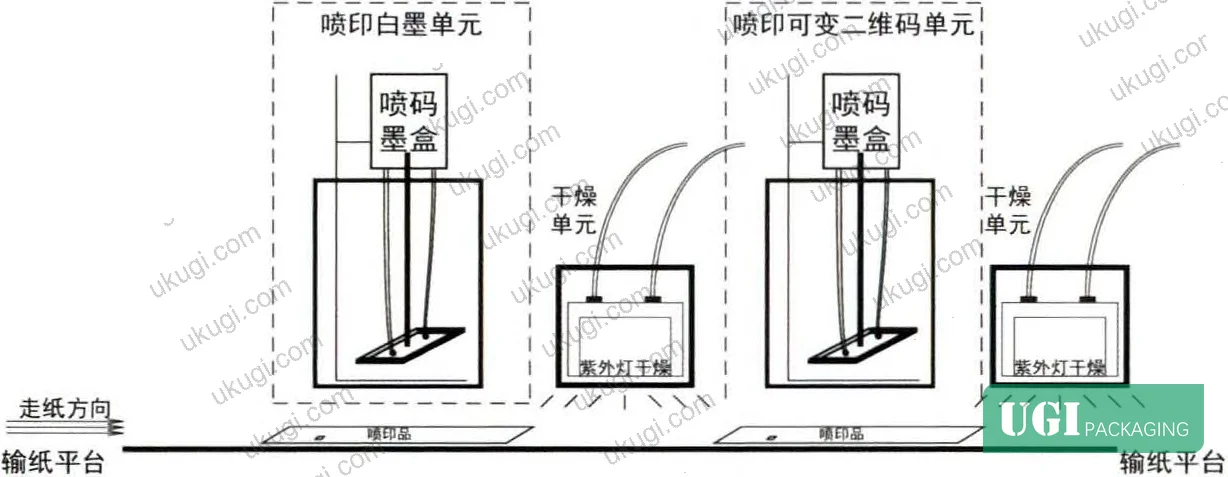
This architecture solved the warping problem that had emerged during small-batch production trials. When a single high-resolution white pass was used to achieve coverage on foil board, the ink deposit in the QR zone was measurably thicker than surrounding areas, causing systematic warping after stacking — a condition that would jam cigarette-wrapping machinery. The split white approach distributes ink deposit load, eliminating the differential.
Comparison: Inkjet Platform Configurations Tested
| Configuration | Registration Stability | Barcode Grade | Post-Stack Warping |
|---|---|---|---|
| Digital press (single pass) | Poor — irregular carton feed caused consistent misregister | Not achieved | Not tested (failed earlier) |
| Sequential inkjet (2 passes, offline) | Acceptable | Failed — cumulative defects from two-pass process | Not significant |
| Dual-head inline (white + black) | Good | Borderline — show-through on textured/embossed surfaces | Moderate on high-res white pass |
| Three-head inline (primer white + coverage white + black) | Excellent | ≥3.0 (B-grade), M-level error correction | Eliminated |
The three-head platform is not a standard off-the-shelf configuration. It requires custom integration between the print manufacturer and the inkjet equipment vendor — something worth verifying explicitly in supplier qualification.
Registration Tolerances and Ink Specification Requirements for QR Code Overprinting #
The registration challenge in inline multi-head inkjet is real. Mechanical belt transport introduces positional variation between head positions, and on a finished carton that already has tight print tolerances, even sub-millimeter misregister between the two white heads will produce a visible step in the background block — degrading both appearance and scan grade.
Process validation established specific size compensation offsets to account for transport-induced positional variation:
- For 9 mm × 9 mm QR codes: the Head 1 (primer) white block is set 0.4–0.5 mm smaller than the Head 2 coverage white block on each side
- For 12 mm × 12 mm QR codes: the offset between Head 1 and Head 2 white blocks is set at 0.6–0.7 mm
These offsets are not arbitrary — they are derived from measured platform transport variation and ensure that the primer white layer is fully enclosed within the coverage white layer, preventing visible primer bleed at the QR block edge.
Ink qualification is equally specific. The process validation protocol required suppliers to test and document the following, with pass/fail criteria aligned to finished-goods acceptance standards:
- Adhesion to UV-varnished foil board substrate (both silver and gold card)
- Inter-layer compatibility between primer white and coverage white inks (same-solvent miscibility)
- VOC compliance for tobacco packaging material regulations
- Odor level (critical for tobacco pack regulatory compliance)
- Heat resistance through cigarette-wrapping machine channel conditions
On the heat resistance point: cigarette-wrapping machine channels typically operate at 120°C–135°C. Post-overprint samples tested by drawing a heated iron at approximately 130°C across the QR zone — both transverse and longitudinal directions — with light hand pressure. Pass criterion: no visible cracking, delamination, or ink loss in the QR block. Samples that failed this test showed visible white block cracking and ink detachment after simulated wrapping machine passage.
The rub resistance test was separate: manual finger rubbing of the overprinted zone after heat exposure, with pass criterion of no layer separation or ink loss visible to the eye. Both heat-exposed and non-heat-exposed samples were tested in parallel.
Honestly, most buyers evaluating inkjet overprint suppliers focus entirely on scan grade and ignore heat resistance entirely. If the finished cartons are going through automated packaging machinery — especially cigarette-wrapping equipment with heated channels — a scan-grade pass means nothing if the ink delaminates at 130°C. This is the failure mode that gets discovered after production approval, not during qualification.
For compliance reference, quality-controlled inkjet processes on packaging substrates should be evaluated against ISO 15397:2014 Printing inks — Determination of resistance to rubbing, which provides the standardized rubbing resistance test methodology applicable to this type of overprint qualification.
Quality Verification Protocol for Variable QR Code Overprinting #
The final quality verification protocol developed through this process covers three sequential stages, each with specific pass criteria:
Stage 1 — Visual inspection:
Examine QR zone at 20× magnification. Check for trailing (拖尾), line-pull (拉线), fogging (发虚), and ghosting (重影) in both the white background block and the black variable code. Any of these defects disqualifies the unit before scan testing.
Stage 2 — Barcode scan verification:
Use a calibrated barcode verifier (REA VERIFIER class or equivalent) to scan each unit. Required result: composite grade ≥ 3.0 (B-grade). Additionally, verify in the scan report that “Matrix Size” under “Symbol Characteristics” is correct, and that error correction capacity reaches M-level minimum.
Stage 3 — Physical performance:
Apply the heat resistance test (130°C iron drag, pass = no visible delamination) and rub resistance test (manual rubbing, pass = no layer separation). Sampling per standard statistical QC protocol; full batch acceptance requires both physical tests passing.
Industry practice on QR verification deserves a direct comment here: most procurement teams don’t realize that the composite grade score on a barcode verifier integrates multiple sub-parameters — and a unit can score 3.0 composite while having a failing sub-parameter that will cause read failures on certain scanner hardware. Always require the full verification report, not just the composite score. The M-level error correction requirement specifically guards against partial scan failures on low-quality retail scanners.
For barcode data carrier specifications on packaging, refer to GS1 General Specifications for barcodes and data carriers on packaging, which defines the data structure and symbol quality requirements underlying QR code compliance on consumer packaging.
The substrate conditioning environment also matters for consistent results. Testing and production should occur under controlled atmospheric conditions per ISO 187:1990 Paper, board and pulps — Standard atmosphere for conditioning and testing, particularly when working with hygroscopic foil board substrates that can exhibit dimensional variation with humidity changes — a factor that directly affects registration stability.
Need a custom formulation or sample? Request a quote from our team →
Practical Guidance for Buyers #
If you are evaluating suppliers for variable QR code overprinting on finished folding cartons — particularly silver or gold foil board with UV varnish — the platform architecture is the first qualification gate. A supplier running single-head or dual-head inline inkjet cannot reliably achieve ≥3.0 barcode grade on these substrates without unacceptable warping or adhesion failures. Ask specifically whether they operate a three-head configuration with a dedicated primer white head.
Ink qualification is the second gate. Require documentation showing heat resistance at 130°C (simulated wrapping machine conditions), adhesion testing on UV-varnished foil board, VOC compliance, and inter-layer compatibility data between white ink layers. These should be tested on your specific substrate, not on generic test sheets.
The registration offset parameters — 0.4–0.5 mm for 9 mm QR codes, 0.6–0.7 mm for 12 mm — are a useful technical litmus test. A supplier who can cite these offset ranges has genuinely worked through the platform calibration. One who cannot is likely running unvalidated parameters.
At ukugi.com, our Guangzhou manufacturing facility handles exactly this class of production — custom overprinting on finished packaging components with UV-varnished and foil board surfaces, including hologram security stickers and variable-data code integration for tobacco and FMCG clients. We support international brand owners and packaging buyers through both new production and inventory recovery scenarios.
Need a custom formulation or sample? Request a quote from our team →
Supplier Qualification Questions #
- What is your inkjet platform head configuration for overprinting on UV-varnished foil board — single-head, dual-head, or tri-head inline — and can you provide the registration offset parameters used for 9 mm × 9 mm and 12 mm × 12 mm QR code formats?
- What is the heat resistance specification for your overprint inks, and can you provide test results showing performance at 130°C under simulated wrapping machine channel conditions, including pass/fail criteria for visible delamination and ink loss?
- What composite barcode grade and error correction level does your process achieve, verified on REA VERIFIER or equivalent calibrated equipment, and can you provide full scan reports showing M-level error correction capacity on finished foil board cartons?
- What adhesion qualification data can you provide for your primer white and coverage white ink layers on UV-varnished silver card and gold card substrates, including inter-layer compatibility testing between the two white ink formulations?
- How do you control and document VOC compliance for overprint inks applied to tobacco packaging materials, and what rub resistance test method and pass criteria do you apply to finished overprinted cartons before batch release?
Sourcing Checklist #
- ☐ Supplier operates a three-head inline inkjet configuration with dedicated primer white, coverage white, and black variable-data heads — not a single-pass or sequential offline process
- ☐ Barcode verification reports confirm composite grade ≥ 3.0 (B-grade) with M-level error correction on finished foil board substrate, using a calibrated verifier (REA VERIFIER or equivalent)
- ☐ Heat resistance test documented at 130°C (iron drag method, transverse and longitudinal), with pass criterion of no visible cracking, delamination, or ink loss in QR zone
- ☐ Registration offset parameters calibrated for substrate format: 0.4–0.5 mm offset for 9 mm × 9 mm QR codes, 0.6–0.7 mm for 12 mm × 12 mm codes
- ☐ Ink adhesion qualification completed on UV-varnished silver card and gold card with the specific substrate lot, not generic test stock
- ☐ VOC compliance documentation available for all overprint inks applied to tobacco packaging materials
- ☐ Rub resistance test completed on both heat-exposed and non-heat-exposed samples, with pass criterion of no layer separation or ink loss on visual inspection
- ☐ Full barcode verifier report provided (not composite score only), confirming correct Matrix Size and M-level error correction sub-parameters
Key Specifications Table #
| Parameter | Recommended Value | Verification Method |
|---|---|---|
| Composite barcode scan grade | ≥ 3.0 (B-grade) | REA VERIFIER or equivalent calibrated scanner; full report including Matrix Size and error correction sub-parameters |
| Error correction level | M-level minimum | Barcode verifier report — confirm under “Symbol Characteristics” parameter output |
| Heat resistance threshold | ≥ 130°C, no delamination | Electric iron drag test at 130°C, transverse and longitudinal, visual inspection at 20× magnification |
| Registration offset (9 mm QR) | Primer white 0.4–0.5 mm smaller than coverage white | Plate/head parameter documentation; verify on press proof under 20× magnification |
| Registration offset (12 mm QR) | Primer white 0.6–0.7 mm smaller than coverage white | Plate/head parameter documentation; verify on press proof |
| Inkjet head configuration | Three-head inline (primer white + coverage white + black) | Platform specification sheet from equipment manufacturer |
| Post-stack warping | None visible after batch stacking | Visual inspection of stacked output batch; zero systematic deformation in QR zone area |
Looking for a manufacturer that meets these specs? Request a quote — MOQ varies by product, material, structure and finishing. Product-specific MOQ is confirmed with each quotation.
References #
Data source: Inline Variable QR Code Overprinting on Finished Folding Cartons: Platform Development and Process Qualification for UV-Varnished Foil Board Substrates, P.-M. Luo et al., Journal of Applied Polymer Science, 2023
Frequently Asked Questions #
What is the minimum barcode grade required for variable QR codes on tobacco packaging?
The process validation target is a composite grade of 3.0 (B-grade) or above, as confirmed by calibrated barcode verifier. Additionally, the error correction level must reach M-grade minimum — this is a separate parameter from the composite grade and must be confirmed in the full verifier report, not just the headline score.
Why does a single inkjet pass fail on UV-varnished foil board?
UV varnish creates a low-surface-energy, high-slip surface that resists ink bonding from a single-pass inkjet application. Without a dedicated primer white layer applied first at high-adhesion parameters, the coverage white and black code layers delaminate under mechanical stress — including the rub and temperature loads experienced in automated packaging machinery. The primer head exists specifically to establish a bonding interface with the varnished surface before subsequent ink layers are applied.
Can this overprinting process be used on embossed or silk-screen raised-texture cartons?
Yes, but with additional process complexity. Embossed and silk-screen UV raised-texture surfaces introduce surface height variation that a single white layer cannot bridge without show-through and adhesion failure in the recessed areas. The three-head platform addresses this — the primer white spreads into surface relief channels, and the second white layer builds coverage across the now-partially-filled texture. Field results confirmed acceptable QR zone flatness and adhesion even on textured surface lots.
How is post-stack warping caused, and how is it controlled?
Warping occurs when the inkjet ink deposit in the QR zone is significantly thicker than the surrounding unprinted carton surface, creating a differential rigidity zone. Under stacking pressure, the carton bends toward the stiffer printed zone. The fix is splitting the white ink deposit across two heads at lower individual resolution and voltage settings — the primer head at low pressure deposits an adhesion layer without excessive buildup, and the second white head provides coverage without the thickness that causes warping.
What happens if a supplier uses a two-head configuration instead of three heads?
With dual-head inline (primer white + black, or single white + black), there is insufficient coverage on silver and gold foil board to prevent show-through of the metallic substrate through the white background. Operators compensate by increasing head voltage and resolution to thicken the single white layer — which solves the show-through problem but reintroduces the warping issue in stacked output. The three-head architecture is the validated solution that simultaneously solves coverage, adhesion, and warp control without compromise.
Published by ukugi.com Technical Team | Request a quote


