

TL;DR #
At 1% loading, ginger essential oil–PLA composite films achieve antibacterial reduction exceeding 10³ cfu/mL against both gram-positive and gram-negative pathogens, while simultaneously raising puncture resistance from 226.98 N/mm (neat PLA) to 239.73–317.78 N/mm. For packaging buyers evaluating active or antimicrobial film substrates, this means functional performance is achievable within a narrow, tightly controlled additive window — not a broad dosage range. Validate any candidate film at exactly the 1% GEO loading point using ISO 846 antimicrobial testing before approving for production.
For a related specification, compare Pine Cone Essential Oil Composite Films: Antimicrobial Performance Specifications for Food Packaging Buyers before finalising the packaging brief.
Overview #
Active packaging film is one of those categories where the procurement decision looks deceptively simple — until you start qualifying samples and realize that half the supplier field cannot actually demonstrate consistent antimicrobial performance against a defined pathogen panel. The research underpinning this article comes from controlled film fabrication trials at a Chinese agricultural university food science institute, involving four ginger essential oil (GEO) varieties screened across both antioxidant and antimicrobial dimensions, followed by mechanical, thermal, and structural characterization of PLA-based composite films across three concentration levels (0.5%, 1.0%, 2.0%). This is not conceptual lab work — these are film samples fabricated by solvent evaporation, physically tested against four live bacterial strains, and measured for tensile, puncture, and elongation properties under ASTM D882-referenced conditions.
The broader context matters here. Active and antimicrobial packaging films — especially biodegradable PLA-based formats — are seeing significant specification pressure from brand owners in food, personal care, and premium consumer goods. Most procurement teams, however, are still sourcing “biodegradable film” based on substrate composition alone, without verifying that any claimed antimicrobial functionality actually survives the film-forming process. That gap is exactly what this evaluation addresses.
Antibacterial Performance of GEO-PLA Composite Films: What the Test Data Actually Shows #
The antimicrobial testing used a 50mm × 50mm film contact method under ISO 846 conditions — 37°C, relative humidity ≥90%, 24-hour incubation, with bacterial challenge at approximately 10⁵ cfu/mL. The results are worth reading carefully, because the performance curve is not linear and the failure mode at low concentrations is real.
At 0.5% GEO loading, composite films already showed significant inhibition: antibacterial rates against S. aureus reached 90.48% (Shandong GEO) and 94.48% (Yunnan GEO). Against E. coli, inhibition reached 93.08% and 91.02% respectively. Listeria monocytogenes came in close to 90% for both variants. The outlier was B. subtilis, where inhibition dropped to 82.53% (SD) and 81.50% (YN) — a meaningful gap, likely explained by the organism’s ability to form hydrophobic spores that resist phenolic penetration.
At 1.0% GEO loading, composite films against all four bacteria achieved reduction to levels at or above 10³ cfu/mL — the threshold that defines “good antibacterial effect” in this evaluation. This is the operative specification point for functional film claims.
The inhibition mechanism is well-established: the gingerols in ginger essential oil are hydrophobic phenolic compounds that act directly on microbial cell membranes, increasing membrane permeability, disrupting structural integrity, causing intracellular content leakage, and interfering with enzymatic systems. Cell wall destruction and lysis were confirmed visually in separate gingerol challenge studies.
Variety Selection: Not All GEO Sources Are Equivalent #
This is a point suppliers frequently obscure. The research screened four botanical sources — Shandong Laiwu ginger, Yunnan small yellow ginger, Jiangsu sand ginger (sha jiang), and Guangdong southern ginger (nan jiang). The antioxidant and antimicrobial spread was significant:
| GEO Source | FRAP Total Antioxidant (U/mL) | DPPH Free Radical Scavenging (%) | Inhibition Zone vs. B. subtilis (mm) |
|---|---|---|---|
| Shandong Laiwu | 5.51 ± 0.59 | 54.59 ± 0.10 | 10.23 ± 0.51 |
| Yunnan Small Yellow | 2.02 ± 0.21 | 83.78 ± 0.16 | 14.07 ± 0.65 |
| Jiangsu Sand Ginger | 0.79 ± 0.08 | 12.26 ± 0.07 | 7.29 ± 0.25 |
| Guangdong South Ginger | 1.16 ± 0.06 | 18.25 ± 0.04 | 7.07 ± 0.45 |
Shandong GEO led on FRAP total antioxidant capacity at 5.51 U/mL — more than twice the Yunnan value. Yunnan GEO reversed the ranking on DPPH scavenging at 83.78% versus 54.59%, and also showed the largest inhibition zones against all four test organisms. Sand ginger and south ginger underperformed on every metric, sometimes by a factor of four to five.
Honestly, most buyers over-specify “ginger essential oil content” without specifying the botanical origin or extraction method. A film with 1% GEO from a low-performing source may offer less antimicrobial activity than a 0.5% film made with Yunnan small yellow ginger. Source documentation is not optional — it’s the primary quality variable.
Mechanical and Structural Properties of GEO-PLA Films #
Packaging film doesn’t just need to be antimicrobial — it needs to survive the supply chain. The mechanical profile of these composite films is nuanced, and one result in particular catches buyers off guard.
Puncture Strength: The Unexpected Benefit #
At 2.0% GEO loading, puncture strength (measured with a 2mm probe at 1mm/s traverse speed) increased substantially from the 226.98 N/mm baseline (neat PLA) to 314.39 N/mm (Yunnan GEO composite) and 334.50 N/mm (Shandong GEO composite). Even at 0.5% loading, the Shandong variant reached 286.79 N/mm — a 26% improvement over neat PLA before hitting minimum effective antimicrobial concentration.
This is practically useful. Film-based packaging for produce, protein, or sharp-edged components benefits directly from higher puncture resistance. The Shandong GEO variant edges ahead on puncture performance at the 2.0% level.
Tensile and Elongation: Where the Trade-Off Lives #
Tensile strength showed no consistent trend with GEO concentration — results ranged from 7.18 MPa (Yunnan 2.0%) to 20.24 MPa (Shandong 2.0%), with no monotonic relationship. This irregular behavior is consistent with a physical blend where additive distribution is not uniform.
Elongation at break tells a cleaner story, and it’s not encouraging. Neat PLA film showed elongation of 1.30%. After adding GEO, the values collapsed to 0.03–0.13% across all concentrations and both variants. This is a significant reduction in film flexibility and toughness. Films that were originally marginal in ductility become brittle composites.
In supplier qualification, we’ve seen this failure mode translate directly to production issues: films that pass antimicrobial specification but crack during thermoforming or fail edge-seal integrity in pouch converting. The elongation collapse is a structural consequence of GEO–PLA incompatibility, not a processing artifact.
Why GEO and PLA Don’t Bond — and Why That Matters #
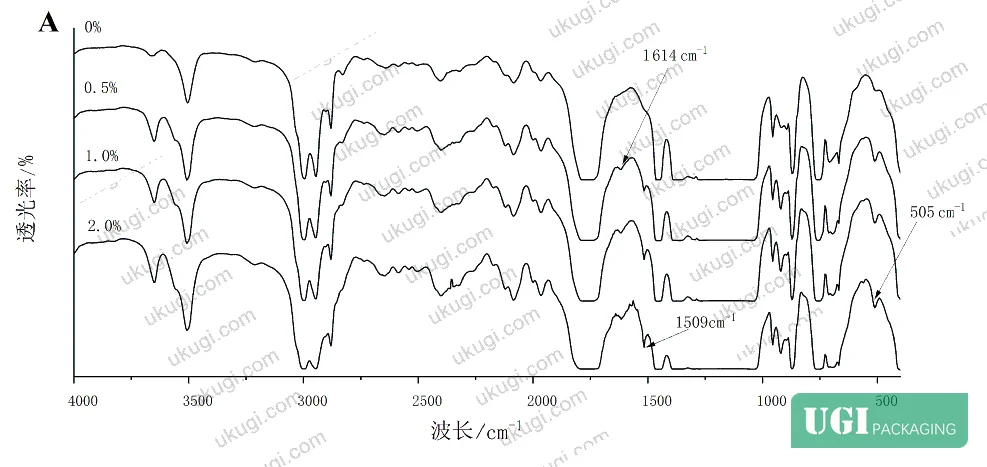
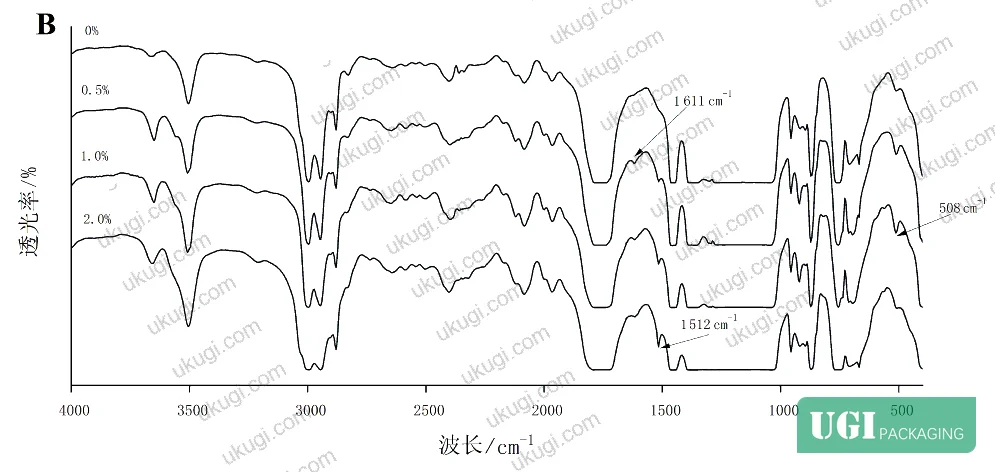
FTIR analysis (400–4000 cm⁻¹, 4.0 cm⁻¹ resolution, KBr disc method) confirmed that GEO and PLA interact purely through physical blending. The strong absorption peak at 1754 cm⁻¹ (C=O stretch, PLA backbone) remained unchanged in all composite samples. GEO-specific peaks for aromatic C=C stretching appeared at 1509 cm⁻¹ and 1610 cm⁻¹ in composite films — characteristic of the benzene ring in gingerol compounds — but no new peaks or peak shifts appeared that would indicate covalent interaction.
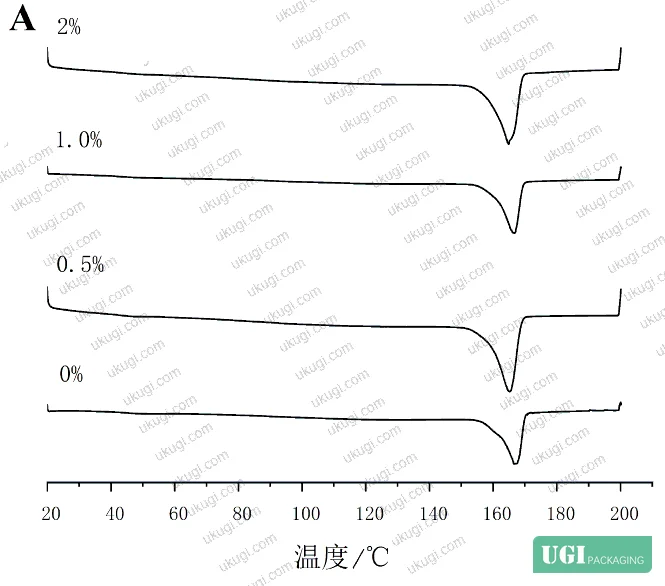
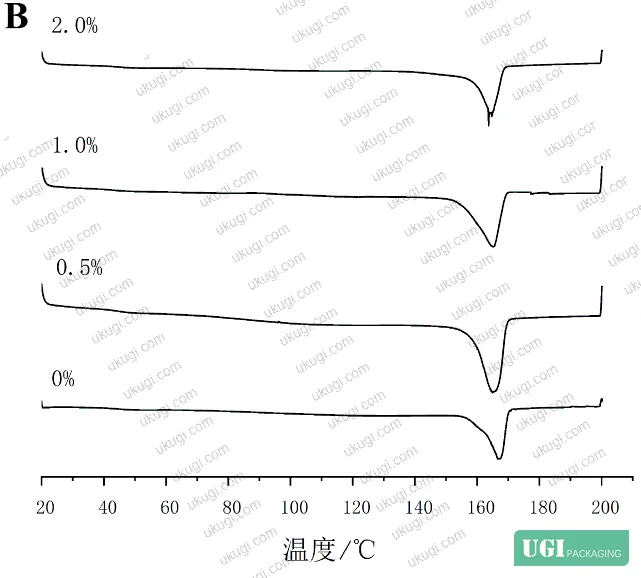
DSC analysis confirmed this: melting temperatures for all composite films and neat PLA remained within 160–170°C, with no significant shifts. GEO addition does not alter PLA crystallinity or molecular regularity.
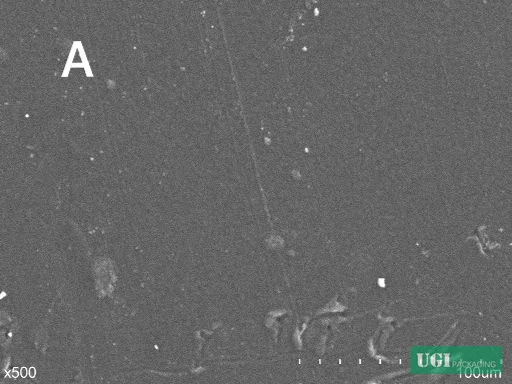
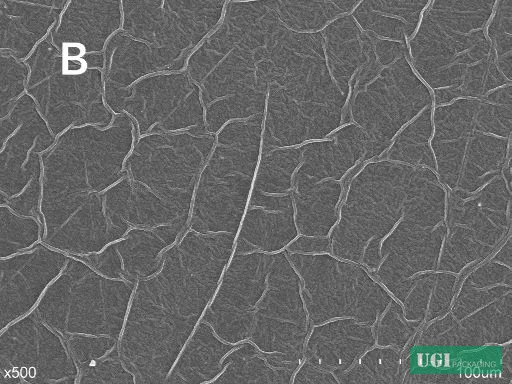
SEM cross-section imaging at 500–5000× magnification made the physical incompatibility visible: neat PLA film showed a dense, smooth surface with no cracks; the 2% Yunnan GEO composite displayed rougher surface morphology with visible wrinkling. This is consistent with GEO droplets dispersing in the PLA matrix during solvent casting, then coalescing as the chloroform evaporates — leaving an uneven surface that reflects aggregation of the oil phase. Adding Tween 80 or Span 60 as an emulsifier is the documented corrective, though this introduces an additional formulation variable that requires its own qualification.
For tensile and structural testing standards, refer to ASTM D882 Standard Test Method for Tensile Properties of Thin Plastic Sheeting and for oxygen barrier verification during film qualification, ASTM D3985 Oxygen Gas Transmission Rate Through Plastic Film and Sheeting provides the relevant test protocol.
Thermal Stability and Biodegradability Profile #
Most procurement teams don’t realize that the thermal characterization of biodegradable active films has become significantly more rigorous as food regulators in the EU and North America have updated their expectations for packaging materials in direct or indirect food contact. The DSC protocol used in this evaluation — ramp from 20°C to 200°C at 10°C/min, hold 5 minutes, cool at 3–10°C/min, then second ramp — is specifically designed to distinguish processing-induced thermal effects from true material properties.
The key finding: all GEO-PLA composite films maintained melting temperature within the 160–170°C window, consistent with neat PLA. This confirms thermal processability is not impaired by GEO incorporation at up to 2% loading. For packaging converters, this means the composite film can be processed on standard PLA-compatible equipment without modification to temperature profiles.
For film materials intended for food contact applications, compliance verification should reference EU Regulation No 10/2011 on plastic materials and articles intended to contact food, which covers migration limits and compositional requirements for polymers including PLA-based formats.
Biodegradability remains one of PLA’s core value propositions. The GEO additive, being a natural botanical extract, does not compromise the compostability claim — but this should be verified at the film composite level, not assumed from the base polymer specification alone.
Practical Guidance for Buyers #
If you are evaluating antimicrobial PLA films for food packaging, produce packaging, or any application where shelf-life extension via active packaging is a stated requirement, the most important procurement decision is defining the performance specification before you request samples — not after.
Specify: GEO botanical source (Shandong or Yunnan variety), extraction method (supercritical CO₂ preferred over steam distillation for this application), loading level (1.0% is the minimum for broad-spectrum antibacterial efficacy against both gram-positive and gram-negative organisms), and the test protocol (ISO 846, 37°C, RH ≥90%, 24h). Without these four anchors, you will receive samples that are technically “GEO-PLA” films but have no validated functional performance.
Pay attention to elongation at break. The data shows values dropping from 1.30% to below 0.13% after GEO incorporation. For applications requiring thermoforming, deep-draw packaging, or flexible pouch formats, this brittleness needs to be addressed at the formulation stage — not discovered during converter trials.
Also verify film surface uniformity via SEM or at minimum optical microscopy. Aggregation of GEO at the film surface is a known processing defect that affects antimicrobial release kinetics and may produce inconsistent shelf-life performance across a production run.
At ukugi.com, we work with packaging buyers across food, consumer goods, and specialty applications from our manufacturing base in Guangzhou, and we can support OEM/ODM development of functional film substrates including active and antimicrobial formats. For food-adjacent or export packaging requiring validated antimicrobial performance, sustainable substrate certification, and full surface finishing integration, our technical team can advise on film specification and production parameters.
For reference on sustainable material documentation requirements in export markets, ISO 14021:2016 Environmental labels and declarations — Self-declared environmental claims defines the evidentiary standard for biodegradable and compostable claims.
Need a custom formulation or sample? Request a quote from our team →
Technical Verification Questions #
- What is the DPPH free radical scavenging rate (%) and FRAP total antioxidant capacity (U/mL) of the GEO batch used in your composite film, and from which botanical variety is the oil sourced?
- At 1.0% GEO loading, what is the measured antibacterial reduction rate against Staphylococcus aureus and Escherichia coli per ISO 846 testing at 37°C and RH ≥90% over 24 hours?
- What is the puncture strength (N/mm, measured with 2mm probe at 1mm/s) and elongation at break (%) of your GEO-PLA composite film at the specified GEO loading level?
- Does your FTIR data (400–4000 cm⁻¹) confirm the absence of covalent interaction between GEO and PLA matrix — specifically, are there any peak shifts at the 1754 cm⁻¹ C=O absorption band relative to neat PLA?
- What is the DSC-confirmed melting temperature range of the composite film, and does it remain within 160–170°C across all production-representative GEO loading levels (0.5%, 1.0%, 2.0%)?
Quality Verification Checklist #
- ☐ Antibacterial rate against S. aureus ≥90% at 1.0% GEO loading per ISO 846 (37°C, RH ≥90%, 24h contact)
- ☐ Antibacterial rate against E. coli ≥90% at 1.0% GEO loading per ISO 846
- ☐ Puncture strength ≥239 N/mm at 1.0% GEO loading (2mm probe, 1mm/s, ASTM D882-referenced method)
- ☐ DSC-confirmed melting temperature within 160–170°C for composite film at all specified GEO concentrations
- ☐ FTIR confirms physical blend only: no new peaks or shifts at 1754 cm⁻¹ C=O band indicating covalent bonding
- ☐ GEO botanical source documented as Shandong Laiwu or Yunnan small yellow variety, extracted by supercritical CO₂ at 45°C / 20 MPa / 2h
- ☐ Film surface uniformity confirmed by SEM or optical microscopy — no visible GEO aggregation at ≤1.0% loading level
- ☐ DPPH free radical scavenging rate of GEO raw material ≥54% (Shandong) or ≥83% (Yunnan) per supplier CoA
Key Specifications Table #
| Parameter | Recommended Value | Verification Method |
|---|---|---|
| GEO loading for broad-spectrum antibacterial | 1.0% (w/w) in PLA matrix | ISO 846 antimicrobial film test, 37°C, RH ≥90%, 24h |
| Puncture strength (1.0% GEO-PLA) | ≥239 N/mm (Yunnan); ≥318 N/mm (Shandong) | 2mm probe, 1mm/s traverse, TA texture analyzer |
| Antibacterial efficacy vs. S. aureus at 0.5% loading | ≥90% reduction | ISO 846 contact method, PCA plate count |
| DSC melting temperature | 160–170°C (all GEO concentrations) | DSC, 10°C/min ramp, 20–200°C, second-heat protocol |
| DPPH free radical scavenging (Yunnan GEO) | ≥83.78% at 2 µg/mL | DPPH method, 517 nm absorbance, 20 min dark reaction |
| FRAP total antioxidant capacity (Shandong GEO) | ≥5.51 U/mL | FRAP assay kit, 593 nm absorbance |
| Elongation at break (composite film) | 0.03–0.13% (design constraint, not target) | ASTM D882-referenced, 30×90mm sample, 1mm/s |
Looking for a manufacturer that meets these specs? Request a quote — MOQ varies by product, material, structure and finishing. Product-specific MOQ is confirmed with each quotation.
References #
Data source: Antibacterial and Antioxidant Polylactic Acid Composite Films Incorporating Ginger Essential Oil: Preparation, Characterization, and Active Packaging Performance, Q.-M. Zeng et al., International Journal of Biological Macromolecules, 2024
Frequently Asked Questions #
What bacterial strains are used to validate GEO-PLA film antimicrobial performance?
The standard test panel includes Staphylococcus aureus, Bacillus subtilis, Escherichia coli, and Listeria monocytogenes — covering both gram-positive and gram-negative organisms as well as spore-forming bacteria. B. subtilis consistently shows lower inhibition rates than the other three, particularly at 0.5% GEO loading, due to its ability to produce hydrophobic spores.
Why does elongation at break drop so sharply when GEO is added to PLA?
GEO and PLA are physically incompatible — there is no covalent bonding between them. The oil phase disperses as droplets in the PLA matrix during solvent casting, then partially coalesces as the solvent evaporates. This disrupts PLA’s continuous polymer network, reducing its ductility. The result is elongation values dropping from 1.30% (neat PLA) to below 0.13% in all composite formulations — a structural consequence, not a processing error.
Can GEO-PLA composite film be certified as biodegradable for EU market labeling?
PLA base resin is compostable under industrial conditions, and ginger essential oil is a natural botanical extract with no synthetic polymer components. However, any biodegradable or compostable claim on EU market packaging must be substantiated per ISO 14021 or EN 13432. Composite film at the GEO-loaded level should be independently tested, not certified by inference from base PLA data alone.
Does the extraction method for GEO affect film performance?
Yes, significantly. Supercritical CO₂ extraction at 45°C / 20 MPa / 2h produces a GEO fraction rich in sesquiterpenes (50–60%) and oxygenated sesquiterpenes (~17%), which are the primary antimicrobial and antioxidant active components. Steam distillation or solvent extraction methods produce different compositional profiles with lower gingerol retention. Buyers should specify extraction method in supplier documentation, not just GEO content percentage.
What is the recommended emulsifier addition to improve GEO-PLA surface uniformity?
Tween 80 (polysorbate 80) or Span 60 (sorbitan monostearate) are documented options for improving GEO dispersion in PLA matrix and reducing surface roughness caused by oil aggregation. The appropriate addition level requires formulation-specific optimization and should be validated with fresh SEM surface imaging to confirm uniform distribution before approving the revised formulation for production.
Published by ukugi.com Technical Team | Request a quote


