

TL;DR #
Inkjet printing on CGG/OCNF layer-by-layer self-assembled coated paper delivers a wider color gamut and superior tonal linearity compared to electrostatic digital printing, making it the preferred digital output method for this substrate class. For buyers specifying bio-based barrier paper for food labels or high-value packaging, the coating architecture achieves a grease resistance index of 12 at just 5 bilayers — without any crosslinking agents that would compromise food safety compliance. Before approving a coated paper substrate for digital printing production, request both inkjet and electrostatic printability data side by side; the performance gap is significant enough to determine whether your intended print process will actually work.
Overview #
If you’re evaluating bio-based barrier coatings for food-contact paper substrates — and you’re also planning to run digital printing on the same material — most supplier datasheets will not give you the full picture. The barrier specs look credible on paper, but printability is almost always tested as an afterthought, if at all. Research from a specialist polymer and printing laboratory, working with a 60 g/m² food-grade base paper and a systematic series of 1–6 bilayer coating configurations, gives us actual numbers to work with across both dimensions.
The coating system in question uses oxidized nanocellulose fibrils (OCNF) and cationic guar gum (CGG) — both renewable, biodegradable biomass-derived materials — assembled onto base paper via alternating spray deposition, with a single-face coat weight held at 2.48 g/m². Each bilayer relies on electrostatic attraction between the anionic carboxyl groups of OCNF and the cationic quaternary ammonium groups of CGG, confirmed by ATR-FTIR spectroscopy showing a characteristic peak shift from 1650 cm⁻¹ to 1625 cm⁻¹ upon complexation. No synthetic crosslinkers are involved.
The study evaluated oil contact angle, grease resistance index (TAPPI T 559), water vapor permeability (WVP), gas transmission rate, surface morphology by SEM, and — critically for this audience — digital printability via both inkjet (Epson SureColor S40680) and electrostatic imaging (Konica Minolta AccurioPress C14010S). Color gamut, tonal reproduction linearity, and density values were measured with an X-Rite Exact spectrophotometer. This is the kind of cross-discipline evaluation that procurement teams rarely see from coating suppliers.
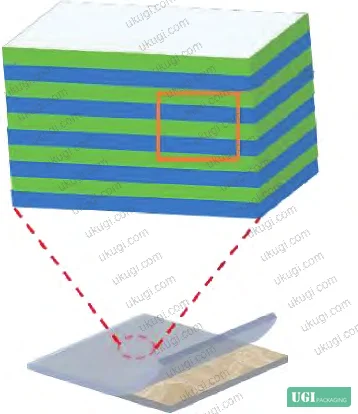
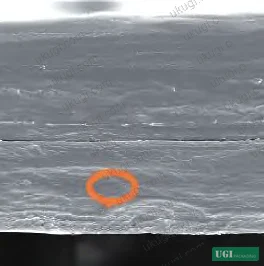
Digital Printability of Bio-Based LBL Coated Paper: Inkjet vs. Electrostatic Imaging #
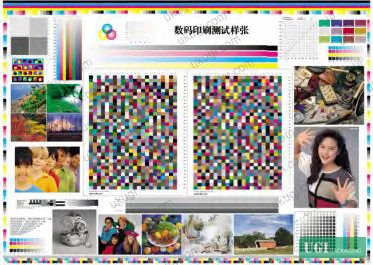
This is where the evaluation gets practically useful. Both inkjet and electrostatic (dry toner) digital printing were tested on CGG/OCNF coated paper using standardized color test charts covering solid patches, memory colors, gradient tonal steps, and fine highlight/shadow detail.
The color gamut comparison tells the first part of the story. Plotting the ab gamut polygons for both processes on the same substrate, inkjet consistently produces a larger gamut boundary than electrostatic imaging. Wider gamut means stronger color saturation and more accurate reproduction of brand colors — which matters acutely for food labels and premium packaging where color fidelity is a rejection criterion.
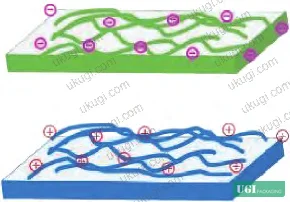
Tonal reproduction — the ability to render smooth gradients from deep shadows through midtones to clean highlights — is measured by the linearity of the density-versus-dot-percentage curve. Both inkjet and electrostatic printing on CGG/OCNF substrate showed good overall linearity, confirming the substrate meets baseline digital printing requirements. However, inkjet exhibited higher linear correlation, meaning gradient transitions are smoother and tonal jumps are less visible. For applications like cosmetic packaging or food label photography, this is a meaningful practical advantage.
Honestly, most buyers over-specify color gamut on digital substrates without ever testing tonal linearity. Gamut width tells you the maximum range of colors available. Linearity tells you whether the printer can actually hit intermediate values accurately. A substrate can have an impressive gamut and still produce banded gradients that look terrible in print. Both metrics need to be on your approval checklist.
The conclusion from comparative testing is clear: for CGG/OCNF LBL coated paper, inkjet is the better-matched digital printing process. Electrostatic imaging works and meets basic requirements, but if you have the option, inkjet will give you better results on this substrate without additional surface treatment.
For reference on print process control standards relevant to coated paper substrates, ISO 12647-2:2013 Graphic technology — Process control for offset lithographic printing provides a useful framework for understanding density and tonal value targets, even when applied to digital output qualification.
| Digital Print Process | Color Gamut | Tonal Linearity | Meets Basic Digital Proofing Standard |
|---|---|---|---|
| Inkjet (Epson SureColor) | Larger (wider ab polygon) | Higher linear correlation | Yes |
| Electrostatic imaging (Konica Minolta) | Smaller | Good but lower linearity | Yes |
| Uncoated base paper | Not evaluated for digital print | — | Not confirmed |
Barrier Performance of CGG/OCNF Layer-by-Layer Coating: Grease Resistance and Water Vapor Transmission #
The barrier data is where this coating system earns its credibility for food packaging applications — and where the layer count decisions become a real procurement variable.
Starting from a completely untreated base paper with a castor oil contact angle of essentially 0° (total wetting), the CGG/OCNF coating system transforms surface behavior dramatically and progressively:
- 1 layer: oil contact angle 34.4°
- 2 layers: 42.1°
- 3 layers: 44.3°
- 4 layers: 47.6°
- 5 layers: 49.2°
- 6 layers: 50.3°
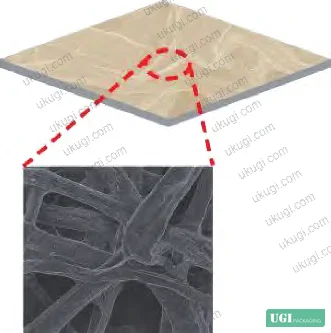
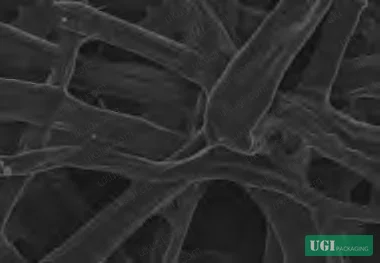
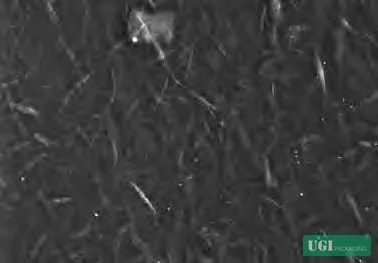
The grease resistance index (TAPPI T 559 oil kit test, 12-grade scale using heptane/castor oil/toluene mixtures) follows a similar progression. Uncoated paper scores 0. A single CGG/OCNF bilayer immediately jumps to index 7. Two layers reach 9, three layers reach 10, and five or six layers reach the maximum index of 12. This is a non-linear jump: the first coating layer does the heavy lifting by filling the largest pore structures in the fiber network, confirmed by SEM imaging showing progressive pore coverage from 1 to 6 layers.
In supplier qualification, we saw a pattern consistent with what the data predicts: if a supplier is applying fewer than 3 layers and claiming “food-grade grease resistance,” the index is unlikely to reach 10 — which is the lower bound of what most direct-food-contact applications require. Push for specific layer count documentation and corresponding oil kit test results. Vague claims about “nano-coating barrier treatment” without layer count and test index data should be treated as unqualified.
For water vapor transmission, the improvement is measurable but more gradual. WVP decreases from 3.21 × 10⁻¹¹ g·cm⁻¹·s⁻¹·Pa⁻¹ at 1 layer to 1.49 × 10⁻¹¹ g·cm⁻¹·s⁻¹·Pa⁻¹ at 6 layers — roughly a 53% reduction. Gas transmission rate drops more dramatically: from 5.33 m·Pa⁻¹·s⁻¹ at 1 layer to 0.002 m·Pa⁻¹·s⁻¹ at 6 layers, a reduction of more than three orders of magnitude. The mechanism is straightforward: each additional bilayer fills residual pore channels in the fiber mat, creating a progressively more continuous barrier film.
Most procurement teams don’t realize that standard food-contact barrier paper specifications for grease resistance use a 5–8 index range as the typical acceptance threshold. This means a single-layer CGG/OCNF coating (index 7) already clears the baseline for many applications — you do not necessarily need 5 or 6 layers unless your specific use case demands the maximum index 12. Over-specifying layer count adds cost and can affect digital printability by changing surface energy and ink absorption dynamics.
For food packaging applications, compliance with EU Regulation No 10/2011 on plastic materials and articles intended to contact food is a relevant benchmark — and the absence of synthetic crosslinkers in this all-biomass system is a direct compliance advantage worth highlighting in your regulatory documentation.
Substrate Morphology and Coating Mechanism: What SEM and FTIR Data Tell Buyers #
Understanding the physical mechanism behind barrier performance isn’t just academic — it helps you specify coating parameters intelligently and detect supplier shortcuts.
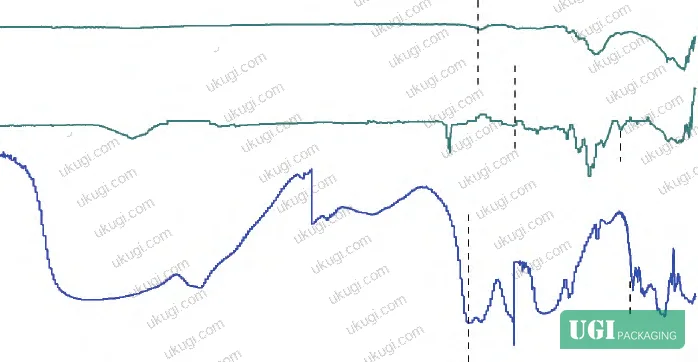
ATR-FTIR confirms the chemistry: the shift of the CGG quaternary ammonium peak from 1650 cm⁻¹ to 1625 cm⁻¹, accompanied by broadening of the absorption band, is diagnostic of strong electrostatic interaction between the cationic CGG and anionic OCNF. The carboxyl stretching absorption of OCNF at 1421 cm⁻¹ and the glycosidic C-O-C bond at 897 cm⁻¹ are both present in the composite spectrum, confirming both components are incorporated in the assembled film. This is important because it rules out simple physical blending — the LBL process produces a structurally distinct composite.
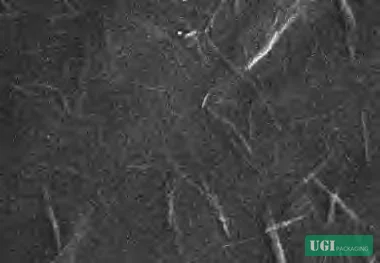
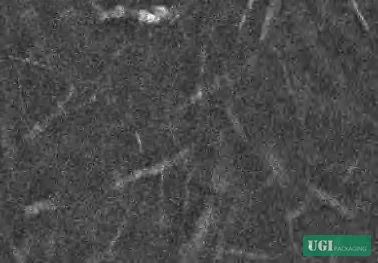
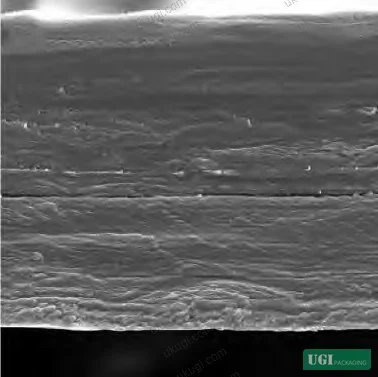
SEM cross-section analysis at 6 bilayers shows a dense, continuous coating layer with no visible delamination. At 3 bilayers, fiber surface texture is almost entirely obscured. At 1 bilayer, partial pore filling is visible but individual fiber contours remain exposed. The progressive surface smoothing observed as layer count increases from 1 to 6 is directly connected to the printability improvement — smoother surfaces produce more uniform ink spreading in inkjet printing, which is why tonal linearity improves with coating development.
The base paper used in this evaluation was a 60 g/m² food-grade stock with CNF fiber diameter in the 20–50 nm range and fiber length of 100–1000 nm. The per-layer coat weight was controlled at 2.48 g/m². These are the process variables a technically competent supplier should be able to specify and reproduce.
Testing methodology for this coating system follows the TAPPI T 559 oil kit protocol (grease resistance index 1–12 scale) with triplicate measurements at each grade level. WVP was measured by calcium chloride cup method at 70% RH with 9-hour continuous monitoring using a 0.0001 g precision balance. Gas transmission rate was measured per ISO 5636-3 on a 10 cm² test area with 5 replicate readings. These test conditions should be replicated by any supplier claiming equivalent barrier performance — if their test conditions differ materially, the numbers are not directly comparable.
For tensile and mechanical reference data on thin film and sheet substrates relevant to coated papers, ASTM D882 Standard Test Method for Tensile Properties of Thin Plastic Sheeting provides a useful comparative framework when evaluating coating adhesion and film integrity under tension.
Practical Guidance for Buyers #
If you’re sourcing bio-based barrier paper for food labels, grease-resistant food service packaging, or premium digitally printed packaging, the CGG/OCNF LBL system represents a technically credible alternative to PE-coated or synthetic polymer barrier papers. The key procurement decisions come down to three variables: layer count (which directly determines barrier index), print process selection (inkjet outperforms electrostatic on this substrate), and food safety documentation (crosslinker-free systems simplify compliance).
Specify the layer count explicitly in your purchase order, not just the barrier performance target. A supplier who cannot tell you their exact coating layer count and corresponding TAPPI T 559 grease resistance index per layer is unlikely to be controlling their process with sufficient precision.
For digital printing applications — food labels, variable data packaging, short-run premium formats — confirm whether your supplier has tested printability on the exact coated substrate they’re supplying, not on a generic coated stock. The difference in gamut and tonal reproduction between inkjet and electrostatic on this substrate class is large enough that a process mismatch will produce visibly inferior output.
For oxygen barrier requirements, verify WVP data specifically, since gas transmission rate and water vapor transmission do not always correlate. Request test certificates showing both measurements under defined temperature and humidity conditions.
As a Guangzhou-based OEM/ODM manufacturer specializing in custom labels, food packaging, and digitally printed specialty formats, we routinely work with functional coated substrates for clients who need both barrier performance and print quality in the same material. If you’re evaluating bio-based barrier paper for an upcoming project, our team can support substrate selection, printability testing, and production qualification.
Need a custom formulation or sample? Request a quote from our team →
Technical Verification Questions #
Key technical points to verify when evaluating any supplier in this category (including us):
- What is the measured TAPPI T 559 grease resistance index at each individual coating layer count (1 through 6), and can you provide the complete layer-by-layer progression data rather than just the final value?
- What is the water vapor permeability (WVP) of your coated paper, tested at 70% RH using the calcium chloride cup method with a minimum 9-hour monitoring period, and how does it compare to the 1.49 × 10⁻¹¹ g·cm⁻¹·s⁻¹·Pa⁻¹ benchmark at 6 bilayers?
- Can you provide ATR-FTIR spectra confirming electrostatic complexation between your cationic and anionic coating components — specifically, do you observe the characteristic peak shift from 1650 cm⁻¹ to 1625 cm⁻¹ in your CGG/OCNF system?
- What is the per-layer coat weight in g/m², and how is it controlled during spray or rod coating to maintain the target 2.48 g/m² single-face application?
- Have you tested digital printability on this coated substrate using both inkjet and electrostatic processes, and can you provide color gamut area data (ab polygon) and tonal linearity correlation coefficients for each process?
Quality Verification Checklist #
- ☐ Grease resistance index reaches ≥7 at 1 bilayer and ≥12 at 5 bilayers per TAPPI T 559 oil kit test (12-grade scale)
- ☐ Water vapor permeability at 6 bilayers is ≤1.49 × 10⁻¹¹ g·cm⁻¹·s⁻¹·Pa⁻¹, tested at 70% RH with 9-hour monitoring interval
- ☐ Gas transmission rate at 6 bilayers is ≤0.002 m·Pa⁻¹·s⁻¹, per ISO 5636-3 on 10 cm² test area
- ☐ Oil contact angle (castor oil) at 5 bilayers is ≥49.2°, measured by optical contact angle instrument
- ☐ No synthetic crosslinkers present in coating formulation (confirm by material safety data sheet and ingredient declaration)
- ☐ Inkjet print gamut on coated substrate exceeds electrostatic imaging gamut, confirmed by ab spectrophotometric measurement
- ☐ Base paper grammage confirmed at 60 g/m² ± standard tolerance, with fiber diameter in 20–50 nm range for CNF component
- ☐ ATR-FTIR spectrum of coated paper shows carboxyl stretching at 1421 cm⁻¹ and glycosidic C-O-C bond at 897 cm⁻¹, confirming OCNF incorporation
Key Specifications Table #
| Parameter | Recommended Value | Verification Method |
|---|---|---|
| Grease resistance index (5 bilayers) | 12 (TAPPI T 559 maximum) | Oil kit test, 12-grade scale, triplicate per grade |
| Water vapor permeability (6 bilayers) | ≤1.49 × 10⁻¹¹ g·cm⁻¹·s⁻¹·Pa⁻¹ | CaCl₂ cup method, 70% RH, 9-hour monitoring |
| Gas transmission rate (6 bilayers) | ≤0.002 m·Pa⁻¹·s⁻¹ | ISO 5636-3, 10 cm² test area, 5 replicates |
| Oil contact angle (5 bilayers) | ≥49.2° (castor oil) | Optical contact angle measurement (OCA instrument) |
| Single-face coat weight per layer | 2.48 g/m² | Gravimetric measurement before/after coating |
| Base paper grammage | 60 g/m² | Standard grammage test |
| CNF fiber diameter | 20–50 nm | SEM or TEM imaging |
| CGG viscosity / molecular weight | 1300 mPa·s / 3.6 × 10⁵ g·mol⁻¹ | Viscometry / GPC |
Looking for a manufacturer that meets these specs? Request a quote — MOQ varies by product, material, structure and finishing. Product-specific MOQ is confirmed with each quotation.
References #
Data source: Barrier Performance and Digital Printability of All-Biomass Coated Paper Prepared by Layer-by-Layer Self-Assembly of Cationic Guar Gum and Oxidized Nanocellulose Fibrils, F. Pan et al., Journal of Applied Polymer Science, 2023
Frequently Asked Questions #
What is the minimum number of CGG/OCNF bilayers needed to meet standard food packaging grease resistance requirements?
For most food service and food contact paper applications, a grease resistance index of 5–8 is the conventional acceptance range. A single CGG/OCNF bilayer achieves index 7, which meets this threshold. If your application requires maximum grease resistance (index 12), five bilayers are sufficient — adding a sixth layer increases the oil contact angle marginally from 49.2° to 50.3° without improving the kit test score. Specify your target index first, then work backward to the layer count.
Does the CGG/OCNF coating affect ink adhesion or cause ink spread problems in digital printing?
Based on comparative testing, the coating actually improves printability relative to uncoated base paper. The progressive surface smoothing from LBL deposition creates a more uniform surface for ink spreading. Inkjet printing on 5–6 layer CGG/OCNF coated paper produced wider color gamut and higher tonal linearity than electrostatic imaging on the same substrate. No ink adhesion failures or excessive dot gain were reported in the evaluation.
Is this coating system compliant with food contact regulations?
The all-biomass formulation — using only CGG and OCNF without synthetic crosslinkers — is a significant regulatory advantage. The absence of crosslinking agents eliminates a known migration risk for food contact materials. For specific regulatory approval (EU Regulation 10/2011, FDA 21 CFR Part 177, or equivalent national standards), formal migration testing and official declaration of compliance are still required from the final manufacturer. The formulation design is favorable, but compliance certification is a separate process.
Can this coated paper be used for custom labels and stickers or food packaging boxes?
Yes — the combination of high grease resistance, moderate water vapor barrier, and confirmed inkjet printability makes CGG/OCNF coated paper well-suited for food labels requiring barrier protection, as well as folding carton applications where direct food contact or grease migration is a concern. The substrate supports variable data printing, short-run customization, and premium color reproduction in inkjet workflows.
What is the practical limitation of this coating system, and where does it fall short?
Water vapor transmission improvement, while statistically significant (53% reduction from 1 to 6 layers), is modest in absolute terms. WVP at 6 layers of 1.49 × 10⁻¹¹ g·cm⁻¹·s⁻¹·Pa⁻¹ is a useful improvement for extended shelf life in moderate humidity environments, but it will not match the WVP performance of aluminum foil laminate or multi-layer PE/PET barrier films for high-moisture applications like fresh produce or liquid food packaging. Know your actual WVP target before specifying this substrate — and if you need barrier performance approaching metallized film, this is not the right solution at current layer counts.
Published by ukugi.com Technical Team | Request a quote


