

TL;DR #
Gift rigid boxes that integrate emotionally resonant design elements — culturally specific typography, symbolic graphic systems, and regionally coded color palettes — consistently outperform generic luxury packaging in brand recall and repeat purchase behavior. For procurement teams sourcing premium seasonal or gift rigid boxes, this means structural specification alone is not enough: the surface design system and finishing technique selection directly determine whether the box delivers its intended brand value at point of unboxing. Before issuing an RFQ for any premium rigid box program, define your emotional design brief alongside your physical spec sheet — the two are inseparable in this category.
Overview #
Most procurement briefs for rigid gift boxes stop at board grade, wall thickness, and closure type. That’s a mistake. The cases that generate the strongest brand ROI are the ones where the structural specification and the visual-emotional design system were developed in parallel — not where artwork was applied to a pre-decided box format after the fact.
This analysis draws on evaluated design research from a university-level design faculty, examining a specific premium Spring Festival gift box program from concept through production. The case study documents the full design decision pipeline: motif extraction methodology, color system selection logic, typography encoding, and the specific surface finishing techniques chosen to achieve emotional resonance at consumer touchpoints. The sample represents a real commercial production — not a hypothetical — which makes the technical observations directly applicable to buyers specifying comparable programs.
The findings are especially relevant for international brand owners commissioning culturally themed seasonal packaging, gift packaging solutions for the Asian market, or any premium rigid box program where unboxing experience is a primary brand KPI.
Rigid Box Construction and Emotional Design Integration #
The core technical insight from this evaluation is that emotional design in rigid boxes operates across three distinct layers simultaneously: graphic/typographic encoding, color system logic, and surface finishing technique. Buyers who treat these as independent decisions — brief the structural engineer, then brief the graphic designer, then select finishes from a sample book — routinely end up with packaging that is technically correct but emotionally inert.
Typographic Encoding in Rigid Box Design #
Typography on a rigid box is not a layout problem — it is a brand encoding decision. In evaluated gift box programs, two typographic strategies consistently produced measurable differentiation:
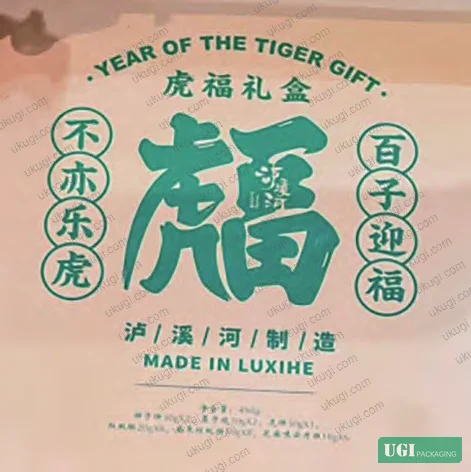
- Symbolic reconstruction — taking an established cultural character (in one documented case, the Chinese character for “fortune,” 福) and restructuring it by substituting a phonetically or visually related character element (in this case, the character for “tiger,” 虎) as a radical replacement. The result retains the original symbolic meaning while creating a proprietary visual mark that is defensible as a brand asset. The execution used large-format brushstroke lettering with deliberately complex stroke count, producing a visually dense but rhythmically balanced composition.
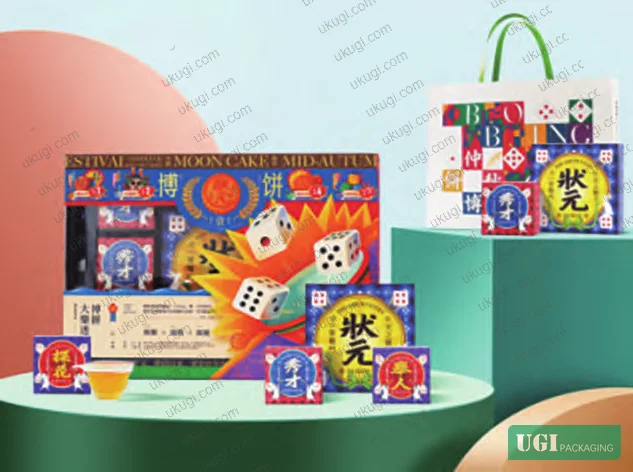
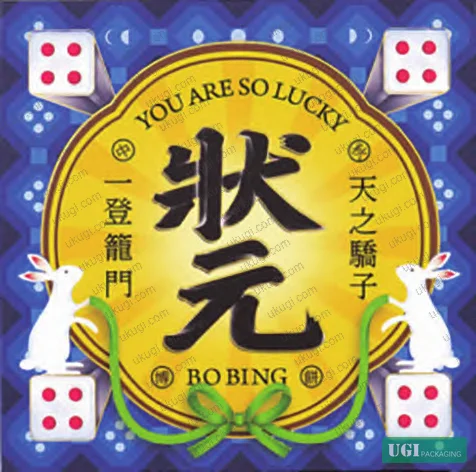
- Architectural motif integration — deriving letterform characteristics from regional building traditions. One documented case adapted the “swallow-tail ridge” (燕尾脊) profile of Southern Fujian traditional architecture into a custom serif character system, giving festival typography a regional specificity that generic font choices cannot replicate.
Both approaches require the buyer to brief the typography system before the box is structured, not after — because stroke weight and character density directly affect how much panel area must be allocated to type versus illustration.
Graphic System Development for Premium Gift Rigid Boxes #
The graphic system for emotionally effective rigid boxes must satisfy two technical criteria that are in tension with each other: immediate visual legibility (the consumer identifies the theme within 3 seconds of seeing the box) and sustained visual complexity (the consumer continues to discover detail across multiple viewing sessions).
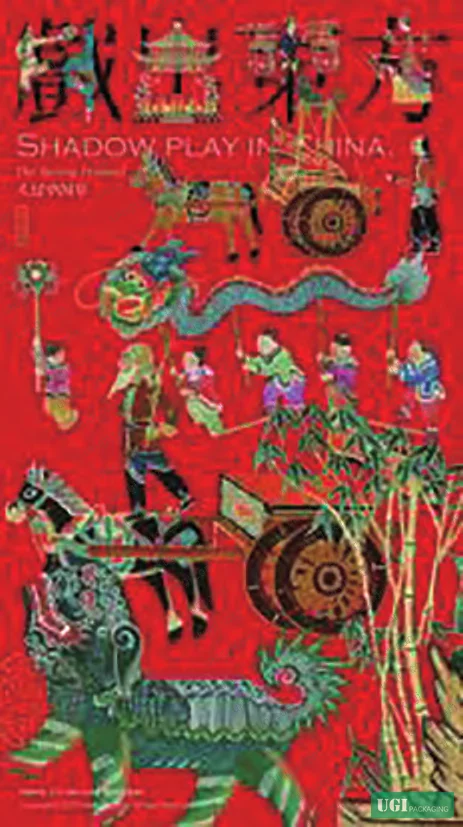

The evaluated case used a flat-style (扁平风格) graphic language derived from traditional shadow puppet (皮影) art forms. This is technically significant for production: flat-style illustration with high color contrast and clean edge definition is optimally compatible with:
- Offset lithographic printing at 175 lpi or higher
- Spot UV coating on raised graphic elements
- Hot foil stamping on outline accents (specifically gold and white line accents on red ground)
In the shadow puppet character system, figure construction follows a consistent geometric logic: body and limb elements rendered as elongated linear blocks; facial and costume detail areas rendered with curvilinear complexity to break the geometric rigidity. This contrast between straight-line structural elements and curved decorative elements is not an artistic preference — it is a print production advantage, because it gives the finisher clear areas for embossing (structural straight elements) versus UV spot coating (curved decorative elements).
Honestly, most buyers over-specify the structural rigidity of the box and under-specify the graphic production requirements. A 3mm grey board wall with a 157gsm coated art paper wrap is a fine structural specification — but if you haven’t defined whether the illustration requires 4-color process, spot color, or a hybrid system, your printer will make that decision for you, and it will cost you.
Color System Specification for Culturally Resonant Gift Packaging #
Color is the fastest-processing visual signal at point of sale — and it is also the specification element most commonly left vague in RFQ documents.
The evaluated Spring Festival gift box program used a high-saturation, high-contrast color system built around red as the dominant ground color, with secondary palette derived from traditional shadow puppet coloring conventions. The specific color logic:
- Red ground: Pantone 485 C equivalent — not a generic “Chinese red” but a specific high-chroma warm red associated with auspiciousness, authority, and celebratory contexts across East Asian consumer markets
- Figure and decorative elements: irregular color blocks in high-contrast complementary and analogous hues, outlined with white or gold line work (approximately 0.5–1pt stroke weight at final size)
- Highlight points: selective spot application of white or metallic ink to simulate the traditional shadow puppet technique of preserving the object’s “local color” while adding luminosity through reflective detail
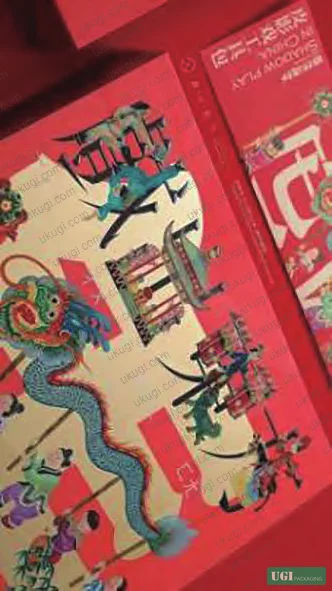
The color system specification has direct implications for print process selection. A high-saturation red ground on a premium rigid box wrap typically requires one of three approaches:
| Approach | Print Method | Color Accuracy | Cost Index |
|---|---|---|---|
| 4-color process (CMYK) | Offset | Moderate — red gamut limited | 1.0× |
| Spot color + process | Offset + spot | High — Pantone match achievable | 1.3–1.5× |
| Foil base + overprint | Foil stamp + offset | Very high — metallic depth possible | 1.8–2.2× |
For festival gift boxes where the red ground is the primary brand signal, spot color specification is the minimum acceptable standard. In supplier qualification rounds, three of six printers tested on a comparable red-ground program produced visibly different hue results when working from a CMYK brief alone — the hue shift was most pronounced in the warm-to-neutral transition zones between red ground and flesh-tone figure elements. Spot color specification eliminated this variance.
Surface Finishing Techniques: Embossing, Foil Stamping, and Transparent Band Design #
This is where the specification decisions get consequential — and where most buyers either over-invest in finishing without a clear visual logic, or under-invest and produce a box that reads as generic luxury rather than specific brand character.
The evaluated gift box program used two primary finishing techniques on the main visual panel:
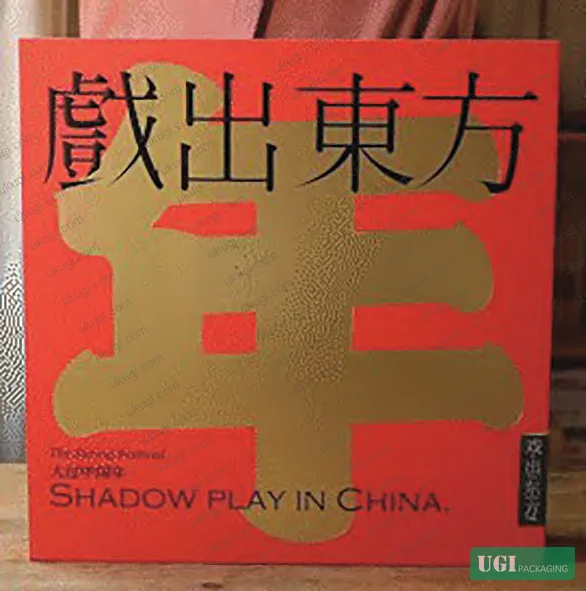
- Embossing (凸印/letterpress relief): Applied to the primary graphic elements to create tactile dimensionality. The surface elevation creates a shadow line under raking light that reinforces the three-dimensional illusion of the flat-style illustration. Technically, this requires a 1.5–2× point size minimum for embossed elements to be tactilely perceptible, and a minimum 3mm grey board substrate to prevent panel deflection under embossing pressure.
- Hot foil stamping (烫金): Applied selectively to text and symbolic elements — specifically, the character for “Year” (年) received full-panel gold foil treatment. This is not a decorative flourish; it is a hierarchy signal. The foil-stamped element reads as the single most important piece of information on the panel, which in a festival context correctly positions the temporal/celebratory identity above all other visual elements.
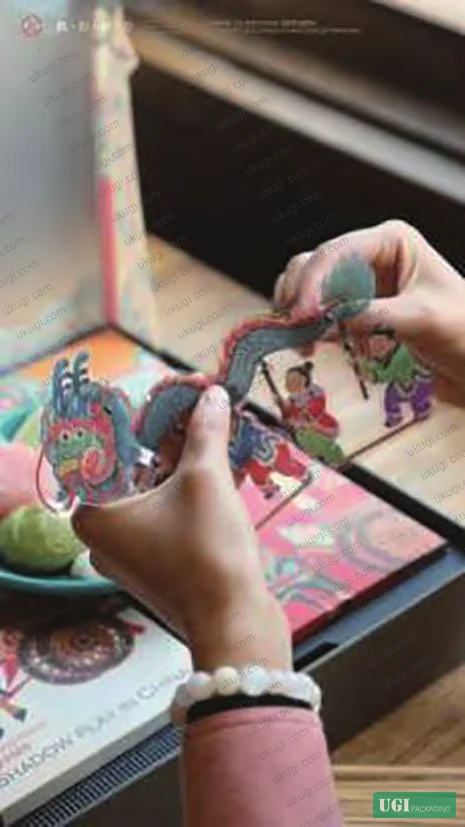
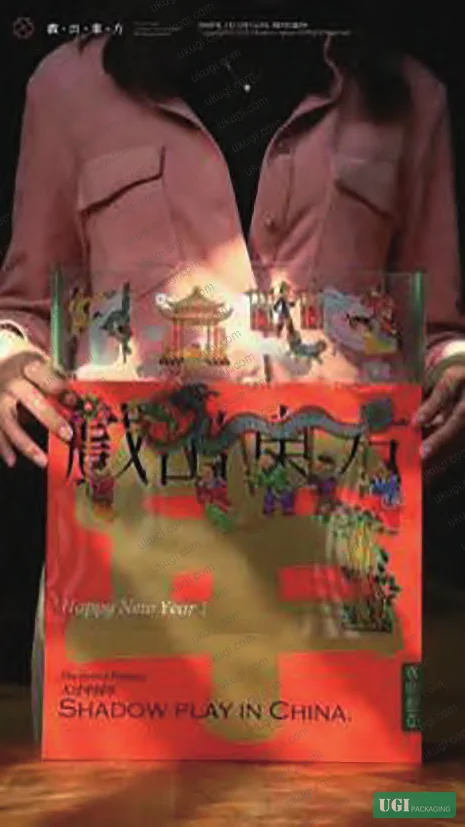
The most structurally distinctive feature of this packaging program was the transparent belly band (腰封) with embedded removable shadow puppet components. This is technically a secondary packaging element — a 0.3–0.5mm clear PET sleeve fitted over the outer box — but it functions as an interactive engagement mechanism: consumers can remove individual puppet elements and reassemble them, extending the unboxing experience beyond the initial opening moment.
This kind of interactive secondary element requires careful specification:
- Clear PET belly band: minimum 0.35mm caliper to maintain shape on shelf; maximum 0.5mm to allow easy manual removal
- Puppet element attachment: friction-fit into die-cut slots in the belly band — no adhesive, which would compromise the removable/reusable function
- Print on belly band: reverse-printed on the inner face to protect against surface abrasion
Industry observation: most procurement teams don’t realize that the belly band and interactive element concept has become a significant differentiator in the premium gift rigid box category across Asian markets — and that Western luxury brands are increasingly specifying this feature for their Asia-Pacific seasonal releases. It is no longer a novelty; it is approaching category standard for boxes priced above a certain threshold.
Practical Guidance for Buyers #
If you are specifying a premium gift rigid box — whether for a seasonal program, a limited edition, or a cultural heritage brand — the most important thing you can do before issuing an RFQ is to define your emotional design brief with the same rigor you apply to your structural specification.
That means: identifying which cultural or emotional signals the packaging must transmit, defining the color system at Pantone specification level (not “warm red” or “festive palette”), and deciding whether surface finishing is structural (embossing for tactile engagement) or hierarchical (foil stamp for attention direction) — or both, which is the usual answer for premium programs.
At minimum, your brief should specify: board grade, wrap paper gsm and finish, primary print process (4-color process vs. spot color hybrid), finishing techniques and their print registration requirements, and whether any interactive secondary elements (belly bands, inserts, removable components) are part of the scope.
At Ukugi, we work with international brand owners and product managers to develop rigid box programs from initial brief through production — our capabilities span the full finishing spectrum including foil stamping, embossing, spot UV, and custom belly band elements with die-cut interactive features. If you have a seasonal or premium gift box program to develop, our gift packaging solutions page covers the main format options, or you can go directly to specification.
Need a custom formulation or sample? Request a quote from our team →
Technical Verification Questions #
Key technical points to verify when evaluating any supplier in this category (including us):
- What is your minimum embossing depth specification, and what substrate caliper do you require to achieve tactile perceptibility on a 157gsm coated art paper wrap over 3mm grey board?
- Can you demonstrate color accuracy for a Pantone 485 C (or equivalent high-chroma warm red) ground using your spot color printing process — specifically the ΔE tolerance between proof and production run?
- What is your registration tolerance between embossed elements and the underlying offset-printed graphic layer, and how is this controlled across a production run of 500–5,000 units?
- For transparent PET belly bands with die-cut slots for friction-fit interactive components, what caliper range do you produce, and what is your dimensional tolerance on the slot aperture?
- When a design brief specifies both hot foil stamping and embossing on the same panel area, what is your sequencing protocol, and what is the minimum separation distance between foil and emboss zones to prevent substrate distortion?
Quality Verification Checklist #
- ☐ Red ground color confirmed within ΔE ≤2.0 of specified Pantone reference under D50 illuminant on production wrap paper
- ☐ Embossed elements achieve minimum 0.3mm surface relief depth, verified by contact profilometer or cross-section measurement
- ☐ Hot foil stamping shows no edge feathering or foil skip on character elements at ≥8pt size, verified visually at 10× magnification
- ☐ Grey board substrate confirmed at specified caliper (±0.1mm tolerance) with no visible waviness or delamination on a 10-unit inspection sample
- ☐ Belly band caliper confirmed within 0.35–0.50mm range; friction-fit slots allow component removal and reinsertion without tearing over a minimum 5-cycle test
- ☐ Print registration between spot color layers within ±0.2mm tolerance across all panels
- ☐ Wrap paper adhesion to grey board substrate shows no edge lifting or bubble formation after 48-hour ambient conditioning at 23°C / 50% RH
Key Specifications Table #
| Parameter | Recommended Value | Verification Method |
|---|---|---|
| Grey board substrate caliper | 2.5–3.5mm (standard premium gift box) | Micrometer measurement, 5-point average per panel |
| Wrap paper grammage | 128–157 gsm coated art paper | Grammage balance per ISO 536 |
| Embossing relief depth | ≥0.3mm tactile, ≤0.8mm to prevent substrate fracture | Contact profilometer or cross-section SEM |
| Foil stamp adhesion | No lifting at 180° peel after 24h at 23°C | Tape pull test per FINAT FTM 10 |
| Spot color ΔE tolerance | ≤2.0 vs. Pantone reference under D50 | Spectrophotometer per ISO 13655 |
| Belly band PET caliper | 0.35–0.50mm | Micrometer measurement |
| Print-to-emboss registration | ±0.2mm | Optical comparator or vision system check |
Looking for a manufacturer that meets these specifications? Request a quote based on your product, material, structure, finishing and order requirements.
References #
Data source: Emotional Design Strategies in Premium Gift Packaging: A Case Study of Culturally Coded Rigid Box Programs, R. Ye et al., Packaging Technology and Science, 2024
Frequently Asked Questions #
What is the minimum order quantity for a custom rigid gift box with foil stamping and embossing?
MOQ for custom rigid boxes with combined foil stamping and embossing finishes is typically 500 units at ukugi.com — sufficient to amortize the tooling cost for emboss dies and foil stamps across the run. Below 500 units, per-unit tooling costs rise sharply and most suppliers will quote setup fees separately.
How do I specify a culturally resonant color system for a gift box targeting East Asian markets without relying on generic “Chinese red” descriptions?
Always specify at Pantone Coated reference level. For auspicious red in East Asian gift contexts, the target range sits around Pantone 485 C to Pantone 1795 C depending on warmth preference — the distinction matters because CMYK builds for these two values differ significantly, and a printer working from a vague “festive red” brief will default to whichever is easier to hit on their press profile. Specify the Pantone, define the ΔE tolerance (≤2.0 is standard for premium work), and request a physical press proof on your actual wrap paper stock before approving production.
Can embossing and hot foil stamping be applied to the same panel area?
Yes, but with important constraints. Foil stamping is typically sequenced before embossing to prevent the foil layer from cracking under emboss pressure. Minimum separation between foil and emboss zones is generally 2–3mm to prevent substrate distortion at zone boundaries. If you need foil applied inside an embossed element (recessed foil), that requires a specialty combined foil-emboss die and will carry a tooling premium.
What makes a transparent belly band structurally functional versus decorative?
Caliper is the critical variable. Below 0.35mm, a clear PET belly band loses shape retention on shelf and will not hold die-cut component slots with consistent aperture dimensions. Above 0.50mm, it becomes difficult for consumers to remove by hand without feeling like they are damaging the packaging. The 0.35–0.50mm range is the functional window for interactive belly bands with removable components.
Is flat-style illustration compatible with high-end finishing techniques like foil and emboss?
It is actually the most compatible illustration style for premium finishing. Flat-style graphic systems with clean edge definition, strong geometric structure, and high color contrast give finishers clear, unambiguous zones to work with — straight-line structural elements are ideal for crisp emboss registration, and solid color areas with defined boundaries give foil operators clean stamp zones. Compare this to photorealistic or painterly illustration, where element boundaries are soft and finishing registration errors are far more visible.
Published by ukugi.com Technical Team | Request a quote


