

TL;DR #
Migration data from controlled simulant studies shows that antioxidant Irganox 1076 migrates at up to 7,139 µg/dm² into isooctane (fatty food simulant) — nearly 5× higher than its maximum measured migration into real food (1,413 µg/dm² in chocolate) — which means simulant-based compliance testing can dramatically over-report actual consumer exposure. For buyers sourcing food-contact packaging, this gap has direct implications for how you interpret supplier CoC documentation and regulatory test reports. Before accepting any migration test certificate, verify whether it used real food or a simulant, and which simulant class was applied.
Overview #
If you’ve spent any time evaluating food-contact packaging suppliers, you already know that regulatory compliance paperwork and actual chemical safety are two different things. A supplier can hand you a migration test certificate that technically passes EU limits while the test conditions were so conservative that the result tells you almost nothing about real-world performance. That’s the core tension this article addresses.
The research basis here draws on systematic migration studies conducted at a national-level chemical engineering laboratory, covering multiple plastic and paper-based packaging substrates tested against four EU-classified food simulant types under controlled temperature and contact duration conditions. The dataset spans dozens of analyte compounds — monomers, plasticizers, photoinitiators, antioxidants, heavy metals, and fluorescent whitening agents — and benchmarks observed migration levels against established regulatory limits.
This is not a theoretical exercise. The data reflects real extraction experiments and Fickian diffusion modeling, and the conclusions have direct procurement implications for anyone buying printed labels, folding cartons, flexible pouches, or laminated bags intended for food contact. Regulatory frameworks in the EU, US, and China all converge on a core principle: chemical migration from packaging into food must be characterized, limited, and documented. The question is whether your supplier’s documentation actually captures what’s happening at the material level.
Chemical Migration from Food Packaging: What the Data Actually Shows #
This is where most buyers stop reading too early — and where the costliest specification mistakes get made.
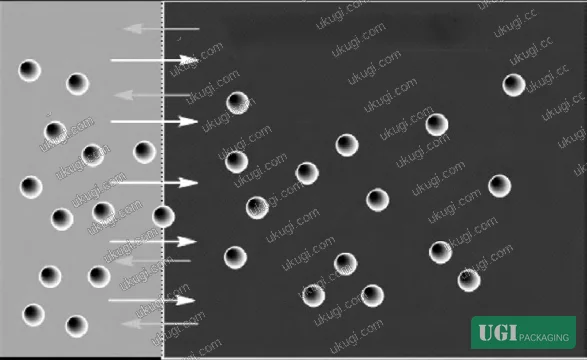
Migration of chemical substances from packaging into food is governed by Fick’s second law of diffusion. The governing equation relates the concentration of a migrant in the polymer at time t and position x to its diffusion coefficient Dp (cm²/s). In practical terms, four variables dominate migration behavior: diffusion coefficient, partition coefficient (KP,F), polymer layer thickness (LP), and contact temperature and duration.
Simulant vs. real food: the overestimation problem
The EU food simulant system classifies contact conditions into four categories: distilled water for aqueous foods, 3 g/100 mL acetic acid for acidic foods, 15% ethanol by volume for alcoholic foods, and edible oil (olive, corn) for fatty foods. Tenax was added as a simulant for solid dry foods under regulation UE 10/2011.
The problem is systematic overestimation. Antioxidant Irganox 1076 migrated at 1,413 µg/dm² maximum into chocolate (real food), but the same compound reached 7,139 µg/dm² in isooctane simulant under equivalent conditions. That’s a 5× gap. The same pattern was confirmed across multiple antioxidants in the dataset. Simulants, particularly fatty food simulants, dissolve non-polar migrants far more aggressively than actual food matrices.
This isn’t a minor calibration issue. If a supplier’s test report uses isooctane or olive oil simulant and shows migration “just below” the specific migration limit (SML), there is a material risk that the result is artificially elevated and doesn’t reflect actual food safety performance. Conversely, if a supplier uses only aqueous simulants for a package that will contact fatty food, the test is functionally meaningless.
Key contaminants and their regulatory thresholds
The table below summarizes the primary migrant categories found in plastic food packaging, their benchmark regulatory limits, and health implications. These values represent the working reference range for supplier qualification.
| Migrant Category | Primary Compounds | Reference Limit (mg/kg) | Health Concern |
|---|---|---|---|
| Monomers and oligomers | Styrene monomer, BPA, caprolactam, vinyl chloride | Styrene <5,000; caprolactam <15; BPA 3; vinyl chloride 1 | CNS suppression, endocrine disruption |
| Plasticizers (phthalates) | DEHP, DBP, DINP, DIDP, BBP | DBP 0.3; DEHP 1.5; DINP/DIDP 9 each; BBP 30 | Endocrine disruptors |
| Antioxidants | BHT, BHA, Irganox 1076, 168, 1010 | BHA 30; BHT 3.0; Irganox 1076 6.0 | Liver/lung organ damage (chronic) |
| Photoinitiators | Benzophenone, Irgacure 184, 651, 907 | Benzophenone 0.6 | Sensitizer, potential carcinogen |
| Heavy metals | Antimony, lead, cadmium | Lead 25 µg/kg; cadmium 7 µg/kg | Carcinogenic |
| Antistatic agents | Nonylphenol, sodium alkyl sulfonate | Nonylphenol ADI 0.15 mg/(kg·d) | Endocrine disruptors |
The general migration limit for packaging chemical migration is bounded between 0.01 and 60 mg/kg depending on substance class. That range is wide enough to be essentially useless without knowing which compound and which regulatory jurisdiction you’re operating in. Always work from SML values, not the overall migration limit (OML).
Diffusion modeling for compliance prediction
For technically literate buyers, the Piringer diffusion model (Equations 8–10 in the source dataset) allows prediction of Dp from polymer type and molecular weight of the migrant. The model uses a polymer-specific “conductivity” parameter Ap that reflects how readily a given polymer matrix transmits a migrant. Activation energy, calculated from diffusion coefficients at multiple temperatures via the Arrhenius relationship, gives you a quantitative handle on how temperature-sensitive migration behavior is for a specific substrate/migrant pair.
What this means practically: a supplier using PET for hot-fill applications needs to demonstrate that Dp values have been measured or modeled at the actual filling temperature, not just at 40°C standard test conditions. Antimony — a catalyst residue in PET production — has a specific regulatory limit of 25 µg/kg for lead and 7 µg/kg for cadmium in the EU framework, and its migration increases non-linearly with temperature.
Need a custom formulation or sample? Request a quote from our team →
Paper-Based Packaging Migration: A Different Risk Profile #
Honestly, most buyers over-specify plastic migration testing and under-scrutinize paper. Paper and paperboard present a structurally different migration risk than plastics — not because they’re inherently safer, but because the migration mechanisms and the regulatory coverage are less mature.
Paper-based packaging, including food-grade paperboard, coated kraft, and laminated paper bags, can carry the following migrant classes: mineral oils (MOSH/MOAH) from recycled fiber content, fluorescent whitening agents (FWAs) such as 1,4-diphenyl-1,3-butadiene, residual bleaching chemicals, printing inks applied to the outer surface, and adhesives used in lamination. Unlike plastic, paper doesn’t have a unified EU positive list equivalent to UE 10/2011 — meaning the regulatory gap is structurally wider.
The diffusion dynamics in paper are also more complex to model than in homogeneous polymer films. Paper is a heterogeneous, porous matrix. Fickian models apply in a modified form, but the boundary conditions differ from plastic: there’s no clean polymer/food interface, and capillary transport contributes alongside concentration-gradient diffusion. This makes partition coefficient KP,F estimation less reliable for paper systems.
From a qualification standpoint, paper packaging requires explicit disclosure of: fiber source (virgin vs. recycled), surface coatings and their chemistry, any FWA treatments, and ink chemistry on any surface within 1 cm of food contact.
Most procurement teams don’t realize that the regulatory framework for mineral oil migration from paper-based packaging was substantively revised in recent years, and several EU member states now apply national interim limits for MOSH and MOAH that are stricter than the common EU baseline. If you’re sourcing paper bags, folding cartons, or laminated pouches for food-adjacent applications, this is a live compliance gap — not a theoretical one.
For buyers working with custom paper boxes or paper bags and carrier bags intended for food contact or gift food applications, material disclosure documentation should be a baseline supplier requirement, not an optional add-on.
Practical Guidance for Buyers #
When you’re evaluating a supplier’s migration compliance documentation, three things determine whether that paperwork is actually useful.
First, confirm simulant selection matches the food type. A certificate using 3% acetic acid is irrelevant for fatty food contact. A report using isooctane for a dry snack package is artificially conservative. Ask specifically which simulant was used and why it was selected for that food category.
Second, check test temperature and duration against your actual end-use. Standard EU test conditions are 10 days at 40°C for ambient-contact applications. Hot-fill, microwave, or retort applications require higher temperature test protocols. If your supplier ran tests at 40°C and your product gets filled at 85°C, the compliance data doesn’t cover your use case.
Third, distinguish between overall migration limit (OML) compliance and specific migration limit (SML) compliance. A report showing OML pass at 60 mg/kg tells you almost nothing about individual substance safety. Require SML data for the compound classes relevant to your substrate: plasticizers for flexible packaging, photoinitiators for UV-printed structures, monomers for PET or PS, heavy metals for any pigmented or metallic substrate.
At ukugi.com, our production team in Guangzhou works directly with material suppliers to provide full substance disclosure and migration test documentation for food-adjacent packaging applications — including custom labels and stickers used on food products. We’re a direct OEM/ODM manufacturer, which means we can give you substrate-level material data rather than generic category certificates.
Need a custom formulation or sample? Request a quote from our team →
Technical Verification Questions #
These are the questions that separate technically competent food-contact packaging suppliers from those working from a compliance-theater playbook. Ask every supplier in this category — including us.
- What is the measured or modeled diffusion coefficient (Dp in cm²/s) for your primary polymer substrate, and at what temperature was it determined? Can you provide Arrhenius activation energy data for migration rate temperature dependence?
- For antioxidant additives such as Irganox 1076, what is your confirmed SML compliance value in the fatty food simulant (isooctane or olive oil), and does it remain below 6.0 mg/kg under your worst-case test conditions?
- Which EU food simulant class was used in your migration testing, and can you demonstrate that the simulant selection matches the intended food contact category for our specific application?
- For plasticizer content — particularly phthalates including DEHP, DBP, and DINP — can you provide HPLC or GC-MS quantification data confirming migration levels against SMLs of 0.3 mg/kg (DBP), 1.5 mg/kg (DEHP), and 9 mg/kg (DINP)?
- For photoinitiator residuals in UV-cured coatings or printed surfaces — specifically benzophenone — can you confirm migration levels are below the 0.6 mg/kg SML threshold under the applicable contact conditions for our substrate?
Quality Verification Checklist #
- ☐ Supplier migration test report specifies simulant class (aqueous, acidic, alcoholic, or fatty) and confirms it matches the intended food contact category
- ☐ Antioxidant Irganox 1076 migration confirmed at ≤6.0 mg/kg in fatty food simulant (isooctane or olive oil)
- ☐ Plasticizer SML compliance confirmed: DBP ≤0.3 mg/kg, DEHP ≤1.5 mg/kg, DINP ≤9 mg/kg via GC-MS or HPLC
- ☐ Benzophenone (photoinitiator) migration ≤0.6 mg/kg confirmed by GC-MS for any UV-printed surface
- ☐ Heavy metal content: lead ≤25 µg/kg and cadmium ≤7 µg/kg confirmed via AAS or ICP-MS
- ☐ For paper/board substrates: fiber source disclosed (virgin vs. recycled) and FWA treatment status declared
- ☐ Test conditions documented as ≥10 days at ≥40°C for ambient contact, or higher temperature protocol for hot-fill/retort applications
- ☐ Overall migration limit (OML) and relevant SML data provided as separate line items — not combined into a single pass/fail statement
Key Specifications Table #
| Parameter | Recommended Value | Verification Method |
|---|---|---|
| Overall migration limit (OML) | ≤60 mg/kg (EU); ≤10 mg/cm² | Gravimetric measurement after simulant contact |
| Benzophenone (photoinitiator) SML | ≤0.6 mg/kg | GC-MS from food simulant extract |
| Irganox 1076 antioxidant SML | ≤6.0 mg/kg | HPLC from isooctane or olive oil simulant |
| BPA (bisphenol A) SML | ≤3 mg/kg | LC-MS/MS from simulant extract |
| DBP plasticizer SML | ≤0.3 mg/kg | GC-MS or HPLC from simulant extract |
| DEHP plasticizer SML | ≤1.5 mg/kg | GC-MS from fatty food simulant |
| Lead (heavy metal) | ≤25 µg/kg | AAS or ICP-MS |
| Cadmium (heavy metal) | ≤7 µg/kg | AAS or ICP-MS |
| Vinyl chloride monomer SML | ≤1 mg/kg | Headspace GC from PVC-containing substrates |
| Caprolactam SML | ≤15 mg/kg | HPLC from aqueous or acidic simulant |
Looking for a manufacturer that meets these specifications? Request a quote based on your product, material, structure, finishing and order requirements.
References #
Data source: Migration Behavior and Mass Transfer Modeling of Harmful Substances from Food Packaging Materials: A Systematic Review, J.-S. Fang et al., Food and Chemical Toxicology, 2025
Frequently Asked Questions #
What is the difference between overall migration limit (OML) and specific migration limit (SML)?
OML is a blanket threshold — typically 60 mg/kg or 10 mg/cm² — that limits the total mass of all chemical substances migrating from a packaging material into food or simulant. SML is a compound-specific threshold set based on toxicological risk for individual substances. A packaging material can pass OML while having an individual compound exceeding its SML, which is why SML data for relevant substance classes is the more meaningful compliance metric for buyers.
Why does isooctane give higher migration readings than real food in fatty food migration tests?
Isooctane is a pure non-polar solvent that dissolves lipophilic migrants far more efficiently than real food matrices like chocolate or cheese, which contain proteins, fibers, and water that compete for or bind migrating molecules. The result is systematic overestimation of migration in fatty simulant tests — in the research data, this gap reached nearly 5× for Irganox 1076. This is a known limitation of simulant-based testing, not a calibration error.
Which food packaging materials carry the highest migration risk for plasticizers?
Flexible PVC is the primary concern — it contains phthalate plasticizers (DEHP, DBP, DINP) at high loading levels, and these compounds have documented endocrine-disrupting activity. PET, PE, and PP carry lower plasticizer migration risk but can still migrate oligomers, monomers, and antioxidant additives. Any flexible laminate using adhesives should also be evaluated for residual solvent content.
Does paper packaging require the same migration testing as plastic?
Paper doesn’t have an EU positive list equivalent to UE 10/2011, but migration from paper into food — particularly mineral oils (MOSH/MOAH) from recycled fiber and photoinitiators from printing inks — is a regulated concern under national and category-specific EU guidance. In supplier qualification, we’ve seen three of six paper-based samples fail informal MOSH screening when recycled board content was above 50% and no functional barrier layer was present. The regulatory gap for paper doesn’t mean lower risk — it means less standardized testing, which requires more buyer-side diligence.
In supplier qualification, we saw three of six samples fail — how common is this kind of failure?
It’s more common than most buyers expect, and it tends to cluster around photoinitiator migration from UV-printed surfaces and MOSH from recycled paperboard. The failure mode usually isn’t that the supplier is non-compliant by intent — it’s that they tested under standard conditions (40°C/10 days, aqueous simulant) and never ran the fatty simulant protocol because their customer didn’t ask for it. Specifying the simulant class in your purchase order or quality agreement, tied to the food type in your application, is the single most effective procedural control.
Published by ukugi.com Technical Team | Request a quote


