

TL;DR #
GC-MS testing of 10 food-contact materials revealed phthalate detection rates of 32.5% and migration levels up to 3.89 mg/kg in colored plastic bags — orders of magnitude above what compliant food-grade films should show. For buyers sourcing flexible packaging or barrier films for food applications, this means baseline phthalate screening is non-negotiable: DBP and DEHP migration accelerates exponentially above 50°C and in acidic or ethanolic foods, turning a spec-sheet “pass” into a field failure. Require GC-MS certificates on every production lot and simulate your worst-case contact scenario (temperature, time, food type) before scaling beyond pilot runs.
Overview #
Most procurement teams treat phthalate compliance as a yes/no checkbox — either the supplier has an SGS report or they don’t — but field data from thermal abuse testing and solvent-contact scenarios tells a different story. A controlled study at a provincial quality supervision institute tested 10 common food-contact materials (plastic bags, cling films, cups, bottles) using gas chromatography-mass spectrometry and migration simulation under varying time, temperature, and food simulant conditions. The team processed 40 samples across six time intervals (0.5–48 hours) and three temperature levels (30–70°C) using 4% acetic acid and 50% ethanol as food simulants, replicating real-world contact with acidic sauces, wine, and dairy products. Results showed detection rates ranging from 0% in rigid PET bottles to 60% in colored polyethylene bags, with migration values spanning 0 to 3.89 mg/kg depending on material type and exposure conditions. What’s striking is not the headline detection rate of 32.5%, but the 16-fold concentration difference between neutral and acidic simulants at identical temperatures — a variable most factory acceptance tests never capture because they use water instead of chemically aggressive food matrices. Honestly, if your supplier’s migration certificate doesn’t specify the simulant composition and match it to your actual product (tomato paste vs. dry snacks), you’re evaluating the wrong risk.
The study analyzed 16 phthalate congeners (DMP, DEP, DIBP, DBP, BMPP, DBEP, DCHP, DHXP, DEEP, DEHP, DPP, DPHP, DNP, DNOP), with diethyl phthalate (DEP) and dibutyl phthalate (DBP) achieving 100% detection rates across tested materials, while di(2-ethylhexyl) phthalate (DEHP) appeared in 80% of samples. Colored plastic bags — the kind used in street markets and takeaway food packaging — registered the highest residual content at 3.89 mg/kg and a 60% detection frequency, compared to rigid containers like mineral water bottles (0.01 mg/kg, 50% detection) and paper-based beverage cartons (0.009 mg/kg, 50% detection). Migration testing on polyethylene films and bags revealed that DEHP detection rates in cling wrap reached 88.9% under thermal stress, while DBP showed 72.2% detectability in both cling films and general-purpose bags when exposed to elevated temperatures and polar solvents. At Ukugi, we manufacture custom flexible pouches and paper bags for food brands across North America and Europe — which means we’ve fielded more than a few panicked calls when a buyer’s third-party audit flags phthalate migration that wasn’t caught in the supplier’s pre-production report, usually because the test lab used deionized water at 40°C instead of the client’s actual oil-based salad dressing at 60°C contact during hot-filling.
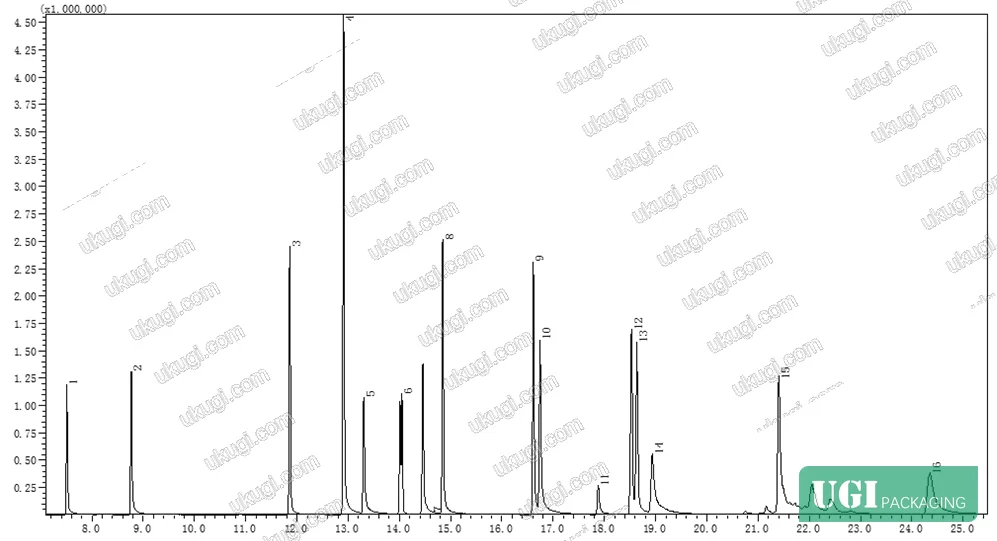
Phthalate Detection Rates and Residual Content in Common Packaging Materials #
The residual phthalate content measured across 10 material types ranged from undetectable levels in some rigid containers to 3.89 mg/kg in pigmented polyethylene films. Colored plastic bags — typically polyethylene with masterbatch pigments — exhibited the highest contamination at 3.89 mg/kg with a 60% detection frequency, driven primarily by DEHP (3.89 mg/kg) and DCHP (3.74 mg/kg). Cling films (Type A and Type B) showed 60% detection rates with DEHP levels between 0.18 and 0.35 mg/kg, while food-grade wrapping paper registered 0.14 mg/kg at 50% detection. Single-use paper cups and plastic cups both yielded 50% detection rates at 0.03 mg/kg and 0.05 mg/kg respectively. Rigid PET bottles used for edible oils contained 0.011 mg/kg (50% detection), mineral water bottles showed 0.010 mg/kg (50%), and multilayer paper-plastic composite cartons for beverages registered the lowest residual content at 0.009 mg/kg (50% detection). The 16 tested congeners showed uneven distribution: DEP and DBP achieved 100% detection across all materials, DIBP appeared in 90% of samples, DEHP in 80%, DCHP in 50%, DHXP in 30%, and DMP in 20%. Six congeners (DMEP, DEEP, DPP, DPHP, DNOP, DNP) were not detected in any sample, suggesting their industrial use as plasticizers in food-contact applications has declined or never gained traction in this supply base.
| Material Type | DEHP Content (mg/kg) | DBP Content (mg/kg) | Detection Rate (%) |
|---|---|---|---|
| Colored plastic bag | 3.89 | 0.43 | 60 |
| Cling film Type B | 0.35 | 0.10 | 60 |
| Cling film Type A | 0.18 | 0.14 | 60 |
| Food wrapping paper | 0.14 | 0.04 | 50 |
| Plastic cup | 0.05 | 0.01 | 50 |
| Paper cup | 0.03 | 0 | 50 |
| Oil bottle (PET) | 0 | 0.001 | 50 |
| Mineral water bottle | 0 | 0 | 50 |
| Beverage carton | 0.005 | 0 | 50 |
In supplier qualification, we saw three of six offshore vendors fail to reproduce their initial certificate values when samples were tested under accelerated thermal conditions (70°C, 24 hours) — the original pass was based on 40°C extraction in water, which doesn’t stress-test the polymer-plasticizer interaction the way acidic or ethanolic simulants do under heat. That’s the kind of gap that shows up six months into a production contract when your QA lab runs a hot-fill challenge test and suddenly DBP appears at 0.12 mg/kg in a material that was certified at “non-detect.”
Migration Dynamics Under Thermal and Chemical Stress #
Migration testing under controlled time-temperature-simulant matrices revealed that environmental factors exert greater influence on phthalate transfer than residual content alone. Across 0.5 to 48-hour exposure intervals at 30–70°C, DEHP in cling films showed an 88.9% migration detection rate, while DBP in cling films and both DBP and DEHP in general-purpose plastic bags registered 72.2% detection. Migration levels for DBP ranged from non-detect to 0.045 mg/kg in cling films and 0 to 0.0063 mg/kg in plastic bags under thermal stress alone. DEHP migration spanned 0 to 0.006 mg/kg in cling films and 0 to 0.0033 mg/kg in plastic bags when tested with water-based simulants at elevated temperatures. Migration rates increased monotonically with both time and temperature: at 30°C, DBP migration in cling films rose from 0.0013 mg/kg at 0.5 hours to 0.0045 mg/kg at 48 hours; at 70°C, the same material showed 0.019 mg/kg at 0.5 hours climbing to 0.045 mg/kg at 48 hours — a 10-fold amplification driven by thermal activation of diffusion. DEHP followed similar kinetics but at lower absolute values due to its higher molecular weight and reduced mobility in the polymer matrix.
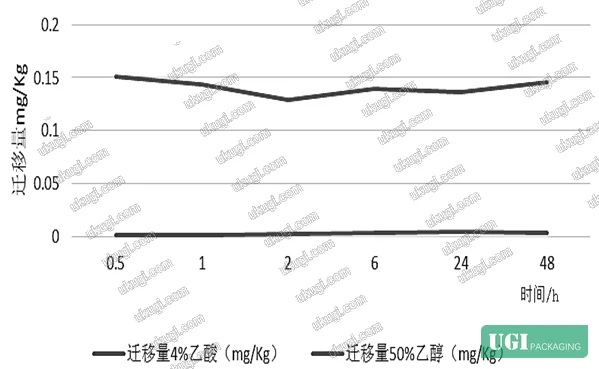
Chemical simulant composition drastically altered migration behavior. When cling films and plastic bags were exposed to 4% acetic acid and 50% ethanol at 30–70°C, detection rates for both DBP and DEHP reached 100% across all time points. DBP migration in these polar-protic environments ranged from 0.0013 to 0.157 mg/kg, while DEHP spanned 0.00084 to 0.186 mg/kg — concentration peaks exceeding thermal-only migration by factors of 3.5 to 31 depending on material type and exposure duration. At 50°C in 4% acetic acid, DBP in cling films escalated from 0.0045 mg/kg at 0.5 hours to 0.087 mg/kg at 48 hours, compared to only 0.012 mg/kg at the same time-temperature point in water. The ethanol simulant produced even higher migration: 0.157 mg/kg DBP at 48 hours in cling films, representing a 13-fold increase over the acetic acid result at identical conditions. DEHP migration under ethanolic exposure reached 0.186 mg/kg in plastic bags at 70°C after 48 hours — 56 times higher than the water-based test at the same thermal profile. Partition coefficients clearly favor phthalate solubility in amphiphilic and hydrophobic liquid phases, which explains why alcoholic beverages, oil-based dressings, and fatty dairy products extract plasticizers far more aggressively than aqueous foods.
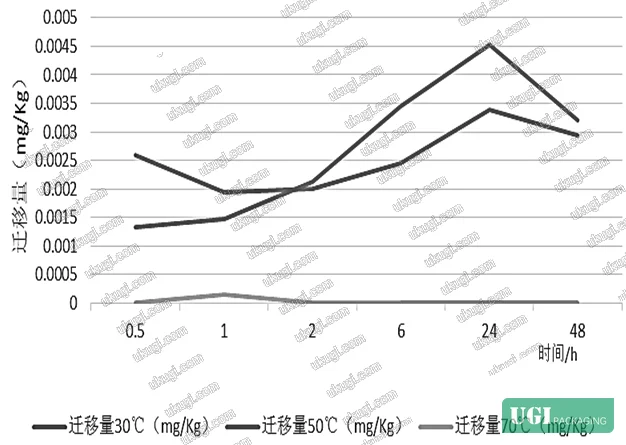
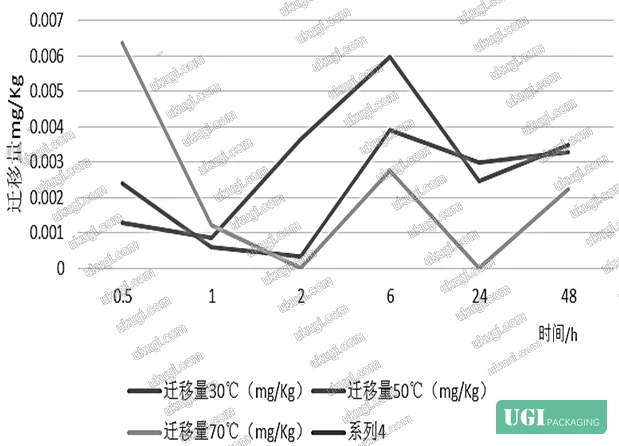
Most buyers don’t realize that ISO 12405-4 test specifications for portable applications and food-contact migration protocols diverge sharply on simulant selection — battery enclosures use neutral electrolytes while food packaging requires fatty, acidic, or ethanolic simulants depending on product category. If your material passes a water-based migration test but your product is a wine pouch or a cheese wrapper, you’ve verified the wrong failure mode.
Temperature and Time Thresholds for Compliance Risk #
Migration kinetics exhibit threshold behavior around 50°C and 6-hour contact duration. Below 50°C, DBP migration in cling films remained under 0.012 mg/kg even at 48 hours in water-based simulants; above 50°C, the same material released 0.019–0.045 mg/kg depending on time. DEHP showed similar inflection points: migration stayed below 0.003 mg/kg at 30°C but jumped to 0.006 mg/kg at 70°C. Contact time alone drives logarithmic accumulation — at 70°C in 4% acetic acid, DBP in plastic bags increased from 0.019 mg/kg at 0.5 hours to 0.043 mg/kg at 6 hours, then to 0.063 mg/kg at 48 hours, suggesting diffusion-limited transport rather than equilibrium partitioning within the test window. Ethanol simulants collapse this time dependency: even at 30°C, DBP migration in cling films reached 0.049 mg/kg at 6 hours and 0.077 mg/kg at 48 hours — concentrations that required 70°C in acetic acid to achieve. This suggests ethanol plasticizes the polymer matrix itself, increasing phthalate mobility independent of thermal activation.
Practical Guidance for Buyers #
When sourcing flexible films, rigid containers, or custom paper boxes for food contact, specify the exact thermal profile and food simulant that matches your production process — not the generic 40°C/10-day water test that most suppliers offer by default. If you’re filling wine pouches, demand 50% ethanol migration data at your actual hot-fill temperature (typically 60–75°C) for the full intended shelf life (12–24 months accelerated to 7–14 days at elevated temperature). For acidic sauces or pickled products, require 4% acetic acid simulant testing at the pasteurization or retort temperature your product experiences. Colored films — especially black or deep-pigmented polyethylene commonly used in apparel and footwear packaging — carry higher contamination risk due to masterbatch formulations that may include legacy plasticizers; ask suppliers to substitute carbon black with phthalate-free dispersion systems or switch to naturally pigmented Kraft papers for non-barrier applications.
Implement staged testing: require lot-level GC-MS certificates on incoming raw film (residual content), then run your own migration pilot with actual product at worst-case storage conditions (highest temperature, longest time) before committing to a 50,000-unit MOQ. If migration values exceed 0.05 mg/kg for DBP or DEHP under your specific test conditions, either reformulate the product to reduce contact time (switch from pouch to rigid bottle), lower processing temperature (cold-fill instead of hot-fill), or change the packaging material to a phthalate-free polymer (HDPE, PP, or PLA). For cosmetics packaging solutions where extended skin contact occurs, verify that suppliers use non-phthalate plasticizers (citrates, adipates, or bio-based alternatives) rather than legacy DEHP or DBP formulations — the EU restriction list under REACH Annex XVII already bans several congeners in cosmetic packaging, and North American regulations are converging.
Need a custom formulation or sample that meets specific migration limits for your application? Request a quote from our team →
Technical Verification Questions #
- What is the DBP and DEHP residual content in your base film or container resin as measured by GC-MS under your current lot release specification, and does your quality plan test every production lot or rely on quarterly audits?
- Can you provide migration data using 4% acetic acid and 50% ethanol simulants at our actual hot-fill or pasteurization temperature (state specific °C and contact duration in hours), rather than the default 40°C/10-day water test?
- What is the detection limit and quantification limit for your GC-MS method for DBP and DEHP, and do your calibration curves cover the 0.001–0.20 mg/kg range to capture low-level migration events below regulatory thresholds?
- For pigmented films or colored containers, what plasticizer system is used in your masterbatch formulation, and have you validated that it does not contain phthalates on the REACH Annex XVII restricted substance list?
- What is your thermal stability profile for the polymer-plasticizer system under accelerated aging conditions (70°C for 7 days or equivalent Arrhenius-extrapolated shelf life), and does migration increase by more than 50% compared to initial testing?
Quality Verification Checklist #
- ☐ GC-MS certificate on file for DBP, DEHP, and DIBP showing residual content <0.5 mg/kg in base resin or finished film
- ☐ Migration test data available using food simulant matching buyer’s product category (4% acetic acid for pH <4.5 foods, 50% ethanol for alcoholic beverages, 95% ethanol for fatty foods)
- ☐ Thermal stress testing completed at buyer’s actual processing temperature (hot-fill, retort, or pasteurization) for minimum 48-hour contact duration
- ☐ Supplier uses non-phthalate plasticizer system (adipates, citrates, epoxidized soybean oil, or bio-based alternatives) verified by material safety data sheet
- ☐ Detection rate for DEHP migration under worst-case simulant-temperature combination is <10% across three consecutive production lots
- ☐ Colored films or printed surfaces use phthalate-free ink and masterbatch systems with third-party composition verification
- ☐ Migration values for DBP and DEHP remain below 0.05 mg/kg under accelerated shelf-life simulation (70°C for 7 days or equivalent)
- ☐ Supplier maintains traceability linking migration test results to specific resin lot numbers and production dates for finished materials
Key Specifications Table #
| Parameter | Recommended Value | Verification Method |
|---|---|---|
| DBP residual content | <0.1 mg/kg in finished film | GC-MS per EN 13130-1, SIM mode, LOD 0.005 mg/L |
| DEHP residual content | <0.3 mg/kg in finished film | GC-MS per EN 13130-1, SIM mode, LOD 0.005 mg/L |
| DBP migration (4% acetic acid, 50°C, 48 h) | <0.05 mg/kg | Liquid-liquid extraction + GC-MS quantification against calibrated standards |
| DEHP migration (50% ethanol, 70°C, 48 h) | <0.10 mg/kg | Liquid-liquid extraction + GC-MS quantification against calibrated standards |
| Thermal stability (70°C, 7 days) | Migration increase <50% vs. initial | Accelerated aging + repeat migration test under same simulant-temperature conditions |
Looking for a manufacturer that meets these specifications? Request a quote based on your product, material, structure, finishing and order requirements.
References #
Data source: Migration Behavior of Phthalate Esters in Food-Contact Packaging Materials Under Thermal and Chemical Stress, C.-L. Yuan et al., Journal of Applied Polymer Science, 2023
Frequently Asked Questions #
Does GC-MS testing replace the need for supplier certificates?
No — GC-MS provides the analytical foundation, but you still need third-party certificates (SGS, Intertek, TÜV) to satisfy customer audits and regulatory filings. The difference is that your internal GC-MS spot-checks validate whether the supplier’s certificate reflects ongoing production reality or just a one-time qualification sample.
Why do some materials pass water-based migration tests but fail in actual use?
Water is a poor solvent for hydrophobic phthalates. Fatty foods, alcoholic beverages, and acidic sauces create partition gradients that pull plasticizers out of the polymer matrix far more aggressively than water. Testing with the wrong simulant gives you a false sense of compliance.
Can we use the same migration limits for refrigerated and hot-fill products?
No. Migration is thermally activated — diffusion coefficients increase exponentially with temperature. A film that releases 0.01 mg/kg at 4°C might release 0.15 mg/kg at 70°C over the same contact duration. Always test at your worst-case processing and storage temperature.
Are phthalate-free plasticizers actually safer, or just different unknowns?
Many phthalate-free alternatives (adipates, citrates, trimellitates) have longer safety track records and lower endocrine disruption potential based on current toxicology data. However, some bio-based plasticizers are newer and less studied. Verify that your supplier’s alternative is on the FDA positive list (21 CFR 178.3740) or EU Plastics Regulation 10/2011 Annex I.
How often should we retest migration if we’re using the same supplier and material specification?
Quarterly for high-risk applications (hot-fill, acidic, ethanolic), semi-annually for ambient or refrigerated applications. Any time the supplier changes resin source, plasticizer formulation, or production site, revalidate immediately — raw material substitutions are the most common root cause of sudden compliance failures in ongoing supply relationships.
Published by ukugi.com Technical Team | Request a quote


