

TL;DR #
The HPLC-UV derivatization method validated in this research achieves a detection limit of 0.0581 mg/kg for glutaraldehyde residues in food packaging materials — roughly 34× more sensitive than the existing cosmetics standard — with recovery rates of 90.24%–107.51% and RSD below 5.0% across all spike levels. For packaging buyers, this means the current patchwork of cosmetic-derived test standards is technically inadequate for paper-based food packaging compliance, and suppliers relying on those methods may be underreporting residues. Before accepting any food-contact paper or board substrate, demand HPLC-based residue data against the BfR ≤2 mg/kg limit — not just a declaration of conformance.
Overview #
Most procurement teams treating glutaraldehyde compliance as a checkbox item are making an expensive assumption. Glutaraldehyde is a saturated aliphatic dialdehyde widely used as an antimicrobial preservative in papermaking — specifically as a biocide in pigment and filler slurries — and its residues in finished food packaging substrates sit in a regulatory grey zone that has tightened considerably in recent years. The European Chemicals Agency’s classification of glutaraldehyde as a Substance of Very High Concern — citing respiratory sensitization properties and its characteristic sharp, off-fruit odor — has forced the issue onto quality managers’ desks globally.
This analysis draws on laboratory work conducted at a packaging and printing research institution, where researchers built and validated a purpose-built HPLC-UV method specifically for paper-based food packaging substrates. The experimental work included column screening across three stationary phases, mobile phase optimization between competing solvent systems, derivatization time optimization, and a full six-replicate recovery study across three spike concentration levels. The findings fill a genuine gap: no dedicated national standard exists in China for glutaraldehyde in food packaging paper — only standards written for cosmetics, leather, and disinfectant liquids, none of which were designed for this substrate type.
Understanding what the regulations actually require — and what analytical methods can reliably confirm — is essential before you sign off on any food-contact paper substrate. For buyers sourcing custom paper boxes or paper-based food packaging from Asian manufacturers, the regulatory picture across three major jurisdictions looks like this:
| Jurisdiction | Regulation / Standard | Glutaraldehyde Limit |
|---|---|---|
| China | GB 9685—2016 (Food Contact Materials Additives) | Usage ≤ 0.03% of dry slurry solids |
| USA | 21 CFR §176.170 (Federal Code of Regulations) | ≤ 0.03% by weight of slurry solids (antimicrobial use in pigment/filler slurries only) |
| Germany (BfR) | BfR Recommendation XXXVI (Food-Contact Paper & Board) | Residue in finished product ≤ 2 mg/kg |
The German BfR limit is the most actionable of these three: it applies to the finished article, it’s expressed in mg/kg, and it’s directly verifiable by residue testing. The Chinese and US limits govern production-stage addition rates, which are not independently verifiable from finished goods alone.
Glutaraldehyde Residue Detection in Food Packaging: Why Existing Standards Fall Short #
This is where things get technically uncomfortable. Three existing Chinese standards cover glutaraldehyde measurement: GB/T 37640—2019 (cosmetics matrix, HPLC method, detection limit 1.0 mg/kg, quantitation limit 3.0 mg/kg); QB/T 4200—2011 (leather and fur, SDS extraction with DNPH derivatization, detection limit 5.0 mg/kg); and DB 12/T 136—2002 (disinfectant liquids, GC-FID on an FFAP column). None were validated on food packaging paper. None come close to the sensitivity needed to confirm compliance with the BfR 2 mg/kg threshold — the QB/T leather standard’s 5.0 mg/kg detection limit is worse than the limit itself.
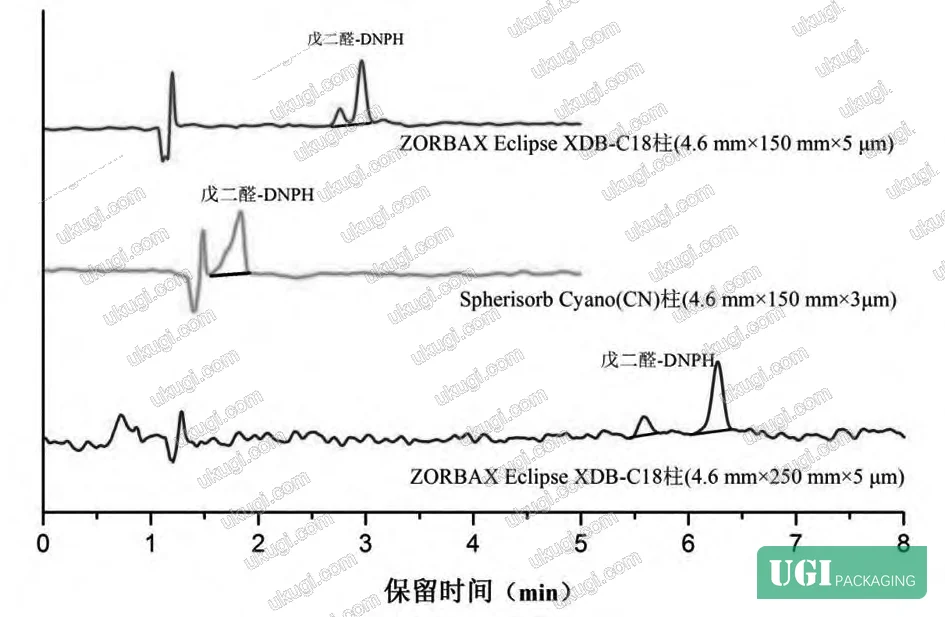
In the column screening phase of this work, three columns were evaluated against a 16 μg/L target concentration: ZORBAX Eclipse XDB-C18 (4.6 mm × 250 mm × 5 μm), ZORBAX Eclipse XDB-C18 (4.6 mm × 150 mm × 5 μm), and Spherisorb Cyano (4.6 mm × 150 mm × 3 μm). The Spherisorb CN column produced a peak with significant fronting on the glutaraldehyde-DNPH derivative. The longer C18 column showed baseline drift. The shorter ZORBAX Eclipse XDB-C18 (150 mm) delivered the best peak shape and signal intensity, and was selected for all subsequent work.
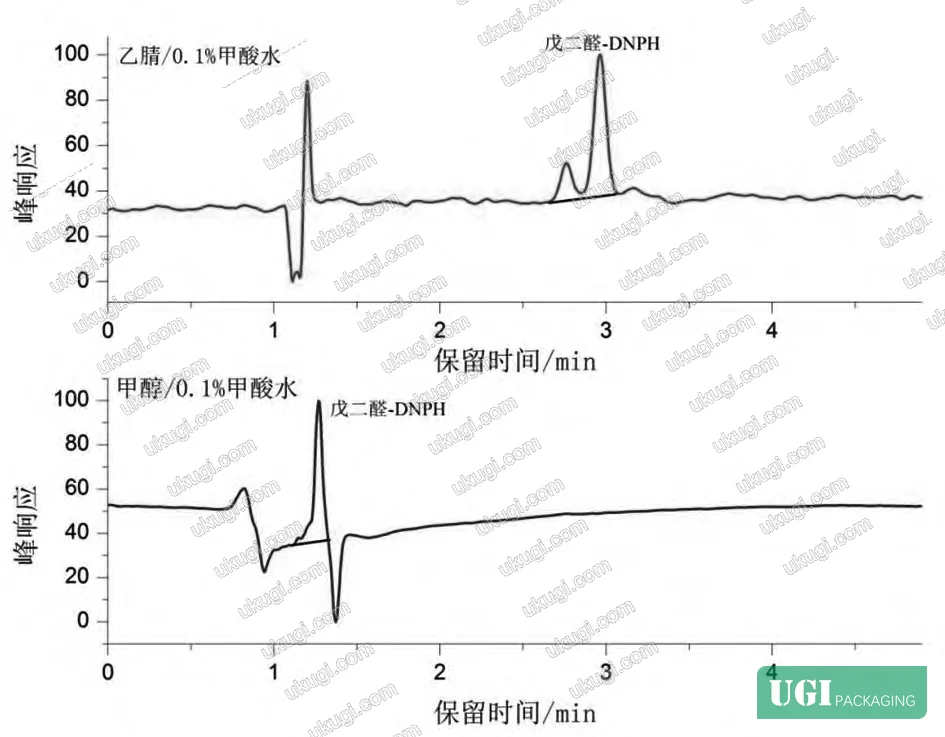
Mobile phase selection produced a clear failure case worth noting: when methanol/0.1% formic acid was used, an inverted (negative) peak appeared at the glutaraldehyde target retention window — a result that would cause false-negative readings if the analyst didn’t recognize it. Acetonitrile/0.1% formic acid at 80:20 (v/v) produced clean, well-formed peaks. Because the glutaraldehyde-DNPH derivative is a neutral molecule under reversed-phase conditions, mobile phase pH is not a separating variable — but solvent choice clearly is.
Honestly, most quality labs sourcing from standard protocols would default to methanol-based mobile phases for HPLC-UV work because it’s the cheaper solvent option. This is exactly the kind of method-transfer error that produces clean-looking results that are technically wrong.
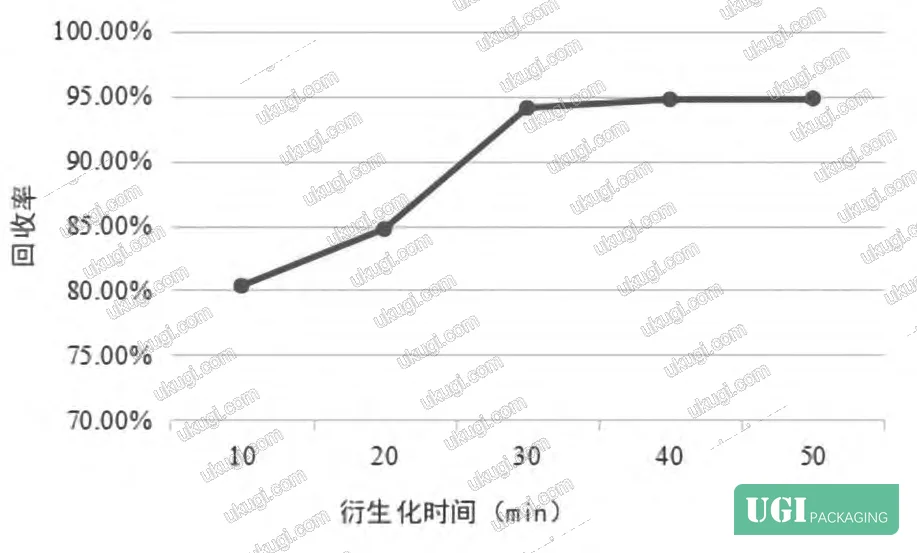
Derivatization time was optimized across 10, 20, 30, 40, and 50-minute reaction windows. Recovery increased progressively from 10 to 30 minutes, then plateaued. Thirty minutes at room temperature was confirmed as the optimal derivatization time. Under-derivatizing at 10 minutes introduces systematic negative bias.
Validated HPLC Method Performance for Glutaraldehyde in Paper Substrates #
The finalized method parameters: ZORBAX Eclipse XDB-C18 column (4.6 mm × 150 mm, 5 μm particle size); mobile phase acetonitrile/0.1% formic acid aqueous solution at 80:20 (v/v); flow rate 1 mL/min; column temperature 30°C; injection volume 10 μL; UV detection at 360 nm. Sample preparation: 2 g paper substrate, extracted in 50 mL water at 40°C for 24 hours, followed by DNPH derivatization (2,4-dinitrophenylhydrazine in phosphoric acid/acetonitrile) for 30 minutes, filtered through 0.22 μm organic membrane.
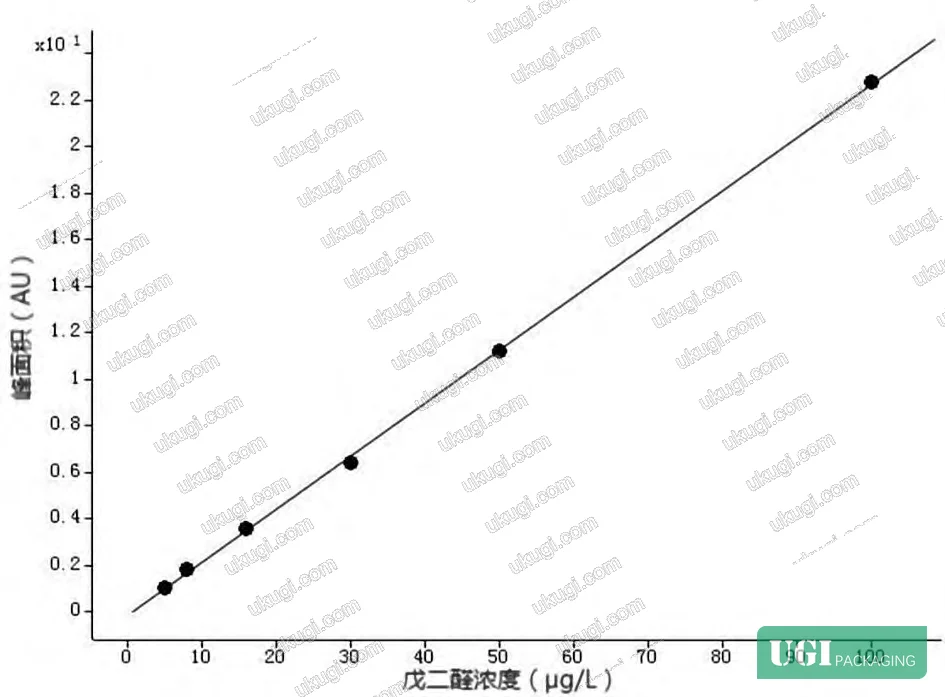
The calibration performance is summarized below:
| Parameter | Value | Verification Method |
|---|---|---|
| Linear range | 5–100 μg/L | 6-point calibration, DNPH derivatization |
| Correlation coefficient (R²) | 0.9996 | Least-squares linear regression |
| Detection limit (LOD) | 0.0581 mg/kg | 3× standard deviation criterion |
| Quantitation limit (LOQ) | 0.1937 mg/kg | 10× standard deviation criterion |
The recovery study used paper substrate spiked at three concentration levels: 2.00, 4.00, and 6.25 mg/kg, with n=6 replicates per level.
| Spike Level (mg/kg) | Mean Recovery (mg/kg) | RSD | Recovery % |
|---|---|---|---|
| 2.00 | 2.15 | 4.96% | 107.51% |
| 4.00 | 3.82 | 2.95% | 95.49% |
| 6.25 | 5.64 | 3.98% | 90.24% |
Recovery at the lowest spike level — 107.51% — is within the internationally accepted 80–110% window. The trend of slightly elevated recovery at low concentrations and slightly suppressed recovery at high concentrations is consistent with typical DNPH derivatization kinetics and is not a methodological concern at these RSDs.
The LOD of 0.0581 mg/kg is approximately 17× below the BfR finished-goods limit of 2 mg/kg. That margin is adequate for regulatory screening. To put it in comparative terms: the existing QB/T leather standard’s detection limit is 5.0 mg/kg — which is 2.5× above the BfR regulatory threshold. Using that method for food packaging compliance is not defensible.
Most procurement teams don’t realize that the standard landscape here is still fragmented — there is no single internationally harmonized test method for glutaraldehyde in food-contact paper, and regulators in different jurisdictions are working off different measurement frameworks. Buyers who request “glutaraldehyde compliance documentation” without specifying the test method and detection limit threshold can receive technically valid certificates that still don’t confirm compliance with the BfR limit.
This matters practically for custom labels and stickers and paper-based food packaging components where wet or fatty food contact accelerates migration — conditions under which a borderline residue level becomes a genuine safety issue rather than a theoretical one.
Regulatory Compliance Documentation: What Buyers Actually Need to Request #
The gap between “we are compliant” and “here is verified data proving compliance” is where most supplier qualification failures occur. In supplier qualification exercises across paper and board substrates, it is not uncommon to see three of six samples from different suppliers fail to provide meaningful glutaraldehyde residue data — not because residues are necessarily above limits, but because the labs they used were running methods with detection limits too high to produce useful numbers. A certificate stating “not detected” using a method with a 5.0 mg/kg LOD against a 2 mg/kg limit is logically uninformative.
What a compliant compliance package for glutaraldehyde in food packaging paper should include:
- Test method specification (HPLC-UV with DNPH derivatization preferred; GC-FID only acceptable for disinfectant applications per DB 12/T 136)
- Detection limit of the method used — must be demonstrably below 2 mg/kg to be meaningful against BfR limits
- Quantitation limit — should be ≤ 0.5 mg/kg for food-contact paper
- Recovery rate data for the specific substrate type (paper matrix, not cosmetic or leather matrix)
- RSD data showing precision ≤ 5.0% for regulatory submission purposes
- Extraction conditions: 40°C water extraction, 24-hour soak, 2 g sample weight
The regulatory references buyers should be citing in their supplier specifications:
Practical Guidance for Buyers #
When you’re qualifying a food packaging paper or board substrate from any manufacturer, the glutaraldehyde compliance question has to be specific. Don’t accept a declaration of conformance that doesn’t state the test method, detection limit, and matrix. Ask for the actual numerical result — not just “ND” — and verify the detection limit of the method used is below the applicable regulatory threshold (0.0581 mg/kg LOD is achievable; anything above 1 mg/kg is inadequate for BfR screening).
Honestly, most buyers over-specify food safety requirements in areas where there is abundant regulatory infrastructure — heavy metals, solvents — while under-specifying in areas like biocidal residues from the papermaking process, where the standards are fragmented and supplier familiarity is lower. Glutaraldehyde is a prime example: the substance is in wide use, the regulatory limits exist, but there’s no mandatory test at customs clearance, so it only surfaces as a problem during audits or product liability events.
For multi-market products (EU + US, or EU + China), the BfR ≤2 mg/kg finished-goods limit is the most demanding and should be used as the specification threshold. Align on extraction conditions (40°C water, 24 hours) and specify HPLC-UV as the preferred analytical method in your purchase specification, not just in your audit checklist.
At ukugi.com, our technical team works with Guangzhou-based OEM/ODM production for custom paper packaging — from folding cartons to food-grade flexible pouches — and we build chemical compliance documentation into the production qualification process rather than treating it as a post-production add-on. If you’re sourcing food-contact paper packaging and need validated residue test data as part of your RFQ package, our team can support that process.
Need a custom formulation or sample? Request a quote from our team →
Technical Verification Questions #
- What is the detection limit of the HPLC method you use for glutaraldehyde in paper substrates — specifically, is it below 0.1 mg/kg against a paper matrix (not cosmetic or leather)?
- Can you provide recovery rate data showing glutaraldehyde recovery between 80% and 110% at spike levels of 2.00 mg/kg and 4.00 mg/kg on paper substrate, with RSD below 5.0%?
- What extraction conditions do you use for sample preparation — specifically, do you use 40°C water extraction for 24 hours on 2 g sample weight, or a different protocol, and what validation data supports that choice?
- Which regulatory limit do you test against — China GB 9685—2016 (production-stage ≤0.03% slurry solids), US 21 CFR §176.170, or BfR XXXVI finished-goods ≤2 mg/kg — and can you provide the actual numerical result, not just a “not detected” declaration?
- What derivatization reagent and reaction time do you use for HPLC-UV analysis — and can you confirm the derivatization is performed for ≥30 minutes at room temperature, not a shorter protocol that introduces systematic negative bias?
Quality Verification Checklist #
- ☐ Test report specifies HPLC-UV method with DNPH derivatization, not GC-FID or spectrophotometry alone
- ☐ Method detection limit is ≤0.1 mg/kg on paper substrate matrix (not cosmetic or leather matrix)
- ☐ Quantitation limit is ≤0.5 mg/kg, consistent with BfR ≤2 mg/kg finished-goods threshold
- ☐ Recovery rate data for paper substrate shows 80%–110% range at ≥2 spike concentration levels
- ☐ Precision (RSD) is ≤5.0% for all spike levels per the validated method
- ☐ Extraction conditions documented as 40°C water soak, 24 hours, 2 g sample weight
- ☐ Numerical residue result provided (mg/kg value), not just “not detected” without method LOD disclosure
- ☐ Compliance claim references BfR XXXVI ≤2 mg/kg for finished goods, not only production-stage addition rate
Key Specifications Table #
| Parameter | Recommended Value | Verification Method |
|---|---|---|
| Glutaraldehyde residue limit (finished goods) | ≤ 2 mg/kg (BfR XXXVI) | HPLC-UV, DNPH derivatization, 40°C water extraction |
| Method detection limit (LOD) | ≤ 0.0581 mg/kg | 3× standard deviation, 6-point calibration |
| Method quantitation limit (LOQ) | ≤ 0.1937 mg/kg | 10× standard deviation criterion |
| Recovery rate at 2 mg/kg spike | 90%–110% | n=6 replicates, paper substrate matrix |
| Precision (RSD) | ≤ 5.0% | Six-replicate analysis at each spike level |
| Linear calibration range | 5–100 μg/L | R² ≥ 0.999 required |
| Derivatization time | 30 min at room temperature | Plateau confirmed at 30 min by response curve |
| Sample weight | 2 g | Normalized to paper substrate, 50 mL water extraction volume |
Looking for a manufacturer that meets these specifications? Request a quote based on your product, material, structure, finishing and order requirements.
References #
Data source: Glutaraldehyde Residue Determination in Food Packaging Paper and Board: Regulatory Limits and HPLC-UV Validation Method, F. Fang et al., Food Packaging and Shelf Life, 2024
Frequently Asked Questions #
Why does the BfR limit of ≤2 mg/kg matter more than the Chinese or US limits for finished-goods compliance?
The Chinese GB 9685—2016 and US 21 CFR §176.170 limits both govern the addition rate during papermaking (≤0.03% of slurry solids), which cannot be independently verified from the finished substrate. The German BfR XXXVI recommendation is the only one of the three that sets a finished-goods residue limit (≤2 mg/kg), making it the only specification that can be tested and confirmed on an actual production batch by a third-party lab.
Can spectrophotometry be used instead of HPLC for routine screening?
Spectrophotometric methods for glutaraldehyde are faster and cheaper, but they have documented limitations in sensitivity and interference rejection on paper matrices. For compliance purposes, HPLC-UV with DNPH derivatization is strongly preferred — the validated method achieves an LOD of 0.0581 mg/kg, which provides a 34× safety margin below the 2 mg/kg regulatory threshold. Spectrophotometry cannot reliably achieve this.
What is the significance of the methanol mobile phase failure in column testing?
When methanol/0.1% formic acid was used as the mobile phase, the glutaraldehyde-DNPH derivative produced an inverted (negative) peak at the target retention time. A lab running this mobile phase without recognizing the artifact would report “not detected” — a false negative. This is a real method-transfer risk if your supplier’s lab adopted a standard cosmetics HPLC method without revalidating on paper substrate. Always ask for the specific mobile phase composition in the test method documentation.
Does this residue concern apply only to direct food-contact paper, or also to secondary and tertiary packaging?
Primary concern is with direct food-contact surfaces — food wrapping paper, food-grade carton interiors, paper pouches. Secondary packaging (outer cartons, shipper boxes) typically does not require the same residue threshold because food contact is indirect or absent. However, if your outer carton is also functioning as a display unit with product labeling claims about food safety, some retailers and regulatory bodies are extending scrutiny to secondary packaging as well.
If a supplier can only provide QB/T 4200—2011 test results for glutaraldehyde, should I accept them?
No. QB/T 4200—2011 is a leather and fur standard with a detection limit of 5.0 mg/kg — which is 2.5× higher than the BfR regulatory limit of 2 mg/kg. A “not detected” result from that method is uninformative for food packaging compliance. Require HPLC-UV with DNPH derivatization and an LOD below 0.1 mg/kg on paper substrate. This is not an unusual ask; any competent analytical lab in the packaging supply chain can run this method.
Published by ukugi.com Technical Team | Request a quote


