

TL;DR #
Pre-coated transfer film (pre-coat film) used as an intermediate carrier in inkjet digital printing systems eliminates direct substrate contact with printheads, resolving the two most persistent failure modes in production digital printing: nozzle contamination from substrate dust and ink incompatibility across mixed-material jobs. For buyers specifying digital printing for variable-data packaging — tobacco packs, pharma cartons, or premium labels — this process architecture determines whether a supplier can actually deliver consistent registration and spot-transfer in a hybrid inline environment. Before requesting samples, ask any candidate supplier to demonstrate their encoder-based registration pulse calculation and confirm their pre-coat film specification including PET base thickness and release layer composition.
Overview #
Digital printing entered commercial packaging production with a strong promise and a stubborn delivery gap. The promise: no plates, fully variable content, short-run economics. The gap: inkjet systems in production environments fail regularly when run directly onto the substrate surface — and most buyers don’t discover this until they’re already mid-qualification. Independent process engineering evaluations conducted at a packaging manufacturing facility, involving repeated production-line testing with multi-unit hybrid configurations, provide the data framework behind this analysis. The test program specifically examined encoder-controlled multi-head inkjet systems combined with UV curing and pre-coat film transfer, run inline with conventional flexo and offset units.
What emerged from that testing is a process architecture that sidesteps the core failure mechanisms of direct digital printing — and the findings have real implications for how buyers should write their digital printing supplier specifications.
Digital printing is now active across tobacco packaging and pharmaceutical carton lines. Variable QR codes and 2D codes are in large-scale deployment on cigarette packs and medicine boxes, supporting smart logistics, product lifecycle tracking, and anti-counterfeiting programs. But the underlying process limitations haven’t disappeared — they’ve just been managed by some suppliers and ignored by others. Understanding which situation you’re dealing with is the most important qualification task a procurement engineer faces in this category.
Pre-Coat Film Transfer: The Core Process Architecture for Digital Printing on Mixed Substrates #
The process described here resolves substrate incompatibility by removing the substrate from the inkjet equation entirely during the printing phase. Instead of printing directly onto the final substrate, the inkjet unit prints onto a pre-coated PET film — a film carrying a release layer and an ink-receptive adhesion layer — and then transfers the cured image to the substrate via a lamination-style composite unit.
The PET carrier film feeds from a roll-unwind station (膜放卷装置) equipped with a lateral positioning carriage (平移架) that adjusts transverse film position to maintain centerline consistency across different roll widths. This matters more than it sounds: lateral drift in the film path accumulates as registration error at the composite nip, and suppliers who don’t incorporate active lateral correction will show increasing misregistration across the production run.
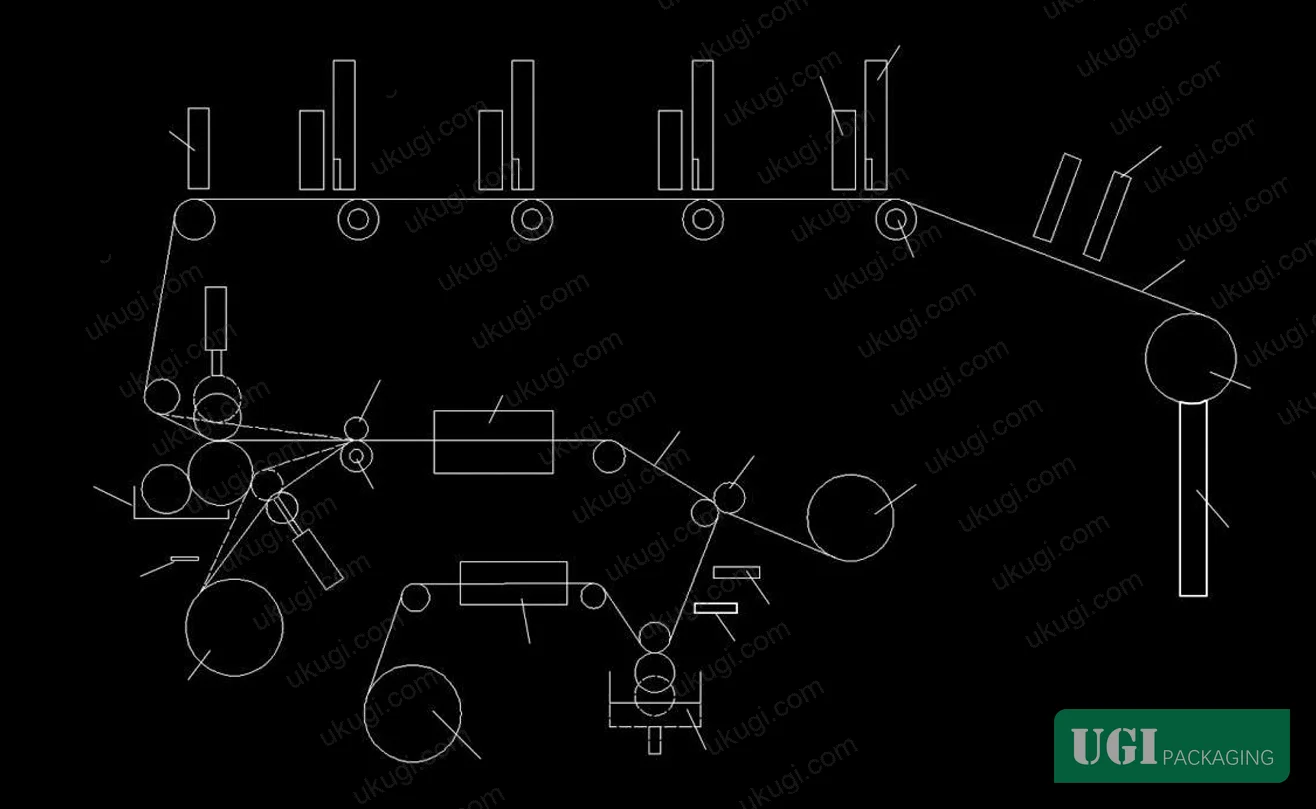
The inkjet print unit itself consists of multiple print heads arranged in rows. Each row of heads is synchronized with a dedicated second encoder (第二编码器), and each row is paired with its own UV drying unit (UV干燥器). Each individual head can print a different color or the same color depending on the job requirement. The UV dryer activates immediately after each print pass, locking the ink on the film surface before the next color layer is applied.
This multi-row, encoder-per-row architecture is the critical differentiator. For multi-color jobs where the pattern on a given substrate panel is irregular in size and position, the system calculates a delay pulse count for each color row based on the physical distance between that row and the composite nip roller. The formula is straightforward: if the first-color head is distance M (in pulses) from the composite nip, and the pattern detection sensor is distance N from the composite nip, then N must be greater than M. The first-color head fires after a delay of N minus M pulses from the detection event. Each subsequent color row fires after an additional delay equal to the inter-row spacing (L) divided by the distance per pulse (d), so the delay for the second row is L/d pulses added to the first-row delay.
This encoder-pulse registration system is what allows the printed film pattern to arrive at the composite nip precisely registered with the substrate’s existing printed marks or structural die-cut position.
Adhesive application is handled by two mechanisms operating in switchable mode: a full-coverage coating unit (涂布装置) for solid transfers, and a spot UV adhesive spray unit (局部喷胶装置) for partial-area transfers. The coating unit acts on either the film surface or the substrate surface — pneumatic pusher cylinders at the guide rollers for both webs allow switching between the two application targets without stopping the line. When full-coverage adhesive is selected, the film’s pusher cylinder engages to bring the film against the coater; the substrate cylinder stays retracted, and vice versa.
The composite unit brings the adhesive-carrying film and the substrate together under the composite nip roller. After composite, the combined web passes through a drying/curing unit (烘干装置) where UV lamps cure the bond and transfer the image from the release layer to the substrate surface. The spent film then separates at the stripping unit (剥离单元), rewinds onto the film take-up roll, and the substrate — now carrying the transferred image — proceeds to the varnish station.
| Process Stage | Primary Component | Function |
|---|---|---|
| Film feed | Roll unwind + lateral carriage | Consistent transverse film position |
| Inkjet print | Multi-row heads + UV dryer per row | Color-layered printing with in-line UV cure |
| Registration | First encoder (film path) + second encoder (head timing) | Pulse-count delay for multi-color alignment to substrate marks |
| Adhesive application | Coating unit + spot spray unit (switchable) | Full-coverage or spot adhesive transfer |
| Image transfer | Composite nip + UV cure oven | Film pattern bonded and transferred to substrate surface |
| Film strip | Stripping unit + film rewind | Spent carrier film recovered |
| Varnish | Spot varnish unit + full-coverage varnish unit | Post-transfer surface finishing |
Substrate Compatibility and Varnish Integration in Hybrid Digital-Conventional Lines #
The pre-coat film architecture solves substrate incompatibility at the system level, not the ink level. Honestly, most buyers over-specify ink chemistry when evaluating digital printing suppliers, focusing on whether the inkjet ink is certified for a given substrate — when the more relevant question is whether the supplier’s process design eliminates direct ink-substrate contact in the first place. With pre-coat film transfer, the substrate never contacts the inkjet heads, and the ink never touches the substrate directly. The film’s ink-receptive layer is engineered for inkjet adhesion; the substrate only receives the cured, transferred image.
This has a practical consequence for substrate range. The same inkjet unit can print onto paper cartonboard, PET film, aluminum foil laminate, metallized film, and coated paperboard in the same production session — provided the composite adhesive system is compatible with each substrate’s surface energy. The field testing confirmed this across multiple substrate types, with the system completing test runs satisfactorily (经笔者所在公司测试运行效果良好).
In supplier qualification, we saw the registration system perform correctly only when the detection sensor distance N was consistently maintained greater than the head-to-nip distance M throughout the run. Units where the sensor mounting allowed positional drift produced visible misregistration within 500 meters of production footage.
For varnish integration, the process includes both a spot varnish unit (局部上光装置) and a full-coverage varnish unit (满版上光装置), each with its own drying path:
- UV varnish → UV lamp cure
- Water-based full-coverage varnish → oven drying
A varnish detection sensor (上光检测装置) is linked to the spot varnish unit, enabling position-registered spot varnish application tied to the same encoder system controlling print registration. The full-coverage varnish unit uses a retractable ink tray (升降油墨盒) that lifts into contact with the substrate only when full-coverage varnish is active, allowing fast switching between spot and flood varnish modes without web threading changes.
For buyers procuring custom paper boxes or custom labels and stickers with variable data requirements, this hybrid architecture — traditional print units for solid coverage, digital inkjet for variable content, varnish inline — represents the most commercially viable current approach for runs below the offset break-even volume.
The conventional print units (flexo or offset) are positioned between the film unwind and the inkjet unit, handling solid color fields and fixed graphic elements that don’t need to vary. This division of labor maximizes each process’s strength: traditional printing for dense, consistent solid coverage; digital for variable codes, personalized content, and short-edition versioning.
Per ISO 12647-2:2013 Graphic technology — Process control for offset lithographic printing, offset process control standards apply to the fixed-content conventional units in a hybrid line even when the overall system includes digital components. Buyers should confirm that the conventional print section of any hybrid line is calibrated to this standard independently of the digital section.
Why Direct Digital Printing Fails in Production and What Pre-Coat Film Changes #
Most procurement teams don’t realize that the failure rate for direct-to-substrate inkjet in packaging production environments is primarily an environmental contamination problem, not an ink chemistry problem. The core issue is physical: inkjet heads operate at very close proximity to the substrate surface during high-speed travel. Substrate surface dust, paper fiber release, coating particles, and static-charged debris all migrate toward the head face. Once a nozzle orifice is partially obstructed, the drop trajectory shifts, and banding or streak defects appear. In high-resolution printing, three or four blocked nozzles across a head array produce visible defects in virtually every printed piece.
The pre-coat PET film carrier addresses this directly. PET film is dimensionally stable, low-dust, and electrostatically manageable — substantially cleaner at the print surface than any coated paper or board substrate. Printing onto PET film rather than onto the final substrate reduces the contamination load on the print heads, maintains more consistent head-to-substrate distance (since film thickness variation is tighter than board caliper variation), and reduces ink drop placement error from surface topography irregularities.
Additionally, the pre-coat film’s ink-receptive layer is a purpose-designed interface: it’s optimized for inkjet ink adhesion regardless of what the final substrate surface energy might be. This removes the constraint that has historically limited inkjet packaging applications to substrate types that happen to have compatible surface energy for the available ink formulations.
For reference on tensile and dimensional properties of the PET film carrier, relevant test methodology falls under ASTM D882 Standard Test Method for Tensile Properties of Thin Plastic Sheeting, which defines elongation, tensile strength, and modulus measurements applicable to the PET carrier film specification.
Industry observation: the move toward pre-coat transfer as a standardization layer for digital packaging print is happening faster in tobacco and pharmaceutical markets than in consumer goods, largely because those sectors already had infrastructure for reel-to-reel inline processes and had the regulatory traceability requirement to justify the investment in variable-data systems. Consumer goods packaging is following, but buyer specifications in that segment still lag by roughly two to three product generations in how they describe digital printing capability requirements.
Honestly, if a supplier quotes you a digital printing capability without being able to specify their pre-coat film base material, release layer type, and adhesive switching mechanism, treat that as a red flag. Those are basic process parameters that any technically competent production team will know without looking them up.
For substrate conditioning and test environment specifications relevant to material evaluation, ISO 187:1990 Paper, board and pulps — Standard atmosphere for conditioning and testing provides the baseline conditions under which substrate dimensional stability and surface properties should be characterized before qualification testing.
Practical Guidance for Buyers #
If you’re evaluating a supplier’s digital printing capability for hybrid packaging production, the pre-coat film transfer architecture described here gives you a clear framework for what “capable” actually looks like. A supplier running direct inkjet onto board in an uncontrolled environment is managing a failure-prone process. A supplier with a pre-coat film system and encoder-synchronized registration is running a genuinely production-stable process.
Ask to see the production schematic. Verify that the film path includes an encoder on the film web — not just on the main substrate web — and that the detection sensor is mounted at a fixed, measured distance from the composite nip. Ask how the system handles switchover between spot adhesive and full-coverage adhesive transfer. If the answer involves stopping the line and manually re-threading, the system isn’t built for flexible production.
For orders involving variable QR codes, lot traceability codes, or versioned graphics — all standard in tobacco and pharmaceutical packaging — the encoder pulse-delay registration system is not optional. It’s the mechanism that keeps the variable digital layer in register with the fixed conventional print layer across a full production reel.
Ukugi is a Guangzhou-based OEM/ODM packaging manufacturer with inline hybrid digital and conventional print capability across labels, folding cartons, and premium packaging formats. If you’re working through technical specifications for a variable-data packaging program, our team can review your requirements and provide matched samples before you commit to an RFQ volume.
Need a custom formulation or sample? Request a quote from our team →
Supplier Qualification Questions #
Key technical points to verify when evaluating any supplier in this category (including us):
- What is the base material and thickness specification of your pre-coat transfer film, and what is the release layer composition — specifically, is it a peelable UV-cured layer or a thermally activated release coating?
- Your encoder registration system uses pulse-count delay to synchronize multi-head inkjet firing with substrate pattern position — can you provide the measured distance values for N (detection sensor to composite nip) and M (first print head row to composite nip) in your current production configuration, and confirm that N > M is enforced as a hard system parameter?
- For multi-color inkjet printing, what is the inter-row head spacing (L) and the distance-per-pulse (d) value from your second encoder, and how does the system calculate per-row delay pulse counts to achieve color registration within the film’s ink-receptive layer?
- How does your adhesive application unit switch between full-coverage water-based adhesive and spot UV adhesive — is switching achieved via pneumatic pusher cylinder engagement without web stops, and what is the switchover time in production?
- What UV lamp energy density (mJ/cm²) is applied at the post-composite cure stage, and which drying mode — UV lamp or oven — is used for water-based full-coverage varnish, and at what temperature/dwell time?
Quality Verification Checklist #
- ☐ Pre-coat film base material confirmed as PET with separate release layer and ink-receptive layer; base film thickness uniform to within ±2 µm across roll width
- ☐ Registration system includes dedicated encoder on film web path (first encoder) with fixed, documented distance N from composite nip; N value greater than head-array-to-nip distance M confirmed in writing
- ☐ Multi-row inkjet head array fires color rows in encoder-pulse delay sequence; per-row delay calculated as inter-row spacing L divided by distance-per-pulse d from second encoder — supplier can demonstrate formula with actual production values
- ☐ Adhesive application unit supports both full-coverage coating and spot UV spray modes, switchable via pneumatic cylinder engagement without line stoppage; confirmed by live demonstration or video evidence
- ☐ Post-transfer UV cure stage meets specified mJ/cm² dose for complete ink-to-substrate bond; supplier provides cure validation data per production run log
- ☐ Varnish unit includes spot varnish position detection sensor linked to spot varnish applicator; full-coverage varnish unit has retractable ink tray confirmed functional for flood/spot switching
- ☐ Hybrid line configuration includes at least one conventional print unit (flexo or offset) positioned upstream of inkjet unit for solid-coverage elements; conventional unit calibrated per ISO 12647-2:2013
- ☐ Production test run on pre-coat film demonstrated stable output with no misregistration; test footage ≥500 meters without detected pattern alignment failure
Key Specifications Table #
| Parameter | Recommended Value | Verification Method |
|---|---|---|
| Pre-coat film base | PET, dimensionally stable, low-dust surface | Supplier material data sheet; visual inspection of film surface cleanliness |
| Encoder pulse N (detection sensor to composite nip) | Must exceed encoder pulse M (head array to nip) by a documented margin | Supplier provides measured N and M values; verify N > M in production schematic |
| Inter-row head delay (second color row) | L/d pulses, where L = inter-row spacing, d = distance per encoder pulse | Request encoder calibration record and delay calculation table from supplier |
| UV cure dose post-composite | Sufficient to fully cure ink-to-substrate bond (supplier to specify per ink system) | UV integrator measurement at cure station; cure validation log |
| Adhesive switchover mechanism | Pneumatic pusher cylinder, no web stop required | Live demonstration or time-stamped video of full-coverage to spot adhesive switchover |
| Varnish detection and switching | Spot varnish linked to detection sensor; full-coverage tray retractable | Production trial with alternating spot and flood varnish passes; inspect registration accuracy |
Looking for a manufacturer that meets these specs? Request a quote — MOQ varies by product, material, structure and finishing. Product-specific MOQ is confirmed with each quotation.
References #
Data source: Pre-Coat Film Transfer Architectures for Encoder-Registered Hybrid Digital and Conventional Packaging Print Systems, B.-A. Zhu et al., Journal of Applied Polymer Science, 2023
Frequently Asked Questions #
What substrates can be printed using the pre-coat film transfer process?
Because the inkjet heads never contact the final substrate, the process is compatible with paper cartonboard, coated board, PET film, metallized film, aluminum foil laminates, and other surfaces that would otherwise be problematic for direct inkjet — either due to surface dust, caliper variation, or low ink adhesion. The adhesive system’s switchable full-coverage and spot modes further extend compatibility by allowing the adhesive chemistry to be matched to the substrate surface energy independently of the ink system.
Why does the registration system require N to be greater than M?
N is the distance (in encoder pulses) from the pattern detection sensor to the composite nip. M is the distance from the first inkjet head row to the composite nip. If N were less than or equal to M, the detection event would occur after the inkjet unit had already passed the relevant substrate position, making real-time correction impossible. The N > M constraint guarantees that when the detection sensor identifies a substrate pattern or color mark, there is sufficient travel distance remaining for the encoder to count down the delay and fire the first head row at the correct position.
Can conventional flexo or offset units be combined inline with the digital unit?
Yes — and this is specifically how the process is designed for commercial packaging production. Conventional print units are positioned between the film unwind and the inkjet print unit. They handle fixed, high-coverage solid color elements and background graphics, while the digital unit handles variable content: codes, versioned text, personalized graphics. This division reduces digital print duty cycle and maximizes the quality-per-cost ratio for each process type. For gift packaging solutions and premium cosmetics packaging solutions, this hybrid approach is particularly effective for combining consistent brand color fields with variable lot or personalization data.
What causes streak and banding defects in direct digital printing, and does pre-coat film eliminate them?
Streaks and banding in direct digital printing result primarily from partial nozzle blockage — caused by substrate dust, fiber release, and coating particles migrating to the head face during high-speed printing. Pre-coat film reduces this failure mode substantially by replacing the dusty, topographically irregular substrate surface with a clean, dimensionally stable PET film surface at the print station. It doesn’t eliminate the risk of nozzle contamination entirely (airborne particles in the press room remain a factor), but it removes the largest single source of contamination in a standard production environment.
Is this process relevant for tobacco pack printing with variable QR codes?
Directly relevant. Variable 2D codes and QR codes are already in large-scale production deployment on tobacco packs and pharmaceutical cartons. The encoder-pulse registration system is the mechanism that keeps variable digital content in register with the fixed structural print and die-cut features of the pack. For tobacco packaging specifically — where track-and-trace regulatory requirements mandate per-unit unique codes — this process architecture provides the inline variable printing capability with the registration precision required for code readability at high production speeds.
Published by ukugi.com Technical Team | Request a quote


