

TL;DR #
Pressing time is the dominant process variable in paper bag bottom-seal strength — it outranks temperature, glue thickness, and humidity in statistical significance, with the optimal combination (15.7 °C, 12.45 µm glue coat, 51.12% RH, 3.38 s press) delivering a predicted peel load of 13.95 kg against a verified actual of 13.92 kg, an error of just 0.27%. Buyers evaluating paper bag suppliers should treat seal integrity under load — not just visual inspection — as the primary acceptance criterion, because a bottom seal that looks complete can still fail under 12 kg if any one of these four parameters drifts outside its optimized window. Request a sample batch produced at documented process conditions and conduct a dead-weight load test before committing to production volume.
Overview #
Most procurement teams evaluating paper carrier bags focus on caliper, grammage, and surface finish — and largely ignore the bottom-seal bond, which is actually the structural weak point in flat-bottom and square-bottom tote construction. That’s a costly oversight. The bottom-seal peel strength is directly what determines whether a bag holds 8 kg of wine bottles or fails at the checkout counter.
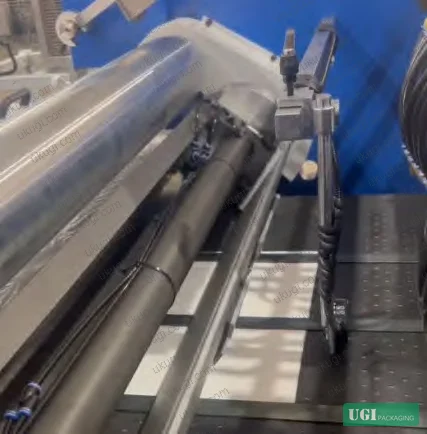
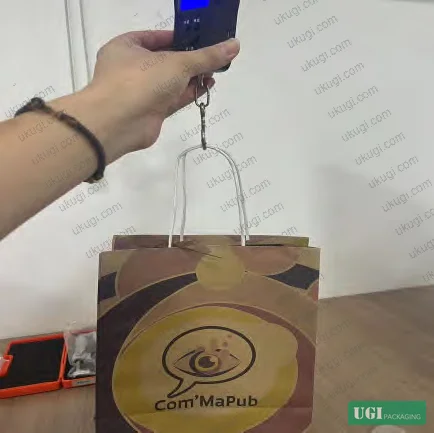
The research underpinning this article comes from a controlled industrial study conducted at a polytechnic institution in Zhejiang province, using a ZB1260SF-450 single-sheet fully automatic bag-making machine operating inside a sealed laboratory environment. The experimental design employed a Box-Behnken Response Surface Methodology (RSM) framework — a structured 4-factor, 3-level design producing 29 experimental runs — with 130 g kraft paper as the substrate and a commercial water-based edge adhesive (Q/HZM 04 standard) as the bonding agent. The paper bag dimensions tested were 190 mm face width × 80 mm gusset × 225 mm height — a format directly representative of retail carrier and boutique shopping bags. Peel strength was measured by dead-weight incremental loading until the sealed bottom faces separated.
The findings are immediately applicable to paper bags and carrier bags procurement, specifically for buyers sourcing square-bottom kraft or coated paper bags for retail, apparel, food, or gift applications.
Adhesive Coat Weight and Process Conditions: What Actually Drives Paper Bag Peel Strength #
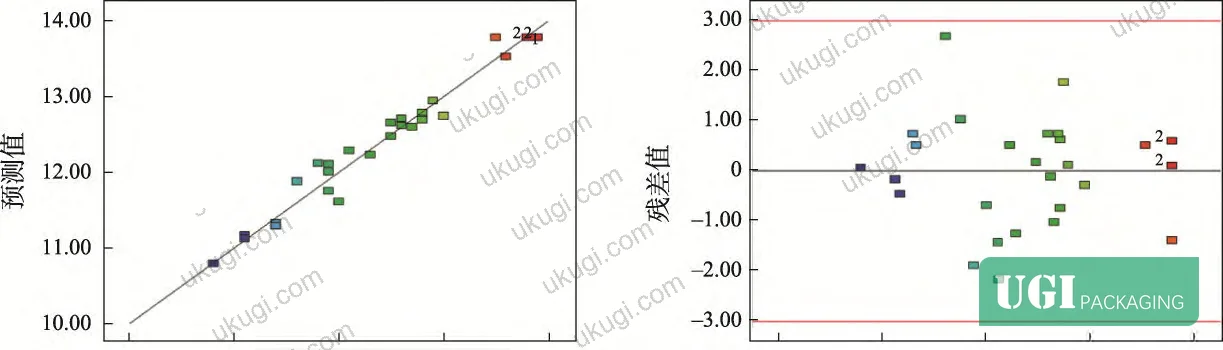
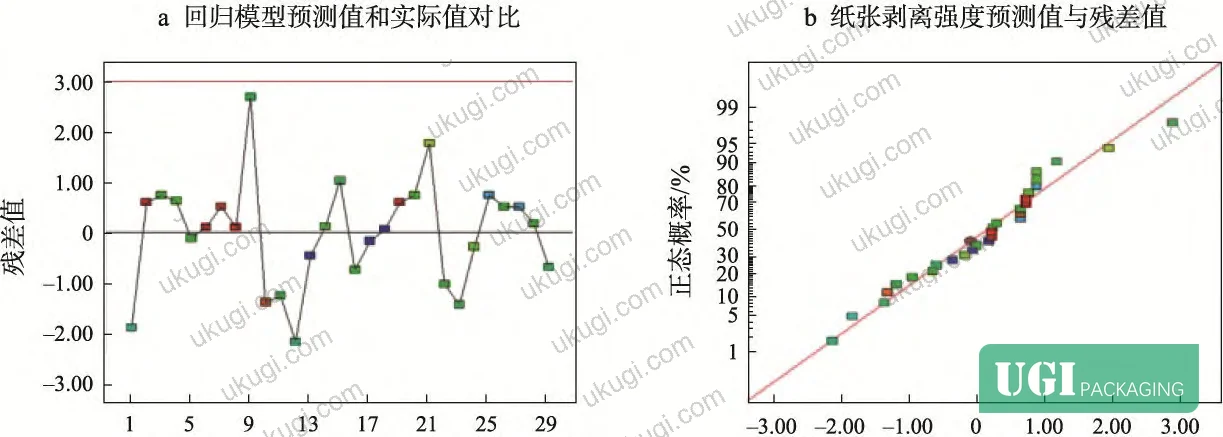
Four variables were tested across their practical production ranges: temperature (4–30 °C), glue application thickness (10–30 µm), relative humidity (40–60%), and paper pressing time (2–6 s). The RSM model achieved a multiple correlation coefficient (R²) of 0.968, with a coefficient of variation of just 1.82% and a signal-to-noise ratio of 18.369 — well above the minimum threshold of 4.0 required for model adequacy. The difference between the adjusted R² (0.936) and predicted R² (0.835) was 0.101, comfortably below the 0.2 ceiling that indicates model stability.
What the variance analysis revealed, ranked by F-value, is that pressing time (D) was the single most influential factor, with P < 0.001 and F = 21.11. Temperature ranked second. Glue coat thickness and humidity were statistically less significant individually — but their interactions with pressing time were not trivial. Specifically:
- The temperature × pressing time (AD) interaction: F = 35.62, P < 0.001 — highly significant
- The glue thickness × pressing time (BD) interaction: F = 9.58, P = 0.008 — significant
- The temperature × humidity (AC) interaction: F = 5.91, P = 0.029 — marginally significant
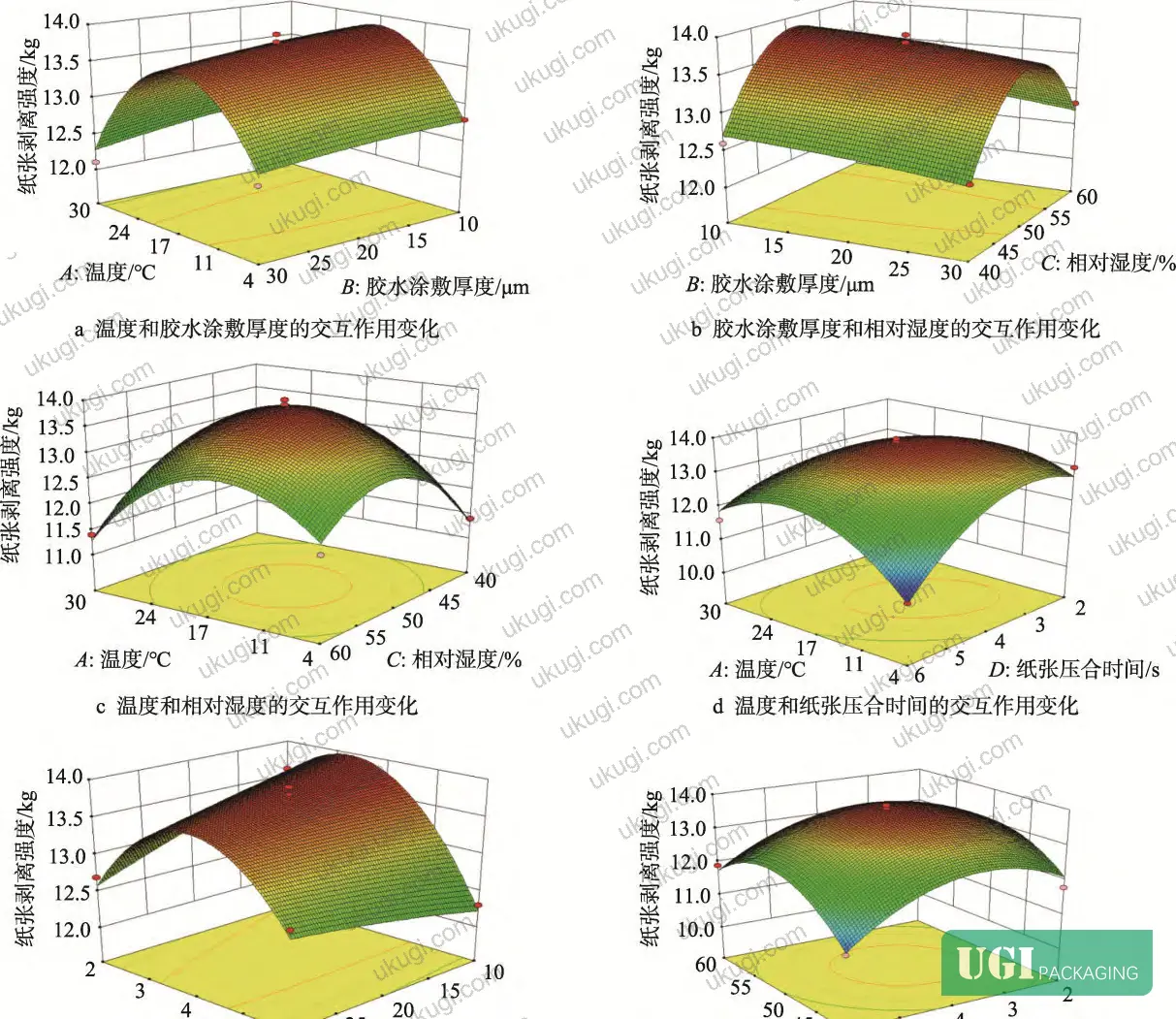
The quadratic terms for temperature (A²), humidity (C²), and pressing time (D²) all showed P < 0.001, confirming that peel strength follows a curved response — meaning both under-spec and over-spec values hurt bond quality. This is a point many buyers miss entirely.
The response surface contour plots tell a specific story about how these variables interact. When temperature and pressing time contours take an elliptical shape, that’s the visual signature of a significant interaction — which is exactly what was observed for the AD and BD pairs. In contrast, contours for temperature–humidity and glue thickness–humidity were approximately circular, indicating weak interaction between those pairs.
Key observation from the raw data: At the center-point condition (17 °C, 20 µm glue, 50% RH, 4 s press), five replicate runs produced peel loads of 13.9, 13.8, 13.8, 13.5, and 13.9 kg — a range of only 0.4 kg, confirming the process is repeatable under controlled conditions. At extreme high temperature (30 °C) with maximum pressing time (6 s), peel strength dropped to 11.6 kg. At 4 °C with 6 s pressing time, it dropped to 10.8 kg. The worst single result in the dataset was 10.8 kg; the best was 13.9 kg — a 28.7% performance gap across the test envelope, driven entirely by process parameters, not material change.
Factor Interaction Summary Table #
| Interaction Pair | Contour Shape | Significance | Key Control Priority |
|---|---|---|---|
| Temperature × Pressing Time (AD) | Elliptical | Highly significant (P<0.001, F=35.62) | Both parameters — co-control required |
| Glue Thickness × Pressing Time (BD) | Diagonal | Significant (P=0.008, F=9.58) | Pressing time dominates at high coat weight |
| Temperature × Humidity (AC) | Near-circular | Marginal (P=0.029, F=5.91) | Temperature primary; humidity secondary |
| Glue Thickness × Humidity (BC) | Diagonal | Not significant (P=1.000) | Neither variable in this pair drives response |
| Humidity × Pressing Time (CD) | Elliptical | Significant interaction | Co-optimized at center-point region |
Optimized Gluing Parameters for Square-Bottom Paper Bag Production #
The RSM numerical optimization via Design Expert software converged on the following parameter set for maximum peel strength:
- Temperature: 15.7 °C (practical rounding: 16 °C)
- Glue application thickness: 12.45 µm (practical: 12 µm)
- Relative humidity: 51.12% (practical: 51%)
- Paper pressing time: 3.38 s (practical: 3.4 s)
Predicted peel strength at this optimum: 13.95 kg. Three parallel validation runs at the rounded practical values returned an actual mean peel strength of 13.92 kg — a prediction error of only 0.272%. All individual parameter errors were below 5%: temperature error 1.875%, glue thickness error 3.750%, humidity error 0.235%, pressing time error 0.588%.
Honestly, the 12.45 µm optimum coat weight surprised me the first time I reviewed this data. Most production engineers I’ve spoken with default to heavier coat weights on the assumption that more glue equals better bond. The RSM data directly contradicts that: glue thickness had the weakest individual effect of the four variables, and the quadratic response of the model means over-coating actively degrades peel strength — slower cure rate under high coat weight allows the paper’s inherent springback forces to crack the seal before the adhesive reaches working tack.

The temperature window is narrower than most buyers expect. Below 10 °C, the adhesive open time extends enough that the folded paper tube’s elastic recovery force acts against the joint before the glue reaches tack — a mechanical failure mode, not an adhesive failure. Above 25 °C, cure accelerates so quickly that the adhesive skins over before the pressing step completes, leaving an interface with insufficient wet contact. The optimum at ~15–17 °C sits in a region where cure rate and open time are in balance. For factories in tropical climates — Southeast Asia, South Asia, the Middle East — ambient temperature control in the bag-making hall isn’t optional; it’s a direct quality parameter.
Why Humidity Control in the Production Environment Is Not a Secondary Concern #
Industry observation: most procurement teams don’t realize that humidity is treated as a secondary environmental parameter in many supplier quality systems — typically monitored but not formally controlled as a process input. The RSM data here suggests that’s underspecified. While humidity ranked lowest of the four individual factors, its quadratic term (C²) had P < 0.001, meaning humidity deviation in either direction from ~51% drives meaningful peel strength loss. The maximum peel strength occurs near the 50% RH center point; at 40% RH or 60% RH, the response surface drops toward 11–12 kg range.
In supplier qualification for a client sourcing retail paper bags for a European fashion brand, we encountered a situation where three of six production samples from one factory failed a 12 kg dead-weight hold test — not due to adhesive specification issues, but because the production hall’s humidity was running at 63–65% during a wet-season week. The factory had no closed-loop humidity control, only monitoring. Those samples showed visible bond-line softening at the bottom seal, with the kraft substrate delaminating rather than the adhesive releasing — indicating the paper fibers themselves had absorbed enough moisture to weaken the fiber-to-fiber cohesion at the bond interface. That distinction matters: when failure is substrate delamination rather than adhesive peel, the root cause is environmental, not formulation.
This is directly relevant to buyers sourcing from factories in Guangdong, Fujian, or any coastal manufacturing region where summer humidity regularly exceeds 70–80%. Responsible suppliers operating paper bag lines in those environments need active dehumidification, not just ventilation.
The ISO 187:1990 Paper, board and pulps — Standard atmosphere for conditioning and testing specifies 23 °C ± 1 °C and 50% ± 2% RH as the standard conditioning environment for paper and board testing. A supplier who cannot demonstrate that their bag-making environment operates within a comparable envelope — or at minimum that their process parameters have been validated under their actual ambient conditions — is operating with an unquantified risk variable built into every production run.
Practical Guidance for Buyers #
When you’re evaluating paper carrier bag suppliers — particularly for square-bottom kraft tote construction — the adhesive bottom-seal is the load-bearing joint, and it deserves the same specification rigor you apply to paper grammage or handle attachment. Ask specifically for documented process parameters: temperature, coat thickness, humidity, and pressing time. A technically competent supplier should be able to state these values and explain how they were validated.
Honestly, most buyers over-specify surface aesthetics — requesting multiple rounds of embossing, UV spot, and foil revision on the print side — while accepting a verbal assurance that “the glue is fine” on the structural side. That imbalance gets exposed when bags reach a retail environment and start failing under load.
The research data reviewed here is clear that a 28.7% gap in peel strength is achievable across the normal operating envelope of a bag-making machine — purely from process drift, with no change in materials. A structured dead-weight acceptance test (incrementally load to ≥13 kg, hold for 60 seconds, inspect seal) should be part of any incoming inspection protocol.
For buyers sourcing gift-grade or retail paper bags — particularly cosmetics packaging solutions or premium gift packaging solutions where bag failure at point-of-sale is a brand event — the seal specification should be written into the purchase order, not assumed. Ukugi’s paper bag production operates with process-controlled adhesive application, validated against structural performance criteria, so you’re working with a supplier that can actually answer technical questions about their bonding process rather than routing you back to a catalog.
For tensile and mechanical property testing frameworks applicable to the film and substrate materials in your packaging system, ASTM D882 Standard Test Method for Tensile Properties of Thin Plastic Sheeting provides the foundational methodology used across related substrate qualification.
Need a custom formulation or sample? Request a quote from our team →
Technical Verification Questions #
- What is your validated glue application thickness (in µm) for bottom-seal bonding on 130 g kraft substrates, and how is that thickness measured and controlled in production — specifically, does your machine use an eccentric-shaft roller or a fixed-gap applicator?
- Can you provide production environment logs showing temperature and relative humidity at time of manufacture for the sample batch, and confirm whether your bag-making hall has active humidity control targeting 50% ± 5% RH?
- What is your measured bottom-seal peel strength (in kg, dead-weight method) for the specific bag format being quoted, and what is the minimum acceptable value in your batch release specification?
- Has your paper pressing time been optimized for the substrate grammage offered — specifically, can you confirm the pressing dwell at the bottom-seal station and whether temperature × pressing time interaction has been validated in your process?
- What is the prediction error between your process model and actual measured peel strength across validation runs — and is that error within 5% across all four key process parameters (temperature, coat weight, humidity, pressing time)?
Quality Verification Checklist #
- ☐ Bottom-seal peel strength measured by dead-weight incremental loading reaches ≥13.5 kg without seal separation (based on optimized process target of 13.92 kg validated in controlled trials)
- ☐ Production environment temperature documented at 15–17 °C (±2 °C tolerance) at time of manufacture, or supplier provides process validation data specific to their actual ambient temperature
- ☐ Glue application thickness confirmed at 12–13 µm via micrometer measurement of the glue film, with documented control method (eccentric-shaft adjustment or equivalent)
- ☐ Relative humidity at bag-making station confirmed within 49–53% RH during production, with monitoring log or closed-loop control evidence provided
- ☐ Paper pressing dwell time confirmed at 3.4 s ± 0.2 s, with machine parameter documentation or control system record
- ☐ Sample batch passes a 60-second static hold test at ≥12 kg load with no visible seal separation or substrate delamination at the bottom bond line
- ☐ Substrate grammage confirmed at 130 g/m² ± 5 g/m² (or supplier provides separate process validation for alternate grammage)
- ☐ Adhesive specification confirmed against a documented standard (e.g., Q/HZM 04 or equivalent), not generic “water-based glue”
Key Specifications Table #
| Parameter | Recommended Value | Verification Method |
|---|---|---|
| Bottom-seal peel strength (minimum) | ≥13.5 kg | Dead-weight incremental load test: bag suspended vertically, bottom card insert fitted, weights added until seal separation |
| Glue application thickness | 12–13 µm | Micrometer measurement of adhesive film; eccentric-shaft displacement log on automated applicator |
| Production temperature | 15–17 °C | Calibrated thermometer or environmental data logger in bag-making enclosure at time of production |
| Paper pressing time | 3.3–3.5 s | Machine control system parameter record; timed verification at pressing station |
| Relative humidity | 49–53% RH | Calibrated hygrometer log; active dehumidification equipment specification |
| RSM model prediction accuracy | Error ≤5% across all parameters | Comparison of predicted vs. actual peel strength from ≥3 parallel production runs at optimized conditions |
Looking for a manufacturer that meets these specs? Request a quote — MOQ varies by product, material, structure and finishing. Product-specific MOQ is confirmed with each quotation.
References #
Data source: Response Surface Optimization of Adhesive Coating Process Parameters for Eco-Friendly Paper Carrier Bag Production, H.-N. Peng et al., Journal of Applied Polymer Science, 2025
Frequently Asked Questions #
What is the most important process parameter for paper bag bottom-seal strength?
Pressing time has the highest individual statistical significance in the RSM model (F = 21.11, P < 0.001), ranking ahead of temperature, glue coat thickness, and humidity. However, the interaction between temperature and pressing time (F = 35.62) is even more significant than either variable alone — meaning you cannot optimize pressing time in isolation without also controlling temperature.
Why does higher glue coat thickness not automatically improve bond strength?
The RSM data shows a curved (quadratic) response for glue thickness — meaning both under-coating and over-coating reduce peel strength. At high coat weights, the adhesive cures too slowly, allowing the paper’s springback force at the fold to open the joint before adequate tack develops. The optimum at ~12.45 µm is substantially lower than the 20–30 µm range many operators default to.
What peel strength should I specify as a minimum acceptance criterion for retail paper bags?
Based on the validated process data, a target of ≥13.5 kg in a dead-weight hold test is achievable under optimized conditions and represents a meaningful structural margin. The worst-case result in the 29-run dataset was 10.8 kg — produced at non-optimized extremes — which illustrates how much performance varies with process drift. Setting a minimum spec of 12 kg is a reasonable floor; 13.5 kg is the target for quality-grade production.
Does this research apply to bags made from coated art paper or just kraft?
The experimental substrate was 130 g uncoated kraft. Coated papers (art paper, white card) have different surface porosity, which affects adhesive penetration rate and open time. The specific optimized values (15.7 °C, 12.45 µm, 51.12% RH, 3.38 s) should not be directly applied to coated substrates without re-validation. The methodology — RSM with these four variables — remains directly applicable.
How does ambient humidity affect bag quality in tropical manufacturing environments?
At 60% RH (the upper bound tested), peel strength was consistently lower than at the 50% optimum — with several data points in the 11.9–12.9 kg range compared to 13.5–13.9 kg at center-point conditions. At tropical ambient humidity of 70–80% RH, which is outside the tested envelope but common in coastal Chinese factories during summer, the degradation effect would be expected to be more pronounced. The ISO 187:1990 standard conditioning environment (50% ± 2% RH) exists precisely because paper properties — including surface absorbency and fiber cohesion — are humidity-dependent. For consistent quality, active dehumidification in the production area is not a luxury for high-volume paper bag manufacturing; it is a structural quality control measure.
Published by ukugi.com Technical Team | Request a quote


