
Quotation readiness case · clarification required
Why This UK C500/C650 Kraft Paper Food Container Enquiry Needed Product-Code and Compliance Clarification Before Quotation
A UK buyer supplied two familiar capacity codes, a paper-container photograph and several compliance terms, but those inputs did not yet define one manufacturable structure or one verifiable evidence package.
The quotation decision: decode the model before calculating price
We did not treat C500 and C650 as complete paper-container specifications. In the UK takeaway market, these labels are commonly associated with approximately 500 ml and 650 ml rectangular food-container models. The C is a product-family or supplier-model prefix, not an international paper-packaging standard and not proof of a particular material, shape or lid system.
That distinction matters because UK catalogues also use C500/C650 for polypropylene takeaway tubs, while kraft paper containers are often sold simply by nominal capacity. A paper version cannot be quoted by copying the assumptions behind a plastic retail code. The correct response was to confirm the physical pack and separate product identity, food-contact suitability, PFAS requirements and manufacturing-site certification before final pricing.
Case facts
Market and product
UK-bound rectangular kraft paper food containers
Model language
C500 and C650; likely capacity-linked, not a complete specification
Order statement
One shipping container; container size and unit count not specified
Evidence requested
PFAS-free, fluorine-free coating and BRCGS grade information
What the buyer supplied
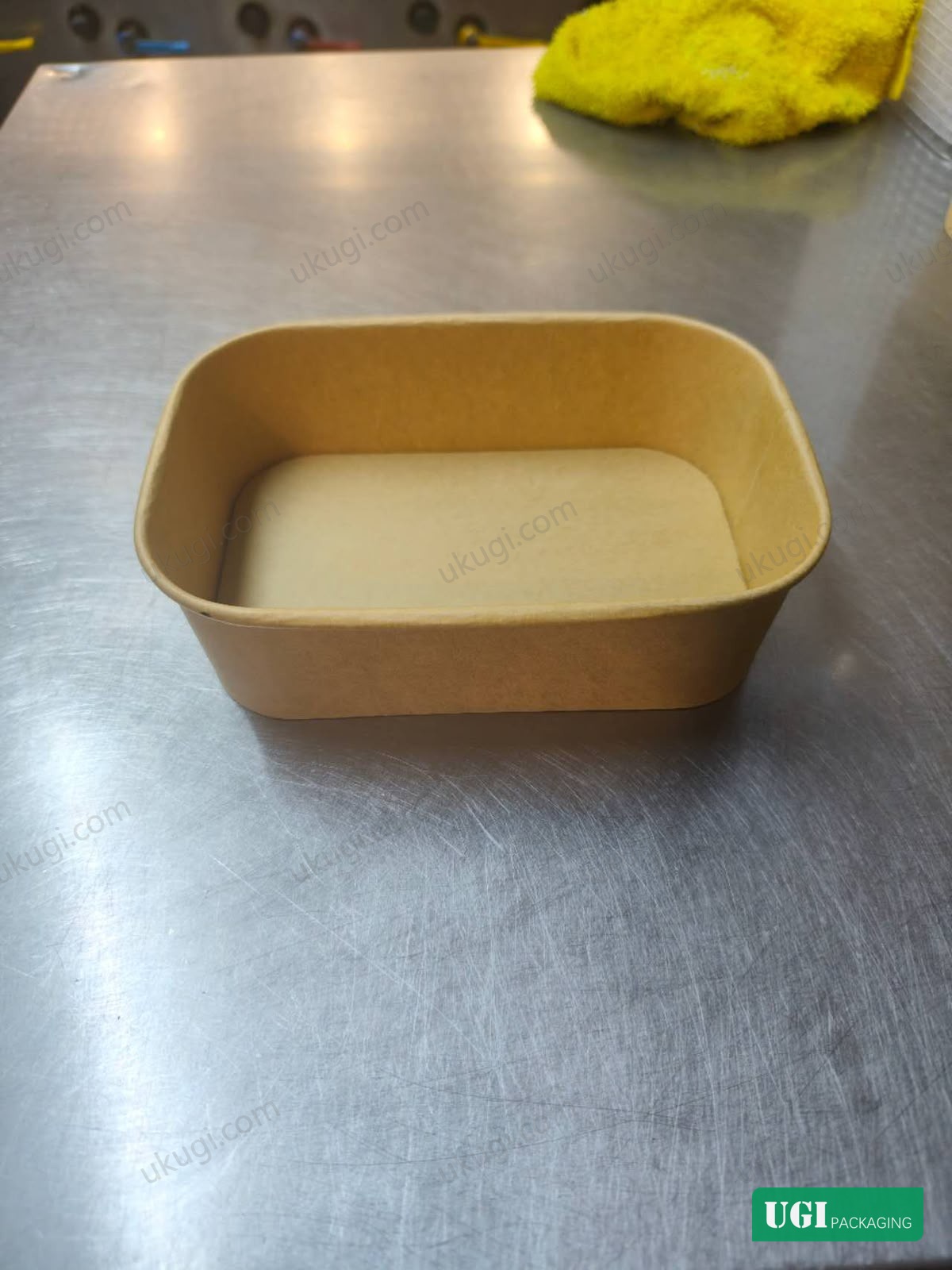
The buyer asked whether kraft paper C500 and C650 containers could be exported to the UK, then stated a one-container quantity and requested PFAS-free paper food containers, a BRC/BRCGS certificate grade and a fluorine-free coating solution. A photograph showed an unbranded rectangular kraft paper food container without a visible lid.
The photograph narrowed the enquiry to a rectangular paper food-container family. It did not establish whether the item was 500 ml or 650 ml, and it did not show a matched lid, dimensioned rim, coating specification, food type, temperature range or test report. A photograph can identify visible form; it cannot prove capacity, chemistry, migration performance or regulatory compliance.
What C500 and C650 mean—and what they do not mean
For this enquiry, the safest working interpretation is that the numbers refer to nominal capacities of approximately 500 ml and 650 ml. That interpretation still needs confirmation against the buyer’s reference product or sample.
The codes do not independently specify whether capacity is nominal, usable or brimful; the top and base dimensions; container height; rim geometry; matched lid; paperboard grade; barrier route; hot, chilled, frozen or microwave conditions; or the required compliance documents. Two containers labelled 650 ml may require different blanks, tooling, lids and carton pack-outs.
For a one-container order, those differences also change units per carton, palletisation, container utilisation and delivered cost.
Known information, missing inputs and quotation impact
| Known / still needed | Evidence or question | Why it changes the quotation |
|---|---|---|
| Known: C500/C650 | Likely capacity-linked UK model language. | The product series, dimensions and capacity method remain undefined. |
| Known: kraft paper appearance | Confirm paperboard grade, basis weight and barrier construction. | Material cost, forming performance and food-use suitability remain open. |
| Known: reference photograph | Confirm top/base dimensions, height, rim and matched lid. | A photograph cannot define the blank, tooling or lid interface. |
| Known: one shipping container | Confirm 20GP/40GP/40HQ, packing, pallets and UK delivery point. | Unit quantity and freight cannot be calculated consistently. |
| Known: PFAS-free requested | Confirm target substances, method, reporting limit and required laboratory. | A supplier statement may not satisfy the buyer’s approval protocol. |
| Known: fluorine-free coating requested | Confirm food, temperature, grease, moisture and holding time. | Barrier chemistry and performance tests depend on actual use. |
| Known: BRC/BRCGS grade requested | Confirm standard issue, producing-site scope, minimum grade and audit mode. | Site certification and product-specific compliance are different evidence layers. |
A buyer preparing the missing inputs can use UGI Packaging’s custom food packaging RFQ checklist.
BRCGS grade, PFAS-free evidence and coating are separate checks
BRCGS Packaging Materials is a site-and-scope audit
The current BRCGS Packaging Materials standard is Issue 7. It allows a manufacturing site to demonstrate controls relevant to quality, legality and product authenticity within a defined certification scope. As AIB International’s certification overview explains, the grade is based on the number and severity of nonconformities and whether the audit was announced or unannounced.
Grades are commonly expressed from AA through A, B, C and D, with AA the highest band. A plus sign indicates an unannounced audit, for example AA+. Buyers should check the current certificate, producing-site address, certified scope, issue, audit date, expiry date and certification body rather than accepting the words “BRC certified” without context. A strong BRCGS grade does not by itself prove that one product is PFAS-free.
PFAS-free needs a defined test boundary
PFAS-free should not be treated as a visual material description. The buyer and supplier need to agree what substances are covered, whether polymeric PFAS are included, the test method, sample construction, reporting limit and acceptance threshold.
The EU Packaging and Packaging Waste Regulation introduces PFAS concentration limits for food-contact packaging from 12 August 2026. That is relevant background for products placed on the EU market, but it is not automatically a UK legal requirement. For this UK project, the purchasing specification and applicable UK food-contact materials regulations must be confirmed separately.
Fluorine-free coating describes a route, not the complete approval
A fluorine-free barrier may use a water-based or dispersion system, or another construction selected for the food, temperature and holding time. The absence of intentionally added fluorinated chemistry is not the same as a completed PFAS test result, and neither claim replaces migration or food-contact documentation for the finished structure.
The coating still has to deliver the required grease, moisture, seal, forming and transport performance. The correct route depends on whether the container will hold dry, oily, acidic, hot, chilled or frozen food and whether reheating is expected.
Evidence needed before a final quotation
- Reference product URL, supplier code or physical sample.
- Dimensioned drawing with top and base dimensions, height and rim profile.
- Capacity definition and test method for both 500 ml and 650 ml versions.
- Lid material, lid dimensions and closure or leak expectation.
- Food type, fill temperature, holding time, grease or moisture exposure and reheating conditions.
- Paperboard and barrier preference, including whether plastic lamination is permitted.
- PFAS specification, target list, test method, reporting limit and accepted report format.
- Required UK food-contact declarations and test reports.
- Required BRCGS standard issue, scope, grade and announced or unannounced status.
- Printing, packing, shipping-container type and UK delivery point.
A factory-ready sequence for this project
- Match the reference. Identify the specific paper-container geometry behind the buyer’s C500/C650 language.
- Confirm dimensions and volume. Record the top, base, height, rim and agreed capacity method.
- Define the lid and use. Confirm lid material, closure, food, fill temperature, hold time and reheating.
- Select a provisional structure. Choose candidate paperboard and a fluorine-free barrier route.
- Agree the evidence package. Fix PFAS and food-contact test/report requirements before sampling.
- Validate samples. Check forming, lid fit, grease and moisture resistance under actual use conditions.
- Confirm print and packing. Finalise artwork, carton pack-out and pallet requirements.
- Quote one defined route. Calculate units per selected shipping container and identify remaining approval gates.
What this Case does and does not establish
This Case records why one anonymized UK enquiry could not yet support a reliable quotation and which inputs would close the gap. It explains how market model language, site certification and product-specific chemical evidence must be separated.
It does not establish that the photograph is exactly 500 ml or 650 ml, that every C500/C650 product has the same dimensions, that a specific UGI Packaging site holds a stated BRCGS grade, or that a particular coating or product has passed PFAS or UK food-contact testing. Those remain project-specific confirmation items.
Copy-and-send C500/C650 paper food container RFQ template
A buyer can replace the brackets below and send the completed brief with the reference product, dimensioned drawing and required compliance protocol.
Related UGI resources
Send the inputs that define the container and the evidence pack
Share the reference product or sample, dimensions, lid interface, food and temperature conditions, coating preference, PFAS test requirement, BRCGS scope or grade requirement, shipping-container type and UK delivery postcode. We can then identify what is quote-ready, what requires sampling and which documents must be confirmed before production.