
Quotation readiness case · clarification required
Why a Concealed Spring Hinge Could Not Use Standard Greyboard
A 1,000-set mug gift-box inquiry exposed a conflict between an ordinary 3 mm greyboard shell and a concealed spring hinge. Substrate, insert, covering and opening structure needed decisions before quotation.
The quotation decision: test the hinge before pricing
This is the first part of a two-stage mug gift-box project. The available record begins with a translated flip-top inquiry, moves to a dated internal engineering analysis, and ends with a later revised lift-off brief. The original English inquiry and a send record for a first UGI reply are not in the supplied archive. We therefore tell the sequence as a documented design discussion, not as a fabricated email exchange. It is a quotation-readiness case, not a claim that a particular version was sampled, tested, ordered or delivered. The buyer and any identifying artwork are deliberately omitted.
The responsible response was to clarify the structure before calculating a final price. The inquiry and factory proposals are not an approved order or test result.
The first request: a jewellery-box opening experience for a mug
The starting brief called for a custom premium rigid flip-top presentation box for a mug. The first trial order was 1,000 sets, with the possibility of repeat orders and greater volume if quality and timing proved stable. The reference showed a navy, short-pile velvet-like outer finish, a warm ivory flocked interior, a shaped protective insert, and a small gold-foil artwork area inside the lid. Those visual references described the intended presentation; they were not a tested production specification or proof of final performance. This account paraphrases the technical request rather than reproducing the translated inquiry page; the underlying original-language customer message was not supplied.
The mug was given as 117 mm high × 85 mm diameter, approximately 132 mm wide including the handle. The proposed insert measured 180 × 165 × 125 mm; the approximate finished outer box was 190 × 175 × 135 mm. The buyer’s first material specification called for 3 mm rigid greyboard, roughly 20 mm of cushioning around the mug and 15–20 mm of protective clearance above it. The box was to contain a shaped, flocked insert. The first RFQ requested separate pricing for a closed-cell XLPE insert and an EPE pearl-cotton insert, including box construction, velvet wrapping, flocked lining, insert, hidden hinge and gold foil, but excluding the mug itself. It also asked for sample cost, sample time, production time for 1,000 sets and disclosure if factory MOQ exceeded that amount. The brief explicitly welcomed better structural, material or process proposals, with explanation and a revised quotation.
One instruction made this much more than a standard greyboard box: the lid was to use a concealed spring-loaded snap-stay hinge, like a jewellery or watch box. Once opened, the lid should remain supported rather than spring back, and no hardware should be visible on the outside. The first case therefore could not responsibly begin with a unit price. It had to begin with the loads that the hidden mechanism would impose on the board.
The original RFQ was unusually specific about what the box supplier, rather than the mug supplier, should provide. Its requested all-in box price covered the 3 mm greyboard shell, navy short-pile exterior, ivory flocked interior, one-piece shaped foam insert, concealed spring hinge and inside-lid gold foil. The mug was expressly outside that scope. It sought two comparable prices by changing only the foam route—XLPE versus EPE—while asking the factory to state a sample fee, sampling period, 1,000-set production period and any MOQ above 1,000. The first reference artwork belonged inside the lid; a surface quotation that priced only the outside velvet would not have answered the inquiry. The brief also invited a more beautiful, durable or manufacturable alternative, provided the factory explained the change and repriced the resulting construction. That invitation matters because the requested board and hinge were not a proven compatible pair.
The issue discovered before pricing
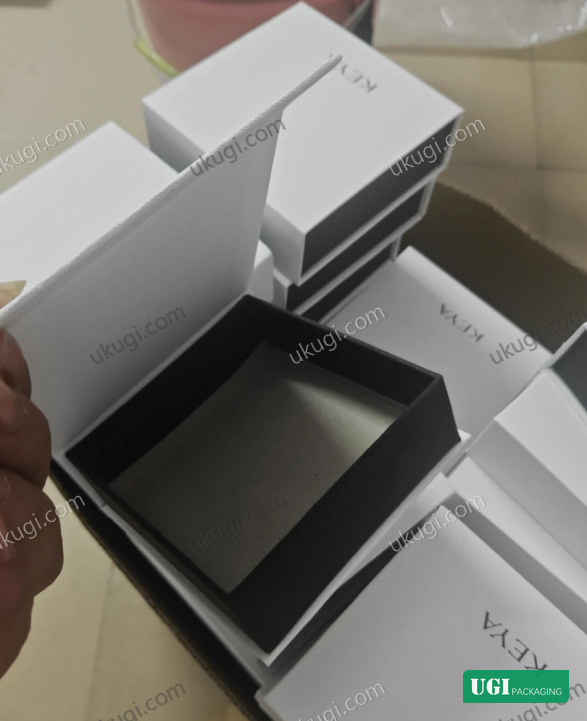
The concealed hinge needs a groove or recess in the box wall. That machining removes part of the board’s cross-section precisely where the spring repeatedly pulls during opening and closing. Ordinary greyboard is pressed paper fibre. At a thin grooved edge it is not equivalent to a homogeneous wood-fibre panel: it can split or crumble at the edge. A single attractive sample would not settle durability in a 1,000-piece run, stacked international transport, storage and repeated consumer use. The project analysis identified potential cracking, chipped corners and lid warping, followed by damage and returns. The source report says multiple factories considered ordinary 3 mm greyboard unstable for this particular hidden spring-hinge construction. This is a project-specific production assessment, not a universal claim that greyboard cannot be used in premium rigid boxes.
UGI’s internal review therefore reached the first professional answer: retain the automatic jewellery-box-style opening effect and change the structural substrate, or change the lid construction and regain the option of ordinary greyboard. This was an engineering analysis, not evidence of an email already sent. The choice affects not only the box material but weight, finishing, insert development, tooling and freight. A quotation made before settling it would compare different products under the same name.
The chronological point matters. The material debate did not begin because a supplier wanted to substitute a cheaper item after accepting the order. It arose while examining whether the requested substrate and the requested concealed mechanism could coexist. A groove that looks neat in a single presentation sample can be the same feature that creates failures after repeated opening and stacked shipment. Conversely, the factory assessment is not a measured failure-rate study: hinge position, groove depth, board grade and cycle performance still require testing. The decision before quotation was to define a sampleable construction, not to declare every paper-based board categorically impossible.
Route A: keep the spring hinge, change the box substrate
High-density paper-based greyboard. This still looks like ordinary greyboard, but its internal fibres are more tightly compressed. In the factory discussion it was presented as harder and more tear-resistant at the hinge groove, with moderate cost and no new injection tooling. It is lighter than MDF, so freight can be lower. It remains a paper-based option: the hinge position, groove geometry and repeated-use performance would still need to be validated in a physical sample before claiming that it is sufficient for this exact box.
Medium-density fibreboard (MDF). MDF has a more uniform engineered wood-fibre structure, stronger edges when grooved and a more solid, heavier hand feel. Factories generally favoured it for carrying the spring hinge. It can also accept flocking or specialty-paper wrapping. The trade-off is greater material and processing cost, more box weight and potentially higher air or ocean freight. A premium feel is not free: when the structure changes from paperboard to MDF, the commercial comparison must include transport as well as factory conversion.
Injection-moulded plastic shell. The shell itself could provide robust hinge support, but it requires dedicated tooling. The project source gave an indicative mould cost of about RMB 10,000 (approximately USD 1,400 at the source’s conversion), not a current supplier quotation. Spread over only 1,000 units, that fixed cost made the plastic route unattractive in this case. The report described several candidate directions but effectively removed injection moulding from the practical shortlist. It would be inaccurate to turn that indicative setup figure into a guaranteed market price.
The decision was not simply “MDF is best.” If low weight and controlled cost were dominant, the high-density paper route deserved testing. If the spring opening, stiffness and heavier luxury feel were essential, MDF was the stronger candidate. Both routes still required a prototype, not a verbal promise of hinge life.
Route B: change the structure instead of forcing the original board
The factories also raised a structural alternative: abandon the concealed spring stay and make either a two-piece lift-off lid and base or a standard magnetic flip-top. Those closures do not impose the same repeated spring-pull load on a grooved hinge line. Ordinary greyboard becomes a plausible substrate again, broadening material options and potentially reducing cost. The corresponding loss is the automatic snap-open and self-supporting lid experience that made the initial concept distinctive. A magnetic flip-top and a separate lift-off lid are also different products and should not be conflated in a quotation. This was the key design advice emerging from the first internal review; the sources do not show that it had already been sent as a formal reply.
This is why a useful pre-quotation question was not “Do you accept a cheaper box?” It was: Is the concealed spring-hinge opening effect essential to the brand experience, or can the opening structure change? Until that answer was known, the factory could not lock a board specification or honestly compare offers.
The insert decision was a second engineering problem
The inner support was not merely decorative. It had to locate a mug whose handle makes the overall width approximately 132 mm, resist movement in transport, carry a flocked visual finish and maintain fit after storage. The original RFQ asked for separate XLPE and EPE prices, while the subsequent factory analysis added CNC-cut EVA as a third route.
XLPE closed-cell foam was described as fine-textured and uniform, with crisp cavity edges, good support, rebound and resistance to permanent deformation. It can be covered or flocked for a refined appearance. Its material and manual finishing cost were higher than EPE. It was therefore a reasonable balance when protection and a clean finish mattered but EVA was not selected.
EPE pearl cotton offered useful shock absorption at a lower material cost. Its fused-bead structure can still feel grainy beneath a velvet or flocked covering. Under prolonged compression in stacked shipping or storage it may flatten more permanently than XLPE, eventually loosening the mug’s fit. That does not make EPE unusable; it makes compression, fit and appearance part of the sample approval. The project report placed it last for a premium tactile presentation, while retaining it as a cost-driven option.
CNC-cut EVA could be specified at an appropriate hardness and machined to the mug body and handle contours. It holds its shape well and gives firmer cavity walls than a soft sponge, while remaining a foam rather than a hard shell. The source described it as mature in gift-box production and especially suitable when a precise high-end reveal mattered. Its development, CNC cutting and associated tooling or setup would raise sample and small-batch cost. The exact process charge required a factory calculation; the report did not establish a universal EVA price.
The sensible comparison therefore included hand feel, protection, dimensional retention, flocked surface quality, sample development and total cost—not just the price per sheet of foam. A buyer who requests only “foam insert” leaves the factory to choose among materially different presentations.
The outer finish also changed the production path
The initial image aimed for a short-pile navy velvet surface. The factory analysis compared that route with textured specialty paper or leatherette-style paper over the box shell.
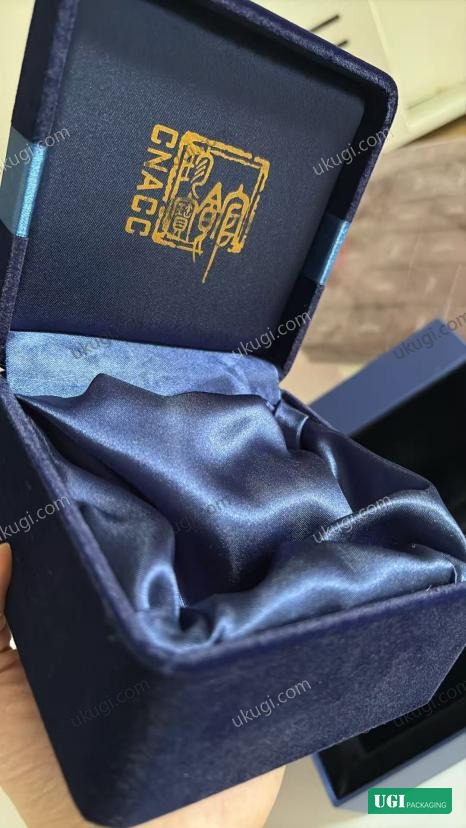
Short-pile velvet wrapping gives a soft hand feel, deep matte appearance and strong opacity. It can mask minor substrate irregularities and align closely with the pictured luxury effect. It also costs more in material and hand wrapping, attracts dust, scuffs or develops pile under transport friction, and can make later foil stamping more difficult. A flawless-looking reference image does not prove bulk finishing yield.
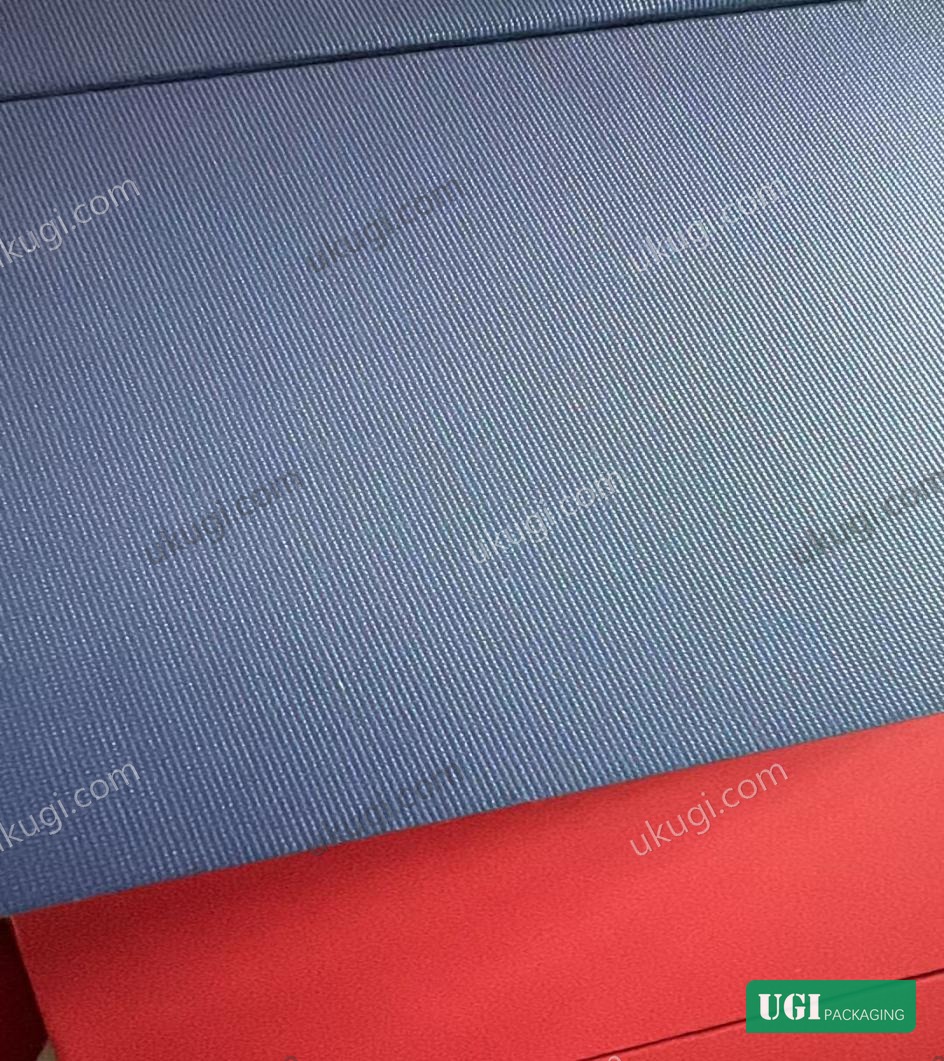
Specialty paper or leatherette paper provides many fine textures, generally better abrasion and dust behaviour, more mature foil, UV and print execution, and lower covering labour than velvet. Its weaker opacity means the board shell beneath must be flatter and better finished. The buyer would need to approve a physical navy swatch rather than assume a screen image accurately defined texture and colour.
The project report combined these decisions into two positioning routes. For an ultra-premium unboxing target with a budget to match, it favoured a spring-hinged MDF shell, shaped EVA insert with flocking, and short-pile velvet wrap. For cost control, it considered high-density paperboard, XLPE or EPE, and specialty paper; under stronger cost pressure, it suggested eliminating the spring hinge in favour of a different closure. These were proposals, not confirmed customer choices or a final factory quotation.
That comparison was not a single ladder from “bad” to “good.” High-density paperboard potentially reduced weight and avoided new injection tooling but did not remove the need for a hinge test. MDF addressed the grooved edge more directly but increased material, conversion and freight burden. Injection moulding changed the process and introduced a roughly RMB 10,000 tool that the source considered uneconomic to amortise over 1,000 sets. EPE could protect the mug but might feel grainier beneath the lining and compress in storage; XLPE gave a finer, more resilient surface at higher material and covering cost; EVA offered the most controlled cavity and premium hand feel among the discussed routes, with greater development expense. Velvet came closest to the reference look yet complicated dust control, transit abrasion and foil work; fine-textured paper made later foil or UV finishing easier but demanded a flatter shell. These variables interact: a heavier MDF box, thick insert and velvet finish cannot be evaluated from a board-price comparison alone.
What the factory still needed before a meaningful quote
The 1,000-set quantity did not itself resolve the brief. The first engineering answer to prepare was a set of four questions: whether the hidden spring stay was mandatory; whether the desired position was an ultra-premium gift or a cost-controlled packaging solution; whether the exterior should be short-pile velvet or a textured paper/leatherette surface; and whether the insert should prioritise crisp presentation, protection, resilience or lower cost. UGI also needed an actual mug or controlled drawing, handle geometry, the final dimensional stack-up, artwork file and placement, and a sampling and shipping basis. The file contains this analysis and proposed clarification, but not proof that the questions were sent or answered at this stage.
Those four customer decisions were the questions at the end of the factory analysis, not optional marketing preferences. The first—whether the spring effect could be surrendered—determined the hinge load and therefore which shells could be shortlisted. The second—gift positioning versus cost control—determined whether the heavier or more labour-intensive route served a real objective. The third chose between the pictured tactile velvet and a more print- and transit-friendly covering. The fourth determined whether the insert should be judged chiefly by the precision of the reveal or by a lower-cost protective function. Without these answers, suppliers could quote superficially similar “rigid mug boxes” while assuming different hinges, boards, inserts and wrapping labour.
The initial RFQ was valuable precisely because it made the conflict visible. The hinge choice narrowed the board options and created much of the spread between possible factory quotes. Insert, surface and structure were a combination matrix: changing any one would also affect perceived quality, durability, labour, weight, lead time and unit economics. No single “best board” or “best foam” answer exists independently of the intended opening experience.
What changed next
The later project brief specified a fully removable two-piece lid and base instead of the concealed spring hinge. It shows a real change in the written design direction; the supplied archive does not contain the intervening customer message or a sent first reply, so we cannot attribute the change to a confirmed customer acceptance of UGI’s precise recommendation. The new structure removed the original hinge-load problem but did not produce a ready-to-quote box. The second Case follows the revised brief through board thickness, lid fit, a shaped ivory EVA insert, protective sheet, wrapping, dimensions, sample approval and the question of whether a proposed 110 mm outer height could even be reconciled with a 117 mm-high mug.
Case facts
Initial order
1,000 sets; repeat production was possible
Mug envelope
117 mm high × 85 mm diameter; about 132 mm including handle
Proposed sizes
Outer 190 × 175 × 135 mm; insert 180 × 165 × 125 mm
Key decision
Keep the spring effect or change the opening structure
Inquiry issues that block quotation
| Known evidence | Still needed | Why it changes the quotation |
|---|---|---|
| Concealed spring-loaded snap-stay hinge | Confirm whether its opening effect is essential | Grooving concentrates repetitive pull stress and narrows substrate choices. |
| Ordinary 3 mm greyboard | Test an approved high-density board or MDF route | An attractive sample alone cannot establish cycle or transit durability. |
| 1,000 sets and all-in box quotation | Separate setup, unit conversion and transport assumptions | Tooling and heavier substrates change unit economics. |
| XLPE and EPE insert quotes | Approve cavity, flocking and possible EVA alternative | The materials differ in surface, compression and cost. |
| Navy velvet and ivory flocking | Approve swatches and foil feasibility | Hand wrapping, abrasion, dust and foil yield affect pricing. |
The numbers and materials are requests or proposals, not approved production results.
Need a comparable quotation for your own mug gift box? Send the actual mug and handle dimensions, intended opening, insert and finish references, artwork status, quantity and destination.
The source package contains two distinct layers of evidence: the original product brief and a later engineering analysis. The first stage is therefore presented as a documented design discussion, not as an invented customer-email exchange. The rendered PDF pages remain private evidence; the public Case uses the independently extracted and watermarked product and material images beside the relevant explanation.
What this Case does and does not establish
This records the translated inquiry and internal engineering assessment; it does not establish that a first UGI reply was sent or that the revised structure was explicitly approved in a supplied customer message. It does not establish an approved substrate, hinge-cycle result, transit test, tooling quotation, final price, sample approval, order or delivery commitment. The reference photos show concept and material comparisons, not completed UGI production for this project. The translated inquiry remains in the private evidence archive; its technical details are explained in the article rather than displayed as page screenshots.
Copy-and-send mug gift-box RFQ template
Replace the brackets with approved inputs and attach a labelled drawing, mug sample or controlled dimensions, and editable artwork.
Related UGI resources
Planning a hinged mug gift box?
Send your mug and handle dimensions, preferred structure, insert and covering references, artwork and delivery plan. We will identify the decisions needed before a defensible quotation.